

Os melhores sistemas de acompanhamento de candidatos (ATS) com tecnologia de IA ajudam a simplificar o recrutamento, automatizar tarefas repetitivas e identificar mais rapidamente os melhores candidatos, para que se possa concentrar na tomada de decisões estratégicas em vez de ficar atolado em tarefas administrativas.
A solução certa baseada em IA melhora a pesquisa, aumenta a precisão da correspondência e automatiza os fluxos de trabalho ao longo de todo o ciclo de recrutamento.
Enquanto antigo recrutador, analisei e testei algumas das principais soluções de ATS com IA para ajudar as equipas a ultrapassar estes desafios. Neste guia, encontrará as principais plataformas que melhoram a eficiência do recrutamento, elevam a experiência dos candidatos e apoiam um recrutamento mais inteligente e escalável para empresas em crescimento.
Why Trust Our Software Recommendations
6,700+
Reviews
20
Industry experts
16+
Evaluation factors
14
Years
Our team has been testing and reviewing software since 2012. As HR experts ourselves, we know how difficult—and important—it is to choose the right software.
For this guide, we evaluated tools using hands-on testing and independent research, scoring tools using our selection criteria. We also draw on insights from industry thought leaders and practicing HR experts.
Our reviews reflect our human editorial judgment, not a sales pitch.
Expert reviewers:
- Phil GrayCOO
 Kim BehnkeHR Tech Editor & Analyst
 Josh BarkerPeople Ops Manager

Tabela comparativa de softwares de ATS com IA
Esta tabela comparativa resume os detalhes de preços das minhas principais seleções de softwares de ATS com IA:
| Tool | Best For | Trial Info | Price | ||
|---|---|---|---|---|---|
| 1 | Best for post-hire quality-of-hire tracking | Free demo available | Pricing upon request | Website | |
| 2 | Best as AI for business | Free trial + Free demo available | From $8/user/month | Website | |
| 3 | Best for custom candidate evaluation | Free demo available | Pricing upon request | Website | |
| 4 | Best for auditable AI hiring practices | Free demo available | Pricing upon request | Website | |
| 5 | Best for global payroll compliance | Free demo available | From $599/employee/month | Website | |
| 6 | Best for easy AI-assisted onboarding | Free plan + free demo available | From $2/user/month (billed annually) | Website | |
| 7 | Best for agentic AI in executive search agencies | Free demo available | From $599/employee/month | Website | |
| 8 | Best for generating targeted screening questions | Free demo available | From $79/user/month | Website | |
| 9 | Best AI-native ATS with intelligent automation | 14-day free trial + free demo available | From $15/user/month (billed annually) | Website | |
| 10 | Best for AI-assisted candidate review | Free demo available | From $335/month (billed annually) | Website |


Análises dos melhores softwares de ATS com IA
Apresento abaixo os meus resumos detalhados das melhores ferramentas de ATS com IA que entraram na minha lista das 10 melhores, incluindo notas sobre os motivos pelos quais as escolhi. Cada análise apresenta uma visão detalhada das principais funcionalidades, vantagens e desvantagens, integrações e casos de utilização ideais de cada sistema, para o ajudar a encontrar a melhor opção para si.
 Best for post-hire quality-of-hire tracking
- Free demo available
- Pricing upon request
Visit WebsiteCustomer Rating:4.6/5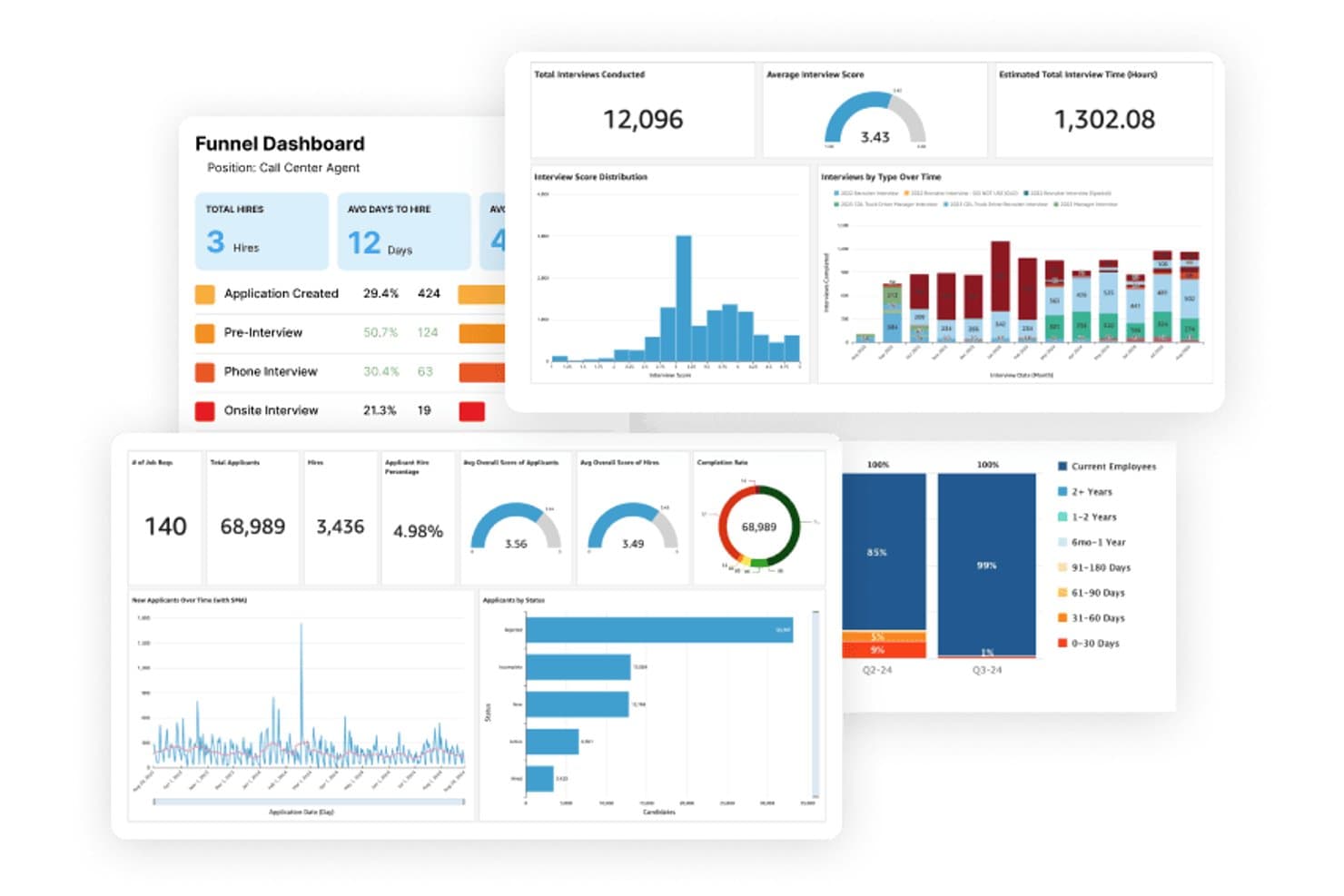
Journeyfront provides recruiting analytics dashboards to track hiring funnels. Journeyfront is an AI-powered ATS built for high-volume hiring that combines automated resume screening and scoring, structured interviews, behavioral assessments, and closed-loop post-hire analytics.
Who Is Journeyfront Best For?
Journeyfront is a strong fit for HR operations managers and recruiters at high-volume employers—like BPOs, contact centers, and retailers—who need to connect pre-hire scores to post-hire performance data.
Why I Picked Journeyfront
I picked Journeyfront as one of the best because it's the only AI ATS I've seen that genuinely closes the loop between hiring decisions and post-hire outcomes. Its quality-of-hire tracking connects pre-hire scores to real retention and performance data by cohort, so you can see whether your scoring criteria actually predict 30-, 90-, or 180-day success. I also like that its predictive job-fit model recalibrates each round based on your own employee data, getting sharper over time.
Journeyfront Key Features
- AI-scored video interviews: Journeyfront automatically scores pre-screen video interviews against your hiring criteria, with human override available for every decision.
- Omni-channel candidate messaging: Send automated outreach via email, SMS, and WhatsApp, triggered by candidate scores or pipeline events.
- Class-based hiring management: Group candidates into hiring cohorts tied to evergreen requisitions, then auto-route and report at the class level.
- Fraud detection: The platform flags VPN use, duplicate IP matches, and location inconsistencies—useful for remote and offshore high-volume hiring.
Journeyfront Integrations
Journeyfront supports an ecosystem of 400+ integrations, including Workday, Oracle, ADP, UKG, BambooHR, Checkr, DocuSign, Google Workspace, Outlook, Zoom, Tableau, and Power BI. An Open API supports custom integrations, while HRIS, ATS, background screening, API, and SSO connections are paid add-ons.
Pros and Cons
Pros:
- Fraud detection for remote and offshore roles
- Cohort-based hiring ties candidates to outcomes
- Predictive job-fit model improves with each hire
Cons:
- Thin independent review base limits validation
- No conversational AI or GenAI copilot
Learn more about Journeyfront: Best as AI for business
- Free trial + Free demo available
- From $8/user/month
Visit WebsiteCustomer Rating:4.4/5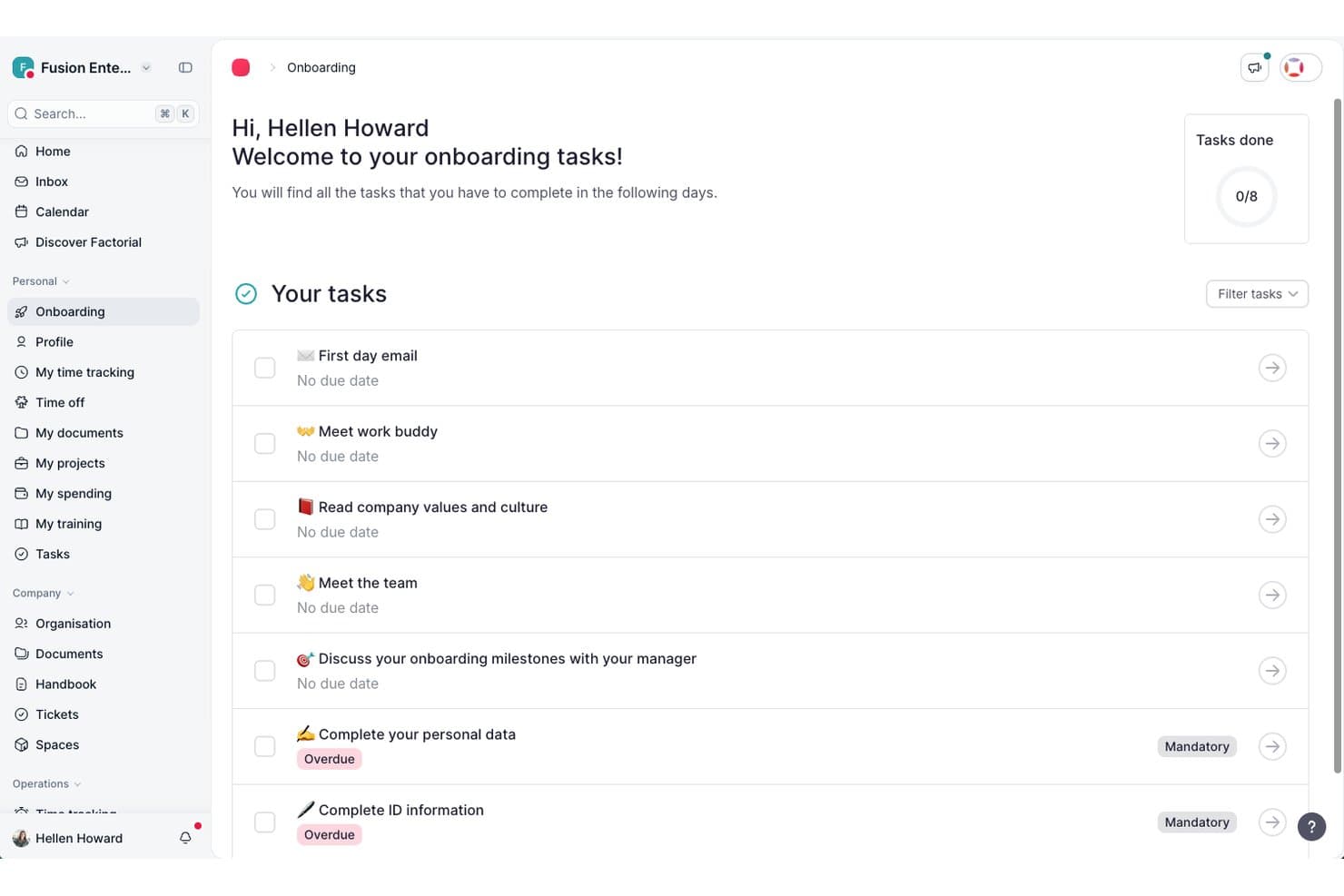
Factorial guides new hires through onboarding tasks in one place. Factorial is an AI-powered HR and business operations platform with an ATS module that covers job posting, AI CV parsing, candidate tracking, hiring-pipeline management, and automated candidate communication.
Who Is Factorial Best For?
Factorial suits growing businesses that want a single AI-powered platform to manage HR, finance, and IT operations without juggling multiple tools.
Why I Picked Factorial
I've included Factorial in my top picks because it's built around a core idea I find compelling: AI for business, where recruiting isn't a standalone task but part of a connected operational layer. In practice, that means Factorial's AI can parse CVs, generate resume summaries, and recommend candidates by comparing applications against your job requirements and company values—all without switching between tools. Its AI agent, Factorial One, can even call candidates and evaluate those conversations against role-specific criteria.
Factorial Key Features
- Hiring-stage configuration: Define and customize recruitment pipeline stages to reflect your team's actual hiring process.
- Multi-portal job posting: Publish job openings across multiple platforms simultaneously, including LinkedIn, Indeed, and InfoJobs.
- Phase-based team permissions: Control which hiring team members can view or move candidates at each stage of the recruitment pipeline.
- Interview scheduling with calendar sync: Link team calendars to the platform and schedule interviews directly within the ATS.
Factorial Integrations
Factorial offers marketplace integrations with LinkedIn, Indeed, Recruitee, Refapp, and InfoJobs. It also supports a public API, webhooks, SDKs, API keys, OAuth 2.0, and Zapier.
Pros and Cons
Pros:
- Shared evaluation notes support hiring teams
- AI summaries aid initial CV review
- Clear visibility across candidate stages
Cons:
- No documented bias-audit controls
- AI ranking logic remains unexplained
 Best for custom candidate evaluation
- Free demo available
- Pricing upon request
Visit WebsiteCustomer Rating:4.7/5
Pinpoint dashboard showing requisition approvals, interview scheduling, candidate metrics, and hiring workflow insights in a centralized ATS interface. Pinpoint is an AI-powered applicant tracking system that offers automated candidate screening, customizable hiring workflows, and advanced analytics for managing recruitment processes.
Who Is Pinpoint Best For?
Pinpoint is a strong fit for in-house recruiting teams at mid-sized companies that need structured, repeatable hiring processes across multiple roles.
Why I Picked Pinpoint
I picked Pinpoint as one of the best because of how much control it gives you over candidate evaluation criteria. The AI Candidate Filters let you write your own prompts to define exactly what the AI screens for—specific skills, experience flags, or role-fit signals—then outputs results as scores, summaries, or yes/no answers you can sort and filter directly in the platform. I also like that candidate scorecards are fully customizable per role, so hiring managers score applicants against criteria that actually reflect what the job requires. Together, these two features mean my team isn't relying on a black-box algorithm to make shortlisting calls.
Pinpoint Key Features
- Automated interview scheduling: Candidates self-schedule interviews using a booking link that syncs with interviewer calendars across time zones, with built-in buffer rules and automated reminders.
- Hiring workflow automations: Build multi-step, branching automation workflows that trigger on application events, job status changes, or offer creation, and apply them across roles and regions.
- Reporting and analytics dashboard: Track metrics like time to fill, source of hire, and pass-through rates using built-in dashboards, or build custom reports with drag-and-drop tools and export them via flat files or API.
- Blind recruitment: Anonymize candidate applications to reduce bias during the screening and shortlisting stages.
Pinpoint Integrations
Pinpoint offers native integrations with LinkedIn, Indeed, Glassdoor, Google Calendar, Outlook, Slack, DocuSign, and Checkr. An API is available for custom integrations.
Pros and Cons
Pros:
- Allows tracking of multiple hiring streams from requisition to onboarding
- Detailed reporting provides insights for data-driven decisions
- Smart matching accelerates hiring with AI-driven candidate matching
Cons:
- Some advanced enterprise workflows require manual setup or custom configuration
- No free trial available; demo only
Learn more about Pinpoint: Best for auditable AI hiring practices
- Free demo available
- Pricing upon request
Visit WebsiteCustomer Rating:4.4/5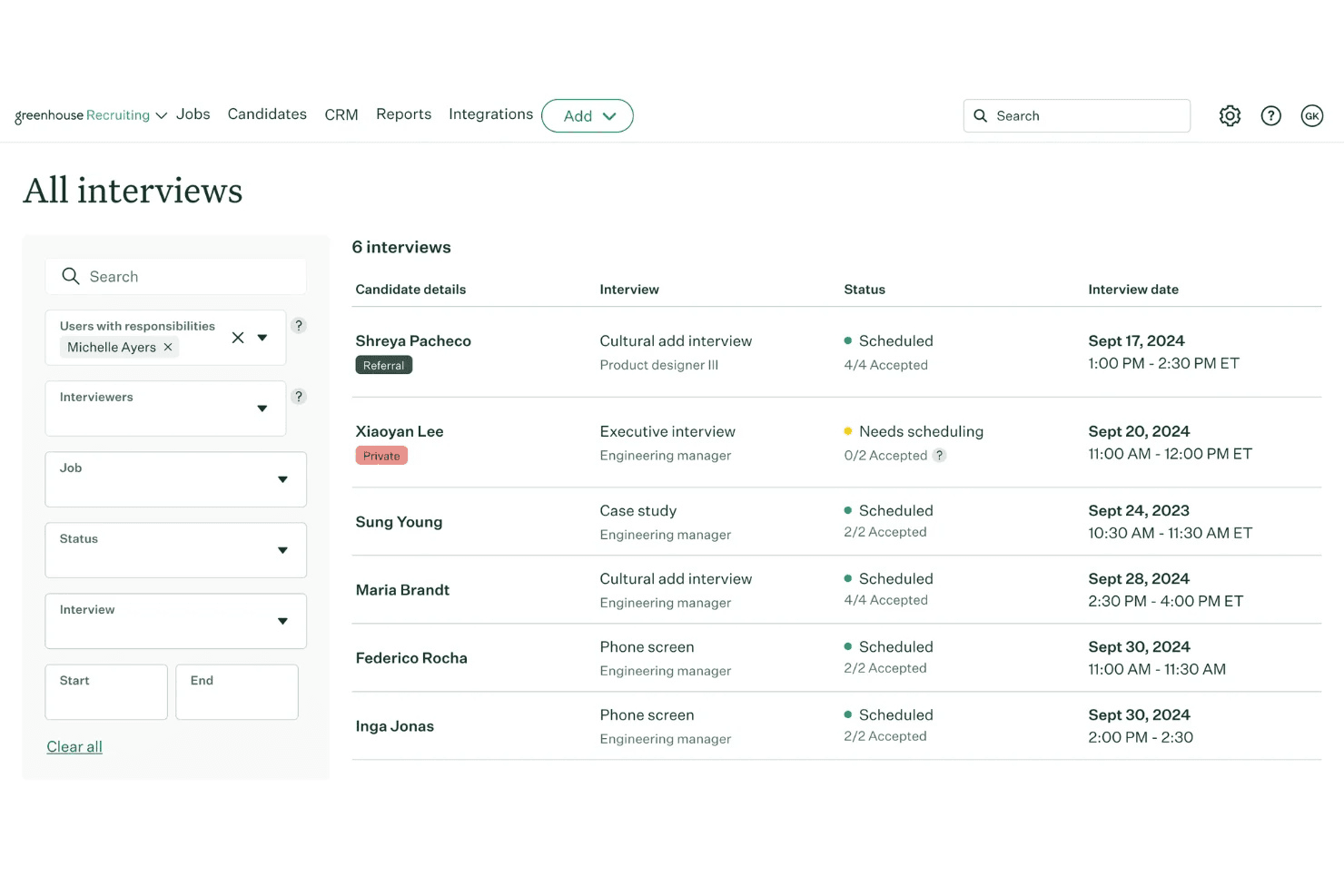
Greenhouse offers an 'All Interviews' dashboard where recruiters can view and filter scheduled candidate interviews by status, date, and interviewer. Greenhouse is an AI-powered applicant tracking system that combines structured hiring workflows, AI candidate matching, DEI tracking, automated scheduling, and audit-ready governance tools across the full recruiting lifecycle.
Who Is Greenhouse Best For?
Greenhouse is a strong fit for mid-market and enterprise companies with dedicated talent acquisition teams that need structured, scalable, and governance-ready hiring processes.
Why I Picked Greenhouse
Greenhouse earns its spot on my shortlist because of how seriously it treats AI accountability in hiring. I love that scorecards are enforced before any candidate moves forward, which creates a defensible hiring record automatically. The Pro plan's audit log and Real Talent CLEAR ID verification add a layer of traceability that most ATS platforms don't offer natively, and I think that matters when AI is influencing who gets shortlisted.
Greenhouse Key Features
- Structured interview kits and scorecards: Provides standardized templates for consistent interviewer feedback and evaluation.
- Real Talent™ AI talent matching: Surfaces top candidates using AI based on skills, experience, and hiring patterns.
- MyGreenhouse candidate portal: Lets candidates view application status and manage interview logistics in one place.
- Sourcing automation tools: Includes Chrome plugin, prospect pools, and automated talent rediscovery for proactive sourcing.
Greenhouse Integrations
Greenhouse offers 500+ native integrations, including Workday, BambooHR, ADP, LinkedIn Recruiter, Docusign, Slack, Calendly, Zoom, Indeed, and Google Workspace. An API is available for custom integrations.
Pros and Cons
Pros:
- Audit logs support AI governance and compliance
- DEI analytics track demographic fairness across stages
- Enforced scorecards create a defensible hiring record
Cons:
- AI matching less mature than newer competitors
- Implementation takes considerable time
 Best for global payroll compliance
- Free demo available
- From $599/employee/month
Visit WebsiteCustomer Rating:4.9/5
Deel Hire employee dashboard showing payslips, onboarding tasks, recent payments, and quick access to work submissions and expenses. Deel Hire is an AI-powered applicant tracking system designed for teams that need to manage global hiring, onboarding, and payroll compliance in one platform.
Who Is Deel Hire Best For?
Deel Hire is a strong fit for HR teams and talent acquisition professionals at companies hiring across multiple countries or regions.
Why I Picked Deel Hire
I picked Deel Hire as one of the best because it's one of the few AI ATS tools that connects recruiting directly to global payroll and compliance in a single platform. When my team hires someone in a new country, Deel Hire's AI-powered screening and candidate matching tools handle the top-of-funnel work, while the platform automatically applies the right compliance rules for that region. I also like that approved headcount from workforce planning flows directly into ATS as job requisitions, so there's no manual re-entry between HR planning and recruiting. Once a candidate accepts an offer, their data moves straight into onboarding and payroll without any handoff gaps.
Deel Hire Key Features
- AI candidate matching: AI compares candidate submissions against job criteria to surface the most relevant applicants for each role.
- Interview scheduling with Google Workspace and Microsoft Teams: Schedule interviews directly from the ATS dashboard, with AI-generated transcript summaries available after each session.
- Configurable hiring analytics: Track sourcing performance, candidate-to-offer ratios, and pipeline health using customizable charts built into the platform.
- Role-based permissions and data retention controls: Set custom access levels, approval workflows, and candidate data retention policies to meet internal and regulatory requirements.
Deel Hire Integrations
Deel Hire offers native integrations with Greenhouse, Lever, Workable, Ashby, Google Workspace, and Microsoft Teams. An API is available for custom integrations.
Pros and Cons
Pros:
- Multiple payment methods and currencies supported
- Automated payroll and tax compliance tools
- Built-in AI misclassification risk assessment
Cons:
- Limited customization for onboarding workflows
- Some compliance features vary by country
Learn more about Deel Hire: Best for easy AI-assisted onboarding
- Free plan + free demo available
- From $2/user/month (billed annually)
Visit WebsiteCustomer Rating:4.8/5
TalentHR offers a built-in AI HR Assistant chatbot (Beta) with a company data toggle and suggested HR questions directly within the platform. TalentHR is an AI-powered applicant tracking system designed for organizations who want to manage candidate sourcing, screening, onboarding tasks, and compliance in one platform.
Who Is TalentHR Best For?
TalentHR suits small to midsize HR teams who want fast setup and built-in AI screening capabilities.
Why I Picked TalentHR
I picked TalentHR as one of the best because its AI-assisted onboarding actually scores candidates, extracts skills from resumes, and suggests new hires based on real data. I like how automated onboarding tasks get pushed straight to HR and hiring managers.
TalentHR Key Features
- Job description templates: Create and customize reusable job descriptions for open roles.
- Multi-stage hiring workflows: Set up structured recruitment pipelines with phases and role-based steps.
- Built-in e-signature management: Collect digital signatures for onboarding documents directly within the platform.
- Comprehensive people analytics: Access reporting dashboards for headcount, turnover, compensation, and other workforce metrics.
TalentHR Integrations
Native integrations are not clearly documented. TalentHR offers an API for custom integrations.
Pros and Cons
Pros:
- Career site generator with job templates
- Built-in digital onboarding documents management
- Automated resume skill extraction and scoring
Cons:
- Fewer advanced workflow customizations than some competitors
- Limited public details on supported integrations
Learn more about TalentHR: Best for agentic AI in executive search agencies
- Free demo available
- From $599/employee/month
Visit WebsiteCustomer Rating:4.2/5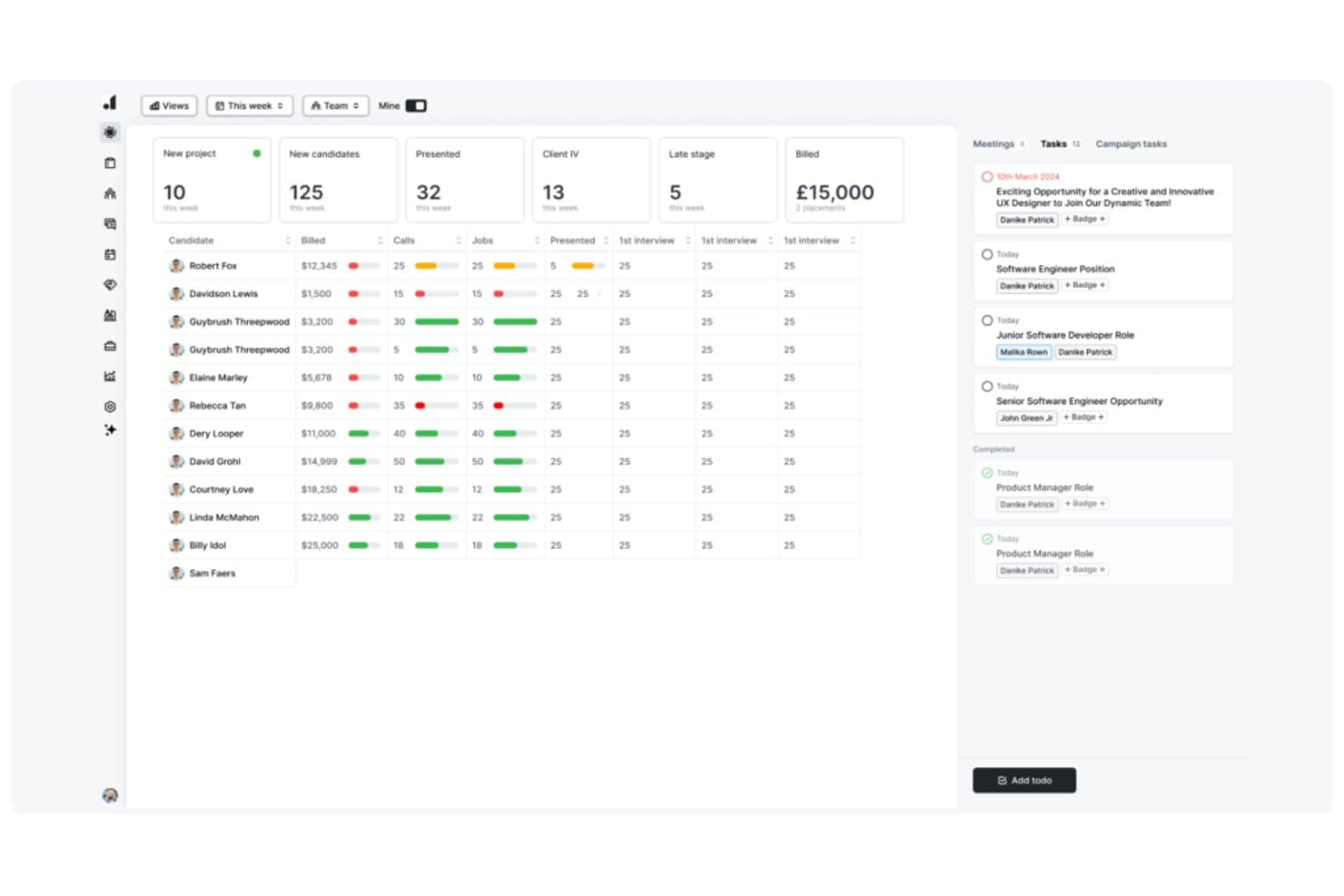
Atlas tracks recruiter activity, placements, and tasks in one dashboard. Atlas is an AI-native ATS and CRM built exclusively for staffing and executive search agencies, combining agentic AI, automated candidate matching, multi-channel outreach, and pipeline management in one platform.
Who Is Atlas Best For?
Atlas is built exclusively for staffing and executive search agencies—it's not designed for in-house or corporate recruitment teams.
Why I Picked Atlas
Atlas earns its spot on my shortlist because it's the only AI ATS I've seen built exclusively for staffing and executive search agencies, with agentic AI doing the heavy lifting autonomously. I'm particularly impressed by Magic Search and Magic Columns, which rank candidates against custom criteria with visible reasoning behind every match—no Boolean strings required. On top of that, Atlas Memory captures every call, email, and WhatsApp message into one searchable layer that feeds AI agents, so they can send follow-ups and book meetings without recruiter input.
Atlas Key Features
- ResumeGPT inbox parsing: Automatically pulls CVs from recruiter inboxes and converts them into structured, searchable candidate profiles with zero manual input.
- CRMx business development pipeline: A Kanban-based BD engine that scores opportunities by deal value, tracks outreach steps, and prioritizes accounts by recent activity and role fit.
- AI Note Taker: Captures full transcripts and key takeaways from calls, video interviews, and meetings in real time, linking them directly to candidate profiles.
- Client-ready shortlist generation: Produces branded, shareable candidate shortlists and longlists directly from the pipeline for immediate client delivery.
Atlas Integrations
Atlas offers integrations with Microsoft Outlook, Google Workspace, Zoom, Google Meet, Microsoft Teams, RingCentral, Aircall, WhatsApp, Broadbean, and idibu. Atlas also provides an Open API and Model Context Protocol support for custom integrations.
Pros and Cons
Pros:
- Customizable Kanban pipeline built for agencies
- Unified memory tracks all recruiter communications
- Agentic AI autonomously ranks and contacts candidates
Cons:
- No built-in DEI or bias monitoring
- Not suitable for in-house recruitment teams
Learn more about Atlas: Best for generating targeted screening questions
- Free demo available
- From $79/user/month
Visit WebsiteCustomer Rating:4.7/5
The platform's robust functionality powers various aspects of your agency's operations, and AI supports along the way. Tracker is an AI-powered applicant tracking system designed for recruiters and HR teams, offering automated candidate screening, workflow automation, and customizable screening tools.
Who Is Tracker Best For?
Tracker is a strong fit for staffing agencies and recruitment firms that manage high volumes of candidates across multiple clients.
Why I Picked Tracker
Tracker earns its spot on my shortlist because of how its AI handles candidate screening. The "create targeted screening questions" feature, powered by its EVA AI agent, generates role-specific and candidate-specific questions on demand—so instead of running every applicant through the same generic checklist, I can zero in on what actually matters for a given role or client. I also like the AI-powered interview preparation tool, which cross-references a candidate's resume, cover letter, and job description to flag strengths and gaps before the interview even starts. That combination means my team spends less time guessing and more time having the right conversations.
Tracker Key Features
- AI candidate ranking: EVA ranks candidates using skills, experience, and historical placement data to surface the best fits for a given role.
- AI-generated job descriptions: Generate and optimize job postings using ChatGPT-powered tools, with options to adjust tone, reduce bias, and improve job board SEO.
- Automated recruitment emails and texts: Draft and send personalized outreach, follow-ups, and rejection messages using one-click AI generation or multi-step sequences.
- Resume reformatting: Convert any candidate resume into a branded document using a voice or text command, then send it directly to clients.
Tracker Integrations
Tracker offers native integrations with LinkedIn, Microsoft Outlook, Microsoft Teams, Broadbean, LogicMelon, and DocuSign. An API is available for custom integrations.
Pros and Cons
Pros:
- User-friendly and easy to learn
- Comprehensive solution (ATS and CRM in one)
- Specifically designed for staffing agencies
Cons:
- Pricing is not transparent
- May not be suitable for in-house recruitment teams
Learn more about Tracker: Best AI-native ATS with intelligent automation
- 14-day free trial + free demo available
- From $15/user/month (billed annually)
Visit WebsiteCustomer Rating:4.8/5
Manatal offers recruitment-related features, automation, and data-driven insights. Manatal is best suited for recruitment teams that want better candidate shortlists without adding more manual screening work. It uses AI to recommend candidates based on job requirements and past hiring behavior, helping recruiters focus faster on the most relevant profiles. It's a good fit for SMBs and growing teams hiring across multiple roles or locations.
Why I Picked Manatal
I picked Manatal because its AI-native ATS helps you identify high-quality candidates faster through AI-driven recommendations that are directly tied to job criteria and historical hiring data.
The platform's intelligent automation ranks and suggests candidates by analyzing CV content, job descriptions, and recruiter activity, reducing time spent reviewing unqualified profiles. I also like that Manatal enriches candidate records with data pulled from over 20 social platforms, giving you more context without manual research.
Its customizable pipelines let your team adapt the hiring flow to different roles while keeping recommendations consistent. For teams hiring at scale, this combination of AI matching and workflow flexibility stands out.
Manatal Key Features
Here are some key features worth highlighting:
- Custom Recruitment Pipelines: Build role-specific hiring stages to match different recruitment processes.
- Advanced Reporting & Analytics: Track hiring speed, source performance, and recruiter activity.
- Branded Career Pages: Create customized job pages to attract and convert candidates.
- Compliance Controls: Supports GDPR and CCPA requirements for candidate data handling.
Manatal Integrations
Integrations include LinkedIn, Indeed, Glassdoor, Monster, Google for Jobs, Facebook Jobs, Slack, Microsoft Outlook, Google Calendar, and Zapier.
Pros and Cons
Pros:
- Customizable pipelines
- Social media enrichment
- AI-driven recommendations
Cons:
- Slow customer support
- Complex user interface
 Best for AI-assisted candidate review
- Free demo available
- From $335/month (billed annually)

SparkHire's AI-assisted review feature creates scorecards and summarizes candidates' responses SparkHire offers an AI-powered applicant tracking system designed for hiring teams that want to simplify and automate the interview process. It’s a strong fit for organizations looking to add AI-powered scheduling and video interviewing to their recruitment stack. If you need to coordinate interviews across time zones or with multiple stakeholders, SparkHire helps reduce manual back-and-forth and streamline candidate screening workflows.
Who Is SparkHire Best For?
SparkHire is a good fit for HR teams and recruiters at organizations that need to automate interview scheduling and coordination, especially lean recruitment teams or organizations managing distributed hiring.
Why I Picked SparkHire
I picked SparkHire because its AI can rank resumes, suggest interview questions, and generate candidate summaries to support faster screening workflows. These features help hiring teams review applicants more efficiently and maintain a more consistent evaluation process.
SparkHire Key Features
Some other features that make SparkHire a strong option for AI ATS users include:
- One-way video interviews: Candidates can record responses to interview questions on their own time, allowing recruiters to review submissions asynchronously.
- Interview evaluation tools: Built-in rating and commenting features let hiring teams assess candidate responses and collaborate on feedback.
- Automated interview reminders: The system sends scheduled reminders to both candidates and interviewers to help reduce no-shows.
- Automated reference checks: Complete digital reference checks without manually coordinating scheduling or follow-ups.
SparkHire Integrations
Integrations include Greenhouse, Lever, Workable, JazzHR, JobAdder, SnapHire, ApplicantStack, AkkenCloud, AcquireTM, and iCIMS.
Pros and Cons
Pros:
- Includes built-in candidate evaluation and rating tools
- Provides one-way and live video interview options
- Supports multi-manager interview scheduling and coordination
Cons:
- No native SMS or WhatsApp interview reminders
- Limited customization for branded candidate experience
Learn more about SparkHire:
Outros softwares de ATS com IA
Eis algumas ferramentas adicionais de ATS com IA que não entraram na minha lista das 10 melhores, mas que ainda assim vale a pena analisar com mais atenção:
- 11AvaHRBest for engaging candidates
- 12CeipalBest for AI-driven workforce management
- 13Breezy HRBest for job advertising automation
- 14RecruiteeBest for team collaboration
- 15LeverBest for candidate relationship management
- 16LoxoBest for AI-powered talent intelligence
- 17JazzHRBest for small business recruitment
- 18SmartRecruitersBest for enterprise-grade recruitment
- 19HireVueBest for video interviewing
- 20iCIMSBest for scalable recruitment solutions
- 21Kula AIBest for automating candidate sourcing
- 22TransformifyBest for predictive analytics when hiring
- 23AviontéBest for end-to-end staffing solutions
- 24AlexBest for automated first-round interviews
- 25VincereBest for staffing agencies
- 26PluralBest for branded candidate experience
- 27Recruit CRMBest ATS + CRM for recruiting agencies
- 28RecruiterflowBest for recruitment automation
- 29WorkableBest for AI resume screening
- 30ClearCoBest for candidate prioritization
Análises relacionadas de softwares de RH
Se ainda não encontrou aqui o que procura, consulte estas outras ferramentas relacionadas que testámos e avaliámos.
- Software de RH
- Software de processamento salarial
- Software de recrutamento
- Serviços de empregador registado
- Sistemas de acompanhamento de candidatos
- Software de gestão da força de trabalho
How I Evaluate AI ATS Solutions
Every tool on this list needs to do more than slap an AI label on basic filters—it has to measurably shorten time-to-hire, surface stronger candidates, or free recruiters from repetitive screening work. I split my evaluation into two layers: core functionality a tool must have to qualify, and differentiating factors that separate good options from great ones.
Core Functionality (Table Stakes For This List)
When I'm selecting tools for my list, I rank each one on a scale from 0 (does not offer the functionality) to 5 (excels in this area) for each core functionality listed below. Then, I calculate the tool's total score into a percentage. Each tool needs to achieve a minimum total score of 65% to be considered for inclusion.
- AI Resume Parsing & Screening: I check whether the tool can extract and structure resume data into searchable profiles, especially across varied formats like PDFs, LinkedIn imports, and portfolio uploads.
- AI Candidate Matching & Ranking: Strong tools go beyond keyword matching. I look for AI scoring that weighs skills, experience, and role fit to surface top candidates for each requisition.
- Applicant Tracking Pipeline: The pipeline should let hiring teams customize stages, move candidates through workflows, and adapt to different hiring processes across departments or locations.
- AI Sourcing & Talent Discovery: I evaluate whether the platform can recommend past applicants or passive candidates from its talent pool—tools like Manatal and Greenhouse approach this differently but both deliver value here.
- Automated Candidate Engagement: This covers AI chatbots, drip sequences, and self-service scheduling. I look for tools that keep candidates informed without adding manual follow-up work for recruiters.
- Predictive Hiring Analytics: Dashboards should go beyond basic counts. I want to see AI-generated insights like time-to-fill forecasts, funnel bottleneck alerts, and quality-of-hire trend reporting.
Once I have a list of tools that meet the criteria, I consider what sets each platform apart.
Differentiating Factors (What Sets Vendors Apart)
Here's how I compare and contrast different vendors:
Standout Features
Bias detection and DEI auditing tools add real value for teams hiring at scale—I look for platforms that flag biased language in job posts and track demographic balance across pipeline stages. Generative AI assistants are another differentiator, especially when they draft job descriptions or outreach messages that recruiters can refine rather than write from scratch. I also evaluate skills-based intelligence, where AI infers adjacent competencies from resumes to support skills-first hiring rather than relying on exact title matches.
Beyond Features
Compliance and AI governance matter more here than in most software categories. I check whether vendors publish bias audit results and support evolving regulations around automated hiring decisions. Integration depth is equally important—an AI ATS that connects natively with your HRIS, job boards, and assessment platforms saves hours of manual data transfer between systems. I also evaluate scalability, particularly whether a platform fits both a 20-person team hiring locally and an enterprise recruiting across multiple regions and entities simultaneously.
Como escolher um software de ATS com IA
À medida que avança no seu processo específico de seleção de software, tenha em mente os seguintes pontos.
- Capacidades genuínas de IA: Certifique-se de que as plataformas ATS que está a considerar possuem capacidades genuínas de IA. Algumas plataformas podem afirmar que são alimentadas por IA, mas ter funcionalidades limitadas. Procure funcionalidades como análise de currículos, seleção automatizada de candidatos e correspondência inteligente de candidatos. Por exemplo, um ATS alimentado por IA pode ajudar a filtrar automaticamente candidatos não qualificados se a sua organização receber muitas candidaturas.
- Experiência do utilizador: O software deve ser fácil de utilizar e melhorar a eficiência. Um sistema complexo pode conduzir à insatisfação e à redução da produtividade entre os colaboradores dos recursos humanos. Por exemplo, uma interface intuitiva que permita uma navegação fácil e um acesso rápido às informações dos candidatos pode melhorar significativamente o recrutamento.
- Integração com sistemas existentes: Verifique se o ATS se integra bem com os seus sistemas de recursos humanos existentes. A integração garante que os dados circulam sem problemas entre diferentes plataformas, reduzindo a necessidade de introdução manual de dados e minimizando os erros. Por exemplo, se a sua organização utilizar um sistema específico de gestão de recursos humanos, o ATS deverá conseguir sincronizar-se com ele para simplificar o processo de contratação.
- Personalização e escalabilidade: A capacidade de personalizar definições e funcionalidades é essencial para adaptar o software aos seus processos de recrutamento específicos. Além disso, o ATS deve ser escalável para acompanhar o crescimento das necessidades da sua organização. Por exemplo, um ATS personalizável pode adaptar-se a diferentes fluxos de trabalho de contratação, enquanto um sistema escalável pode gerir um número crescente de ofertas de emprego e candidaturas à medida que a sua empresa se expande.
- Segurança e conformidade dos dados: Dê prioridade a fornecedores que sigam práticas de segurança padrão do setor e cumpram os regulamentos de proteção de dados. Isto é importante para proteger informações sensíveis dos candidatos e garantir a conformidade legal.
Tendências no software ATS com IA
O software ATS com IA está a evoluir de forma notável, transformando a maneira como as empresas gerem o seu processo de recrutamento. À medida que a tecnologia avança, é essencial manter-se informado sobre os desenvolvimentos mais recentes. Eis algumas tendências importantes a acompanhar atentamente, que poderão ter impacto na sua organização.
- Análise preditiva: A análise preditiva está a ganhar popularidade nos ATS com IA. Ajuda a prever o sucesso e a retenção dos candidatos. Esta tendência é importante para tomar decisões de contratação baseadas em dados.
- Processamento de linguagem natural (NLP): O NLP melhora a análise de currículos e a correspondência de candidatos. Permite uma melhor compreensão dos perfis dos candidatos, o que conduz a processos de contratação mais precisos e eficientes.
- Redução de enviesamentos: Os sistemas ATS com IA estão focados na redução dos enviesamentos na contratação. Os algoritmos estão a ser concebidos para promover a diversidade. Esta tendência é essencial para criar práticas de contratação mais justas.
- Análise de entrevistas em vídeo: A IA analisa agora entrevistas em vídeo em busca de sinais não verbais, linguagem corporal e expressões faciais, proporcionando conhecimentos mais profundos sobre a adequação dos candidatos.
- Integração com ferramentas de RH: Os ATS com IA estão cada vez mais integrados com outras ferramentas de RH. Isto cria uma plataforma unificada para gerir o processo de contratação, simplifica os fluxos de trabalho e melhora a eficiência.
Estas tendências realçam a natureza dinâmica da tecnologia ATS com IA.
O que é o software ATS com IA?
O ATS com IA é um sistema de acompanhamento de candidatos alimentado por inteligência artificial, concebido para automatizar e melhorar o recrutamento. É utilizado por profissionais de RH, recrutadores e responsáveis pela contratação para gerir candidaturas a empregos de forma eficiente, selecionar candidatos e simplificar o fluxo de trabalho de contratação.
O ATS com IA inclui normalmente análise de currículos, classificação de candidatos e ferramentas de comunicação automatizada. Estas funcionalidades ajudam os utilizadores a identificar rapidamente os melhores candidatos, reduzir as tarefas manuais e melhorar a eficiência geral do processo de recrutamento.
Funcionalidades
Eis as principais funcionalidades que qualquer software ATS com IA de qualidade deve ter:
- Publicação automatizada de ofertas de emprego: A IA distribui ofertas de emprego pelas principais plataformas de emprego, sites especializados em talento e canais das redes sociais. Isto ajuda a maximizar a visibilidade e a atrair candidatos qualificados sem trabalho manual adicional.
- Análise de currículos e seleção inteligente: A IA extrai informações importantes dos currículos e seleciona instantaneamente os candidatos com base nas competências, no historial profissional, nas certificações e na experiência. Isto elimina a introdução manual de dados e acelera a filtragem inicial.
- Classificação e pontuação de candidatos: A IA avalia os candidatos utilizando critérios predefinidos e padrões históricos de contratação, produzindo listas restritas classificadas que facilitam a identificação mais rápida dos melhores candidatos.
- Fluxos de trabalho de comunicação automatizados: A automatização integrada de correio eletrónico e SMS mantém os candidatos envolvidos durante todo o processo de contratação, enviando atualizações, lembretes e próximos passos sem exigir a intervenção do recrutador.
- Automatização do agendamento de entrevistas: A IA coordena a disponibilidade dos candidatos e dos entrevistadores para agendar reuniões de forma eficiente, reduzindo o tempo despendido a gerir calendários.
- Gestão do pipeline de talento: As ferramentas AI ATS organizam os candidatos em grupos de talento para funções atuais ou futuras, ajudando-o a criar uma estratégia de recrutamento a longo prazo e a reduzir o tempo de contratação.
- Melhorias na experiência dos candidatos: Os chatbots de IA respondem às perguntas dos candidatos, ajudam nas etapas da candidatura e recolhem informações de pré-seleção — oferecendo apoio em tempo real, 24 horas por dia, 7 dias por semana.
- Algoritmos de redução de preconceitos: Muitas plataformas AI ATS utilizam anonimização ou classificações padronizadas para ajudar a reduzir preconceitos inconscientes e promover decisões de contratação mais justas.
- Análise e relatórios: Os painéis em tempo real acompanham o tempo de contratação, a saúde do pipeline, a qualidade dos candidatos, as taxas de conversão e as métricas de diversidade, ajudando as equipas a tomar decisões de contratação baseadas em dados.
- Informações preditivas sobre contratação: A IA prevê o sucesso dos candidatos, a adequação à cultura da empresa ou o potencial de retenção com base em resultados históricos, sinais comportamentais e competências específicas da função.
- Gestão da conformidade: Os fluxos de trabalho inteligentes ajudam a manter a conformidade com o RGPD, as orientações da EEOC, os requisitos de conservação de registos e outras obrigações legais, através da automatização das tarefas de documentação.
- Otimização da página de carreiras: A IA ajuda a melhorar a linguagem das descrições de funções, o SEO e o esquema da página para aumentar o envolvimento dos candidatos e as taxas de candidatura.
Escolher um AI ATS com estas funcionalidades pode melhorar significativamente o seu processo de recrutamento, tornando-o mais eficiente e eficaz.
Benefícios
Ao utilizarem software AI ATS, as empresas podem subcontratar tarefas complexas de RH, permitindo-lhes concentrar-se nas suas atividades empresariais principais. Apresentamos abaixo cinco benefícios do software AI ATS para utilizadores e organizações.
- Maior eficiência: O AI ATS automatiza tarefas repetitivas, como a triagem de currículos e o agendamento de entrevistas, permitindo aos profissionais de RH concentrarem-se em atividades mais estratégicas.
- Melhor correspondência de candidatos: Ao utilizar algoritmos de aprendizagem automática, o AI ATS consegue associar os candidatos às ofertas de emprego com maior precisão, garantindo que os candidatos mais adequados são identificados rapidamente.
- Redução de preconceitos: O AI ATS pode ajudar a minimizar preconceitos inconscientes no recrutamento, avaliando os candidatos com base em critérios objetivos, o que conduz a uma força de trabalho mais diversificada e inclusiva.
- Informações baseadas em dados: Estes sistemas disponibilizam funcionalidades valiosas de análise e elaboração de relatórios que ajudam as organizações a tomar decisões informadas com base em dados, melhorando as estratégias gerais de recrutamento.
- Poupança de custos: Ao simplificar o processo de contratação e reduzir o tempo de contratação, o AI ATS pode gerar poupanças significativas para as organizações, tornando o processo de recrutamento mais económico.
Ao adotarem estas ferramentas avançadas, as empresas podem melhorar os resultados de contratação e obter uma vantagem competitiva na atração de talento de topo.
Custos e preços
Esta secção apresenta uma estimativa dos planos e custos médios de AI ATS. Os preços variam consoante o tipo de plano e as funcionalidades disponibilizadas. Para uma análise mais abrangente das opções gratuitas, compare as melhores ferramentas ATS gratuitas.
Tabela de comparação de planos de software AI ATS
| Tipo de plano | Preço médio | Funcionalidades comuns |
| Plano gratuito | $0 | Publicação básica de ofertas, gestão limitada de candidatos, relatórios básicos |
| Plano pessoal | $30 - $100 por mês | Publicação melhorada de ofertas, análise de currículos, integrações básicas, suporte limitado |
| Plano empresarial | $150 - $400 por mês | Publicação avançada de ofertas, pesquisa de candidatos, agendamento de entrevistas, análise de dados |
| Plano empresarial de grande escala | $600 - $1,200+ por mês | Fluxos de trabalho personalizáveis, integrações avançadas, suporte dedicado, análise completa de dados |
Uma discriminação dos tipos de planos AI ATS, custos e funcionalidades.
Perguntas frequentes
Eis algumas perguntas frequentes sobre a tecnologia AI ATS.
Como podem as ferramentas AI ATS melhorar o processo de seleção de candidatos?
Os sistemas de acompanhamento de candidatos com tecnologia de IA melhoram o processo de seleção ao automatizar a análise inicial dos currículos e das candidaturas. Estes sistemas utilizam o processamento de linguagem natural (NLP) e algoritmos de aprendizagem automática para analisar os currículos em busca de palavras-chave, competências e experiências relevantes que correspondam à descrição da função.
Esta automatização reduz o tempo que os recrutadores dedicam à análise manual e garante uma avaliação mais objetiva dos candidatos. Além disso, o AI ATS pode classificar os candidatos com base nas suas qualificações, facilitando a identificação rápida dos melhores talentos por parte dos recrutadores.
Quais são os potenciais enviesamentos do software AI ATS e como podem ser atenuados?
O AI ATS pode perpetuar inadvertidamente enviesamentos presentes nos dados de formação utilizados para desenvolver os seus algoritmos. Por exemplo, se os dados históricos de contratação refletirem enviesamentos relacionados com o género ou a etnia, o sistema de IA poderá favorecer candidatos com perfis semelhantes. Para atenuar estes enviesamentos, é importante utilizar dados de formação diversificados e representativos, auditar regularmente os modelos de IA para detetar resultados enviesados e implementar restrições de equidade nos algoritmos.
Além disso, a supervisão humana é essencial para rever e ajustar as decisões da IA, de modo a garantir práticas de contratação equitativas.
Como se integra o AI ATS com outras ferramentas e sistemas de RH?
Um AI ATS disponibiliza normalmente capacidades de integração com várias ferramentas e sistemas de RH, como sistemas de informação de recursos humanos (HRIS), software de processamento salarial e plataformas de emprego. Estas integrações permitem o fluxo de dados entre diferentes plataformas, reduzindo a introdução manual de dados e melhorando a eficiência global.
Por exemplo, um AI ATS pode atualizar automaticamente as informações dos candidatos no HRIS assim que é tomada uma decisão de contratação ou publicar ofertas de emprego em várias plataformas de emprego em simultâneo. A integração com ferramentas de comunicação, como sistemas de email e calendário, também simplifica o agendamento de entrevistas e a comunicação com os candidatos.
Como pode o AI ATS promover a diversidade e a inclusão no recrutamento?
O AI ATS pode promover a diversidade e a inclusão ao reduzir o enviesamento inconsciente no processo de recrutamento. Estes sistemas podem anonimizar informações dos candidatos, como nomes e fotografias, para se concentrarem exclusivamente nas qualificações e competências. Além disso, os algoritmos de IA podem ser concebidos para dar prioridade a grupos diversificados de candidatos e garantir uma representação justa.
Ao utilizar informações baseadas em dados, o AI ATS pode ajudar as organizações a identificar e corrigir lacunas nas suas práticas de recrutamento diversificado, promovendo, em última análise, um local de trabalho mais inclusivo.
Quais são os desafios da implementação de um AI ATS e como podem ser resolvidos?
A implementação de um AI ATS pode apresentar desafios como preocupações relacionadas com a privacidade dos dados, complexidades de integração e adoção por parte dos utilizadores. Para responder às preocupações relativas à privacidade dos dados, deve garantir-se que o ATS cumpre os regulamentos aplicáveis, como o GDPR ou o CCPA, e implementar medidas de segurança para proteger os dados dos candidatos. As complexidades de integração podem ser atenuadas através da escolha de um ATS com APIs flexíveis e um suporte sólido para integrações de terceiros.
Para incentivar a adoção por parte dos utilizadores, deve ser disponibilizada formação completa e apoio aos recrutadores e responsáveis pela contratação, destacando os benefícios e a facilidade de utilização do sistema.
Como gere o AI ATS grandes volumes de candidaturas?
O AI ATS foi concebido para gerir de forma eficiente grandes volumes de candidaturas, automatizando o processo de análise inicial. Estes sistemas podem analisar e interpretar rapidamente milhares de currículos, identificando os candidatos mais qualificados com base em critérios predefinidos.
Através da utilização de algoritmos de aprendizagem automática, o AI ATS pode melhorar continuamente a sua precisão e eficiência na gestão de grandes volumes de candidaturas. Esta capacidade permite aos recrutadores concentrarem-se no contacto com os melhores candidatos e na tomada de decisões de contratação fundamentadas.