

An employer of record in Austria becomes your employees’ local legal employer, and the best employer of record in Austria should match your hiring plans. Compare how providers handle Austrian contracts, 13th and 14th pay, work permits, termination exposure, and offboarding documents. Some also support market testing before you establish a local entity or moving employees to one later, so choose based on your next step.
Why Trust Our Software Recommendations
6,700+
Reviews
20
Industry experts
16+
Evaluation factors
14
Years reviewing software
Our team has been testing and reviewing software since 2012. As HR experts ourselves, we know how difficult—and important—it is to choose the right software.
For this guide, we evaluated tools using hands-on testing and independent research, scoring tools using our selection criteria. We also draw on insights from industry thought leaders and practicing HR experts.
Our reviews reflect our human editorial judgment, not a sales pitch.
Expert reviewers:
- Phil GrayCOO
 Kim BehnkeHR Tech Editor & Analyst
 Josh BarkerPeople Ops Manager

Comparison Table: Employer of Record Software in Austria
Compare pricing and specs side by side for the employer of record providers in Austria that made it onto my shortlist.
Score legend (out of 5)
- Excellent4.5–5
- Good4–4.4
- Average3–3.9
- Below average2–2.9
- Poor1–1.9
Sorted by: Default
| Tool | Starting Price | Website | |||||||
|---|---|---|---|---|---|---|---|---|---|
Best for moving EOR hires to your own entity | 3.7 out of 5 | 3 | 4 | 4 | 4 | 3 | 4 | $599/user/month Free demo available | Website |
Best for Austria work permit sponsorship | 3.5 out of 5 | 2 | 4 | 4 | 4 | 3 | 4 | $199/user/month Free demo available | Website |
Best for Austrian compliance and cost planning | 3.5 out of 5 | 3 | 3 | 4 | 3 | 4 | 4 | $499/employee/month Free demo available | Website |
Best for testing Austria before GmbH setup | 4.0 out of 5 | 3 | 4 | 4 | 3 | 5 | 5 | $599/per employee/month Free demo available | Website |
Best for linking EOR hires to HR and IT | 3.2 out of 5 | 3 | 3 | 3 | 3 | 3 | 4 | $8/user/month Free demo available | Website |
Best for ATS-triggered Austrian onboarding | 3.7 out of 5 | 3 | 5 | 4 | 4 | 3 | 3 | $14/worker/month Free demo available | Website |
Best for German and English contracts | 3.2 out of 5 | 3 | 3 | 3 | 4 | 2 | 4 | $20/user/month Free demo available | Website |
Best for flat-fee global EOR budgeting | 3.2 out of 5 | 2 | 3 | 3 | 4 | 3 | 4 | $599/user/month Free demo available | Website |
Best for termination liability guarantees | 3.3 out of 5 | 3 | 2 | 4 | 3 | 4 | 4 | $29/user/month Free demo available | Website |
Best for budgeting Austria's 13th and 14th pay | 3.3 out of 5 | 3 | 2 | 4 | 4 | 3 | 4 | $699/user/month Free plan + 30-day free trial + free demo available | Website |


Employer of Record Software in Austria Reviews
Below are my reviews of the best employer of record providers in Austria on my shortlist. Each overview covers best-fit use cases and Austrian employment services to help you choose a provider.
 Best for moving EOR hires to your own entity
- Free demo available
- From $599/user/month
Visit WebsiteCustomer Rating:4.6/5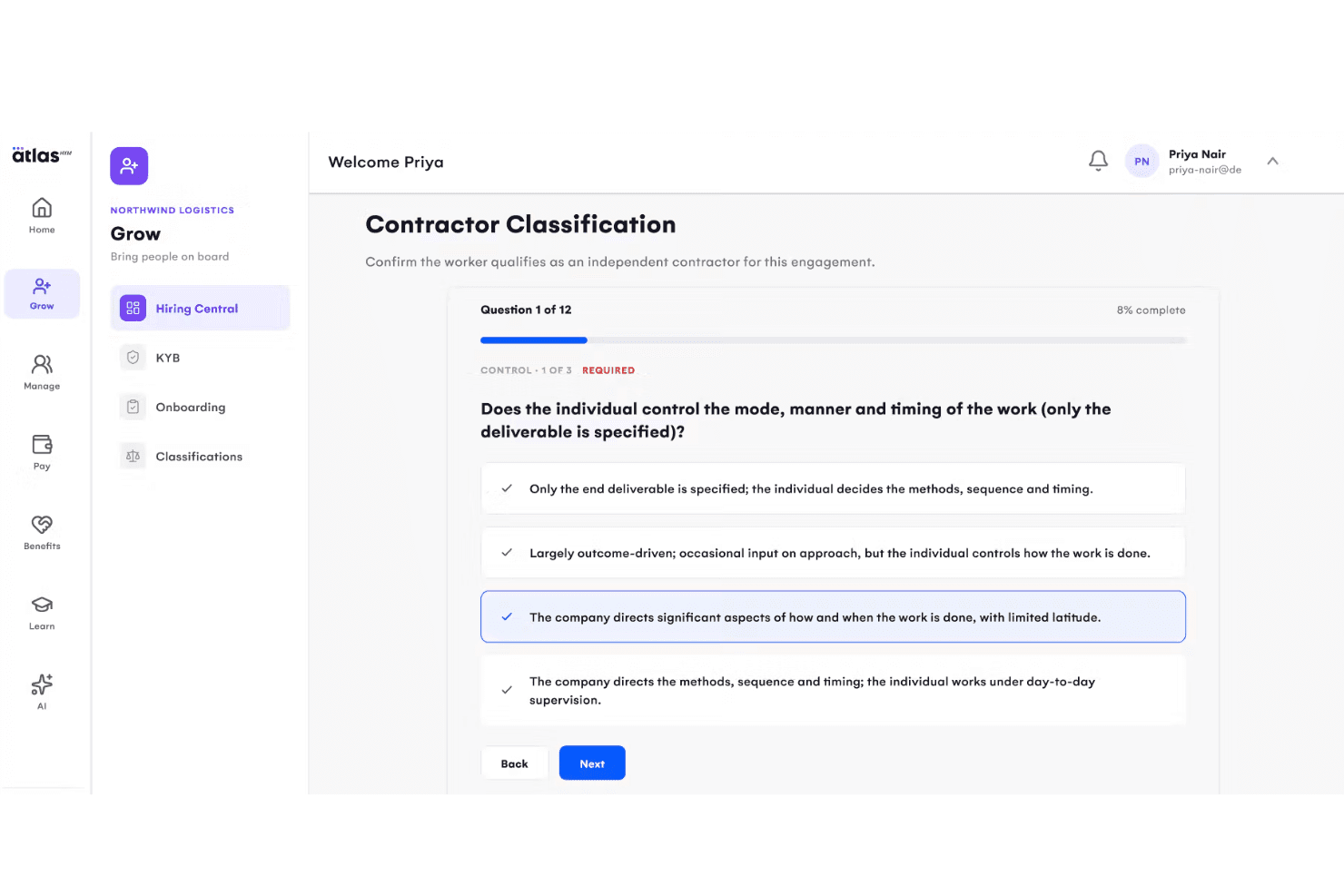
Atlas HXM guides users through contractor classification with a structured questionnaire. Atlas HXM is an employer of record platform that handles Austrian employment contracts, payroll, tax remittance, benefits administration, and compliance management through its own directly owned legal entity.
Who Is Atlas HXM Best For?
Atlas HXM is a strong fit for companies that want to hire in Austria through an EOR now, with a clear path to transitioning those employees onto their own legal entity later.
Why I Picked Atlas HXM
Atlas HXM earns its spot on my shortlist because it's one of the few EOR providers that explicitly supports transitioning Austrian employees from its own entity onto yours, which matters if you're using EOR as a stepping stone rather than a permanent arrangement. I also like that it uses directly owned entities in Austria rather than relying on third-party partners, so liability stays clear from day one. Its Austrian payroll coverage is detailed too, handling 13th and 14th month payments, Lohnsteuer, and the severance fund contributions automatically.
Atlas HXM Key Features
- Compliant Austrian contract drafting: Atlas generates employment contracts that reflect local requirements, including role, salary, leave entitlements, and notice periods.
- 13th and 14th month payroll processing: The platform automatically calculates and processes Austria's mandatory additional salary payments each pay run.
- Collective agreement (Kollektivvertrag) coverage: Atlas applies sector-specific minimum pay rules from Austrian collective agreements when setting up and running payroll.
- Visa and work permit add-on: Atlas offers a paid immigration support service covering permit applications, quota management, and relocation assistance for international hires.
Atlas HXM Integrations
Atlas HXM documents integrations with Workday, BambooHR, Sage, Ashby, Paycor, UKG, Dayforce, Okta, Microsoft, and Google Workspace for HR, payroll, recruiting, and single sign-on workflows.
Pros and Cons
Pros:
- Supports later moves to your entity
- Sends automated local compliance alerts
- Assesses independent contractor classification risks
Cons:
- Non-urgent tickets can take several days
- Payroll delays reported in other markets
Learn more about Atlas HXM: Best for Austria work permit sponsorship
- Free demo available
- From $199/user/month
Visit WebsiteCustomer Rating:4.9/5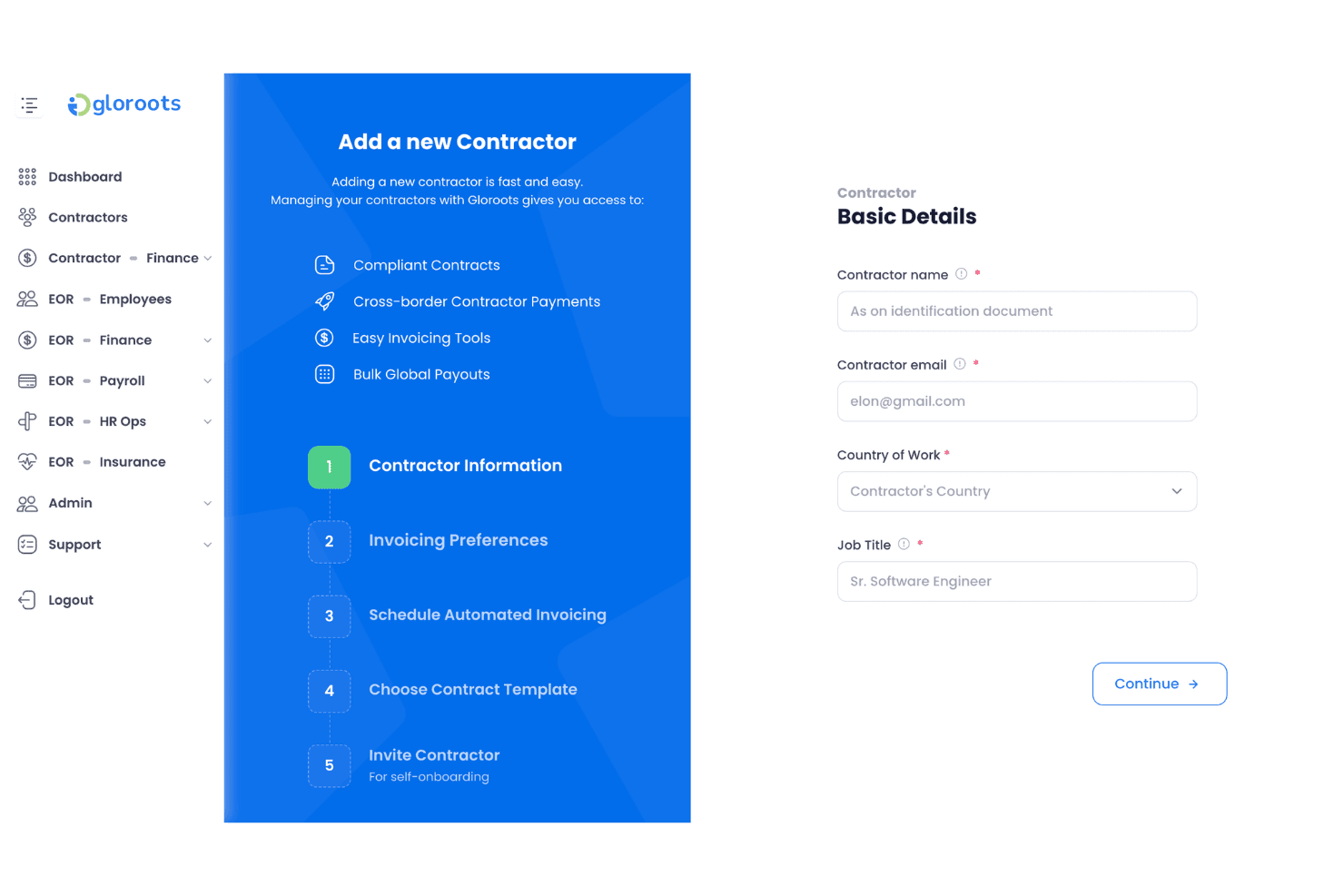
Gloroots lets users onboard contractors in five guided steps. Gloroots is an employer of record platform with its own Austrian legal entity that handles payroll, tax remittance, collective agreement mapping, and contract drafting,
Who Is Gloroots Best For?
Gloroots is a strong fit for global mobility teams that need to sponsor work permits—like the Red-White-Red Card or EU Blue Card—as part of hiring in Austria.
Why I Picked Gloroots
Gloroots earns its spot on my shortlist because of how it handles work permit sponsorship as part of the Austrian hiring process. I specifically like that it can sponsor both the Red-White-Red Card and the EU Blue Card, including the labour market test, contract preparation, and renewals. It also maps the applicable collective agreement (Kollektivvertrag) before the offer goes out, which sets the correct minimum salary and 13th/14th salary entitlements from day one.
Gloroots Key Features
- German-language contracts and payslips: Gloroots drafts employment contracts and payslips in German or bilingual format, including the required written statement of employment terms (Dienstzettel).
- ÖGK registration and ELDA reporting: Gloroots registers employees with the Austrian Health Insurance Fund (Österreichische Gesundheitskasse) before their first day and files monthly social security reports through ELDA.
- Severance fund contributions: Gloroots calculates and remits the employer's monthly contributions to the Austrian employee provision fund (Abfertigung Neu) as part of the standard payroll run.
- Multi-country dashboard: A single platform lets you manage Austrian employees alongside staff in other countries, with consolidated invoicing across currencies.
Gloroots Integrations
Gloroots lists API-based connections with Workday, SAP SuccessFactors, Oracle, and BambooHR, alongside other ERP systems.
Pros and Cons
Pros:
- Remits required severance fund contributions
- Processes local mandatory health registrations
- Work permit sponsorship for Red-White-Red Card
Cons:
- Limited publicly verified Austria-specific customer evidence
- Requires manual work permit renewals
Learn more about Gloroots: Best for Austrian compliance and cost planning
- Free demo available
- From $499/employee/month
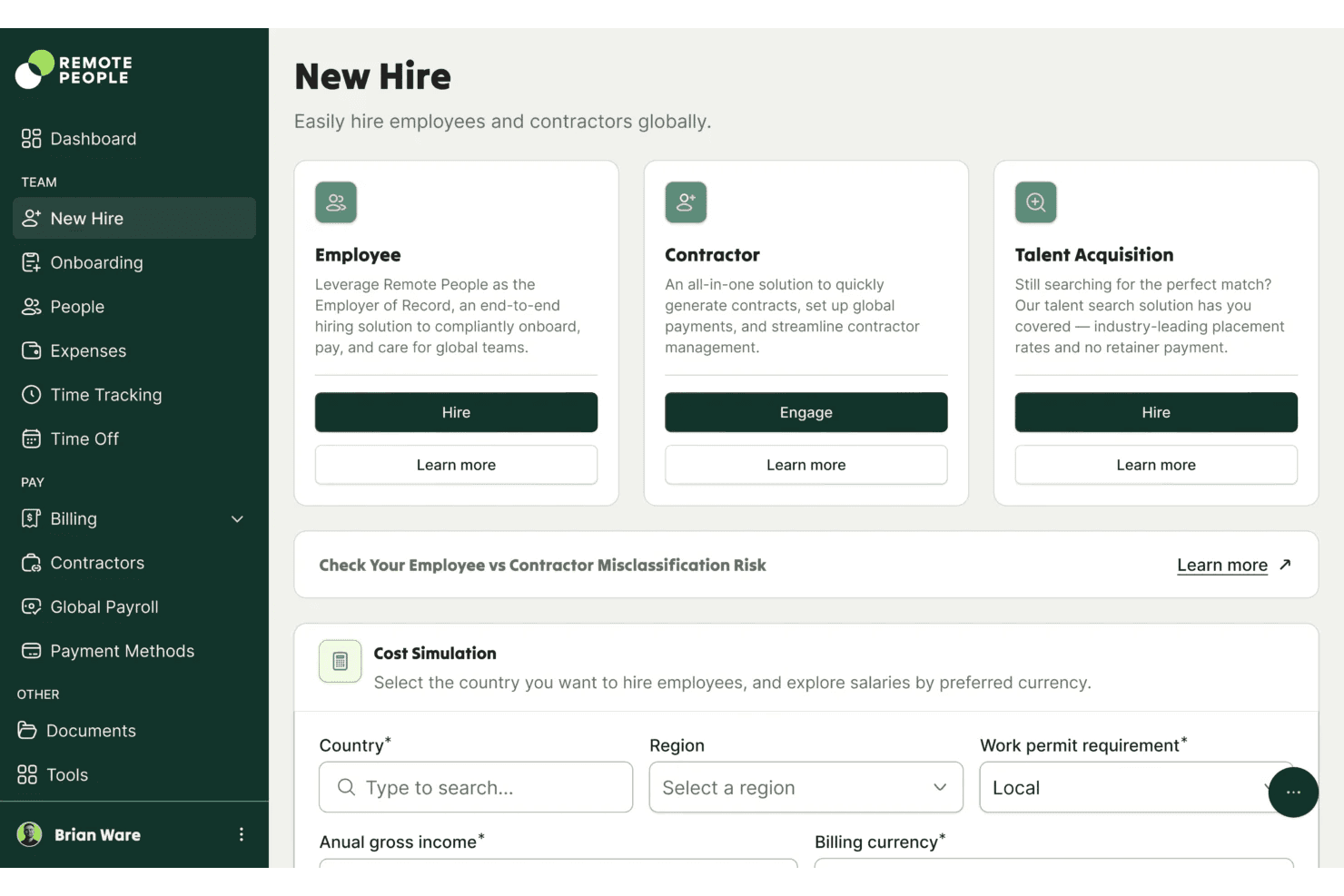
Remote People lets users hire employees, contractors, or find talent globally. Remote People is an employer of record platform that covers legal employment, payroll, tax remittance, contract drafting, and compliance management for Austria, with particular depth on collective agreements, severance funds, and statutory leave rules.
Who Is Remote People Best For?
Remote People is a strong fit for finance and HR teams that need transparent cost breakdowns and detailed Austrian statutory compliance before committing to a hire.
Why I Picked Remote People
I've included Remote People in my top picks because it publishes detailed Austrian employment and payroll guidance. The Austria page publishes the full 2026 employer contribution breakdown (The listed rates total 29.59%, is an illustrative combination, not a universal employer burden. Provincial levies and contribution ceilings affect costs. Importantly, Vienna’s employer housing contribution increased to 0.75% in 2026, while the table uses 0.50%.) alongside the income tax brackets, so your finance team can model the true cost of each hire before signing anything. I also like that it covers collective agreement (Kollektivvertrag) classification and the rules around 13th and 14th salary payments, which catch a lot of first-time Austria hirers off guard.
Remote People Key Features
- Red-White-Red Card sponsorship: Remote People manages Austrian work permit support, subject to eligibility and confirmed service scope.
- Multi-country employee dashboard: A single login lets you manage employees and contractors across 150+ countries, with one consolidated invoice per billing cycle.
- AI Command Center: Submit plain-English HR requests directly in the platform, with specialist review and a logged audit trail for every action taken.
- EOR-to-entity transfer support: When you're ready to incorporate in Austria, Remote People explicitly offers entity incorporation and employee-transfer coordination, including contracts, tenure, benefits, and payroll timing.
Remote People Integrations
Remote People lists integrations with Personio, Workday, SAP SuccessFactors, HiBob, BambooHR, ADP Workforce Now, Microsoft Entra ID, and Okta. It also supports API-based custom integrations.
Pros and Cons
Pros:
- Features complete artificial intelligence command center
- Austrian contribution breakdowns support budgeting
- Coordinates complete local entity transfer
Cons:
- Austria onboarding can take longer than the advertised global 48-hour timeline
- Limits comprehensive background check options
Learn more about Remote People: Best for testing Austria before GmbH setup
- Free demo available
- From $599/per employee/month
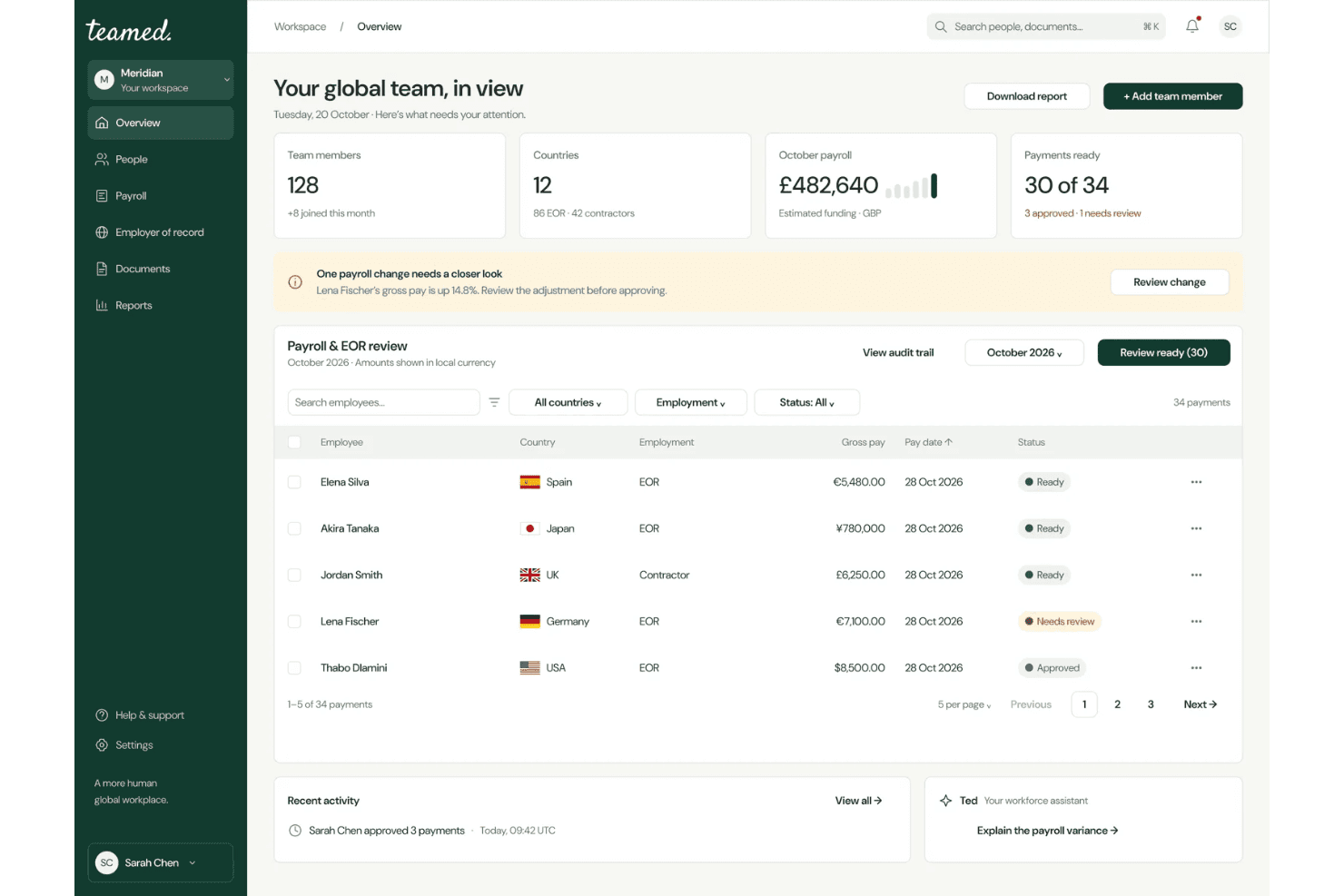
Teamed manages global payroll and EOR operations in one platform. Teamed is an employer of record platform with a wholly-owned Austrian entity that handles local payroll, Kollektivvertrag-compliant contracts, statutory benefits registration, and end-to-end termination management across 187+ countries.
Who Is Teamed Best For?
Teamed is a strong fit for companies that want to hire in Austria on a month-to-month basis while deciding whether to set up their own GmbH.
Why I Picked Teamed
I've included Teamed in my top picks because its "graduation model" is genuinely built for companies that want to hire in Austria without committing to a GmbH upfront. A public crossover calculator shows you exactly when your own entity becomes cheaper than EOR, and workers can migrate from EOR to your own entity on the same account without losing tenure. I also like that Teamed names the applicable collective agreement (Kollektivvertrag) in the offer letter and contract from day one, with German and English documents issued automatically.
Teamed Key Features
- Automated 14-salary payroll: Teamed calculates and processes the holiday bonus (June) and Christmas bonus (November) automatically, applying the correct reduced tax and social security rates for each payment.
- Termination management: Teamed handles notice calculations, works council (Arbeitsverfassungsgesetz) notifications, public employment service (AMS) filings, and final pay, escalating contested cases to employment-law specialists.
- Multi-entity dashboard: A single platform manages EOR employees, contractors, and own-entity staff across multiple countries, with payroll and cost reports filterable by country and department.
Teamed Integrations
Teamed lists 19 integrations, including documented Personio support plus BambooHR, HiBob, Workday, Greenhouse, Xero, QuickBooks, Sage, Slack, Okta, and Zapier. Only Personio has published sync details; there’s no self-serve public API.
Pros and Cons
Pros:
- Offers multi-country dashboard reporting
- Handles complex works council notifications
- Facilitates customized departmental cost filtering
Cons:
- Standard support commitment is 24/5
- Requires complex manual severance calculations
Learn more about Teamed: Best for linking EOR hires to HR and IT
- Free demo available
- From $8/user/month
Customer Rating:4.9/5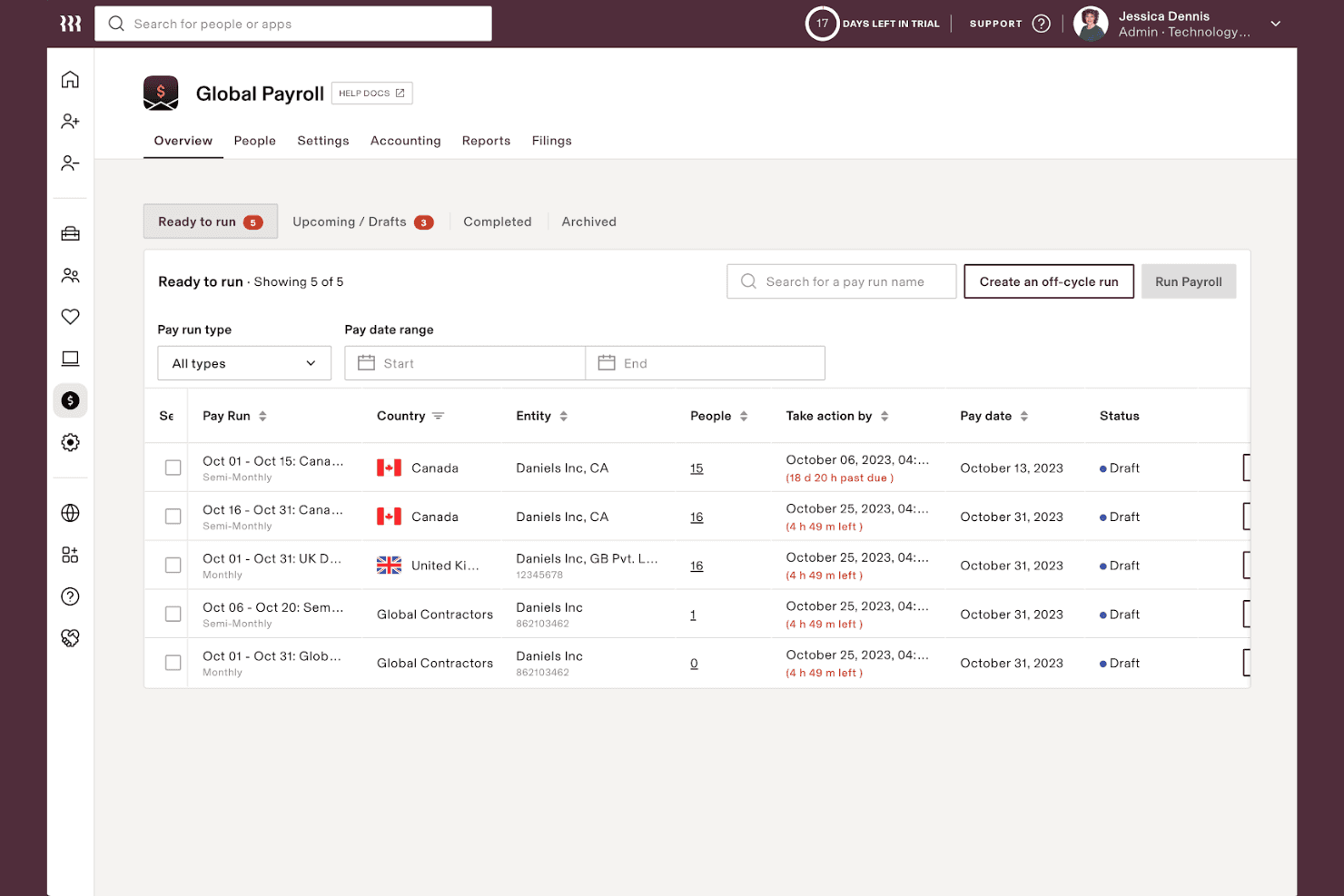
Rippling lets users manage global payroll runs across multiple countries and entities. Rippling is an employer of record platform that handles Austrian employment contracts, payroll, tax remittance, benefits, and compliance—all within a broader HR, IT, and finance system.
Who Is Rippling Best For?
Rippling suits growing companies that want Austrian EOR coverage connected to their broader HR, IT, and finance stack in one place.
Why I Picked Rippling
I picked Rippling as one of the best because it's the only Austria EOR on my list that ties your hire directly to HR, IT, and finance in one system. When you bring on an Austrian employee, Rippling automatically provisions their apps, enrolls them in benefits, and feeds payroll data into your accounting tool, all from a single employee record. I also like that it documents Austrian-specific details like the statutory 25-day leave entitlement and employer contribution rates natively in its payroll engine.
Rippling Key Features
- Austrian tax and contribution automation: Rippling's payroll engine calculates employer and employee contributions across pension, health, unemployment, and municipal tax using current Austrian rates.
- Visa and work permit support: Rippling manages Red-White-Red Card, EU Blue Card, and D visa applications for Austrian hires who need work authorization.
- Entity conversion path: Rippling lets you transfer EOR employees to your own Austrian entity without re-onboarding them when you're ready to incorporate.
- 600+ app integrations: Rippling connects to accounting tools like QuickBooks, Xero, and NetSuite, syncing payroll data automatically across your finance stack.
Rippling Integrations
Rippling offers 600+ ready-made integrations, including QuickBooks Online, Xero, Sage Intacct, and NetSuite for payroll and accounting workflows. It also connects with Slack, Notion, and Confluence, with tools for building custom integrations.
Pros and Cons
Pros:
- Converts EOR hires without repeat onboarding
- Reviewers praise unified HR and payroll workflows
- Revokes platform access upon termination
Cons:
- Live support varies on complex cases
- Lacks dedicated employee relocation assistance
 Best for ATS-triggered Austrian onboarding
- Free demo available
- From $14/worker/month
Visit WebsiteCustomer Rating:4.9/5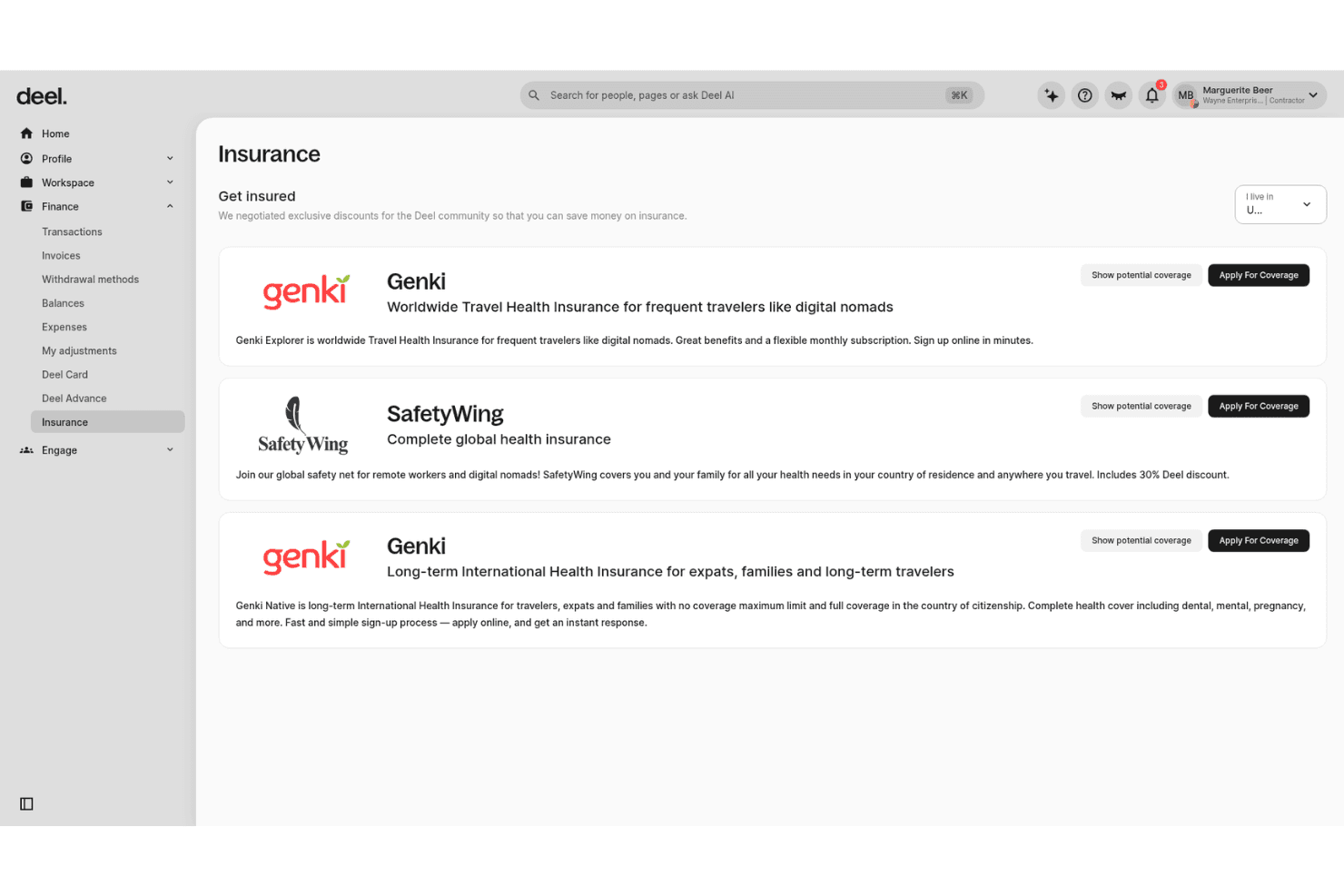
Deel Hire offers discounted health insurance options for remote workers. Deel Hire is an employer of record platform with a wholly owned Austrian entity that handles local employment contracts, payroll, statutory and optional benefits, visa support, and ATS-triggered onboarding across 130+ countries.
Who Is Deel Hire Best For?
Deel Hire is a strong fit for talent acquisition and HR teams that use an ATS to hire in Austria and want onboarding to trigger automatically without manual handoffs.
Why I Picked Deel Hire
I've included Deel Hire in my top picks because its ATS integrations with tools like Greenhouse and Ashby let you reduce manual data entry, contract preparation and onboarding. It operates through DEEL AUSTRIA GmbH, a wholly owned Vienna-registered entity, so there's a direct legal employer on the ground rather than a partner arrangement. I also like that visa support for the Red-White-Red Card Plus and EU Blue Card is built into the same platform, which matters when you're hiring international talent into Austria.
Deel Hire Key Features
- Optional private health insurance: Add supplementary health coverage for Austrian employees through Unisure or Allianz directly within the platform.
- Visa eligibility assessment: Request a free eligibility review for the Red-White-Red Card Plus or EU Blue Card within 48 hours, with full immigration support built in.
- Month-to-month EOR terms: Hire in Austria without a long-term contract commitment, with the option to cancel at any time under applicable local law.
- Multi-entity dashboard: Manage EOR staff, employees on your own entity, and contractors across 130+ countries from a single platform view.
Deel Hire Integrations
Deel Hire offers documented integrations with Greenhouse, Ashby, BambooHR, HiBob, Personio, QuickBooks, Xero, and NetSuite. Greenhouse and Ashby can trigger contracts and onboarding after a candidate is hired.
Pros and Cons
Pros:
- Visa support covers major Austrian routes
- Conducts free visa eligibility assessments
- Provides optional health insurance additions
Cons:
- Termination requires advance Deel review
- Payroll errors reported during employee changes
Learn more about Deel Hire: Best for German and English contracts
- Free demo available
- From $20/user/month (billed annually)
Visit WebsiteCustomer Rating:4.7/5
Multiplier centralizes payroll and contractor payments in one dashboard. Multiplier is an employer of record platform that handles legal employment, payroll processing, employment-related taxes, benefits administration, and contract generation for companies hiring in 150+ countries, including Austria, without establishing their own local entities.
Who Is Multiplier Best For?
Multiplier works well for companies hiring in Austria that want support with locally compliant employment contracts, payroll, and benefits administration.
Why I Picked Multiplier
I've included Multiplier in my top picks because it generates Austrian employment contracts in both German and English, which is a practical necessity when hiring locals who expect documentation in German (Deutsch) while your legal or finance team needs an English version on file. Multiplier handles contract generation in minutes, covers mandatory 13th and 14th-month pay, and manages employer social security contributions as part of the EOR fee, keeping Austrian payroll obligations in one place.
Multiplier Key Features
- Immigration support: Assistance with Austrian work permit sponsorship, eligibility checks, and supporting documentation, subject to the candidate’s circumstances and agreed service scope.
- Contractor-to-employee conversion: Support for transitioning contractors to employment through Multiplier’s EOR service.
- Statutory benefits administration: Administration of Austrian social security, pension contributions, and applicable 13th/14th salary payments, with employment costs charged separately from the EOR service fee.
- Multi-country dashboard: Manage EOR employees, contractors, and payroll for your own entities across supported countries through one platform.
Multiplier Integrations
Multiplier offers a native integration with BambooHR. It also provides API access for Growth plans and custom integrations under an agreed scope for Enterprise plans.
Pros and Cons
Pros:
- Supplies bilingual local employment agreements
- Converts local contractors to employees
- Locally compliant contract generation
Cons:
- Limits custom payroll cycle frequencies
- Austrian compliance guidance contains inconsistent figures
Learn more about Multiplier: 8Best for flat-fee global EOR budgeting
G-P
- Free demo available
- From $599/user/month
Visit WebsiteCustomer Rating:4.5/5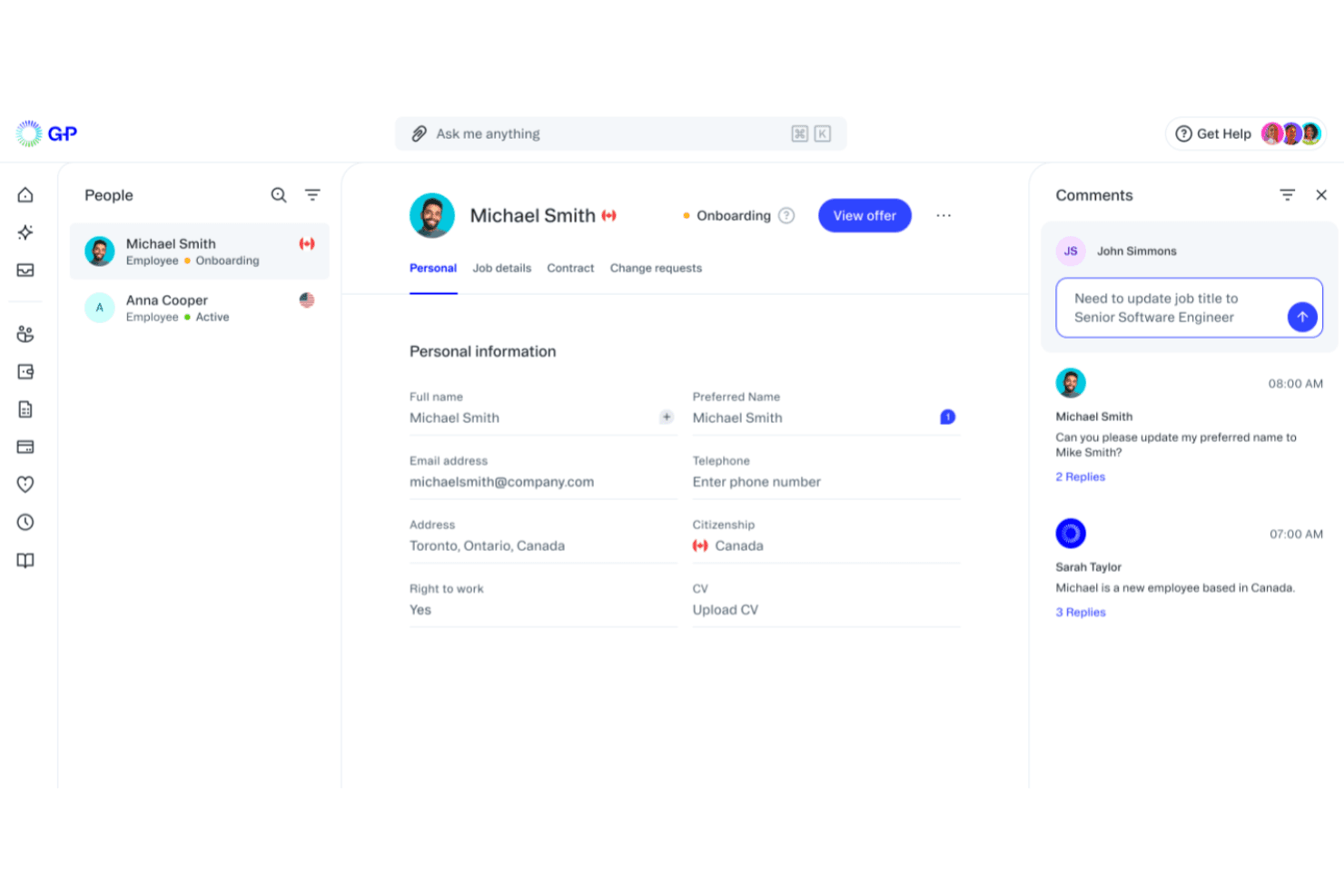
G-P employee management workspace shows onboarding status, personal details, contract information, and collaboration comments for global hiring workflows. G-P is a global employer of record platform that handles legal employment, payroll processing, tax remittance, benefits administration, and compliant onboarding across 180+ countries, including Austria.
Who Is G-P Best For?
G-P is a strong fit for finance and HR teams at mid-to-large enterprises that need predictable per-head costs when hiring across multiple countries, including Austria.
Why I Picked G-P
I've included G-P in my top picks because its flat per-employee fee of $599/month stays the same regardless of country, which makes Austrian headcount costs predictable from day one. I particularly like that it documents Austria-specific payroll detail, including the 1.53% severance fund contribution and the 13th and 14th salary payments, so finance teams aren't caught off guard by statutory obligations. It also supports contractor-to-employee conversion with no minimum contract length, which suits teams testing the Austrian market before committing.
G-P Key Features
- AI-guided contract generation: G-P's platform produces locally compliant Austrian employment contracts in seconds using AI.
- Multi-country workforce dashboard: A single interface manages employees across 180+ countries, including Austria, alongside contractors in 190+ markets.
- Enterprise HRIS and payroll integrations: G-P connects directly with Workday, SAP SuccessFactors, BambooHR, ADP, and other major platforms.
- Contractor-to-employee conversion: G-P supports bulk conversion of contractors to full employees without requiring a minimum contract length.
G-P Integrations
G-P documents integrations with Workday, SAP SuccessFactors, BambooHR, HiBob, Personio, UKG Pro, ADP Workforce Now, Paylocity, Google Workspace, Microsoft Entra ID, and Okta/Auth0. It also offers an API for custom integrations.
Pros and Cons
Pros:
- Broad country coverage suits distributed hiring
- Detailed Austrian payroll guidance flags statutory obligations
- Generates contracts using artificial intelligence
Cons:
- Conflicting Austria guidance weakens compliance confidence
- No Austrian visa or permit support
Learn more about G-P: Best for termination liability guarantees
- Free demo available
- From $29/user/month
Visit WebsiteCustomer Rating:4.4/5
Papaya Global tracks employer costs by country, category, and cost center. Papaya Global is a global employer of record platform that handles legal employment, payroll processing, benefits administration, contract generation, and termination management across 180+ countries, including Austria.
Who Is Papaya Global Best For?
Papaya Global is a strong fit for mid-market and enterprise finance and HR teams managing Austrian hires alongside a multinational workforce, particularly those seeking contractual limits on termination-related financial exposure where coverage applies. Austria-specific protection should be confirmed in the service agreement.
Why I Picked Papaya Global
I've included Papaya Global in my top picks because it advertises a written termination guarantee with defined limits on legal-defence costs and financial exposure in covered countries. It also manages termination and settlement processes, although Austria-specific guarantee coverage should be confirmed in the service agreement. Its Austrian resources explain employer contributions, collective agreement-based working hours, severance arrangements, and immigration routes such as the Red-White-Red Card.
Papaya Global Key Features
- Gross-to-net reporting: Papaya generates standardized G2N reports with a full audit trail from gross pay to net payout for every Austrian payroll run.
- Multi-country employee dashboard: A single system of record manages EOR staff, contractors, and payroll across countries, with real-time alerts and BI analytics.
- Immigration services: The EOR plan includes visa and work permit support, covering Austria-specific options like the Red-White-Red Card and EU Blue Card.
- Global Health Plan: Papaya offers supplemental physical and mental health coverage accessible through a mobile app and a single prepaid card for healthcare payments.
Papaya Global Integrations
Papaya Global documents integrations with Expensify, NetSuite, and Eqip. Its OneData technology connects and standardizes workforce data from other systems, while a REST API supports custom integrations.
Pros and Cons
Pros:
- Provides extensive global health plans
- Generates standardized gross net reports
- Contractual termination liability guarantee
Cons:
- Requires extensive mandatory employee training
- Limits specialized contract worker classifications
Learn more about Papaya Global: Best for budgeting Austria's 13th and 14th pay
- Free plan + 30-day free trial + free demo available
- From $699/user/month
Visit WebsiteCustomer Rating:4.4/5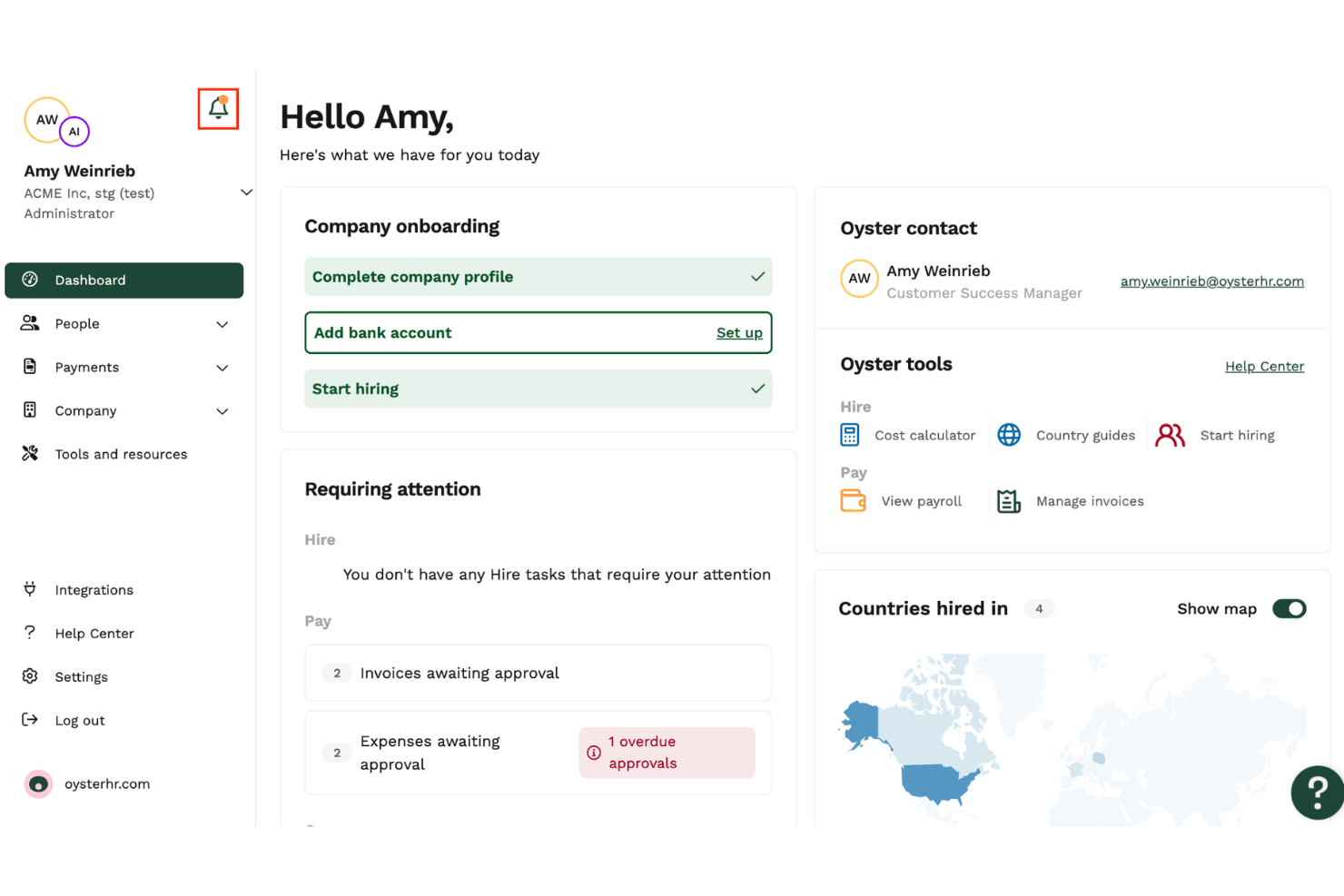
Oyster HR's dashboard guides admins through onboarding and pending approvals. Oyster is an employer of record platform that lets companies hire in Austria without establishing a local entity. It handles German-language employment contracts, applicable collective bargaining agreement requirements, monthly payroll and tax withholding, and accrual and administration of 13th and 14th salary payments where required.
Who Is Oyster HR Best For?
Oyster HR is a good fit for finance and HR teams that want Austrian employment cost estimates to include applicable 13th and 14th salary accruals from day one.
Why I Picked Oyster HR
I picked Oyster HR because it includes Austria’s applicable 13th and 14th salary accruals in employment cost calculations from day one, helping finance teams budget ahead of holiday and Christmas payments. Oyster also says it automatically applies the relevant collective bargaining agreement (Kollektivvertrag) based on the hire’s industry sector, supporting compliance with agreement-specific pay and benefit requirements.
Oyster HR Key Features
- German-language contract generation: Oyster advertises German-language contracts reflecting applicable Austrian employment requirements.
- Sector agreement mapping: The platform supports applicable collective-agreement requirements in contracts and payroll.
- Severance fund contributions: Oyster documents contributions from the second month of employment and ongoing tracking. These are ongoing employer contributions, rather than payments triggered by offboarding.
Oyster HR Integrations
Oyster HR offers integrations with Xero, Slack, Carta, HiBob, Personio, Ashby, BambooHR, Greenhouse, and QuickBooks Online. It also provides a developer API for custom integrations.
Pros and Cons
Pros:
- Drafts compliant local language contract
- Supports Austrian collective-agreement compliance
- Tracks specialized sector agreement mapping
Cons:
- Limits custom offboarding date selections
- Enforces strict mandatory arbitration clauses
Other Employer of Record Software in Austria
Here are a few additional options that didn’t make my shortlist but are still worth checking out:
- 11Payoneer Workforce ManagementBest for Austrian offboarding paperwork
- 12RemoteBest for hiring via its own Austrian entity
- 13MercansBest for Austrian collective-agreement payroll
- 14RemoFirstBest for hiring teams without lock-in contracts
- 15Safeguard GlobalBest for local HR support across markets
- 16LanoBest for consolidating multi-provider payroll
- 17AcvianBest for adding outsourced HR to EOR
- 18Global ExpansionBest for Austrian working-time rule guidance
- 19CXCBest for managing mixed global workforces
- 20PlayrollBest for calculating international employer taxes
Related Reviews
How I Evaluate Employer of Record Software in Austria
I split my evaluation into three parts. First, core functionality—does the provider legally employ workers in Austria and manage Austrian labor law compliance? This carries the most weight. Second, I look for standout features like 13th/14th salary automation. Third, I consider pricing transparency and support responsiveness.
Core Functionality (Table Stakes For This List)
When I'm selecting tools for my list, I score each one on a scale from 0 (does not offer the functionality) to 5 (excels in this area) for each core functionality listed below. I then convert the total into a percentage to help assess each tool's overall fit, with extra weight on any functionalities I've deemed essential.
- Legal Employment Entity (Essential): I check whether the provider owns its Austrian entity or uses a partner, and how much visibility you get into compliance ownership.
- Austrian Compliance Management (Essential): I evaluate how each provider handles Austrian working-time rules, notice periods, statutory leave, and collective bargaining agreement coverage.
- Payroll and Tax Remittance: Accurate 13th and 14th salary processing matters here, so I look at how each provider automates Austrian payroll cycles and social security contributions.
- Benefits Administration: Beyond statutory health and pension, I look for providers that offer supplementary benefits like meal vouchers or private insurance tailored to the Austrian market.
- Contract Drafting and Onboarding: I consider whether contracts reflect Austrian labor law specifics and whether the onboarding workflow includes e-signatures and local documentation collection.
- Termination and Offboarding Support: Austrian severance rules and notice periods vary by tenure, so I evaluate how each provider calculates these and handles required offboarding paperwork.
Once I have a list of tools that meet the criteria, I consider what sets each platform apart.
Differentiating Factors (What Sets Vendors Apart)
Here's how I compare and contrast different vendors:
Standout Features
I check whether a provider automatically maps employees to the correct Austrian collective bargaining agreement (Kollektivvertrag), since misclassification can mean underpaying minimum wages or missing entitlements. Providers like Deel and Oyster HR handle this mapping differently, so I compare how each one identifies the applicable agreement during onboarding. I also evaluate 13th and 14th salary automation—these mandatory pay cycles trip up providers that bolt Austrian payroll onto a generic engine. Visa and work permit assistance matters whenever you're hiring non-EU nationals, so I look at whether the provider manages the full application process or just advises on it.
Beyond Features
I check whether a provider owns its Austrian entity or relies on a local partner, since that affects how fast payroll issues get resolved and who holds liability. Time-to-hire speed matters too—some providers onboard Austrian employees in days, while others take weeks, which can cost you a candidate. I also compare pricing models, looking for flat-fee transparency over percentage-of-salary structures that hide offboarding or currency conversion charges.
How to Choose an Employer of Record in Austria
Choose an Austrian EOR by matching its legal-employment model and documented handling of pay, agreements, permits, and exits to your hiring plan.
| If your priority is… | Look for… |
|---|---|
| If your priority is…Budgeting annual compensation | Look for…A written example showing how 13th and 14th pay appear in the offer and payroll schedule |
| If your priority is…Applying the right minimum terms | Look for…A documented process for identifying the applicable collective bargaining agreement |
| If your priority is…Hiring non-EU nationals | Look for…Written confirmation of work permit sponsorship scope and employee eligibility |
| If your priority is…Planning a future Austrian entity | Look for…A documented process for transferring employment and records to your entity |
How to Vet Your Shortlist
- Review the contract: Request a sample Austrian employment contract and payroll schedule; confirm they show 13th and 14th pay and identify the applicable agreement.
- Test permit scope: Send a written scenario for one non-EU candidate and ask for a reply detailing sponsorship responsibilities, eligibility checks, and required documents.
- Test offboarding: Request a sample exit checklist and a written termination-cost calculation for a hypothetical employee with stated tenure and notice date.
- Verify legal employer details: Request the Austrian employing entity’s registered name and company registration document, then confirm the proposed contracting party matches.
- Choose the operating model: If local control and continuity matter most, favor a provider with its own Austrian entity; if testing the market comes first, weigh partner-based coverage against a later transfer process.
What Is an Employer of Record in Austria?
An employer of record in Austria is a third-party organization that legally employs workers on behalf of another company. It manages local employment contracts, payroll, tax remittances, and employment compliance, while your company directs the employee’s day-to-day work. This arrangement lets you hire in Austria without first establishing a local legal entity.
Features
Here are the main features I look for in an employer of record software in Austria:
- Legal employment entity: The provider employs your Austrian workers through its own local entity or a disclosed partner. Confirm which organization signs the employment contract, handles employer obligations, and holds any required labour-leasing authorization.
- Austrian compliance management: The provider applies local rules for working time, leave, notice periods, and applicable collective agreements that help determine minimum pay and employment terms, and employers must identify the relevant agreement in the employment contract or Dienstzettel. This helps ensure employment terms and minimum pay reflect the worker’s role and circumstances.
- Payroll and tax remittance: The provider calculates payroll deductions, social security contributions, and employer charges, remits amounts to the relevant authorities, and handles required payroll reporting. Clear payroll records help your team check total employment costs.
- 13th and 14th salary processing: The provider shows how additional salary payments are calculated and scheduled when required by the applicable agreement or contract. Ask how these payments appear in the employment offer and payroll calendar.
- Benefits administration: The provider administers required social insurance and any agreed supplementary benefits, such as meal vouchers or private insurance. Confirm which benefits are included and which carry additional fees.
- Contracts and onboarding: The provider prepares Austrian employment contracts and any required statement of employment terms, collects onboarding documents, and completes social insurance registration before work begins. E-signatures and a clear checklist help your team and the employee track required steps.
- Work permit support: The provider explains eligibility, required documents, and its role in any work authorization process. Confirm whether it handles applications or provides guidance only.
- Termination and offboarding: The provider explains applicable notice periods and termination costs, then coordinates final pay and exit documents. Request a sample checklist so you know which steps your team and the employee must complete.
Benefits
Using an employer of record in Austria can offer several practical benefits, including:
- Hiring without an entity: The provider employs workers through its Austrian entity or a disclosed partner, so your company can hire without first establishing a local legal entity.
- Local employment compliance: Support with working-time rules, leave, notice periods, and applicable collective agreements helps align employment terms with Austrian requirements.
- Managed payroll and taxes: Payroll processing covers deductions, social security contributions, and tax remittances, with clear records to review employment costs.
- Scheduled additional salary payments: Payroll services can show how 13th and 14th salary payments are calculated and scheduled when required by the applicable agreement or contract.
- Simpler onboarding: Austrian employment contracts, document collection, and e-signatures can give your team a clear process for bringing employees on board.
- Benefits administration: Providers can administer social insurance and agreed supplementary benefits, with details on which benefits are included or cost extra.
- Structured offboarding: Guidance on notice periods, termination costs, final pay, and exit documents helps your team plan employment changes.
Pricing
Employer of record services in Austria typically cost $299–$699 per employee per month, with fees varying by provider and service scope. These indicative pricing bands aren’t standardized plans, and salary, taxes, and benefits may cost extra.
Plan Comparison Table for Employer of Record Software in Austria
| Plan Type | Average Price | Common Features |
|---|---|---|
| Plan TypeFree Plan | Average Price$0 | Common FeaturesProvider comparisons, introductory consultations, and no employee employment services. |
| Plan TypePersonal Plan | Average Price$299–$399 per employee/month | Common FeaturesEmployment contracts, payroll processing, and statutory compliance support. |
| Plan TypeBusiness Plan | Average Price$400–$699 per employee/month | Common FeaturesEmployment contracts, payroll and tax remittance, benefits administration, and onboarding support. |
| Plan TypeEnterprise Plan | Average Price$700–$1,000 per employee/month | Common FeaturesMulti-country employment support, tailored compliance services, consolidated payroll reporting, and dedicated account management. |
FAQs
Here are answers to common questions about employer of record software in Austria.
Are 13th and 14th salaries mandatory in Austria?
Not universally. Austria doesn’t impose a universal statutory right to 13th and 14th salaries for every employee. These special payments are commonly provided under applicable collective agreements or employment contracts, which set eligibility, amounts, and timing. Ask the EOR to identify the governing agreement and show how each payment appears in the contract and payroll calendar. Check whether amounts are prorated for a midyear start or departure, and include them in annual compensation forecasts rather than treating them as unexpected extra pay.
How does a collective agreement affect an employee’s pay in Austria?
A collective agreement can set minimum pay and other employment terms for a covered role. Which agreement and classification apply generally depends on the employer’s industry and the employee’s work. Ask the EOR to name the agreement, classification group, minimum salary, and relevant allowances. Then compare those details with the employee’s actual duties and proposed pay. If the role spans different functions or the classification is unclear, request a written explanation before approving the contract.
Can an EOR hire a non-EU national in Austria?
Yes, if the person’s residence and work authorization permit the proposed employment and the EOR can support the arrangement. An EOR doesn’t automatically provide work authorization or guarantee approval. Ask who checks eligibility, prepares or submits applications, and communicates with the relevant authorities. Confirm required documents, expected timing, and any limits on the employee’s role or work location. Don’t allow work to begin until the person’s legal right to perform the proposed employment is confirmed.
What happens if we establish our own Austrian entity after hiring through an EOR?
Moving employment to your own entity isn’t necessarily an automatic administrative change. Ask the EOR how it would handle employment agreements, accrued leave, service records, benefits, payroll information, and any outstanding obligations. Get the proposed process and responsibilities in writing before planning a transition. Don’t assume a new contract resets an employee’s service history or resolves existing rights. Have Austrian employment counsel review the arrangement, including whether specific transfer rules apply to your circumstances.