

10 Best Employer of Record South Korea in 2026

Best Employers of Record in South Korea Shortlist


An Employer of Record South Korea legally employs your local team and manages payroll, employment administration, and statutory obligations on your behalf.
If you need to hire in Korea without managing local employment infrastructure yourself, compare providers by their compliance support, employment model, and coverage across your other markets. This guide reviews options for local labor-law support, onboarding, and connections to your HR systems.
Why Trust Our Software Recommendations
Our team has been testing and reviewing software since 2012. As HR experts ourselves, we know how difficult—and important—it is to choose the right software.
For this guide, we evaluated tools using hands-on testing and independent research, scoring tools using our selection criteria. We also draw on insights from industry thought leaders and practicing HR experts.
Our reviews reflect our human editorial judgment, not a sales pitch.
Expert reviewers:
Comparison Table: Employers of Record in South Korea
Compare pricing and specs side by side for the employers of record in South Korea that made it onto my shortlist.
| Tool | Best For | Trial Info | Price | ||
|---|---|---|---|---|---|
| 1 | Best for mixed employee and contractor teams | Not available | From $399/worker/month | Website | |
| 2 | Best for direct-entity hiring in South Korea | Free demo available | From $599/user/month | Website | |
| 3 | Best for Korean labor law compliance depth | Free plan + 30-day trial + free demo available | From $699/user/month | Website | |
| 4 | Best for testing South Korean market entry fast | Free demo available | From $199/user/month | Website | |
| 5 | Best for APAC-wide hiring with a Seoul base | Not available | Pricing upon request | Website | |
| 6 | Best for finance-led global hiring including Korea | Free demo available | From $499/user/month | Website | |
| 7 | Best for Korea severance and pension compliance | Free demo available | From $599/user/month | Website | |
| 8 | Best for unified HR and IT hiring in Korea | Free demo available | Pricing upon request | Website | |
| 9 | Best for Korea-compliant global workforce consolidation | Free demo available | From $599/employee/month | Website | |
| 10 | Best for HRIS-connected Korean hiring at scale | Free demo available | From $459/user/month (billed annually) | Website |


Reviews of Employers of Record in South Korea
Below are my detailed summaries of the best Employers of Record in South Korea that made it onto my shortlist. My reviews cover each EOR service’s Korea-specific compliance support, employment model, and regional coverage to help you find the best fit.

Best for mixed employee and contractor teams
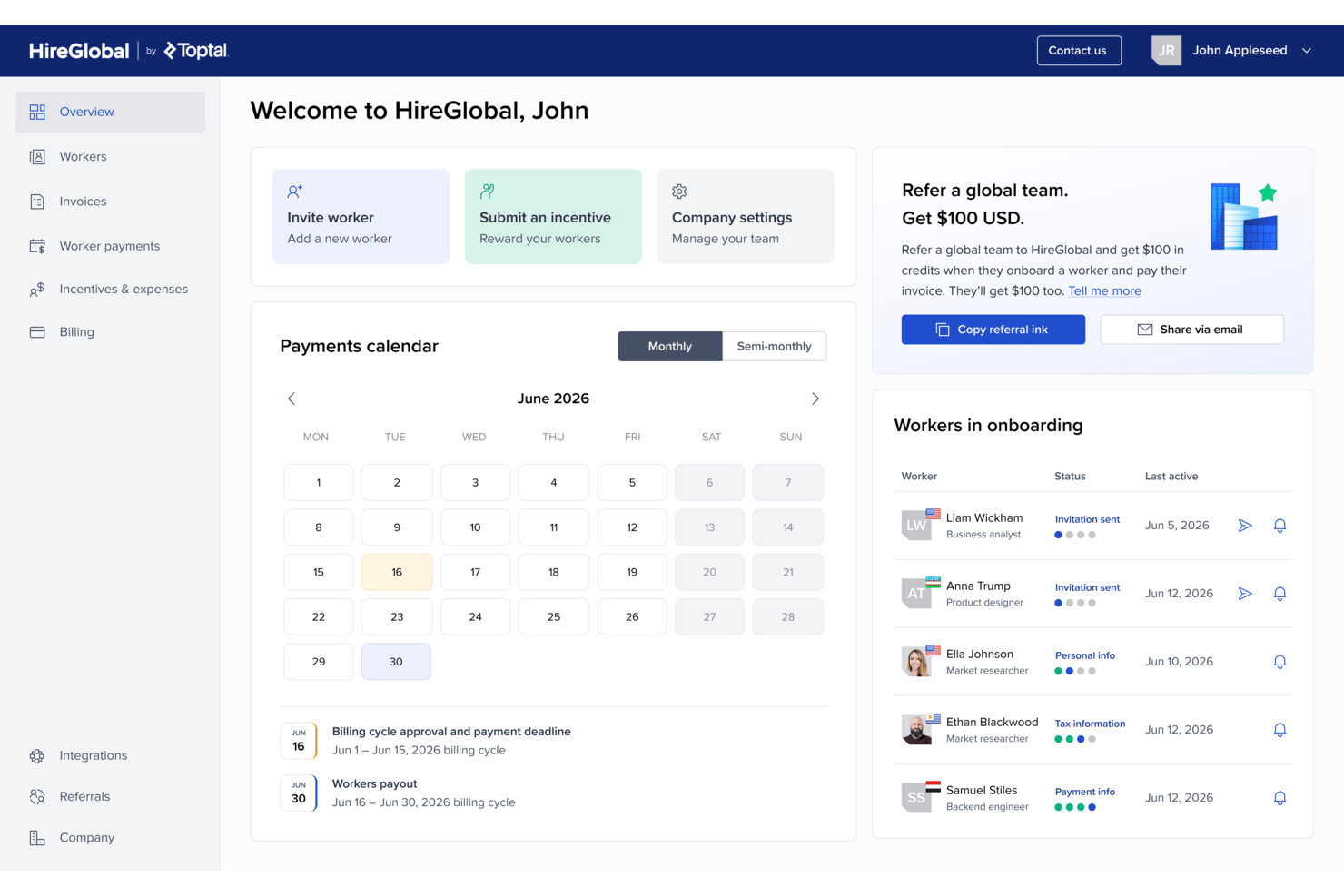
HireGlobal is an employer of record service from Toptal that handles global employment contracts, payroll, benefits administration, and compliance across 180+ countries through a network of local provider partners.
Who Is HireGlobal Best For?
HireGlobal works well for teams that need to manage both full-time employees and independent contractors across multiple countries from a single platform.
Why I Picked HireGlobal
I've included HireGlobal in my top picks because it's one of the few EOR platforms that lets you manage both full-time employees and independent contractors across 180+ countries from a single HRIS. If your South Korea expansion involves a mix of hired staff and project-based contractors, you won't need separate tools or vendors to handle each worker type. HireGlobal's consolidated invoicing and unified workforce visibility mean both employment models sit in one place, keeping payroll and compliance workflows connected.
HireGlobal Key Features
- Locally compliant employment contracts: HireGlobal generates employment contracts that meet local legal requirements in each country where workers are hired.
- Mandatory benefits facilitation: The platform administers statutory local benefits and any additional benefits you choose to offer through its partner network.
- Locally compliant termination handling: HireGlobal manages the end-to-end termination process, including notice periods, severance payouts, and accrued benefits.
- Dedicated client expert access: Each client gets a dedicated expert through the platform to support compliance queries and workforce decisions.
HireGlobal Integrations
HireGlobal has one documented native integration with TopTracker for time tracking, invoice approval, and worker payments.
Pros and Cons
Pros:
- Consolidated invoicing supports global oversight
- Reviewers praise responsive support
- Manage employees and contractors together
Cons:
- Korean payroll and statutory benefits lack detail
- South Korean employing entity remains unconfirmed
Best for direct-entity hiring in South Korea
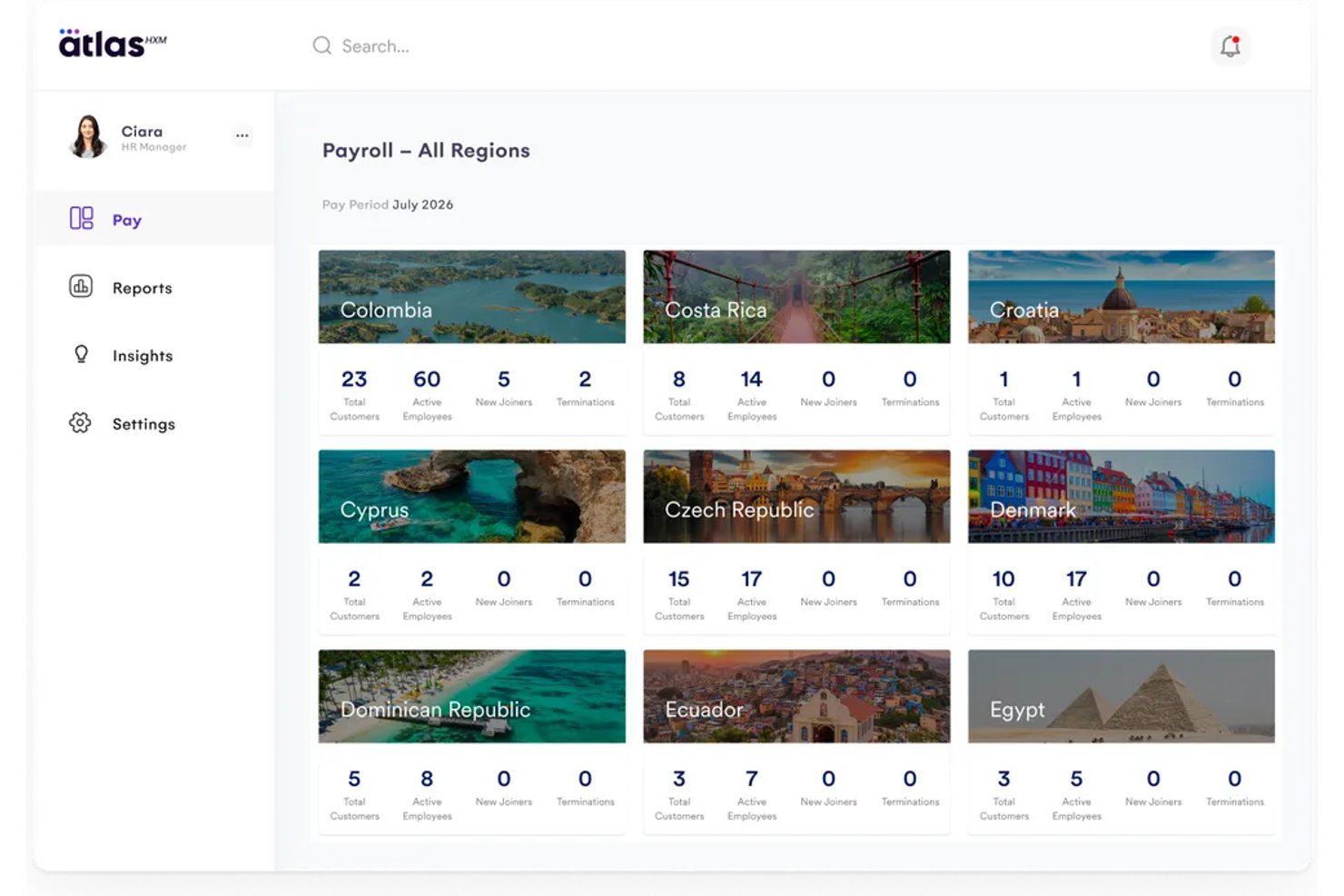
Atlas HXM is a direct-entity Employer of Record that lets you hire employees in South Korea—and 160+ other countries—without setting up a local entity, covering KRW payroll, tax withholding, statutory benefits, and labor law compliance.
Who Is Atlas HXM Best For?
Atlas HXM is a strong fit for global expansion teams that need a direct-entity EOR in South Korea without the overhead of local incorporation.
Why I Picked Atlas HXM
Atlas HXM earns its spot on my shortlist because it operates through a wholly-owned legal entity in South Korea, meaning your Korean hires are employed directly by Atlas rather than through a third-party intermediary. I like that Atlas handles KRW payroll, income tax withholding, and all four mandatory social insurance contributions (National Pension, health, employment, and industrial accident insurance) under one platform. Onboarding in as few as two weeks also makes it a practical choice when you need to get someone hired in Korea quickly.
Atlas HXM Key Features
- Compliance alerts: Atlas sends automated notifications when Korean labor regulations change, so your contracts and processes stay current without manual monitoring.
- Employee self-service portal: Employees access payslips, tax documents, and employment records directly through the Atlas platform.
- Multi-country consolidated invoicing: Atlas rolls up all active employee costs across countries into a single monthly invoice for easier finance reconciliation.
- HR advisory consultants: Dedicated HR Employee Relationship Consultants provide in-region support for leave management and employee relations in Korea.
Atlas HXM Integrations
Documented integrations include Workday, BambooHR, Sage, Ashby, Paycor, UKG, and Dayforce. These connect HRIS, ATS, and SSO workflows for multi-country employment administration.
Pros and Cons
Pros:
- KRW payroll includes all four social contributions
- Responsive named account support
- Direct Korean entity avoids intermediary risk
Cons:
- No documented pension-plan or 52-hour alerts
- Korea visa sponsorship claims conflict

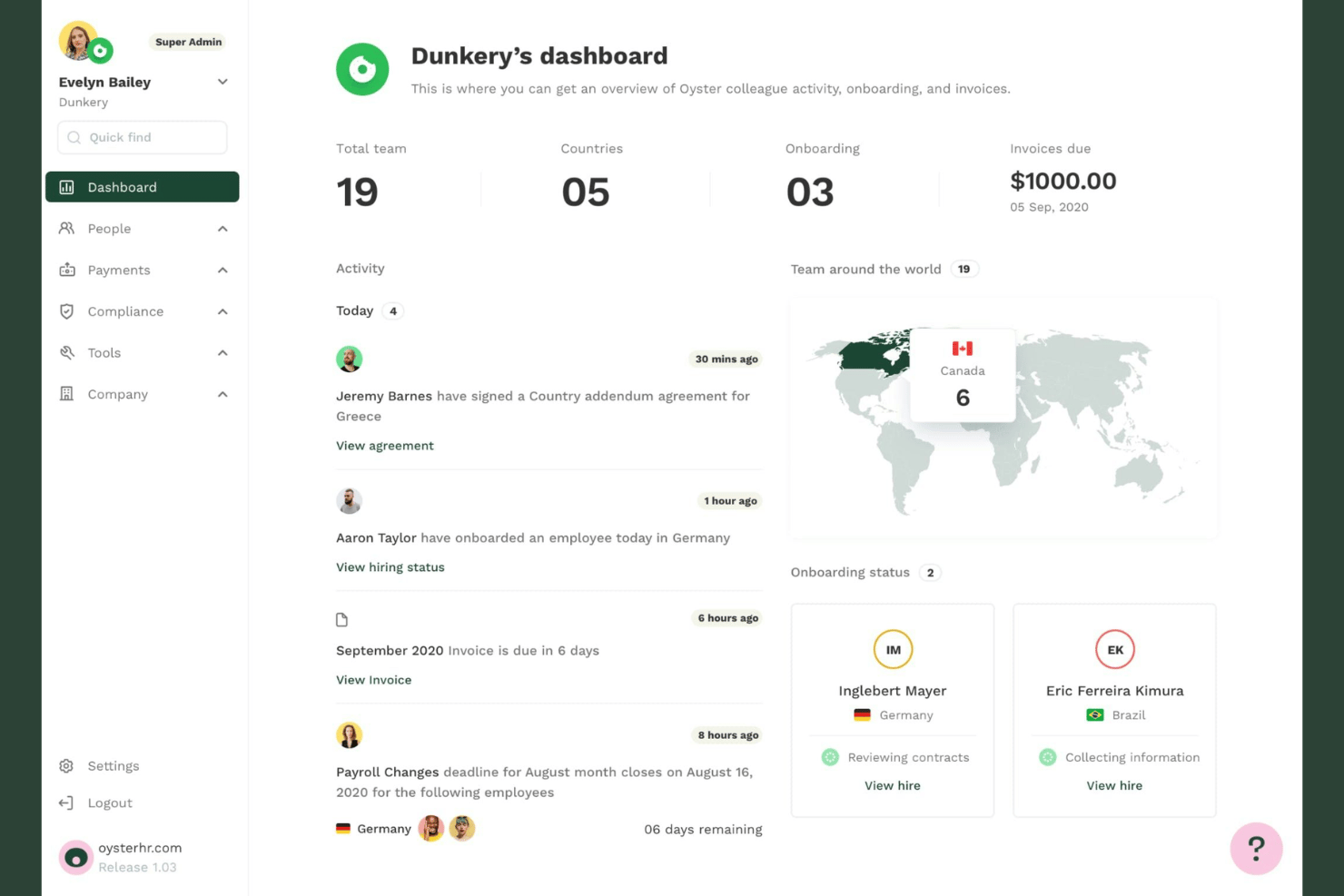
Oyster is a global Employer of Record platform that handles Korean employment contracts, KRW payroll, statutory benefits enrollment, and labor law compliance across 120+ countries from a single dashboard.
Who Is Oyster Best For?
Oyster is a strong fit for global expansion teams that need detailed Korean labor law coverage, including severance, the 52-hour workweek, and proactive tracking of 2026 regulatory changes.
Why I Picked Oyster
I've included Oyster in my top picks because its Korean labor law coverage goes deeper than most EOR platforms I've seen. It actively tracks regulatory changes, including the 2026 Yellow Envelope Law, and it's one of the few platforms I know of that flags the criminal liability exposure tied to overtime and severance violations. Bilingual Korean/English contracts with a built-in contract quality score let you benchmark offers against local norms before anyone signs.
Oyster Key Features
- KRW payroll processing: Oyster runs monthly payroll in Korean won, automatically calculating salaries, taxes, bonuses, allowances, and deductions with downloadable payroll reports.
- 52-hour workweek monitoring: The platform tracks work hours against Korea's legal cap and flags compliance risks before violations occur, with overtime and holiday pay calculated at statutory rates.
- Bilingual contract generation: Oyster produces Korean/English employment contracts in one click, with the Korean version governing in any dispute and electronic signing built into the app.
- Multi-country dashboard: Manage Korean EOR employees alongside contractors and staff across 120+ countries from a single platform, with integrations to HR tools like Workday, BambooHR, and HiBob.
Oyster Integrations
Oyster offers integrations with HiBob, BambooHR, Workday, Greenhouse, Xero, QuickBooks, Concur Expense, Expensify, and Carta, plus a developer API for custom workflows. It also supports Zapier.
Pros and Cons
Pros:
- Korean employee onboarding in approximately 48 hours
- Bilingual contracts include local legal review
- Detailed Korean compliance tracks changing labor rules
Cons:
- Currency conversion fees apply to certain payments
- Refundable deposit required for EOR employees

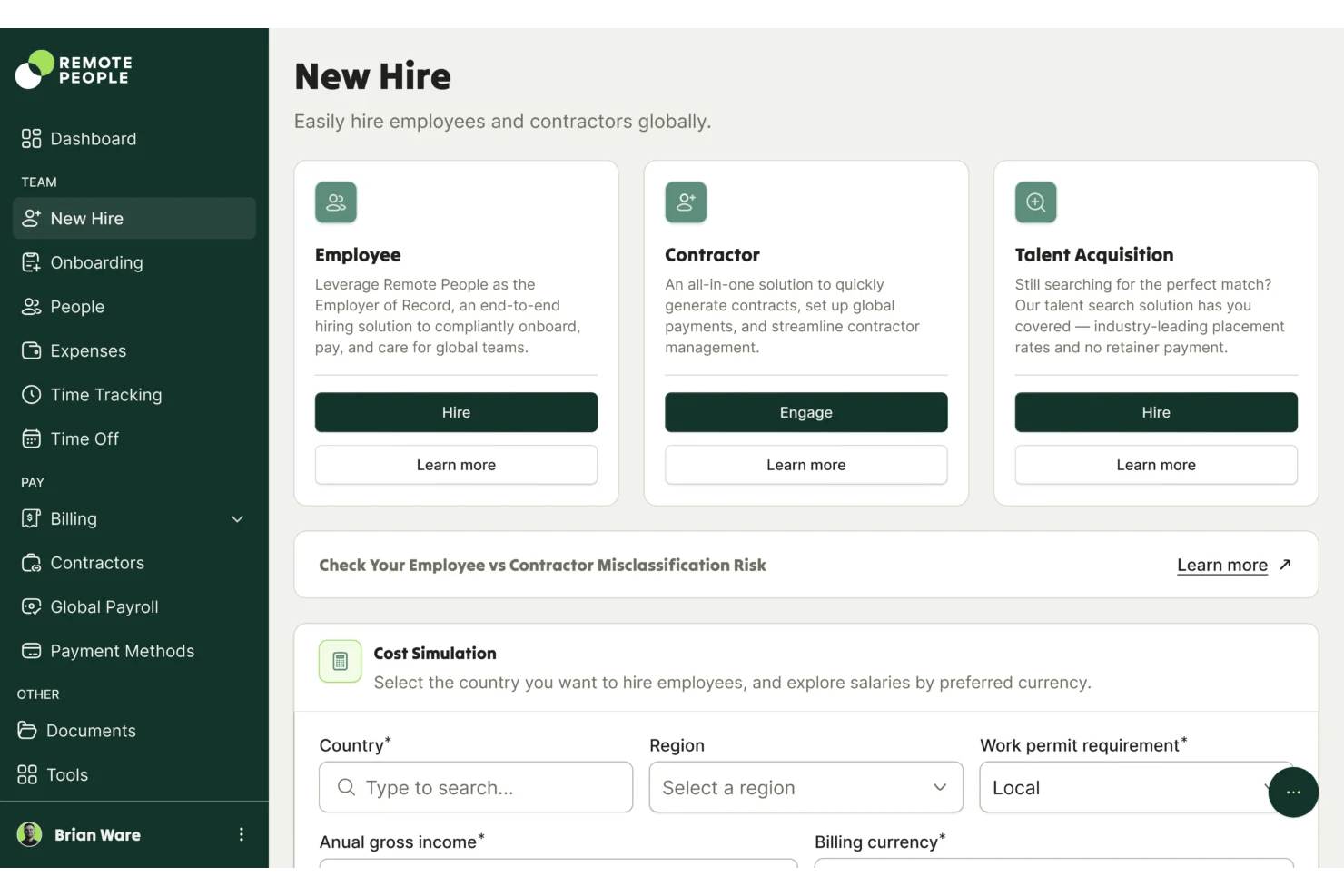
Remote People is an Employer of Record platform that lets you hire full-time employees in South Korea—and 150+ other countries—handling local payroll in Korean won, statutory benefits registration, tax withholding, bilingual employment contracts, and visa sponsorship.
Who Is Remote People Best For?
Remote People works well for companies exploring South Korea for the first time and wanting to hire quickly without committing to a local entity.
Why I Picked Remote People
I've included Remote People in my top picks because it's built for companies that want to test South Korea without the 2–3 month timeline and 25K–50K cost of setting up a local entity. You can have a bilingual Korean/English employment contract ready within within 2–3 business days, which is genuinely fast for a market this compliance-heavy. Remote People also handles E-7-1 and D-7 intra-company transfer visa sponsorship directly, so if your first Korean hire needs a work visa, you're not coordinating with a separate immigration firm.
Remote People Key Features
- Statutory benefits registration: Remote People enrolls employees in all four Korean statutory programs—National Pension, National Health Insurance, Employment Insurance, and Industrial Accident Insurance—using 2026 contribution rates.
- Year-end tax settlement: Remote People manages the February annual tax reconciliation required under Korean tax law, including progressive income tax filing and the 10% local surtax.
- Severance reserve accrual: Remote People calculates and accrues the Korean statutory severance reserve at approximately 8.33% of monthly wages, ensuring the 14-day post-separation payment deadline is met.
- Multi-country consolidated billing: A single invoice and dashboard cover all EOR employees across countries, letting finance teams track cost per employee per country each month.
Remote People Integrations
Remote People lists integrations with Deel Payroll and Gusto for payroll exports, but native integrations and a public API aren’t clearly documented.
Pros and Cons
Pros:
- Consolidated multi-country payroll dashboard
- Recent Korea-specific labor law guidance
- E-7-1 and D-7 visa sponsorship
Cons:
- Visa and immigration services priced separately
- Salaries and statutory contributions billed separately

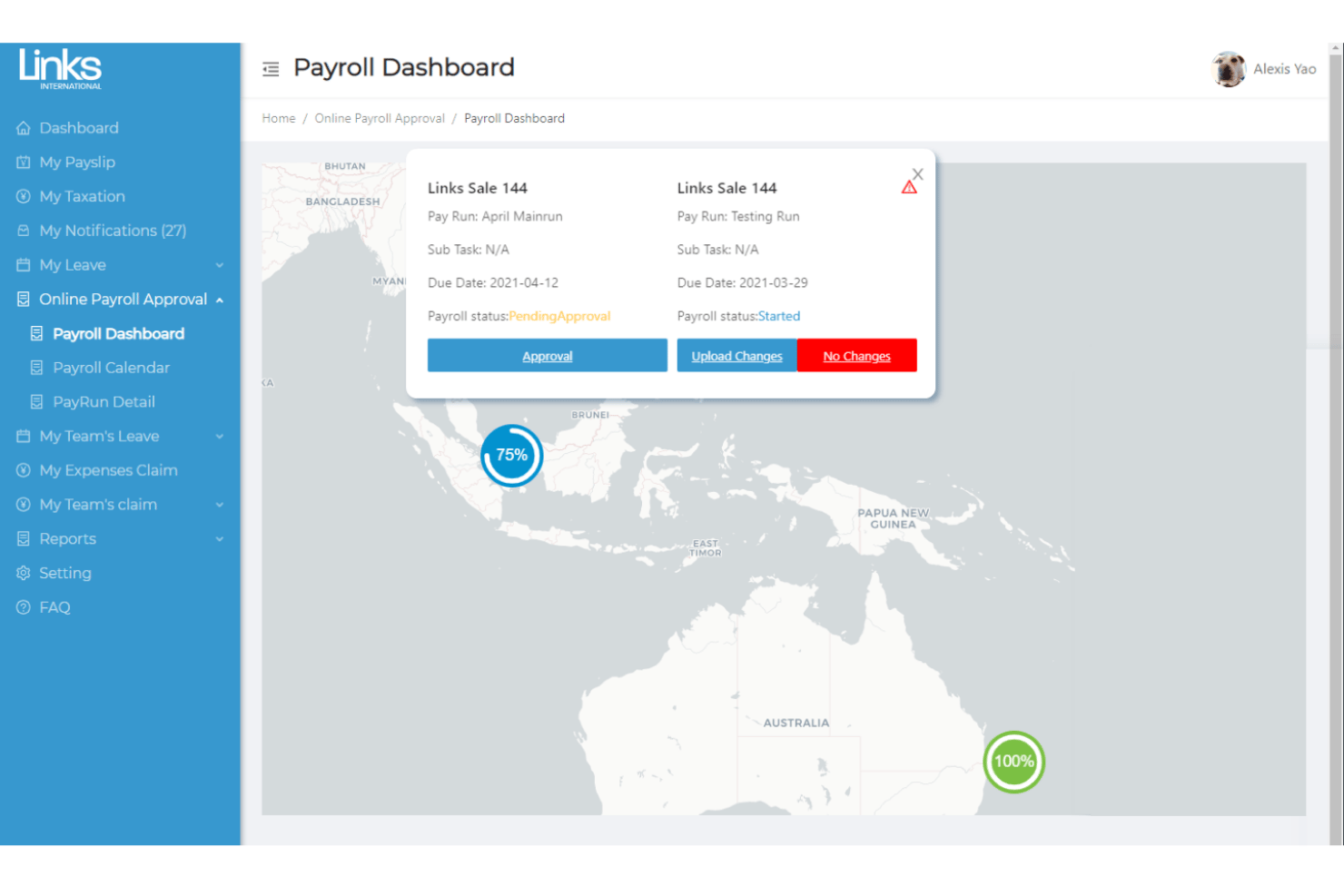
Links International is an APAC-focused Employer of Record and payroll outsourcing provider with its own legal entities across 30+ locations, covering Korean employment contracts, statutory benefits administration, and multi-country payroll consolidation.
Who Is Links International Best For?
Links International is a strong fit for companies already hiring or expanding across multiple APAC markets that want to anchor their South Korea operations with a single regional provider.
Why I Picked Links International
I've included Links International in my top picks because it's the only APAC-regional EOR on this list with its own legal entity and a staffed Seoul office, which matters when Korean labor law questions need answers from someone who actually knows the market. I particularly like that it runs quarterly labor law updates and hosted a live 2026 South Korea compliance webinar covering the minimum wage increase to KRW 10,320/hour and the "Yellow Envelope" law. If your hiring roadmap extends beyond Korea into other Asian markets, Links One consolidates payroll across 30+ APAC locations in a single dashboard.
Links International Key Features
- Statutory insurance administration: Links manages enrollment and contributions across all four mandatory Korean schemes—National Pension, National Health Insurance, Employment Insurance, and Workers' Compensation.
- EOR-to-payroll transition path: Once you establish your own Korean entity, you can switch from EOR to outsourced payroll without changing vendors.
- Links One multi-country dashboard: Consolidates payroll approvals, reports, and data across 30+ APAC and Middle East locations in a single platform.
- SAP, Workday, and Oracle integrations: Links One connects directly to major HR and ERP systems, syncing payroll and time-attendance data across your existing tech stack.
Links International Integrations
Links International documents integrations with SAP SuccessFactors, Workday, Oracle HCM, and time-attendance tools. Links Integration Hub connects payroll, HR, ERP, and time systems across 30+ APAC and Middle East locations.
Pros and Cons
Pros:
- Regional payroll consolidation spans 30+ markets
- All four statutory insurance schemes are covered
- Seoul-based team tracks Korean labor changes
Cons:
- Bilingual contract templates aren't documented
- No public self-service EOR registration

Best for finance-led global hiring including Korea
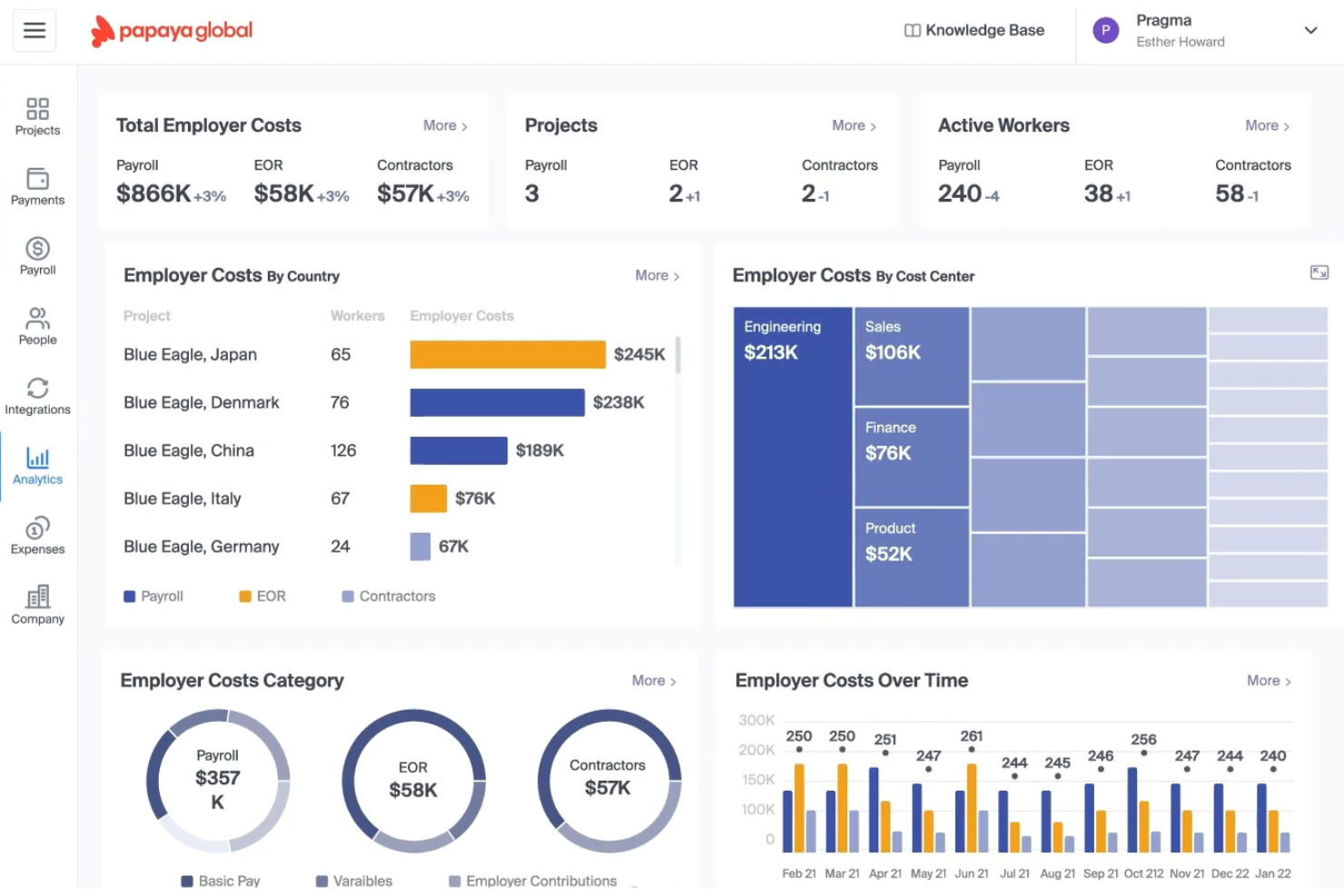
Papaya Global is a multi-country EOR platform that handles payroll processing, statutory benefits administration, tax withholding, contract localization, and immigration support across 180+ countries, including South Korea.
Who Is Papaya Global Best For?
Papaya Global is a strong fit for finance and payroll teams managing multi-country headcount who need consolidated reporting, flat-fee pricing, and audit-ready payroll data across regions including South Korea.
Why I Picked Papaya Global
I've included Papaya Global in my top picks because it's built around the needs of finance and payroll teams managing headcount across multiple countries, Korea included. I especially like its gross-to-net reporting, journal-entry automation, and audit-ready payroll data, which give finance leads the visibility they need when running payroll in KRW across a multi-country portfolio. Its flat-fee pricing per employee (rather than a percentage of salary) also makes cost forecasting straightforward when you're adding Korean hires at senior compensation levels.
Papaya Global Key Features
- Statutory contributions management: Papaya calculates and administers all four major Korean statutory contributions—National Pension, Health Insurance, Employment Insurance, and Industrial Accident Insurance—with current employer rates applied each pay cycle.
- Termination liability guarantee: Papaya's legal team leads the termination process and caps legal defense costs and exposure beyond statutory obligations in a written contractual guarantee.
- Visa and immigration support: The platform assists with Korean work visa categories, including E-series and D-5 visas, before an employee's start date.
- Time and attendance tracking: Workforce OS includes integrated time and attendance tools that import timesheet data via CSV or XLSX and validate hours against Korean legal limits.
Papaya Global Integrations
Papaya Global cites 150+ HRIS and finance integrations, including Workday HCM, HiBob, BambooHR, Oracle HCM, NetSuite, and Expensify. Its API and Integration Center support custom data flows.
Pros and Cons
Pros:
- Local compliance experts and 24/7 support
- Korean statutory contributions are itemized
- Audit-ready payroll data supports Korean reporting
Cons:
- Conflicting Korean guidance weakens compliance confidence
- Unnamed Korean partner remains the legal employer
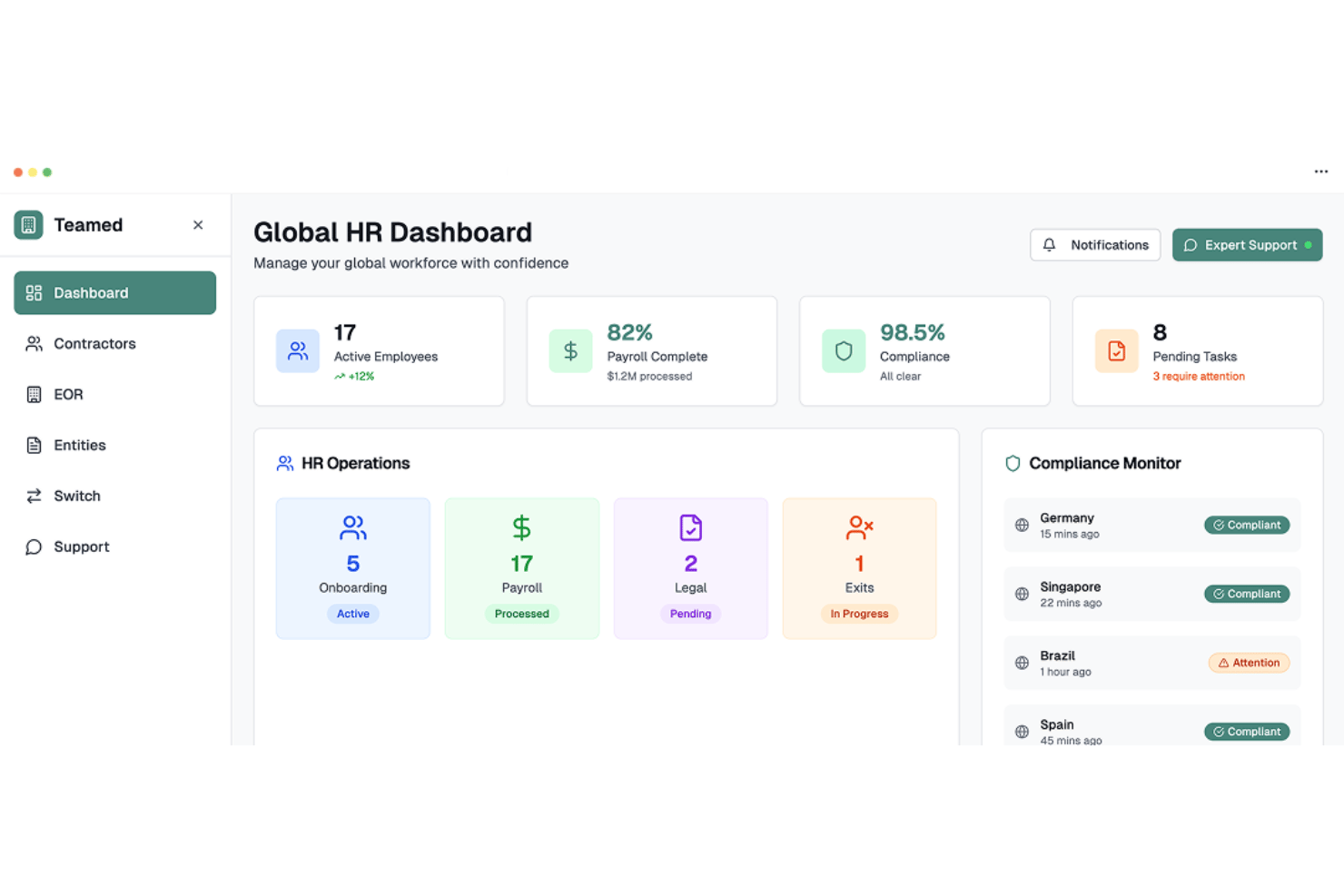
Teamed is an Employer of Record platform with a wholly-owned South Korean entity that handles local payroll, four mandatory insurance enrollments, severance accrual through a DB-IRP fund, bilingual contract generation, and tax filings with the National Tax Service.
Who Is Teamed Best For?
Teamed is a strong fit for finance and HR teams that need transparent, itemized cost management alongside full Korean statutory compliance.
Why I Picked Teamed
Teamed earns its spot on my shortlist because of how thoroughly it handles Korea's complex employment compliance requirements, particularly statutory severance and mandatory social insurance. Its local HR and legal experts help manage severance obligations and disputes while supporting compliance with the country's four major insurance programs: national pension, health, employment, and industrial accident insurance. Teamed also provides itemized invoices showing statutory benefits and employer social contributions, with government-mandated charges passed through at cost.
Teamed Key Features
- Bilingual contract generation: Teamed drafts Korean/English employment contracts on the same day, with statutory clauses written by local lawyers rather than generic templates.
- Entity graduation support: A crossover calculator and a 4–6 week graduation process let you move from EOR to your own Korean entity without re-onboarding employees or breaking severance accrual.
- Named country specialist: Every account gets a dedicated Korea people ops specialist with 24/5 support and a stated 15-minute first response time.
- Multi-model payroll: Teamed supports payroll on its own EOR, on your existing Korean entity, or as a standalone payroll-only service.
Teamed Integrations
Teamed has one fully documented native integration, Personio. It also lists BambooHR, HiBob, Workday, Xero, QuickBooks, and Zapier as integrations confirmed during setup; no public self-serve API is available.
Pros and Cons
Pros:
- Dedicated HR and legal specialists for employment compliance
- All four Korean insurances are administered
- Zero FX markup on the fee.
Cons:
- Visa sponsorship is decided case by case
- $599 monthly EOR fee excludes salaries and statutory contributions

Rippling
Best for unified HR and IT hiring in Korea
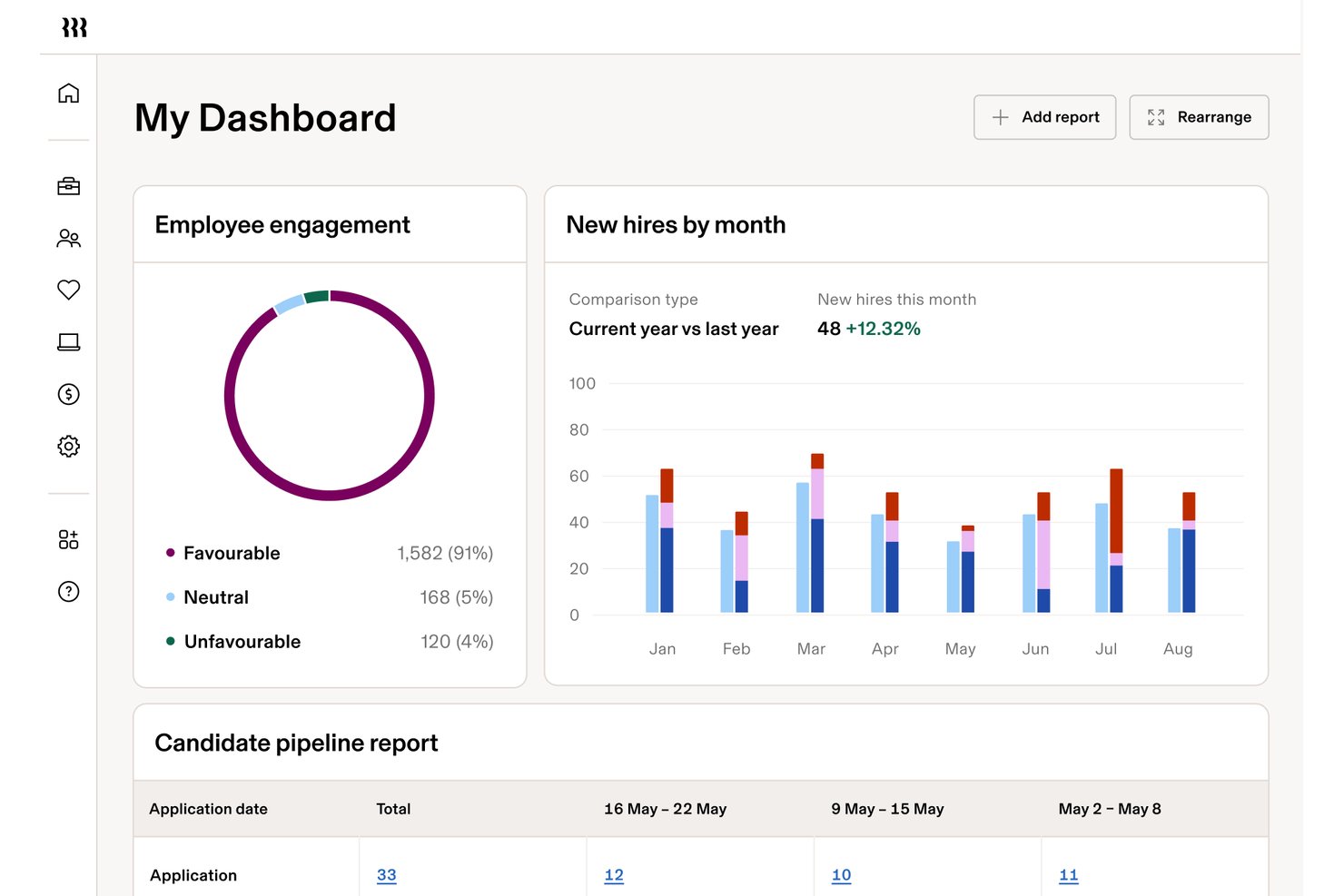
Rippling is a global EOR platform that lets you hire employees in South Korea without a local entity, handling employment contracts, payroll, statutory benefits, tax withholding, and HR and IT management from a single system.
Who Is Rippling Best For?
Rippling is a strong fit for global HR teams that already manage employees across multiple countries and want to add South Korea to an existing unified platform rather than bolt on a separate tool.
Why I Picked Rippling
Rippling earns its spot on my shortlist because it's the only Korea EOR option I've found that manages employment contracts, payroll, and IT provisioning from a single employee record. When you're hiring across multiple countries and adding South Korea to the mix, that matters: one platform handles mandatory insurance deductions (National Pension, Health, Employment, and Industrial Accident Compensation) and syncs them directly with payroll, so nothing falls through the cracks between systems.
Rippling Key Features
- Contract localization: Rippling auto-generates employment agreements that include the statutory elements required under Korean labor law, such as contract type, working hours, salary, and termination terms.
- Contractor-to-EOR conversion: Workers can move from contractor status to EOR employment and then to your own local entity without going through a full re-onboarding process.
- 600+ app integrations: Rippling connects with over 600 third-party tools, with options to automate user provisioning, SSO, and profile syncing across your tech stack.
- Entity-vs-EOR cost calculator: Rippling includes a built-in calculator that estimates the cost of setting up a local entity in South Korea versus hiring through EOR.
Rippling Integrations
Rippling offers 600+ ready-made integrations, including NetSuite, HubSpot, Ashby, Greenhouse, Notion, and Quickbooks Online. It also supports custom integrations through APIs and connectors.
Pros and Cons
Pros:
- Automated payroll and statutory tax calculations
- Detailed Korean contract and termination guidance
- Unified HR, payroll, and IT records
Cons:
- EOR services may use local employment partners
- Core Rippling platform required for additional modules
New Product Updates from Rippling

Rippling Expands Automated Compliance With AI Workflows
Rippling expands Automated Compliance with multi-framework support, AI workflows, an audit portal, and trust centers. These updates help GRC teams manage compliance work and audits. For more information, visit Rippling’s official site.

Best for Korea-compliant global workforce consolidation
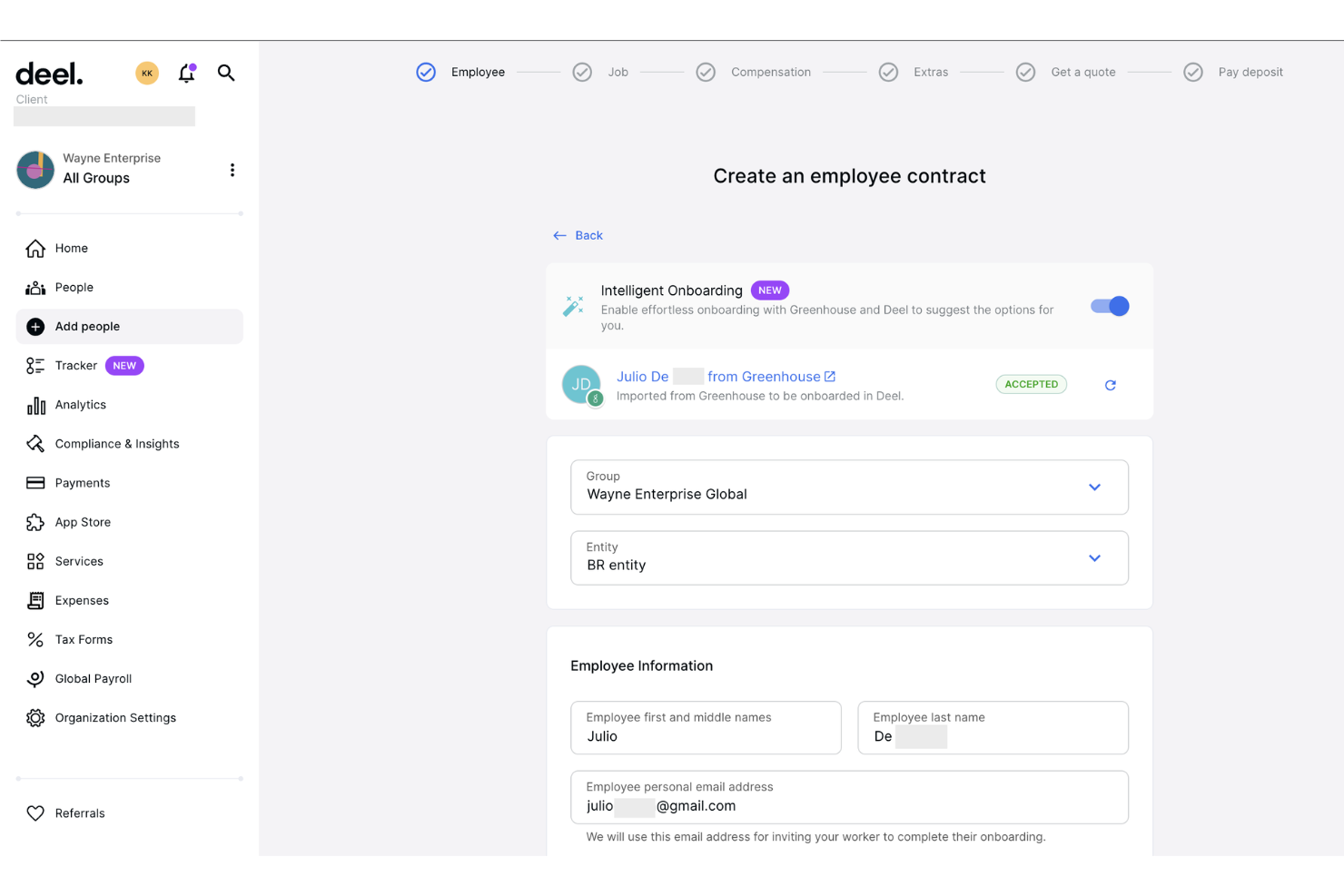
Deel is a global Employer of Record platform that lets you hire employees in South Korea—and 130+ other countries—without a local entity, covering KRW payroll, the four statutory insurances, severance accrual, and labor law compliance from a single dashboard.
Who Is Deel Hire Best For?
Deel Hire is a strong fit for companies already hiring across multiple countries that need to add South Korea to an existing global workforce without juggling separate vendors.
Why I Picked Deel Hire
I've included Deel Hire in my top picks because it's one of the few tools here that lets you fold South Korea into an existing multi-country workforce without switching platforms or vendors. I particularly like how Deel tracks Korean-specific regulatory shifts, like the Yellow Envelope Act (the Trade Union and Labor Relations Adjustment Act amendment), and flags how client involvement in daily work could affect employer status. Its monthly severance accrual spreads Korea's statutory lump-sum obligation across invoices, which removes the cash-flow shock most teams don't anticipate until their first offboarding.
Deel Hire Key Features
- Statutory insurance administration: Deel registers and manages contributions for all four mandatory Korean insurances—National Pension, National Health Insurance, Employment Insurance, and Industrial Accident Insurance.
- Multi-country unified dashboard: Manage EOR, contractors, global payroll, HR, and immigration for 130+ countries from a single platform.
- Native time tracking: Employees can clock in and out via web or mobile, with integrations for Hubstaff and Time Doctor to log hours against Korea's working-time rules.
- HRIS and accounting integrations: Deel connects with Workday, BambooHR, NetSuite, QuickBooks, and Xero to sync employee, payroll, and compensation data.
Deel Hire Integrations
Deel Hire integrates with Workday, BambooHR, NetSuite, QuickBooks, Xero, Hubstaff, and Time Doctor. It also supports custom connections through its API and is available on Zapier.
Pros and Cons
Pros:
- Monthly severance accrual spreads final liability
- Administers all four statutory Korean insurances
- Own Korean entity signs employment contracts
Cons:
- Korean contract language remains unconfirmed
- Employer contributions add approximately 12% to salary costs

Multiplier
Best for HRIS-connected Korean hiring at scale
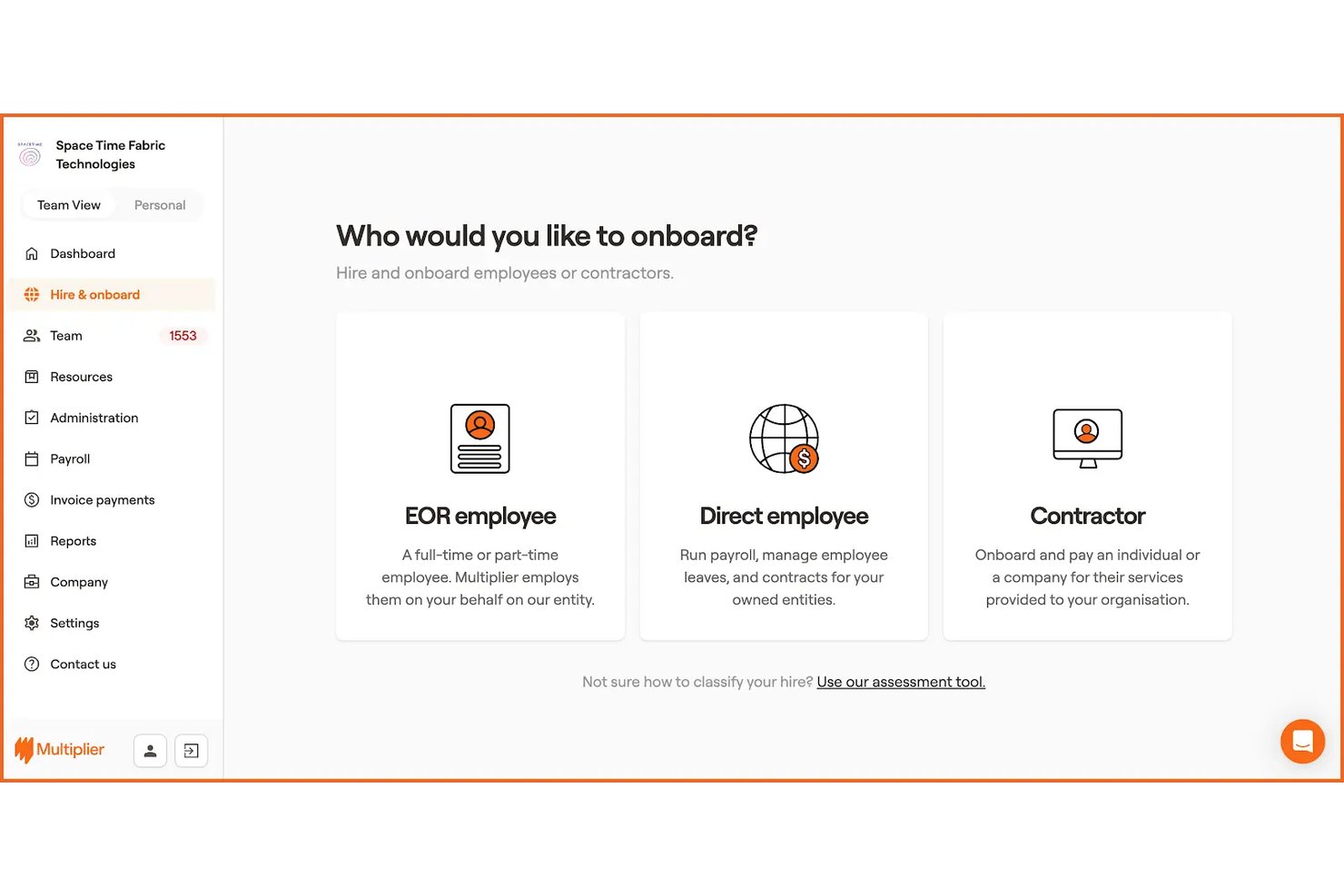
Multiplier is a global Employer of Record platform that handles Korean payroll in KRW, statutory benefits across all four social insurance schemes, tax withholding and filing, contract generation, and multi-country workforce consolidation from a single dashboard.
Who Is Multiplier Best For?
Multiplier is a strong fit for HR and global expansion teams managing headcount across multiple countries who need South Korea included in a consolidated platform without standing up a local entity.
Why I Picked Multiplier
I picked Multiplier as one of the best because it's built to plug directly into the HRIS your team already runs—Workday, BambooHR, HiBob—and sync Korean employee records, payslips, and onboarding updates without manual exports. That two-way integration matters when you're managing headcount across multiple countries and South Korea is just one node in a larger workforce. I also like that Multiplier automates contributions to all four of Korea's mandatory social insurance schemes (National Pension, National Health Insurance, Employment Insurance, and Workers' Compensation) alongside monthly KRW payroll, so your Korean hires are handled within the same dashboard as the rest of your global team.
Multiplier Key Features
- Visa sponsorship support: Multiplier, as the registered legal employer, sponsors E-7 and D-8 work visas and manages the associated paperwork on your behalf.
- Year-end tax settlement processing: Multiplier handles Korea's annual year-end tax settlement each February, including monthly withholding and filing with the tax office by the 10th of the following month.
- Contractor and EOR consolidation: You can manage Korean EOR employees alongside contractors and global payroll workers from a single dashboard, with bundle pricing available.
- Configurable HRIS sync: Employee records, payslips, time off, and onboarding updates sync bidirectionally between Multiplier and connected HRIS tools, with configurable sync frequency and custom fields.
Multiplier Integrations
Multiplier lists 20+ integrations, including Workday, BambooHR, HiBob, and Personio. BambooHR supports two-way employee, payroll, time-off, payslip, and onboarding sync, while API access supports custom connections.
Pros and Cons
Pros:
- Handles Korean year-end tax settlement
- Automates all four Korean social insurances
- Quick employee setup
Cons:
- No documented DB/DC pension administration
- Custom reporting unavailable on the Core plan
Other Employers of Record in South Korea
Here are a few additional options that didn’t make my shortlist but are still worth checking out:
- G-P
For AI-guided Korean hiring compliance
- Payoneer Workforce Management
For multi-country payroll including Korea
- Remote
For hiring in Korea via an owned local entity
- Mercans
For flat-fee global payroll across many markets
- Safeguard Global
For quick Korean market entry via owned entities
- Asanify
For visa-backed Korean workforce hiring
- GoGlobal
For APAC-led Korean market entry
- Playroll
For Korea compliance with multi-country oversight
- Pearson & Partners Korea
For Korea entry via bundled EOR and recruitment
- WTS Energy
For energy-sector Korean workforce hiring


How I Evaluate Employer of Record in South Korea
I split my evaluation into three parts. First, core functionality—specifically, whether a provider can legally employ workers through its own Korean entity and maintain labor law compliance for contracts, terminations, and statutory obligations; this carries the most weight. Second, I look for standout features like severance and retirement pension management. Third, I consider pricing transparency and speed to hire.
Core Functionality (Table Stakes For This List)
When I'm selecting tools for my list, I score each one on a scale from 0 (does not offer the functionality) to 5 (excels in this area) for each core functionality listed below. I then convert the total into a percentage to help assess each tool's overall fit, with extra weight on any functionalities I've deemed essential.
- Local Entity Employment (Essential): I check whether a provider employs workers through its own registered entity in South Korea or relies on a third-party partner with limited oversight.
- Korean Labor Law Compliance (Essential): I evaluate how each provider handles contracts, terminations, notice periods, and working-hour rules under Korean labor regulations.
- Local Payroll Processing: Accurate, on-time salary disbursement in Korean won matters, so I look for automated payroll with clear payslips and reporting.
- Statutory Benefits Administration: South Korea requires national pension, health insurance, employment insurance, and workers' compensation—I confirm each provider covers all four.
- Tax Withholding and Filing: I look for automated calculation and remittance of income tax and social insurance contributions to Korean authorities on the correct schedule.
- Contract Localization: Compliant bilingual contracts are standard in South Korea, so I check whether templates meet statutory clauses and can be customized by role.
Once I have a list of tools that meet the criteria, I consider what sets each platform apart.
Differentiating Factors (What Sets Vendors Apart)
Here's how I compare and contrast different vendors:
Standout Features
Korea's 52-hour workweek cap carries real penalties, so I look for real-time hour tracking that flags overtime before a breach occurs. Severance and retirement pension management matters just as much—providers like Deel and Teamed handle the calculation differently, and I evaluate whether each platform keeps pace as Korea shifts from lump-sum severance to mandatory pension contributions. I also check for visa sponsorship coordination, since hiring foreign talent on E-7 or D-8 visas requires tight handoffs between immigration and employment onboarding.
Beyond Features
I check whether a provider owns its Korean entity or subcontracts to a local partner, since partner-dependent models can create gaps in compliance accountability. Speed to hire matters too—some providers onboard in days while others take weeks, which makes a real difference when you're testing the Korean market with a small initial team. I also evaluate how each platform connects to existing HRIS tools like Workday or BambooHR, because managing Korea payroll data in a separate silo adds unnecessary reconciliation work for your finance and HR teams.
How to Choose an Employer of Record in South Korea
Choose an EOR by verifying who legally employs your worker, how Korean statutory obligations are assigned, and what written evidence supports those commitments.
| If your priority is… | Look for… |
|---|---|
| Clear employment accountability | The Korean entity named as employer in the contract |
| Correct statutory deductions | A breakdown of all four required social insurance programs and remittance responsibilities |
| Managing working hours | Written procedures for recording hours and addressing applicable legal limits |
| Predictable exit obligations | A documented process for severance, retirement pension, and termination payments |
How to Vet Your Shortlist
- Verify the employing entity: Request the Korean business registration document and compare its entity name with the employer listed in a draft contract.
- Trace statutory contributions: Ask for a sample payroll breakdown covering national pension, health insurance, employment insurance, and workers’ compensation, plus the agreement clause assigning remittance responsibility.
- Test working-hour guidance: Send a written scenario for a role approaching applicable working-hour limits and request the response as a support ticket or policy document.
- Review exit calculations: Request a sample severance and retirement pension calculation, along with the written process for termination payments and required notices.
- Choose the accountability tradeoff: Favor a provider’s own Korean entity when direct responsibility is your priority; consider a partner-based model when regional coverage matters more, but require the responsible party to be named in the contract.
What Are Employers of Record in South Korea?
An employer of record in South Korea is a local legal employer that hires workers on behalf of another company. It typically manages employment contracts, payroll, and statutory obligations, while your company directs the employee’s day-to-day work.
Features
Here are the main features I look for in an Employer of Record in South Korea:
- Local employment entity: The provider’s Korean entity is named as the legal employer in the employment contract. This clarifies who is responsible for employment administration and local obligations.
- Korean labor law compliance: The provider supports compliant contracts, working-hour rules, required notices, and termination procedures. Ask how it handles changes in law and documents its guidance.
- Localized employment contracts: Contracts reflect Korean employment requirements and the worker’s role, pay, and terms. Bilingual versions can help both your team and the employee review the agreement.
- Local payroll processing: The provider calculates salary in Korean won, produces payslips, and schedules payments. Payroll records should show how gross pay becomes net pay.
- Statutory benefits administration: The provider manages enrollment and contributions for national pension, health insurance, employment insurance, and workers’ compensation. Confirm which party files and remits each contribution.
- Tax withholding and filings: The provider calculates applicable income tax and social insurance deductions, then handles required remittances and reporting. Clear payroll records help your team reconcile costs.
- Working-hour tracking: Time records help monitor schedules and identify potential issues with applicable working-hour limits. Ask whether the provider supplies tracking tools or relies on your existing process.
- Severance and retirement pension administration: The provider explains how exit payments and retirement pension obligations are calculated and administered. Request written procedures for both ongoing funding and employee termination.
Benefits
Here are several benefits an Employer of Record in South Korea can offer:
- Local employment access: A provider’s Korean entity or disclosed local partner can employ your team without requiring your company to establish its own entity.
- Korean labor compliance support: Guidance on contracts, working hours, required notices, and termination procedures helps you address local employment requirements.
- Payroll and statutory administration: Local payroll, tax withholding, and administration of required social insurance contributions bring recurring employment obligations into one service.
- Localized employment contracts: Contracts tailored to Korean requirements and the employee’s role make employment terms clearer for your team and your new hire.
- Exit planning: Providers that document severance, retirement pension, and termination payment processes help you anticipate obligations when employment ends.
- Faster market entry: Hiring through an existing Korean employment arrangement can avoid the delay of establishing your own local entity, though onboarding times vary.
- Working-hour visibility: When a provider offers time tracking, it can help your team spot schedules approaching applicable limits and respond sooner.
Costs and Pricing
South Korea EOR fees commonly range from $300 to $700 per employee each month. Providers usually charge per employee rather than offering fixed personal, business, or enterprise plans, and larger teams may receive custom quotes. Employee salary, statutory contributions, and optional services can add to the total.
Plan Comparison Table for Employer of Record in South Korea
These labels are budgeting categories, not standard EOR plan names. The ranges below are indicative service-fee estimates, not guaranteed quotes.
| Plan Type | Average Price | Common Features |
|---|---|---|
| Free Plan | $0 for EOR service; generally not offered | No employee employment, no local payroll, and no statutory benefits administration. |
| Personal Plan | $300–$600 per employee/month | Local employment, payroll processing, and statutory contribution administration. |
| Business Plan | $400–$700 per employee/month | Local employment, payroll processing, statutory contribution administration, and localized contracts. |
| Enterprise Plan | $600–$1,000+ per employee/month; custom quotes are common | Local employment, payroll processing, statutory contribution administration, localized contracts, and dedicated support. |
FAQs
Here are answers to common questions about Employer of Record services in South Korea:
Can an EOR in South Korea support work visas?
Sometimes, but an EOR arrangement doesn’t automatically provide work authorization. The provider must confirm it can support the worker’s visa category and meet applicable sponsor requirements. Ask who prepares supporting documents, which entity appears in the application, and whether the provider handles renewals. Confirm the worker’s eligibility before setting a start date; immigration approval and processing times sit outside ordinary payroll onboarding. Visa coordination is a service, not a guarantee of approval. Request a written outline of responsibilities and expected steps for that specific hire.
Can I use a South Korean EOR to hire independent contractors?
An EOR is generally intended to employ workers as employees, not to make a contractor arrangement compliant by changing its label. Classification depends on the actual working relationship and applicable Korean rules, not simply the contract title. Before engaging someone as a contractor, assess who controls their hours and methods, whether they work independently, and how payment is structured. If the role resembles employment, get Korea-specific legal advice before onboarding. Review the arrangement again if the role or level of control changes.
Does hiring through a South Korean EOR remove my company’s legal risk?
No. An EOR can take on employment administration and obligations assigned to it, but the arrangement doesn’t erase every risk for your company. Your business still directs day-to-day work, and contract terms, worker classification, and actual practices all matter. Ask the provider to identify responsibilities for payroll filings, statutory contributions, workplace issues, and claims in writing. Have local counsel review the agreement and operating model, especially before making decisions about discipline or termination.