

10 Best iCIMS Talent Cloud Competitors In 2026

Best iCIMS Talent Cloud Competitors Shortlist


The best iCIMS Talent Cloud competitors give you advanced applicant tracking, strong integration options, and reporting built for high-volume hiring. If you’re looking for alternatives, you probably want a system that’s easier to use, offers more flexible workflows, or matches your company’s growth without the typical roadblocks.
In this list, you’ll find top-rated ATS solutions that offer unique strengths and features. I’ve broken them down so you can compare critical differences, spot the right fit for your hiring needs, and make a smart, confident choice.
What Is iCIMS Talent Cloud?
iCIMS Talent Cloud is an applicant tracking system (ATS) built to manage the full hiring process, from job posting to offer acceptance. It supports high-volume recruitment, integrates with HR and productivity tools, and offers automation for tasks like screening and scheduling. HR teams use iCIMS Talent Cloud to centralize candidate data, track applicants, and improve hiring workflows for businesses of all sizes.
iCIMS Talent Cloud Competitors Comparison Table
This comparison table highlights pricing details for my top iCIMS Talent Cloud competitors.
| Tool | Best For | Trial Info | Price | ||
|---|---|---|---|---|---|
| 1 | Best for global hiring and compliance management | Free demo available | From $599/user/month | Website | |
| 2 | Best for high-volume enterprise hiring | Free demo available | Pricing upon request | Website | |
| 3 | Best for HCM and payroll integration | Free demo available | Pricing upon request | Website | |
| 4 | Best for multi-brand recruiting workflows | Free demo available | Pricing upon request | Website | |
| 5 | Best for fast all-in-one hiring | 15-day free trial | From $299/month (billed annually) | Website | |
| 6 | Best for CRM and applicant tracking in one | Free demo available | Pricing upon request | Website | |
| 7 | Best for collaborative enterprise hiring | Free demo available | From $14,995/year (billed annually) | Website | |
| 8 | Best for AI-driven talent experience | Free demo available | Pricing upon request | Website | |
| 9 | Best for candidate nurturing | Free demo available | Pricing upon request | Website | |
| 10 | Best for extensive enterprise compliance | Free demo available | Pricing upon request | Website |


Why Trust Our Software Recommendations
Our team has been testing and reviewing software since 2012. As HR experts ourselves, we know how difficult—and important—it is to choose the right software.
For this guide, we evaluated tools using hands-on testing and independent research, scoring tools using our selection criteria. We also draw on insights from industry thought leaders and practicing HR experts.
Our reviews reflect our human editorial judgment, not a sales pitch.
Expert reviewers:
Best iCIMS Talent Cloud Competitors Reviews
Below are my detailed summaries of the best iCIMS Talent Cloud competitors that made it onto my shortlist. My reviews offer a detailed look at the features, integrations, and best use cases of each platform to help you find the best one for you.
Best for global hiring and compliance management
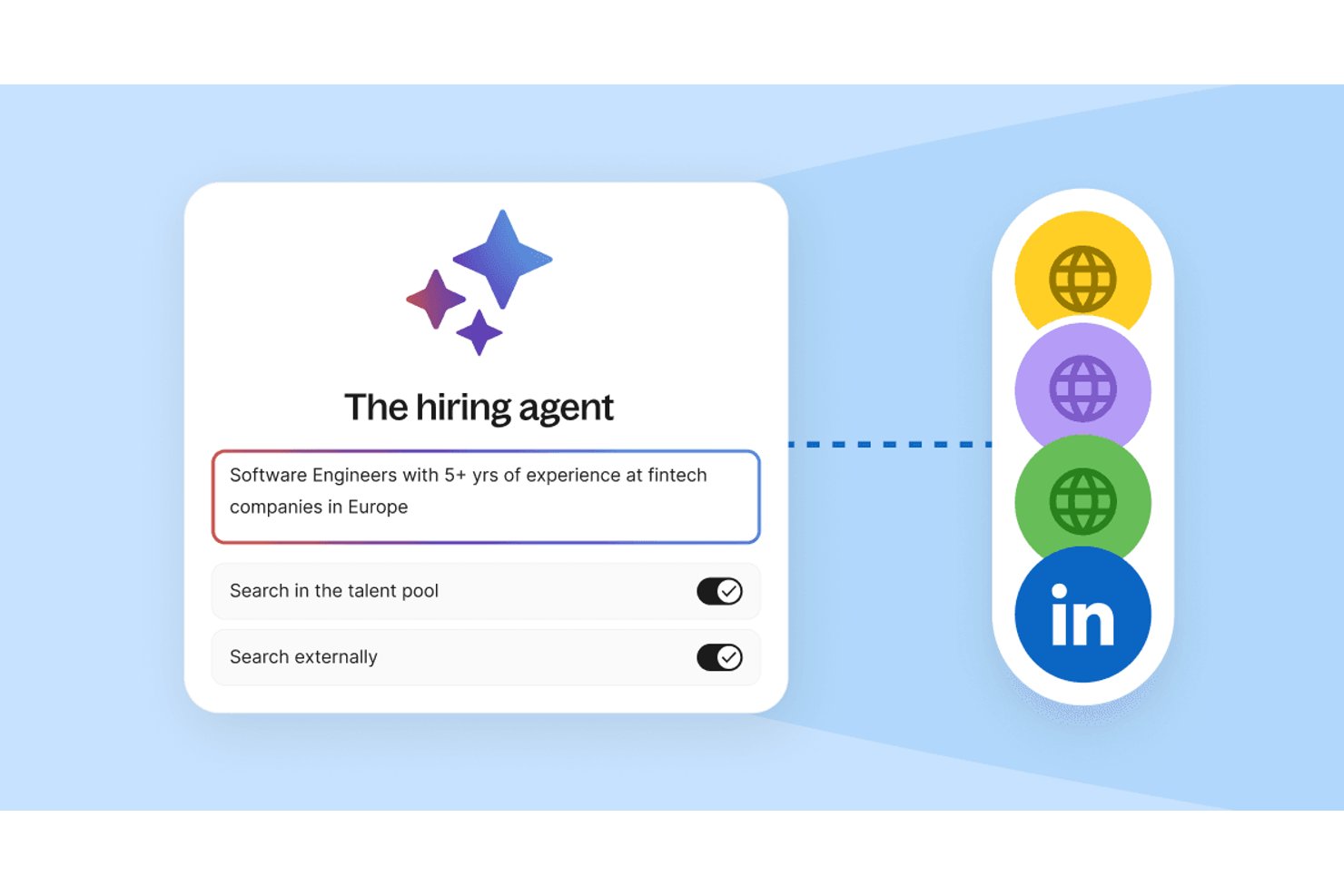
Deel Hire is a global hiring and compliance platform built for organizations that need to recruit, contract, and onboard talent across multiple countries without juggling separate legal, payroll, and HR tools.
Who Is Deel Hire Best For?
It's a strong fit for enterprise HR and people ops teams hiring across multiple countries who need compliance, contracts, and onboarding handled in one place.
Why Deel Hire Is a Good Best Icims Talent Cloud Competitors
I picked Deel Hire as one of the best because its global compliance layer handles the legal complexity that iCIMS leaves to your team. When hiring in a new country, Deel auto-generates locally compliant contracts and manages statutory tax filings automatically. The EOR coverage across 130+ countries means converting a candidate into a fully employed worker without setting up a local entity first.
Deel Hire Key Features
- AI-powered interview summaries: Automatically generates post-interview notes and feedback to speed up candidate review.
- End-to-end candidate pipeline management: Lets you track applicants by stage and move talent through every part of the hiring process.
- Global background check integration: Partners with Certn for international background screening during onboarding workflows.
- HRIS and payroll system integrations: Connects out of the box with platforms like Workday, BambooHR, SAP SuccessFactors, and QuickBooks.
Deel Hire Integrations
Deel Hire offers native integrations with Workday, BambooHR, SAP SuccessFactors, Personio, Greenhouse, Lever, Ashby, Workable, JazzHR, Teamtailor, Okta, and QuickBooks. An API is available for custom integrations.
Pros and Cons
Pros:
- Auto-generates locally compliant employment contracts
- Combines hiring and EOR in one platform
- Handles compliance across 130+ countries natively
Cons:
- Reporting lacks depth for enterprise TA teams
- ATS depth lags behind dedicated recruiting platforms
Dayforce
Best for high-volume enterprise hiring
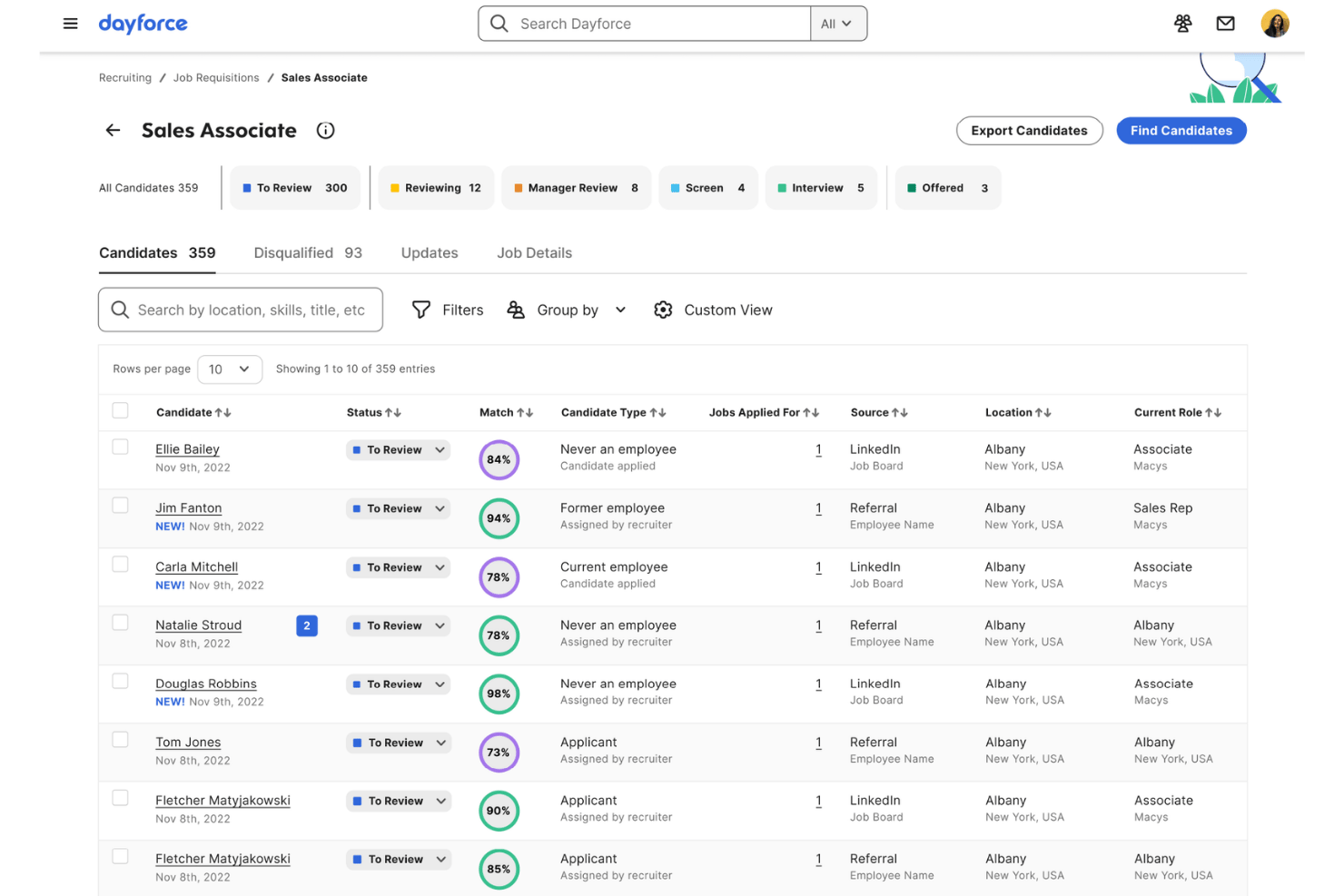
Dayforce is an enterprise HCM platform that gives large organizations a unified system for recruiting, onboarding, payroll, and workforce management—removing the data silos that slow down high-volume hiring teams.
Who Is Dayforce Best For?
Dayforce is a strong fit for enterprise organizations in shift-heavy industries—manufacturing, healthcare, retail, and hospitality—with 1,000 to 10,000 employees.
Why Dayforce Is a Good iCIMS Talent Cloud Competitor
I've included Dayforce in my top picks because its AI-assisted candidate screening and mass action tools are built for the volume and velocity that enterprise recruiting teams deal with daily. When you're managing hundreds of open requisitions, auto-triggered candidate actions and chatbot screening cut manual work significantly. I also like that onboarding lives in the same platform, so candidate data transfers automatically from recruiting without any re-entry.
Dayforce Key Features
- Integrated onboarding workflows: Gather new hire information and automate onboarding tasks from the same platform used for recruiting.
- Mobile-optimized employee self-service: Let candidates and employees update personal data, view pay details, and access onboarding documents from any device.
- Dynamic job requisition management: Create, edit, and approve job reqs with built-in routing and real-time status tracking.
- Configurable analytics dashboards: Build custom reports to monitor hiring funnel metrics, source effectiveness, and compliance data.
Dayforce Integrations
Integrations are not publicly listed.
Pros and Cons
Pros:
- Built-in internal mobility marketplace for retention
- AI screening built for high-volume pipelines
- Unified recruiting and HCM in one system
Cons:
- Reporting setup demands heavy admin involvement
- Lengthy enterprise implementation timelines
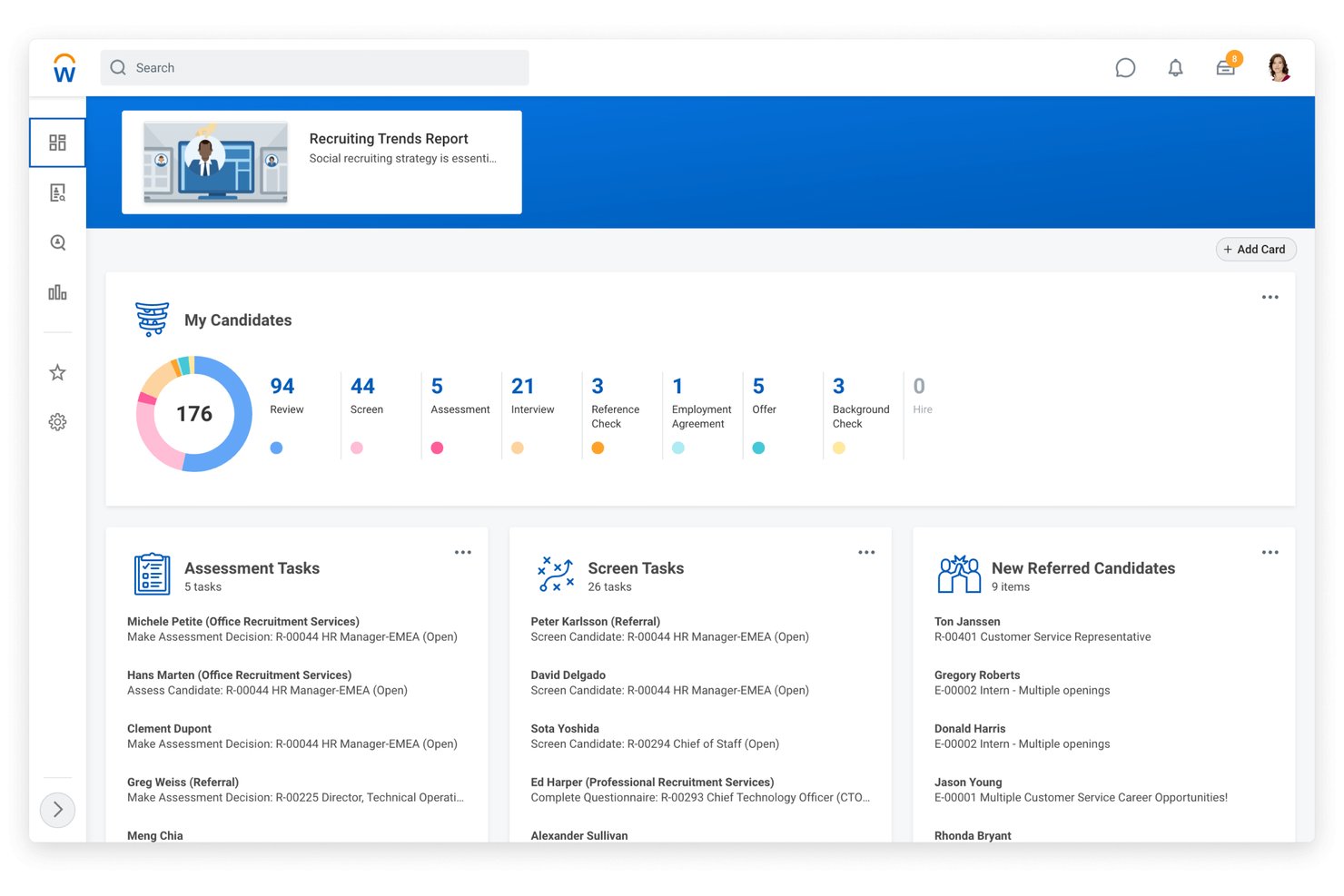
Workday HCM is an enterprise HR suite that connects recruiting, payroll, and workforce management in a single platform, making it a natural fit for large organizations that want talent acquisition to live inside the same system as their core HR data.
Who Is Workday HCM Best For?
Enterprise organizations with complex, multi-country workforces that need payroll, compliance, and recruiting managed within a unified HR system.
Why Workday HCM Is a Good iCIMS Talent Cloud Competitor
I've included Workday Human Capital Management (HCM) in my top picks because of how tightly recruiting connects to payroll and core HR within a single data model. When a candidate accepts an offer, their profile carries directly into the employee record, with no manual data migration or integration mapping required. I also appreciate Workday Skills Cloud, which ties hiring decisions to internal mobility and succession planning in real time.
Workday HCM Key Features
- Configurable approval workflows: Build complex approval routing for requisitions, offers, and job changes within HR teams.
- Peakon employee engagement surveys: Collect real-time employee feedback to inform recruiting and retention strategies.
- Global payroll connectors: Integrate payroll data across multiple countries and vendors from one central platform.
- Workday Extend for HR apps: Create and deploy custom HR and recruiting applications with low-code development tools.
Workday HCM Integrations
Integrations are not publicly listed.
Pros and Cons
Pros:
- Internal mobility marketplace reduces external hiring spend
- Skills Cloud powers skills-based candidate matching
- Single system spans recruiting through payroll
Cons:
- Recruiting access requires full HCM subscription
- Full implementation commonly takes 6-plus months
Pinpoint
Best for multi-brand recruiting workflows
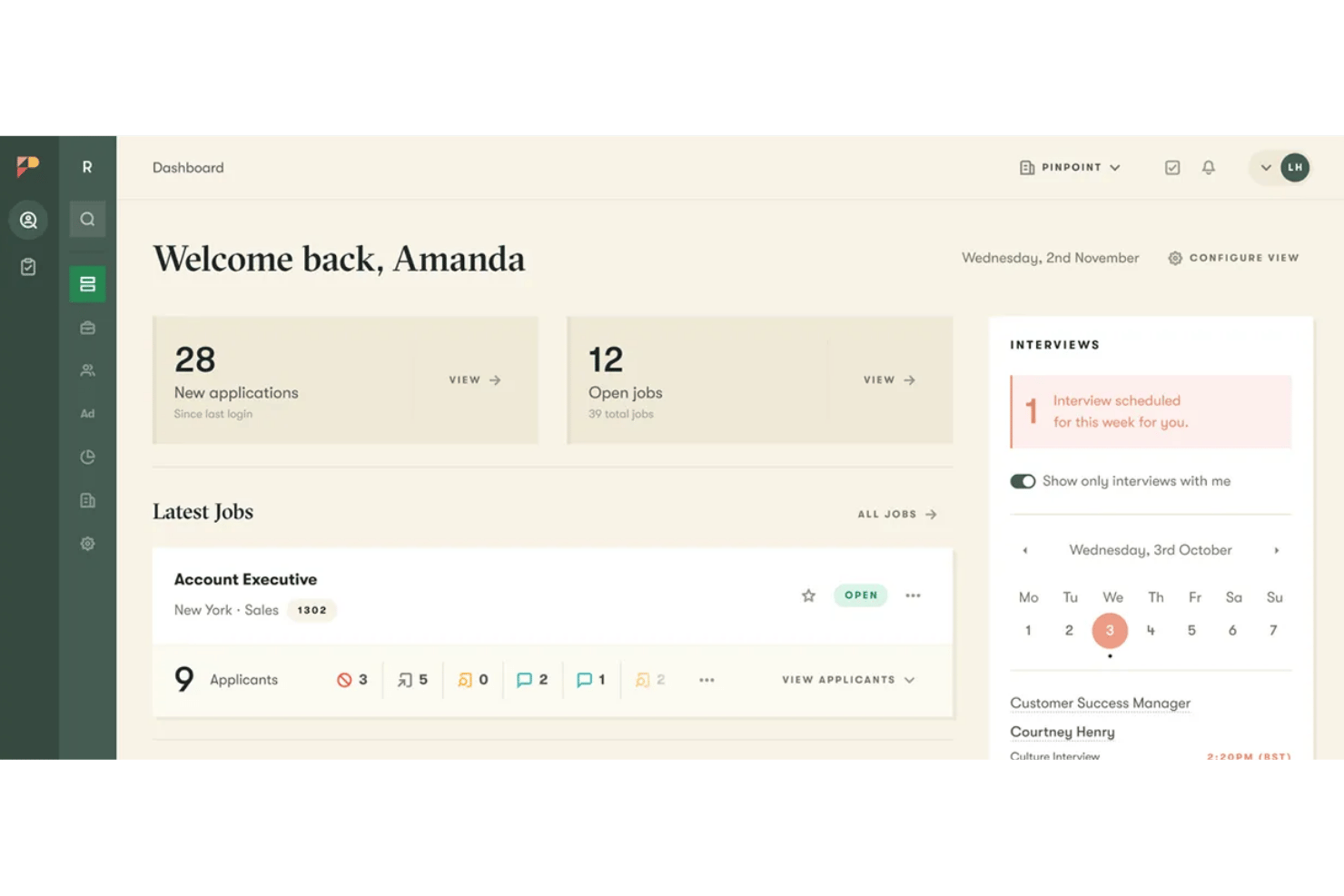
Pinpoint is a mid-market ATS built for in-house recruiting teams that hire across multiple brands, locations, and worker types—combining AI-assisted candidate selection, a built-in CRM, and configurable branded career sites in one platform.
Who Is Pinpoint Best For?
Pinpoint suits growing companies with 100–1,000 employees that have dedicated in-house recruiting teams managing complex, multi-stream hiring without enterprise-level budgets.
Why Pinpoint Is a Good iCIMS Talent Cloud Competitor
I picked Pinpoint as one of the best because its multi-brand architecture is genuinely built in, not bolted on. Each brand gets its own careers site, hiring workflow, candidate communications, and scoped team permissions. I particularly like the AI Match Score and AI Hiring Copilot, which operate within each brand's pipeline independently, so a company running several brands never risks candidate data bleeding across hiring streams.
Pinpoint Key Features
- Talent Pipeline CRM: Lets you build and organize passive candidate pools with bulk outreach and talent nurture workflows.
- Self-service interview scheduling: Candidates pick interview times using real-time availability synced with your team’s calendar.
- One-way video interviews: Collects pre-recorded candidate responses for faster screening and review at scale.
- Anonymized screening: Removes personal details from applications to reduce bias and support fairer hiring.
Pinpoint Integrations
Pinpoint offers native integrations with BambooHR, HiBob, ADP, Gusto, and Rippling for HRIS connectivity, as well as Slack, Microsoft Teams, Google Calendar, Outlook, and Zapier. An API is available for custom integrations.
Pros and Cons
Pros:
- Highly responsive onboarding and support team
- Fast implementation relative to enterprise ATS
- Multi-brand career sites built natively
Cons:
- No internal mobility or talent marketplace
- Reporting lacks depth for enterprise-scale needs
New Product Updates from Pinpoint

Pinpoint Adds Copilot, Hire Surveys, and LinkedIn Apply Connect
Pinpoint adds Copilot in Teams, Quality of hire surveys, LinkedIn Apply Connect integration, and onboarding updates. These releases expand AI, hiring insights, integrations, and onboarding capabilities. For more information, visit Pinpoint’s official site.

Workable
Best for fast all-in-one hiring
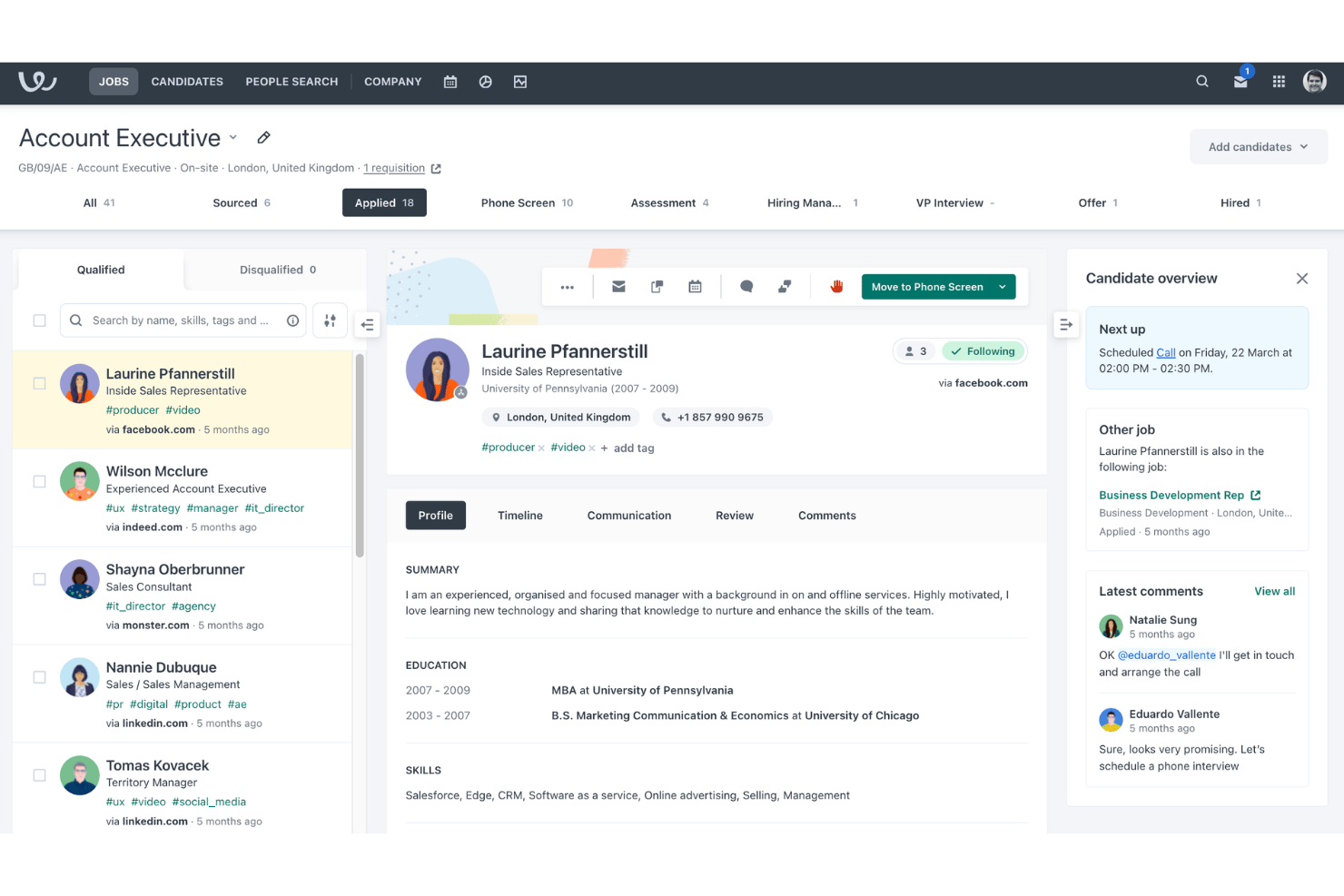
Workable is an all-in-one recruiting and HR platform built for SMB and mid-market teams that need a faster, more affordable alternative to enterprise ATS tools like iCIMS—combining candidate sourcing, pipeline management, and core HR solutions in a single system.
Who Is Workable Best For?
Workable fits growing companies in the 10–500 employee range that want a single platform to handle both recruiting and people management without a lengthy enterprise implementation.
Why Workable Is a Good iCIMS Talent Cloud Competitor
I've included Workable in my top picks because it genuinely delivers on "all-in-one" in a way that most ATS tools don't. I particularly like the Workable AI Agent, which actively sources passive candidates from a 400M+ profile database and screens them against your ideal candidate profile without waiting for inbound applications. I also appreciate that the onboarding portal, time-off management, and HRIS live inside the same system, so my team isn't stitching together a separate HR platform post-hire.
Workable Key Features
- Branded careers page builder: Create mobile-optimized, customizable career sites with your company branding and job search functionality.
- Multi-stage interview pipelines: Design custom interview workflows with automated stage movement, scorecards, and role-based permissions.
- Native HRIS integration: Sync candidate and employee data easily with connected HR systems for onboarding and record-keeping.
- Custom report builder: Generate dashboards and export data by requisition, source, time-to-fill, and DEI metrics for better talent insights.
Workable Integrations
Workable offers native integrations with Slack, Zoom, Microsoft 365, Google Workspace, LinkedIn, Indeed, Docusign, BambooHR, Checkr, and more. An API is available for custom integrations.
Pros and Cons
Pros:
- Career page builder requires no separate module
- Job posting reaches 200+ boards simultaneously
- AI sourcing finds passive candidates automatically
Cons:
- Limited configurability for complex approval workflows
- Reporting depth lags behind enterprise-grade platforms
New Product Updates from Workable
Workable Recruiting Enables Direct LinkedIn Job Promotion
Workable Recruiting lets teams purchase and manage paid LinkedIn job promotion directly in Workable. This gives recruiters more control over campaign spend and performance. For more information, visit Workable’s official site.

Lever
Best for CRM and applicant tracking in one
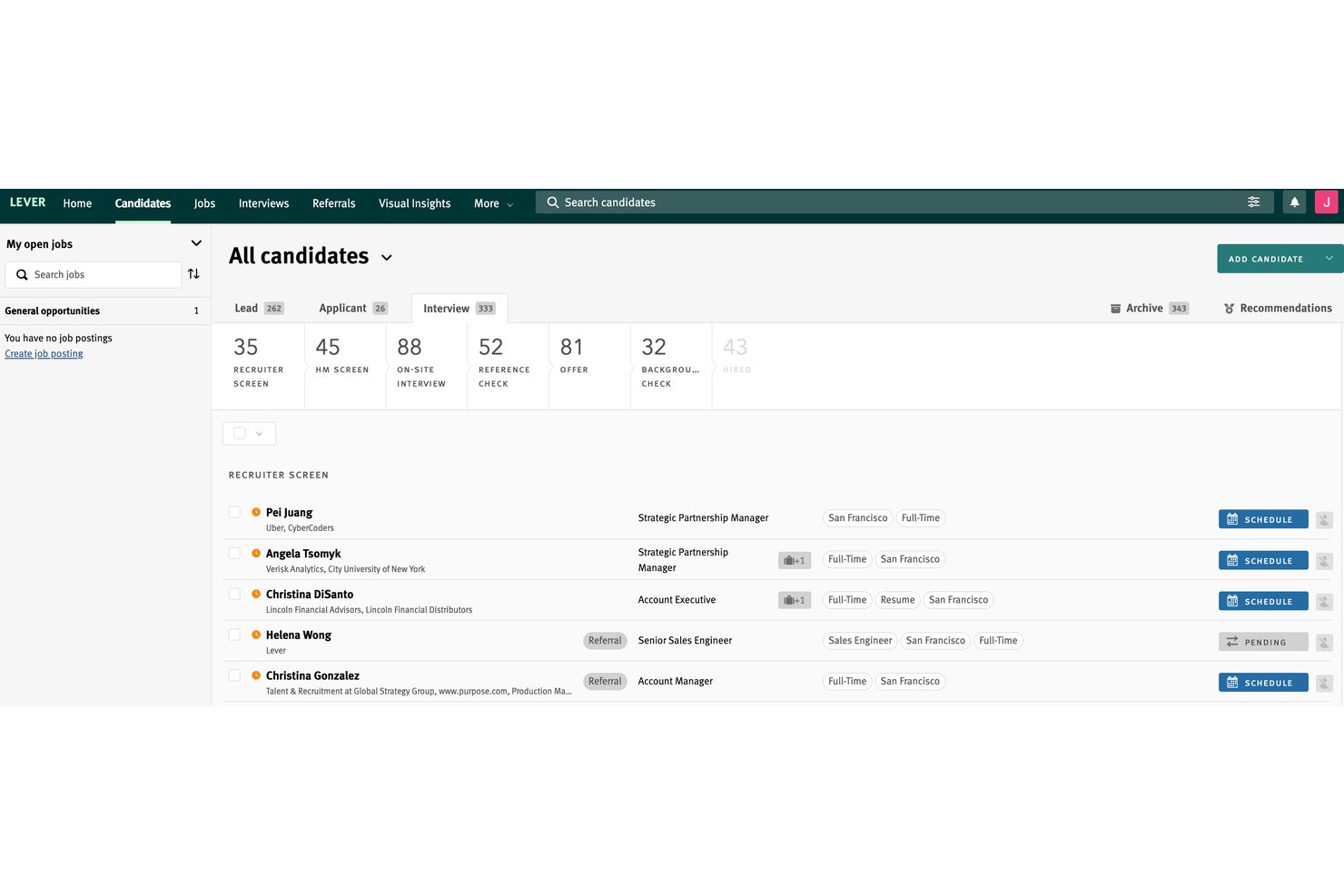
Lever is an AI-powered recruiting platform that unifies candidate tracking and candidate relationship management in one system, giving mid-market TA teams a single place to manage active pipelines and nurture passive talent.
Who Is Lever Best For?
Lever is a strong fit for growing companies hiring between 20 and 100 people per year that need structured recruiting workflows without the complexity of a full enterprise suite.
Why Lever Is a Good iCIMS Talent Cloud Competitor
I've included Lever in my top picks because it's one of the few platforms where the CRM isn't a bolt-on module. Talent pools, nurture campaigns, and silver medalist tracking are built into every plan, so my team manages sourcing and pipeline from a single candidate profile. The Talent Fit engine then ranks candidates by skills and experience before they reach a recruiter's queue, which cuts a lot of the manual triage work out of high-volume requisitions.
Lever Key Features
- AI Interview Companion: Offers automated interview notes, sentiment tracking, and bias flagging during live interviews.
- Visual Insights analytics: Provides configurable dashboards with 20+ talent acquisition metrics and DEI-focused reporting tools.
- SOC 2 Type II certification: Ensures enterprise-grade security and compliance standards for sensitive candidate data.
- 400+ integrations marketplace: Connects with HRIS, background check, assessment, and productivity platforms through prebuilt connectors and open APIs.
Lever Integrations
Lever offers 300+ native integrations, including Justworks, BambooHR, HiBob, LinkedIn, Indeed, and more, and provides an API for custom integrations.
Pros and Cons
Pros:
- Visual Insights dashboards include DEI hiring metrics
- Talent Fit engine ranks applicants before review
- Built-in CRM nurtures passive talent automatically
Cons:
- Onboarding tools less developed than dedicated platforms
- Reporting depth lags behind enterprise-grade rivals
Best for collaborative enterprise hiring
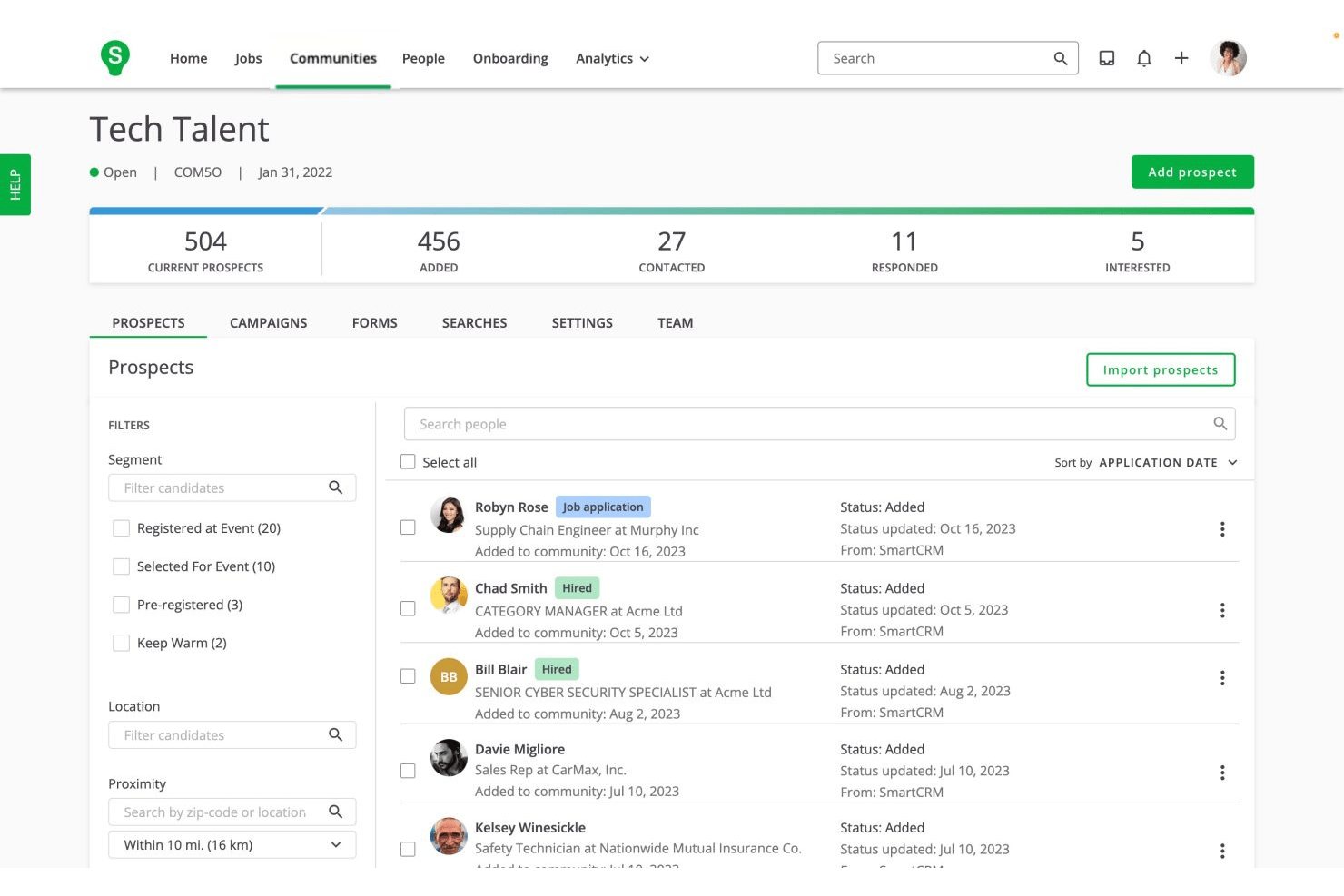
SmartRecruiters is an AI-powered talent acquisition suite built for enterprise hiring teams that need to manage high-volume requisitions, collaborative hiring workflows, and candidate pipelines across multiple brands or regions in one platform.
Who Is SmartRecruiters Best For?
SmartRecruiters is a strong fit for enterprise organizations in retail, healthcare, and hospitality that hire at scale across multiple locations or brands.
Why SmartRecruiters Is a Good iCIMS Talent Cloud Competitor
I've included SmartRecruiters in my top picks because of how well it handles hiring as a team sport. The platform's collaborative workflows let recruiters, hiring managers, and interviewers work from a shared pipeline, leaving structured feedback and moving candidates forward without relying on email threads. Winston AI, the platform's built-in matching engine, automatically ranks applicants against job criteria so my team isn't starting each review from scratch. I also appreciate the dynamic self-scheduling tool, which cuts the back-and-forth out of interview coordination entirely.
SmartRecruiters Key Features
- Programmatic job advertising: Automatically distributes job posts across job boards and reallocates spending based on real-time performance.
- Internal mobility marketplace: Matches current employees to relevant openings, gigs, and projects using skills data.
- Native CRM and nurture campaigns: Lets you create segmented talent pipelines, automate outreach, and run recruiting events.
- Skills-based talent intelligence: Surfaces skills gaps and enables skills-based hiring through a built-in skills ontology and analytics.
SmartRecruiters Integrations
SmartRecruiters offers native integrations with SAP SuccessFactors, Docusign, LinkedIn, ADP Workforce Now, and Oracle, and provides an API for custom integrations. It also supports marketplace integrations for background checks, assessments, and onboarding tools.
Pros and Cons
Pros:
- Native internal mobility marketplace for existing employees
- Collaborative hiring workflows across the full team
- Built-in programmatic job ad distribution
Cons:
- Onboarding module less mature than standalone tools
- Reporting customization requires significant admin configuration

Phenom
Best for AI-driven talent experience
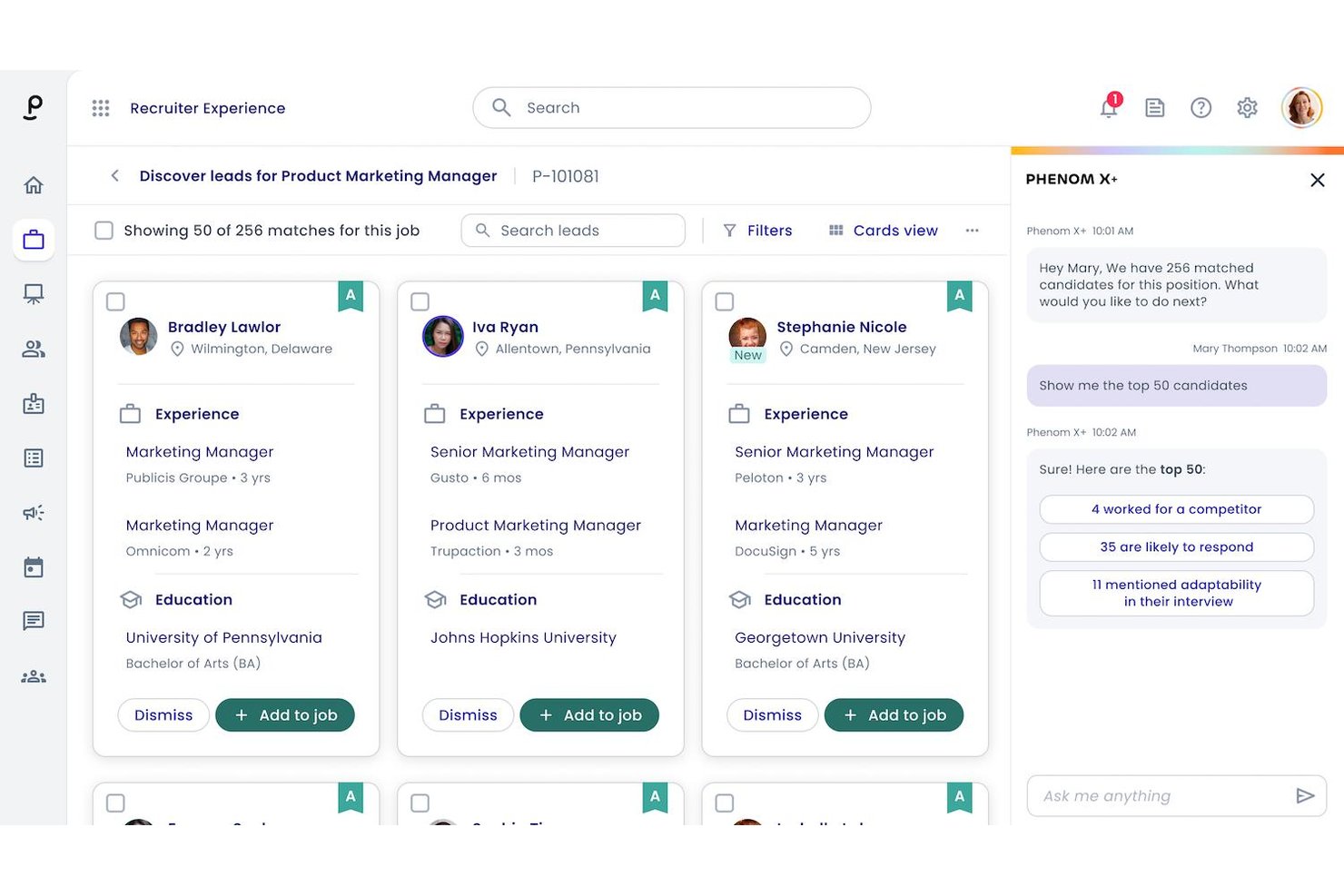
Phenom is an applied AI platform for enterprise recruiting teams that automates sourcing, screening, and candidate engagement while adding internal mobility and career site capabilities on top of your existing ATS.
Who Is Phenom Best For?
Phenom is built for large enterprises with 500+ employees that run high-volume, global hiring and need a specialist layer on top of an existing ATS or HCM.
Why Phenom Is a Good iCIMS Talent Cloud Competitor
I picked Phenom as one of the best because its AI-driven candidate experience goes well beyond what most ATS platforms offer natively. The hyper-personalized career site uses generative AI to serve dynamic job recommendations and branded content to each visitor, while the built-in CRM automates nurture campaigns and interview scheduling. I especially appreciate the X+ AI Agents, which autonomously handle screening and sourcing so recruiters can redirect their time toward high-value candidate conversations.
Phenom Key Features
- Internal mobility marketplace: Matches employees to open roles, gigs, and projects based on skills within the organization.
- Skills-based talent intelligence: Uses a skills ontology to surface workforce skills gaps and enable skills-based hiring decisions.
- Programmatic job advertising: Automatically distributes job ads across boards and allocates spend based on real-time campaign performance.
- Multi-language career site support: Delivers candidate experiences in 50+ languages for large organizations hiring across global markets.
Phenom Integrations
Phenom offers native integrations with SAP SuccessFactors, ADP, Cornerstone, and Checkr. An API is available for custom integrations.
Pros and Cons
Pros:
- Career site personalization
- Built-in internal mobility
- AI-driven candidate matching
Cons:
- Functionality overlaps with standalone ATS
- Multi-month setup
Jobvite
Best for candidate nurturing
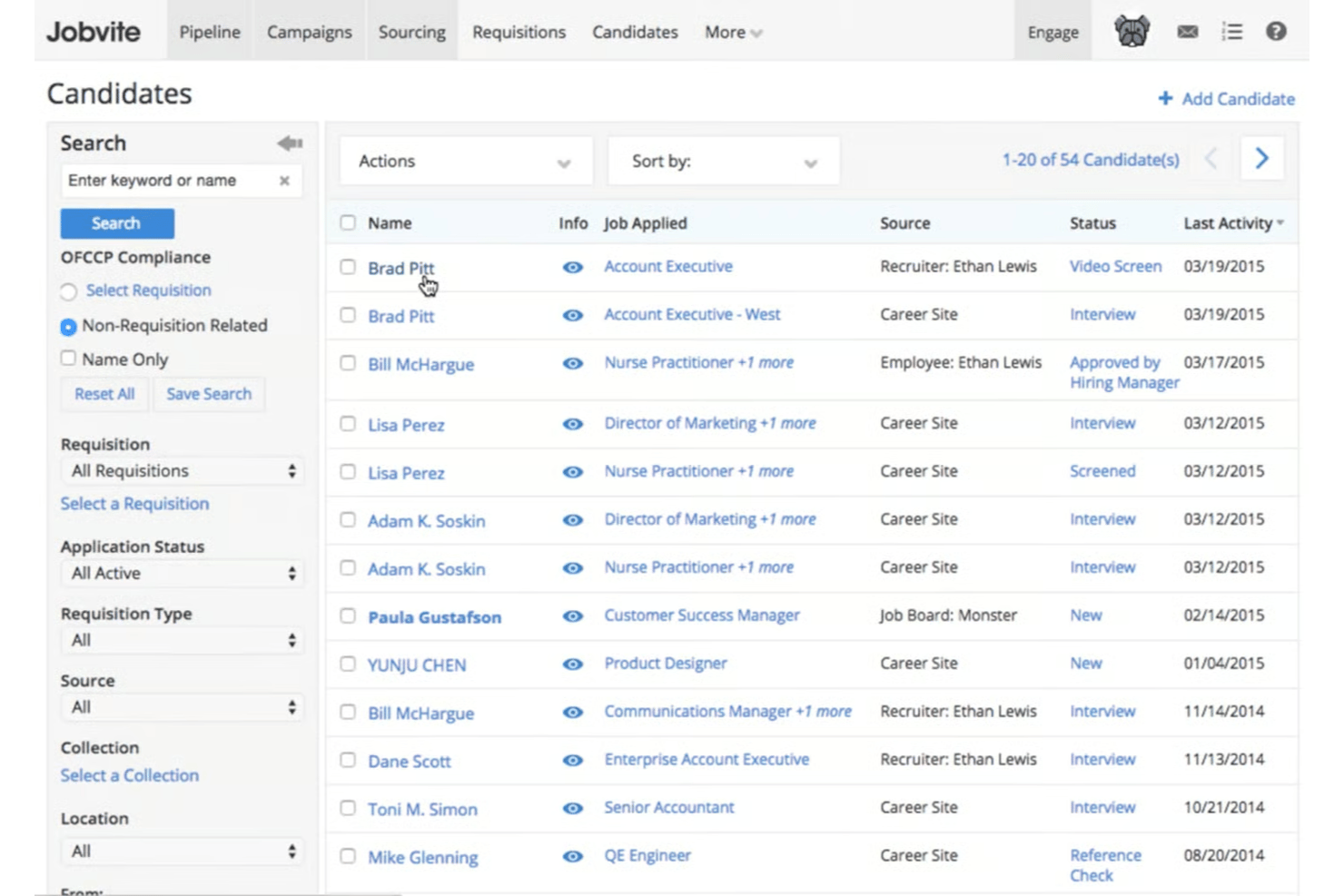
Jobvite is an enterprise recruiting platform built for mid-sized to large organizations that need to manage high-volume hiring, multi-location pipelines, and long-term candidate relationships without juggling multiple disconnected tools.
Who Is Jobvite Best For?
Jobvite fits talent acquisition teams at mid-market and enterprise companies that fill a high volume of roles across multiple locations or business units.
Why Jobvite Is a Good iCIMS Talent Cloud Competitor
I've included Jobvite in my top picks because its built-in CRM genuinely sets it apart for candidate nurturing in ways iCIMS doesn't match out of the box. I love how you can run multi-touch nurture campaigns directly from the platform, segmenting talent pools and sending targeted messaging to passive candidates without exporting to a separate tool. The AI-powered candidate matching also surfaces best-fit candidates from existing pipelines automatically, so my team isn't starting from scratch on every requisition.
Jobvite Key Features
- AI interview companion: Guides interviewers with real-time structured prompts and unbiased question sets.
- Branded career site builder: Lets teams create mobile-optimized, fully branded job sites for candidates.
- Automated employee referrals: Manages referrals, sharing, tracking, and reward programs in one place.
- 60+ prebuilt analytics dashboards: Provides detailed, configurable reporting on hiring funnel and source effectiveness.
Jobvite Integrations
Jobvite offers native integrations with LinkedIn, ADP, BambooHR, Bryq, Glassdoor, HackerRank, HiBob, Juicebox, and Namely. An API is available for custom integrations.
Pros and Cons
Pros:
- Internal mobility marketplace for employee retention
- Programmatic job advertising included natively
- Built-in CRM for passive candidate nurturing
Cons:
- Implementation timeline can stretch for enterprise
- Reporting customization requires technical configuration
Oracle Taleo
Best for extensive enterprise compliance
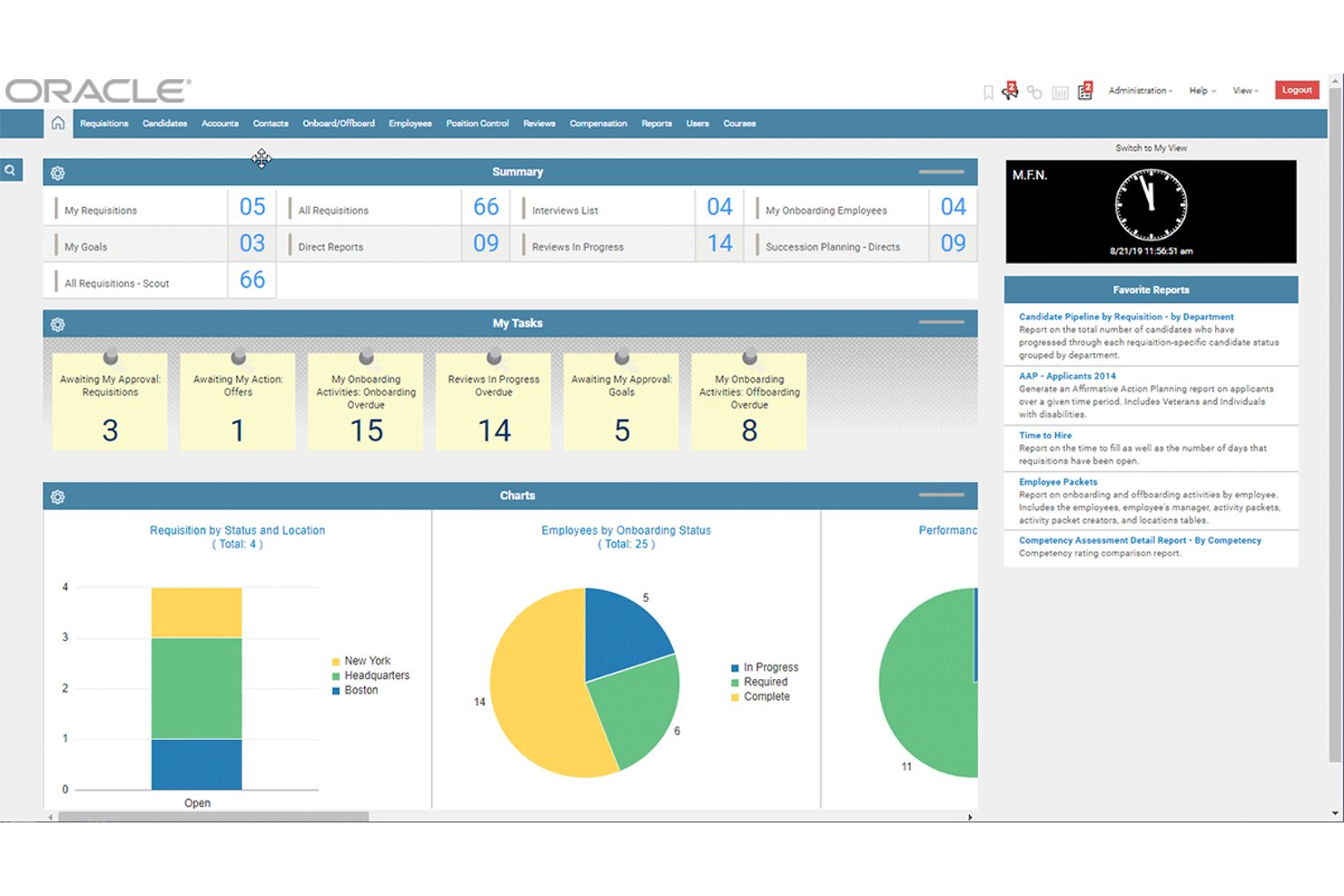
Oracle Taleo is an enterprise talent acquisition suite built for large organizations that need configurable hiring workflows, compliance-grade controls, and deep integration with existing HCM and HRIS systems.
Who Is Oracle Taleo Best For?
Oracle Taleo is a strong fit for large, multinational organizations with complex compliance requirements and dedicated HR technology teams managing high-volume hiring.
Why Oracle Taleo Is a Good iCIMS Talent Cloud Competitor
I picked Oracle Taleo as one of the best because its enterprise compliance controls go deeper than most ATS platforms I've evaluated. Taleo's configurable hiring workflows enforce approval chains and compliance checkpoints at every stage, which matters when you're managing hiring across multiple regions or regulated industries. I also appreciate the platform's top-tier security architecture and its 200+ certified partner integrations, many purpose-built for background screening and regulatory reporting requirements.
Oracle Taleo Key Features
- Requisition management: Organize and track high volumes of job openings across multiple departments and regions in a centralized workflow.
- Branded career sites: Build configurable, mobile-optimized job sites that showcase your employer brand and support custom search flows.
- Prebuilt HRIS integrations: Connect with major HCM and payroll systems to ensure accurate data sync across platforms.
- Offer management tools: Create, issue, and track job offers with configurable approval chains and digital acceptance workflows.
Oracle Taleo Integrations
Oracle Taleo offers over 200 certified native integrations, including LinkedIn. An API is also available for custom integrations.
Pros and Cons
Pros:
- Native onboarding module built into platform
- Configurable approval workflows for enterprise hiring
- Deep OFCCP and GDPR compliance controls
Cons:
- UI feels dated compared to newer platforms
- Lacks native dynamic AI candidate ranking
Other iCIMS Talent Cloud Competitors
Here are some additional iCIMS Talent Cloud competitor options that didn’t make it onto my shortlist, but are still worth checking out:
- Greenhouse
For structured hiring and interview workflows
- Ashby
For advanced recruiting analytics
- Avature
For configurable recruiting automation
- BambooHR®
For small businesses
- Bullhorn
For staffing agency recruitment
- ClearCo
For mid-market talent management
- Zoho Recruit
For budget-friendly customization
- Teamtailor
For employer branding and career sites
- Gem
For AI-driven candidate sourcing
- Eightfold
For AI-driven talent matching


How I Evaluate iCIMS Talent Cloud Competitors
I split my evaluation into two layers: core capabilities iCIMS Talent Cloud competitors must have, and differentiators that set each platform apart. Core covers applicant tracking, CRM, career sites, and HCM integrations—what iCIMS already does.
Core Functionality (Table Stakes for This List)
When I'm selecting tools for my list, I rank each one on a scale from 0 (does not offer the functionality) to 5 (excels in this area) for each core functionality listed below. Then, I calculate the tool's total score into a percentage. Each tool needs to achieve a minimum total score of 65% to be considered for inclusion.
- Applicant Tracking: I evaluate how well each platform handles requisition management, pipeline stages, and workflow automation for teams juggling hundreds of open roles at once.
- Candidate Relationship Management: Strong CRM means segmented talent pools, drip campaigns, and engagement scoring—not just a static database of past applicants.
- Career Site Builder: I look for branded, mobile-optimized career sites with search and filtering, especially multi-brand support for companies hiring under different entities.
- Onboarding Module: Each tool should offer pre-boarding task lists, document collection, and e-signatures so new hires aren't stuck filling out paperwork on day one.
- Enterprise Integrations: I check for prebuilt connectors and open APIs to major HCM systems, background check providers, and assessment platforms like HireRight or HackerRank.
- Reporting & Analytics: Dashboards covering time-to-fill, source of hire, and DEI metrics matter here—I look for custom report builders, not just canned exports.
Once I have a list of tools that meet the criteria, I consider what sets each platform apart.
Differentiating Factors (What Sets Vendors Apart)
Here's how I compare and contrast different vendors:
Standout Features
Conversational AI recruiting is a major differentiator—chatbots that screen candidates and schedule interviews over SMS cut days off response times for high-volume roles. I also look at whether a platform includes an internal mobility marketplace, which matches current employees to open roles based on skills rather than posting externally first. Skills-based talent intelligence takes this further by surfacing gaps across your workforce and shifting hiring away from job titles and degrees.
Beyond Features
Pricing transparency matters a lot here. I check whether CRM, onboarding, and analytics come bundled or as paid add-ons, since module-based pricing can inflate total cost fast. Implementation timelines vary widely too—some vendors get you live in weeks, while enterprise-scale rollouts with data migration from legacy systems can stretch past six months. I also evaluate AI governance, specifically whether vendors provide documented bias audits and audit logs for automated screening decisions.
Why Look For An iCIMS Talent Cloud Competitor?
While ICIMS Talent Cloud is a good choice of applicant tracking software, there are a number of reasons why some users seek out alternative solutions. You might be looking for an ICIMS Talent Cloud competitor because…
- You need more transparent or flexible pricing models
- Implementation times are longer than your team can support
- Integration with your existing HRIS or payroll system is limited
- You want modern candidate engagement features like AI chatbots
- Reporting and analytics don’t cover your custom business needs
- Global support or multi-language options are not strong enough
If any of these sound like you, you’ve come to the right place. My list contains several applicant tracking system options that are better suited for teams facing these challenges with ICIMS Talent Cloud and looking for alternative solutions.
ICIMS Talent Cloud Key Features
Here are some of the key features of ICIMS Talent Cloud, to help you contrast and compare what alternative solutions offer:
- Applicant tracking: Manages the full hiring workflow, from requisition posting to offer acceptance, keeping the candidate pipeline organized and transparent for everyone involved.
- Candidate relationship management: Allows recruiters to build, nurture, and track relationships with passive and active talent through segmented campaigns, talent pools, and ongoing engagement.
- Career site builder: Lets teams create mobile-friendly, branded career sites that enable candidates to find, search, and apply for jobs easily while presenting your employer brand consistently.
- Onboarding module: Simplify completion of new hire paperwork, e-signatures, task lists, and pre-boarding workflows so new hires feel ready on day one.
- Enterprise integrations: Connects with popular HCM, HRIS, background check, payroll, and assessment systems using prebuilt connectors and open APIs, reducing manual data entry and sync errors.
- Reporting and analytics: Offers configurable dashboards and custom reports, including metrics like time-to-hire, source of hire, funnel conversions, and DEI tracking, guiding better recruiting decisions.
- Conversational AI recruiting: Uses chatbots and virtual assistants to screen candidates, answer FAQs, and schedule interviews through SMS or messaging apps, speeding up response times for high-volume roles.
- Internal mobility marketplace: Matches existing employees to open roles or projects based on their skills, helping with retention and talent growth while reducing external recruiting costs.
- Skills-based talent intelligence: Surfaces workforce and candidate skill gaps, supporting hiring decisions rooted in current needs and future objectives rather than just work experience or degrees.
- Programmatic job advertising: Automates job post distribution and ad spend across multiple boards based on performance data, improving reach and cost-efficiency for active job openings.