

Çalışan ücretlendirmesini yönetmek karmaşıktır. Maaşları ve primleri elektronik tablolarda manuel olarak takip ediyor, ücret eşitliği sorunlarıyla mücadele ediyor veya ücretlendirmeyi şirket hedefleriyle uyumlu hale getirmekte zorlanıyorsanız yalnız değilsiniz. Birçok İK profesyoneli bu zorluklarla karşılaşıyor; bu da ücretlendirmeyi etkili bir şekilde yönetmeyi ve size yardımcı olacak doğru yazılımı seçmeyi daha da zorlaştırıyor.
Ücretlendirme yönetimi yazılımı tam da bu noktada devreye girer. Doğru araç; maaş düzenlemelerini otomatikleştirmenize, ücret eşitliğini sağlamanıza, primleri ve yan hakları yönetmenize ve mevzuata uyumlu kalmanıza yardımcı olabilir; üstelik zamandan tasarruf etmenizi ve hataları azaltmanızı sağlar.
İK yazılımlarını değerlendirme konusunda yıllara dayanan deneyimimle, mevcut en iyi seçenekleri bulmak için onlarca ücretlendirme yönetimi aracını araştırdım. Bu yazıda, ihtiyaçlarınıza uygun yazılımı bulmanıza yardımcı olmak için en iyi seçimlerimi ayrıntılı olarak ele alacağım.
Ücretlendirme Yönetimi Yazılımı Nedir?
Ücretlendirme yönetimi yazılımı, işletmelerin çalışan ücretlerini etkili bir şekilde yönetmesine ve düzenlemesine yardımcı olmak üzere tasarlanmış pratik bir araçtır. Maaşların, primlerin ve diğer ücretlendirme biçimlerinin hesaplanması sürecini otomatikleştirerek doğruluk ve tutarlılık sağlar.
Amaç, şirketlerin ücretleri performansla uyumlu hale getirmesine, bütçelere bağlı kalmasına ve rekabetçi maaş yapılarını korumasına yardımcı olmaktır. Kullanımı idari görevleri kolaylaştırır, stratejik finansal planlamayı destekler ve adil ve şeffaf ücretlendirme uygulamalarına katkıda bulunarak çalışan memnuniyetini ve elde tutmayı artırır.
Why Trust Our Software Recommendations
6,700+
Reviews
20
Industry experts
16+
Evaluation factors
14
Years
Our team has been testing and reviewing software since 2012. As HR experts ourselves, we know how difficult—and important—it is to choose the right software.
For this guide, we evaluated tools using hands-on testing and independent research, scoring tools using our selection criteria. We also draw on insights from industry thought leaders and practicing HR experts.
Our reviews reflect our human editorial judgment, not a sales pitch.
Expert reviewers:
- Phil GrayCOO
 Kim BehnkeHR Tech Editor & Analyst
 Josh BarkerPeople Ops Manager

Ücretlendirme Yönetimi Yazılımları Karşılaştırma Tablosu
Bu karşılaştırma tablosu, en iyi ücretlendirme yönetimi yazılımı seçimlerimin fiyatlandırma ayrıntılarını özetlemektedir:
Score legend (out of 5)
- Excellent4.5–5
- Good4–4.4
- Average3–3.9
- Below average2–2.9
- Poor1–1.9
Sorted by: Default
| Tool | Starting Price | Website | |||||||
|---|---|---|---|---|---|---|---|---|---|
Best for compensation equity & retention | Not rated | Not rated | Not rated | 2 | 2 | 5 | 4 | Pricing upon request Free demo available | Website |
Best for real-time benchmarking in 110+ countries | 3.2 out of 5 | 3 | 4 | 4 | 4 | 2 | 2 | $5/user/month Free demo available | Website |
Best for adaptive enterprise compensation planning | 3.5 out of 5 | 3 | 4 | 4 | 4 | 3 | 3 | $15,000/year Free demo available | Book Demo |
Best for AI-driven compensation modeling | Not rated | Not rated | 1 | 2 | 1 | 5 | Not rated | Pricing upon request Free demo available | Website |
Best for evaluating job roles | Not rated | 3 | 5 | 4 | 4 | Not rated | 4 | Pricing upon request Free demo available | Website |
Best for replacing spreadsheets | 3.2 out of 5 | 3 | 3 | 4 | 4 | 3 | 2 | Pricing upon request Free demo available | Website |
Best for pay reviews tied to Workday HCM | 3.5 out of 5 | 3 | 4 | 4 | 4 | 3 | 3 | Pricing upon request Free demo available | Website |
Best for candidate offers and employee rewards | 3.3 out of 5 | 3 | 4 | 3 | 4 | 3 | 3 | $3/user/year Free demo available | Website |
Best for modeling pay-gap fixes within budget | 3.7 out of 5 | 4 | 4 | 4 | 4 | 4 | 2 | Pricing upon request Free demo available | Website |
Best for human-reviewed AI pay decisions | 3.8 out of 5 | 4 | 4 | 4 | 4 | 4 | 3 | Pricing upon request Free demo available | Website |


En İyi Ücretlendirme Yönetimi Yazılımları İncelemeleri
Kısa listeme giren en iyi 10 ücretlendirme yönetimi yazılımının her biri hakkında kısa bir açıklamayı burada bulabilirsiniz. Listenin sonunda yer alan ek önerileri keşfetmek için okumaya devam edin.
 Best for compensation equity & retention
- Free demo available
- Pricing upon request
Visit WebsiteCustomer Rating:4.3/5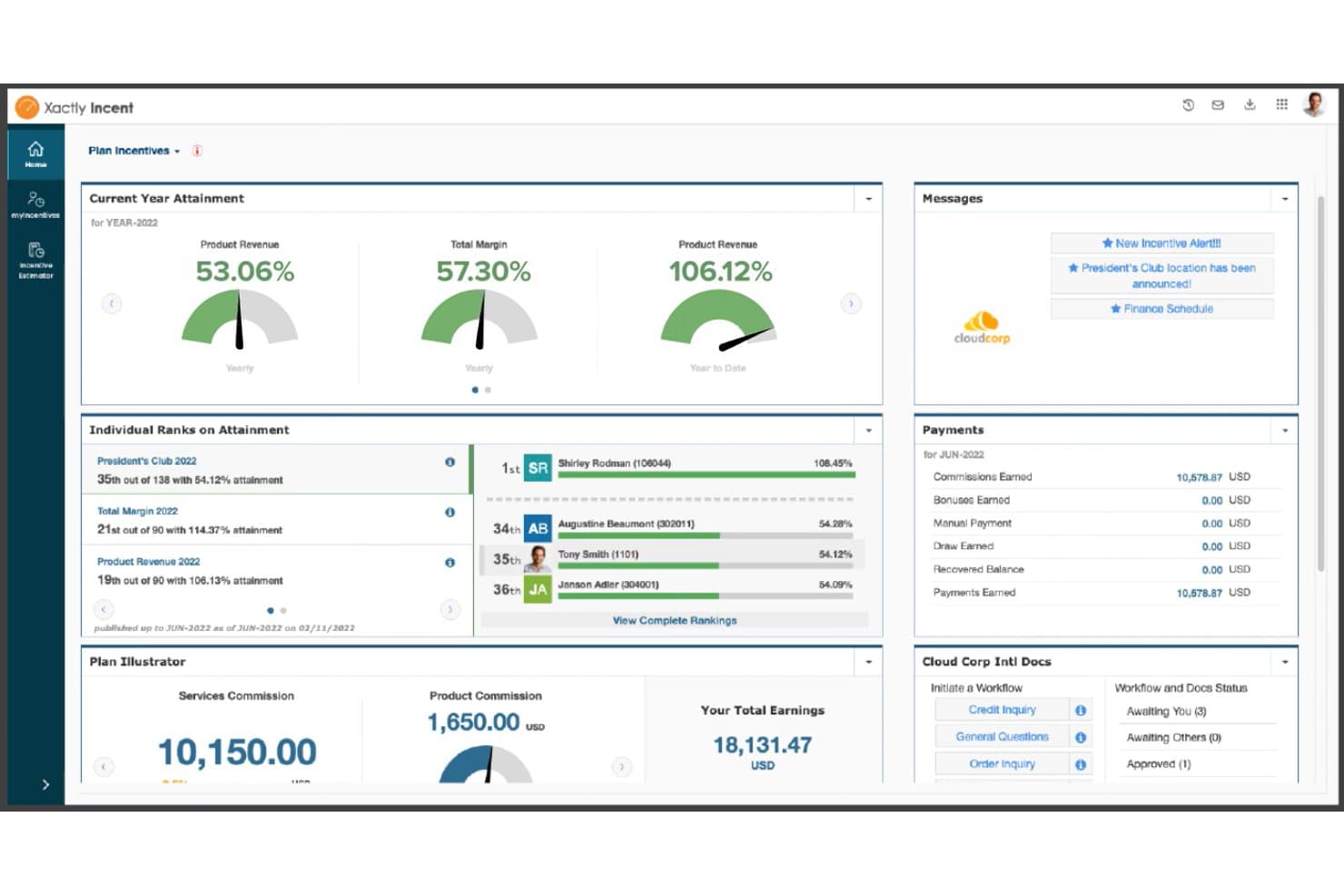
Xactly Incent helps drive top performance by visually charting sales targets until bonuses are attained. Xactly Incent is an incentive compensation management platform that automates commission calculations, variable pay plan configuration, and sales performance benchmarking.
Who Is Xactly Best For?
Xactly Incent is a strong fit for sales operations and finance teams at mid-to-large enterprises that need to automate complex commission calculations and variable pay programs at scale.
Why I Picked Xactly
I picked Xactly as one of the best because its built-in benchmarking dataset, covering 19+ years of cross-industry pay and performance data, gives compensation teams a real foundation for designing incentive plans that keep sales talent competitive. I also like how its AI anomaly detection flags unusual payouts before payroll runs, which directly supports compensation equity by catching errors before they affect people's paychecks.
Xactly Key Features
- Compensation calculation engine: Automates complex commission calculations, including true-up changes, using current deal data and compensation-plan logic.
- Plan rollover automation: Administrators can automate the rollover of existing compensation plans into the next cycle without rebuilding from scratch.
- Payout and dispute-resolution workflows: Built-in workflows let teams log, track, and resolve commission payment disputes directly within the platform.
- Mobile performance data access: Sales reps can view earnings and attainment data on the go through native Android and iOS apps.
Xactly Integrations
Xactly offers native integrations with Salesforce, ServiceNow, Microsoft Dynamics, NetSuite, and Snowflake. It also provides REST and Connect APIs, plus ODBC/JDBC drivers and ETL integrations for custom connectivity.
Pros and Cons
Pros:
- Benchmarking draws on 19 years of data
- Payout dashboards clarify earnings and attainment
- Commission calculations reduce spreadsheet work
Cons:
- No salary bands or pay equity analysis
- Complex plans can be difficult to configure
Learn more about Xactly: Best for real-time benchmarking in 110+ countries
- Free demo available
- From $5/user/month
Visit WebsiteCustomer Rating:4.8/5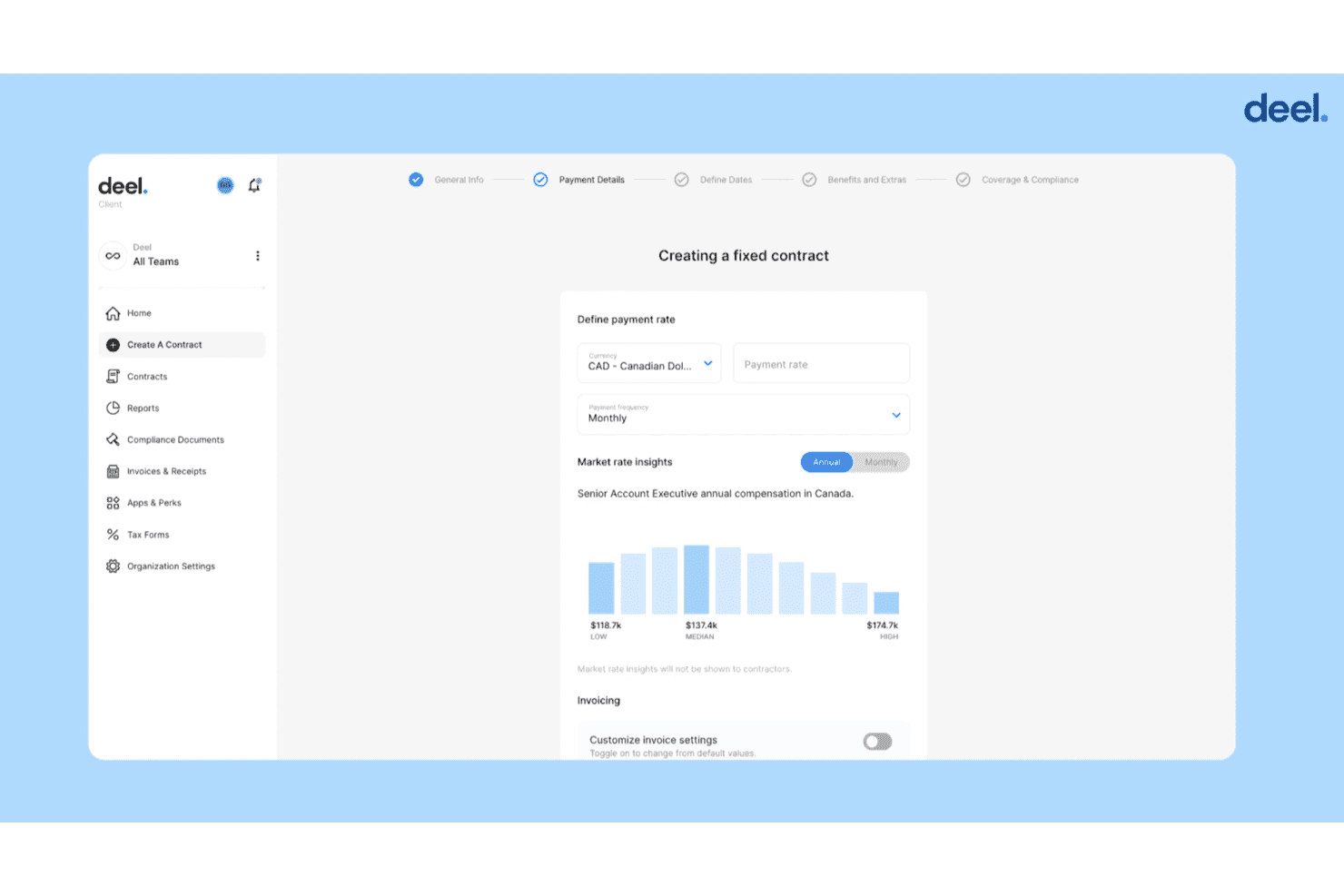
Deel’s rich analytics includes salary benchmark data, sourced from a global pool of contracts. Deel HR is a global HR platform that covers compensation planning, pay structure management, salary bands, compensation review cycles, pay equity reporting, and benchmarking data across 150+ countries.
Who Is Deel HR Best For?
Deel HR is a strong fit for globally distributed organizations that need to manage compensation bands, review cycles, and pay benchmarking across multiple countries from a single platform.
Why I Picked Deel HR
Deel HR earns its spot on my shortlist because its Global Salary Insights dataset spans 150+ countries, giving globally distributed teams real compensation benchmarks without needing a separate survey subscription. I especially like how compensation bands tie directly to geographic sub-markets, so a band for a senior engineer in Brazil auto-assigns at a different range than one in Germany. Compa-ratio dashboards then let me see at a glance where workers across those markets fall relative to their bands.
Deel HR Key Features
- Compensation review cycles: Configure multi-phase review cycles for merit increases, market adjustments, and bonus allocations, with role-based access and a full audit trail.
- Pay equity dashboards: Monitor gender and age pay gaps, headcount by gender, and compensation by country using filterable analytics dashboards.
- Job architecture builder: Define nested job family groups, families, and profiles with levels and tracks that connect directly to compensation bands and career paths.
- Variable bonus management: Set target bonuses as flat-rate or percentage-based amounts with annual, quarterly, or monthly frequencies, and log actual payouts within a compensation cycle.
Deel HR Integrations
Deel HR offers native integrations with Deel HRIS and Deel Engage; Deel Payroll integration is tentatively planned for 2026. APIs and real-time webhooks support custom integrations.
Pros and Cons
Pros:
- Reviewers praise centralized HR administration
- Budget requests roll up through manager hierarchies
- Geographic bands connect roles, levels, and currencies
Cons:
- Bonus workflows omit commission and equity modeling
- Deel-derived benchmarks vary by role and geography
 Best for adaptive enterprise compensation planning
- Free demo available
- From $15,000/year
Visit WebsiteCustomer Rating:4.6/5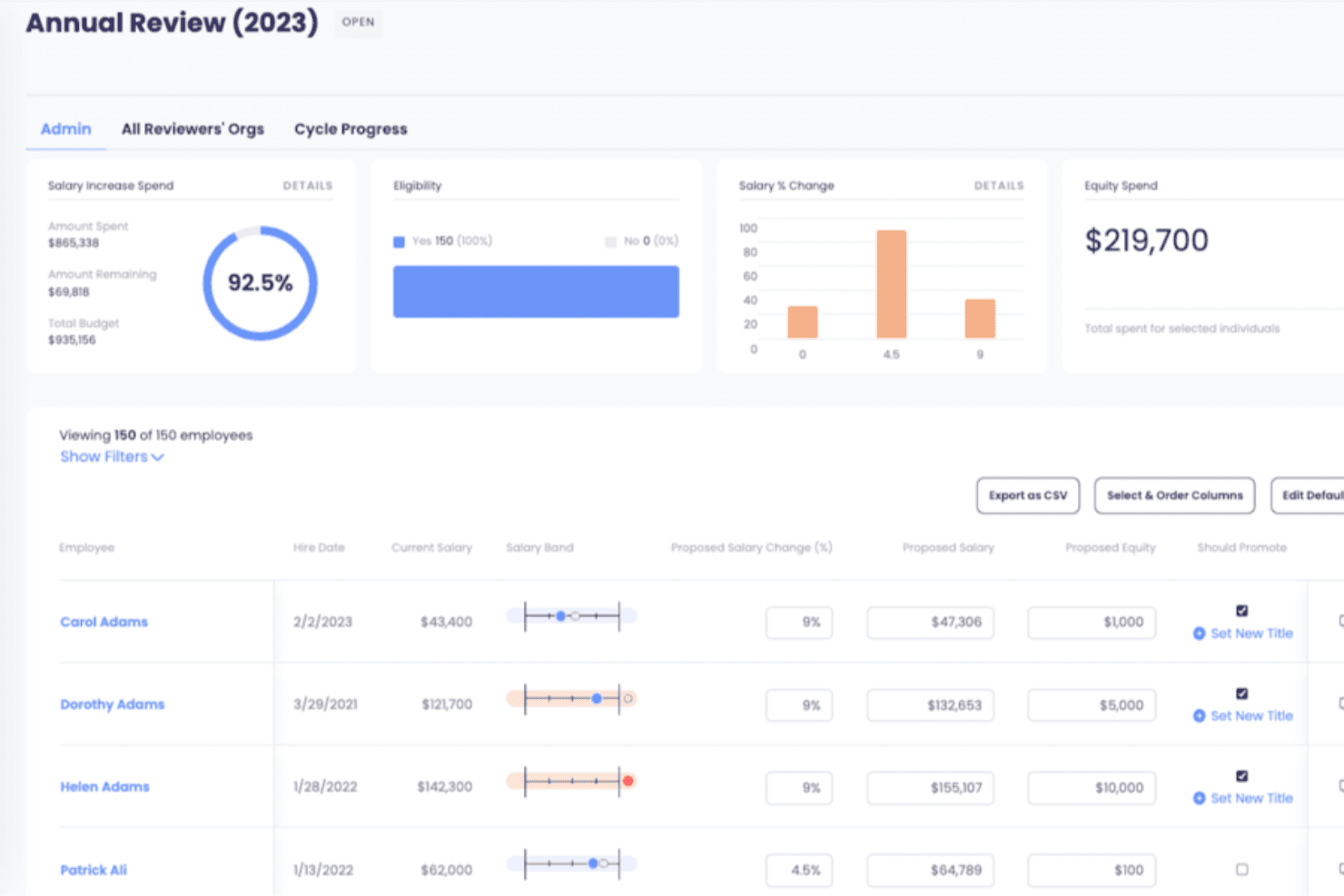
Aeqium’s dashboard features various charts and graphs that provide detailed insights into compensation trends and patterns within an organization. Aeqium is an AI-powered compensation management platform that handles compensation cycle configuration, pay band management, pay equity analysis, and total rewards reporting.
Who Is Aeqium Best For?
Aeqium is a strong fit for compensation and total rewards teams at mid-to-large enterprises that run complex, multi-layered review cycles across regions, functions, and currencies.
Why I Picked Aeqium
Aeqium earns its spot on my shortlist because of how well it handles compensation cycles that don't fit a single template. I love that you can configure merit, bonus, equity, and stock-refresh cycles with separate eligibility rules, approval chains, and budget logic, then run them concurrently without things breaking down. Draft Band Sets let my team stage full or partial band revisions, review them against live data, and discard them if needed before anything goes live.
Aeqium Key Features
- AI-powered compensation configuration: Aeqium Assist lets you set up compensation rules, eligibility criteria, approval workflows, and permissions using plain-language instructions.
- Pay equity add-on: Automated regression-based analysis surfaces adjusted and non-adjusted pay gaps with macro-level summaries and individual-level breakdowns.
- Interactive offer letters: Build personalized, branded offer letters that let candidates explore equity value under different vesting or growth scenarios.
- Employee total rewards portal: Give employees a configurable, self-serve view of their current and historical salary, bonuses, equity, and benefits in one place.
Aeqium Integrations
Aeqium has documented native integrations with BambooHR and Carta, plus connections to 200+ HR platforms and tools. It also offers open API connections for custom integrations.
Pros and Cons
Pros:
- Managers adopted workflows after brief introductions
- Draft band sets support staged revisions
- Flexible cycles handle varied compensation programs
Cons:
- No built-in compensation benchmarking dataset
- Reviewers request stronger budgeting and reporting
Learn more about Aeqium: Best for AI-driven compensation modeling
- Free demo available
- Pricing upon request
Visit WebsiteCustomer Rating:4.8/5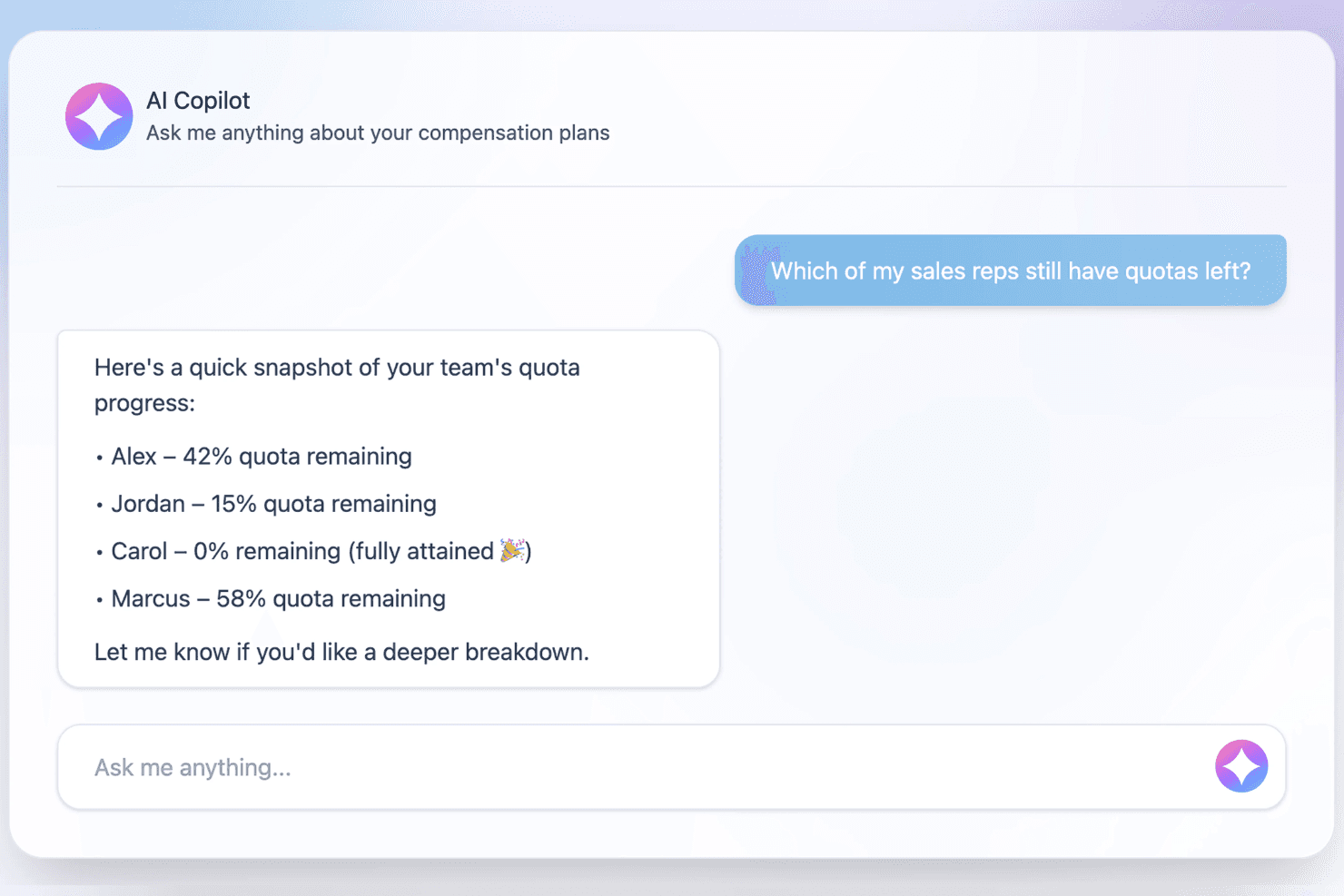
Visdum’s AI Copilot answers compensation questions instantly with clear, real-time quota insights. Visdum is a sales compensation platform that automates commission tracking, plan design, and incentive pay modeling using AI-driven tools.
Who Is Visdum Best For?
Visdum is a strong fit for finance and RevOps teams that need to automate and model complex sales commission structures across large or distributed sales organizations.
Why I Picked Visdum
I picked Visdum as one of the best because its AI-driven compensation modeling goes well beyond static plan templates. I'm especially impressed by the AI Copilot, which monitors commission data in real time, surfaces anomalies, and traces issues to their root cause, and the no-code plan builder, which lets you configure tiered accelerators, splits, and clawbacks without touching a spreadsheet. If your sales org runs complex incentive structures, Visdum's real-time commission estimator lets reps model their own earnings from live deal data, which cuts disputes before they start.
Visdum Key Features
- Plan document e-signature collection: Generate compensation plan documents and route them to reps for e-signature through DocuSign or Adobe Sign, with approval tracking and version history.
- Calculation audit trail: Trace every payout back to its source deal, with a full log of adjustments and approvals for finance review.
- ASC 606 and IFRS 15 compliance reporting: Generate amortization schedules and track commission capitalization and expenses by deal, period, or plan to meet accounting standards.
- Payroll and ERP data push: Send approved commission payouts directly to payroll systems like ADP, Paychex, and Deel, with categorized, time-stamped journal entries for reconciliation.
Visdum Integrations
Visdum offers 100+ native integrations, including Salesforce, HubSpot, Workday, HiBob, ADP, Paychex, Deel, and Oracle NetSuite. It also provides an API for custom integrations and supports Google Sheets, Microsoft Excel, and Snowflake data connections.
Pros and Cons
Pros:
- Reviewers praise hands-on onboarding and support
- Shows deal-level calculations and supports disputes
- Models complex commission rules and tiered payouts
Cons:
- No pay-equity analysis or market benchmarking
- No salary bands or merit-review workflows
Learn more about Visdum:
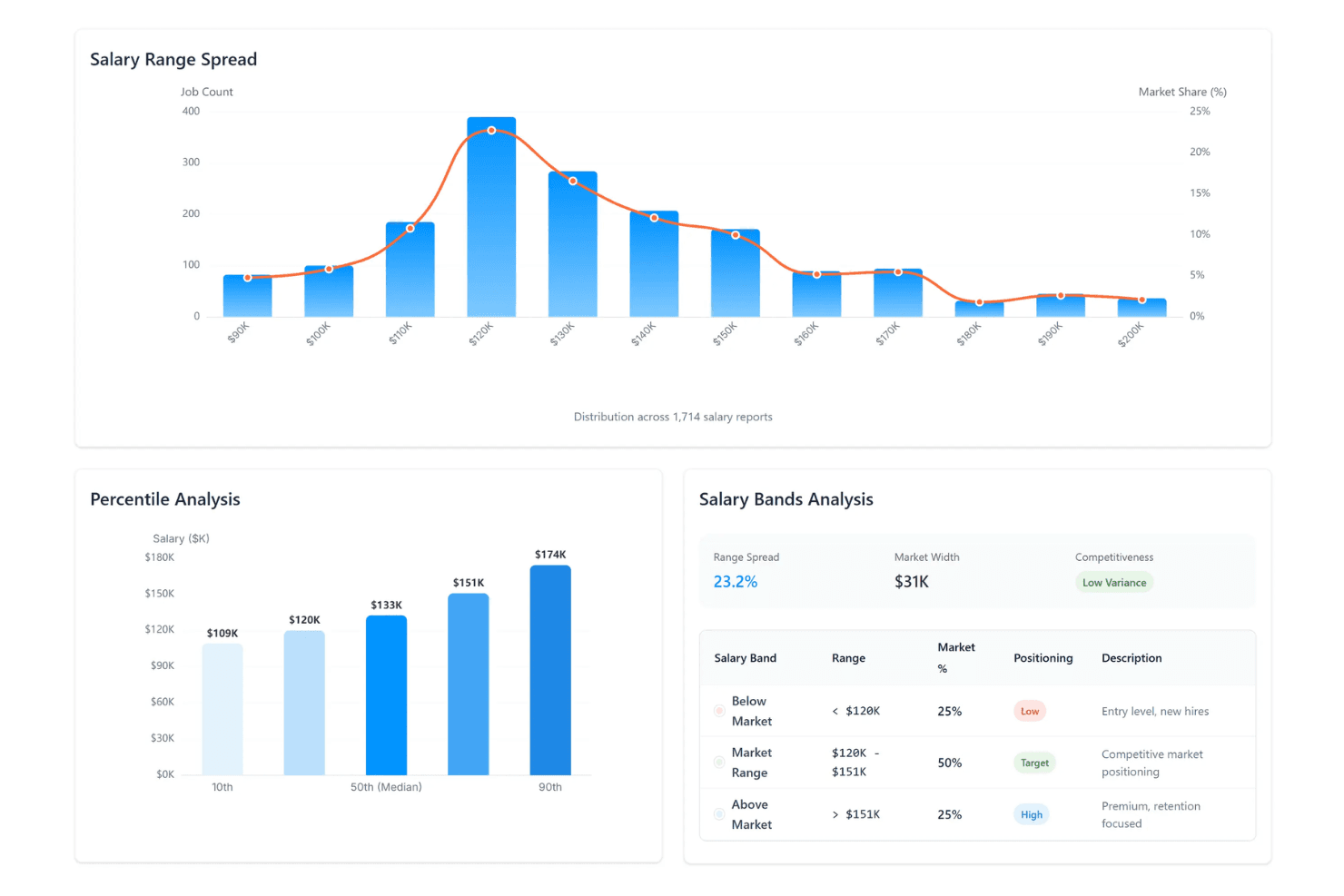
SalaryCube offers advanced real-time salary benchmarking charts. SalaryCube is an AI-powered compensation platform that combines market benchmarking, pay range building, job role evaluation, FLSA classification, and merit cycle planning for U.S. employers.
Who Is SalaryCube Best For?
SalaryCube is a strong fit for U.S.-based compensation managers and total rewards teams who need to benchmark roles, build pay ranges, and run merit cycles from one platform.
Why I Picked SalaryCube
SalaryCube earns its spot on my shortlist because of how well it handles job role evaluation, particularly through its AI Job Match and Hybrid Jobs tools. I like that AI Job Match maps job descriptions to benchmark roles with confidence scores, cutting out the guesswork when pricing a role you can't neatly categorize. Hybrid Jobs goes a step further, letting you blend multiple job families with custom weights to price roles that cross traditional boundaries.
SalaryCube Key Features
- Range Builder: Creates salary ranges from benchmark data using percentile recipes, rounding rules, or custom values, with version history and market refresh built in.
- FLSA Analyzer: Walks you through duties and salary tests to classify roles, then exports answers, results, and decision history in structured audit reports.
- Bigfoot Live: Delivers daily-updated salary data for 35,000+ U.S. job titles across industries and metro areas, sourced from job postings, public filings, and client participation.
- Comp Planning: Configures merit cycles with department budget pools, multi-step approval chains, manager worksheets, and a payroll-ready CSV export at cycle close.
SalaryCube Integrations
SalaryCube supports CSV or API connections with Workday, UKG, BambooHR, and ADP, plus survey imports from Mercer, Radford (Aon), Willis Towers Watson, Comptryx, Payscale, Salary.com, and WorldatWork. An API is available for custom integrations; Greenhouse is still in development.
Pros and Cons
Pros:
- Reviewers praise helpful, responsive support
- Market data helps validate salary ranges
- Role benchmarks adapt to location and industry
Cons:
- Bonus and equity pay modeling is absent
- Niche-role benchmark data can be sparse
Learn more about SalaryCube: Best for replacing spreadsheets
- Free demo available
- Pricing upon request
Visit WebsiteCustomer Rating:4.9/5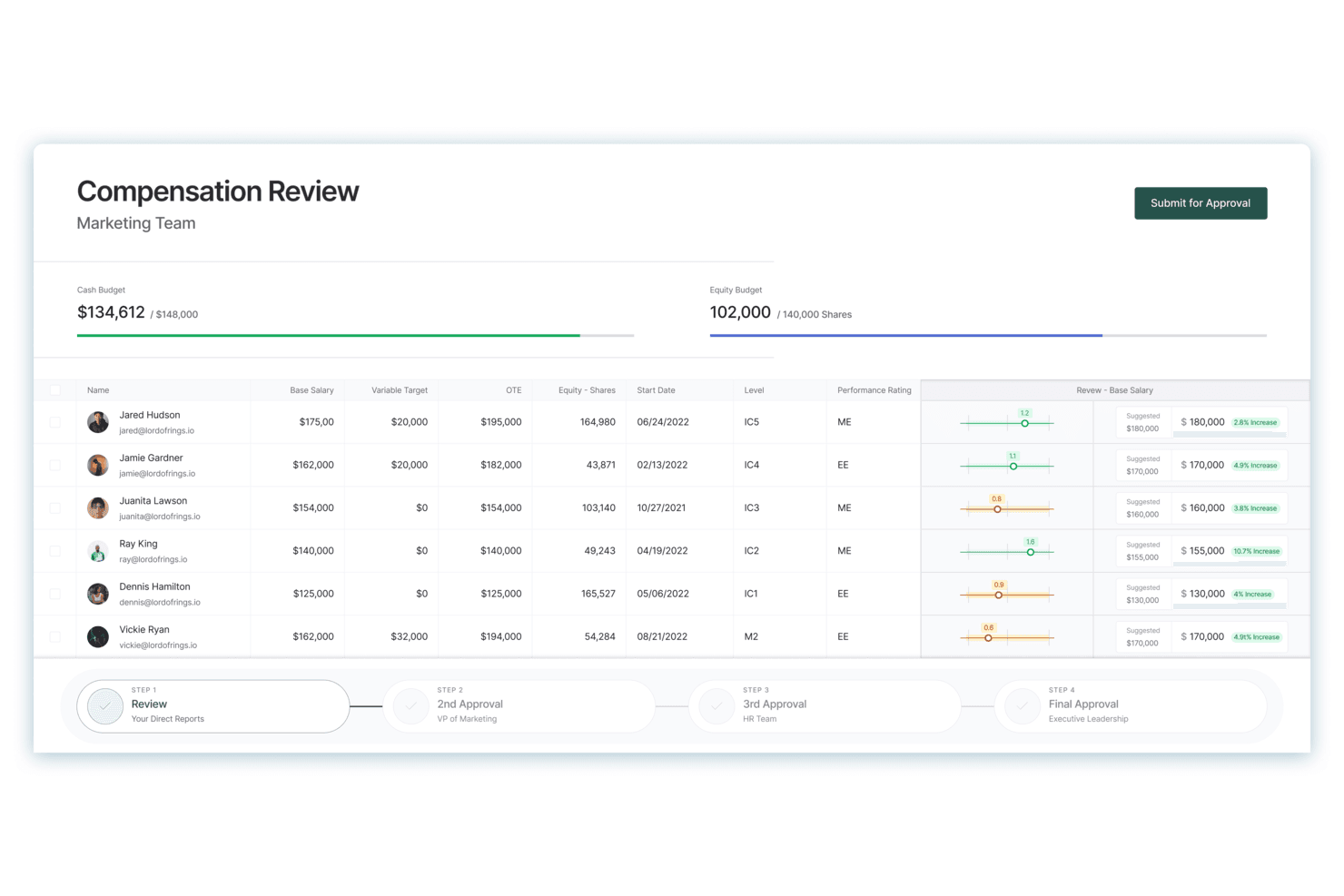
Comprehensive is a customizable and cost-effective compensation management software. Comprehensive is a compensation management platform that centralizes salary review cycles, pay range management, budget planning, approval workflows, pay equity reporting, and total rewards communication.
Who Is Comprehensive Best For?
Comprehensive is a strong fit for HR and people operations teams that are still running compensation reviews in spreadsheets and want a purpose-built platform to manage the full cycle.
Why I Picked Comprehensive
I picked Comprehensive as one of the best because it's purpose-built to get compensation teams off spreadsheets and into a real workflow. I love how merit logic can pull in performance ratings, compa-ratio position, and tenure to auto-calculate suggested increases, and how managers see live budget usage with overrun warnings as they make recommendations. The configurable, multi-level approval chains and built-in pay equity reporting with demographic segmentation make it a genuinely complete cycle management tool, not just a fancier spreadsheet.
Comprehensive Key Features
- Total Rewards dashboard: Gives employees a self-serve view of their salary, bonuses, equity, and benefits in one place, with configurable exchange rates for local currency display.
- AI manager coaching: Generates personalized talking points to help managers navigate employee compensation conversations throughout the year.
- Demographic pay equity segmentation: Breaks down compensation outcomes by race, gender, age, and promotion rates when the relevant data is available.
- Carta equity integration: Syncs equity data daily from Carta, including grant type, quantity, vesting schedule, and exercise price, for display in Total Rewards reporting.
Comprehensive Integrations
Comprehensive offers native integrations with Rippling, BambooHR, 15Five, and Carta. Additional listed integrations include Paylocity, Paycor, Culture Amp, Klaar, Mercer, Salary.com, and Shareworks, with ADP Marketplace available through its marketplace.
Pros and Cons
Pros:
- Centralized award letters simplify review follow-through
- Merit formulas use ratings, tenure, and range position
- Live budget visibility flags overspending
Cons:
- Cycle setup and uploads feel tedious
- Reporting views can require manual exports
Learn more about Comprehensive: Best for pay reviews tied to Workday HCM
- Free demo available
- Pricing upon request
Visit WebsiteCustomer Rating:4.3/5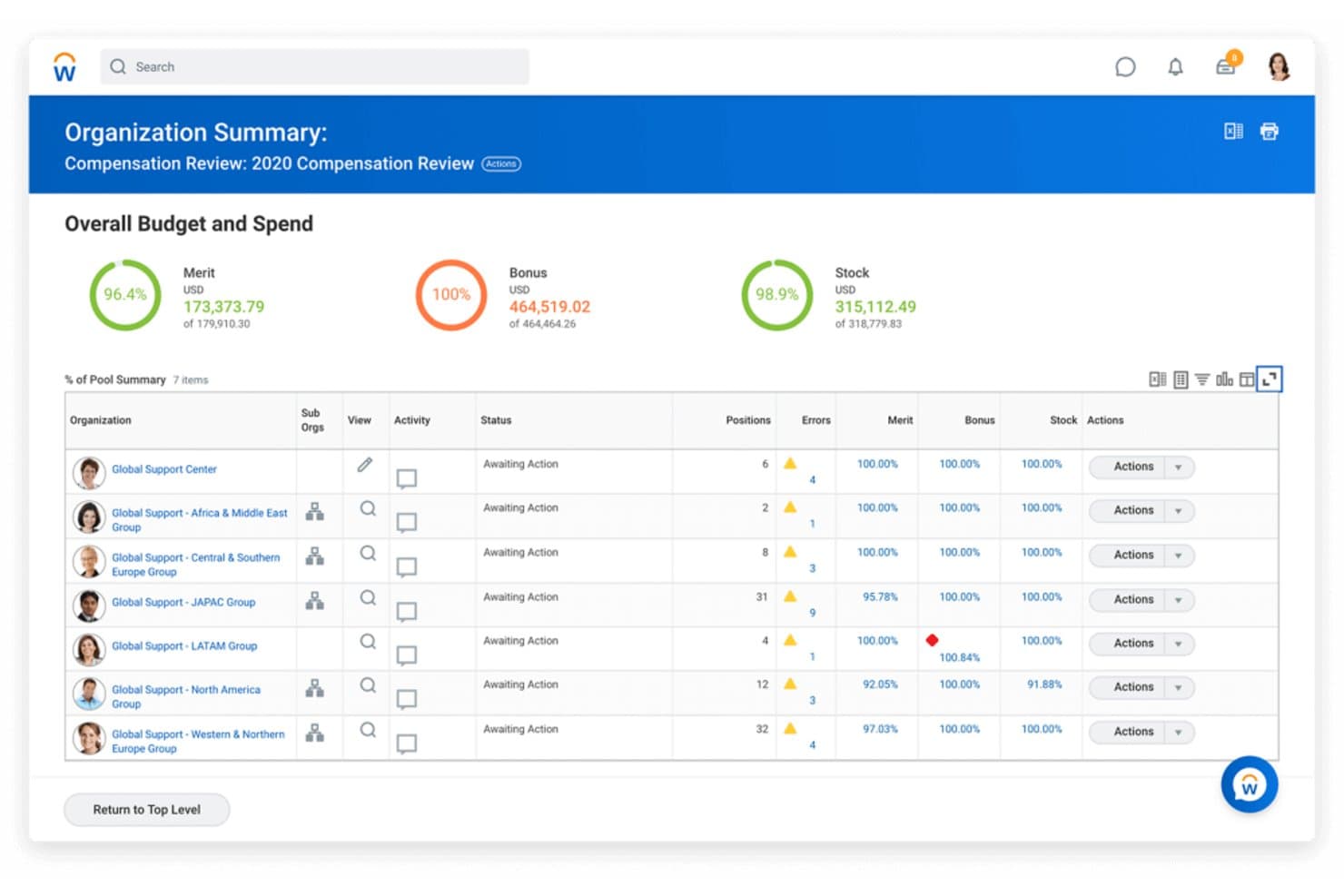
Workday’s compensation solution can track merit, bonuses, and stock options. Workday Compensation Management Software is a compensation planning and management solution that centralizes pay reviews, salary structures, market benchmarking, pay equity analysis, and total rewards within the Workday HCM platform.
Who Is Workday Best For?
Workday Compensation Management Software is a strong fit for organizations already running Workday HCM, where pay reviews, merit cycles, and total rewards can all draw from a single, unified people data model.
Why I Picked Workday
I've included Workday in my top picks because it's the only tool on this list where pay reviews live natively inside the same platform managing your headcount, performance ratings, and payroll. When your merit cycle runs in Workday, managers already see each employee's skills and performance data alongside their compensation, so there's no exporting or cross-referencing. I also like the real-time budget tracking across pools, which lets HR and finance watch spend as planners make award decisions, not after the fact.
Workday Key Features
- Pay Equity Discovery Board: A configurable dashboard that visualizes potential pay gaps across gender, ethnicity, and age in one view.
- Total rewards statements: Personalized, configurable statements that communicate each employee's full financial rewards package, normalized across currencies.
- Compensation matrices: Performance ratings, potential scores, and compa-ratios can be used to automatically calculate merit increases and bonus pools.
- Survey benchmarking import: Administrators can load external survey data, match it to internal job profiles using machine-learning, and apply weights and aging factors to build market benchmarks.
Workday Integrations
Workday documents integrations with Compa and Microsoft Teams, plus connections to Slack through Workday Everywhere. It also provides public APIs, SOAP web services, and MCP endpoints for custom integrations.
Pros and Cons
Pros:
- Live budget tracking shows award-pool spend
- Market survey results support tailored benchmarks
- Reviews draw on existing employee performance data
Cons:
- Pay ranges warn but don’t block outliers
- First-cycle setup requires careful plan validation
Learn more about Workday: Best for candidate offers and employee rewards
- Free demo available
- From $3/user/year (billed annually)
Visit WebsiteCustomer Rating:4.9/5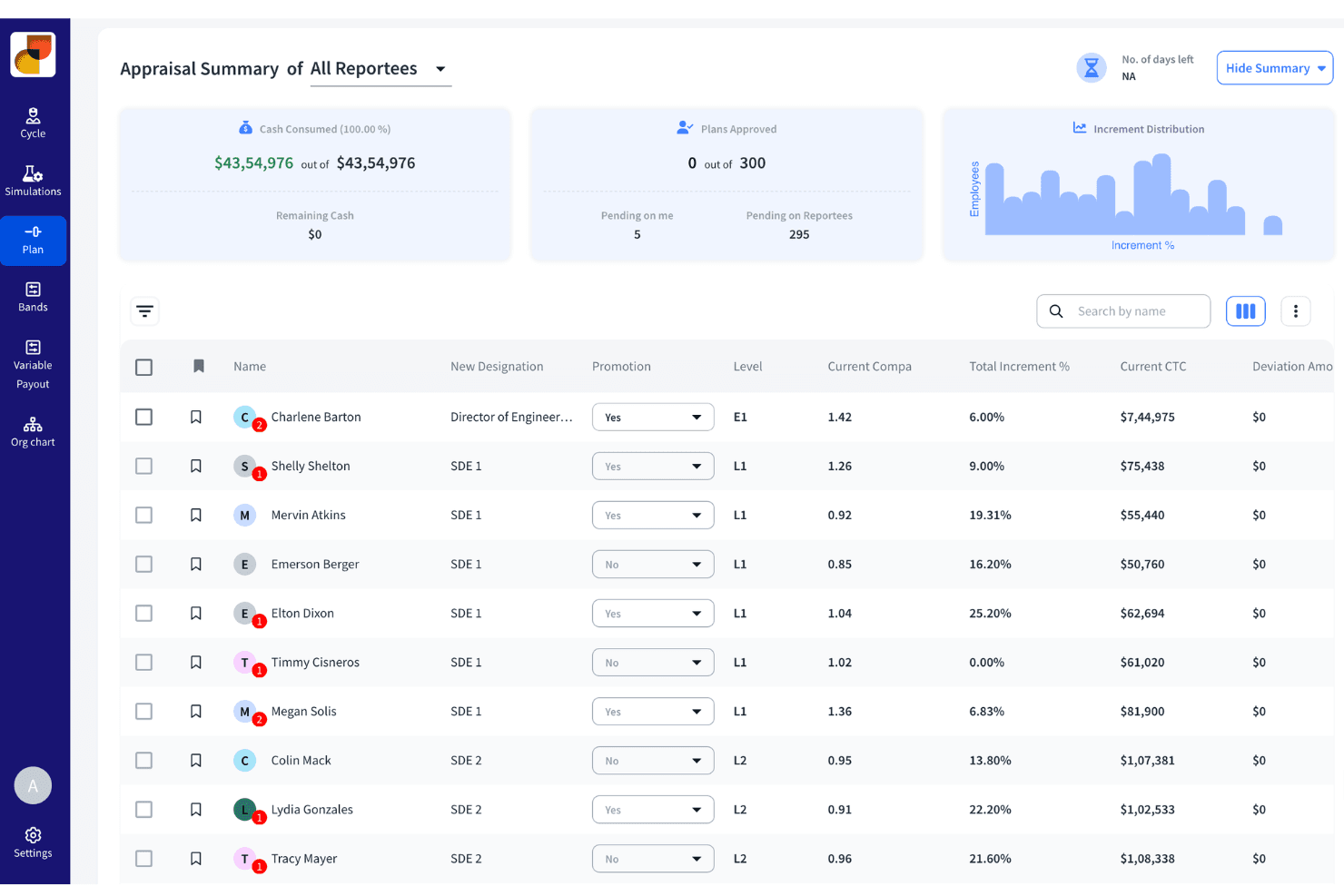
CompUp is a full stack comp management software with planning, budgeting, and communication of total rewards. CompUp is a compensation management platform that covers pay structure design, budget planning, review cycle workflows, pay equity analysis, benchmarking, and total rewards statements alongside candidate offer management.
Who Is CompUp Best For?
CompUp is a strong fit for HR and total rewards teams that need to manage the full compensation lifecycle—from candidate offers through annual review cycles and personalized rewards statements—in one place.
Why I Picked CompUp
I picked CompUp as one of the best because it's the only tool on my list that connects candidate offers and employee rewards in a single platform. I love how the HireSure.ai module lets you present a fully itemized offer—fixed pay, variable pay, equity, and benefits—with a GPT-powered chatbot that answers candidate questions about the role and compensation in real time. On the employee side, CompUp generates personalized total rewards statements that break down salary, bonuses, equity, and benefits by location and currency, so employees see the full value of their package rather than just their base pay.
CompUp Key Features
- Multi-level budget allocation: Distribute compensation budgets across multiple manager layers with configurable rules and guardrails for each level.
- Pay equity and bias detection: Automatically flag potential bias in compensation recommendations and identify pay gaps across your workforce.
- Salary band management: Build, store, edit, and share pay ranges by role, level, and geography with modular access for different stakeholder groups.
- Compensation benchmarking: Filter market data by location, industry, company stage, and headcount, and assemble a peer basket to compare your pay against similar organizations.
CompUp Integrations
CompUp reports integrations with over 50 HR systems and 15+ HR tech stacks, but doesn’t name vendors or clarify native or bidirectional connections. It also offers accessible APIs for custom integrations.
Pros and Cons
Pros:
- Connects candidate offers with personalized rewards statements
- Manager approvals include guardrails and bias flags
- Replaces spreadsheet-based compensation budgeting with simulations
Cons:
- Reviewers report occasional loading and runtime delays
- Benchmarking centers on Indian funded startups
Learn more about CompUp: Best for modeling pay-gap fixes within budget
- Free demo available
- Pricing upon request
Visit WebsiteCustomer Rating:4.7/5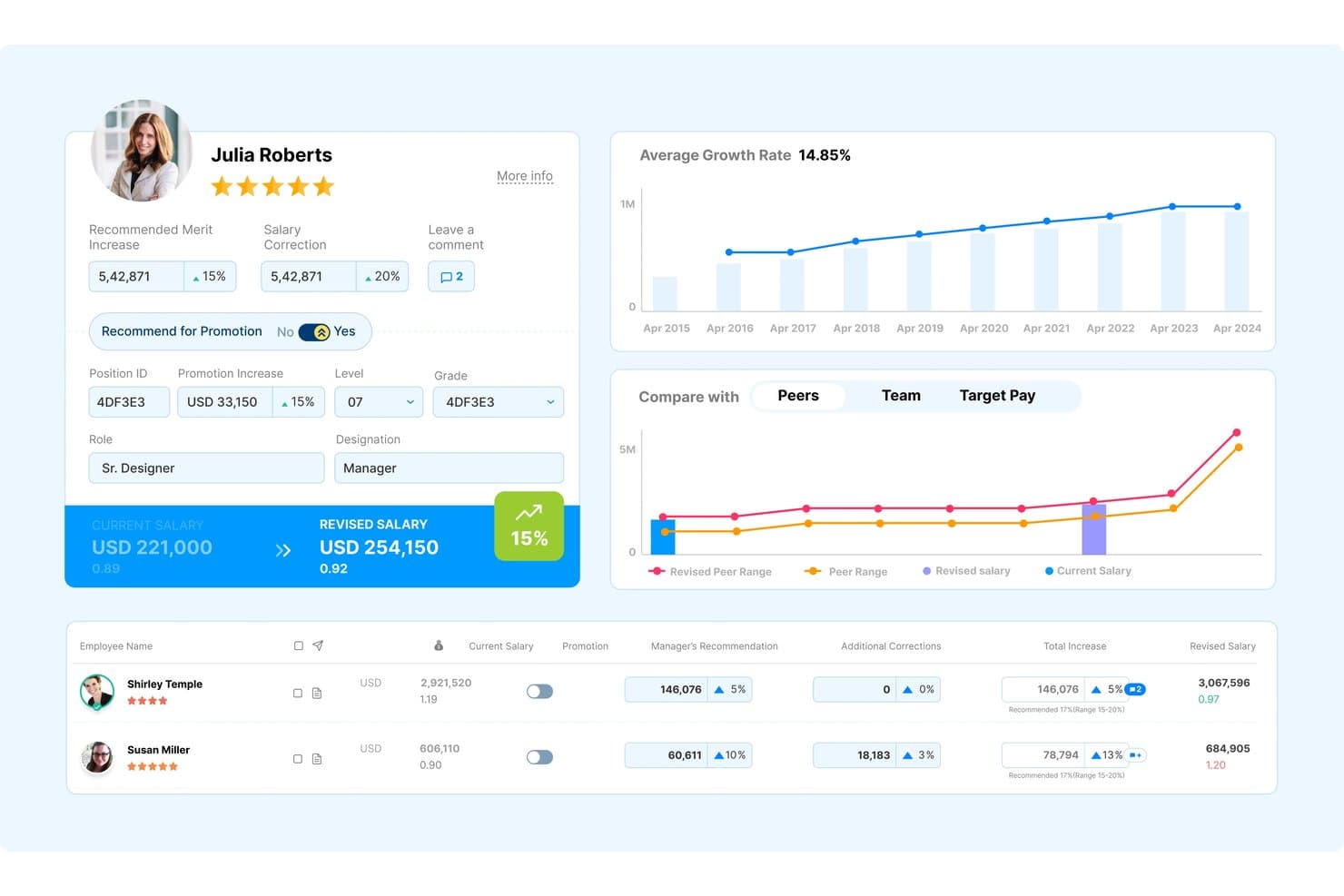
Compport lets users manage salary revisions and promotions in one dashboard. Compport is an AI-native compensation management platform that covers merit cycles, bonus planning, pay equity analysis, long-term incentives, total rewards statements, and sales incentive planning.
Who Is Compport Best For?
Compport is a strong fit for compensation managers and total rewards leaders at mid-to-large enterprises who need to run structured pay cycles, model pay-gap fixes, and manage multiple reward types in one platform.
Why I Picked Compport
I picked Compport as one of the best because it's the only tool I've seen that lets you model pay-gap fixes against a real budget constraint before committing to a plan. Its CompportIQ Comp Planner can build a multi-year merit plan to close pay gaps, show you the annual cost per year, and route it through approval workflows, all within your configured bands and rules. The pay equity dashboards go further by flagging statistical outliers and exporting a full auditor packet with the inputs and method behind each result.
Compport Key Features
- Total Rewards Statement: Employees can view salary, bonuses, equity, and benefits in a single personalized dashboard, with historical compensation changes and an equity-potential simulator.
- Sales incentive plan builder: Configure multiple sales schemes using a formula builder, map formulas to KPIs, and simulate potential earnings for each rep before launch.
- Prorated variable pay calculation: The bonus module calculates payouts based on each employee's historical assignments and time in role, handling mid-cycle changes automatically.
- Configurable LTI management: Set up grant and vesting schedules, apply performance-based vesting multipliers, and give employees visibility into their equity portfolio in one place.
Compport Integrations
Compport offers native integrations with ADP, Darwinbox, Oracle, SAP SuccessFactors, and Workday. It also lists integrations with BambooHR, UKG, and Salesforce, though their integration types aren't specified.
Pros and Cons
Pros:
- Model pay-gap fixes against annual budgets
- Salary, bonus, and LTI plans share workflows
- Reviewers report faster annual review processing
Cons:
- Third-party data updates can slow compensation work
- Rule setup requires familiarity with internal policies
Learn more about Compport: 10Best for human-reviewed AI pay decisions
beqom
- Free demo available
- Pricing upon request
Visit WebsiteCustomer Rating:4.4/5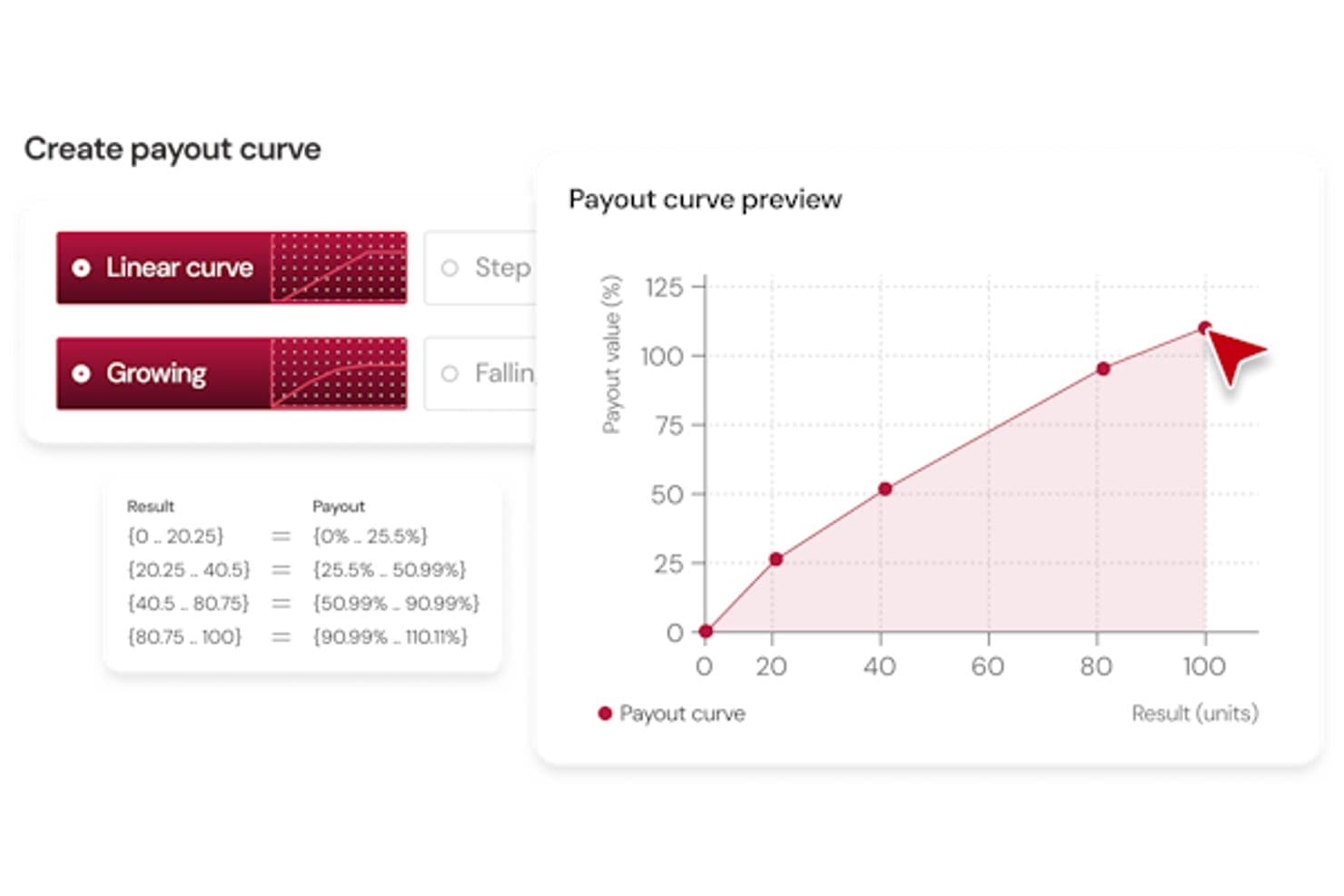
beqom lets users build custom payout curves for compensation plans. beqom is a compensation management platform that covers salary and merit reviews, short- and long-term incentives, pay equity analysis, and pay transparency, with built-in AI tools for pay recommendations and gap analysis.
Who Is beqom Best For?
beqom is a strong fit for large, global organizations where compensation teams need AI-generated pay suggestions with structured human review and sign-off at every step.
Why I Picked beqom
I picked beqom as one of the best because of how it handles AI pay recommendations without letting the AI have the final word. Tools like Comp Navigator generate pay suggestions for new hires, promotions, and merit reviews, while the Optimization Algorithm proposes raise allocations across your population. Every recommendation goes through manager review, HR validation, and a documented approval chain before anything is communicated to employees.
beqom Key Features
- Pay equity gap analysis: Analyzes pay structures and workforce demographics to flag equity issues and send prioritized pay-adjustment recommendations to HR and managers.
- Top-down budgeting: Models and cascades compensation budgets from the top down across countries and employee populations before review cycles begin.
- Digital reward statements: Gives employees localized, self-service access to personalized compensation information with tailored visibility and access controls.
- Configurable calculation workspace: A no-code environment for building and managing compensation logic, including bonus schemes, merit rules, and incentive calculations.
beqom Integrations
beqom integrates with Workday, SAP SuccessFactors, Oracle, UKG, and Dayforce, plus ADP Marketplace for pay-equity analysis. It also provides standard APIs for custom integrations.
Pros and Cons
Pros:
- Responsive support during urgent situations
- Handles complex incentives and calculation simulations
- Configurable global salary and bonus cycles
Cons:
- Heavy customization raises admin and implementation demands
- Reporting can obscure stalled approvals
Learn more about beqom:
Diğer Ücretlendirme Araçları
En iyi ücretlendirme yönetimi yazılımları listesine giremeyen birkaç seçenek aşağıda yer alıyor. Bunların her biri için kapsamlı bir incelemeye yer verecek kadar alanım olmadı, ancak yine de değerlendirmeye değerler:
- 11AssembleBest for benchmarking with Deel workforce data
- 12Decusoft ComposeBest for carried-interest pay plans
- 13LatticeBest for tying pay bands to job architecture
- 14TrinetBest for pay strategy with HR consultants
- 15HiBobBest for manager pay with finance guardrails
- 16WorkleapBest for linking pay bands across currencies
- 17OpenCompBest for linking headcount to equity dilution
- 18QobraBest for testing commission plans on past data
- 19CompeaseBest for comparing pay across locations
İlgili İK Yazılımı İncelemeleri
Aradığınızı burada hâlâ bulamadıysanız test edip değerlendirdiğimiz diğer ilgili araçlara göz atın:
- İK Yazılımı
- Bordro Yazılımı
- İşe Alım Yazılımı
- Kayıtlı İşveren Hizmetleri
- Aday Takip Sistemleri
- İşgücü Yönetimi Yazılımı
How I Evaluate Compensation Management Software
I split my evaluation into three parts, with the most weight on core functionality: setting pay bands, allocating merit budgets, and routing manager approvals. Next, I look for standout features such as pay simulation sandboxes for testing budget scenarios. Finally, I consider support, onboarding, and pricing value beyond the feature set.
Core Functionality (Table Stakes For This List)
When I'm selecting tools for my list, I score each one on a scale from 0 (does not offer the functionality) to 5 (excels in this area) for each core functionality listed below. I then convert the total into a percentage to help assess each tool's overall fit, with extra weight on any functionalities I’ve deemed essential.
- Compensation Planning (Essential): I look for budget allocation and tracking across departments, including how teams can model merit and bonus pools during annual reviews.
- Pay Structure Management (Essential): I assess whether teams can create and maintain salary bands by role, level, job family, or geography as the organization grows.
- Review Workflows: For annual cycles, I check for configurable approval steps, manager recommendations, decision tracking, and audit trails.
- Pay Equity Analysis: I look for analysis across demographic and role-based factors that helps HR identify pay gaps and assess potential adjustments.
- Market Benchmarking: I check how teams compare internal pay with external market data, including available survey sources and update options.
- Incentive Pay Modeling: I assess support for modeling bonuses, commissions, or equity and connecting incentive decisions with relevant performance data.
Once I have a list of tools that meet the criteria, I consider what sets each platform apart.
Differentiating Factors (What Sets Vendors Apart)
Here's how I compare and contrast different vendors:
Standout Features
I look for pay simulation sandboxes that let you model raise scenarios and see how each one shifts compa-ratios or widens equity gaps before anything hits payroll. Manager enablement tools matter just as much—I check whether the platform provides in-workflow talking points and guardrails so managers can explain pay decisions without HR scripting every conversation. I also evaluate total rewards statements, since a branded portal showing pay, benefits, and equity in one view gives employees context that a salary number alone can't.
Beyond Features
I check whether a vendor's HRIS and payroll connectors sync bidirectionally with platforms like Workday, ADP, or BambooHR, since one-way imports still leave teams reconciling data in spreadsheets mid-cycle. Data security matters just as much—I look for role-based access controls, field-level permissions, and SOC 2 compliance so salary details stay visible only to authorized reviewers. I also evaluate how well each platform scales across currencies, languages, and multi-entity structures for organizations expanding into new regions.
Ücretlendirme Yönetimi Yazılımı Nasıl Seçilir?
Yazılıma, ekibinizin gerçekten yönetmesi gereken ücretlendirme süreçlerini eşleştirerek başlayın; bunlar maaş incelemeleri, ikramiyeler, ücret eşitliği, kıyaslama veya karmaşık teşvik planları olabilir. Ardından entegrasyonlar, uyumluluk desteği, raporlama, ölçeklenebilirlik ve kullanım kolaylığı gibi faktörleri karşılaştırın.
Özel ihtiyaçlarınıza göre seçeneklerinizi daraltmak için aşağıdaki aracımızı deneyin.
Daha ayrıntılı bir açıklama için ücretlendirme yönetimi yazılımının nasıl seçileceğine ilişkin rehberimize göz atın.
Ücretlendirme Yönetimi Yazılımının Özellikleri
Çalışan ücretlendirmesini yönetmek; maaşlar, komisyonlar, ikramiyeler ve ücret düzenlemeleri gibi pek çok hareketli parçayı içerir ve doğru araçlar olmadan tüm bunlar kısa sürede bunaltıcı hâle gelebilir. Ücretlendirme yönetimi yazılımı bu süreçleri basitleştirmeye ve çalışanlara adil, zamanında ve şirket politikalarıyla uyumlu şekilde ödeme yapılmasını sağlamaya yardımcı olabilir.
Bir çözüm seçerken göz önünde bulundurmanız gereken en önemli özellikler şunlardır:
- Özelleştirilebilir ücretlendirme planları, farklı roller için uyarlanmış ücret yapıları oluşturmanıza olanak tanıyarak benzersiz komisyon ve ikramiye planlarını yönetmeyi kolaylaştırır
- Dinamik ücret politikası araçları, çalışan türlerini departmanlar, ekipler, beceri grupları, coğrafi konumlar ve diğer ilgili değişkenlere (ör. ücret bantları) göre birbirinden ayırır
- Maaş kıyaslama verileri küresel kaynaklardan sağlanır; böylece küresel maaş dalgalanmalarına rağmen ücret oranlarınızın her zaman rekabetçi kalmasını sağlayabilirsiniz
- Toplam ücret yönetimi ve sunum araçları (ör. yeni işe alınanlar için açıklayıcı veya görsel iş teklifleri)
- Veri içgörüleri, iş gücünüzün demografik özellikleri genelinde ücret eşitliğini izler (ör. çeşitlilik, eşitlik ve kapsayıcılık (DEI) metriklerinin takibi)
- Teşvik özellikleri, ücretlendirme kararlarını performans yönetimi, verimlilik veya hedefe dayalı verilerle ilişkilendirir
- İş akışı onay otomasyonları, maaş değişikliklerini veya ikramiyeleri onaylama sürecini kolaylaştırarak gecikmeleri azaltır ve uygun denetimi sağlar
- Self servis işlevleri, çalışanların ücret bilgilerine, vergi belgelerine ve ücret dökümlerine erişmesini sağlayarak şeffaflığı artırır ve idari soruları azaltır
- İK, bordro ve muhasebe sistemleriyle entegrasyon, İK teknoloji ekosisteminiz genelinde verilerin sorunsuz şekilde akmasını sağlayarak tekrarları ve hataları azaltır
Doğru ücretlendirme yönetimi yazılımını seçmek; süreçleri basitleştiren, doğruluğu sağlayan ve ücretlendirmeyi performansla uyumlu hâle getirmeye yardımcı olan bir çözüm bulmakla ilgilidir. Bu özelliklerle, maaşları, komisyonları ve ikramiyeleri yönetme biçiminizi iyileştirirken en önemli konuya (ekibinize) odaklanabilirsiniz.
Ek Kaynaklar
Yüksek nitelikli yetenekleri çekmek ve elde tutmak için başka yollar mı arıyorsunuz? Kuruluşunuz bünyesinde birinci sınıf ücretlendirme ve çalışan bağlılığı uygulamaları geliştirmenize yardımcı olacak en iyi kaynaklarımızdan bir derleme:
- Otomatik Ödüllendirme için En İyi Çalışan Yan Hakları Programları
- En İyi Yetenek Yönetimi Sistemleri
- En İyi Yetenekleri Çekmek ve Elde Tutmak için 10 Özgün Çalışan Sağlığı Programı Fikri
- En İyi Çalışan Bağlılığı Yazılımları
- Ücret Farkına Dikkat: Pivot HR Services'tan Robin Turnill ile bir podcast
- Her İK Profesyonelinin Bilmesi Gereken En İyi Performans Yönetimi Araçları
- Bilmeniz Gereken 20 Çalışan Yan Hakları Türü
- Çalışan Yan Haklarının Maliyeti