

Global payroll services in Germany are payroll platforms designed to pay employees in Germany accurately while meeting all local and international compliance requirements. If you’re supporting a workforce across German borders, you know how tricky payroll, German tax rules, and ever-changing regulations can get.
This guide highlights solutions that help HR teams automate filings, sync with HR software, and manage payroll for both local German staff and global teams. You’ll find options for everything from compliance and analytics to transparent pricing and fast integrations—making it easier for you to handle payroll complexity as your business grows.
Why Trust Our Software Recommendations
6,700+
Reviews
20
Industry experts
16+
Evaluation factors
14
Years reviewing software
Our team has been testing and reviewing software since 2012. As HR experts ourselves, we know how difficult—and important—it is to choose the right software.
For this guide, we evaluated tools using hands-on testing and independent research, scoring tools using our selection criteria. We also draw on insights from industry thought leaders and practicing HR experts.
Our reviews reflect our human editorial judgment, not a sales pitch.
Expert reviewers:
- Phil GrayCOO
 Kim BehnkeHR Tech Editor & Analyst
 Josh BarkerPeople Ops Manager

Global Payroll Services in Germany Comparison Table
The table below compares pricing details for my top global payroll services in Germany.
Score legend (out of 5)
- Excellent4.5–5
- Good4–4.4
- Average3–3.9
- Below average2–2.9
- Poor1–1.9
Sorted by: Default
| Tool | Starting Price | Website | |||||||
|---|---|---|---|---|---|---|---|---|---|
Best for multi-country EOR payroll at scale | 3.5 out of 5 | 4 | 3 | 4 | 4 | 3 | 3 | $599/user/month Free demo available | Website |
Best for EOR via a wholly-owned German entity | 3.2 out of 5 | 3 | 3 | 3 | 4 | 2 | 4 | $29/user/month Free demo available | Website |
Best for low-cost contractor payroll for Germany | 1.7 out of 5 | 2 | 1 | 2 | 1 | 1 | 3 | $399/user/month Not available | Book Demo |
Best for compliant German payroll for SMBs | 3.0 out of 5 | 3 | 3 | 4 | 2 | 2 | 4 | $20/user/month Free demo available | Website |
Best for cross-partner payroll reconciliation | Not rated | 2 | 2 | 3 | 2 | Not rated | 4 | $199/user/month Free plan + demo available | Website |
Best for AI answers to payslip questions | 2.8 out of 5 | 3 | 2 | 3 | 3 | 2 | 4 | Pricing upon request Free demo available | Website |
Best for salary and authority payment tracking | 3.5 out of 5 | 3 | 3 | 4 | 4 | 2 | 5 | $29/user/month Free demo available | Website |
Best for testing payroll provider switches | 3.3 out of 5 | 3 | 3 | 3 | 4 | 3 | 4 | $599/user/month Free demo available | Website |
Best for German employer cost forecasting | 3.3 out of 5 | 4 | 3 | 2 | 3 | 4 | 4 | $500/employee/month Not available | Website |
Best for German Kurzarbeit administration | 3.7 out of 5 | 4 | 4 | 3 | 3 | 4 | 4 | $299/per employee/month Free demo available | Website |
Best for keeping existing providers | 3.3 out of 5 | 3 | 3 | 4 | 4 | 2 | 4 | €19/employee/month Free demo available | Website |


Global Payroll Services in Germany Reviews
Below are my detailed summaries of the best global payroll services in Germany that made it onto my shortlist. My reviews offer a detailed look at the features, compliance capabilities, and pricing of each platform to help you find the best one for you.
 1Best for multi-country EOR payroll at scale
G-P
- Free demo available
- From $599/user/month
Visit WebsiteCustomer Rating:4.5/5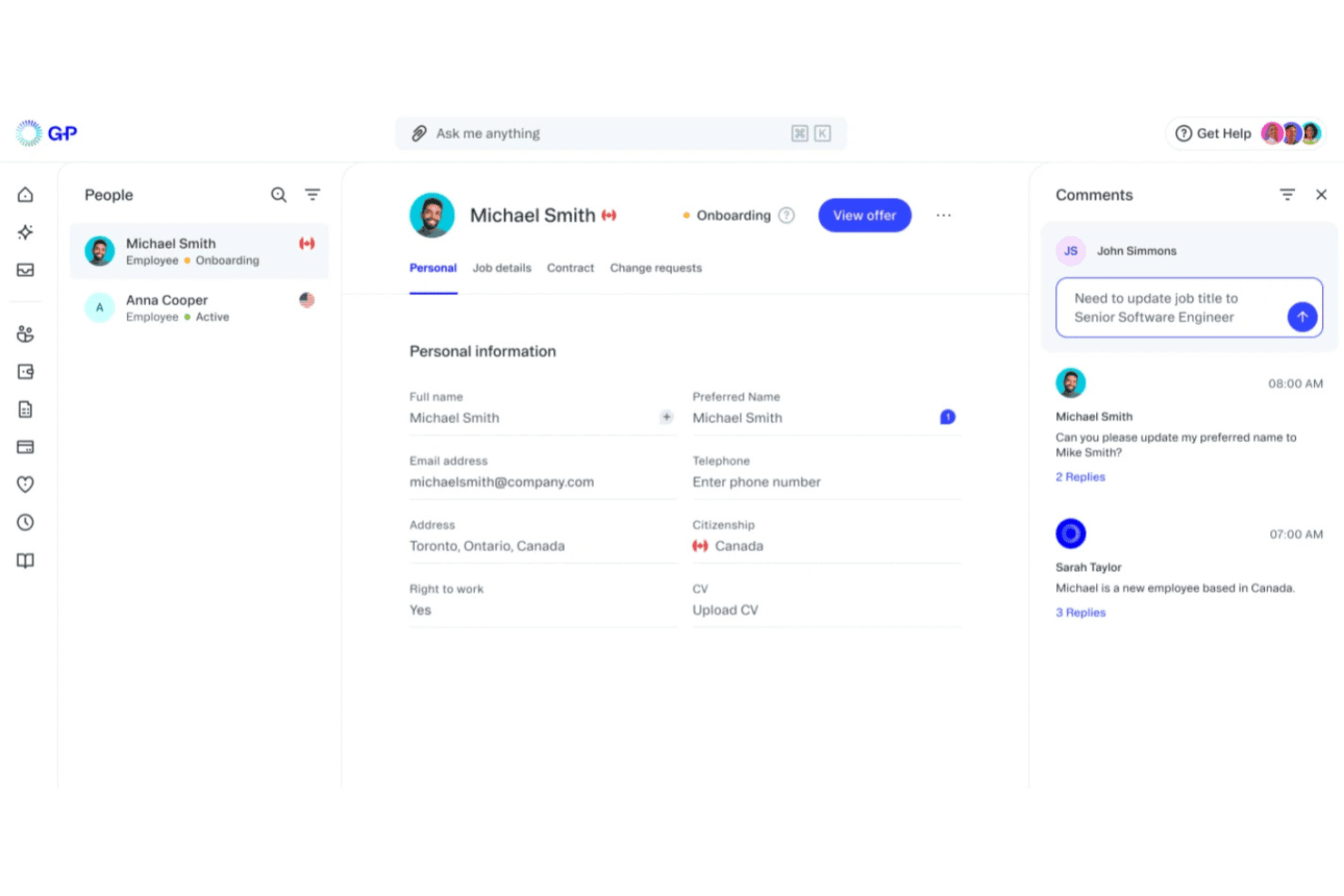
G-P centralizes employee onboarding profiles with collaborative comments. G-P is a global employer of record (EOR) platform that manages employment contracts, payroll processing, statutory compliance, and HR administration across 180+ countries, including Germany, without requiring you to set up a local legal entity.
Who Is G-P Best For?
G-P is a strong fit for multinational companies hiring across several countries at once, with Germany as one stop on a broader global expansion.
Why I Picked G-P
I've included G-P in my top picks because it's the clearest choice when Germany is just one country on a longer hiring list. Its AÜG license means it can legally act as the employer of record in Germany without you setting up a GmbH, while the same platform covers 180+ countries under a single invoice. I also like G-P Gia, its AI compliance agent, which monitors German regulatory changes like social contribution threshold updates and flags them before they affect your payroll runs.
G-P Key Features
- G-P Gia™ AI compliance agent: Monitors employment law changes across 180+ countries in real time and flags updates—like German social contribution threshold changes—before they affect your payroll runs.
- ELStAM integration: Retrieves each German employee's tax class and church tax obligation directly from Germany's electronic tax card system to calculate Lohnsteuer withholding accurately.
- Multi-currency payroll consolidation: Processes payroll across all active countries and currencies under a single invoice, with payments supported in 150+ currencies.
- G-P Assist 24/7 support: Connects you to live HR, employment, and payroll specialists around the clock for Germany-specific guidance on contracts, contributions, and compliance questions.
G-P Integrations
G-P offers native integrations with Workday, SAP SuccessFactors, SAP BTP, BambooHR, HiBob, Personio, and UKG. Its open API supports custom integrations, but DATEV integration isn't documented.
Pros and Cons
Pros:
- Real-time German compliance alerts via AI
- Manages 180+ countries under one invoice
- Germany payroll covered with AÜG license
Cons:
- Lacks DATEV and ELSTER automation features
- No standalone payroll for existing GmbH
Learn more about G-P: Best for EOR via a wholly-owned German entity
- Free demo available
- From $29/user/month
Visit WebsiteCustomer Rating:4.8/5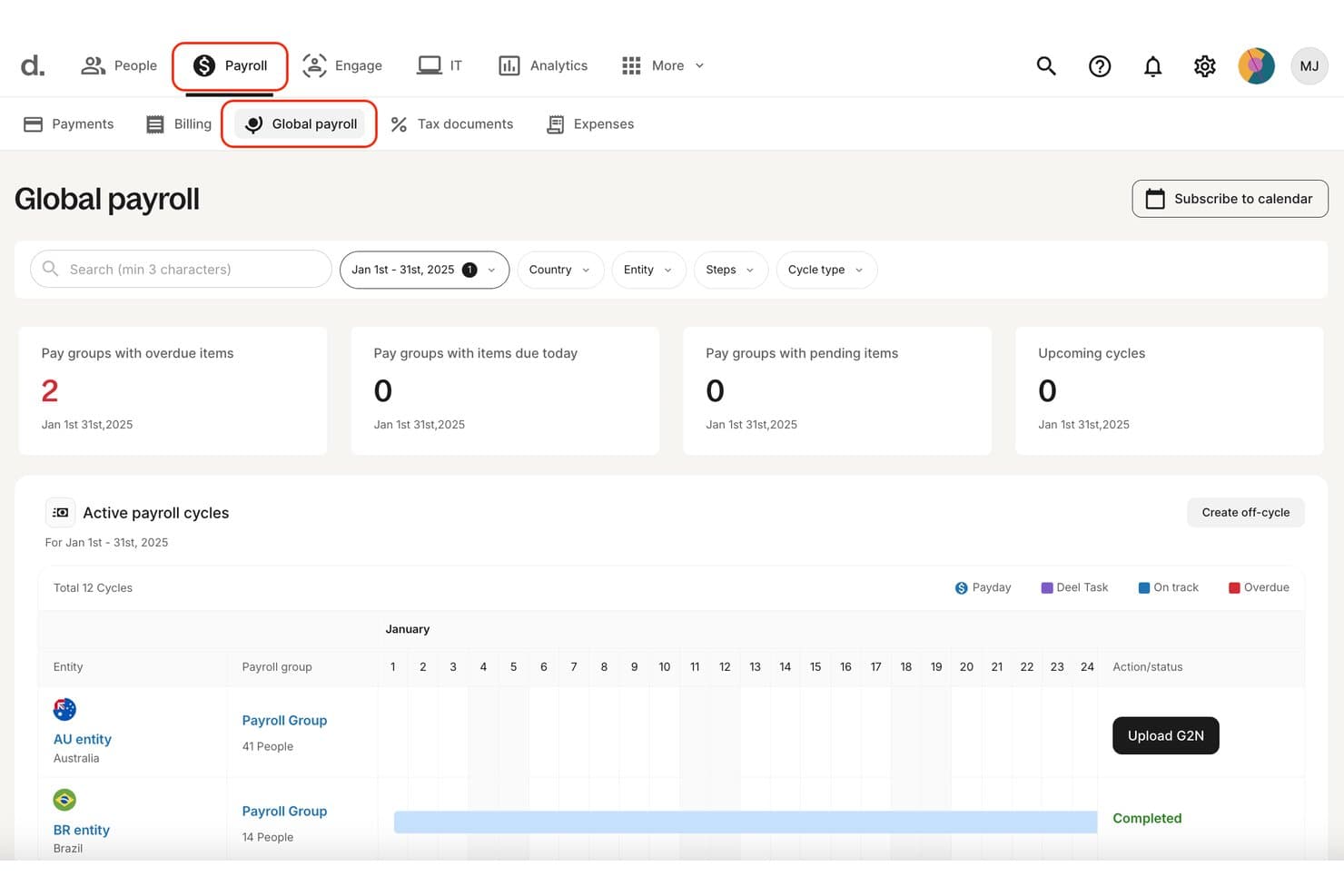
Deel Payroll tracks active payroll cycles across global entities in one view. Deel Payroll is a global payroll and employer of record platform that handles payroll processing, statutory compliance, and multi-country workforce management across 130+ countries, with both EOR and entity-based payroll options for Germany.
Who Is Deel Payroll Best For?
Deel Payroll is a strong fit for multinationals that need to hire in Germany without setting up a local entity, then scale into direct entity payroll as headcount grows.
Why I Picked Deel Payroll
I picked Deel Payroll as one of the best because it operates a wholly-owned German GmbH for EOR, not a third-party partner arrangement, which means full compliance accountability sits with Deel directly. I've seen this matter in practice: when Lohnsteuer filings hit the Finanzamt via ELSTER or social insurance reports go through DEÜV, there's no intermediary absorbing the liability. Companies can also transition from EOR to entity-based global payroll as headcount scales, without switching vendors.
Deel Payroll Key Features
- Continuous Compliance monitoring: Automatically tracks and applies German regulatory updates, including minimum wage changes and social contribution rate adjustments, before each payroll run.
- AI-powered anomaly detection: Scans payroll data ahead of each run to flag missing inputs, calculation errors, and legal risks specific to German statutory requirements.
- DATEV export integration: Generates DATEV-compatible accounting files for direct use by German tax advisors and local finance teams.
- Multi-language payslip generation: Produces German-compliant payslips (Gehaltsabrechnung) in both German and English to serve in-country employees and international HQ teams simultaneously.
Deel Payroll Integrations
Deel Payroll offers integrations with QuickBooks, Xero, BambooHR, Expensify, NetSuite, Sage Intacct, Greenhouse, Workday, SAP, and ADP, among others available through its app store. It also connects with Zapier and provides an API for custom integrations.
Pros and Cons
Pros:
- Multi-language German-compliant payslip generation
- Direct electronic filings to German authorities
- EOR via wholly-owned German GmbH entity
Cons:
- No automated Kurzarbeit payroll workflow
- Cannot administer company car Sachbezüge under EOR
Learn more about Deel Payroll: Best for low-cost contractor payroll for Germany
- Not available
- From $399/user/month
Customer Rating:4.5/5
HireGlobal's dashboard centralizes global worker onboarding and payroll scheduling. HireGlobal is Toptal's global employer of record and payroll platform that covers contractor management, hiring, onboarding, compliance, and workforce payments across 180+ countries through AOR, Virtual EOR, and Local EOR models.
Who Is HireGlobal Best For?
HireGlobal is a strong fit for companies hiring their first employees in Germany who want EOR coverage at a lower price point than most established providers.
Why I Picked HireGlobal
I've included HireGlobal in my top picks because it's one of the most affordable ways to bring on your first employee in Germany without committing to a high-cost EOR contract. It covers German tax, benefits, and statutory compliance through a vetted local partner network. I also find the Virtual EOR model genuinely interesting: it bundles up to $1 million in compliance indemnification per worker, which gives you real legal protection while you're still figuring out your German hiring footprint.
HireGlobal Key Services
- Consolidated single invoicing: Clients receive one invoice covering all workers, regardless of country or currency, reducing payroll admin across multi-country teams.
- Agent of Record (AOR) contracts: HireGlobal generates compliant contractor agreements through its AOR model, reducing worker misclassification risk from the first hire.
- SOC 2-certified data security: The platform meets all five SOC 2 Trust Service Criteria, with end-to-end encryption and isolated virtual environments protecting worker and payroll data.
- TopTracker time tracking integration: Native integration with Toptal's time tracking tool connects logged hours directly to invoice approval and payment workflows.
HireGlobal Integrations
HireGlobal has one documented native integration: TopTracker. Other native integrations and API are not clearly documented.
Pros and Cons
Pros:
- Consolidated invoicing simplifies global payroll management
- Unique $1M compliance indemnification per hire
- Covers hiring in over 180 countries
Cons:
- German compliance depends on local partners only
- No Germany-specific statutory reporting features
Learn more about HireGlobal: Best for compliant German payroll for SMBs
- Free demo available
- From $20/user/month (billed annually)
Visit WebsiteCustomer Rating:4.7/5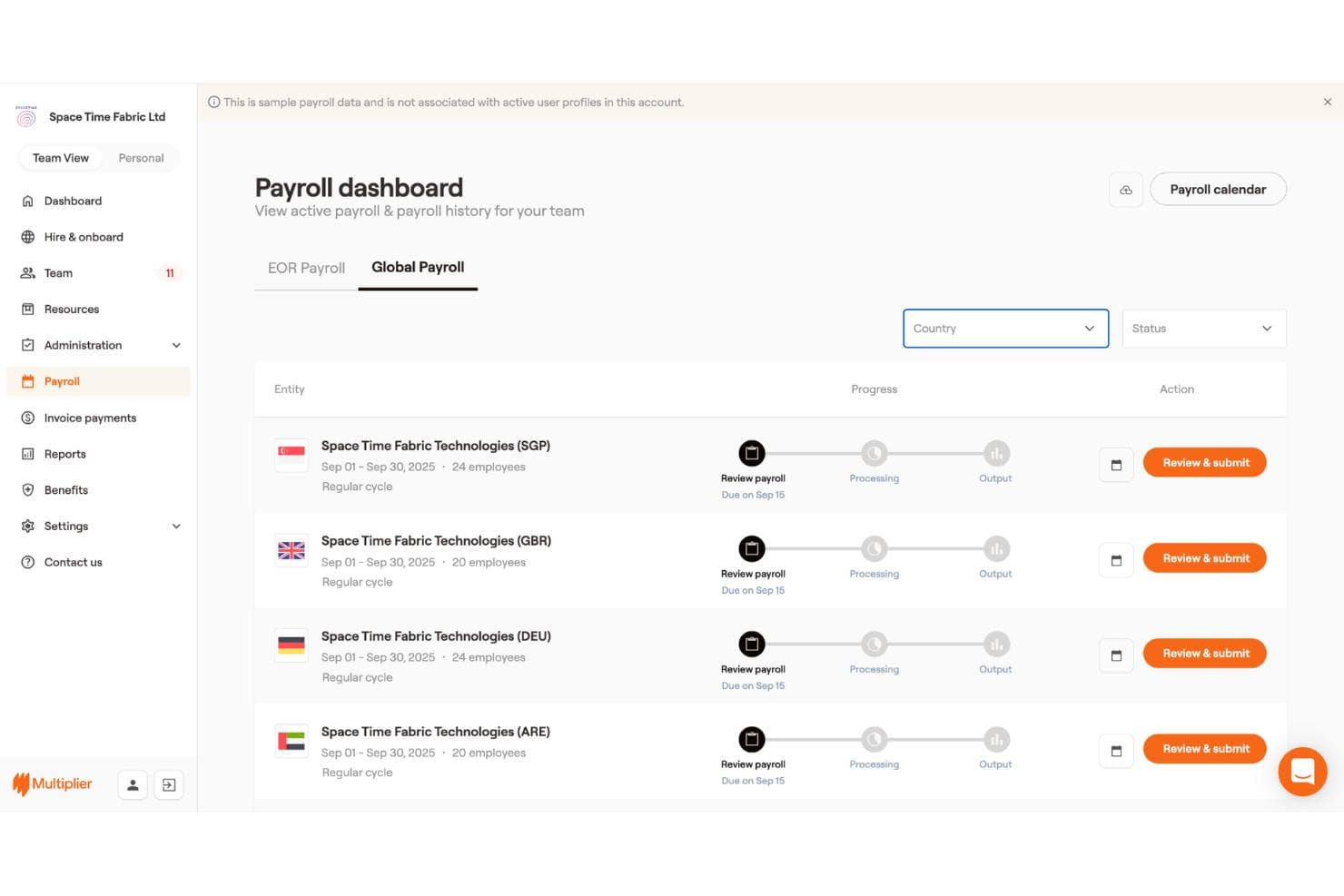
Multiplier centralizes global payroll across multiple countries, including Germany, in one dashboard. Multiplier is a global employment platform that handles multi-country payroll, EOR arrangements, and statutory compliance across 100+ countries from a single dashboard.
Who Is Multiplier Best For?
Multiplier is a strong fit for SMBs hiring in Germany without a local entity, especially those managing payroll across multiple countries simultaneously.
Why I Picked Multiplier
I've included Multiplier in my top picks because it handles German statutory payroll compliance without requiring a local entity. I like how it automatically calculates Lohnsteuer, Solidaritätszuschlag, and the full ~40% social contribution split across health, pension, unemployment, and care insurance. My team can run German payroll alongside 100+ other countries from a single dashboard, which removes the complexity of managing separate in-country providers.
Multiplier Key Services
- Unified multi-country payroll dashboard: Manage and process payroll for over 100 countries, including Germany, from a single interface.
- German-compliant payslip generation: Automatically create German Gehaltsabrechnung and Lohnsteuerbescheinigung with required statutory fields in local language.
- Native HRIS integrations: Connect with platforms like BambooHR, HiBob, Personio, SAP SuccessFactors, and Workday for streamlined data sync.
- EOR or entity payroll flexibility: Switch between Employer of Record and direct entity payroll for German hires as your business structure evolves.
Multiplier Integrations
Native integrations are not publicly listed.
Pros and Cons
Pros:
- Fast German employee onboarding process
- Supports EOR without a German entity
- Automated Lohnsteuer and social contribution calculations
Cons:
- Customer support response times can lag
- ELSTER filing not fully automated
Learn more about Multiplier: Best for cross-partner payroll reconciliation
- Free plan + demo available
- From $199/user/month
Visit WebsiteCustomer Rating:4.5/5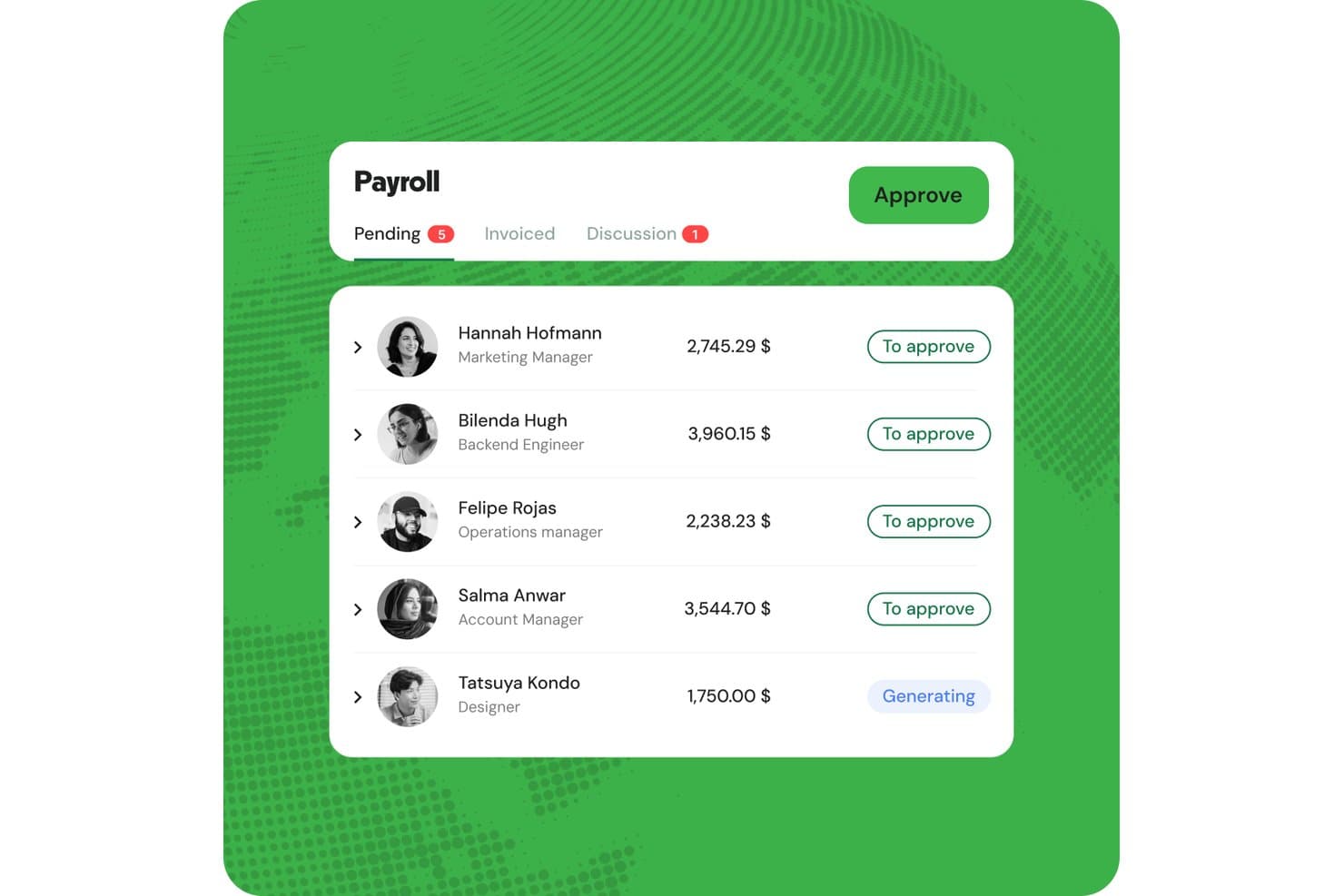
RemoFirst lets users review and approve global payroll in one place. RemoFirst is a global payroll platform that consolidates international employee and contractor management, multi-currency payments, and local benefits administration into a single approval workflow.
Who Is RemoFirst Best For?
RemoFirst suits finance and payroll teams managing distributed international workforces who need multi-country payroll consolidated into a single approval and payment workflow.
Why I Picked RemoFirst
I picked RemoFirst as one of the best because of how it handles cross-partner payroll reconciliation through its RemoAI Payroll Agent, which flags discrepancies across partners, clients, and payouts in near real time. When your team is running payroll across Germany and several other countries simultaneously, that kind of automated discrepancy detection reduces the manual review burden significantly. I also like that global payroll spend consolidates into a single approval workflow, with EUR invoicing issued around the 15th of each month.
RemoFirst Key Features
- Global workforce dashboard: View all employees and contractors in one place, with visibility into worker locations, classification, and payroll spend across countries.
- Local-currency employee payments: Pay employees in their local currency while tracking total payroll spend in a single currency of your choice.
- Local benefits administration: Manage time-off requests, yearly bonuses, and financial benefits calculated according to each country's local laws.
- HRIS integrations: Connect RemoFirst with Workday, BambooHR, and ADP Workforce Now to sync global workforce data across your existing HR stack.
RemoFirst Integrations
RemoFirst offers four native integrations: Workday, BambooHR, GoCardless for payroll funding, and ADP Workforce Now.
Pros and Cons
Pros:
- Many reviewers praise responsive account support
- Reviewers report punctual local-currency payments
- Cross-country payroll approvals reduce reconciliation work
Cons:
- Some users report slow legal-case resolution
- German statutory calculations and filings remain unclear
 Best for AI answers to payslip questions
- Free demo available
- Pricing upon request
Customer Rating:4.9/5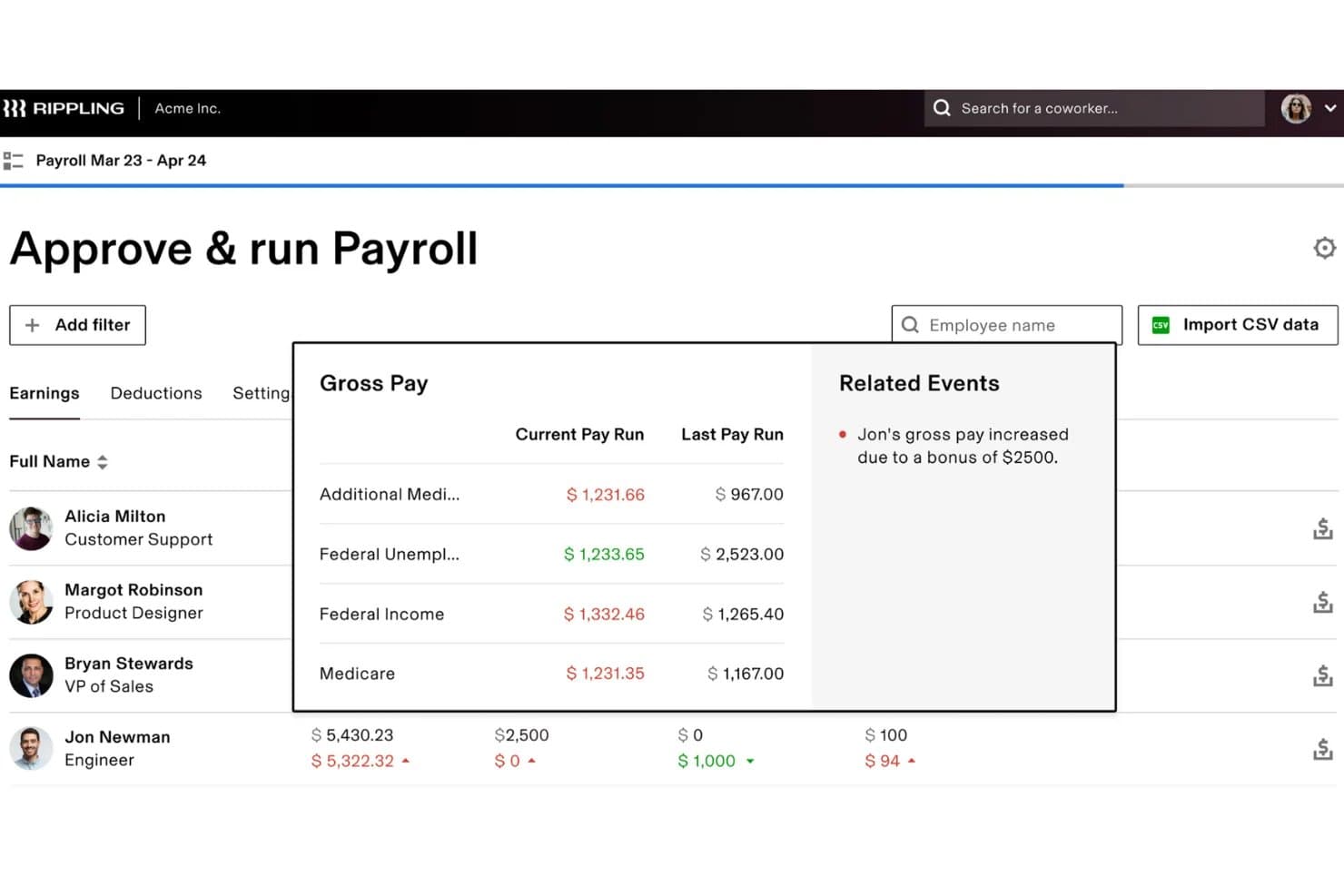
Rippling automates payroll for accurate, compliant, and time-saving processing in Germany. Rippling is a global payroll platform that lets you run payroll for employees and contractors across 180+ countries—including Germany—from a single system, with built-in EOR hiring, cross-country workforce reporting, and automated data sync from HR, time tracking, and benefits.
Who Is Rippling Best For?
Rippling suits HR and payroll teams at mid-sized companies that need to hire and pay employees across multiple countries from one platform, without setting up local entities in each market.
Why I Picked Rippling
I picked Rippling as one of the best because of how it handles employee payslip questions through AI. If a German employee notices a difference between two payslips—say, a change in church tax deductions—they can ask Rippling AI directly instead of emailing HR. That alone saves real back-and-forth time. I also like that Rippling runs payroll across 180+ countries in one flow, so your German hires sit alongside the rest of your global workforce in a single system.
Rippling Key Features
- EOR-based German hiring: Hire German employees without setting up a local entity, with Rippling handling tax withholding, social insurance, and compliance under the EOR model.
- Cross-country workforce reporting: Build dashboards that compare payroll costs, compensation, and workforce data across Germany and other countries in one view.
- Automated payroll data sync: HRIS, time-tracking, benefits, and expense data feed into payroll automatically, reducing manual data entry across your global team.
- Role-based payroll permissions: Define which team members can access payroll data, approve hours, or run payroll, giving you control over who touches sensitive information.
Rippling Integrations
Rippling lists 600+ out-of-the-box integrations, including Slack, Zendesk, Google Workspace, and Cylance. It also offers a REST API and webhooks for custom integrations.
Pros and Cons
Pros:
- Reviewers value accessible paystubs and tax forms
- EOR handles German tax and social withholding
- AI answers reduce payslip-question back-and-forth
Cons:
- Users report slow, inconsistent support responses
- Reviewers report difficult payroll reporting
 Best for salary and authority payment tracking
- Free demo available
- From $29/user/month
Visit WebsiteCustomer Rating:4.4/5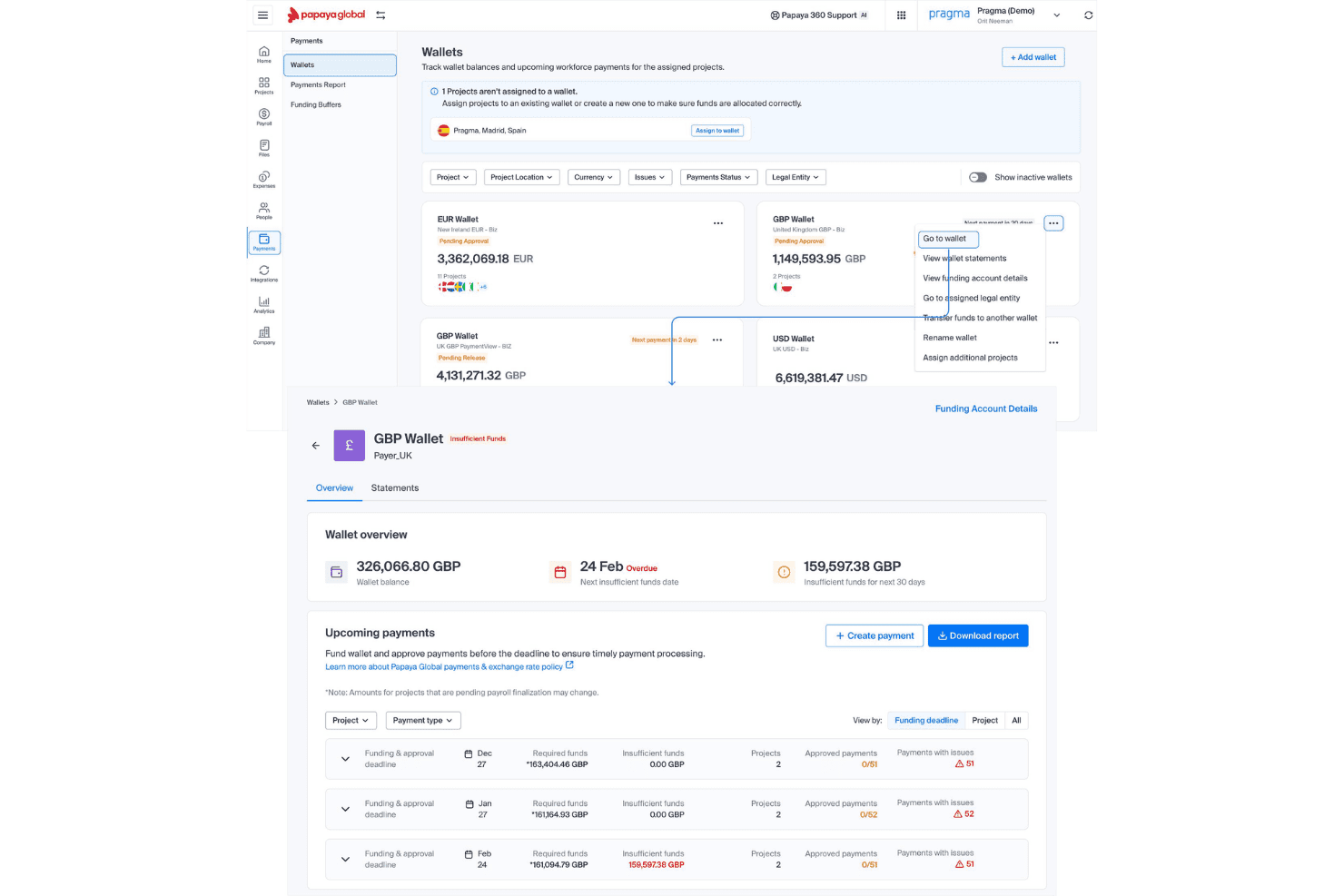
Papaya Global brings wallet balances and upcoming payroll payments into one view. Papaya Global is a global payroll platform that covers payroll processing, statutory payments, compliance monitoring, and workforce data consolidation across 180+ countries, with dedicated EUR payment routing and real-time cost visibility for German payroll operations.
Who Is Papaya Global Best For?
Papaya Global is a strong fit for multinational teams that need clear visibility into salary payments and authority disbursements across multiple countries from a single platform.
Why I Picked Papaya Global
I picked Papaya Global as one of the best because of how clearly it separates salary payments from authority disbursements, giving you a real-time view of both in a single dashboard. Its Germany payments guide tracks specific EUR routes, including an INSTANT RTP option with a 16:00 cutoff, alongside monthly deadlines for named authorities like Finanzamt Charlottenburg and specific health insurers. I also like that 100% payment liability coverage backs every transaction, so if a German statutory payment goes wrong, it's on Papaya, not your team.
Papaya Global Key Features
- AI payroll validation: Analyzes salary updates, gross-to-net reports, and local compliance requirements before each payroll run, then flags issues and suggests corrective actions.
- OneData ingestion: Pulls workforce data from HRIS, ERP, time-and-attendance systems, flat files, and Excel into a single normalized data layer ahead of each payroll cycle.
- Compliance engine with regulatory alerts: Automatically reflects local statutory updates in the platform and notifies your team of any items requiring action across supported countries.
- 100% payment liability coverage: Transfers financial responsibility for employee and statutory payment errors to Papaya Global, removing that risk from your team.
Papaya Global Integrations
Papaya Global offers native integrations with Workday HCM, SAP SuccessFactors, Oracle HCM, BambooHR, and Personio, plus time-and-attendance systems. OneData supports HCM, HRIS, ERP, and Excel sources, while a REST API supports custom integrations.
Pros and Cons
Pros:
- Users report helpful compliance guidance
- Reviewers value consolidated payroll and cost visibility
- Reviewers praise timely cross-border salary payments
Cons:
- Support delays surface on urgent, complex cases
- German ELStAM and DEÜV filing support unconfirmed
Learn more about Papaya Global: Best for testing payroll provider switches
- Free demo available
- From $599/user/month (billed annually)
Customer Rating:2.9/5
Remote payroll run dashboard showing breakdown by salary, incentives, and expenses. Remote is a payroll and employment provider that runs multi-country payroll—including Germany—through a single platform, handling gross-to-net calculations, tax filings, statutory contributions, and HRIS integrations across 100+ countries.
Who Is Remote Best For?
Remote is a strong fit for global payroll managers who need to consolidate multi-country payroll operations across a single platform while keeping costs predictable.
Why I Picked Remote
I've included Remote in my top picks because its structured parallel-run process makes it one of the more practical options when you're switching Germany payroll providers. Before go-live, Remote runs one to two parallel test sets using your existing inputs, reconciles the outputs against your current reports, and even sends a €0.01 test payment to employees so you can confirm the payment flow works before committing. That kind of controlled handover reduces the risk of a messy cutover when moving German employees from one payroll system to another.
Remote Key Features
- Multi-country payroll calendar: Manage payroll cut-offs and off-cycle runs across all your countries, including Germany, in a single payroll calendar.
- Cost-center reporting: Break down payroll reports by country, entity, and cost center, with general-ledger export for finance-system reconciliation.
- HRIS data sync: Native integrations with Workday, BambooHR, Personio, HiBob, NetSuite, and Xero automatically sync employee, time-off, and expense data to payroll.
- Self-serve or managed payroll: Choose between running payroll yourself or handing it to a Remote specialist, with the option to switch between both modes.
Remote Integrations
Remote offers native integrations with Workday, BambooHR, Personio, HiBob, NetSuite, and Xero for syncing payroll, time, and expense data. It also supports API, webhooks, and SDKs for custom integrations.
Pros and Cons
Pros:
- Country and cost-center payroll reporting
- Reviewers report timely employee payments
- Parallel payroll tests reduce switch risk
Cons:
- Complex support requests can take longer to resolve
- Reviewers report payslip errors after sick-time updates
 Best for German employer cost forecasting
- Not available
- Typically from ~$500/employee/month
Visit WebsiteCustomer Rating:5/5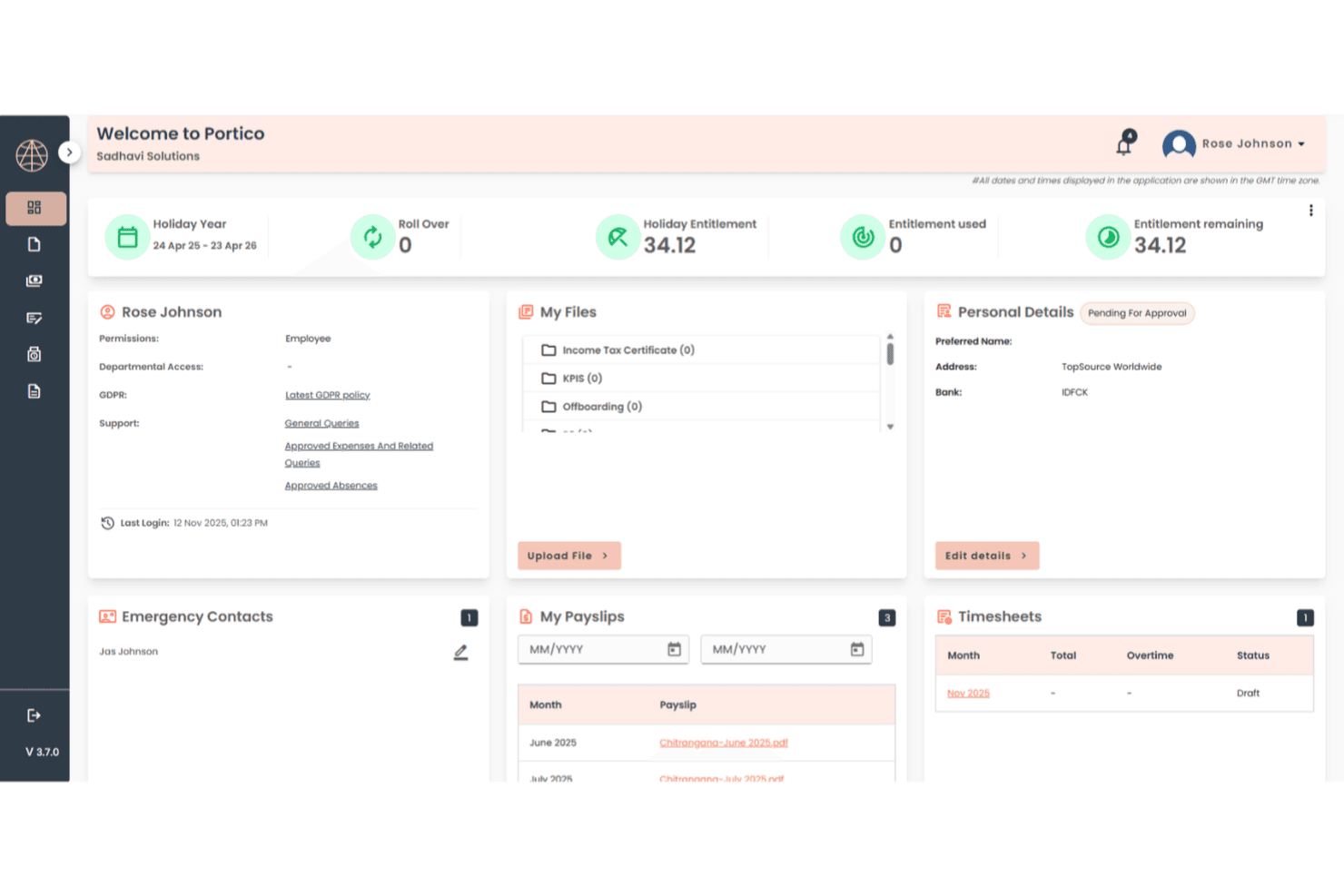
TopSource centralizes payroll, timesheets, and payslips in one dashboard. TopSource is a managed global payroll service that runs payroll across 164 countries through its Portico platform, with a particular depth in German statutory compliance, employer cost calculation, and EOR-to-entity transition support.
Who Is TopSource Best For?
TopSource is a strong fit for international expansion leads and global payroll managers who need detailed German employer cost visibility alongside a clear path from EOR employment to a registered entity.
Why I Picked TopSource
I picked TopSource as one of the best because its German employer cost forecasting goes deeper than most providers I've looked at. It breaks down every statutory contribution layer, including pension (9.30%), unemployment (1.30%), health, long-term care, and levies like U1 and U2, into salary-specific tables covering headcounts above and below 30 staff. I also like that it delivers a custom employer cost estimate within one business day once you share role, salary, and headcount details.
TopSource Key Features
- EOR-to-GmbH transition support: TopSource guides you through moving German EOR employees to your own entity, including AÜG compliance planning and new contract coordination.
- Named account manager and local specialists: Each account gets a dedicated manager plus access to in-country German payroll experts through the Portico platform.
- ERP-ready payroll journals: Portico generates standardized German payroll journals mapped to your general-ledger codes, delivered for month-end close.
- 164-country consolidated payroll dashboard: Portico gives you a live view of payroll status, timelines, and cost data across all countries, including Germany, in one place.
TopSource Integrations
TopSource documents 14 integrations, including Workday, SAP SuccessFactors, UKG, BambooHR, HiBob, Personio, Keka, Greenhouse, Lever, and Workable. Its custom API supports connections with HRIS, ATS, accounting, reporting, time-tracking, and leave systems.
Pros and Cons
Pros:
- Named local payroll support draws positive reviews
- Employer cost estimates show levy-level detail
- German compliance expertise earns reviewer praise
Cons:
- Reporting automation and detail need improvement
- Reviewers flag a dated portal interface
Learn more about TopSource: 10Best for German Kurzarbeit administration
Mercans
- Free demo available
- From $299/per employee/month
Visit WebsiteCustomer Rating:4.8/5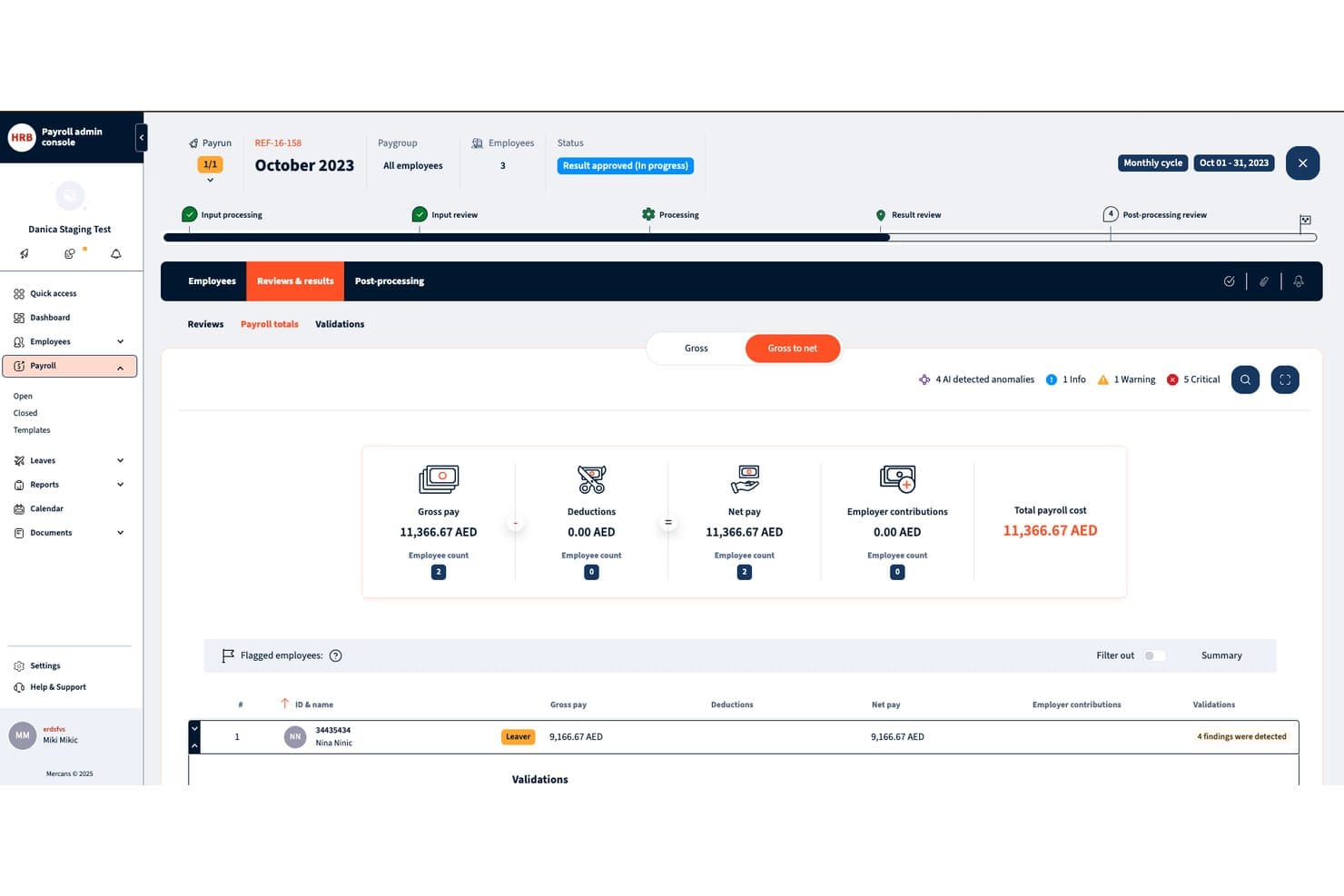
Mercans streamlines payroll review with real-time gross-to-net totals. Mercans is a global payroll and employer of record platform that handles German wage-tax calculations, social-insurance remittances, statutory filings, Kurzarbeit administration, and multi-country payroll consolidation through its HR Blizz SaaS platform.
Who Is Mercans Best For?
Mercans is a strong fit for global payroll managers and international expansion leads who need compliant, full-cycle payroll in Germany, including Kurzarbeit administration and statutory filings.
Why I Picked Mercans
Mercans earns its spot on my shortlist because of how thoroughly it handles Kurzarbeit (short-time work) administration, covering everything from the initial Federal Employment Agency notification to monthly benefit applications, employee-level Sollentgelt/Istentgelt calculations, and separate Kurzarbeitergeld payslip presentation. I also like that it manages the full German statutory filing calendar, including DEÜV reporting, wage-tax remittance by the 10th of the following month, and social-insurance prepayments corrected across pay periods.
Mercans Key Features
- SEPA payment processing: Disburses German employee salaries in euros via SEPA credit transfer from any SEPA-zone account, without requiring a German bank account.
- Employee self-service portal: Gives employees a personalized dashboard to view payslips, access pay details, and update their own information.
- Multi-country payroll dashboard: Displays pay groups, payroll cycles, headcount, and costs across all countries in a single administrator view.
- HCM integration layer: Syncs HR and payroll data in real time with systems like Workday, Oracle Cloud HCM, and HiBob to reduce manual data entry.
Mercans Integrations
Mercans offers more than 100 inbound and outbound integrations, including Oracle Cloud HCM, Workday, HiBob, SAP SuccessFactors, and Darwinbox. It also provides Payroll, Validation, SSO, Loader, HRB, and ESS APIs for custom connectivity.
Pros and Cons
Pros:
- Consolidated reporting supports multi-country payroll oversight
- G2 reviewers praise accurate, timely payroll
- Kurzarbeit support covers notifications, calculations, and claims
Cons:
- German implementation timelines aren’t documented
- Support response times receive mixed reviews
Learn more about Mercans:
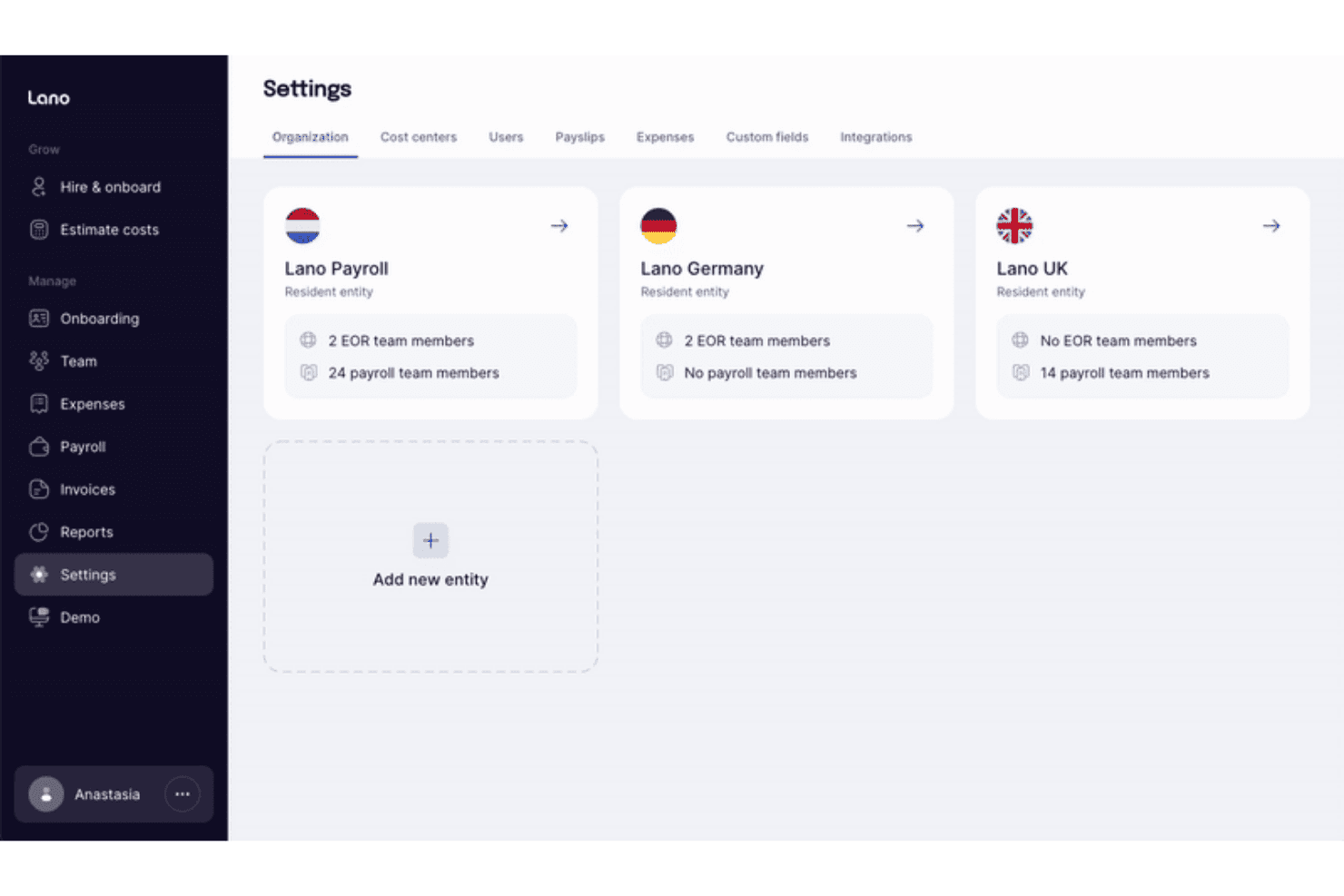
Lano lets users manage multiple resident entities, including Germany. Lano is a global payroll platform that lets you run multi-country payroll through a local partner network, consolidate payroll data from existing providers, and manage employee payments, benefits, and taxes across 170+ countries in one place.
Who Is Lano Best For?
Lano works well for global payroll managers who already have local payroll providers in place and want to consolidate data across multiple countries without replacing existing setups.
Why I Picked Lano
I've included Lano in my top picks because it's one of the few platforms that lets you keep your existing local payroll providers in place rather than forcing a full migration. If you're already running payroll in Germany through a local partner, Lano pulls that data into a single consolidated dashboard alongside other countries, so you get unified gross-to-net reporting and multi-entity analytics without rebuilding from scratch. Its payroll consolidation plan even lets you add new partners or bring in your own.
Lano Key Features
- Two-way HRIS integration: Syncs employee data, salary, vacation, and benefits information between Lano and platforms like HiBob, Workday, Personio, and SAP.
- Multi-entity payroll reporting: Tracks payroll costs by country, entity, or department, with breakdowns of gross pay, net pay, taxes, and employer contributions.
- AI-assisted payroll audits: Flags discrepancies and inconsistencies across payroll data before each cycle is finalized.
- EUR local payouts for Germany: Processes employee salary payments in EUR directly, with local payments completing within two business days.
Lano Integrations
Lano offers integrations with HiBob, Workday, Personio, SAP, Zoho People, and Lucca for employee, salary, vacation, benefits, and payslip data. It also supports custom integrations through its REST API and marketplace integrations, including DATEV.
Pros and Cons
Pros:
- EUR payouts typically complete within two days
- Keep existing German payroll providers in place
- Reviewers praise consolidated global payroll visibility
Cons:
- Reviewers report uneven support response
- Partner-mediated compliance queries can take longer
Learn more about Lano:
Other Global Payroll Services in Germany
Here are some additional global payroll services in Germany options that didn’t make it onto my shortlist, but are still worth checking out:
- 12Payoneer Workforce ManagementBest for German tax detail in a global view
- 13AtlasBest for EOR payroll with human support
- 14CloudPayBest for payroll teams needing layered review
- 15PeblBest for forecasting global hiring costs
- 16OysterBest for weighing EOR against a German entity
- 17DATEV PayrollBest for tariff-based pay progression
How I Evaluate Global Payroll in Germany
I split my evaluation into three parts, giving the most weight to core functions: calculate German taxes and social contributions, and consolidate payroll across countries. Next, I look for differentiators such as Kurzarbeit support. Finally, I consider factors beyond features, including German payroll expertise, onboarding, and transparent pricing.
Core Functionality (Table Stakes For This List)
When I'm selecting tools for my list, I score each one on a scale from 0 (does not offer the functionality) to 5 (excels in this area) for each core functionality listed below. I then convert the total into a percentage to help assess each tool's overall fit, with extra weight on any functionalities I’ve deemed essential.
- German Payroll Compliance (Essential): I look for accurate German tax and social contribution calculations, including support for changes to employee pay and statutory requirements.
- Multi-Country Payroll (Essential): I assess whether teams can manage payroll across countries and review consolidated data without manually combining separate reports.
- German Payroll Execution: I check for complete payroll runs, from gross-to-net calculations and payslips to employee disbursements in Germany.
- Statutory Filings: I look for support to prepare and submit German tax and social insurance reports, with clear records for HR to review.
- HR Data Integration: I evaluate how payroll connects with HRIS, time, and benefits data, such as employee changes that need to flow into a pay run.
- Currency And Payments: I check for EUR payroll disbursement and support for handling payments in multiple currencies across global entities.
Once I have a list of tools that meet the criteria, I consider what sets each platform apart.
Differentiating Factors (What Sets Vendors Apart)
Here's how I compare and contrast different vendors:
Standout Features
I check whether a platform handles Kurzarbeit natively, since short-time work schemes require accurate wage subsidy calculations that change with each government directive. I also look for real-time compliance alerts that flag upcoming shifts in German tax brackets or social insurance thresholds before they take effect. Entity setup guidance matters too—if your team is moving from an EOR arrangement to direct employment, vendors like Papaya Global and Remote offer advisory support for registering a legal entity in Germany, which can shave weeks off the transition.
Beyond Features
I check whether a vendor employs in-country German payroll specialists available during CET business hours, since generic multi-country support teams often can't resolve time-sensitive filing issues. Entity-versus-EOR flexibility matters just as much—I look for contract terms that let you shift from an employer-of-record model to direct entity payroll without re-platforming or losing historical data. I also evaluate pricing transparency, confirming what's included per employee versus billed as add-ons for off-cycle payments or terminations.
How to Choose a Global Payroll Service in Germany
Choosing the right global payroll platform for Germany comes down to which compliance risks and process headaches you’re trying to tackle first. Use this table to match your top priority with must-have capabilities:
| If your priority is… | Look for… |
|---|---|
| If your priority is…Direct authority submission | Look for…Automated ELSTER, DEÜV, and Krankenkasse e-filings |
| If your priority is…Reducing documentation errors | Look for…Platforms issuing Gehaltsabrechnungen and Lohnsteuerbescheinigungen in German, not just English |
| If your priority is…Multi-country payroll on one system | Look for…Unified dashboards and consistent workflows across all managed countries |
| If your priority is…Flexibility between EOR and local entity payroll | Look for…Both models supported plus a clear entity migration path |
| If your priority is…Handling complex German benefits | Look for…Automated Sachbezüge calculations and compliance with VWL, bAV, and non-cash perks |
How to Vet Your Shortlist
- Request document samples: Get native German payslips and Lohnsteuerbescheinigung from each vendor—ensure fields, language, and formatting all match statutory requirements.
- Ask for e-filing proof: Require confirmation of direct ELSTER, DEÜV, and Krankenkasse submissions, ideally with screenshots or documentation from a live environment.
- Run a sample GL export: Request a DATEV or SAP-compatible data export using true test data, not a dummy demo.
- Submit a real-world scenario: Have the vendor walk through a Kurzarbeit or Sachbezugsfreigrenze scenario, showing all necessary process steps and payroll calculations.
- Tradeoff: EOR or direct payroll: Decide if you need fast hiring via EOR now, or if you’ll benefit more from seamless in-house payroll as your German team grows.
What are Global Payroll Services in Germany?
Global payroll services in Germany refer to platforms or services that manage employee pay, tax, and statutory reporting for German-based staff from a central system that can handle multiple countries. They automate German-specific payroll tasks—like tax calculations, social insurance, and required filings—while integrating with global HR and finance tools. This approach helps organizations stay compliant with German laws and streamline payroll administration alongside other countries.
Features
When selecting global payroll services in Germany, keep an eye out for the following key features:
- Automated tax calculations: Calculates German payroll taxes such as Lohnsteuer, Kirchensteuer, and Solidaritätszuschlag based on each employee’s earnings and local requirements.
- DEÜV and ELSTER integration: Submits digital wage reports and tax filings directly to German authorities, saving time and reducing compliance risks.
- Compliant German payslips: Generates detailed employee payslips in German, including all required statutory details and deductions for transparency and compliance.
- Multi-country payroll dashboard: Lets you consolidate payroll data for Germany and other countries in one view, supporting global workforce oversight.
- Social security contributions: Calculates and manages contributions to German health insurance, pension schemes, unemployment funds, and other required institutions.
- Employer of Record (EOR) support: Enables employment of German staff via an EOR for companies without a local entity, handling contracts, onboarding, and payroll.
- Accounting and HRIS integrations: Syncs with major HR and finance platforms, and exports data in formats like DATEV to automate accounting processes.
- Benefit and allowance automation: Manages perks such as meal vouchers, company cars, and non-cash benefits (Sachbezüge), and applies the correct social and tax treatment.
- Regulatory updates and compliance monitoring: Incorporates changes to laws and contribution rates automatically, minimizing manual intervention and compliance errors.
- Employee self-service portals: Allows staff to access payslips, tax certificates, and update personal details directly, reducing admin workloads for HR teams.
Benefits
Implementing global payroll services in Germany provides several benefits for your team and your business. Here are a few you can look forward to:
- Reduced compliance risk: Automated German tax calculations and direct filings help your business stay current with statutory and regulatory changes.
- Centralized multi-country payroll: Manage German and international payroll together in one dashboard, giving HR and finance full visibility and control.
- Faster onboarding and expansion: EOR support lets you legally hire and pay staff in Germany without opening a local entity.
- Accurate payroll and reporting: Built-in checks on everything from Lohnsteuer to DEÜV filings improve accuracy and reduce the chance of costly errors.
- Streamlined HR and finance workflows: Integrations with HRIS and accounting platforms mean fewer manual entries and more time for strategic work.
- Greater employee transparency: German-language payslips and self-service portals let employees track pay, taxes, and documents with ease.
- Seamless benefits administration: Automated handling of benefits, perks, and allowances takes the guesswork out of German wage-related compliance.
Why Use Global Payroll Services in Germany?
Global payroll services can help international employers pay employees in Germany accurately while managing local tax, social security, and reporting requirements. German employers are responsible for withholding wage tax and employee social security contributions and remitting them to the appropriate authorities.
Using a global payroll provider can help you:
- Manage German payroll compliance: Automate wage tax, statutory deductions, and required payroll processes.
- Handle social security contributions: Manage contributions for health, pension, unemployment, nursing care, and accident insurance.
- Simplify multi-country payroll: Manage German employees alongside workers in other countries through one payroll system.
- Reduce manual administration: Centralize payroll calculations, employee data, reporting, and payments instead of managing separate local processes.
For multinational employers, the main advantage is combining German payroll expertise with a consistent global payroll process.
Outsourcing Payroll in Germany
Companies that outsource payroll in Germany usually choose one of three routes. The right one depends on whether you already have a German entity and how many countries you pay people in.
Local payroll company
A local payroll company, often a tax adviser or a payroll bureau, runs payroll for your German entity and files with the German authorities. It suits businesses that operate only in Germany and already have a legal entity there.
Global payroll provider
A global payroll provider runs payroll in many countries under one contract and works with in-country partners for local filings. It suits companies that pay teams in several countries and want one process and one data set.
Employer of record (EOR)
An employer of record becomes the legal employer of your German staff, so you can hire and pay people without setting up a German entity first. It suits companies hiring their first employees in Germany.
How is Payroll Calculated in Germany?
Payroll in Germany starts with an employee’s gross salary (Bruttolohn), from which the employer calculates and withholds applicable taxes and employee social security contributions before paying the net salary (Nettolohn).
Typical payroll calculations include:
- Wage tax (Lohnsteuer): Based on taxable earnings and factors such as the employee’s tax class and allowances.
- Social security: Contributions generally cover pension, health, unemployment, and long-term care insurance and are largely shared between employer and employee.
- Additional taxes: Church tax may apply to eligible employees, while the solidarity surcharge applies in qualifying cases.
The employer withholds the required deductions, pays the employee their net salary, and remits the relevant taxes and social contributions to the appropriate authorities.
German payroll taxes and social contributions in 2026
Social insurance contributions are split between employer and employee. These are the 2026 rates:
| Contribution | Total rate | Employer | Employee |
|---|---|---|---|
| ContributionPension | Total rate18.6% | Employer9.3% | Employee9.3% |
| ContributionUnemployment | Total rate2.6% | Employer1.3% | Employee1.3% |
| ContributionHealth (general rate) | Total rate14.6% | Employer7.3% | Employee7.3% |
| ContributionLong-term care | Total rate3.6% | Employer1.8% | Employee1.8% |
In Saxony the long-term care split differs (employer 1.3%, employee 2.3%), and employees aged 23 or over without children pay an extra 0.6% for long-term care. Health insurers also charge an additional contribution on top of the general rate, which varies by insurer.
Contributions are only due up to a ceiling. For 2026 the ceilings are:
- Pension insurance: €8,450 a month (€101,400 a year).
- Health and long-term care insurance: €5,812.50 a month (€69,750 a year).
- Compulsory insurance threshold, above which an employee can opt for private health insurance: €6,450 a month (€77,400 a year).
The statutory minimum wage in 2026 is €13.90 per hour. Employers also withhold wage tax (Lohnsteuer) from each payslip using the employee’s tax class (I to VI) and the tax data retrieved through the ELStAM system, plus church tax where it applies: 8% of the tax in Bavaria and Baden-Württemberg and 9% in the other states. Wage tax is reported electronically through ELSTER, generally by the 10th of the following month.
How is Payroll Compliance Regulated in Germany?
Payroll compliance in Germany is governed by tax, social security, and employment regulations, with employers responsible for calculating deductions, maintaining payroll records, and submitting required payments and reports.
Key requirements include:
- Wage tax: Employers must calculate and withhold wage tax using each employee’s electronic tax information (ELStAM) and remit it to the tax authorities.
- Social security: Employers must calculate and remit required health, pension, unemployment, long-term care, and accident insurance contributions.
- Employee reporting: Employers must register employees with the appropriate tax and social security systems and provide required payroll documentation.
For international employers, using a payroll provider with German tax and social security expertise can help reduce compliance risk and keep payroll processes aligned with local requirements.
Works councils and payroll data
A works council (Betriebsrat) can be formed in a company with at least five employees aged 18 or over, at least three of whom have worked there for six months or more. Where one exists, introducing a payroll or HR system that collects personal data generally needs the works council’s involvement, because such systems can be used to monitor employees. The GDPR (DSGVO) applies in full to payroll data either way, so ask every provider where employee data is stored and processed before you sign.
Trends in Global Payroll Software in Germany
Global payroll software in Germany is becoming more automated, integrated, and compliance-focused as payroll reporting continues to move toward digital processes.
- More Digital Payroll Reporting: Germany increasingly relies on electronic processes such as ELStAM for wage-tax data and digital interfaces for payroll records.
- Greater System Integration: Employers are prioritizing connections between payroll, HR, finance, time tracking, and benefits systems to reduce manual data handling.
- Increased Payroll Automation: Automation and AI are being explored to improve payroll efficiency, data validation, and error detection while reducing administrative work.
- Stronger Compliance and Data Security: Changing payroll regulations and digital reporting requirements are increasing the importance of compliance monitoring, privacy, and cybersecurity.
For international employers, these trends favor payroll platforms that combine German compliance capabilities with automated, multi-country payroll management.
Costs and Pricing
Selecting global payroll services in Germany requires an understanding of the various pricing models and plans available. Costs vary based on features, team size, add-ons, and more. The table below summarizes common plans, their average prices, and typical features included in global payroll services in Germany:
Plan Comparison Table for Global Payroll Services in Germany
| Plan Type | Average Price | Common Features |
|---|---|---|
| Plan TypeFree Plan | Average Price$0 | Common FeaturesBasic demo access, limited documentation preview, and no live payroll processing. |
| Plan TypePersonal Plan | Average Price$10-$40/user/month | Common FeaturesPayroll for solo users, standard German payslips, and basic support. |
| Plan TypeBusiness Plan | Average Price$40-$100/user/month | Common FeaturesMulti-country payroll, ELSTER and DEÜV filings, HRIS integrations, and employee self-service portals. |
| Plan TypeEnterprise Plan | Average Price$100+/user/month | Common FeaturesEOR/entity support, custom integrations, advanced security, regulatory advisory, and dedicated support. |
German Payroll and Employment Requirements
Employers running payroll in Germany must account for both payroll deductions and employee entitlements under German labor laws. Important requirements include:
- Taxes and social insurance: Payroll calculations may include wage tax and contributions toward pension insurance, unemployment insurance, health insurance, long-term care insurance, and statutory accident insurance.
- Working hours: The German Working Hours Act (Arbeitszeitgesetz) regulates working time, rest periods, and related requirements.
- Minimum wage: Employers must comply with Germany's statutory minimum wage, which can affect payroll calculations for eligible employees.
- Paid leave: Payroll processes may need to account for annual leave, public holidays, sick pay, and maternity leave, depending on the employee's circumstances and applicable requirements.
- Employment terms: An employment contract should reflect applicable German employment requirements, including working conditions and statutory notice periods where relevant.
For foreign employers, these requirements make local payroll and employment expertise particularly important. A global payroll provider—or, where appropriate, an EOR or PEO-style employment solution—can help manage payroll alongside applicable German tax, social insurance, and employment obligations.
Minijobs and Midijobs in 2026
A Minijob pays up to €603 a month in 2026. A Midijob pays between €603.01 and €2,000 a month, and the employee’s social contributions are reduced across that range, rising to the full rate at €2,000. Check which category each employee falls into before you set up their payroll record.
Leave, sick pay and public holidays
| Topic | What German law provides |
|---|---|
| TopicAnnual leave | What German law providesAt least 20 days on a five-day week and 24 days on a six-day week. |
| TopicSick pay | What German law providesThe employer pays 100% of normal salary for up to six weeks. Statutory health insurance sick pay then pays 70% of normal pay for up to 78 weeks. |
| TopicPublic holidays in 2026 | What German law providesNine nationwide: Jan 1, Apr 3, Apr 6, May 1, May 14, May 25, Oct 3, Dec 25 and Dec 26. Several more apply only in some states. |
Termination of employment
A dismissal must be in writing and signed by hand by an authorised representative of the employer; email or fax is not valid. Statutory employer notice periods run from four weeks to seven months depending on length of service, and a probation period of up to six months can carry a notice period of two weeks. German law has no general statutory severance. Severance is paid under a settlement, a social plan or a collective agreement. Where a works council exists, it must be heard before any dismissal.
Global Payroll Services in Germany FAQs
Here are some answers to common questions about global payroll Services in Germany:
What statutory filings must German payroll providers handle?
German payroll providers must file Lohnsteuer (income tax), DEÜV reports to social security, and submit data through the ELSTER and Krankenkasse portals. Automated filings help ensure nothing falls through the cracks.
Can I use global payroll in Germany without a local entity?
Yes, many payroll vendors offer Employer of Record (EOR) support in Germany, so you can hire and pay staff legally without needing a German GmbH of your own.
Are German payslips always issued in German?
Yes, payslips must be provided in German to meet statutory requirements, but some platforms also offer multi-language options for global teams or international management.
How can I handle both German and international payroll from one system?
Look for platforms with unified multi-country dashboards and localized workflows for each country. This lets you process German payroll alongside other regions with consistent reporting.
What’s unique about handling benefits in German payroll?
Managing benefits like meal vouchers, company cars, and tax-free allowances involves strict tax and social insurance treatment. Using a platform with built-in German Sachbezüge functionality helps you stay compliant.
What is the minimum wage in Germany in 2026?
The statutory minimum wage is €13.90 per hour in 2026.
How long does an employer pay for sick leave in Germany?
Employers continue to pay 100% of normal salary for up to six weeks. After that, statutory health insurance sick pay applies.
Does a works council need to approve a payroll system in Germany?
Only where a works council exists. Systems that collect personal data generally need the works council’s involvement, and the GDPR (DSGVO) applies either way.