
Reseña de Fetcher: Ventajas, Desventajas, Funciones y Precios



Fetcher is a talent acquisition software that automates candidate sourcing and outreach for recruiting teams. It continuously searches candidate databases and delivers curated profiles directly to your pipeline, without manual boolean searches or hours spent on LinkedIn. I'd consider it if your team is losing too much time at the top of the funnel and not enough time talking to candidates. Compared to a tool like LinkedIn Recruiter, where sourcing is still largely a manual effort, Fetcher takes more of that work off your plate by automating both discovery and initial outreach sequences.
Fetcher Evaluation Summary
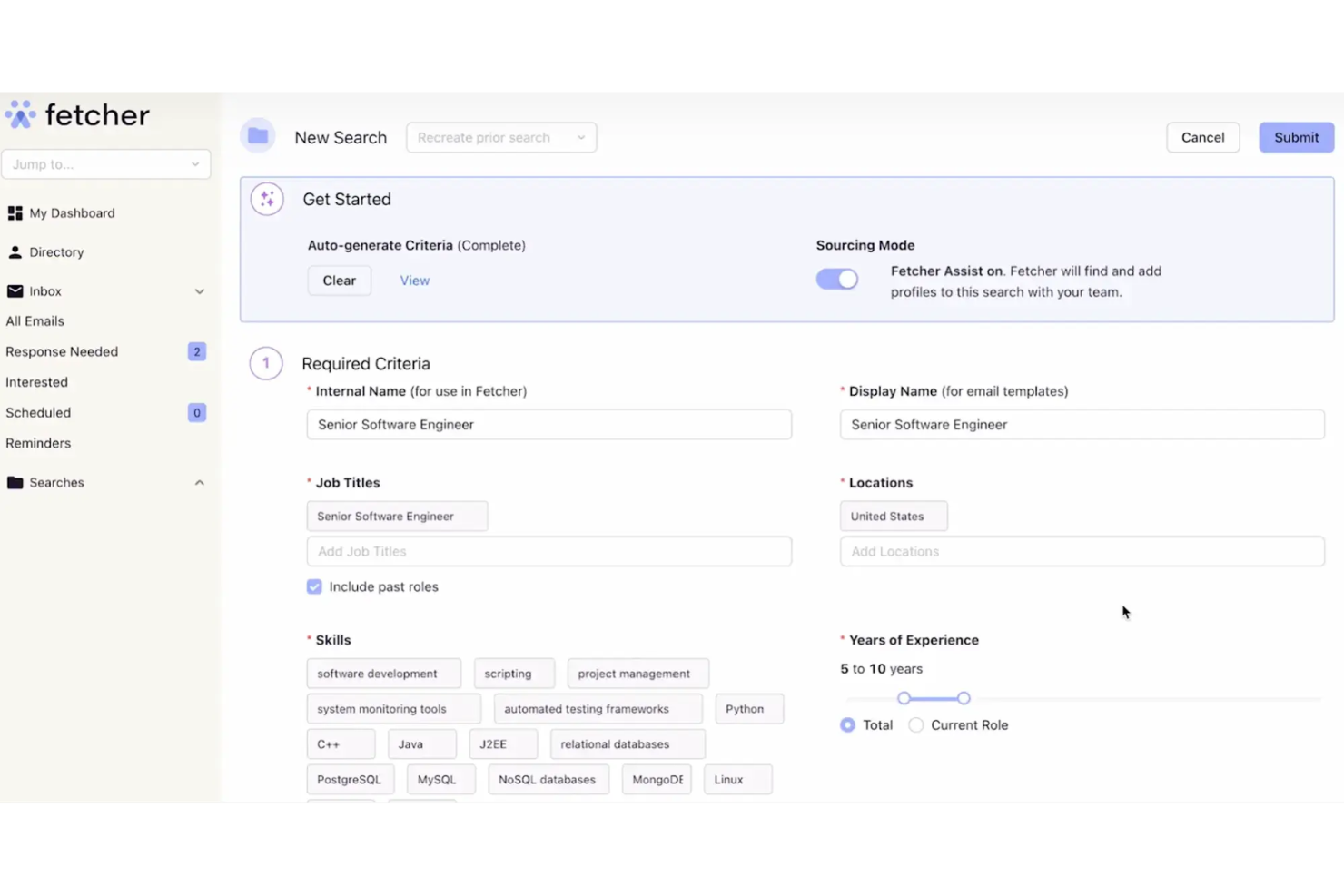
- From $115/month (billed annually)
- Free demo available
Por qué confiar en nuestras reseñas de software
Nuestro equipo lleva probando y evaluando software desde 2012. Como expertos en RR. HH., sabemos lo difícil —y lo importante— que es elegir el software adecuado.
Para esta guía, evaluamos las herramientas mediante pruebas prácticas e investigación independiente, puntuando las herramientas según nuestros criterios de selección. También nos basamos en la experiencia de líderes de opinión del sector y de profesionales de RR. HH. en activo.
Nuestras reseñas reflejan nuestro criterio editorial humano, no un discurso de ventas.
Revisores expertos:
Fetcher Overview
In my opinion, Fetcher is a solid choice for teams looking to automate candidate sourcing. Its standout features and ease of use make it appealing for tech startups and mid-sized businesses. Compared to its competitors, Fetcher excels in providing a user-friendly interface and reliable customer support. However, it might not offer as many integrations as some other tools. If your team prioritizes ease of use and efficient sourcing, Fetcher could be a great fit. Its pricing is competitive, making it a valuable option for companies with limited budgets.
pros
-
Automates candidate sourcing, saving your team time.
-
User-friendly interface makes it easy for your team to navigate.
-
Reliable customer support helps resolve your issues quickly.
cons
-
Limited integrations might not fit all your tech stack needs.
-
Some users find the customization options lacking.
-
May not be ideal for very large enterprises with complex requirements.
-

Justworks
Visit WebsiteThis rating combines scores from multiple user review sites to reflect overall customer sentiment about the product.4.6 -
Small Improvements
Visit WebsiteThis rating combines scores from multiple user review sites to reflect overall customer sentiment about the product.4.3 -
HiBob
Visit WebsiteThis rating combines scores from multiple user review sites to reflect overall customer sentiment about the product.4.5




Cómo probamos y puntuamos nuestras herramientas
Hemos pasado años construyendo, refinando y mejorando nuestro sistema de pruebas y puntuación de software. La rúbrica está diseñada para capturar los matices de la selección de software y lo que hace que una herramienta sea efectiva, centrándose en los aspectos críticos del proceso de toma de decisiones. A continuación, puedes ver exactamente cómo funcionan nuestras pruebas y puntuaciones a través de siete criterios. Esto nos permite ofrecer una evaluación imparcial del software basada en la funcionalidad principal, características destacadas, facilidad de uso, incorporación, soporte al cliente, integraciones, reseñas de clientes y relación calidad-precio.
Funcionalidad principal (25% de la puntuación final)
El punto de partida de nuestra evaluación siempre es la funcionalidad principal de la herramienta. ¿Tiene las funciones básicas que se espera encontrar? ¿Alguna de esas funciones básicas está restringida a planes de precio superiores? En esencia, esperamos que una herramienta se compare favorablemente con las capacidades básicas de sus competidores.
Características destacadas (25% de la puntuación final)
Luego, evaluamos características poco comunes que van más allá de la funcionalidad principal que normalmente se encuentra en herramientas de su tipo. Una puntuación alta refleja funciones especializadas o únicas que hacen que el producto sea más rápido, eficiente o que ofrezca un valor adicional al usuario. También evaluamos lo fácil que es integrar con otras herramientas comúnmente usadas en el entorno tecnológico para ampliar la funcionalidad y utilidad del software. Las herramientas que ofrecen muchas integraciones nativas, conexiones de terceros y acceso a API para construir integraciones personalizadas obtienen las mejores puntuaciones.
Facilidad de uso (10% de la puntuación final)
Consideramos qué tan rápido y fácil es ejecutar las tareas definidas en la funcionalidad principal utilizando la herramienta. El software que obtiene una puntuación alta está bien diseñado, es intuitivo, ofrece aplicaciones móviles, proporciona plantillas y hace que tareas relativamente complejas parezcan simples.
Incorporación (10% de la puntuación final)
Sabemos lo importante que es la rápida adopción del equipo para una nueva plataforma, por eso evaluamos qué tan fácil es aprender y usar una herramienta con una capacitación mínima. Evaluamos cuán rápido un miembro del equipo puede configurarse y comenzar a usar la herramienta sin experiencia. Las soluciones con mejores puntuaciones requieren poco o ningún soporte.
Soporte al cliente (10% de la puntuación final)
Revisamos cuán rápido y fácil es obtener ayuda mediante teléfono, chat en vivo o base de conocimientos. Las herramientas y empresas que ofrecen soporte en tiempo real obtienen las mejores puntuaciones, mientras que los chatbots obtienen las peores.
Reseñas de clientes (10% de la puntuación final)
Además de nuestras propias pruebas y evaluaciones, consideramos el puntaje neto de promotores de clientes presentes y pasados. Revisamos su probabilidad, dada la opción, de elegir nuevamente la herramienta por su funcionalidad principal. El software con una puntuación alta refleja un alto puntaje neto de promotores por parte de clientes actuales o anteriores.
Relación calidad-precio (10% de la puntuación final)
Por último, considerando todos los demás criterios, revisamos el precio promedio de los planes de entrada frente a las funciones principales y valoramos el resto de los criterios de evaluación. El software que ofrece más por menos tendrá una mejor puntuación.
Core Features
AI-Powered Sourcing: Fetcher uses AI to automate the candidate sourcing process, saving your recruitment team time. It helps you find qualified candidates without manual effort.
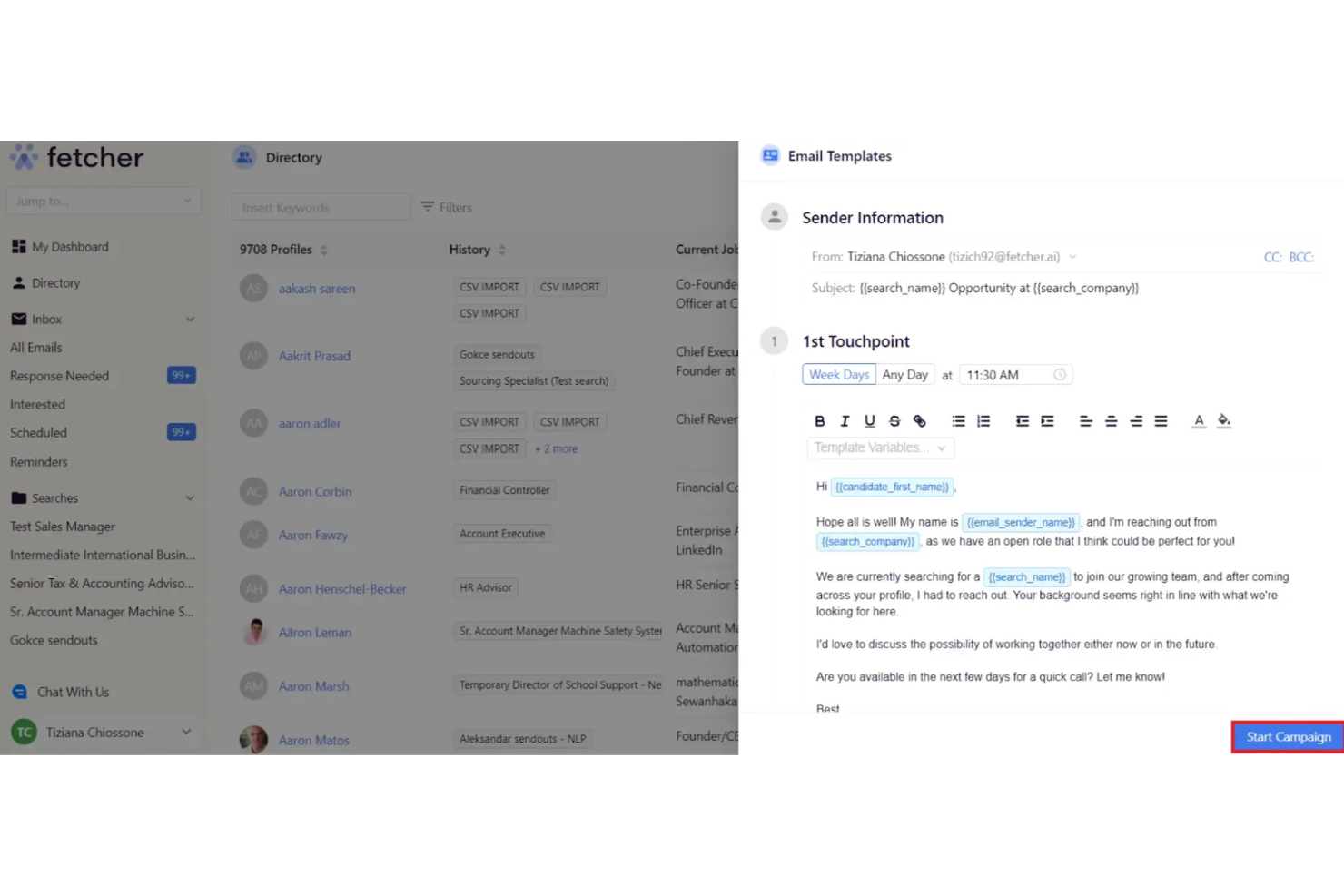
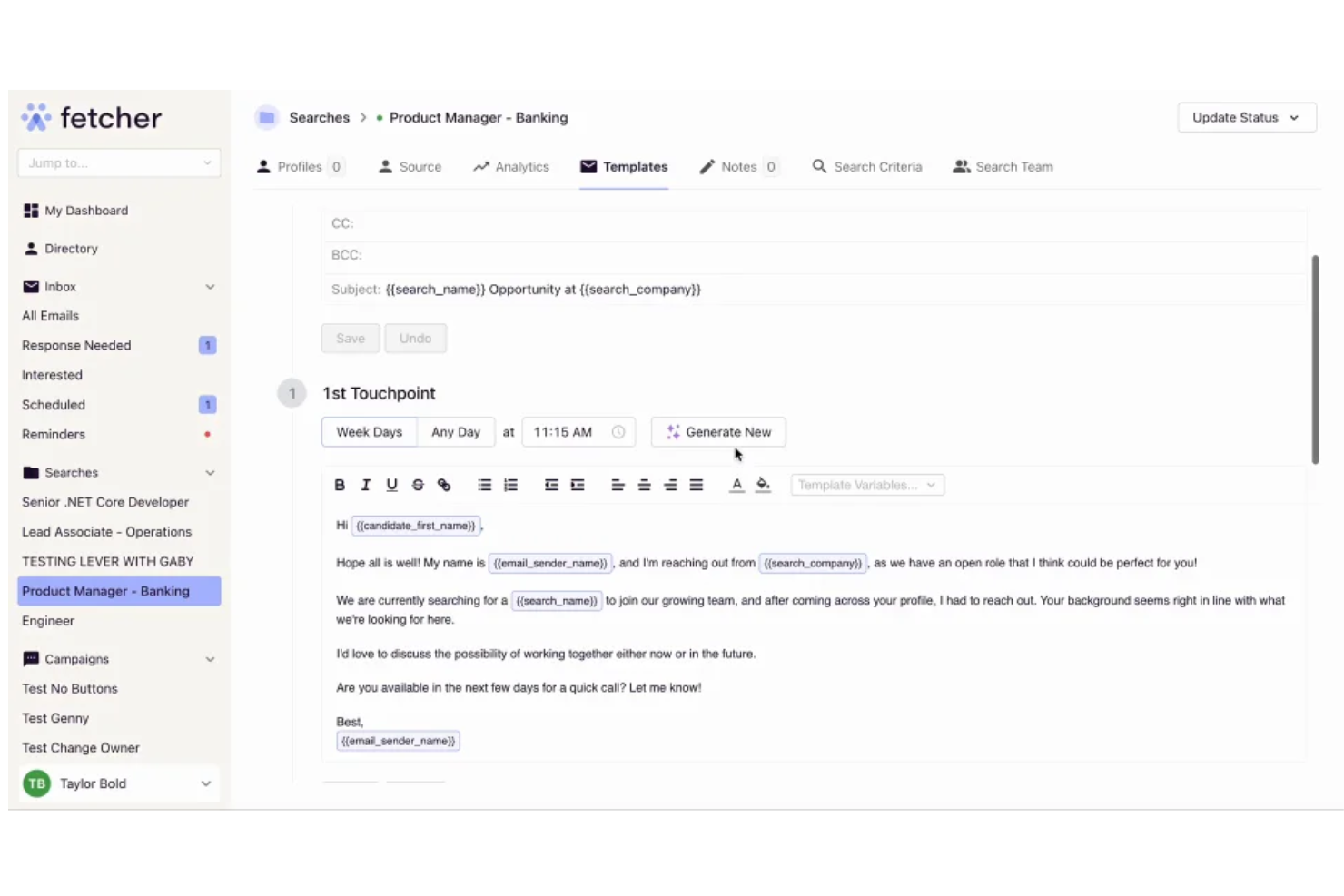
Email Automation: You can schedule and send personalized emails to candidates, making outreach and follow-up consistent without manual effort.
Candidate Tracking: Fetcher provides tools to track your candidates throughout the hiring process. This helps you keep an organized view of your recruitment pipeline.
Analytics Dashboard: Fetcher offers an easy-to-read dashboard with insights into your recruitment metrics. This helps your team make data-driven hiring decisions.
Collaborative Hiring: Your team can collaborate easily with shared notes and feedback. This feature ensures everyone stays on the same page.
Customizable Templates: Fetcher allows you to use and customize email templates. It speeds up your communication and maintains your brand voice.
Ease of Use
Fetcher is user-friendly, making it easy for your team to navigate and use daily. Its clean interface and intuitive design mean you won't spend much time on training. Users appreciate how quickly they can set up and start using the system. With features like customizable templates and an analytics dashboard, your team can manage recruitment tasks without hassle. Fetcher provides a smooth experience, even for those new to recruiting software.
Integrations
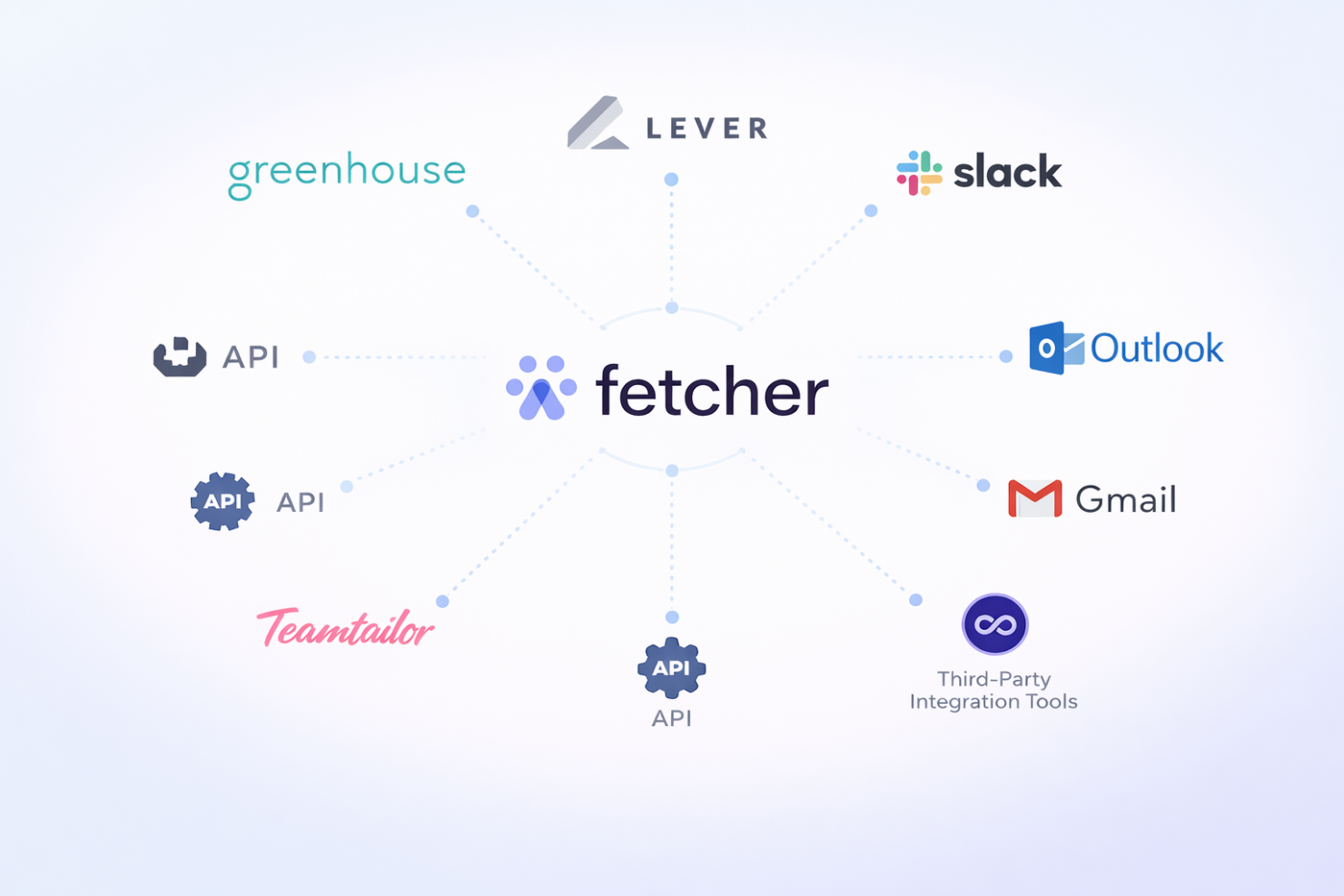
Fetcher integrates with Greenhouse, Lever, Slack, Gmail, Outlook, and Teamtailor. It also has an API for additional integrations and can connect with third-party integration tools.
Fetcher Specs
- 360 Degree Feedback
- API
- Application Tracking
- Batch Permissions & Access
- Behavioral Testing
- Budgeting
- Calendar Management
- Candidate Database
- Cognitive Testing
- Compliance Tracking
- Dashboard
- Data Export
- Data Import
- Data Visualization
- Email Integration
- Employee Database
- Employee Engagement
- Employee Incentive Management
- Employee Onboarding
- External Integrations
- Feedback Management
- Forecasting
- Interview Scheduling
- Multi-User
- Notifications
- Onboarding
- Personality Testing
- Psychometric Testing
- Referral Tracking
- Scheduling
- Soft Skill Testing
- Softphone
- Status Notifications
- Travel Management