

Avis sur le logiciel de gestion de la performance Betterworks pour 2026



Betterworks is a continuous performance management software that connects goals, coaching, feedback, and talent insights in one platform.
Betterworks is built primarily for mid-sized and enterprise organizations that need stronger alignment across teams, better visibility into employee performance, and more consistent talent decisions. It’s especially well-suited for companies with complex structures, matrixed teams, or global workforces.
In this review, I’ll break down its key features, strengths, limitations, pricing structure, integrations, onboarding experience, and ideal use cases.
Betterworks Evaluation Summary
- From $8/user/month
- Free demo available
Pourquoi faire confiance à nos avis sur les logiciels
Notre équipe teste et évalue des logiciels depuis 2012. En tant qu’experts RH nous-mêmes, nous savons à quel point il est difficile — et important — de choisir le bon logiciel.
Pour ce guide, nous avons évalué les outils grâce à des tests pratiques et une recherche indépendante, en notant les outils selon nos critères de sélection. Nous nous appuyons également sur les enseignements de leaders d’opinion du secteur et de professionnels des RH en activité.
Nos avis reflètent notre jugement éditorial humain, et non un argumentaire de vente.
Réviseurs experts:
Betterworks Overview
Betterworks stands out most for how deeply it connects performance management with broader talent intelligence. Rather than functioning as just an OKR tracker or annual review tool, it brings together goals, feedback, 1:1s, calibration, engagement surveys, succession planning, and AI-powered skills insights in one connected system. That makes it especially valuable for organizations that want performance management to actively drive business execution and workforce planning.
I also like how well Betterworks integrates into everyday work tools like Slack, Microsoft Teams, Jira, Salesforce, and Gmail, helping managers and employees stay aligned without adding extra administrative work. Its AI features, including performance summaries and skills intelligence, add meaningful context for coaching and talent decisions instead of simply automating documentation.
That said, Betterworks is best suited for mid-sized and enterprise companies with established HR processes. Smaller teams may find the platform more complex than necessary, especially given its guided onboarding approach and enterprise-focused structure.
pros
-
Connects goals, feedback, and coaching into one continuous performance system.
-
Supports enterprise-scale OKR alignment across complex, matrixed organizational structures.
-
Embeds performance workflows directly into everyday collaboration and productivity tools.
cons
-
Mobile functionality lacks the depth available in the desktop experience.
-
Initial admin setup involves a noticeable learning curve for new users.
-
Some HCM integrations require additional API or iPaaS configuration.
Is Betterworks Right For Your Needs?
Who Would be a Good Fit for Betterworks?
Betterworks is best suited for mid-sized and enterprise organizations that want to connect performance management directly to business execution and talent strategy. If you’re managing complex teams, scaling goal alignment across departments, or trying to improve continuous feedback and coaching, the platform offers a strong mix of structure and visibility. I think you’ll get the most value from Betterworks if you already have an HRIS in place and want a more advanced performance enablement layer on top of it.
-
Enterprise Organizations
If your company has hundreds or thousands of employees, Betterworks is built for that level of scale. Its plans and feature set are designed specifically for mid-market (500+ employees) and enterprise organizations (thousands of employees) managing large workforces.
-
Technology and SaaS companies
If you run a fast-moving technology or SaaS organization, Betterworks helps keep teams aligned around shifting business priorities. Its OKR structure and continuous feedback workflows work especially well in performance-driven environments.
-
Financial & Professional Services
If your organization depends on clear accountability, structured evaluations, and measurable performance outcomes, Betterworks provides strong visibility into goals, coaching, and calibration processes.
-
Manufacturing & Telecommunications
If you operate across multiple business units, locations, or reporting structures, Betterworks helps standardize performance management across complex operational environments.
-
Healthcare Organizations
If you need consistent performance conversations and workforce visibility across large healthcare teams, Betterworks offers centralized performance management with enterprise-level oversight and reporting.
-
Businesses Already Using an HRIS
If you already rely on an HRIS for employee records, Betterworks works well as a dedicated performance enablement layer. You can add continuous goals, feedback, and talent intelligence without replacing your existing HR system.
Who Would be a Bad Fit for Betterworks?
Betterworks is less ideal if you want a lightweight, all-in-one HR platform with minimal setup requirements. Because it’s designed primarily for larger organizations with established HR infrastructure, smaller businesses and companies without mature people operations may find the platform too advanced for their needs. You may also run into limitations if you expect Betterworks to function as a complete HRIS or learning management system.
-
Small Businesses
If you run a smaller business, Betterworks will likely feel oversized and unnecessarily complex. Most smaller organizations simply do not need enterprise-grade calibration, cascading OKRs, or talent intelligence capabilities.
-
Organizations Looking for Self-Serve Onboarding
If you want a quick, self-service rollout, Betterworks may not be the best fit. The platform uses a guided implementation process rather than lightweight setup workflows.
-
Businesses Looking for a Replacement HRIS
If you need a full HR management platform, Betterworks is not designed for that purpose. It works best as a performance and talent layer on top of systems like Workday, ADP, UKG, or SuccessFactors.
-
Teams Wanting a Built-In LMS
If employee learning and course delivery are your primary focus, Betterworks may leave gaps. It integrates with LMS platforms like Udemy and LinkedIn Learning instead of replacing them.
-
Low-Cost, Lightweight Needs
If your priority is affordability and simplicity, Betterworks may offer more functionality than you realistically need.
-
Mobile-First Performance Management Priorities
If your employees rely heavily on mobile devices, Betterworks may feel somewhat limited compared to the desktop experience. Most advanced workflows and administrative tasks are better suited for web usage.
Comment nous testons et évaluons nos outils
Nous avons passé des années à construire, affiner et améliorer notre système de test et d’évaluation des logiciels. La grille d’évaluation est conçue pour saisir les nuances de la sélection des logiciels et ce qui rend un outil efficace, en se concentrant sur les aspects critiques du processus décisionnel. Ci-dessous, vous pouvez voir exactement comment fonctionne notre test et notre système d’évaluation à travers sept critères. Cela nous permet de fournir une évaluation impartiale des logiciels basée sur les fonctionnalités principales, les caractéristiques remarquables, la facilité d’utilisation, l’intégration, le support client, les intégrations, les avis clients et le rapport qualité-prix.
Fonctionnalités principales (25 % de la note finale)
Le point de départ de notre évaluation est toujours la fonctionnalité principale de l’outil. Dispose-t-il des fonctionnalités de base qu’un utilisateur s’attend à voir ? Certaines de ces fonctionnalités principales sont-elles réservées à des forfaits plus élevés ? En substance, nous nous attendons à ce qu’un outil soit à la hauteur des capacités de base de ses concurrents.
Fonctionnalités remarquables (25 % de la note finale)
Ensuite, nous évaluons les fonctionnalités remarquables, peu courantes, qui vont au-delà de la fonction principale habituellement présente dans les outils de ce type. Un score élevé reflète des fonctionnalités spéciales ou uniques qui rendent le produit plus rapide, plus efficace, ou offrent une valeur ajoutée à l’utilisateur. Nous évaluons également la facilité d’intégration avec d’autres outils généralement présents dans la pile technologique pour étendre la fonctionnalité et l’utilité du logiciel. Les outils qui proposent de nombreuses intégrations natives, des connexions tierces et un accès API pour développer des intégrations personnalisées obtiennent les meilleurs résultats.
Facilité d’utilisation (10 % de la note finale)
Nous prenons en compte la rapidité et la simplicité d’exécution des tâches définies par la fonctionnalité principale à l’aide de l’outil. Un logiciel bien noté est bien conçu, intuitif à utiliser, offre des applications mobiles, propose des modèles, et permet de simplifier des tâches relativement complexes.
Mise en route (10 % de la note finale)
Nous savons à quel point une adoption rapide par l’équipe est cruciale pour une nouvelle plateforme, c’est pourquoi nous évaluons la facilité d’apprentissage et d’utilisation d’un outil avec un minimum de formation. Nous évaluons la rapidité avec laquelle un membre de l’équipe peut s’installer et commencer à utiliser l’outil sans expérience préalable. Les solutions bien notées impliquent qu’aucune ou très peu d’assistance soit requise.
Support client (10 % de la note finale)
Nous examinons la rapidité et la simplicité d’obtention d’aide par téléphone, chat en direct ou base de connaissances. Les outils et sociétés qui proposent une assistance en temps réel obtiennent les meilleurs scores, tandis que les chatbots sont moins bien notés.
Avis clients (10 % de la note finale)
En plus de nos propres tests et évaluations, nous prenons en compte le score net de recommandation (NPS) des clients actuels et passés. Nous évaluons leur propension, s’ils en avaient l’option, à choisir à nouveau l’outil pour la fonctionnalité principale. Un logiciel obtenant un score élevé reflète un NPS élevé de clients actuels ou passés.
Rapport qualité-prix (10 % de la note finale)
Enfin, en tenant compte de tous les autres critères, nous comparons le prix moyen des forfaits d’entrée de gamme aux principales fonctionnalités et considérons la valeur des autres critères d’évaluation. Un logiciel qui en offre plus, pour moins, sera mieux noté.
Core Features
Enterprise Goal & OKR Alignment
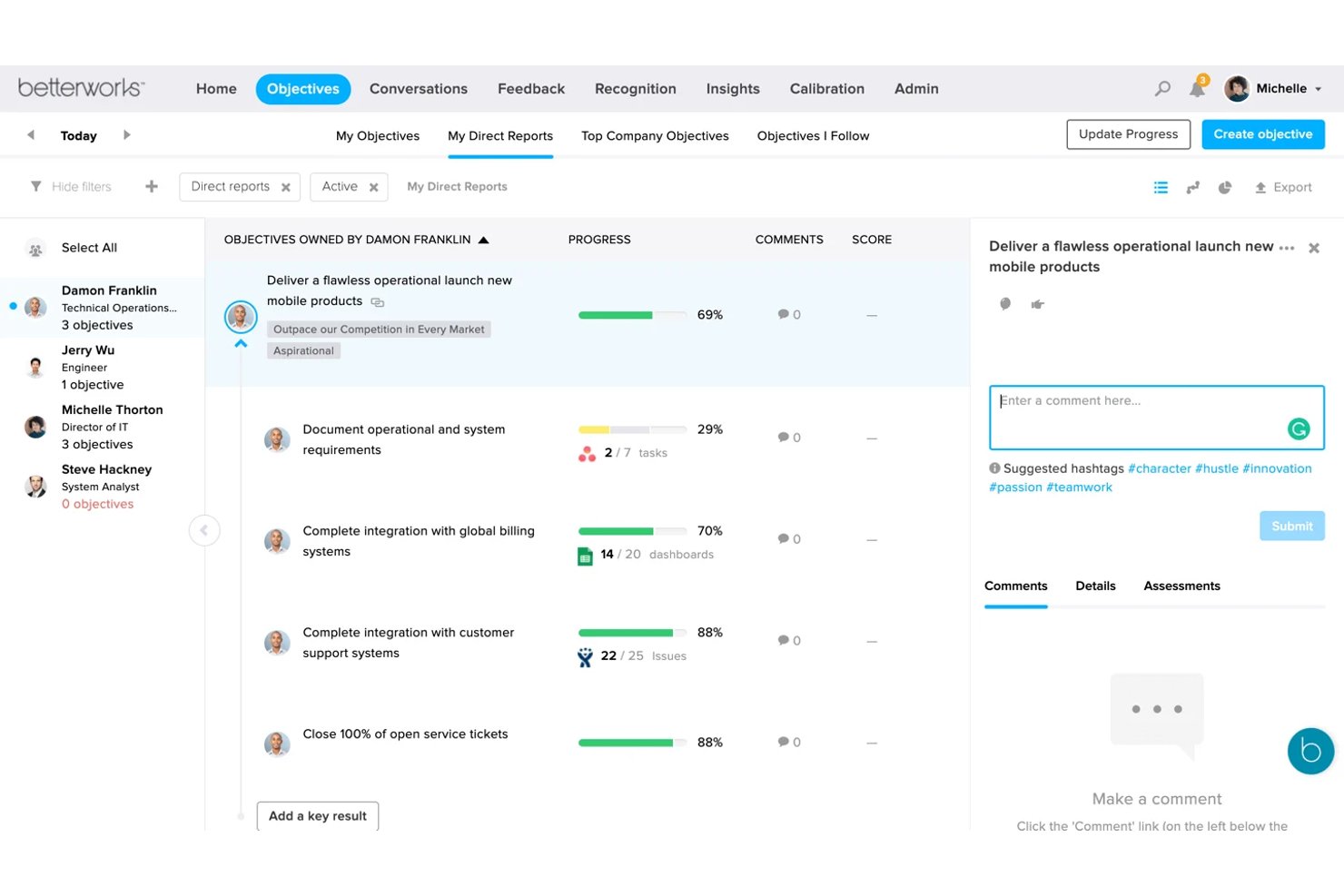
Betterworks stands out for its sophisticated OKR alignment capabilities designed for large organizations. You can cascade goals across departments and teams while maintaining visibility into how individual work supports company objectives.
Performance Tracking
Betterworks combines performance analytics, feedback, and AI-generated insights to help you monitor employee progress over time. You can identify strengths, skill gaps, and coaching opportunities using real-time performance data.
Feedback and Recognition
The platform supports continuous feedback and employee recognition workflows that encourage ongoing communication between managers and employees. This helps keep performance conversations active instead of limited to annual reviews.
1:1 Meetings and Conversations
Betterworks includes structured 1:1 meeting and conversation tools that help managers coach employees more consistently. Shared agendas, historical context, and goal visibility keep discussions focused and actionable.
Reporting and Analytics
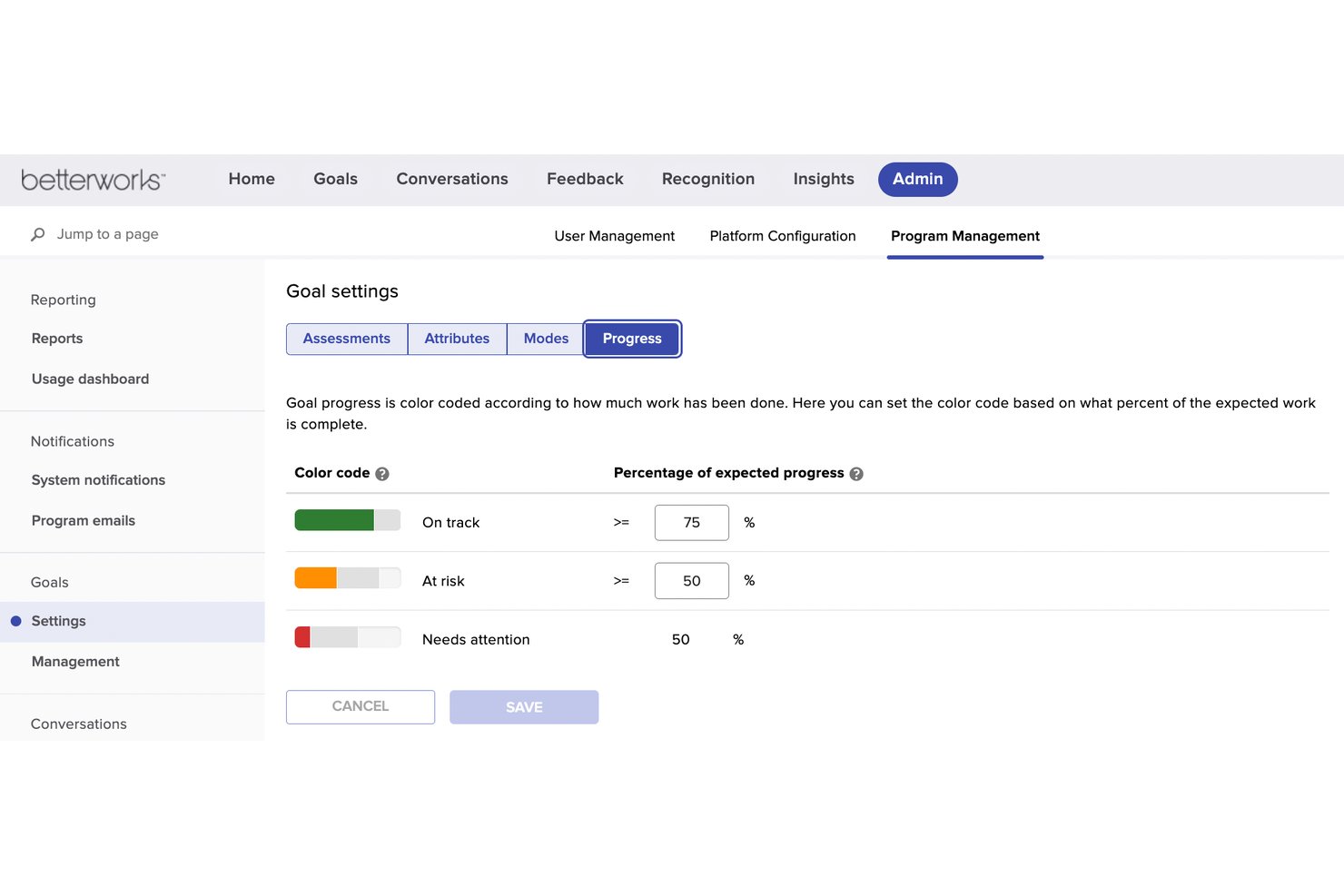
The platform offers reporting dashboards and analytics tools that help you measure alignment, engagement, and overall performance trends. These insights make it easier to track progress and support decision-making.
Employee Engagement Surveys
Betterworks includes employee engagement tools with recurring surveys, trend analysis, and action planning features. This helps you identify engagement issues and respond proactively.
Standout Features
Calibration Tools
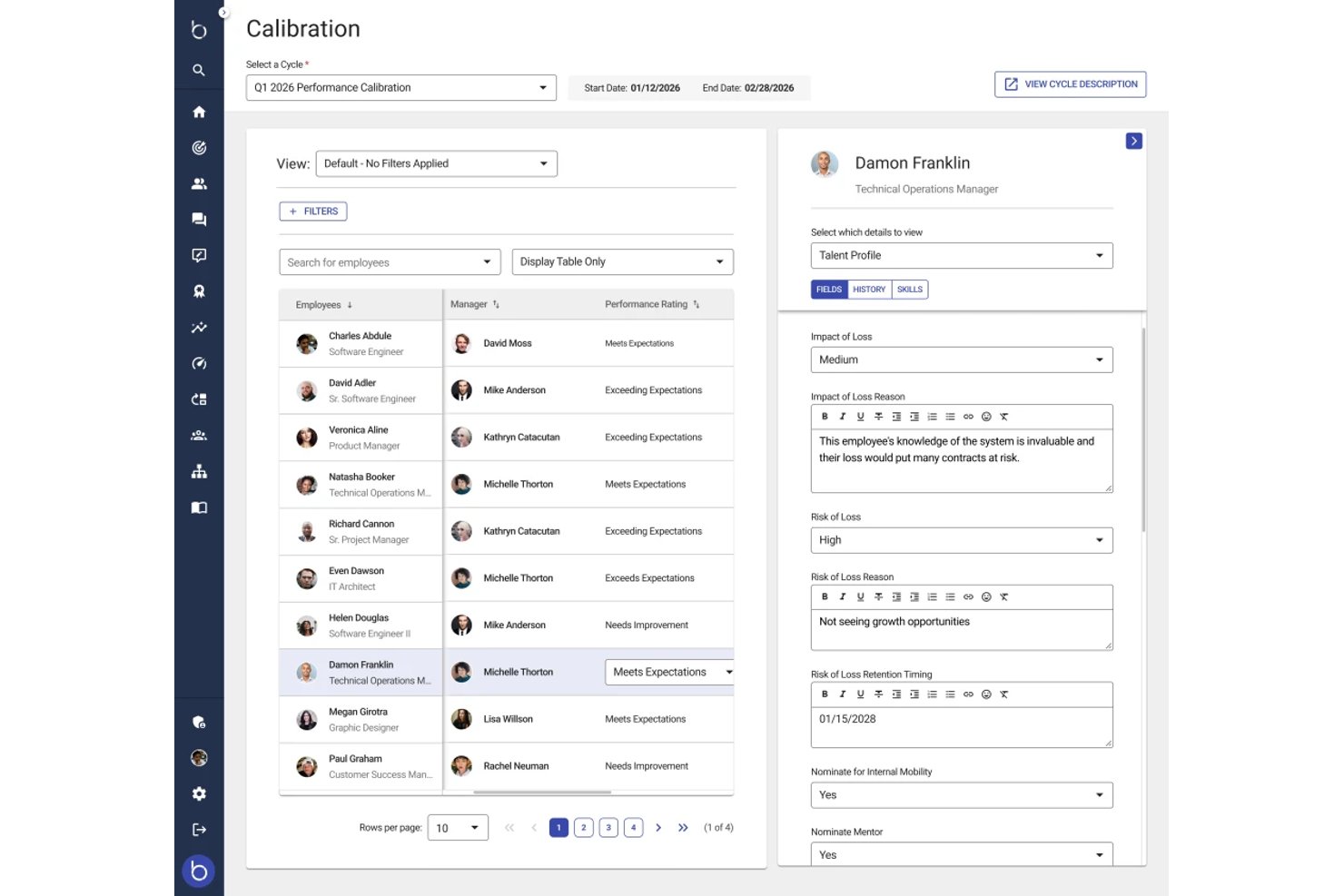
The platform offers enterprise-grade calibration workflows that help HR teams run fairer and more consistent performance evaluations. Features like rating distribution views, 9-box grids, and shared performance context improve decision-making during calibration sessions.
Talent Intelligence and Unified Talent Profiles
Betterworks differentiates itself with AI-powered talent intelligence features that combine performance, skills, feedback, and readiness data into unified employee profiles. This gives leaders a more complete view of workforce capability for succession planning and talent mobility.
AI-Powered Performance Insights
The platform uses AI to generate performance summaries, recommend goals, infer skills, and surface coaching insights from real work data. Unlike simpler AI assistants, Betterworks grounds these insights in ongoing goals, conversations, and feedback.
Ease of Use
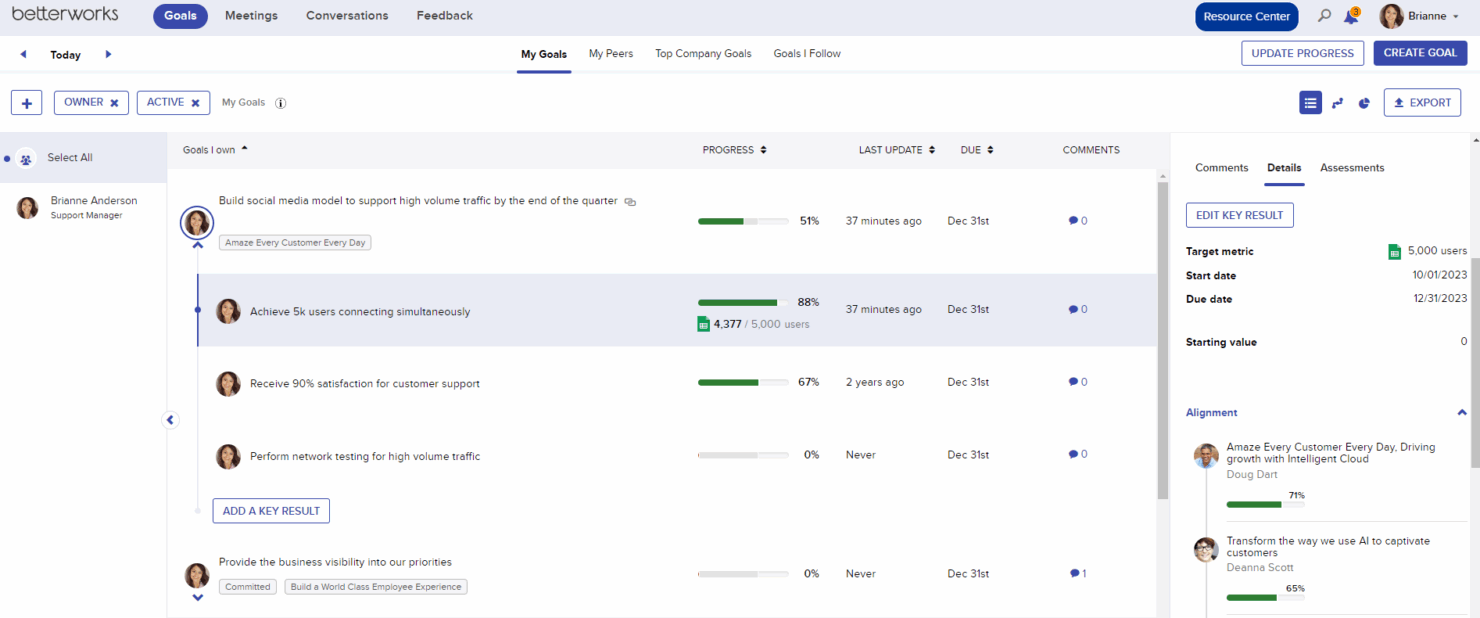
Betterworks offers a relatively modern and approachable interface for an enterprise performance management platform. The layout makes it easier to navigate goals, feedback, reviews, and performance conversations without feeling overly cluttered, especially for everyday users and managers.
I like that many workflows are structured clearly, which helps guide employees through tasks like updating goals, completing reviews, and participating in 1:1 conversations. Integrations with tools like Slack, Microsoft Teams, and Gmail also reduce friction by allowing employees to interact with performance workflows inside the tools they already use daily.
That said, Betterworks is still a feature-rich enterprise platform, so there can be a learning curve during initial setup and onboarding.
Onboarding
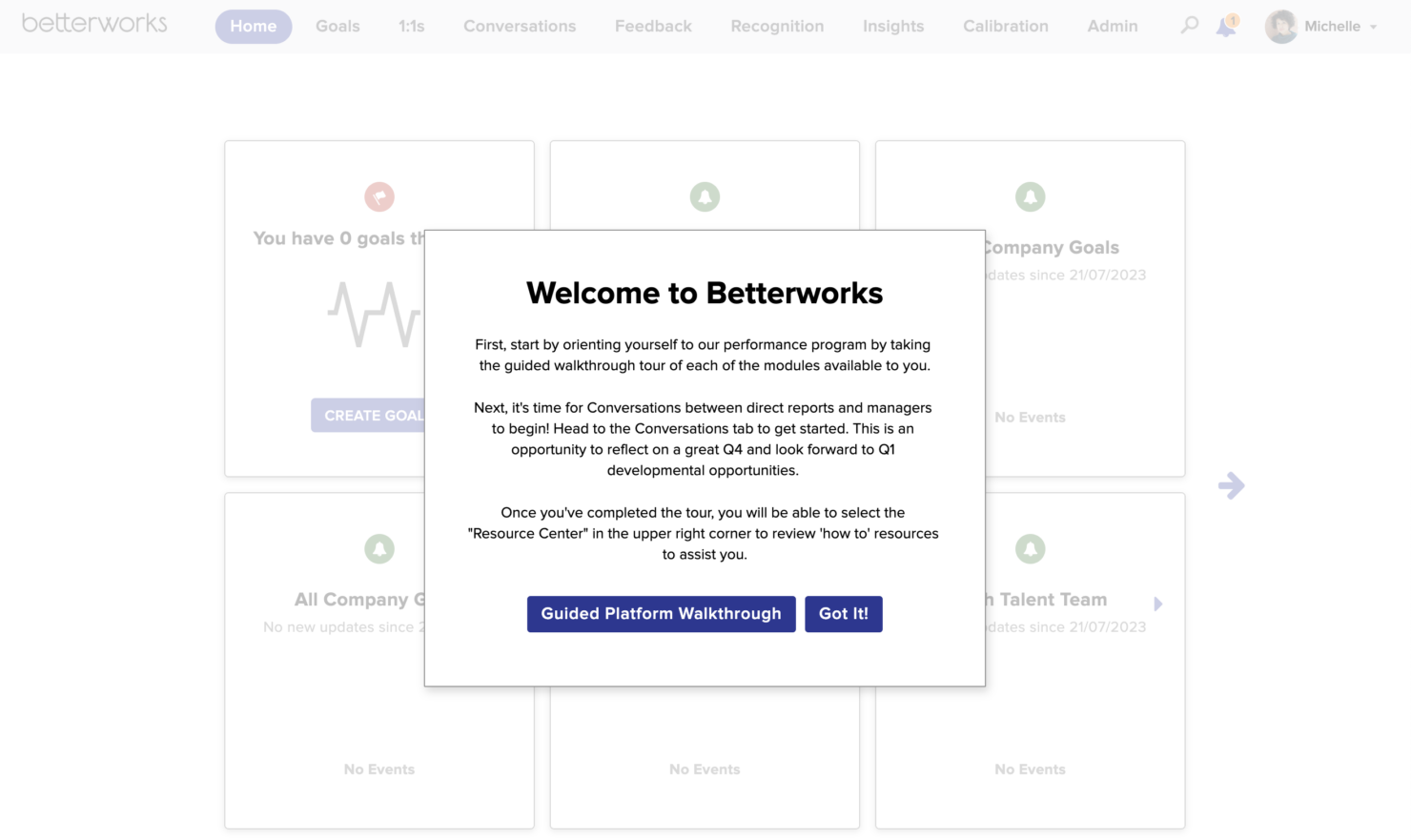
Betterworks uses a guided onboarding process built for mid-sized and enterprise organizations rather than a self-serve setup. You’ll typically work with a dedicated Customer Success Manager and Implementation Manager who help configure performance cycles, templates, integrations, and workflows based on your organization’s goals and performance strategy. The onboarding process also includes HRIS and collaboration tool integrations, data migration, admin enablement, training materials, webinars, tutorials, and access to a customer community.
In my experience, Betterworks places a strong emphasis on change management and long-term adoption rather than fast deployment alone. Simpler implementations can launch in roughly 6–10 weeks, while larger enterprise rollouts often take 10–16 weeks depending on organizational complexity, regional requirements, and integration needs.
Customer Support
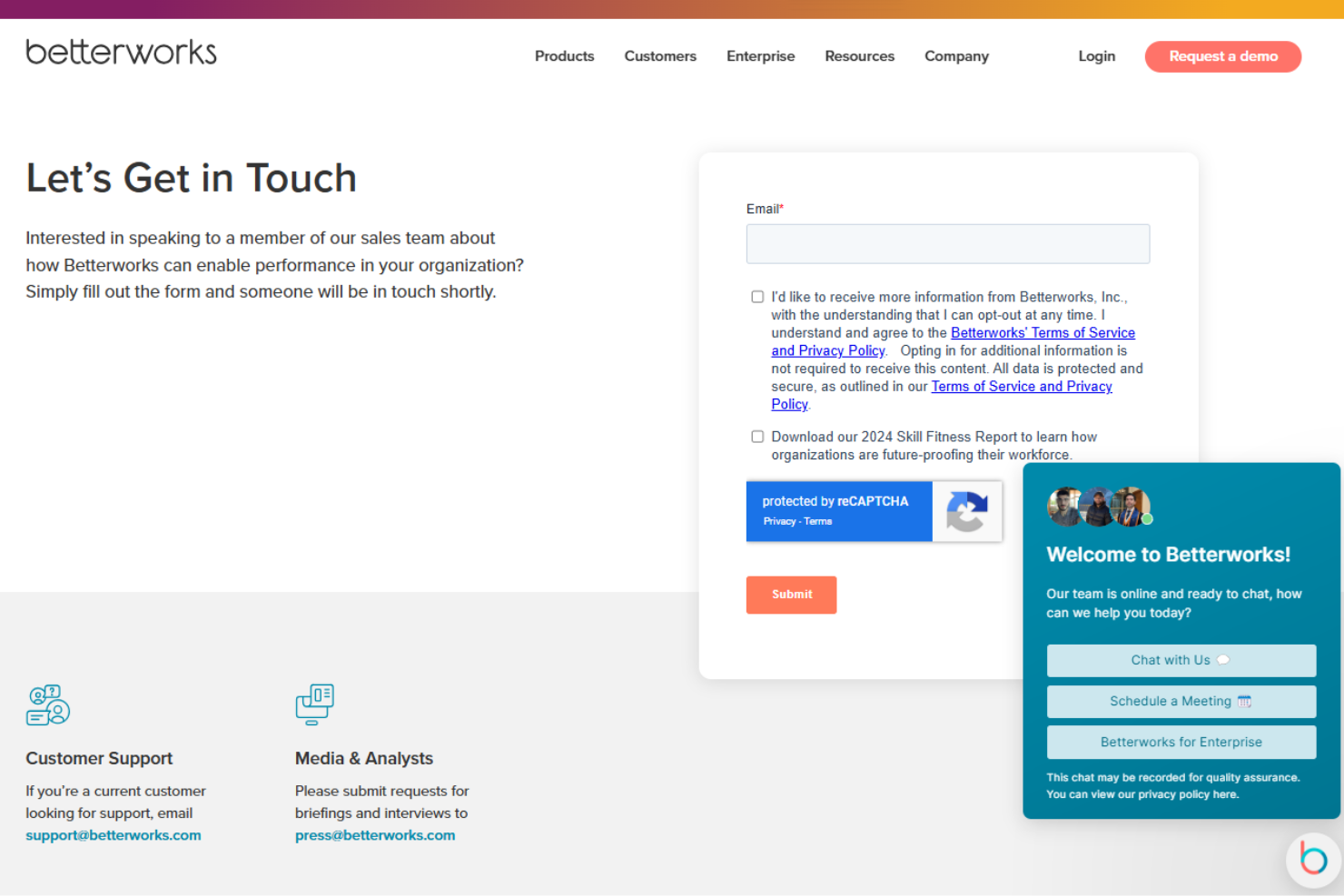
Betterworks offers structured customer support geared toward enterprise customers, including access to a dedicated customer success team, implementation guidance, webinars, tutorials, and detailed support resources. The platform also provides ongoing enablement and optional Signature Support services for organizations needing more hands-on assistance during rollout and long-term adoption.
Integrations
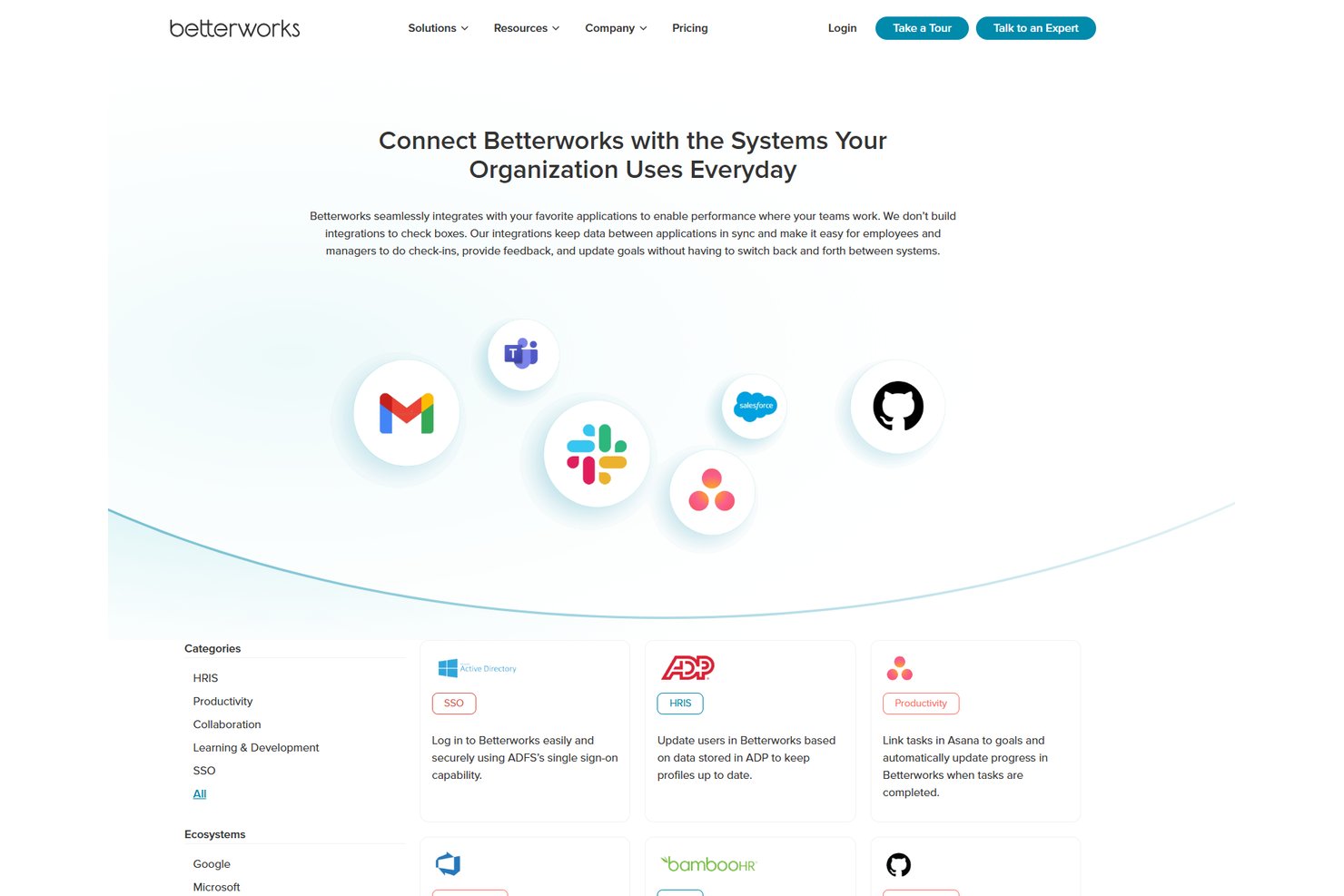
Betterworks integrates with a wide range of HRIS, collaboration, productivity, learning, and SSO platforms to keep performance management connected to your existing workflows. Supported integrations include Workday, SAP SuccessFactors, ADP, BambooHR, UKG Pro, Oracle, Slack, Microsoft Teams, Jira, Salesforce, Gmail, Google Sheets, Asana, GitHub, LinkedIn Learning, Udemy, Okta, and OneLogin.
The platform also has a REST API with token-based authentication, versioned endpoints, pagination, and secure HTTPS access, giving larger organizations more flexibility for custom integrations and enterprise data syncing.
Value for Money
Betterworks is positioned as an enterprise-grade performance management platform, so its pricing is best suited for larger organizations that need advanced goal alignment, calibration, talent intelligence, and ongoing support. While pricing is not publicly disclosed, the platform delivers strong value for companies looking for a connected system that combines performance management, feedback, engagement, and workforce insights in one place.
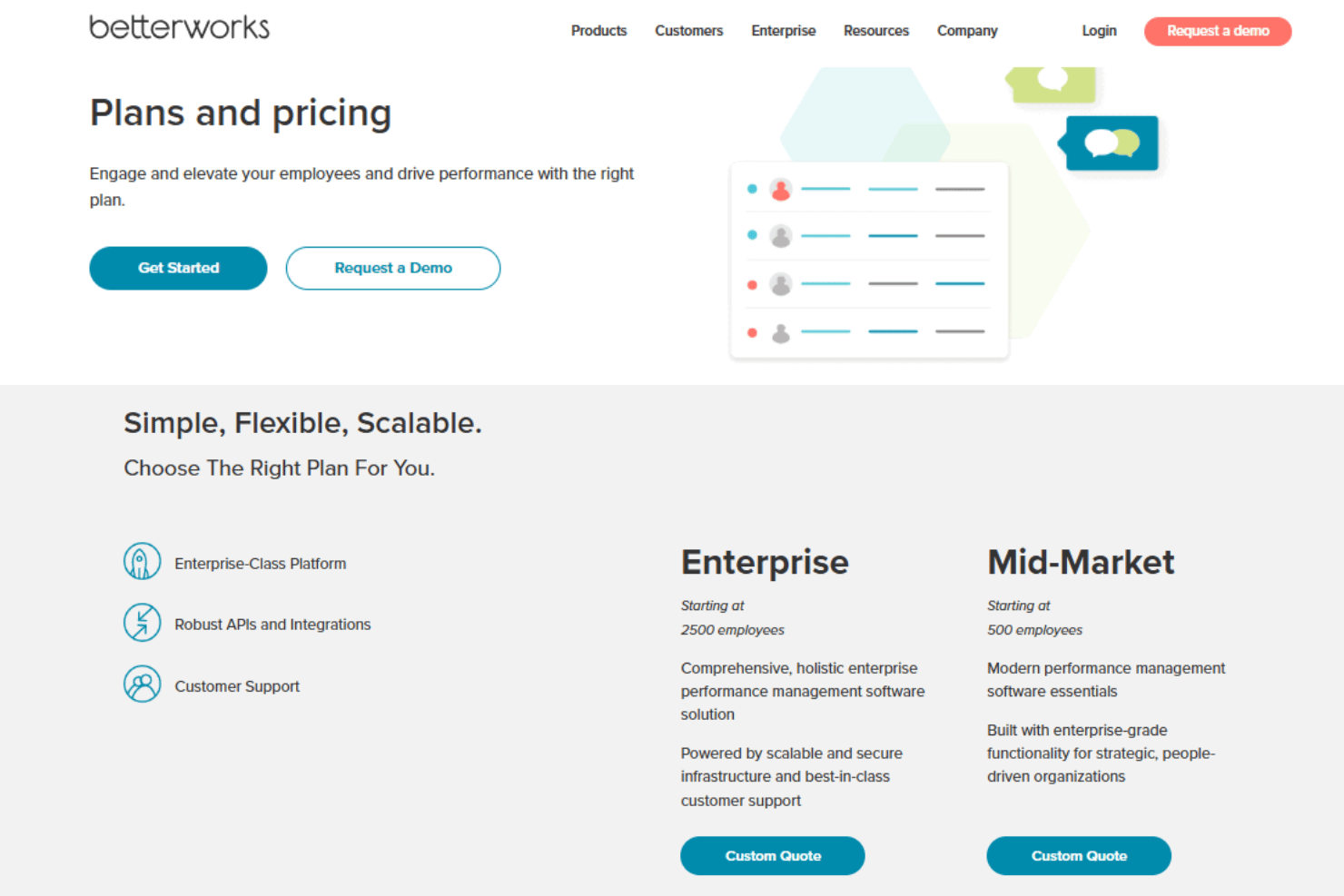
- Mid-Market Plan: Starts at 500 employees and includes Betterworks’ core performance management, talent intelligence, integrations, analytics, and enterprise-grade platform features.
- Enterprise Plan: Starts at 2,500 employees and adds higher-touch services such as Signature Support and change management support for larger, more complex deployments.
Both plans include enterprise-grade security, localization support, integrations, and API access, though you’ll need to contact Betterworks directly for custom pricing details.
Betterworks Specs
- 360 Degree Feedback
- API
- Application Tracking
- Attendance Tracking
- Budgeting
- Calendar Management
- Dashboard
- Data Export
- Data Import
- Data Visualization
- Employee Database
- Employee Engagement
- Employee Incentive Management
- Employee Onboarding
- External Integrations
- Feedback Management
- Forecasting
- Multi-User
- Notifications
- Onboarding
- Scheduling
- Timesheets
- Vacation & Absence Calendar
Betterworks FAQs
How does Betterworks handle data security and compliance?
Can Betterworks handle OKR management at scale?
How customizable is the Betterworks platform?
What kind of training does Betterworks provide for new users?
Does Betterworks offer mobile access?
How does Betterworks facilitate employee engagement?
Is Betterworks a replacement for an HRIS?
Is Betterworks suitable for small businesses?
Betterworks Company Overview & History
Betterworks, founded in 2013, is headquartered in Menlo Park, California, with an additional office in New York City. The company specializes in enterprise performance management and talent intelligence software designed to help organizations align goals, improve coaching, and make more informed talent decisions. Its platform combines goals and OKRs, feedback, performance reviews, calibration, employee engagement, succession planning, and AI-powered workforce insights in one connected system.
Over the years, Betterworks has expanded from an enterprise OKR platform into a broader performance management and talent intelligence solution. The company has raised more than $65 million in funding, including a $15.5 million Series A round led by Kleiner Perkins in 2014, a $20 million Series B round in 2016, and an additional $27 million extension to its Series B funding in 2019.
Betterworks Major Milestones
- 2013: The company was founded in Menlo Park, California.
- 2014: Raised $15.5 million in Series A funding led by Kleiner Perkins.
- 2016: Secured $20 million in Series B funding to expand enterprise solutions.
- 2019: Extended Series B funding by $27 million, bringing total funding to over $65 million.
- 2026: Launched AI-powered Talent Intelligence capabilities and repositioned the platform around performance enablement and workforce intelligence.