How Companies Use ActivTrak To Recapture Millions in Lost Value


Most companies have value drains hiding in plain sight. And you’re probably familiar with the symptoms — missed goals, ballooning labor costs, tech spend that never seems to shrink.
But the root causes? Those are hard to diagnose. That is, unless you collect and analyze workforce data.
If it feels like you’re working harder than ever for smaller gains, it’s time to start using workforce analytics. Let's break down what’s really going on inside most organizations, and how companies like yours use ActivTrak to fix common issues.
Without workforce visibility, leaders are flying blind
Every executive wants to allocate resources wisely. But how often do you make decisions based on gut instinct or anecdotal evidence?
We’re under water.
We need more people.
We need more tools.
These are common justifications for big, important decisions. But without actual data, you’re guessing — and guesses get expensive. They result in overhiring, overspending and undetected inefficiencies that cost millions.
Do you miscalculate staffing?
Staffing is among the biggest investments leaders make, yet most organizations manage labor with insufficient information: Managers say teams are overworked, leaders approve additional headcount and organizations grow without confirmation the workload justifies it.
Here’s the catch: Nearly 60% of managers admit they lack the data to accurately gauge if teams are understaffed or overstaffed. They don’t have concrete numbers on workload distribution and can’t see how employees spend their days.
See how a 2,500-employee company achieved $1M+ in labor savings with ActivTrak.
Do operational inefficiencies hinder performance?
Operational drag is another major value drain, but most leaders can’t spot it until performance dips or budgets tighten. And the numbers tell a sobering story. ActivTrak’s Productivity Lab found that organizations lose an average of $11.2M in productivity per 1,000 employees every year.
 found that organizations lose an average of $11.2M in productivity per 1,000 employees every year.
That’s equivalent to 130 employees getting paid for full-time work they don’t actually do. It’s not that teams don’t work hard — they do. But without clarity, people spend too much time on the wrong tasks. Left unaddressed, those inefficiencies add up to a major expense.
See how one ActivTrak customer recovered 12,000 productive hours a month.
Does your organization overspend on technology?
Software waste is another drain on profitability. It happens when leaders renew subscriptions and invest in new tools without knowing who gets value from them — and how.
This isn’t just a theory — research shows nearly one-third of SaaS spend goes to waste.
And the explosion of AI exacerbates this problem, as organizations increase AI budgets with no way to measure the impact of these new tools.
See how ActivTrak allowed one firm to uncover $400K in software license savings.
Can you measure workplace policies?
No matter which work model you adopt — return-to-office, hybrid or remote — the challenge is the same. How do you know if people follow your policies? How location impacts productivity and performance? If employees are focusing on the right tasks at the right time? Many leaders don’t.
For example, consider the latest RTO findings. More than 70% of business leaders believe in-person work strengthens engagement and culture, even though one in five employees ignore return-to-office rules — and many say they’re more productive when working from home. Without actual data, there’s no way to confirm who’s right.
See how ActivTrak helps business leaders measure productivity by location.
Do you unknowingly overpay contractors?
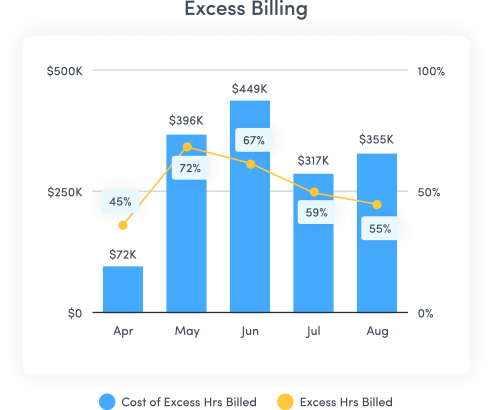
Contractor relationships depend on trust, but trust alone doesn’t protect your budget. While most organizations accept contractor invoices at face value, ActivTrak research indicates 15-30% of invoices are overbilled.
That's not a rounding error. It's a significant line item. If you spend $1 million each year on contracted labor and overpay by 15%, that's $150,000 walking out the door every year — money you could recover with proper visibility. But most leaders never check because they lack the visibility to do so.
See how one healthcare organization uncovered $500K in potential overbilling.
5 ways successful companies use ActivTrak to recapture lost value
Once you see how work actually happens, it’s easy to make smarter, faster decisions that add up to real savings. In other words…
Visibility changes everything.
Let’s look at five ways ActivTrak helps companies like yours take back valuable time and money.
1. Prevent overstaffing
The problem: It’s hard to tell when teams are truly maxed out. This leads to unnecessary hiring, inflated payroll and unhealthy hire-and-fire cycles.
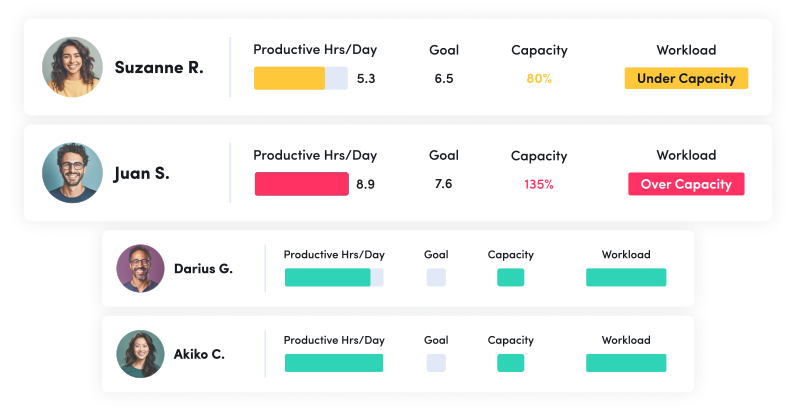
The solution: ActivTrak provides visibility into workload distribution, productive hours and team capacity so you can reassign work, rebalance teams and validate staffing needs.
How Echo Global Logistics uncovered more than $1M in labor savings: By using ActivTrak, leaders at this supply chain company discovered more than 16,000 hours a month of untapped capacity. Instead of hiring more employees, they found ways to use current staff more efficiently. The result? More than $1 million in annualized savings.
How it works: Before adding headcount, you need to know if you’re making the most of existing talent. ActivTrak provides this visibility based on real employee data.
2. Increase productive hours
The problem: Most companies pay full-time employees for 40 hours a week even though a lot of time goes to unnecessary meetings, distractions, context switching and administrative tasks.
The solution: ActivTrak reveals how much time employees spend on low-value activities, giving you a clear roadmap for reclaiming meaningful hours.
How Parts ASAP recovered 12,000 productive hours a month: Leaders at this manufacturing company wanted to understand why work kept falling behind even though employees were busy. By monitoring activity with ActivTrak, they saw where hours were lost. Once leaders understood the problem, they made small changes that improved per-employee productivity by 28%.
How it works: Productivity isn’t about squeezing more hours out of people. You need to make sure they spend the right hours on the right work. ActivTrak shows how much time goes to core activities so you know exactly what to change.
3. Right-size your tech stack
The problem: Most organizations unknowingly pay for unused apps, duplicate software and licenses tied to departed employees.
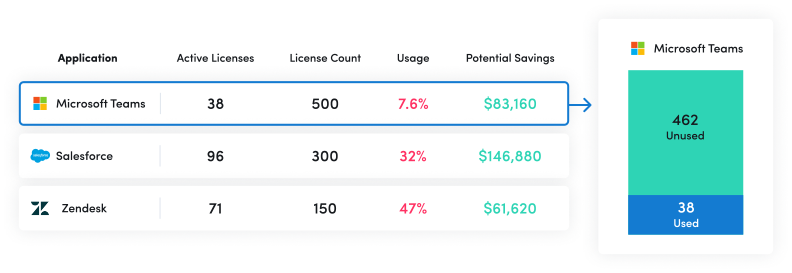
The solution: ActivTrak shows which tools people use, and how often, so you can consolidate systems and negotiate better vendor contracts.
How a financial services firm identified $400K in software license savings: When you support thousands of distributed employees, adopting new tools is a regular occurrence. But those technology costs add up fast. With ActivTrak, one company built a quick, comprehensive list of unused licenses and unnecessary subscriptions — an instant $400,000 savings.
How it works: Investing in technology without usage data is like going to a car dealership blindfolded. ActivTrak provides clarity into one of your largest expense categories so you don’t get drawn into paying for software you don’t need.
4. Validate RTO and other workplace policies
The problem: Leaders struggle to determine whether RTO, hybrid, remote and flexible policies improve productivity and morale — or quietly degrade them.
The solution: ActivTrak monitors productivity by location so you can see where and when people are most productive.
How Preferred Rate Mortgage made a successful switch to remote work: When leaders started allowing employees to work from home — unusual for the industry — they had no way to measure impact. ActivTrak showed teams were more productive when working remotely. This allowed the company to adjust office plans and reduce real estate costs.
How it works: Workplace policies shouldn’t rely on assumptions. ActivTrak reveals how team output changes between office, remote and hybrid work so you can move forward with confidence.
5. Verify contractor invoices
The problem: Most organizations pay outsourced labor based on a trust-based system. Contractors submit invoices, companies pay them and no one checks to see if hours billed match hours worked.
The solution: ActivTrak automatically compares invoiced hours to actual work, making it easy to catch billing errors and duplicate payments.
How a healthcare organization recovered $500K in potential overbilling: With 600 remote contractors, it was crucial for this ActivTrak customer to ensure accurate invoices. Automated reconciliation reports helped them spot errors and recover money they’d been overpaying for months.
How it works: No one wants to pay for work that isn’t being done — but only data gives you the insight to avoid overpayments. ActivTrak turns contractor billing from a trust-based system into a data-verified process.
Get the clarity you need to move forward with confidence
These organizations have recaptured millions of hidden inefficiencies in a matter of weeks or months — and you can too. It all starts with visibility.
ActivTrak provides a clear view of how work happens, allowing you to make critical decisions based on real-time employee activity data. We’ll show you where time goes, where you’re leaking money and how to help people do their best work.
Ready to see the hidden value inside your own organization? Create your free ActivTrak account today.