
Essential Background Screening Practices (What to Check, When & Why It Matters)



Background checks are rarely the problem.
Risk comes from inconsistent, undocumented, or poorly defined screening policies.
For HR, Talent Acquisition, People & Culture, and compliance leaders, the real risk is not whether screening takes place, but how decisions are applied, documented, and defended. While ad-hoc screening may seem flexible in the moment, over time it creates legal exposure, operational inefficiency, and potential reputational harm.
This is why screening policies still matter.
Many organizations think they have an effective background check policy simply because screening generally happens. In reality, intent alone does not ensure proper governance.
The most common risk in screening today is not misconduct or negligence, it’s inconsistency. The same role is screened differently across teams or regions, decisions made without clear documentation or timing that fails to align with fair chance requirements. Over time, these gaps create exposure that is difficult to defend.
A strong screening policy creates a framework that protects both employers and candidates. It clarifies what to include in each check, ensures fairness, creates consistent decision-making, and provides a framework that stands up to regulatory scrutiny.
The Four Foundations
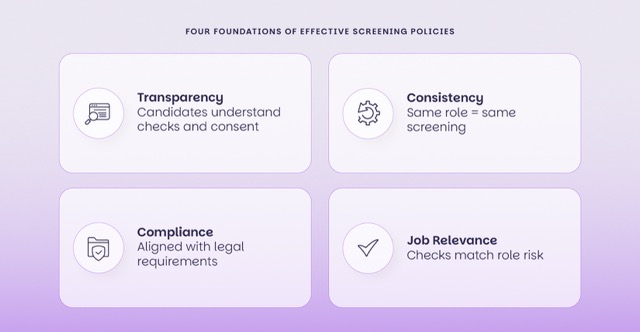
Effective background check policies are built on four core principles. When any of these foundations are missing, risk grows, often surfacing only when screening decisions are challenged.
Transparency
Candidates should have a clear understanding of what checks may be conducted, why they are needed, and how their information is used. Transparency builds trust, reduces the risk of disputes, and supports informed consent.
Consistency
The same role should be screened the same way, every time. Consistency reduces bias, supports fair hiring outcomes, and ensures screening decisions can be clearly explained if questioned.
Compliance
Screening policies must align with applicable federal, state, and local requirements, as well as any role-specific obligations. A clearly defined policy helps organizations navigate complex and evolving regulatory expectations with confidence, ensuring the business is not left open to compliance concerns.
Job relevance
Not every check is appropriate for every role. All screenings should be relevant to the risks and nature of the position. This prevents employment checks from becoming overly broad.
Defining “What to Check” in a Screening Policy
A common misconception is that a screening policy should list every check an organization might ever use. In practice, effective policies define which types of checks may be used and the conditions under which they are appropriate.

Most screening policies cover categories such as:
- Professional reference checks
- Identity checks
- Criminal background checks
- Employment and education verification
- Motor vehicle reports (where driving is a core job requirement)
- Drug testing and credit checks (where legally permitted and role-relevant)
A screening policy does not mandate all checks for all roles.
It establishes a structured framework that links screening decisions to job relevance, risk exposure, and regulatory considerations. This approach ensures screening is proportionate and consistent, supporting the fair treatment of candidates.
Setting the Right Timing for Background Checks
Timing is one of the most common sources of risk in pre-employment screening. A strong policy provides guidance on when checks should occur, without turning into an operational checklist.
Key considerations include:
- Providing a stand-alone disclosure and obtaining written authorization before any checks begin
- Aligning with fair chance and ban-the-box principles that limit early inquiries into criminal history
- Ensuring pre-adverse and adverse action requirements have been met prior to making any hiring decisions under the Fair Credit Reporting Act (FCRA) and other related state and local laws.
Timing matters for two key reasons.
From a legal perspective, conducting checks out of sequence can undermine the defensibility of an otherwise lawful screening decision. From a candidate experience standpoint, poorly timed checks can erode trust and negatively impact your employer brand.
From Policy to Practice: The Role of SOPs
Policies define intent. Standard operating procedures (SOPs) bring that intent to life. Even the strongest policy becomes ineffective without SOPs to translate the principles into consistent, repeatable actions.
An SOP is a step-by-step instruction manual that guides recruiters, hiring managers, and HR teams on how to apply the policy in day-to-day practice.
The distinction between policy and SOPs is critical. Policies set direction by defining what should happen and why. SOPs translate policy into action, ensuring requirements are followed in practice. When policies and SOPs are aligned, governance is strengthened, compliance and operational risk is reduced and screening policies are applied in practice, not just documented on paper.
Risks Created by Unclear Screening Policies
Without a clear screening policy, the same issues tend to surface repeatedly. Candidates in identical roles may be screened differently. When screening results raise questions, decisions are often made without clear documentation. Candidate rights, disclosures and appeal processes can be unclear. Documentation may fall short when audits, investigations or disputes arise.
A structured, policy-led approach addresses these gaps early before they create legal, compliance or reputational risk.
Supporting Policy-Led Screening in Practice
A well-designed screening policy only reduces risk if it can be applied consistently in practice. That requires systems and processes that reinforce policy intent, rather than undermine it.
Checkmate was built for organizations that lead with policy rather than ad-hoc decision-making. With the ability to choose checks based on role, region (over 190+ countries) or risk level, smart workflow templates, in-built fraud protection and adherence to current security standards, a clear compliance dashboard and renewal and expiry alerts, our software helps support the consistent application of screening requirements, and clear documentation of decisions and audit-ready records to help hiring teams apply background check policies with confidence.
The focus is not on increasing the volume of checks, but on ensuring the right checks are applied in the right way, every time, without adding unnecessary operational complexity.
Your Next Step: The Background Check Policy Playbook
Understanding what good screening governance looks like is only the starting point. Putting it into practice in a way that is clear and compliant requires a structured approach.
Inside our Background Check Policy Playbook, you’ll find practical information for designing pre-employment screening policies that hold up in real-world conditions, including:
- A complete 12-point framework for background check policy design
- Practical guidance aligned to U.S. compliance expectations
- Clear examples, checklists and policy considerations
- Insights co-developed with industry and compliance experts.
For teams ready to transition from ad-hoc screening to a clear, role-based policy approach, our playbook provides a straightforward starting point and actionable guidance to inform your next steps.
Download the Background Check Policy Playbook to start applying policy-led screening with confidence and strengthen your compliance and accountability today.
 to start applying policy-led screening with confidence and strengthen your compliance and accountability today.