

How to use elia to plan office space in insurance and finance



I've heard this exact story so many times that I've lost count. “We moved to a 2:1 desk ratio and downsized our space, saving a fortune." It’s a no-brainer, right? A national insurer we spoke to recently did just that, and initially it looked like a great plan. 2 employees for every desk, less space to lease, lower costs.
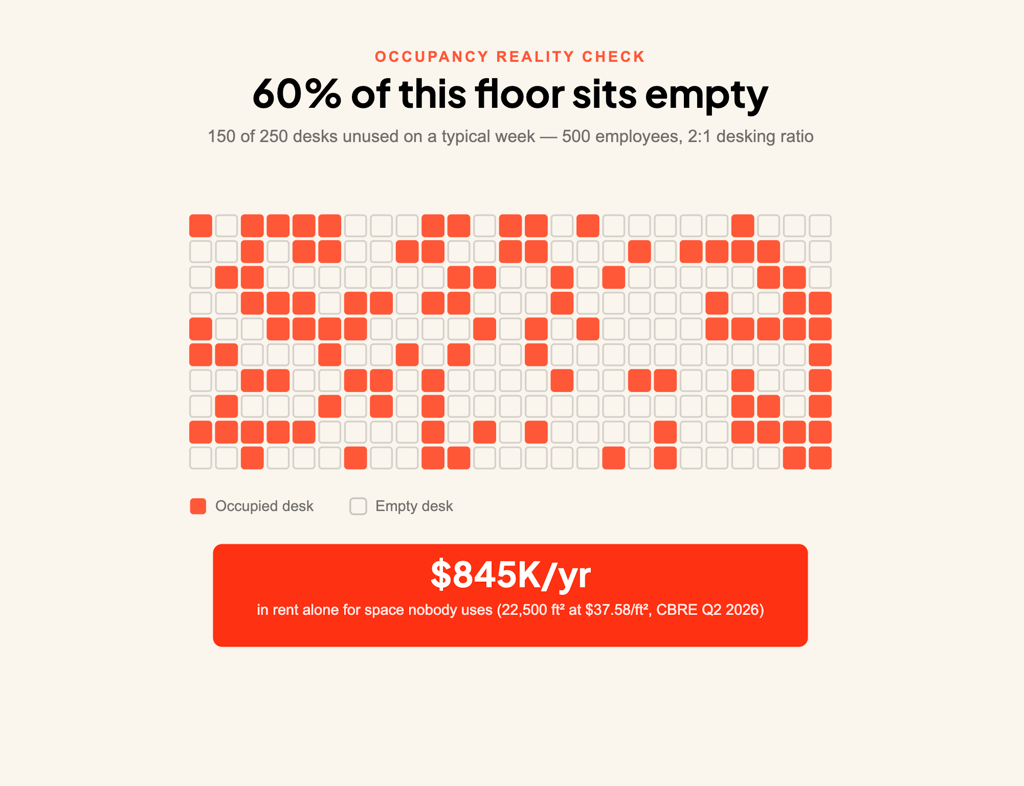
But when you look at the real numbers, it's a different story. Their floors were running at just 40% occupancy on average. That meant 60% of the space was just sitting empty, except for 4 days a year when the IT team had a company-wide meeting that needed all the desks. So they were basically paying for a space they only used 4 days a year.
We see this over and over in insurance and financial services, so we thought we'd take a closer look at what's going on. Here's how elia is helping teams like yours sort this out, step by step.
If elia's new to you, it's a workplace platform: desk and room booking, request management, visitor check-in, and the sensors and analytics that show how your space gets used, all in one place.
 : desk and room booking, request management, visitor check-in, and the sensors and analytics that show how your space gets used, all in one place.
TL;DR: how to use elia for insurance and financial services
- Get desk and room sensors up and running. They track real presence, anonymized and aggregated, which is the data a densification decision needs.
- Give the data a couple of weeks to run, let's say 2-4 weeks to catch both a quiet week and a busier one like quarter-end or all-hands.
- Set up flexible booking rules for teams that know they're going to be busier at certain times (like IT or training). Don't give them extra space permanently, just make it available when they need it.
- Turn on colleague invites for teams that need to be in the same room at the same time (like junior underwriters shadowing seniors).
- Schedule a regular occupancy report to land in front of whoever makes the real estate decisions.
- Reserve sensitive spaces, like a compliance department or a claims file room, for specific teams with access policies, and log client or auditor visits digitally instead of on a paper sign-in sheet.
What a 60% empty floor costs in the real world
Take a typical mid-sized insurer with 500 employees on a 2:1 ratio: that's 250 desks. At 40% weekly occupancy, that's 150 desks sitting empty most days. Financial services floors usually come in at around 150 square feet per desk, plus shared space, which is about 22,500 square feet of empty space that's costing them money.
The average U.S. office rent hit $37.58 per square foot in Q2 2026, up 2.6% year over year, according to CBRE. Run that math, and you're looking at around $845,000 a year in rent alone before you even factor in electricity and security costs that scale up with the empty space.
Your numbers will be different, but the basic principle is the same: the gap between what you're paying and what people are using is way bigger.
Why insurance and financial services hit this problem first
Two things collide in this industry: real estate is one of the biggest line items on the budget, so finance teams have to justify every square foot. A 2:1 or 3:1 desk ratio looks fantastic on a slide, but…
Then there’s the fact that office attendance is uneven by function, in a way one company-wide ratio can't account for:
- Claims and operations teams might be in 5 days a week.
- Underwriting or actuarial might be hybrid or part-time.
- IT, legal, and other centralized functions cluster into predictable spikes: training weeks, all-hands, quarter-end.
One ratio for the whole company can't hope to balance all these needs. One team we spoke to shed 2 floors during the pandemic and ended up with the opposite problem: more people than desks on busy days, all sorted out with manual scheduling every single week.
Common desk ratio assumptions in insurance and financial services
Here are a few things people assume about RTO and densification plans that rarely survive a close look at the real attendance data:
1. Two mandated days means two days of even attendance
Take that same 500-employee office at a 2:1 ratio, 250 desks. Mandate 2 days a week, and people still won't spread evenly across the week. If 70% all show up on a Wednesday, that's 350 people for 250 desks – a pretty big shortfall – even though average weekly utilization looks fine on paper.
2. Every department needs the same ratio
A team that only meets in person 4 times a year for training doesn't need permanent space for those meetings. They need flexibility to use more space when they need it, and then access to that space to be freed up again for the rest of the year.
3. Fewer desks means lower costs
True, but only if you're left with desks that can actually be used. That means having enough meeting rooms to accommodate everyone when they’re all in, and a booking system that works, so people aren't wandering around trying to find a place to sit. And, you need data that lets you catch a wrong ratio before the lease renews.
4. Booking data is close enough
Not really. It overcounts because someone books a desk then doesn't show up, and it still counts as used. You need sensor data on real presence to know whether a ratio is working.
That fourth point kind of blows up the other three. Most ratio decisions get made based on booking data that isn't very accurate in the first place.
| Assumption | What really happens | What elia shows you |
| A 2:1 ratio means 40-60% weekly occupancy is fine | Attendance clusters Tuesday-Thursday, so peak days are a lot hotter than the average | Heatmap by day and floor, so you size for the peak |
| Every department needs the same ratio | Centralized teams (IT, training) spike a few times a year and sit empty the rest | Zone-level rules that give priority access during spikes |
| Fewer desks means lower cost | Cost is only going to drop if the remaining desks are usable and findable | Automated occupancy reports that catch a bad ratio before the lease renews |
| Booking data is accurate enough to plan around | No-shows inflate the numbers, so the calendar looks fuller than the office is | Sensor data on real presence |
Setting it up
Here's what the fix looks like once you put it on a real floor:
- Install the sensors. elia's desk and room sensors are battery-powered and wireless, so you can get a floor up and running without any cabling or IT involved. They measure actual presence, anonymized and never linked to an individual, which is important because a desk might be booked and empty, or unbooked but in use. Booking data alone won't tell you which.
- Let an attendance cycle run for a bit. 2 to 4 weeks, at least. This way, you see a normal week and a spike week (quarter-end or an all-hands) before touching the ratio.
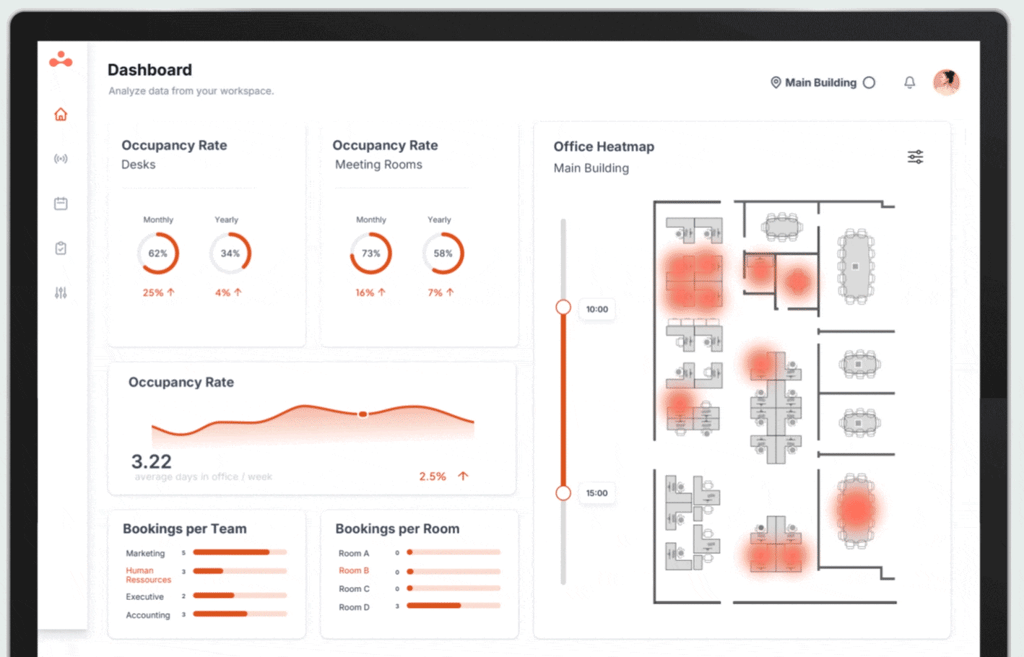
- Take a look at the heatmap by day, time, and floor. That's how you figure out if your 2:1 ratio is holding, or if it's more like 3:1 on quiet days and 1:1 during the quarterly chaos.
- Set up zone-level booking rules for the teams that jam up the space. In elia, space isn't locked to one team by default. So a department like IT can get priority on more desks or rooms when they need them, and then it just reverts to open booking once the spike is over.
- Turn on colleague invites where mentoring is a priority. Employees can see who else has booked for a given day and sit near them, or send an invite so a colleague books alongside them.
- Schedule the report to go out automatically each month. An occupancy summary goes to whoever's in charge of real estate decisions, so nobody has to remember to export a spreadsheet by hand.
Why junior staff are the other reason companies are pushing RTO
Office costs aren't the only thing driving these mandates. Just as often, leaders tell us that their junior employees lose the most when work goes fully remote.
There's some research backing that up. In The Power of Proximity to Coworkers, Natalia Emanuel, Emma Harrington, and Amanda Pallais studied software engineers at a large firm and found that sitting near teammates meant more feedback, and that the benefits landed hardest on younger, less-tenured workers. When offices closed, that feedback advantage largely disappeared.
New hires pick up a lot of what they know by being near the people doing the job: casually asking a question or two, observing a senior underwriter or claims handler work through a file, getting pulled into a conversation they wouldn't have known to join. Remote work, as you might expect, removes that entirely, and the slowdown shows up in output months later.
A 2-day mandate doesn't guarantee the right people end up in the building on the same day. A junior underwriter might come in as scheduled while the senior colleague they're trying to shadow comes in on a completely different day. Colleague invites are the solution to that problem, letting people see who's coming in and plan their days around it.
How a financial services firm fixed the same coordination problem
Gestion FÉRIQUE, a Montreal-based, 170-person financial services firm that manages retirement funds for engineers, ran into the identical problem after moving to hybrid work across 2 offices and 86 bookable desks. Flexibility without visibility meant employees showed up on their scheduled days with no way of knowing whether the colleagues they needed were also in.
Now, our employees can plan their in-office days more easily, knowing when their colleagues will be present and choosing a desk that suits their needs. It’s convenient and fosters collaboration.
Restricted access and visitor management for finance and insurance teams
Desk ratios aren't the only thing that makes this industry different.
A big chunk of insurance and financial services offices have space that simply MUST remain locked down: compliance file rooms, underwriting archives, trading desks, executive floors, rooms held for regulatory reviews. Generic booking tools don't handle that situation well because they treat every desk the same, whether it should be open for booking or not.
elia's access policies do this right in front of you. Administrators can lock specific desks, rooms or zones down to specific teams or individuals, so compliance keeps their own space, underwriting has their own file access, and nobody outside those teams gets to book it by mistake.
Likewise for visitor management: a digital sign-in system with host notifications gets rid of the old paper sign-in sheet, so you have a real record of who was on-site and when.

Where to get started
If you're building the case for finance or leadership, get specific: the ratio you're running today was set on an assumption, and here's what the actual numbers say 6 months in. That's a lot harder case to argue with than a bigger budget ask on faith.
If you're in the middle of a densification plan or an RTO rollout right now, the fastest way to see where you stand is to run your own floor plan and attendance pattern before your next lease decision, not after.
Frequently asked questions
Does elia monitor employees with these sensors?
No. The data is anonymous and aggregated, so it can’t be tied back to any individual. The sensors read whether a space is being used, not who’s using it or how long they’re there. elia is made to run places. You get occupancy patterns by desk, floor, and day to make informed real estate decisions, without it turning into employee surveillance. In a compliance-sensitive industry, that distinction matters to your people and to your legal team.
Do we have to replace our existing tools to use elia?
No. elia runs alongside what you already have. Desk and room booking syncs up with your Outlook and Microsoft 365 calendars, so people can book through the tools they use every day without having to start from scratch.
Is elia secure enough for financial services data?
elia’s ISO 27001 certified. That’s usually the first thing security and compliance teams will ask, and for good reason. If you have requirements beyond that, mention them early, so the team can confirm what’s in place before you commit.
What if some of our teams have assigned desks, not hot desks?
Pretty common in insurance and finance, and elia handles both. Stick with assigned desks for the teams that need them, introduce a hot desk or neighborhood arrangement for the hybrid teams, and still get reliable occupancy data across the whole lot. That’s because a sensor will happily read a desk whether it has a name on it or just a finger on a booking system, so your overall utilization picture isn’t skewed towards the flexible bits.

