

10 Best Safety Management Software Reviewed For 2026

10 Best Safety Management Software List


Managing workplace safety can be a daunting task, especially with the ever-changing regulations and the need to keep your team safe. As someone well-versed in the HR management industry, I understand the challenges you face. Safety management software can help simplify these complexities by organizing data, tracking incidents, and ensuring compliance.
In this article, I'll share my top picks for safety management software. I've independently tested and reviewed these tools to provide you with unbiased insights. You'll find practical solutions tailored to your needs, making it easier to choose the right one for your team. Let's explore how these tools can make safety management more manageable for you.
Why Trust Our Software Recommendations
Our team has been testing and reviewing software since 2012. As HR experts ourselves, we know how difficult—and important—it is to choose the right software.
For this guide, we evaluated tools using hands-on testing and independent research, scoring tools using our selection criteria. We also draw on insights from industry thought leaders and practicing HR experts.
Our reviews reflect our human editorial judgment, not a sales pitch.
Expert reviewers:
Safety Management Software Comparison Table
This comparison table summarizes pricing details for my top safety management software selections:
| Tool | Best For | Trial Info | Price | ||
|---|---|---|---|---|---|
| 1 | EHS management software that offers both remote and in-person training | Not available | Website | ||
| 2 | Best for OSHA-compliant healthcare safety plans | Free demo available | Pricing upon request | Website | |
| 3 | Advanced EHS software designed to support ISO 45001 safety indicators | Free demo available | From $30/user/month (billed annually, min 5 seats) | Website | |
| 4 | HR software solution with integrated modules for health & safety and training management | Free demo or a free trial | From £16/month for up to 5 people | Website | |
| 5 | User-friendly incident tracking software with customizable risk assessment capabilities | Free demo available | Pricing upon request | Website | |
| 6 | Customizable EHS software that integrates with other modules for quality, risk management, sustainability, and ESG | Free demo available | From $44/user/month (billed annually) | Website | |
| 7 | Comprehensive safety management system with deep employee engagement and safety culture building tools | Request a free demo | Price upon request | Website | |
| 8 | Sophisticated safety management software with granular reporting and AI-generated data summaries | Free demo available | Pricing available upon request | Website | |
| 9 | Mobile-friendly, full-feature safety management system with predictive information and a patented safety score | 30-day free trial | From $16 USD/user/month | Website | |
| 10 | Mobile-friendly EHS software with equipment tracking capabilities | Free demo via their website | Pricing upon request | Website |
Best Safety Management Software
Below you’ll find a brief description of each safety management software to showcase each tool’s best use case, plus some noteworthy features, and screenshots to give you a snapshot of the user interface. Keep reading to find additional bonus picks at the bottom of the list.
EHS management software that offers both remote and in-person training

BIStrainer lands on my shortlist for the way it supports both remote and in-person training under one EHS platform. When teams split between job sites, offices, and remote locations, I find this kind of flexibility makes it easier to roll out safety programs on everyone’s schedule. I like that you can assign and track online courses while still managing classroom sessions and hands-on certifications in one system.
BIStrainer’s Best For
- Organizations delivering both online and in-person safety training
- Safety managers tracking blended EHS training and compliance
BIStrainer’s Not Great For
- Companies focused only on on-site, instructor-led training
- Teams needing advanced incident or hazard reporting tools
What sets BIStrainer apart
BIStrainer handles safety programs by letting you mix remote and in-person training from the same dashboard. Unlike providers that tie you to online learning only, it assumes you need to manage live sessions, supervisor sign-offs, and site-specific requirements too. I often see this work best for safety managers who juggle blended workforces and tight training records in regulated fields.
Tradeoffs with BIStrainer
BIStrainer optimizes for blended learning and certification, but you give up depth in incident and hazard tracking. If you need strong safety event management, you’ll want to add a second tool.
Best for OSHA-compliant healthcare safety plans

MedTrainer is on my shortlist because it covers OSHA safety planning and compliance needs for healthcare workplaces in one place. I’ve found its policy and procedure builder to be very effective for maintaining up-to-date safety documentation and ensuring nothing gets missed during audits.
What really stands out to me is how you can assign and track mandatory OSHA training by department, which is especially useful for clinics or multi-site organizations. I appreciate being able to organize and update compliance records across locations without digging through spreadsheets.
MedTrainer’s Best For
- Healthcare organizations needing OSHA-compliant safety documentation and training
- Multi-site clinics centralizing safety policies and audits
MedTrainer’s Not Great For
- Teams outside healthcare needing general safety management
- Organizations wanting deep custom incident tracking features
What sets MedTrainer apart
MedTrainer focuses on making OSHA and healthcare safety compliance routine instead of reactive. Unlike something like Google Workspace where you’re piecing documents and spreadsheets together, MedTrainer assumes you want safety plans, training, and policies centrally managed and audit-ready. In practice, this is especially helpful for healthcare organizations that are juggling multiple sites or accreditation standards.
Tradeoffs with MedTrainer
MedTrainer optimizes for healthcare safety and compliance, but that focus means you get less flexibility for non-healthcare or highly customized safety processes. You’re mostly working within structured, predefined workflows.
Cority
Advanced EHS software designed to support ISO 45001 safety indicators
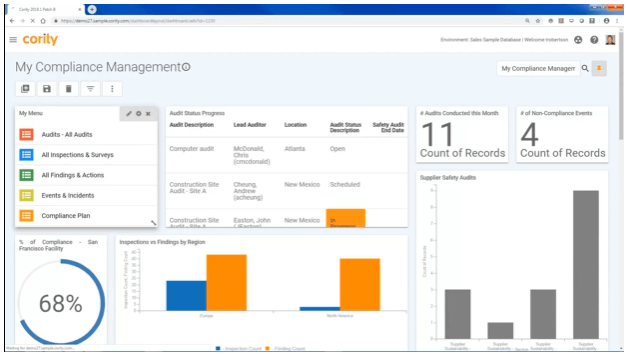
Cority earns its spot here for how well it centralizes enterprise-scale EHS management with a clear focus on ISO 45001 compliance. I recommend it when you need detailed tracking and incident reporting that can stand up to global safety standards.
What makes Cority valuable to me is its real-time safety indicators dashboard and customizable audit workflows. I especially like how this lets safety and HR teams monitor, prove, and improve compliance across multiple sites.
Cority’s Best For
- Large organizations managing complex EHS and compliance needs
- Teams needing ISO 45001-aligned safety indicators and audits
Cority’s Not Great For
- Small businesses with basic health and safety needs
- Teams seeking a lightweight or entry-level safety solution
What sets Cority apart
Cority stands out for how it expects safety and compliance teams to work across multiple sites using tightly defined processes and structured audit trails. Unlike more flexible tools like monday.com that let you design your own workflows, Cority has a stronger focus on supporting formal health and safety standards across global locations.
I see this working best when you need standardized data, centralized dashboards, and reporting that ties directly to regulations like ISO 45001.
Tradeoffs with Cority
Cority optimizes for standardization and regulatory alignment, but this means you give up flexibility for custom workflows or lighter use cases. Smaller teams or those needing a more adaptable solution can find it restrictive.

HR software solution with integrated modules for health & safety and training management
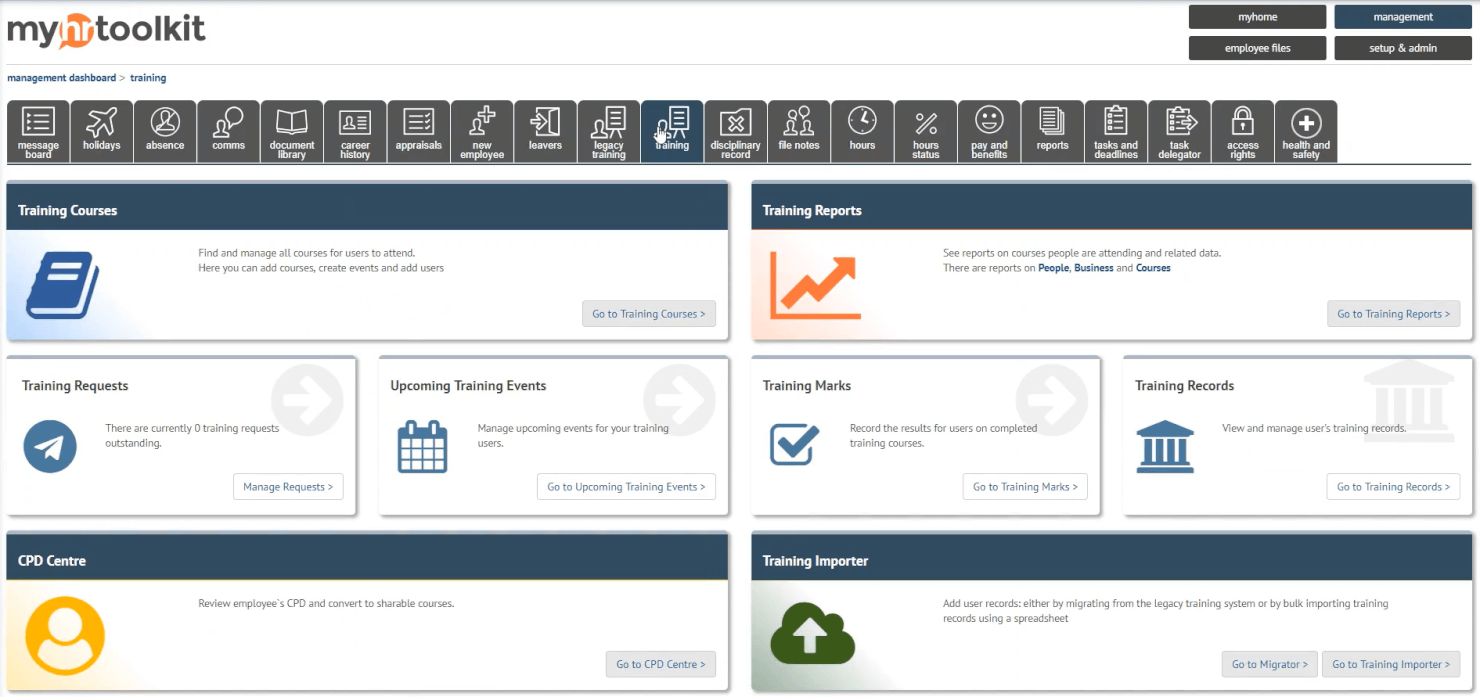
myhrtoolkit earns a spot on my list for how it brings essential health and safety tracking right into your core HR processes. I like how its integrated modules help you manage accident reporting, monitor staff compliance, and drive training management from the same system.
I find it works especially well for small and midsize teams needing to centralize incident records and training documentation. That full visibility over both safety and HR events is what sets it apart for me.
myhrtoolkit’s Best For
- Small to mid-sized businesses managing safety and HR together
- Teams needing built-in training and incident tracking
myhrtoolkit’s Not Great For
- Large enterprises with complex regulatory needs
- Highly specialized industries needing advanced safety analytics
What sets myhrtoolkit apart
myhrtoolkit stands out by blending HR management with health and safety recordkeeping in a way you don’t see with traditional HRIS tools like BambooHR. Instead of keeping compliance and training records as an afterthought, everything is managed side by side. Smaller organizations tend to use it to maintain a single source of truth without layering on a separate safety platform.
Tradeoffs with myhrtoolkit
myhrtoolkit optimizes for simple, integrated workflows, but teams needing custom compliance automation or advanced analytics find those areas limited. For highly regulated or technical environments, it often falls short.

User-friendly incident tracking software with customizable risk assessment capabilities

BrightSafe is on my shortlist because it gives you straightforward incident tracking tied to flexible risk assessments, which helps when you need both documentation and prevention in one place. I recommend BrightSafe when you want to move beyond spreadsheets and paper trails, especially if your workplace handles varied safety risks.
What stands out for me is how you can tailor risk assessments to fit different sites or activities, then quickly log accidents, near misses, and hazards for a complete safety record. I like how everything’s auditable and accessible for quick reviews, which is important when protocols or compliance checks come up.
BrightSafe’s Best For
- Organizations tracking workplace incidents and tailoring risk assessments
- Safety managers handling compliance across multiple worksites
BrightSafe’s Not Great For
- Businesses needing integrated equipment maintenance management
- Teams requiring advanced analytics beyond incident tracking
What sets BrightSafe apart
BrightSafe makes safety tracking feel accessible for managers who want to move away from manual processes. Instead of overwhelming you with configuration, it lets you document incidents and tailor risk assessments for different departments or sites. I find it expects you to approach safety by building a living record and acting on real evidence, rather than reacting in the moment.
Unlike Alliant Safety or more complex EHS suites, BrightSafe is great for teams who want accountability and traceability baked into the daily flow, but not at the cost of cumbersome setup.
Tradeoffs with BrightSafe
BrightSafe optimizes for simple, repeatable incident management, which means you sacrifice advanced analytics and customizable automation that larger, compliance-heavy sites often need.

Intelex
Customizable EHS software that integrates with other modules for quality, risk management, sustainability, and ESG
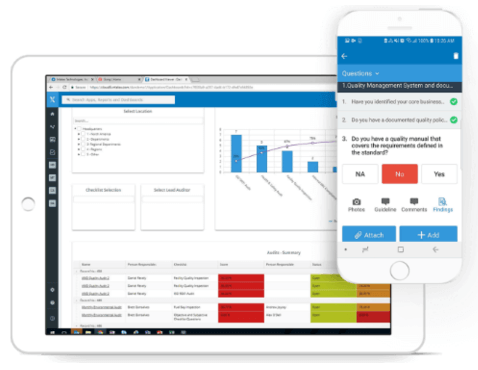
Intelex is a go-to for organizations with complex safety needs and a need for serious flexibility. I’ve seen teams get value from its modular approach—especially when they’re already tracking quality, environmental, or risk data and need everything in one tool.
What stands out for me is how you can configure workflows and link safety metrics directly to ESG and sustainability targets. If you want custom dashboards to keep incident data, audits, and improvement actions tightly connected, Intelex delivers.
Intelex’s Best For
- Organizations integrating safety, quality, and ESG management
- EHS teams needing highly configurable dashboards and workflows
Intelex’s Not Great For
- Small businesses needing basic, out-of-the-box safety tools
- Teams seeking quick setup with minimal configuration
What sets Intelex apart
Intelex takes a modular approach that expects you to manage safety, quality, and ESG metrics together. I see teams build out processes that match their compliance needs rather than forcing work into prefab workflows like you find in basic safety apps. Unlike something like SafetyCulture, you get lots of flexibility to design forms, dashboards, and incident tracking to your needs.
This setup makes the most sense when you’re dealing with complex requirements that change across regions or business units.
Tradeoffs with Intelex
Intelex optimizes for customization, but setup takes time and ongoing admin work. If you want something you can launch and use quickly, this isn’t a good fit.

Comprehensive safety management system with deep employee engagement and safety culture building tools

Cority Safety Cloud makes my list for organizations that need a single, unified platform for incident management, audits, and corrective actions. What I like is how Cority keeps safety front and center by engaging employees directly in reporting hazards and sharing real-time feedback through mobile tools. I’ve seen teams benefit from the behavioral safety and culture-building features when fostering shared responsibility is the goal.
This is best when you want to go beyond checklists and truly engage people in safety culture, not just compliance.
Cority Safety Cloud’s Best For
- Large enterprises with complex safety compliance needs
- Organizations building a participatory, employee-driven safety culture
Cority Safety Cloud’s Not Great For
- Small businesses with basic or occasional safety tracking needs
- Teams wanting a lightweight, quick-to-set-up safety solution
What sets Cority Safety Cloud apart
Cority Safety Cloud is designed for organizations that want safety to be a shared, everyday activity across the business. Unlike lighter tools like SafetyCulture, Cority leans into creating a feedback loop where employees take an active role—not just reporting hazards but shaping the overall program alongside EHS leaders.
In practice, this works best when you want safety engagement that feels bottom-up, not just top-down policy enforcement.
Tradeoffs with Cority Safety Cloud
Cority focuses on enterprise-level detail and engagement, but setup and program design can be time-intensive. For small organizations or teams that need to respond quickly, that complexity may slow deployment and early results.
SiteDocs
Sophisticated safety management software with granular reporting and AI-generated data summaries

SiteDocs earns its spot for safety-first organizations looking to level up beyond simple checklists. When I test its granular reporting and AI data summaries, I see a clear advantage for teams managing hundreds of inspections, audits, and incidents.
I appreciate how SiteDocs lets you drill into individual trends while also surfacing bigger patterns through automated insights. This is exactly what I want when safety leaders need both detail and clear, actionable summaries to guide decisions.
SiteDocs’s Best For
- Safety managers tracking large volumes of inspections or incidents
- Organizations that want AI-powered safety data summaries
SiteDocs’s Not Great For
- Small teams with only basic safety requirements
- Groups that prefer simple, checklist-based safety tools
What sets SiteDocs apart
SiteDocs stands out by organizing safety management around detailed audit trails and summary dashboards. Unlike basic checklist apps or Google Forms, it expects you to dig into trends and compliance gaps over time, not just collect signoffs or one-off forms. In practice, this works best for safety leaders who need to monitor ongoing risk, with AI surfacing key findings so you don’t miss patterns in a sea of reports.
Tradeoffs with SiteDocs
SiteDocs optimizes for high-volume, structured tracking, but that focus means small teams with simple workflows might find the setup and reporting more than they need.
Safesite
Mobile-friendly, full-feature safety management system with predictive information and a patented safety score
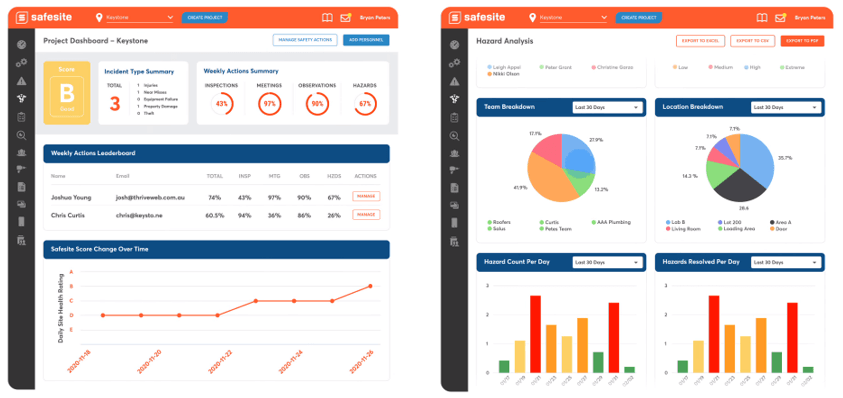
Safesite is on my list because it’s way ahead in predictive safety management. I like how everything is designed for mobile use, so teams can log hazards, incidents, or safety activities right in the field. The patented safety score gives you a direct read on jobsite risk, which I find helps supervisors act fast and make real improvements.
Safesite’s Best For
- Field teams that need mobile-first safety management
- Companies tracking risk with real-time, predictive data
Safesite’s Not Great For
- Organizations with paper-based or very manual processes
- Small crews that don’t track safety activities digitally
What sets Safesite apart
Safesite approaches safety as a proactive, continuous process that happens out in the field. Instead of relying on desktop-based dashboards like you find with something like SafetyCulture, Safesite expects crews to log activity, report hazards, and track metrics directly on mobile devices. This works well when you want real-time awareness and visibility for superintendents or safety managers as jobs progress.
Tradeoffs with Safesite
Safesite optimizes for mobile-first digital workflows, but you give up options for running traditional, paper-heavy processes. If you’re not ready for digital recordkeeping, it can feel like extra work.

Mobile-friendly EHS software with equipment tracking capabilities
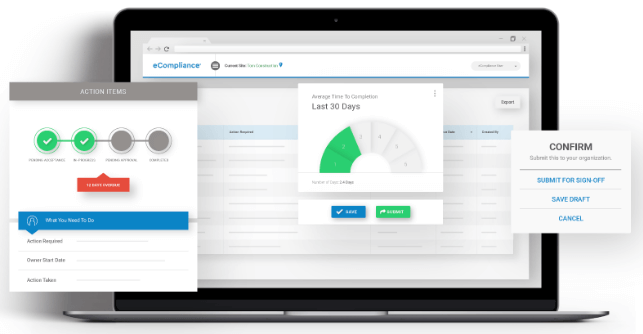
eCompliance makes this list because it specializes in simplifying field safety management for teams who need mobile access. When I evaluated its equipment tracking features, I saw how easy it is for frontline staff to check inspection records or maintenance status right from their phone.
The mobile app reduces paperwork and keeps asset data up to date, which I find especially valuable for safety leads coordinating across multiple job sites. I like how inspection scheduling and hazard reporting are tightly linked to the equipment profiles—this fits real-world scenarios where compliance and asset safety overlap.
eCompliance’s Best For
- Safety teams needing mobile equipment inspection and tracking
- Companies running multiple worksites with distributed field staff
eCompliance’s Not Great For
- Organizations that don’t manage equipment assets
- Teams needing in-depth incident investigation and root cause analysis
What sets eCompliance apart
eCompliance is designed for field teams who need to log inspections, access safety forms, and track equipment without leaving the worksite. Unlike options like SafetyCulture that emphasize audits or observation-based reporting, eCompliance expects staff to use mobile devices to close inspection loops and manage asset status live, right where the work happens.
In practice, this makes the tool a good fit for organizations with a lot of moving physical equipment across jobsites.
Tradeoffs with eCompliance
eCompliance optimizes for mobile-first safety tasks, but in doing so, it limits the level of customization and analytics you could get from more dashboard-oriented systems. If your team wants to build out specialized workflows or analyze trends in detail, you'll hit limits here.
Other Safety Management Software
Here are a few more options that didn’t make the best safety management software list. I didn’t have room for a full review for each of these but they are still worthy of consideration:
- WHS Monitor
Advanced safety management solution including access to 7 million safety documents and templates
- SafetyAmp
Cloud-based safety management software with configurable recordkeeping apps to automate compliance tracking tasks
- Weever
Digital operations management platform with employee engagement features to keep safety top-of-mind
- Lighthouse
Straightforward web-based safety management software with offline data storage for workers in remote locations
- EHS Insight
Safety management and injury tracking software compliant with OSHA, WCB, RIDDOR and MSHA - available as a free trial.
- Eddy
HR software system with built-in training tracking module and document storage for copies of certifications.
- Employment Hero
HRIS system with an integrated training tracker including automatic email notifications to ensure employees stay compliant.
- GoCanvas Safety
Advanced digital safety management system with e-signatures, digital photo capture, and client-facing reports - available as a 10-day free trial.
- LogicManager
HRMS software with modules for health & safety, risk management and compliance - known for excellent customer service and implementation services.
- ProntoForms
Safety management system built to support field teams, including solution-based templates or the ability to build your own.


How I Evaluate Safety Management Software
I split my evaluation into two layers: baseline criteria every tool must meet—like OSHA recordkeeping and incident workflows—and differentiators that separate best-fit tools from the rest.
Core Functionality (Table Stakes For This List)
When I'm selecting tools for my list, I rank each one on a scale from 0 (does not offer the functionality) to 5 (excels in this area) for each core functionality listed below. Then, I calculate the tool's total score into a percentage. Each tool needs to achieve a minimum total score of 65% to be considered for inclusion.
- Incident & Injury Reporting: I look for structured intake forms, investigation workflows, and corrective action tracking that let HR log everything from a warehouse slip-and-fall to a near-miss on a job site.
- Regulatory Compliance Management: Each tool should support OSHA 300, 300A, and 301 log generation (or regional equivalents), so your team can pull audit-ready records without rebuilding them in a spreadsheet.
- Safety Training & Certification Tracking: I evaluate whether the platform tracks completions, certification expiration dates, and renewal reminders—especially for role-specific requirements like forklift operation or confined space entry.
- Risk Assessments & Inspections: Tools should offer configurable inspection templates and scheduling, so a safety lead can run a monthly fire extinguisher audit or a quarterly site hazard assessment from a single system.
- Safety Document & Policy Management: I check for centralized storage with version control and employee acknowledgment tracking, which matters when you need to prove staff reviewed updated PPE procedures or new SDS sheets.
- Reporting & Analytics Dashboards: The platform should surface key safety KPIs like TRIR, DART rates, and incident trends in configurable dashboards your HR leadership team can actually act on.
Once I have a list of tools that meet this criteria, I consider what sets each platform apart.
Differentiating Factors (What Sets Vendors Apart)
Here's how I compare and contrast different vendors:
Standout Features
Mobile and offline access matters when your workforce is spread across job sites or warehouse floors—I look for apps that let supervisors complete inspections and log incidents without a Wi-Fi connection. Workers' comp integration is another differentiator, since linking an incident record directly to a claim saves HR from re-entering data across systems. I also check whether a platform handles contractor and visitor safety, which is a real need for teams managing mixed workforces across multiple locations.
Beyond Features
HRIS integration is a big one—I check whether a platform syncs with systems like Workday, BambooHR, or ADP so employee rosters and org data stay current without manual imports. Industry and workforce fit also matters; a tool built for construction crews spread across job sites has different configuration needs than one designed for a healthcare facility. I evaluate compliance and security standards closely too, since safety platforms store sensitive injury and medical records that demand protections like SOC 2 certification and role-based access controls.
How to Choose Safety Management Software
It’s easy to get bogged down in long feature lists and complex pricing structures. To help you stay focused as you work through your unique software selection process, here’s a checklist of factors to keep in mind:
| Factor | What to Consider |
|---|---|
| Scalability | Will the software grow with your company? Check if it supports more users and data as your business expands. |
| Integrations | Does it integrate with your current systems? Look for compatibility with tools like HR systems and ERPs. |
| Customizability | Can you tailor the software to your workflows? Ensure you can modify forms and processes to fit your needs. |
| Ease of use | Is the software intuitive? Evaluate if your team can quickly learn and navigate the platform without frustration. |
| Implementation and onboarding | How smooth is the transition? Consider the resources needed for setup and training, and the time to go live. |
| Cost | What's the total cost of ownership? Compare subscription fees, hidden costs, and value for features offered. |
| Security safeguards | Are data protection measures in place? Ensure compliance with industry standards and data encryption. |
| Compliance requirements | Does it support necessary regulations? Verify if the software meets industry-specific compliance needs. |
What Is Safety Management Software?
Safety management software is a tool that helps organizations manage workplace safety and compliance. Professionals like safety managers, HR personnel, and compliance officers generally use these tools to ensure a safe work environment and adhere to regulations. Incident reporting, risk assessment, and compliance tracking features help with maintaining safety standards and regulatory compliance. Overall, these tools provide value by simplifying safety processes and reducing workplace risks.
Features
When selecting safety management software, keep an eye out for the following key features:
- Incident reporting: Allows users to document and track workplace incidents efficiently, aiding in timely response and prevention.
- Risk assessment: Helps identify potential hazards and evaluate risks to ensure proactive safety measures are in place.
- Compliance tracking: Ensures adherence to industry regulations by monitoring compliance status and generating necessary reports.
- Audit management: Facilitates regular safety audits and inspections, helping maintain safety standards across the organization.
- Document management: Organizes safety documents and records, making it easy to access and update important information.
- Mobile access: Provides on-the-go access to safety data and reporting, useful for field workers and remote teams.
- Customizable workflows: Allows tailoring of processes and forms to match specific organizational needs and workflows.
- Data analytics: Offers insights through real-time dashboards and reports, helping make informed safety decisions.
- Training management: Supports the scheduling and tracking of safety training sessions, ensuring employee readiness.
- Integration capabilities: Connects with existing systems like HR and ERP software to streamline safety operations and data sharing.
Benefits
Implementing safety management software provides several benefits for your team and your business. Here are a few you can look forward to:
- Improved compliance: Keeps your organization aligned with industry regulations through compliance tracking and reporting.
- Enhanced safety culture: Promotes a proactive approach to safety with incident reporting and risk assessment tools.
- Time savings: Reduces administrative tasks by automating processes like audits and inspections.
- Better decision-making: Provides insights through data analytics, helping you make informed safety decisions.
- Increased accessibility: Offers mobile access, allowing your team to manage safety data from anywhere.
- Tailored processes: Customizable workflows let you adapt the software to fit your specific safety management needs.
- Effective training: Manages and tracks training sessions, ensuring your team is well-prepared for safety challenges.
Costs & Pricing
Selecting safety management software requires an understanding of the various pricing models and plans available. Costs vary based on features, team size, add-ons, and more. The table below summarizes common plans, their average prices, and typical features included in safety management software solutions:
Plan Comparison Table for Safety Management Software
| Plan Type | Average Price | Common Features |
|---|---|---|
| Free Plan | $0 | Basic incident reporting, limited user access, and basic compliance tools. |
| Personal Plan | $10-$30/user/month | Incident reporting, document management, risk assessment, and mobile access. |
| Business Plan | $30-$60/user/month | Audit management, compliance tracking, customizable workflows, and integrations. |
| Enterprise Plan | $60-$100/user/month | Advanced analytics, dedicated support, advanced security features, and full customization. |
FAQs
Is it difficult to switch to new safety management software?
Switching to new software can be challenging, but many providers offer onboarding support. Look for solutions with training resources, product tours, and dedicated support teams. Plan your transition carefully by evaluating data migration needs and preparing your team for the change.
How secure is safety management software?
Most safety management software includes security measures like data encryption and user authentication. When choosing software, ask about their security protocols and compliance with standards like GDPR or ISO. Ensure the software protects sensitive data and aligns with your organization’s security policies.
Can safety management software be customized for my industry?
Yes, many solutions offer customization options to fit specific industry needs. You can often tailor workflows, forms, and reports to match your operational requirements. When evaluating software, check for features that allow customization and ask about industry-specific templates or modules.