

People Technologist Says AI Adoption is 10% Technology, 90% Psychology

AI Integration: AI should enhance employees' roles, not replace them, by focusing on strategic tasks.
Leadership Evolution: AI creates execution uniformity, with humans providing the creative spark AI cannot replicate.
Project Efficiency: AI can transform project management by handling data, reporting, and workflow automation with minimal input.
Employee Self-Service: AI shifts self-service models from search-driven to conversational, improving accessibility and efficiency.
Adoption Challenges: AI adoption is mostly psychological, requiring cultural changes to ensure successful integration.
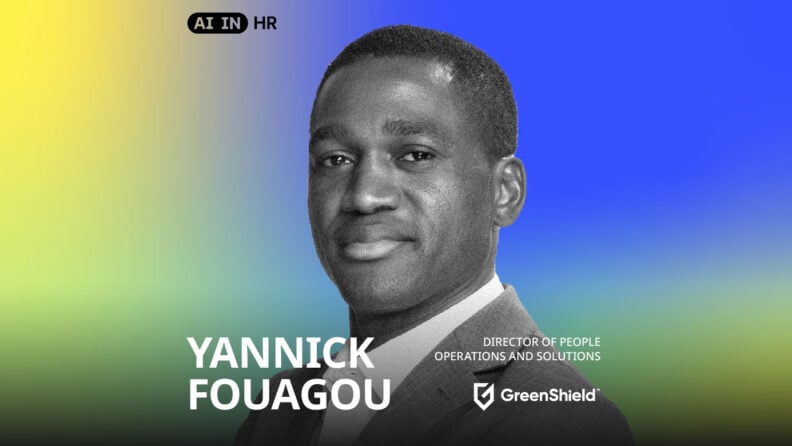
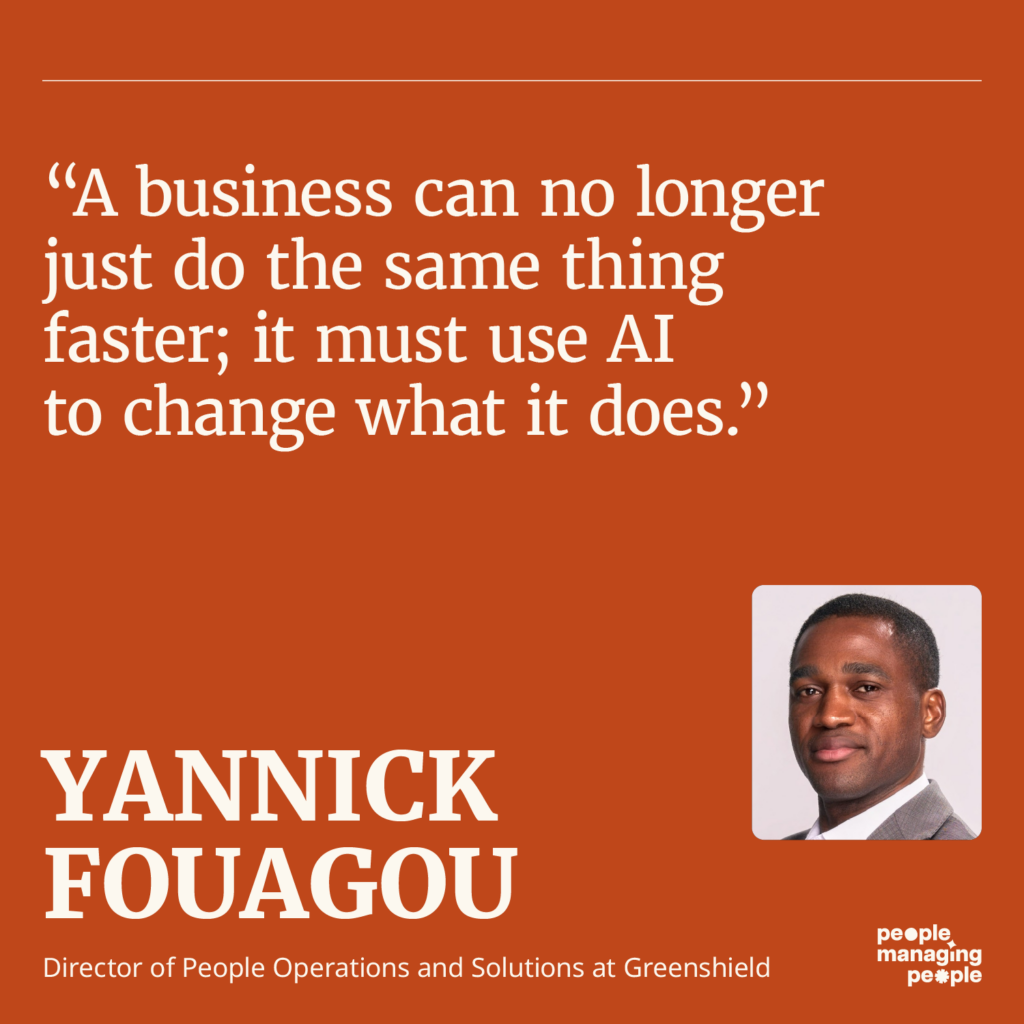
Yannick Fouagou is the Director of People Operations and Solutions at Greenshield, where he focuses on bridging data-driven efficiency with human-centric leadership.
We asked him about the "human" element of AI integration and adoption. He told us why — and how — AI must lift up employees instead of replacing them.
Mastering Tech That Could Automate Away Humanity
My career is a tale of two decades: the first as an Electronics Engineer in Oil & Gas, and the second as a "People Technologist." In other words, I transitioned from managing rigorous quality systems in extreme environments to leading digital transformations that redefine the employee lifecycle.
This technical foundation, combined with the chaos of raising five children, taught me a vital truth: People react to unpredictability in ways logic cannot always map. And this realization led me to the intersection of People Analytics and Psychology, eventually inspiring my leadership novel, Chaos Year.
Because, while systems provide structure, the human element determines resilience.
Today, I work to bridge the gap between data-driven efficiency and human-centric leadership. My overarching purpose can be distilled into one word; empathy. I use technology not to replace connection, but to protect it.
Looking ahead, I'm focusing on moving organizations beyond mere "survival" and toward intentional growth. By leveraging my engineering mindset, I help leaders navigate the "meltdown" of legacy structures.
Whether through my books or my role in People Ops, my goal is to humanize the workplace by mastering the very technologies that threaten to automate our humanity away.
How AI Reshapes Leadership and Organizational Structure
I was skeptical of AI initially. But I have evolved from that skepticism to a balanced realization. AI creates uniformity in execution, but humans remain the differentiator. We must transition from "obsolete humans" doing routine work to "awakened humans" who drive strategy.
- Old Assumption: AI replaces knowledge workers.
- New Reality: AI replaces the routine. Humans must provide the creative, critical, and unique "spark" AI cannot simulate.
Why AI Integration Transforms Organizational Performance
Here's an example. In a recent HR modernization project, we moved beyond "using" AI to making it the project’s "nervous system." Feeding every meeting transcript, decision log, and requirement into a custom AI agent created a living repository of project intelligence.
This agent didn't just store data, it actively generated weekly status reports, identified contributors for recognition, and wrote complex test scenarios.
This integration allowed us to defy the "Iron Triangle" of project management—delivering on time, on budget, and with high quality. We transitioned from low-code RPA to no-code agentic AI, automating end-to-end workflows like survey analysis and executive reporting with minimal intervention.
- Production gain: Executive presentations dropped from two days of work to just four hours.
- Strategic shift: Leadership now refines strategy rather than resizing PowerPoint boxes.
Ultimately, I view AI like electricity in a home. My role as a leader is no longer just lighting the room (providing tools), but teaching my team how to use that power to boil water or charge a car too (driving outcomes).
By automating the transactional, we cleared the path for deep, strategic work previously buried under administrative overhead.

How AI Can Overhaul Employee Self-Service
We've also completely overhauled Employee Self-Service (ESS), shifting from a "Search" to a "Conversation" model.
Previously, employees hunted through SharePoint sites or PDFs to find policies. Now, we have loaded all our policies and Standard Operating Procedures (SOPs) into Knowledge Base Articles (KBAs) accessible via a conversational AI agent.
An employee can simply ask, "What is the policy on bereavement leave?" or "How do I update my tax forms?" and get an instant, contextualized answer.
The most powerful part of this overhaul is the feedback loop. We use AI to analyze the "No Results Found" queries and the FAQs. The AI identifies gaps in our documentation and recommends creating new KBAs. It tells us, "50 people asked about EV charging stations this week, and we have no policy. Draft one." This keeps our knowledge base living.
Why AI’s Promise and Business Reality Often Misalign
With that said, I see a gap between AI’s promise and its reality. There are two primary tensions causing this.
First, the "Use Case" tension: Companies chase AI talent, but ignore the need for business acumen. The truth is that it's easier to teach AI skills to a business expert than to teach business depth to a tech architect. So, we upskill our domain experts to identify where the tech fits.
Second, the "Uniformity" Tension. As everyone adopts the same AI tools, industries risk falling into a "sea of sameness." To break out of this loop, organizations must rethink their value propositions.
For example, a service provider must evolve into a data-driven platform to create a sustainable competitive moat.
To address these tensions, I focus on "Matrix Integration." We break down silos between HR, Finance, and IT to allow data to flow seamlessly across the organization.
Why AI Adoption is 10% Technology and 90% Psychology
The most surprising thing I've learned is that AI adoption is 10% technology and 90% human psychology.
I initially assumed everyone would be equally eager to adopt these tools, but I quickly realized that AI requires the same legacy change management we’ve used for decades. If you skip the human work of addressing fear, resistance, and the change curve, even the most advanced technology will still fail.

To manage this, I have returned to the fundamentals of organizational design. I explicitly segment my stakeholders into "promoters" and "detractors" and meet them where they are on the curve. We don't just roll out tools, we codify the new way of working into SOPs and policies to ensure accountability. This means that the shift is cultural and structural, rather than just a temporary spike in excitement.
This realization has shifted my leadership focus toward human readiness. We measure the ROI of our tools not just in time saved, but in the "awakening" of our staff.
- Step 1: Define the Context (why it matters to the specific team).
- Step 2: Identify the Curve (where is the resistance?).
- Step 3: Measure the Impact (is the time saved being used for high-value work?).
Why Organizations Must Teach Employees to Ask Three Questions

Being "AI-Ready" isn't about technical certification, it's about having an AI-first mindset. It's the reflex to pause before starting any task and ask three questions:
- "Can AI do this for me?"
- "Can AI take me from Zero to Hero on this topic?" (i.e., teach me the basics instantly).
- "Can AI be my Management Consultant?" (i.e., critique my strategy).
Building this mindset aligns with the Change Management philosophy I mentioned earlier. We treat AI adoption as a behavioral shift, not a software rollout. We encourage teams to see AI not as a tool they have to use, but as a partner that removes the drudgery from their day. The goal is to move from "doing the work" to "directing the work."
How Key AI Tools Advance HR and Leadership Efficiency
My tool stack focuses on the enterprise-grade ecosystems driving our business, categorized into two primary engines:
1. The System of Record: HCM Full Stack
We use the full suite — Recruiting, Talent, Learning, and Self-Service. It serves as our single source of truth. Maintaining the full stack in one place ensures data integrity and a seamless user experience, allowing us to automate hire-to-retire workflows without integration breaks. It provides the stability and compliance a large organization requires.
2. The System of Productivity: Microsoft 365 Ecosystem
This is where the work happens. We use the full stack — Power BI for real-time people analytics, Power Apps for building custom low-code solutions, and Teams/SharePoint for collaboration.
And most notably, we integrated Microsoft 365 Copilot into this ecosystem. It has been a game-changer for velocity. It allows us to summarize meetings, draft strategic communications, and query our data within the flow of work. It removes administrative drudgery and provides my team with access to tier-1 knowledge. And it democratizes digital transformation, empowering my team to build their own automated solutions without always relying on IT developers.
A PowerPoint Agent Changes How Leaders Spend Time
I am currently obsessed with our AI PowerPoint Creation Agent, which we built using Co-Pilot Studio.
I realized a massive inefficiency in our work centered around the fact that while executive presentations have extremely high strategic value (they drive decisions), making them is often low-skill and low-efficiency — essentially hours spent resizing boxes and aligning fonts.
We built an agent to solve this. We feed it raw data, narrative structure, and our brand guidelines. Within minutes, it generates a 90% complete deck with professional visuals and coherent storytelling.
The impact is that it returned hours of "deep work" time to my leadership team. We no longer spend our weekends formatting slides, we spend that time refining the strategy itself. It shifted our focus from presentation mechanics to strategic substance.
Why Micro-agents Beat Autonomous Roles
Small, dedicated agents like that are very useful. But we're also asking big questions: Can an agent be an end-to-end project manager — listening to meetings, assigning actions, and setting milestones without human intervention? Can AI be my security manager? Can it be my CMO?
Right now, the technology is often sub-optimal for these fully autonomous roles. But the potential is undeniable.
Why AI is Changing the Social and Intellectual Contract of Work
I predict a dual evolution of the social and intellectual contract of work.
First, I believe the massive productivity gains from AI will make Universal Basic Income (UBI) a necessity rather than a theory. As the four-day work week becomes standard, the very definition of "poverty" and "utility" will shift, forcing a total renegotiation of how society values human time and contribution.
Second, I predict the Return of the Polymath. In the past, complexity forced us to become hyper-specialized "cogs." AI reverses this by handling the technical execution of disparate tasks, allowing a single individual to master multiple domains once again. We are entering an era where a "Grand Thinker" can once again be a philosopher, a coder, and a strategist simultaneously, fueled by AI-driven execution.
To prepare for this, we must be "on the Ark", embracing the flood of change rather than watching from the shore. The future belongs to those who can synthesize information across boundaries to solve problems that don't yet exist.
Why Leaders Should Use AI to Get Closer Teams
People run from chaos. In this moment of transformation, your role as a leader is not to add to the chaos with more tools and complexity, but to use AI to reduce it.
My advice: Anchor yourself in empathy.
As we automate the transactional, the relational becomes your true currency. Do not use AI to distance yourself from your team, use it to clear your desk so you can spend more time with them.
Follow along
You can follow Yannick Fouagou's work on LinkedIn.
More expert interviews to come on People Managing People!