


Reseña de Intuit Enterprise Suite 2026: Ventajas, Desventajas, Características y Precios


As organizations grow, managing finances, payroll, approvals, reporting, and day-to-day administrative operations across multiple entities becomes increasingly difficult. Disconnected systems and manual processes can make it harder for HR and finance teams to stay aligned, maintain compliance, and make informed decisions.
Intuit Enterprise Suite is business management software designed for growing and mid-market organizations that need more than basic accounting tools. It offers ERP capabilities, including financial management, payroll, reporting, workflow automation, and multi-entity management, helping finance, HR, and operations teams keep core business processes connected.
In this detailed review, I'll cover Intuit Enterprise Suite's features, pricing, pros and cons, and ideal use cases to help you decide whether it's the right business management software for your organization.
Intuit Enterprise Suite Evaluation Summary
- Pricing upon request
- Free demo available
Por qué confiar en nuestras reseñas de software
Nuestro equipo lleva probando y evaluando software desde 2012. Como expertos en RR. HH., sabemos lo difícil —y lo importante— que es elegir el software adecuado.
Para esta guía, evaluamos las herramientas mediante pruebas prácticas e investigación independiente, puntuando las herramientas según nuestros criterios de selección. También nos basamos en la experiencia de líderes de opinión del sector y de profesionales de RR. HH. en activo.
Nuestras reseñas reflejan nuestro criterio editorial humano, no un discurso de ventas.
Revisores expertos:
Intuit Enterprise Suite Overview
In my opinion, Intuit Enterprise Suite stands out as a strong business management platform for growing organizations. If you're looking for AI-powered automation, multi-entity management, advanced reporting, and better control over administrative workflows, it's worth a closer look. While implementation requires more planning than simpler business software, I think it delivers a good balance of functionality, usability, and scalability.
pros
-
Multi-entity management simplifies financial operations across growing organizations.
-
AI-powered automation helps reduce manual financial, administrative, and operational tasks.
-
Advanced reporting and real-time business insights improve decision-making.
cons
-
May offer more functionality than smaller businesses with basic accounting needs.
-
Organizations migrating from simpler accounting software may face a learning curve.
-
Advanced customization and complex implementations require additional planning and configuration.
Is Intuit Enterprise Suite Right For Your Needs?
Who Would be a Good Fit for Intuit Enterprise Suite?
Intuit Enterprise Suite is best suited for growing and mid-market organizations that have outgrown basic accounting software but don't want the complexity of a traditional ERP. I think it's an especially good fit for businesses managing multiple entities, departments, or locations that need stronger financial visibility, administrative control, workflow automation, and AI-powered reporting.
-
Multi-Entity Organizations
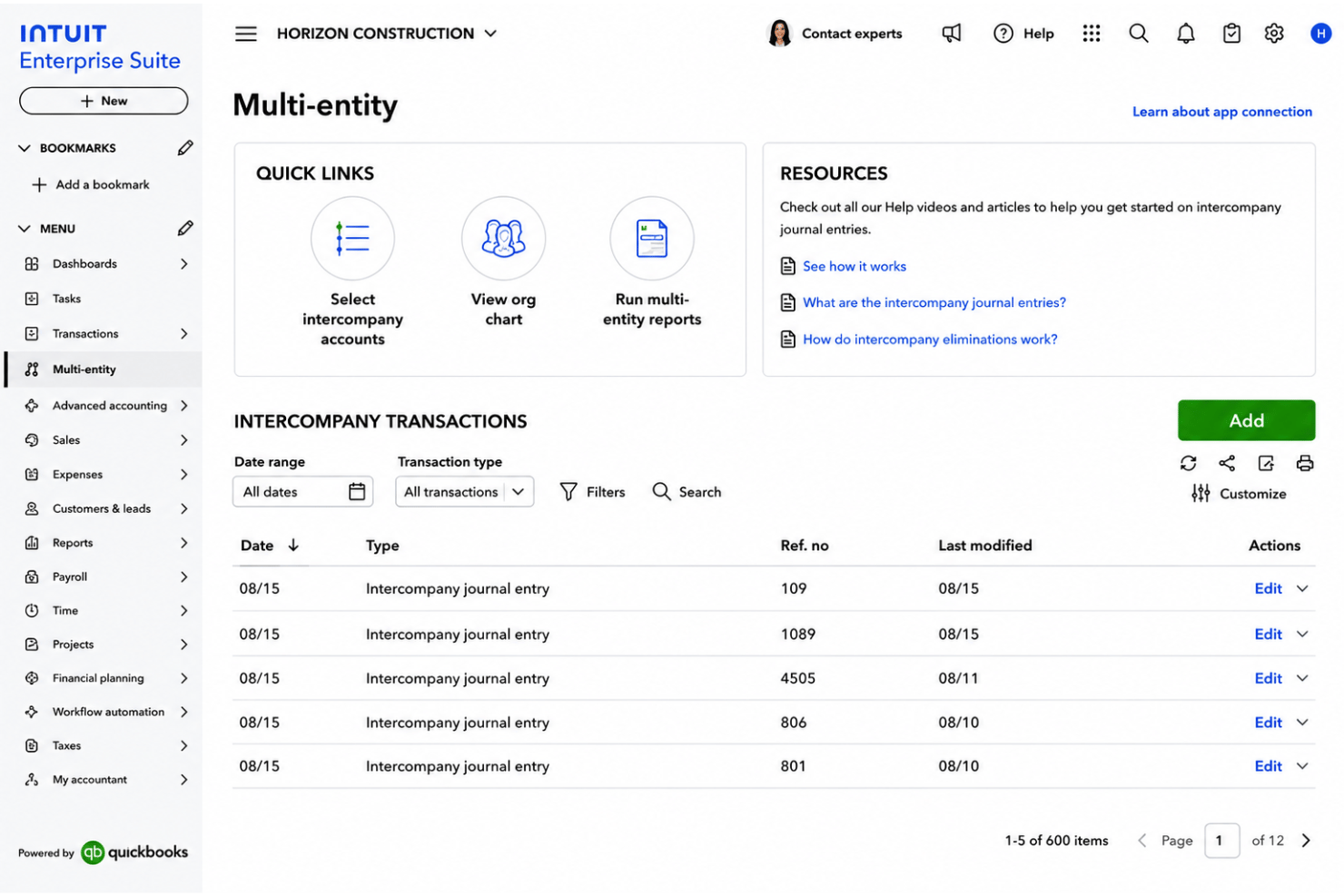
Manage multiple legal entities, automate intercompany transactions, and consolidate financial reporting from a single system.
-
Professional Services Firms
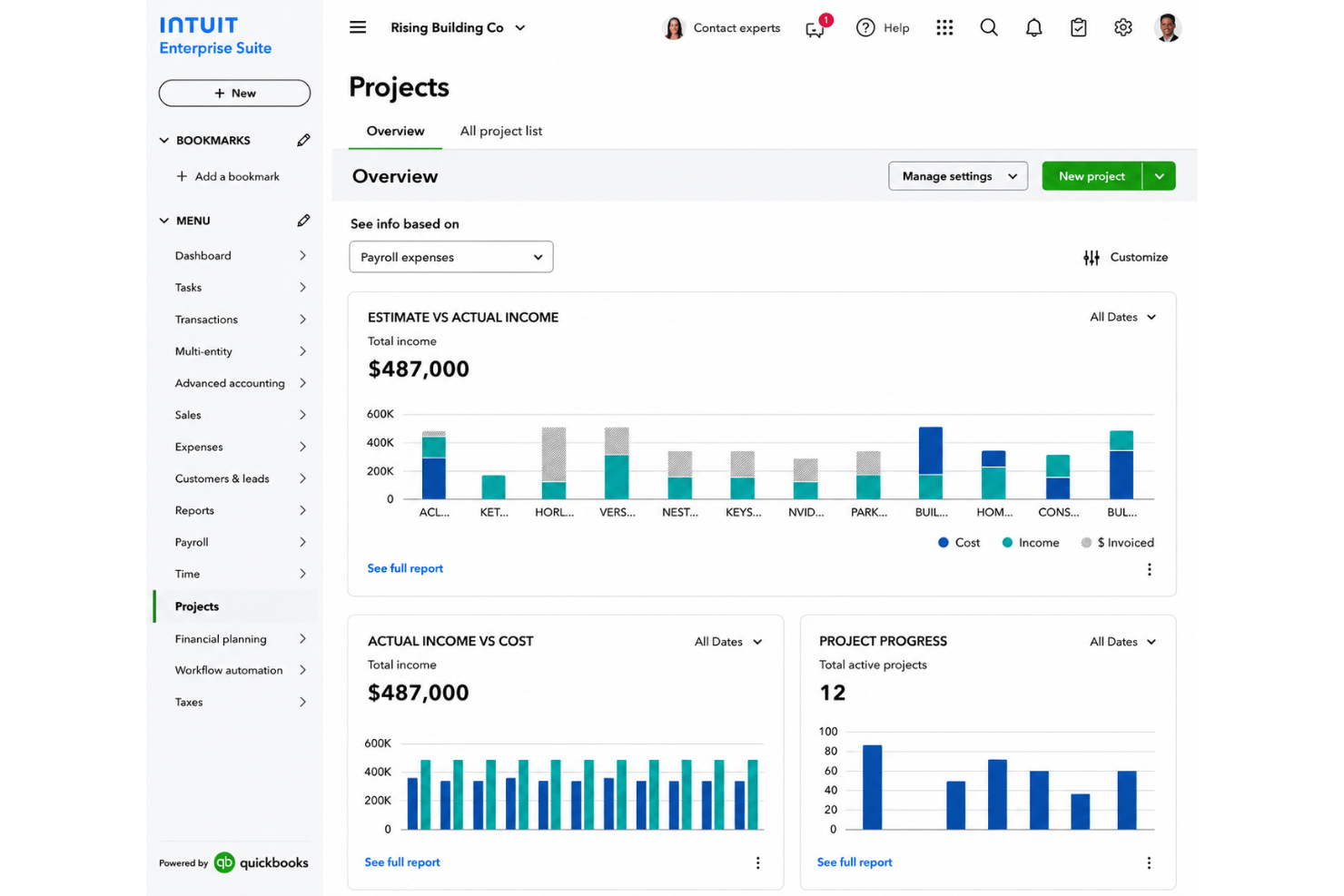
Track projects, manage financial performance, and automate accounting workflows while improving visibility across teams.
-
Technology & SaaS Companies
Support growing operations with AI-powered reporting, forecasting, and financial controls as the business scales.
-
Construction & Project-Based Businesses
Manage project accounting, budgeting, and financial reporting with workflows designed for project-driven organizations.
-
Manufacturing, Wholesale & Distribution
Monitor financial performance across products, locations, and business units while improving operational visibility.
-
Growing Mid-Market Businesses
Organizations expanding across multiple entities or locations can benefit from enterprise-level financial management without the complexity of a traditional ERP.
Who Would be a Bad Fit for Intuit Enterprise Suite?
Intuit Enterprise Suite isn't designed for freelancers, sole proprietors, or businesses with simple bookkeeping needs. It may also be more functionality than necessary for organizations with a single legal entity or limited reporting requirements. Businesses seeking highly customized ERP deployments or specialized industry solutions may be better served by a more tailored enterprise platform.
-
Freelancers & Sole Proprietors
Businesses with basic bookkeeping, invoicing, and expense tracking needs are likely better served by a simpler accounting solution.
-
Very Small Businesses
Organizations with minimal financial complexity may not need the platform's advanced automation, reporting, and multi-entity capabilities.
-
Single-Entity Businesses
Companies with straightforward financial operations and limited reporting requirements may find the platform more robust than necessary.
-
Organizations Seeking Highly Customized ERP Deployments
Businesses requiring extensive ERP customization or highly specialized enterprise workflows may need a more configurable ERP solution.
-
Specialized Industry Environments
Organizations with niche industry requirements beyond Intuit Enterprise Suite's supported capabilities should consider industry-specific software.
-
Complex Global ERP Implementations
Large organizations requiring extensive global ERP deployments, highly customized enterprise architectures, or region-specific compliance capabilities may benefit from a more specialized global ERP platform.
Cómo probamos y puntuamos nuestras herramientas
Hemos pasado años construyendo, refinando y mejorando nuestro sistema de pruebas y puntuación de software. La rúbrica está diseñada para capturar los matices de la selección de software y lo que hace que una herramienta sea efectiva, centrándose en los aspectos críticos del proceso de toma de decisiones. A continuación, puedes ver exactamente cómo funcionan nuestras pruebas y puntuaciones a través de siete criterios. Esto nos permite ofrecer una evaluación imparcial del software basada en la funcionalidad principal, características destacadas, facilidad de uso, incorporación, soporte al cliente, integraciones, reseñas de clientes y relación calidad-precio.
Funcionalidad principal (25% de la puntuación final)
El punto de partida de nuestra evaluación siempre es la funcionalidad principal de la herramienta. ¿Tiene las funciones básicas que se espera encontrar? ¿Alguna de esas funciones básicas está restringida a planes de precio superiores? En esencia, esperamos que una herramienta se compare favorablemente con las capacidades básicas de sus competidores.
Características destacadas (25% de la puntuación final)
Luego, evaluamos características poco comunes que van más allá de la funcionalidad principal que normalmente se encuentra en herramientas de su tipo. Una puntuación alta refleja funciones especializadas o únicas que hacen que el producto sea más rápido, eficiente o que ofrezca un valor adicional al usuario. También evaluamos lo fácil que es integrar con otras herramientas comúnmente usadas en el entorno tecnológico para ampliar la funcionalidad y utilidad del software. Las herramientas que ofrecen muchas integraciones nativas, conexiones de terceros y acceso a API para construir integraciones personalizadas obtienen las mejores puntuaciones.
Facilidad de uso (10% de la puntuación final)
Consideramos qué tan rápido y fácil es ejecutar las tareas definidas en la funcionalidad principal utilizando la herramienta. El software que obtiene una puntuación alta está bien diseñado, es intuitivo, ofrece aplicaciones móviles, proporciona plantillas y hace que tareas relativamente complejas parezcan simples.
Incorporación (10% de la puntuación final)
Sabemos lo importante que es la rápida adopción del equipo para una nueva plataforma, por eso evaluamos qué tan fácil es aprender y usar una herramienta con una capacitación mínima. Evaluamos cuán rápido un miembro del equipo puede configurarse y comenzar a usar la herramienta sin experiencia. Las soluciones con mejores puntuaciones requieren poco o ningún soporte.
Soporte al cliente (10% de la puntuación final)
Revisamos cuán rápido y fácil es obtener ayuda mediante teléfono, chat en vivo o base de conocimientos. Las herramientas y empresas que ofrecen soporte en tiempo real obtienen las mejores puntuaciones, mientras que los chatbots obtienen las peores.
Reseñas de clientes (10% de la puntuación final)
Además de nuestras propias pruebas y evaluaciones, consideramos el puntaje neto de promotores de clientes presentes y pasados. Revisamos su probabilidad, dada la opción, de elegir nuevamente la herramienta por su funcionalidad principal. El software con una puntuación alta refleja un alto puntaje neto de promotores por parte de clientes actuales o anteriores.
Relación calidad-precio (10% de la puntuación final)
Por último, considerando todos los demás criterios, revisamos el precio promedio de los planes de entrada frente a las funciones principales y valoramos el resto de los criterios de evaluación. El software que ofrece más por menos tendrá una mejor puntuación.
Core Features
Multi-Entity Management
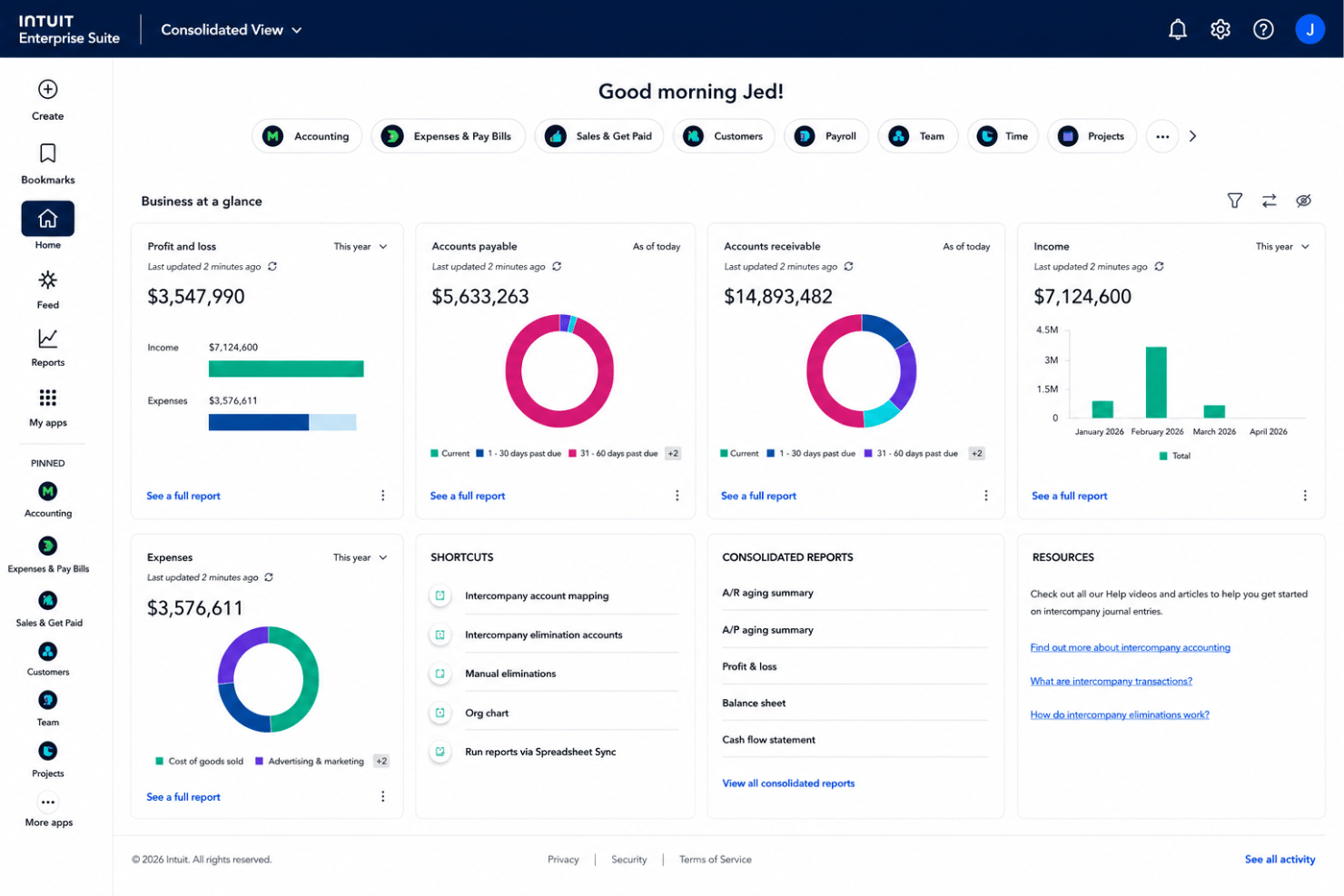
Manage multiple legal entities from a single system while maintaining separate books for each business. Intuit Enterprise Suite automates intercompany transactions, consolidates financial data, and provides organization-wide visibility without relying on spreadsheets.
Advanced Financial Reporting
Build customizable financial reports and interactive dashboards using real-time data. Business intelligence and dimensional reporting tools let you monitor KPIs, analyze performance, and drill down into financial metrics across entities and departments.
Multi-Dimensional Accounting
Manage financial data using dimensions such as entities, departments, locations, projects, and product lines for more flexible reporting and analysis. Multi-dimensional accounting makes it easier to understand business performance from different perspectives without maintaining separate ledgers.
Workflow Automation
Reduce manual work by automating approvals, financial processes, and administrative workflows. Built-in workflow automation improves efficiency while strengthening accountability through configurable approval processes.
Dimensional Forecasting
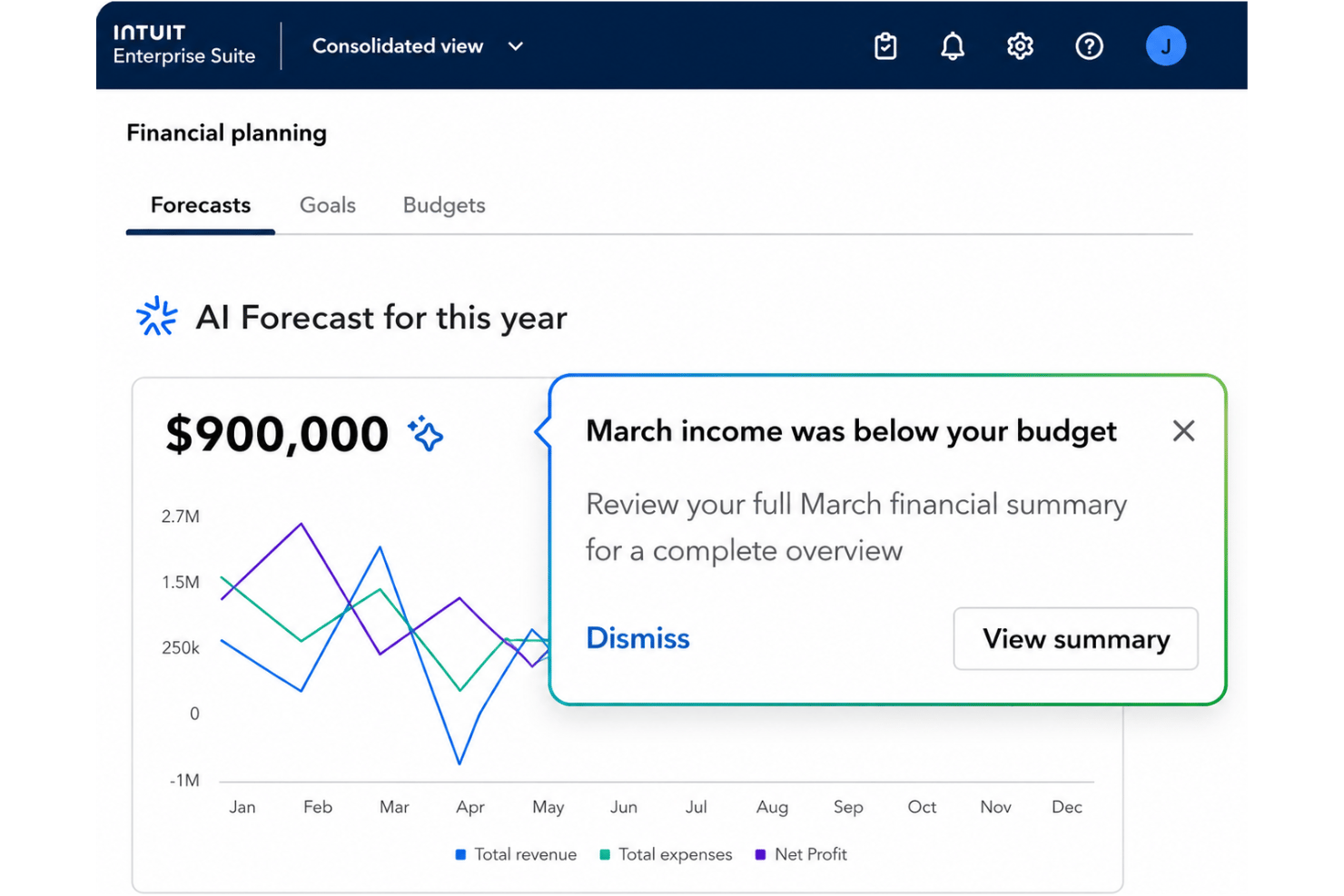
Create forecasts using multiple business dimensions to model different scenarios and improve planning. This helps organizations make more informed financial decisions as operations become more complex.
Intuit Ecosystem Integrations
Connect with QuickBooks, Payroll, Payments, Mailchimp, and other Intuit products, along with supported third-party applications. Shared data helps reduce duplicate work while keeping financial and operational information synchronized.
Standout Features
Intuit AI Agents
Intuit AI Agents automate complex financial and operational tasks by surfacing insights, answering business questions, and assisting with workflows. They help reduce manual effort while giving finance and business leaders faster access to actionable information.
Native Money Services
Intuit Enterprise Suite includes built-in payment processing, bill pay, and access to business lending. Keeping these services within the Intuit ecosystem helps reduce reliance on separate financial tools while keeping payment and cash flow workflows connected.
Ease of Use
Despite offering ERP capabilities, Intuit Enterprise Suite is designed with usability in mind. The interface is clean and organized, and businesses familiar with Intuit products should find navigation intuitive. While implementation requires more planning than simpler business management software, built-in automation and a logical workflow help finance, HR, and operations teams manage day-to-day administrative tasks more efficiently.
Onboarding
Intuit Enterprise Suite follows a guided onboarding and implementation process to help businesses transition successfully. Customers work with a dedicated customer success manager and implementation resources to configure the platform, migrate financial data, establish reporting structures, and connect business systems.
Training is available through self-paced learning, live expert sessions, and tailored onboarding plans, while the implementation timeline varies depending on the organization's size, number of entities, and reporting requirements.
Customer Support
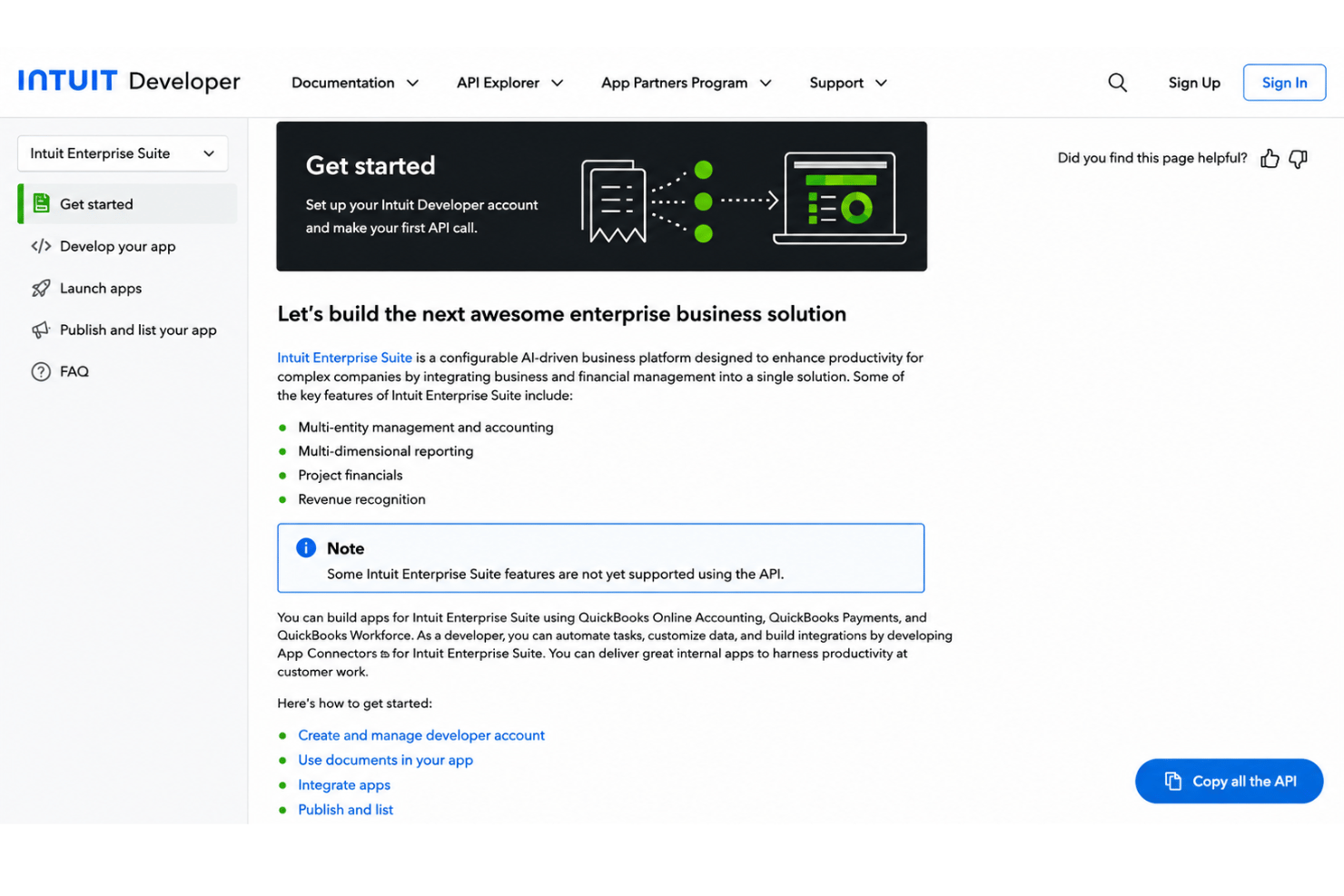
Intuit Enterprise Suite provides product support Monday through Friday from 8:00 AM to 9:00 PM ET and Saturdays from 9:00 AM to 6:00 PM ET. Businesses can also upgrade to premium support for dedicated assistance and faster response times.
In addition to direct support, users have access to implementation resources, customer success guidance, and training to help them get the most from the platform.

Integrations
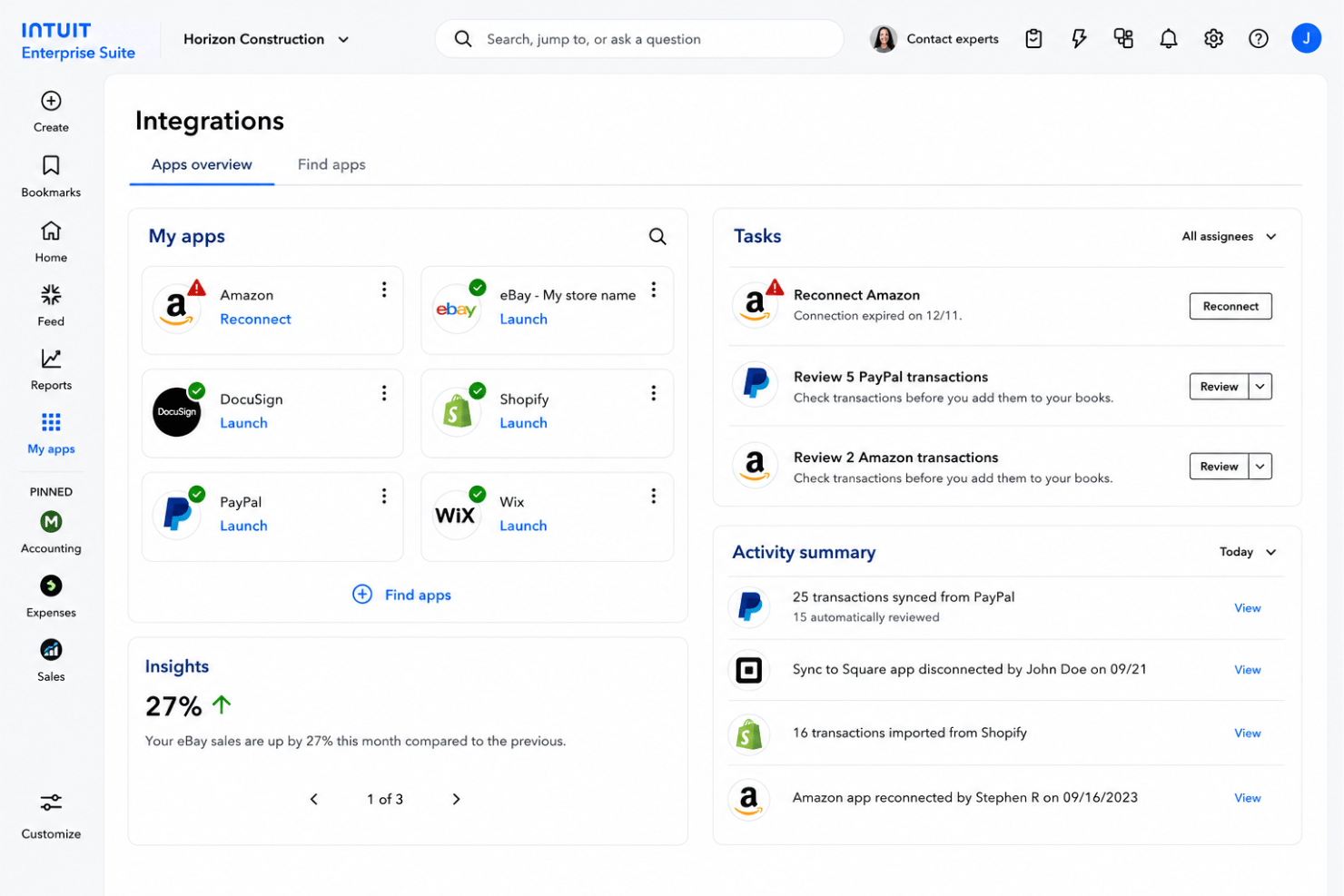
Intuit Enterprise Suite integrates with native Intuit products for payroll, payments, workforce management, and marketing, while supporting connections with over 850 specialized apps.
Available integrations include Amazon, Shopify, PayPal, eBay, DocuSign, BigTime, and Wix, and APIs help businesses connect additional systems to keep financial and operational data synchronized.
Value for Money
Intuit Enterprise Suite uses flexible, contract-based pricing that's customized to each organization, so businesses need to contact the sales team for a quote. Pricing varies based on factors such as the number of users, entities, selected modules, add-ons, and implementation requirements.
While the lack of transparent pricing makes it harder to compare with competitors, the platform is designed for growing and mid-market organizations that need advanced financial management and ERP capabilities.
Intuit Enterprise Suite Specs
- Accounts Payable
- Accounts Receivable
- API
- Batch Permissions & Access
- Budgeting
- Calendar Management
- Customer Management
- Dashboard
- Data Export
- Data Import
- Data Visualization
- Expense Tracking
- External Integrations
- Forecasting
- General Account Ledger
- Inventory Tracking
- Lead Management
- Lead Scoring
- Marketing Automation
- Multi-User
- Notifications
- Password & Access Management
- Payroll
- Project Management
- Scheduling
- Supplier Management
- Tax Management
- Third-Party Plugins/Add-Ons
- Travel Management
Intuit Enterprise Suite FAQs
Is Intuit Enterprise Suite an ERP?
Who is Intuit Enterprise Suite best suited for?
How secure is my company's financial data in Intuit Enterprise Suite?
Does Intuit Enterprise Suite support role-based access controls?
How does Intuit Enterprise Suite support growing businesses?
What does the onboarding process look like?
Is Intuit Enterprise Suite just a larger version of QuickBooks?
Does Intuit Enterprise Suite require a traditional ERP implementation?
Intuit Enterprise Suite Company Overview & History
Founded in 1983 in Palo Alto, California, by Scott Cook and Tom Proulx, Intuit is a global financial technology company headquartered in Mountain View, California. The company develops business and financial software, including QuickBooks, TurboTax, Credit Karma, and Mailchimp, serving millions of consumers, small businesses, accountants, and mid-market organizations worldwide.
Intuit Enterprise Suite, launched in 2024, extends the company's portfolio with an AI-native ERP platform designed to help growing businesses manage increasingly complex financial and operational workflows.
Intuit Enterprise Suite Major Milestones
- 1983: Intuit was founded in Palo Alto, California, by Scott Cook and Tom Proulx.
- 1992: Released QuickBooks, expanding into small business financial management software.
- 1993: Became a publicly traded company on the NASDAQ under the ticker INTU.
- 2021: Acquired Mailchimp for approximately $12 billion, expanding its customer engagement and marketing capabilities.
- 2024: Launched Intuit Enterprise Suite, an AI-native ERP platform for growing and mid-market businesses.
- 2026: Continues expanding Intuit Enterprise Suite with AI-powered automation, business intelligence, workforce management, and multi-entity financial management capabilities.