

Workers Are Ready for AI Agents—But Organizations Aren’t, Creating “AI Limbo”
A new dual-survey study of workers and HR leaders reveals strong openness to AI agents, alongside gaps in training, enablement, and governance that threaten to slow responsible adoption.

The team at People Managing People is proud to share our new AI Limbo report, which identifies a growing workplace dynamic of "AI Limbo"— a term we've coined to identify where AI adoption is accelerating faster than training, governance, and communication employees need to use these tools effectively and responsibly.
The report draws on two independent surveys conducted in December 2025: one of 1,000 employed workers and another of 379 HR professionals. Together, they offer a rare side-by-side look at how AI agents are being discussed, anticipated, and implemented across organizations—from both the employee and employer perspective.
The findings reveal a clear disconnect. While most workers expect AI agents to be introduced in the near term and are largely open to working alongside them, HR leaders report meaningful gaps in readiness, including limited training, unclear ownership, and underdeveloped governance structures.

As a result, many organizations are operating in AI limbo—a state where enthusiasm and expectations for AI are high, but the policies, systems, and support required for trusted, effective adoption have yet to catch up.
Key Findings
- 66% of workers feel positive about AI in the workplace, compared to just 13% who feel negative
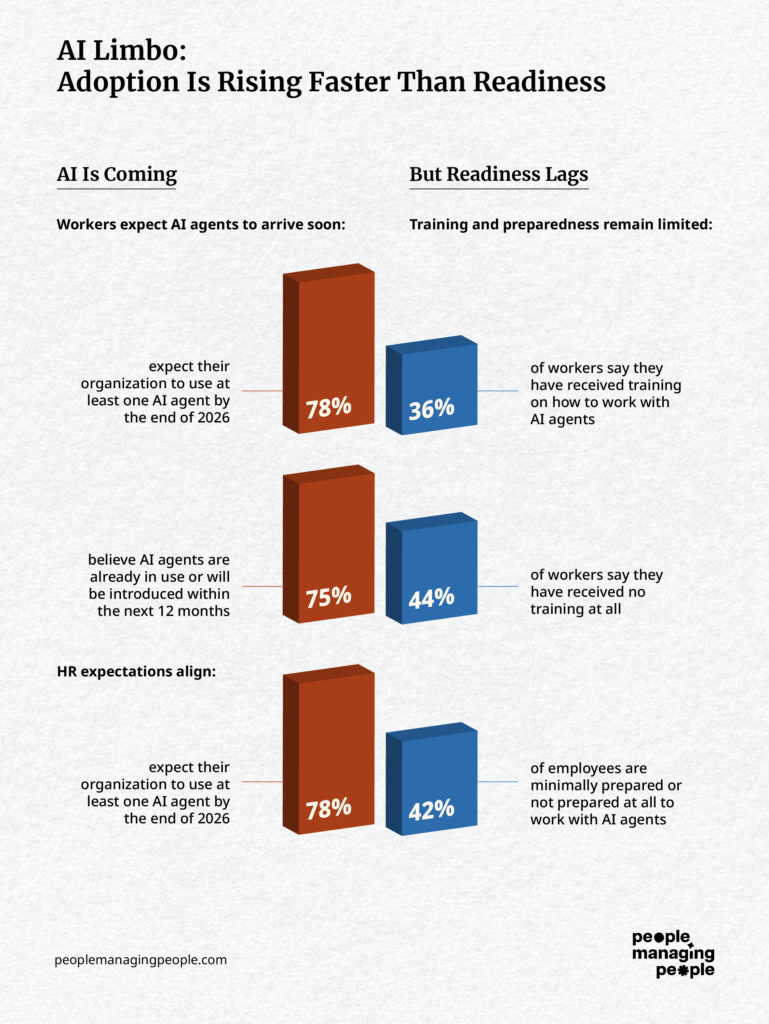
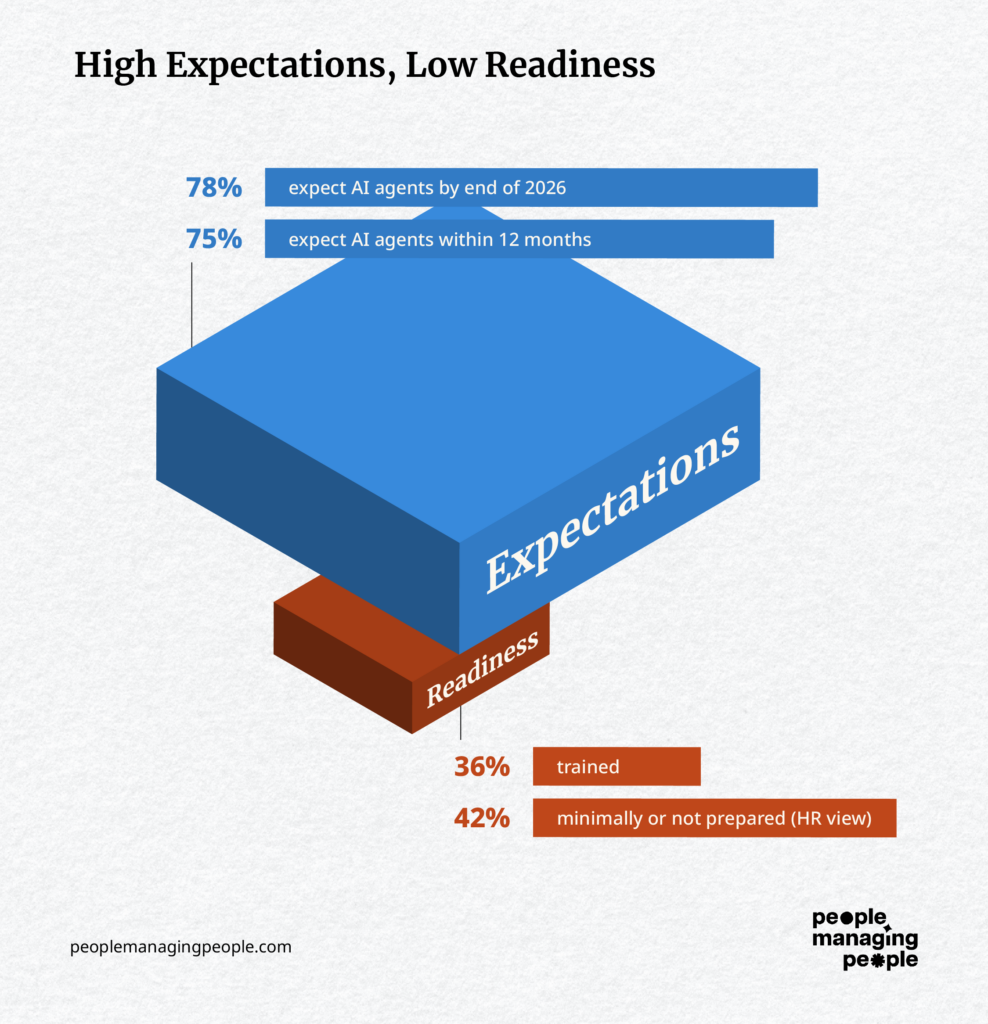
- Only 36% of workers say they have received training on how to work with AI agents
- HR professionals believe 42% of employees are minimally prepared or not prepared at all to work with AI agents
- 78% of workers and HR professionals expect their organization to use at least one AI agent by the end of 2026
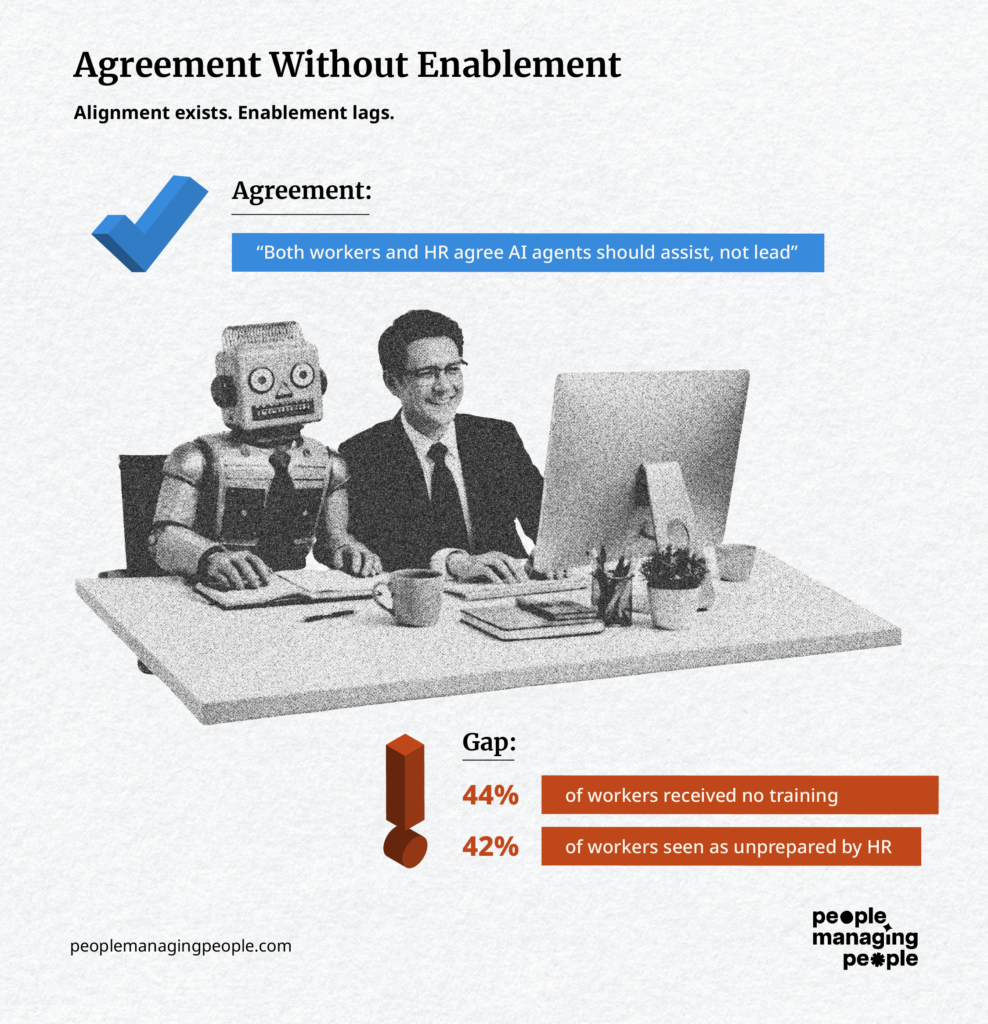
- Both workers and HR professionals agree AI agents should assist with work, not lead people
AI Agents Are Becoming a Near-Term Workplace Reality
AI agents are no longer a distant or abstract concept for most employees. Worker responses show widespread awareness of AI agents and a strong expectation that these tools will be introduced into everyday work in the very near future.
From the employee perspective:
- 78% of workers say they have heard the term “AI agent” used in a workplace context
- 58% say their employer has already mentioned or announced plans to introduce AI agents
- 75% believe AI agents are already in use or likely to be introduced within the next 12 months
HR responses reinforce that this shift is already underway inside organizations, even if formal rollout plans are still evolving.
From the HR perspective:
- 65% of HR professionals say their organization has evaluated or discussed AI agents
- 21% report that AI agents are already being used today
- 78% of HR professionals expect their organization to use at least one AI agent by the end of 2026
Together, these findings point to a clear reality: AI agent adoption is no longer speculative. It’s actively being discussed, tested, and, in some cases, deployed—often faster than organizations have prepared their people and systems to support it.
What this means for HR: AI agent adoption is moving faster than formal rollout plans. Employees already expect these tools to appear in their workflows, which makes early communication and expectation-setting essential. HR teams that clarify timelines, use cases, and guardrails now will reduce confusion and build trust before adoption accelerates further.
Workers Are Optimistic, but Trust Depends on Proper Implementation
Most workers feel positively about AI agents, particularly when they are framed as tools that support productivity rather than replace people.
- 66% of workers say they feel positive about AI in the workplace
- Only 13% of workers report negative feelings toward AI
- 74% of workers would trust properly implemented AI agents to handle repetitive administrative tasks
- 76% of workers would trust AI agents to manage routine workflows such as scheduling or generating reports
What this means for HR: Employee trust in AI is conditional, not automatic. Workers are open to AI agents when they clearly support efficiency and reduce busywork, but that trust hinges on proper implementation. HR teams should prioritize use cases that augment work, communicate limits clearly, and ensure humans remain accountable for outcomes.
These findings also echo trends across People Managing People’s recruiting software, onboarding platforms, and performance management systems, where automation complements human oversight.
HR leaders, however, take a more cautious view of trust.
While workers express confidence in AI agents for routine tasks, HR leaders remain more reserved, reflecting concerns about reliability, risk, and accountability.
- 61% of HR professionals say leadership is positive toward using AI agents
- Only 16% of HR professionals say they completely trust AI agents to reliably complete repetitive tasks
- Nearly 30% of HR professionals say they trust AI agents only a little or not at all
What this means for HR: Leadership caution signals the need for clearer guardrails. Establishing testing standards, human-in-the-loop oversight, and accountability frameworks will be critical to moving from limited trust to scalable adoption.
Workers and Leaders Worry About Different Risks
While workers are generally open to working alongside AI agents, both employees and leadership express concerns about how these systems are introduced and governed.
From the worker perspective:
- 53% of workers worry about potential errors or inaccuracies from AI agents
- 50% cite privacy or data security concerns
- 43% are concerned about reduced human interaction or connection
- 39% worry about losing job responsibilities or relevance
HR responses highlight leadership concerns:
- 61% of leaders are concerned about accuracy and errors
- 60% cite data privacy or security risks
- 39% worry about workforce anxiety or resistance
- 38% cite compliance or legal risk
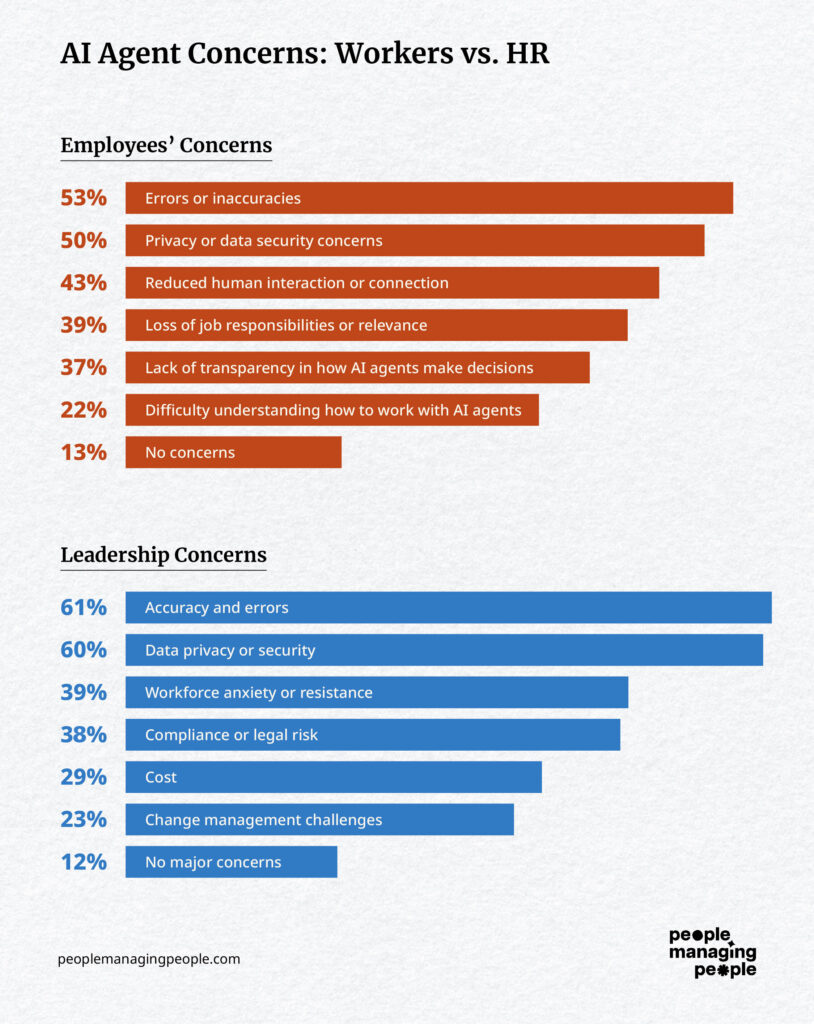
What this means for HR: Workers worry most about trust, transparency, and day-to-day impact, while leaders focus on accuracy, compliance, and risk. HR plays a critical role in bridging this gap by turning governance and safeguards into clear guidance employees can understand and trust as AI agents scale.
Training and Readiness Lag Behind Adoption
Awareness of AI agents is high, but formal enablement has not kept pace. Across both surveys, training emerges as one of the most consistent and significant gaps limiting effective adoption.
From the worker perspective:
- 36% of workers say their employer has provided training on how to work effectively with AI agents
- 44% of workers say they have received no training at all
- 20% of workers say training is currently in progress
HR responses reinforce this readiness challenge.
- 18% of HR professionals say formal AI agent training has been delivered
- 29% of HR professionals say training is still in development
- 29% of HR professionals say no training has been provided
- HR professionals believe 42% of employees are minimally prepared or not prepared at all to work with AI agents
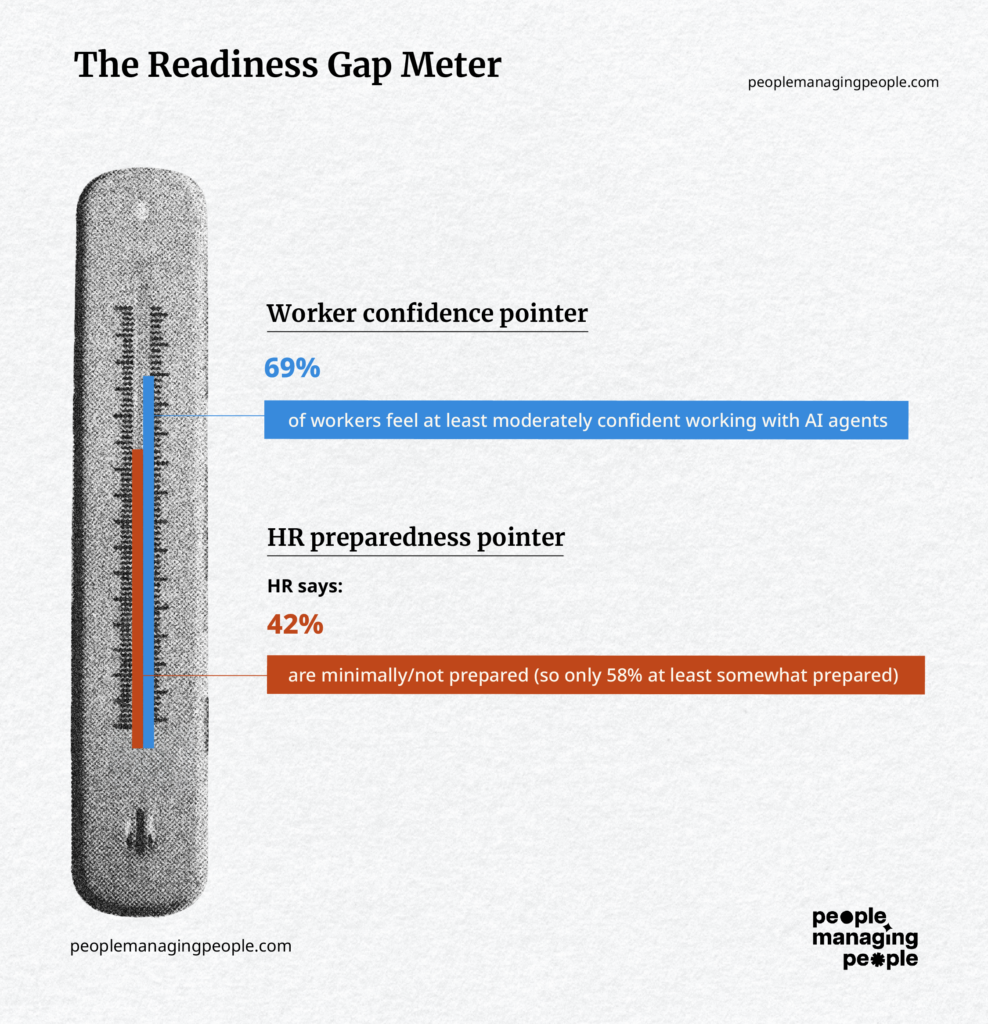
What this means for HR: Training is the clearest bottleneck to successful adoption. Without practical, role-specific guidance, even motivated employees will struggle to use AI effectively, increasing risk and slowing ROI.
Governance and Communication Remain Unclear
While adoption is accelerating, responsibility for AI agents is still poorly defined. The data shows clear misalignment between worker expectations and how organizations are actually structuring oversight.
Worker expectations around ownership:
- 51% of workers believe AI agents should be primarily managed by IT
- Only 9% of workers believe individual employees should manage AI agents
HR-reported governance models:
- 34% of HR professionals say AI agent oversight is shared between HR and IT
- 18% of HR professionals say HR is responsible
- 13% of HR professionals say IT alone is responsible
- 16% of HR professionals say no one is responsible yet
What this means for HR: Unclear ownership creates risk. Without defined accountability and consistent communication, AI adoption can stall or fracture across teams. HR leaders who establish clear governance models and communicate them early can reduce confusion and strengthen trust.
Communication gaps persist across organizations.
Even as leadership discusses AI adoption internally, those conversations are not always reaching employees.
- 73% of HR professionals say leadership has discussed, evaluated, or announced AI agent adoption
- 42% of workers say their employer has not mentioned AI agents at all
What this means for HR: Internal alignment is not enough if messages do not reach employees. Clear, proactive communication helps set expectations, reduce uncertainty, and prevent misinformation as AI agents move closer to everyday use.
Agreement on One Thing: AI Agents Should Assist, Not Lead
Despite differences in readiness and trust, workers and HR professionals show strong alignment on the role AI agents should play.
Worker expectations:
- 57% of workers believe AI agents will be most effective in analytical work
- 52% of workers cite administrative work
- 42% of workers cite technical or operational work
- Only 26% of workers believe AI agents should handle managerial or leadership tasks
HR expectations closely mirror this view.
- 48% of HR professionals expect AI agents to support customer service tasks
- 48% of HR professionals expect AI agents to handle administrative work
- 42% of HR professionals expect AI agents to support analytical work
- Only 12% of HR professionals expect AI agents to be involved in leadership decision-making
Both workers and HR professionals emphasize safeguards as critical to success.
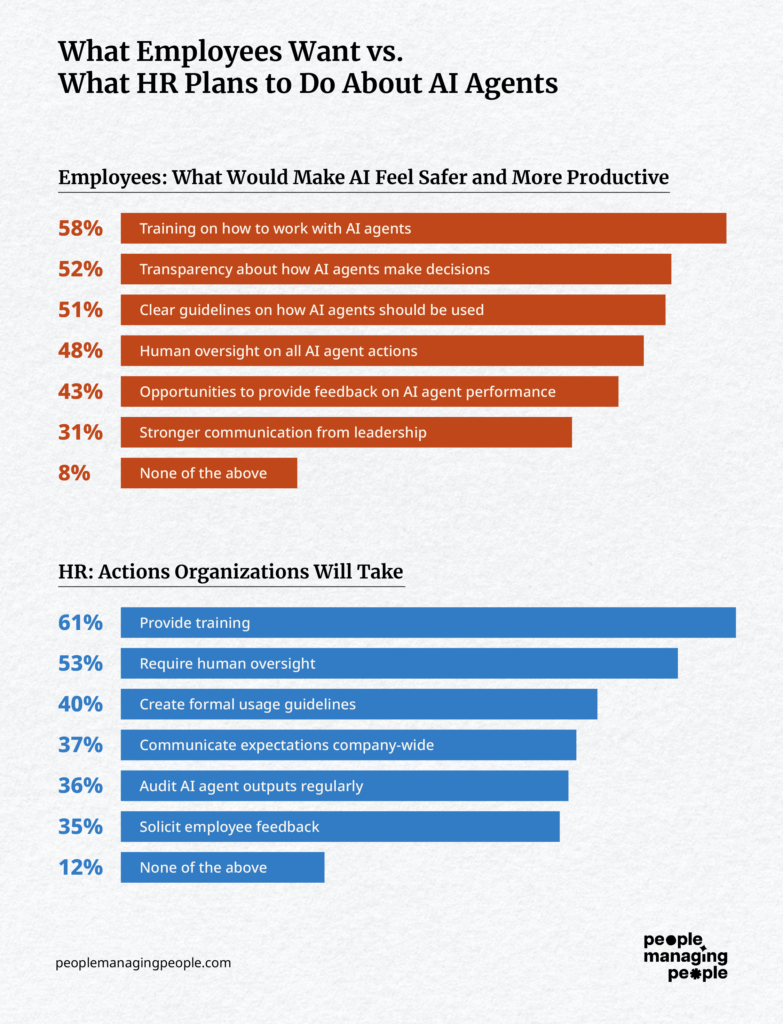
- 58% of workers say training would make AI agents feel safer and more productive
- 52% of workers want transparency around how AI agents make decisions
- 48% of workers want human oversight on all AI agent actions
- 61% of HR professionals say their organization will provide training
- 53% of HR professionals say human oversight will be required
- 40% of HR professionals say formal usage guidelines will be created
What this means for HR: There is strong consensus that AI agents should support work, not replace leadership. HR teams can use this alignment to guide implementation by prioritizing assistive use cases, reinforcing human oversight, and embedding safeguards that maintain accountability and trust.
What This Means for Employers
The findings in this study suggest AI agent adoption is not being slowed by employee resistance but by organizational readiness. Workers are aware, optimistic, and willing to collaborate with AI agents, while HR professionals and leaders are still building the training, governance, and communication frameworks needed to deploy them responsibly. The key question becomes whether organizations can demonstrate true agentic AI readiness by involving stakeholders effectively. Organizations that move quickly to close these gaps are likely to see smoother adoption, higher trust, and stronger outcomes as AI agents become embedded in daily work.
For practical guidance on how to structure AI-ready teams, explore People Managing People’s AI leadership and management software reviews.
Share Your Perspective on AI at Work
People Managing People is continuing to gather insights on how AI is being introduced, governed, and experienced in the workplace.
We’re inviting readers to take a short survey and share how AI is impacting your role, your team, and your organization.
👉🏼 Take the AI workplace survey.
Methodology
This study is based on two surveys conducted in December 2025 using the Pollfish survey platform. The first survey captured responses from 1,000 employed workers across a range of industries and roles. The second survey gathered insights from 379 HR professionals, including HR managers, specialists, people operations professionals, directors, and executives.
Both surveys included a mix of awareness, perception, and expectation-based questions focused on the use of AI agents in the workplace. Topics covered included familiarity with AI agents, anticipated timelines for adoption, trust in AI agents for specific tasks, perceived readiness and training, governance and ownership, and concerns related to accuracy, data security, and workforce impact.
Together, the two surveys provide a dual-perspective view of how AI agents are being discussed, introduced, and governed within organizations, highlighting both employee sentiment and HR-led implementation considerations.
For press inquiries, contact Joseph Santaella at joseph@bwz.com
About People Managing People
People Managing People is the world’s most forward-thinking, community-led platform for leaders using AI to rethink work, redefine great leadership, and lead their teams into the future.
We serve those leading from the front—equipping executives and operations leaders driving AI-powered transformation across culture, systems, and outcomes. If you're reshaping what work needs doing and how people do it to maximize business impact, you're one of us.
Through bold ideas, practical insights, and a vibrant peer community, we help leaders build the tools, knowledge, and network to turn disruption into lasting advantage.
