

How Kyan Health Fixes the 5 Biggest Mental Health Benefit Challenges Employers Face



You want to give your people mental health support that actually helps them. You are also under pressure to spend less. Those two things pull against each other. And if you are responsible for employee mental health, you are the one holding both.
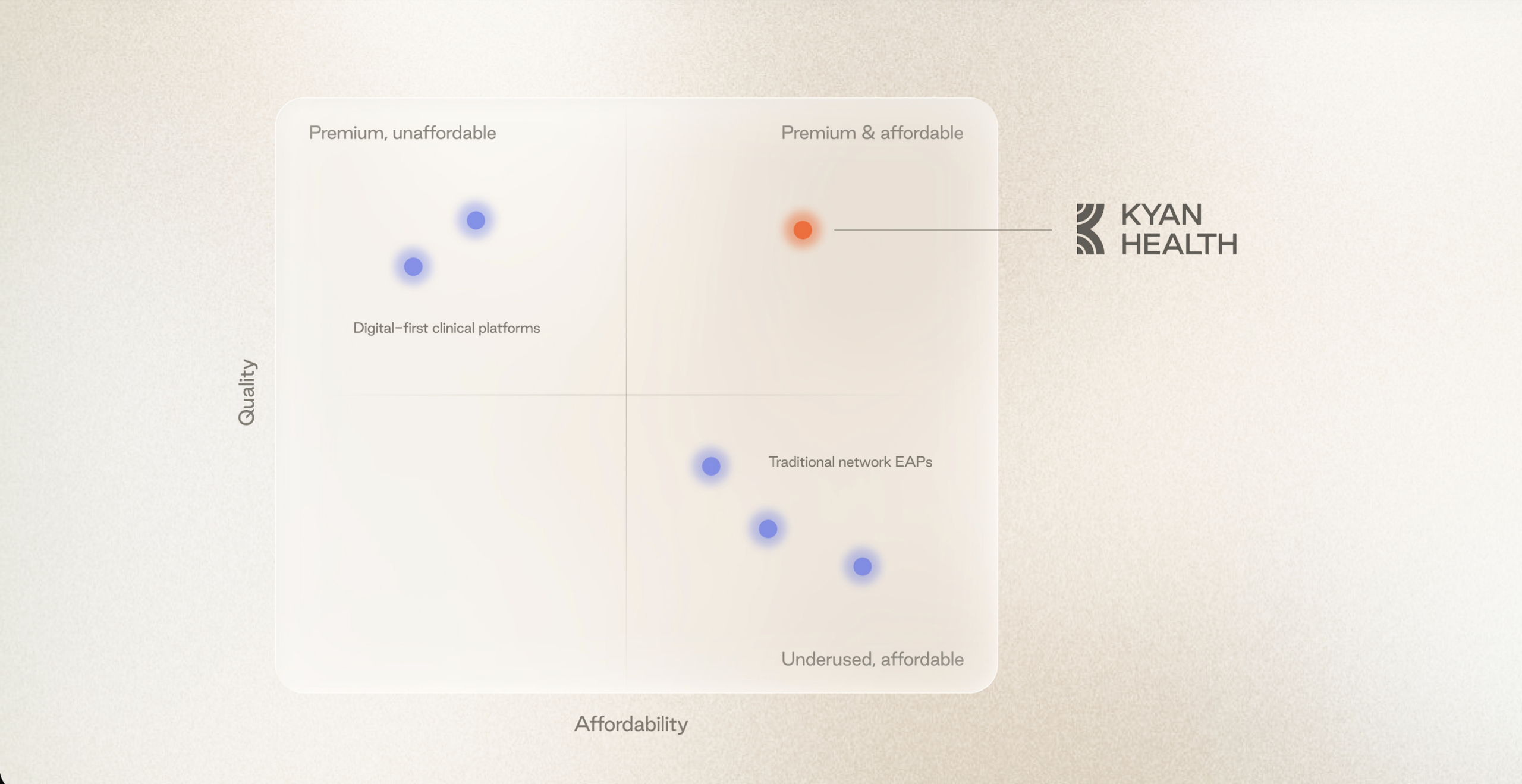
Look at the market and you will usually find two choices. A traditional employee assistance program (EAP) that is affordable and easy to renew, but thin on the care it actually provides resulting in less people using it. Or a modern mental health platform with real depth of care and engagement, but a price that is much harder to justify.
So which one do you choose? The affordable option that gives your team basic care? Or the premium option that costs significantly more? The answer should be neither. There is a third option. Kyan Health is a modern EAP alternative that delivers world-class mental health care at a price all employers can afford. Keep reading to learn more.
 is a modern EAP alternative that delivers world-class mental health care at a price all employers can afford. Keep reading to learn more.
The False Choice HR Has Learned to Accept
Nobody designed the quality and affordability trade-off on purpose. It is just how the market evolved. Traditional EAPs were built to provide broad coverage at a low cost, though often with little to keep people coming back. Newer mental health platforms improved accessibility, experience, and quality of care, but often with a more expensive delivery model.
Each solves part of the problem.
The cheaper option costs less on the invoice. But when people do not get the support they need, the cost does not disappear. It shows up in sick days, presenteeism, turnover, lost productivity, and more pressure on HR.
McKinsey Health Institute estimates that better employee health could create up to $11.7 trillion in annual global economic value, with 77% of that value coming from higher productivity and reduced presenteeism. In the UK alone, Deloitte estimates poor mental health costs employers around £51 billion a year.
So the goal is not to buy the cheapest mental health benefit but to reduce the cost of people struggling without the right support.
And that changes the question: How do you get people the right support without paying for the most expensive option every time? Let's see how Kyan does it.
The 5 Biggest Mental Health Benefit Challenges for HR, And How Kyan Solves Them
Challenge #1: Good Care Gets Expensive Fast
Not everyone who is struggling needs counseling. One employee may need a self-guided exercise to manage stress. Another may benefit from professional coaching. Someone experiencing symptoms of depression or anxiety may need counseling with a licensed mental health professional. Treating all three as if they have the same need is not good care. It also makes the whole model more expensive than it has to be.
How Kyan solves it:
- The right care, not automatically the most expensive care. Members start with an assessment that personalizes their experience and recommends support based on what they actually need. As they use the platform and their needs change, care recommendations evolve with them. More intensive care is there for those who need it, without becoming the default for everyone.
- AI in the back office, humans in the care. Kyan automates repetitive work involved in operating its global provider network, while provider interviews, clinical oversight, and care itself remain human-led.
- A model you can shape. Organizations can choose the services they actually need instead of paying for the same package everywhere.
Matching people to the right level of support is better clinical practice. It also keeps the cost of delivering care down, which is what allows Kyan to offer the depth of a premium platform without the premium price.
Challenge #2: A Benefit Nobody Uses Is Costly Too
You can buy the best mental health platform in the world. It only works if people remember to use it. Most benefits get a lot of attention at launch, then go quiet. So when someone finally needs help, they forget the benefit exists.
How Kyan solves it:
- HR gets tools to launch the program & keep it visible. Rollout plans get the program live in weeks. After that, communication materials and customizable campaigns are ready whenever attention starts to dip, so HR isn't building a new push from scratch every time.
- Customer success stays involved. Kyan's dedicated customer success team supports launches, trains local champions to help spread the word about Kyan, and steps in when engagement starts to flatten.
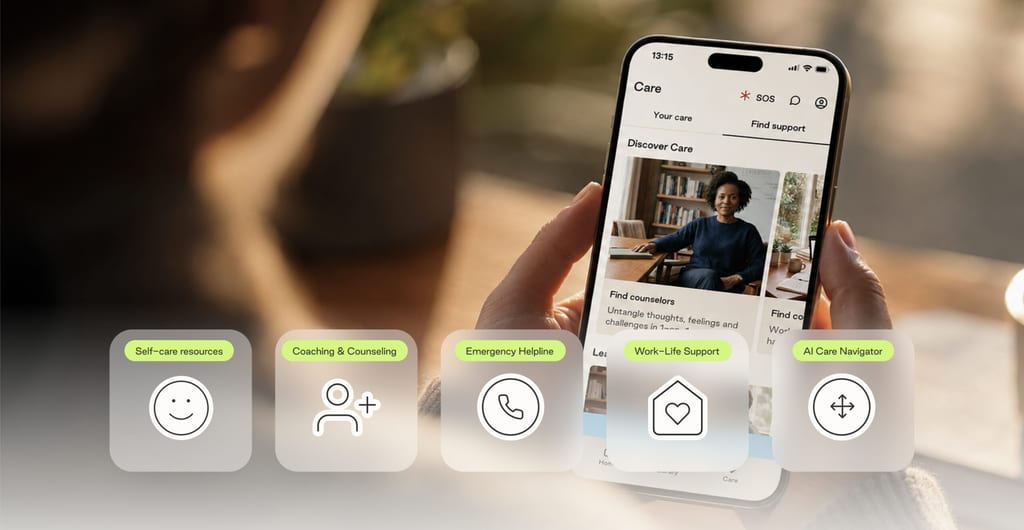
- Kai removes the “where do I even start?” problem. Once employees get activated, Kai, Kyan's AI Care Guide, helps them navigate to the right support, while the platform keeps them engaged over time.
Kyan reports sustained member engagement of up to 30%, roughly 10 times the utilization commonly associated with traditional EAPs.
Affordability comes down to the value you get for what you spend.

Challenge #3: Utilization Does Not Tell Whether People Got Better
Most benefit reporting starts with usage. How many people logged in? How many sessions were booked? Which services did they use? Useful questions. But they do not answer the most important one: Did it help?
How Kyan solves it:
- Go beyond utilization. Kyan combines usage, care, wellbeing, and clinical outcome data so that HR and managers can see which teams are struggling and what is driving it. When a pattern shows up, say stress concentrated in one team, the platform points you to the workshop or resource that addresses it. The insight comes with a next step.
- Track clinical improvement. Measures such as PHQ-9 and GAD-7 can be used to follow changes in symptoms through the care journey and help the platform adjust the level of care they receive. Kyan reports symptom improvement in >90% of clinical cases.
- Connect outcomes to the business. ROI modeling uses workforce data to help HR understand potential organizational impact. Our client On, for example, traced $1.3 million in productivity gains back to Kyan by reducing presenteeism.
And you are not left alone with a dashboard. Kyan's customer success team works through the numbers with you and turns them into practical recommendations and leadership-ready reporting.

Challenge #4: Global Care Takes More Than Translation
Language is only one part of making support relevant across countries and cultures. Employees need care, resources, and support that reflect their local context, from how mental health is understood and discussed to how services are delivered.
How Kyan solves it:
- Employees can access professionals matched by language and location.
- Self-care resources are localized and reviewed by native speakers.
- Customer success support includes regional expertise for different markets.
Kyan's expert network spans more than 140,000 providers across 200 countries and regions, including more than 11,000 licensed providers across all 50 US states.
The goal is global availability of care that feels local when employees use it.

Challenge #5: Every Organization Needs Something Different
A global workforce may need broad provider coverage. Another company may want coaching, work-life services, or additional support for critical incidents. Putting every possible capability into the same package can quickly push costs up.
How Kyan solves it:
Kyan lets organizations shape the program around what their workforce actually needs.
That means companies can build on a strong core offering and add services where they make sense, rather than paying for every possible capability by default.
Additional support can include services such as Critical Incident Response (CIR), giving HR teams structured guidance, designated incident leads, and clinical support when an incident affects a team or site.
The model stays affordable because it is modular. Organizations pay for the capabilities their workforce needs and add others only where they are needed.
The Real Question Was Never Cheap or Good
No mental health platform can fix all the challenges affecting your employees. But the right one makes it easier for them to get support early, helps HR keep that support visible, and shows whether it's actually working.
The trade-off between affordability and quality (cheap programs nobody uses, or good care you can't justify at scale) is a limit of how the market was built, not a rule you have to accept. So instead of asking whether you can afford good care, ask better questions. Is care matched to what people actually need? Is technology lowering cost without lowering quality? Do people use it? Can you prove it helped?
Kyan Health was built around these questions. That is how you end up with quality care people use, at a price you can defend.

