


The right compensation courses depend on where you are in your HR career and what skills you want to build. I've rounded up options that range from salary benchmarking and job evaluation to total rewards strategy, so you can find training that matches your current role and where you want to go next.
The 17 Best Compensation Courses
Below are my summaries of the best compensation courses. My reviews cover each course's learning objectives, best fits, cost, and more.
1. Certified Compensation Professional (CCP®) - WorldatWork
Best for: Compensation professionals seeking a gold-standard industry credential
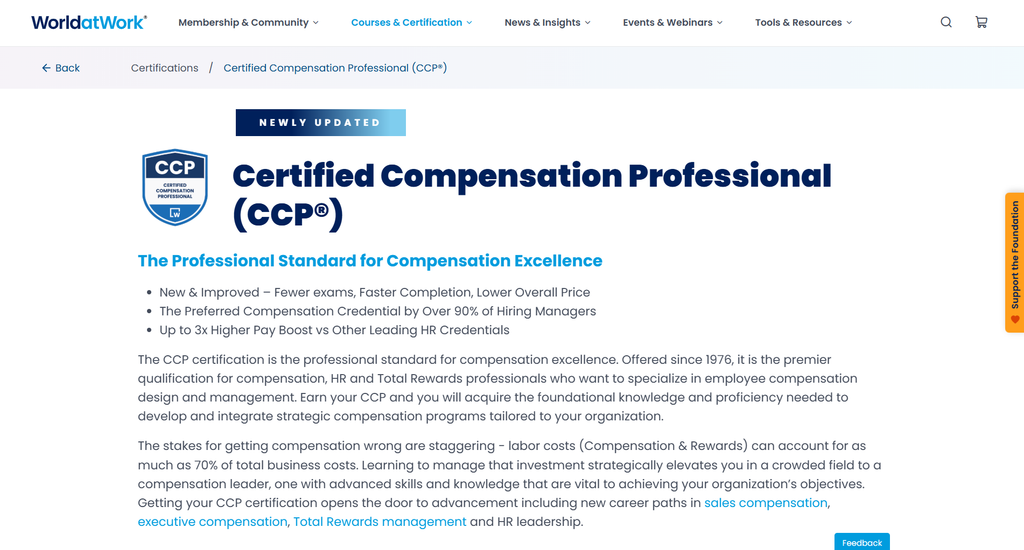
The CCP is WorldatWork's eight-course certification program and the most recognized credential in compensation. With nearly 50 years of history and strong employer preference, it's the benchmark for professionals who want to be taken seriously in the field.
What you'll learn: Design and manage base pay structures, benchmark roles against market data, apply pay equity and analytics, navigate compensation regulations, and connect rewards strategy to business outcomes.
Course details:
- Format: Self-paced e-learning or instructor-led virtual classroom; individual courses or bundled programs
- Duration: ~17 hours of study per course (136 hours total); 1-year access for 4-course bundle, 2-year for 8-course bundle
- Level/prerequisites: Suited for professionals entering the field through senior level; no prerequisites stated
- Price: 8-course bundle from $7,812 USD (includes 2-year membership); 4-course bundle from $4,464 USD; individual courses from $1,395 USD each
- Assessment: One proctored exam per course; all 8 must be passed to earn the CCP designation
- Certificate/credits: CCP® designation awarded by WorldatWork upon passing all eight exams; courses may also count toward recertification credits for other WorldatWork credentials
Considerations: Bundle pricing is only available to learners in the US, Canada, and Mexico; those outside these countries must purchase individual courses at a higher per-course rate.
2. Compensation & Benefits Certificate Program - AIHR
Best for: HR professionals who want a recognized compensation credential
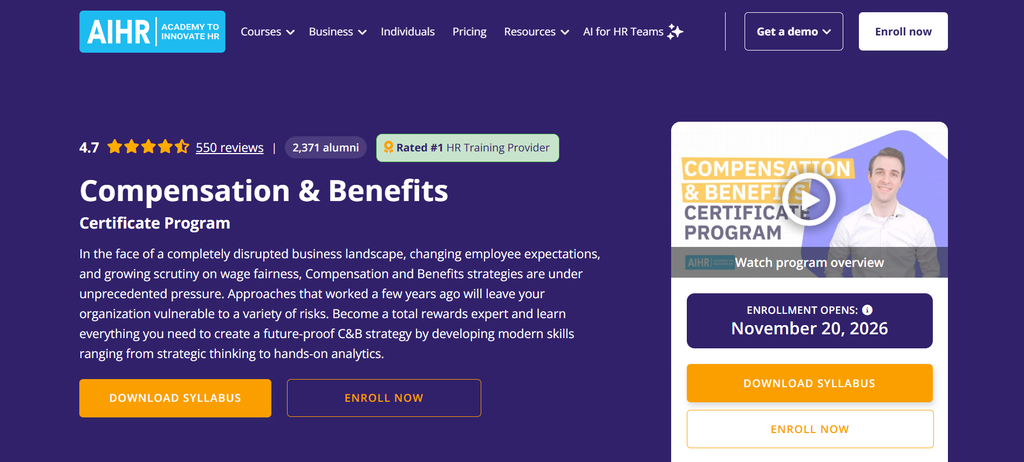
AIHR's Compensation & Benefits Certificate Program is a self-paced program taught by compensation practitioners and PwC Netherlands experts. Its five-course curriculum spans pay strategy, analytics, and pay gap analysis, with 18+ downloadable templates included.
What you'll learn: Design base pay structures, benchmark roles against market data, build sales compensation plans, analyze pay gaps, and apply C&B analytics using established frameworks.
Course details:
- Format: 100% self-paced online; includes assignments, quizzes, role-plays, community discussions, and downloadable templates
- Duration: ~40 hours of learning; 3.5 hours/week in 12 weeks
- Level/prerequisites: Foundational to intermediate; no prerequisites stated
- Price: Standalone enrollment from $1,125 USD (opens periodically); Full Academy Access from $9,750 USD/year
- Assessment: Capstone project and exam required to earn the certificate; unlimited retries allowed
- Certificate/credits: Digital completion certificate; 27 SHRM PDCs, 27 HRCI General Business credits, and 32 HRPA PDCs
Considerations: Standalone enrollment isn't available year-round—if you need immediate access, Full Academy Access at $1,850 USD/year is the only option.
3. Compensation and Benefits Certificate - eCornell
Best for: HR professionals seeking a Cornell-backed pay credential

eCornell's Compensation and Benefits Certificate is a four-course program developed by Cornell ILR faculty and senior HR executives. The Cornell pedigree and practitioner-led instruction make it a credible option for HR professionals who want university-backed training with real-world application.
What you'll learn: Design pay structures, benchmark competitive pay using salary surveys, apply total rewards strategy, navigate pay transparency trade-offs, and evaluate employee benefits programs.
Course details:
- Format: Online; mix of asynchronous coursework, facilitator guidance, peer discussions, live sessions, and graded projects; courses taken sequentially
- Duration: 2 months total; four 2-week courses at 7–10 hours of study per week
- Level/prerequisites: Foundational to intermediate; no prerequisites stated for first course; subsequent courses require completion of prior courses in order
- Price: $3,750 USD (pay in full) or installment plans available; includes HR Symposium access and a six-month AI Workshops All-Access Pass
- Assessment: Graded project work required per course to earn the certificate
- Certificate/credits: Cornell ILR School certificate; 80 SHRM PDCs, 80 HRCI recertification hours, and 80 professional development hours (8 CEUs)
Considerations: The program focuses on U.S. pay practices, data, and regulations, so professionals outside the U.S. may find some content less directly applicable to their context.
Have an account? Log In
4. Foundations of Compensation - SHRM
Best for: HR pros new to compensation structures and systems
SHRM's Foundations of Compensation is an instructor-led seminar that goes deeper into compensation mechanics than broader total rewards programs. It's built for HR professionals stepping into compensation for the first time, with hands-on activities woven throughout.
What you'll learn: Build a point-factor job valuation system, collect and apply salary survey data, design pay structures, calculate compa-ratios, and create short-term incentive plans.
Course details:
- Format: Instructor-led; in-person or live online; live online sessions are recorded and accessible for one year after the program
- Duration: Approximately 15 hours of instructional time (15 PDCs)
- Level/prerequisites: Foundational; no prerequisites stated
- Price: $1,890 USD per learner; SHRM members save $325
- Certificate/credits: 15 SHRM PDCs toward SHRM-CP/SCP recertification; no standalone certificate is awarded
Considerations: This seminar earns PDCs but doesn't award a standalone certificate or credential, so if a formal compensation credential is your goal, you'll need a different program.
5. Compensation Immersion Program - WorldatWork
Best for: HR pros stepping into compensation for the first time
WorldatWork's Compensation Immersion Program delivers a fast foundation in compensation taught by 30+ practicing professionals from firms like Fidelity, WTW, and Korn Ferry—making it one of the most practitioner-rich options in this roundup.
What you'll learn: Analyze and document jobs, source and interpret salary survey data, design base-pay structures, build variable-pay plans, and navigate U.S. federal compensation regulations.
Course details:
- Format: Instructor-led; choose in-person (3 consecutive days), live virtual (7 sessions over 2 weeks), or self-paced e-learning
- Duration: Approximately 21 hours of instructional time; e-learning format includes 120-day access
- Level/prerequisites: Foundational; no prerequisites stated
- Price: Member price approximately $3,145 USD per learner; non-member price $4,493 USD per learner
- Certificate/credits: 21 WorldatWork, 21 SHRM, and 21 HRCI recertification credits; 2.0 CEUs; no standalone certificate awarded
Considerations: Non-member pricing isn't listed publicly, so if you're not a WorldatWork member, you'll need to reach out directly for a quote before you can compare costs with other programs.
6. Managing Employee Compensation - University of Minnesota (via Coursera)
Best for: People managers who want affordable, self-paced pay basics
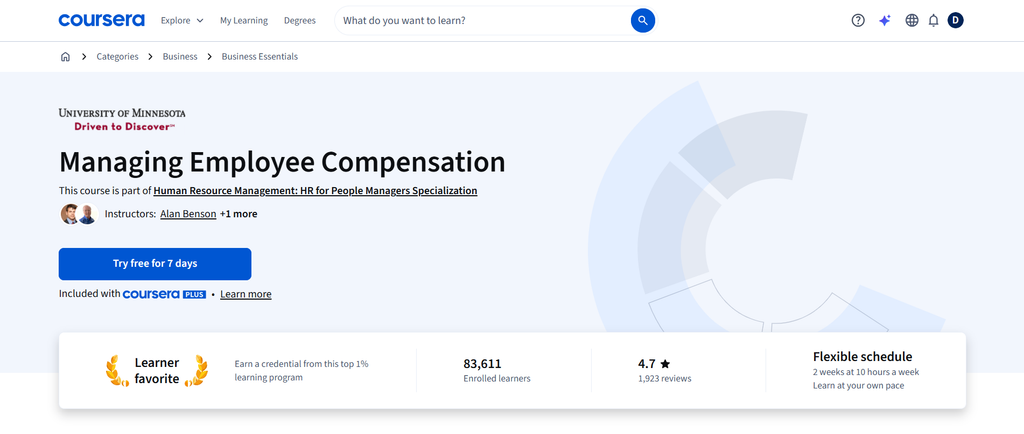
Managing Employee Compensation is a University of Minnesota course on Coursera covering the full pay spectrum—from salary structures to benefits and non-monetary rewards—with hands-on assignments and a 4.7/5 rating from nearly 2,000 learners.
What you'll learn: Build pay structures, benchmark jobs, design short- and long-term incentives, understand U.S. benefits and compliance requirements, and explore non-monetary rewards like recognition and flexibility programs.
Course details:
- Format: Self-paced online via Coursera; includes video lectures, graded assignments, and peer reviews; available in 24 languages
- Duration: Approximately 17 hours of content across four modules; self-paced with no fixed schedule
- Level/prerequisites: Beginner; no prerequisites stated
- Price: Included with Coursera Plus at $239 USD per year; financial aid available
- Assessment: 15 graded assignments, including hands-on pay structure exercises and peer reviews
- Certificate/credits: Shareable completion certificate; counts toward the HR for People Managers Specialization; no professional recertification credits
Considerations: This course doesn't earn SHRM, HRCI, or WorldatWork recertification credits, so if maintaining a professional credential is your priority, it won't count toward your renewal requirements.
7. Managing Employee Compensation and Benefits Specialization - UC Santa Barbara (via Coursera)
Best for: HR generalists expanding into compensation and benefits
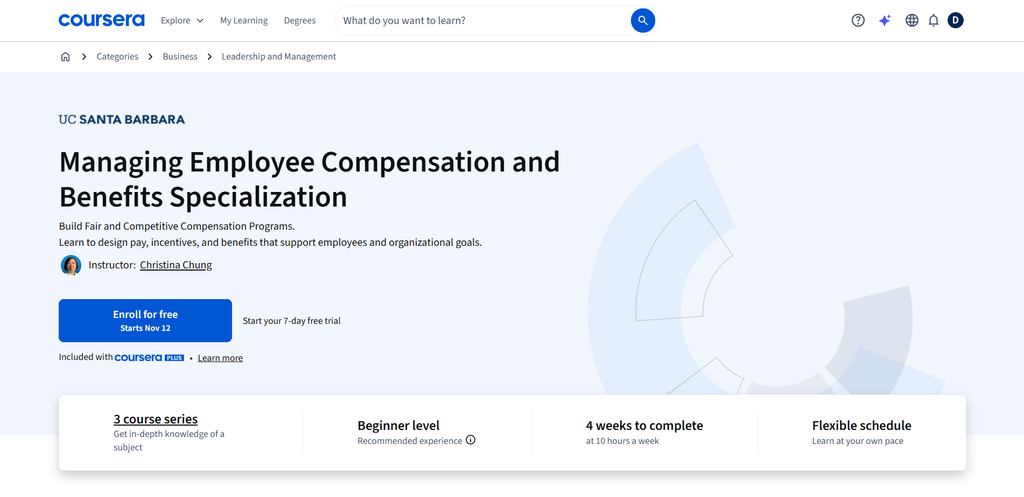
The Managing Employee Compensation and Benefits Specialization is a three-course UCSB program on Coursera. Each course covers a distinct domain—pay structures, incentives, or benefits—so you can focus on whichever area is most relevant to your role right now.
What you'll learn: Build and evaluate pay structures, design performance-based incentive plans, assess health and retirement benefits, and develop practical total rewards recommendations using real workplace scenarios.
Course details:
- Format: Self-paced online via Coursera; three courses can be taken in any order; includes applied learning projects
- Duration: Approximately 15 hours total across three courses (5 hours each); fully self-paced
- Level/prerequisites: Beginner; no prerequisites stated
- Price: Included with Coursera Plus at $239 USD per year; course cannot be audited for free
- Certificate/credits: Shareable career certificate from UC Santa Barbara upon completing all three courses; individual course certificates also available; no SHRM, HRCI, or WorldatWork recertification credits
Considerations: Unlike many Coursera courses, this Specialization can't be audited for free, so you'll need a Coursera Plus subscription or paid enrollment to access any of the content.
8. Compensation and Benefits - HRCI (via Coursera)
Best for: HR generalists who need HRCI-backed pay and benefits fundamentals
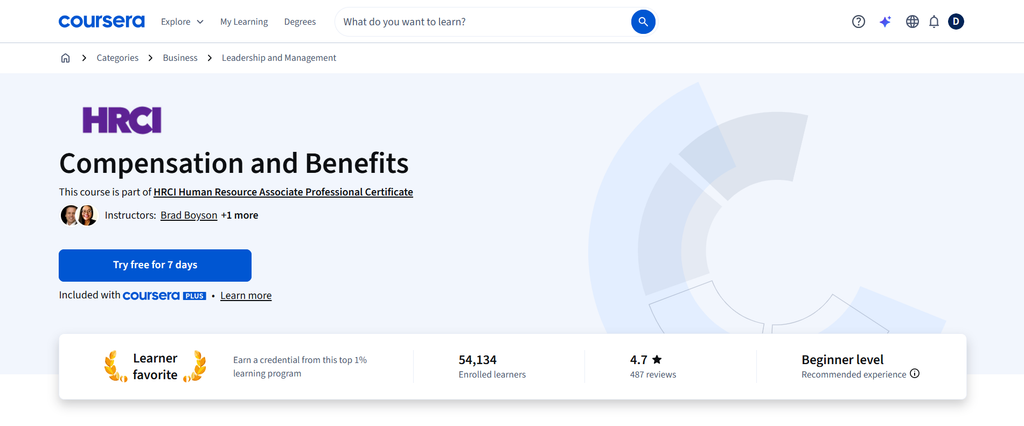
Compensation and Benefits is an HRCI-developed course on Coursera that covers both compensation strategy and the operational side of pay—including payroll, HRIS, and record-keeping—giving you a fuller picture than most foundational courses offer.
What you'll learn: Evaluate compensation strategies, build pay structures, design incentive plans, assess healthcare and retirement benefits, and understand payroll processes and HRIS record-keeping.
Course details:
- Format: Self-paced online via Coursera; includes 83 video lectures, 24 readings, 21 graded assignments, and discussion prompts
- Duration: Approximately 19 hours across four modules; self-paced with no fixed schedule
- Level/prerequisites: Beginner; no prerequisites stated
- Price: Included with Coursera Plus at $239 USD per year; financial aid available
- Assessment: 21 graded assignments across four modules, including quizzes and applied exercises
- Certificate/credits: Shareable certificate; counts toward the HRCI Human Resource Associate Professional Certificate on Coursera; no recertification credits stated
Considerations: Benefits and compliance content is U.S.-specific (FMLA, 401(k), IRA), so international learners should expect some material that won't apply directly to their local context.
9. Human Resources: Compensation and Benefits - LinkedIn Learning
Best for: Busy professionals wanting a quick compensation overview with recertification credits
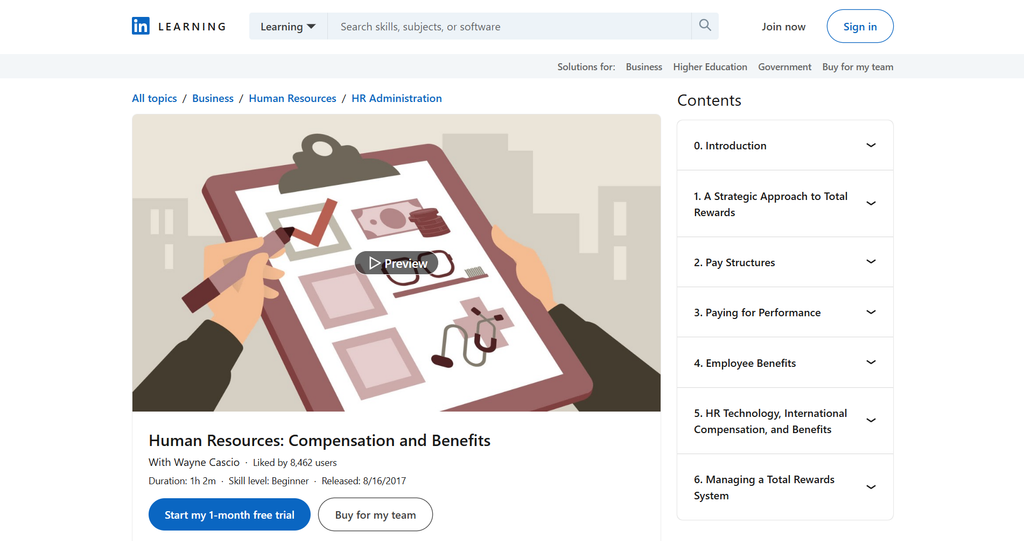
Human Resources: Compensation and Benefits is a one-hour LinkedIn Learning course taught by Wayne Cascio, a University of Colorado Denver professor. It covers the full compensation and benefits landscape and earns both SHRM and HRCI recertification credits.
What you'll learn: Build pay structures, design incentive plans, evaluate employee benefits, understand HR technology in compensation administration, and apply total rewards strategies across domestic and international contexts.
Course details:
- Format: Self-paced online via LinkedIn Learning; video lessons organized across six sections
- Duration: 1 hour 2 minutes of video content; fully self-paced with no fixed schedule
- Level/prerequisites: Beginner; no prerequisites stated
- Price: Included with LinkedIn Learning at $39.99 USD/month or $239.88 USD/year; employer and library access often available
- Assessment: 6 quizzes across the six course sections
- Certificate/credits: Certificate of completion that auto-populates on your LinkedIn profile; eligible for SHRM PDCs and HRCI general recertification credits
Considerations: At just over an hour, this is a strategic overview rather than a deep-dive—if you need hands-on practice or technical depth in areas like job evaluation or incentive plan design, pair it with a longer program.
10. Compensation Programs: Administration and Design - UCLA Extension
Best for: HR professionals pursuing the UCLA Extension HR certificate
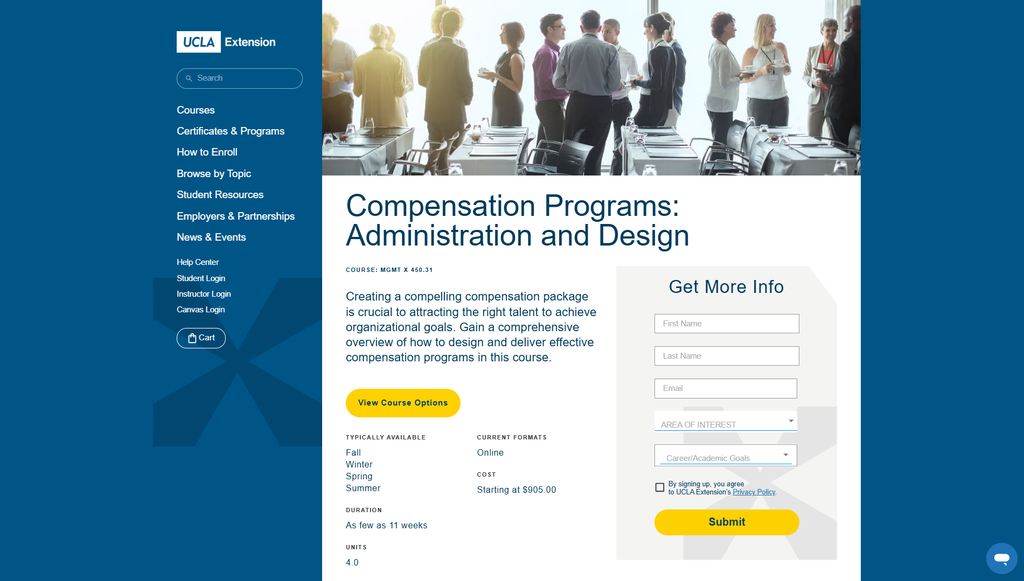
UCLA Extension's Compensation Programs is an instructor-led course taught by working HR practitioners. It goes deeper than self-paced options and counts toward UCLA's HR Management Certificate.
What you'll learn: Design salary structures, build cash-incentive and stock-based programs, apply compensation law, evaluate performance-based pay approaches, and develop a complete compensation program for specific job families and organizational levels.
Course details:
- Format: Online, instructor-led (asynchronous); no set meeting times
- Duration: Approximately 11 weeks; offered each quarter (Fall, Winter, Spring, Summer)
- Level/prerequisites: Introductory; requires MGMT X 450 Elements of Human Resources Management or instructor consent
- Price: $905 USD per course; 10% discount for SHRM and PIHRA members
- Assessment: Graded assignments throughout; a letter grade of C or better is required to earn certificate credit
- Certificate/credits: 4.0 continuing education units from UCLA Extension; counts as a required course toward the UCLA Extension Human Resources Management Certificate; approved for HRCI PHR, SPHR, and GPHR recertification credit hours
Considerations: The prerequisite course and fixed quarterly schedule mean you'll need both foundational HR knowledge and advance planning to enroll.
11. HR: Compensation and Benefits - Florida Atlantic University
Best for: HR pros wanting live instruction and 33 HRCI credit hours
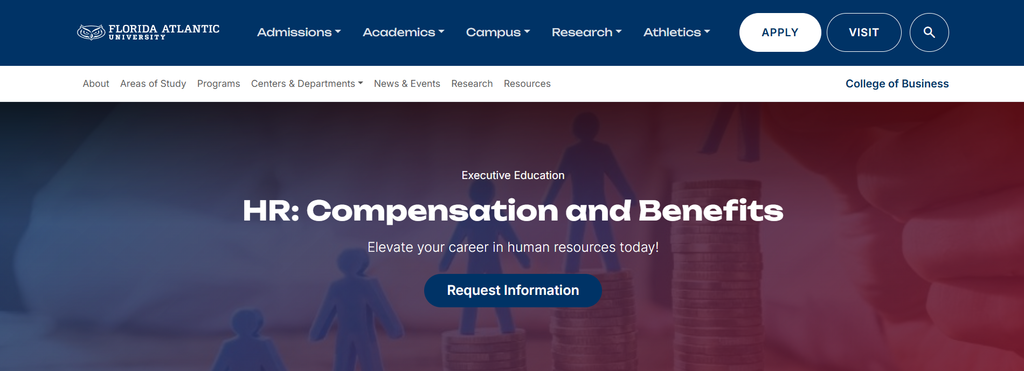
FAU Executive Education's HR: Compensation and Benefits is an 11-session live virtual course built around the Milkovich & Newman Compensation textbook. It earns 33 pre-approved HRCI recertification credit hours—the highest single-course count in this roundup.
What you'll learn: Design pay structures, build cash incentive and performance-based programs, evaluate benefits packages, apply compensation law, and understand international pay across different labor markets and organizational levels.
Course details:
- Format: Live virtual; 11 weekly Thursday evening sessions (6:30–9:30 p.m.); corporate on-site delivery also available
- Duration: 33 hours across 11 sessions; next cohort runs February 4–April 29, 2027
- Level/prerequisites: Not specified by provider
- Price: $1,255 USD per learner; textbook included
- Assessment: Graded assignments throughout the course
- Certificate/credits: 3.3 CEUs from FAU; 33 HRCI general recertification credit hours pre-approved for aPHR, PHR, SPHR, GPHR, and international equivalents
Considerations: The fixed Thursday evening schedule across 11 weeks means you'll need consistent availability—there's no self-paced option if your schedule shifts mid-program.
12. Compensation Training & Certification Program - HRCertification.com
Best for: HR teams training multiple staff on compensation
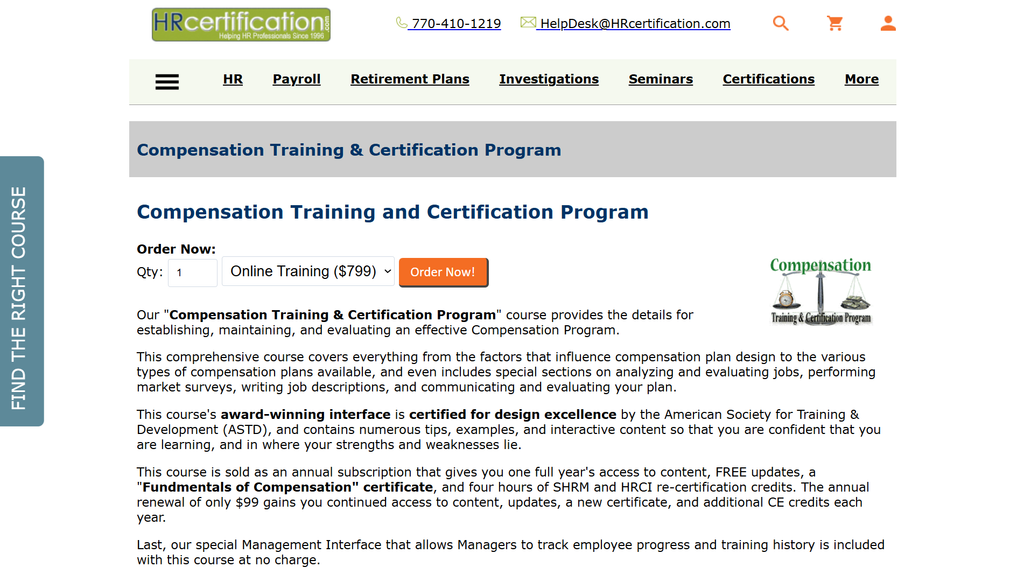
HRCertification.com's self-paced Compensation Training & Certification Program covers the full compensation lifecycle in about four hours. Its annual subscription includes free legal updates, keeping your knowledge current as regulations change.
What you'll learn: Design salary structures, conduct job analysis and market surveys, build a compensation philosophy, communicate pay programs to stakeholders, and manage ongoing plan administration.
Course details:
- Format: Self-paced online
- Duration: Approximately 4 hours of content; 1 year of access, renewable annually
- Level/prerequisites: Not specified by provider
- Price: $799 USD per user (annual subscription); volume discounts available for groups of 2 or more
- Assessment: Interactive quizzes throughout the course
- Certificate/credits: "Fundamentals of Compensation" certificate upon completion; optional "Certified Compensation Administrator" designation via exam; 4 SHRM PDCs and 4 HRCI recertification credit hours
Considerations: Continued access to course content and the ability to earn additional CE credits each year both require renewing the subscription at $99/year.
13. Total Rewards: Compensation, Benefits, and Pay Equity - MindEdge Learning (via Coursera)
Best for: Learners who want a free, beginner-level total rewards overview
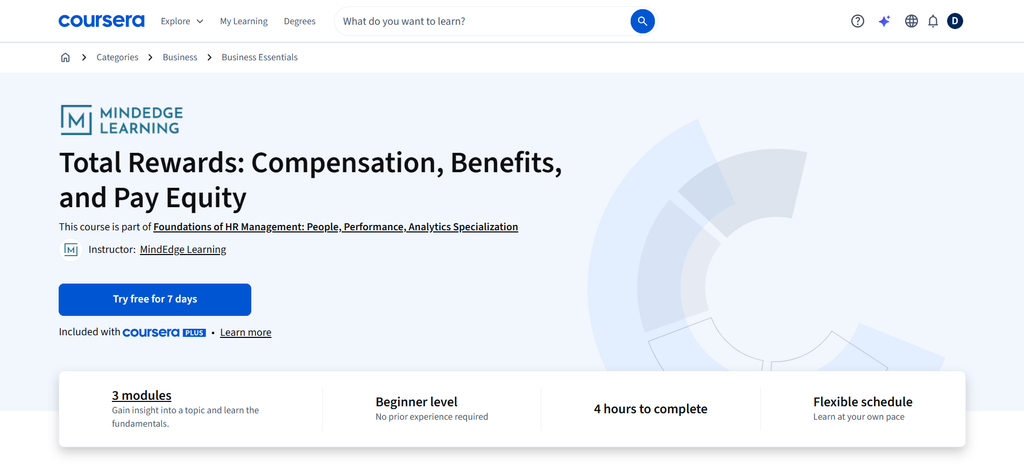
MindEdge Learning's Coursera course covers compensation, benefits, and pay equity in about four hours. It's one of the few short-format options that integrates all three total rewards pillars, and you can audit the full content for free before committing to the certificate.
What you'll learn: Analyze compensation systems, evaluate benefits packages, apply pay equity frameworks, interpret pay-for-performance models, and understand wage and hour compliance fundamentals.
Course details:
- Format: Self-paced online via Coursera
- Duration: Approximately 4 hours across 3 modules; flexible, self-paced schedule
- Level/prerequisites: Beginner; no prerequisites required
- Price: Free to audit; certificate requires a paid course purchase or Coursera Plus subscription ($239 USD/year)
- Assessment: 12 graded assignments across three modules
- Certificate/credits: Shareable career certificate (paid track); professional development credit toward SHRM and HRCI credentials
Considerations: The free audit gives you full content access, but earning the certificate and professional development credit toward SHRM and HRCI credentials requires a paid enrollment or Coursera Plus subscription.
14. Total Rewards Course: Compensation and Benefits, 2900+ Tools - Udemy
Best for: Budget-conscious HR pros who need ready-to-use pay tools
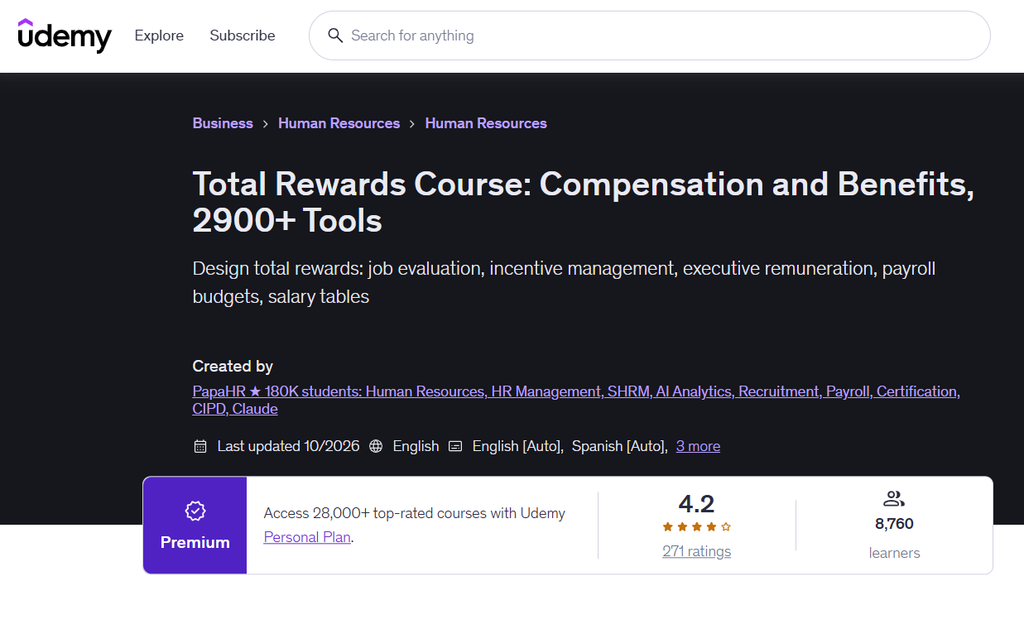
PapaHR's Udemy course pairs compensation and benefits instruction with over 2,900 downloadable tools—salary tables, merit matrices, bonus calculators—making it as much a working library as a learning program.
What you'll learn: Design salary structures and job grades, build incentive and bonus plans, conduct pay equity analysis, budget compensation programs, and prepare for the WorldatWork CCP exam.
Course details:
- Format: Self-paced online via Udemy; on-demand video with downloadable resources and demonstrations of 44 HR platforms
- Duration: Approximately 268 hours of video across 488 lectures; lifetime access after purchase
- Level/prerequisites: No prior total rewards experience required
- Price: $64.99 USD list price; frequently discounted; also available via Udemy Personal Plan from $12.99/month; 30-day money-back guarantee
- Assessment: Practice test included
- Certificate/credits: Udemy Certificate of Completion; includes WorldatWork CCP exam preparation content, though this course awards no CCP credits
Considerations: This course does not carry SHRM PDC or HRCI recertification credits, so it won't count toward those credential renewals.
15. Professional in Compensation and Benefits - Alison
Best for: HR pros who want a free, CPD-accredited intermediate course
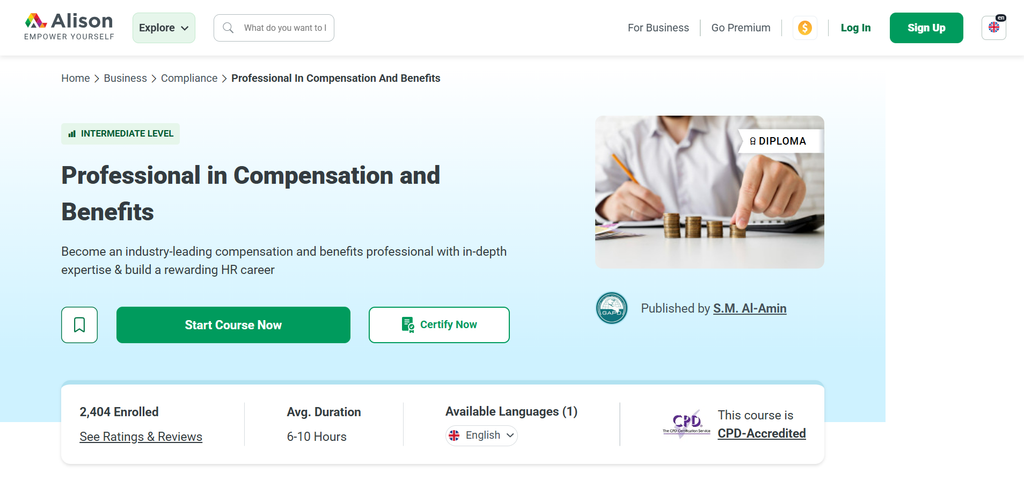
Alison's free, intermediate-level course pairs compensation design with compliance training and carries CPD accreditation—uncommon for a no-cost option. It's a solid pick if you want structured pay fundamentals without a financial commitment.
What you'll learn: Analyze job evaluation methods, design salary structures and incentive programs, apply competency mapping to pay frameworks, and ensure compliance with regulations including FLSA, the Equal Pay Act, and ERISA.
Course details:
- Format: Self-paced online via Alison; available on web and mobile app with offline download
- Duration: 6–10 hours; self-paced with no time limit for completion
- Level/prerequisites: Intermediate; no prerequisites stated
- Price: Free to study; optional digital diploma from €52 EUR or printed diploma from €141 EUR
- Assessment: Module assessments required; minimum score of 80% needed to qualify for the diploma
- Certificate/credits: CPD-accredited Diploma from the UK CPD Certification Service (optional paid purchase); free Learner Record available without purchase
Considerations: Earning the CPD-accredited diploma requires a minimum 80% assessment score and a separate purchase starting at €52 EUR—the free track only provides a Learner Record.
16. Compensation Analysis: Benchmarking, Surveys, and Equity Strategies - Alison
Best for: HR pros who need free pay equity and benchmarking training
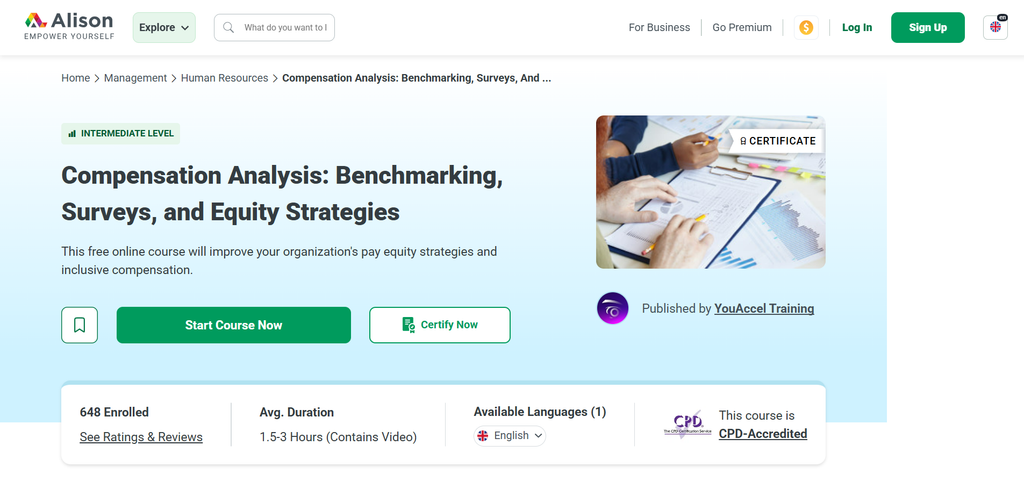
Alison's free, intermediate course from YouAccel Training focuses on the analytical side of pay—benchmarking data, salary surveys, and pay equity audits—rather than broad compensation fundamentals. It's a quick, focused option for targeted pay analysis skills.
What you'll learn: Analyze benchmarking data to assess competitive pay, interpret salary surveys, conduct pay equity audits, identify strategies to address gender and racial pay disparities, and reduce unconscious bias in compensation decisions.
Course details:
- Format: Self-paced online via Alison; available on web and mobile app with offline download option
- Duration: 1.5–3 hours; self-paced with no time limit for completion
- Level/prerequisites: Intermediate; no prerequisites stated
- Price: Free to study; optional digital certificate from €21–€26 EUR or printed certificate from €27–€31 EUR
- Assessment: Module assessments required; minimum score of 80% needed to qualify for the certificate
- Certificate/credits: CPD-accredited Certificate from the UK CPD Certification Service (optional paid purchase); free Learner Record available without purchase
Considerations: Earning the CPD-accredited certificate requires a minimum 80% assessment score and a separate paid purchase—the free track only provides a Learner Record, not a credential.
More Articles
17. Compensation Management - Great Learning Academy
Best for: Beginners who want a free compensation management primer
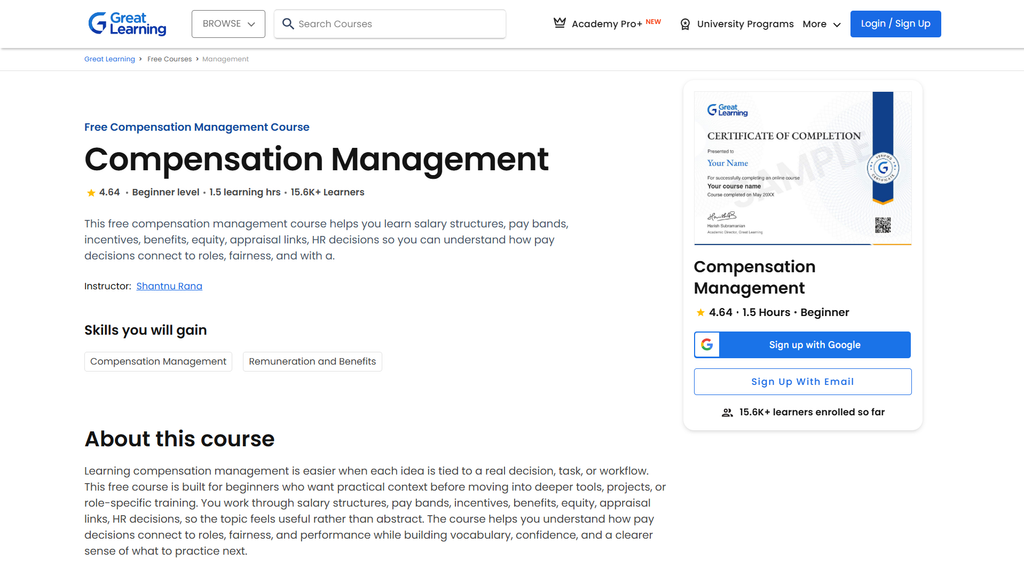
Great Learning Academy's Compensation Management is a free, beginner-level course taught by Shantnu Rana. It covers pay fundamentals in about 1.5 hours—a practical starting point if you're new to compensation and want to build foundational fluency before tackling longer programs.
What you'll learn: Define compensation management, distinguish types of compensation, structure a compensation plan, navigate the compensation management process, and understand executive pay considerations.
Course details:
- Format: Self-paced online via Great Learning Academy; video-based with quizzes and lifetime access
- Duration: 1.5 hours of content; lifetime access with no completion deadline
- Level/prerequisites: Beginner; no prerequisites stated
- Price: Free to study; certificate requires a non-refundable fee (amount not published)
- Assessment: Quizzes included throughout the course
- Certificate/credits: Great Learning Certificate of Completion; no SHRM, HRCI, or CPD credits listed
Considerations: The certificate fee isn't published upfront, so you'll need to enroll before you can confirm the cost—which may matter if you're comparing credentialing options across free courses.
How to Choose a Compensation Course
Start by naming the specific problem you're trying to solve. Whether that's designing a salary structure, auditing pay equity, or simply building foundational vocabulary, your answer should drive every other decision.
- Match the curriculum to your actual work. A course covering FLSA, the Equal Pay Act, and ERISA is valuable if compliance is your gap—but not if you need benchmarking methodology or pay equity audit skills. Read the learning outcomes carefully before enrolling.
- Be honest about your experience level. Beginner courses introduce vocabulary and frameworks; intermediate courses assume you already know them. Starting too high means missing context; starting too low means sitting through material you've already applied on the job.
- Factor in total time, not just duration. A 1.5-hour primer and a 6-week instructor-led program are solving different problems. If you need job-ready competency quickly, a short focused course may serve you better than a longer program where compensation is one module among many.
- Clarify your credential goal before you pay. Completion certificates, CPD-accredited credentials, and SHRM/HRCI recertification credits are not interchangeable. If you need PDCs for recertification, confirm credit eligibility before enrolling—not all courses that mention professional development carry formal credits.
- Consider whether you learn better with feedback or flexibility. Live instructor-led formats give you direct access to questions and peer discussion. Self-paced formats let you move on your own schedule but require self-direction to finish.
- Check the full cost, including credentials. Some courses are free to study but charge separately for a certificate. Know upfront what you're actually getting at no cost versus what requires a purchase.
Compensation Courses FAQ
Will a compensation course qualify you for a compensation analyst role?
A course alone usually isn’t enough. Employers typically also look for relevant HR or finance experience, strong analytical ability, and hands-on familiarity with compensation data. I’d treat coursework as a way to build and demonstrate skills, then look for opportunities to apply them through projects or stretch assignments at work. The credential helps, but what you can actually do with the knowledge is what hiring managers are evaluating.
Will a compensation course cover laws in your country?
Not necessarily. Legal content in most compensation courses focuses on a specific jurisdiction—often the US—and some courses skip legal depth altogether. Before enrolling, check the syllabus for the specific regulations and locations it covers. And regardless of what a course covers, treat it as a learning resource rather than legal advice; consult qualified counsel for compliance decisions.
How can you tell whether a course teaches practical skills?
Look for case studies, exercises, or projects that ask you to work with real compensation data or make actual pay decisions—not just watch lectures or memorize terminology. Review the syllabus and any available sample materials before you commit. If the activities mirror decisions you’d make on the job, that’s a good sign the course will transfer to your work.
Are short courses enough to build expertise in compensation?
Short courses can build foundational knowledge or fill a specific skill gap, but expertise takes time and practice. If you work through a 1.5-hour primer and then apply those concepts to real pay decisions and data, you’ll retain far more than if you just complete the course. For deeper proficiency, plan to combine short coursework with more advanced study or hands-on experience in compensation work.
What's Next?
To stay up to date on the latest in people management, subscribe to our newsletter for leaders and managers. Get insights and offerings for leaders and HR professionals delivered straight to your inbox.


