

AI Is Making People Decisions Worse—Here’s Why


AI is speeding up people decisions at exactly the moment those decisions require more care, more context, and frankly, more humility. In this episode, Matt Poepsel from The Predictive Index joins David Rice at Transform to unpack the growing gap between what AI can do and what organizations actually understand about the people data they’re feeding into it. Because while everyone is obsessed with automation, agents, and productivity gains, most managers still don’t know how to ask the most important question: “Do we actually have the right context for this decision?”
The conversation digs into the uncomfortable reality underneath modern workplace AI adoption. Companies are compressing timelines because AI can generate outputs faster, but they’re still operating from old assumptions about productivity, management, and collaboration. The result? Burnout, shallow decision-making, and what Matt calls “work slop” — endless AI-generated summaries, presentations, and outputs that create distance between people while pretending to improve teamwork. The deeper challenge isn’t technological. It’s behavioral. And most organizations still aren’t equipped to deal with that.

What You’ll Learn
- Why AI struggles with people decisions when behavioral context is missing
- How team dynamics become the biggest hidden risk in AI-assisted work
- Why “more data” doesn’t automatically mean better leadership decisions
- The danger of speeding up hiring and management without improving context quality
- Why behavioral traits matter more than skills in fast-changing workplaces
- How AI can either strengthen trust and collaboration — or quietly erode both
- Why managers aren’t trained to ask for the people data they actually need
- What context-rich AI systems could look like inside modern organizations
Key Takeaways
- AI only works as well as the context you provide. Most organizations are still feeding systems job descriptions, skills, and fragmented HR data while ignoring behavioral dynamics, communication styles, and team friction points — the exact things that determine whether work succeeds or collapses.
- Team-based work is both the most important and most dangerous form of work. Put different personalities, competing goals, and organizational pressure together and you get friction fast. AI can help surface those dynamics, but only if organizations intentionally design for them.
- Faster output doesn’t automatically create better work. AI compresses timelines, which tempts organizations to move recklessly through high-stakes decisions like hiring, performance reviews, and organizational changes. The old carpentry principle still applies: measure twice, cut once.
- Early AI adopters are often the most burned out because they’re applying new tools to old productivity models. Instead of redefining value, many organizations are simply accelerating existing chaos.
- Skills are increasingly temporary. Behavioral patterns are far more stable. Prompt engineering looked like a critical future skill two years ago; now people “just talk to it.” But interpersonal communication, adaptability, storytelling, and collaboration remain durable competitive advantages.
- AI-generated sameness is already affecting hiring. Candidates are using AI to optimize résumés and applications, creating a sea of polished but indistinguishable profiles. Behavioral interviewing and contextual questioning become far more important in separating signal from noise.
- Managers often don’t know what data they should be asking for. Business schools teach strategy and operations, not how to understand people dynamics. HR’s role increasingly becomes translating behavioral insight into practical leadership tools.
- There’s a growing risk that AI creates distance rather than collaboration. “Your agent calling my agent” sounds efficient until nobody is actually talking to each other anymore. Productivity theater scales quickly when nobody pauses to ask whether the work still creates human value.
Chapters
- 00:00 — AI Without Context
- 02:46 — Trusting the Data
- 04:36 — Who Owns AI Decisions?
- 05:53 — Teamwork and Friction
- 07:12 — Agents and Work Slop
- 08:29 — The Speed Trap
- 09:47 — Measure Twice, Cut Once
- 10:59 — Hiring in the AI Era
- 12:30 — Skills vs. Behaviors
- 13:10 — The Right Data
- 14:28 — Building Better Context
- 15:25 — Why Managers Miss It
- 16:36 — HR’s Bigger Role
- 17:33 — Final Thoughts
Meet Our Guest
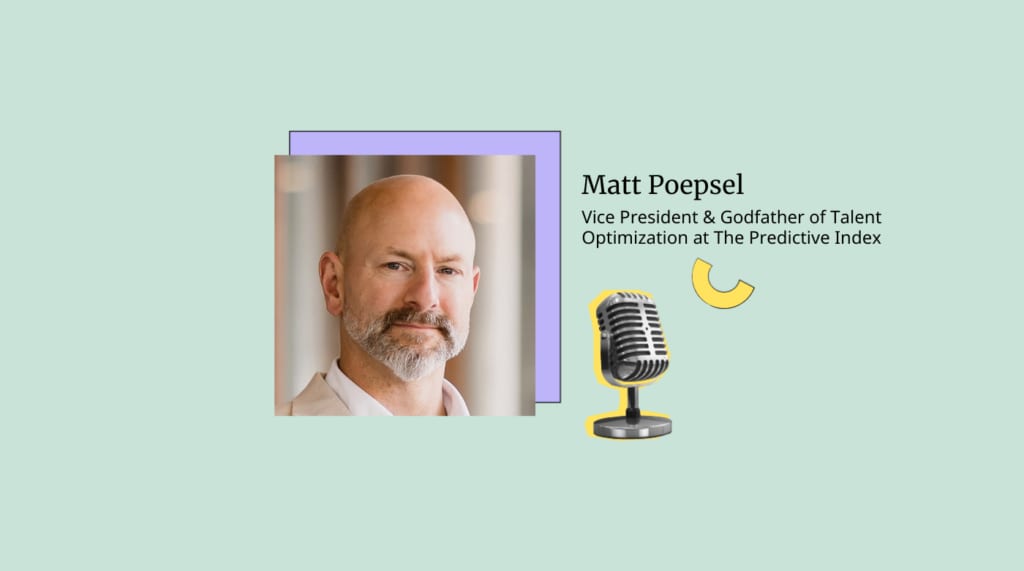
Matt Poepsel is the Vice President and “Godfather of Talent Optimization” at The Predictive Index, where he helps organizations align people strategy with business performance through behavioral science and data-driven leadership practices. With a background in industrial-organizational psychology, executive coaching, and leadership development, Matt is a sought-after speaker, author, and advisor known for translating complex workplace dynamics into practical strategies for building high-performing teams. He hosts the Lead the People podcast and is widely recognized for his work helping leaders improve culture, engagement, and organizational effectiveness through talent optimization.
Related Links:
- Join the People Managing People Community
- Subscribe to the newsletter to get our latest articles and podcasts
- Connect with Matt on LinkedIn
- Visit The Predictive Index
Related articles and podcasts:
David Rice: You're using AI to make hiring decisions, performance reviews, team assignments, high-stakes people decisions that affect careers, culture, and your business outcomes. And in many cases, we have no idea what context we're actually feeding it. It's like asking a friend for advice about your boss, and they'd say, "Well, I don't really know your boss, so how am I supposed to give you great advice?" You're going to have to tell them more. But you're not telling AI more in a lot of cases, you're just hoping it figures it out.
Today's guest is Matt Poepsel from The Predictive Index, and his session at the most recent Transform conference in Las Vegas was titled Smart Tools, Dumb People Decisions. Because here's what's happening. AI can research and write in minutes what used to take two weeks, so we compress expectations. We move faster, but we're still operating from an old mental model with new tools. And the early heavy adopters, they're the most burned out. Something else to consider here is that the most important and dangerous form of work is team-based work.
People with different personality types crash into each other like bumper cars. Add competing goals, which complex strategies necessarily have, and what you've got is a recipe for disaster. But managers don't know to ask for behavioral data. We don't train them that way. We teach strategy, technology, operations, not how to get the people part right.
And now we're adding agents into the mix. Your agents calling my agents, AI spinning up summaries that my AI digests. We're creating actual distance between us while thinking we're being productive. It's work slop, trying to keep up with yesterday's definition of productivity instead of evolving into what value actually looks like.
So on today's show, we're going to cover why AI needs behavioral context, not just job descriptions and skills; the measure twice, cut once principle for high-stakes people decisions and every people decision is high stakes now; why skills are ephemeral, but behavioral traits are stable; how to inject behavioral insights earlier in the hiring process; why managers don't know to ask for the right data and what HR needs to do about that; and finally, the difference between AI that accelerates team dynamics versus AI that destroys trust.
I'm David Rice. This is People Managing People. And if you've been using AI for people decisions without understanding what context actually matters, this conversation will hopefully show you exactly what you're missing. This is an in-person conversation between me and Matt on the expo floor at Transform. So, enjoy. Over to me and Matt.
Well, I'm here with Matt Poepsel from The Predictive Index. Welcome, Matt. It's good to talk to you here at Transform.
Matt Poepsel: Thanks so much. Thanks for having me.
David Rice: I really enjoyed your session yesterday. The title was Smart Tools, Dumb People Decisions.
Matt Poepsel: Yeah, right.
David Rice: And that, let's kinda kick us off.
You know, I, in a lot of cases you're suggesting that AI's making a recommendation, a person's approving it. I'm curious, like, where is the bigger risk here? Is it, like, the over-reliance on it, or is it, like, the fact that in a lot of cases we don't actually know what we're feeding it?
Matt Poepsel: Yeah, that's true. I think there's definitely going to be some over-reliance on it in the beginning, but I don't think using AI tools is itself necessarily a bad thing at all.
But I think the question is we have to understand the ... it only has whatever context that it gives us back.
David Rice: Right.
Matt Poepsel: It would be like if I asked a friend of mine and I said, "You know, you have got some advice for me working with my boss?" They'd be like, "Well, I don't really know your boss, so how am I supposed to give you great advice on that?
You're gonna have to tell me more." So I feel like that's what's happening a lot with these AI tools.
David Rice: Yeah. And I ... Well, the other thing is, like, people data is notorious for having a lot of problems with it, right?
Matt Poepsel: That's true.
David Rice: And so I wonder about, you know, you talk to a lot of folks, how confident would you say people are in what they're putting in?
Matt Poepsel: Yeah, not confident at all. I think- ... I think they're ... in ... we're in the early days of AI where a lot of it's a little bit experimental at first. Like, "How can you help me? I wonder what I'll get back." And over time people are becoming more comfortable with it- Right ... which I think is a good thing, and starting to ask it to do more, more aggressive things in terms of, like, the complexity of with which you might ask it to help you with something.
Right. So it started off as, you know, "Help me phrase this email," has turned into, "Well, help me create like a, ... I have to give a presentation to my team about the latest sales numbers." Yeah. "Can you help me with that?" And so it's starting to increase over time, but I think what, again, goes a little bit unnoticed is, well, if we don't really know about the team in terms of their behavioral styles, their communication preferences, are we really getting the best advice from the AI- Yeah
if it's helping us create that presentation? And that's kind of w- what concerns me a little bit.
David Rice: I've been to a few conferences lately, and a lot of ... there's a lot of chat about governance, especially as we get into the agent era, right? How well do you feel people are defining who owns a decision?
Matt Poepsel: Yeah, that decision's getting kicked about like a, like a- something gets kicked around like a soccer ball, I suppose.
David Rice: Right.
Matt Poepsel: Because I think that it really falls into this kind of in-between state. It's not purely legal, but it's also not purely IT. It's not purely HR. Yeah. And I think a lot of times HR does get assigned with saying, "Okay, you've got to drive this forward," when it comes to the acceptable, the appropriate use of AI, which I think makes sense.
Because at the end of the day, we're talking about putting people potentially in harm's way. If they get something from their manager that's off-putting, it actually can destroy a lot of trust. So I think there's a real high people cost. So I think HR makes sense in that regard. Yeah. But I think that it's also looked at sometimes a little bit transactionally.
When we approach it only from the term of compliance, we're not acknowledging the fact that AI has the potential to really accelerate our ability to get team dynamics right- Yeah ... or to actually power our businesses in new ways.
David Rice: Well, you bring up team dynamics there, and it's like one of the things, it's not fully capable, to your point, of understanding that and understanding how work actually gets done.
So how do you go about sort of structuring the context that you're giving it a- and making structured input so that it does thrive on that?
Matt Poepsel: Yeah it's one of the things I say all the time. The most important and dangerous form of work is team-based work. Because if you think about anything happening in your company, the likelihood that any one person is doing it by themselves is pretty low.
Yeah. Instead, it's teams, if not teams of people working to make these programs, initiatives, business model shifts awesome.
David Rice: Yeah.
Matt Poepsel: So we really need to get team-based work right. And to me, it really starts with the understanding of the behavioral differences and the strategic requirements of that team.
Yeah. So when you think about people having very different personality types, when you put them together on a team, they crash into each other like bumper cars. Now, all of a sudden, when you put in competing goals, 'cause a lot of complex strategies have competing goals in them necessarily, now all of a sudden it's just a recipe for a really poor team dynamic.
David Rice: Yeah.
Matt Poepsel: So you have to understand that when we take all this data about what's the work to be done and who's doing the work, that's a lot of really rich context that an expert human could look at and say, "Oh, I understand why this team is bogging down," or why they're cr- experiencing friction over here in this area.
So the question is then, how are we gonna get AI tools to help us with that, too? I think there's gotta be some thought put into that.
David Rice: And well, it's funny 'cause y- we're talking about team dynamics and teamwork being kind of endangered. But there's all this emphasis on, like, everybody's gonna sort of be, like, entrepreneurs and managers of agents, and I'm like, so if I don't understand how to get people to work together, could I get these agents to work together correctly.
Matt Poepsel: Right. Yeah, have your agent call my agent, right? Yeah. It's like, oh my gosh. So all of a sudden you're going to see this situation where a lot of the work slop that gets created today is because people are trying to keep up with yesterday's definition of what actual productivity looked like-
David Rice: Right.
Matt Poepsel: As opposed to having evolved to what value actually looks like. And I think this is where people feel like, I'm so b- far behind. If an agent could come in and help me automate parts of my job, think about how much more work I could do. And you're like, okay, but is it the right kind of work? Yeah. So immediately when we start back to the team, you're starting to think if you have a team of your agents helping you do your part, I have a team of agent helping me do my part- Yeah
are we in a situation where AI is just spinning up all these summaries and my aiAI is digesting it- Yeah ... and we're creating actual distance between us? That's the part that we have to be very careful about.
David Rice: Well, it's in- you mentioned work slop there, and then I think about the time pressures all the time.
You know, like we're all under this pressure to like move really fast, and that's, it's seen as a competitive advantage, but you know, the incentive is there to trust it and move on. But is that actually driven by sort of, the time pressures? And I guess what I'm asking is like how do we alleviate this?
Because I mean, it's a philosophical question in some ways, like what are we gonna value? But what are you finding, like, is most effective?
Matt Poepsel: Well, I think that it's definitely true that we're seeing time constraints or time being squeezed in some ways. That if you used to have a research task with some writing on top of it, you might give somebody two weeks to get that done.
Yeah. But now, all of a sudden, when you can have these really massive research studies done by AI in just a few minutes, then it seems right to compress the expectation to have things a little faster.
David Rice: Yeah.
Matt Poepsel: However, to your point about trusting the output, well, there still has to be enough fact-checking and enough prompt engineering, and those things don't just come for free.
Yeah. So we have to recognize that maybe our understanding of, and even our estimation of what it might take to turn around a task is a little artificial. But I think then the question becomes, is it still good quality, right? Yeah. Or does it look like AI created it by itself in a vacuum? Yeah. That's not gonna help anybody.
And at the same time, I think the science is showing us that the people who are the earliest heavy adopters of AI are actually the most burned out. Yeah. Because they're still operating out of an old mental model, even though they're using new tools. So I feel like that's ... We're still in the early in the learning curve, you know?
It's not a hype cycle. AI is absolutely creating value, but I think if we're missing out on some of that, or if our experience with it is creating distance with our team members, or it's depleting our own resources and capabilities- Yeah ... then that just is a reflection of how much more we have to stay on top of it.
David Rice: You know, it creates speed, but then, like with people decisions, it often ... We benefit from being a little bit slower, a little bit more intentional, more reflective.
Matt Poepsel: Yeah.
David Rice: That creates this tension, right, between the two things, your goal and how the best way to get it done. So how are you seeing people navigate that and sort of be able to maintain the quality without totally sacrificing the speed that we wanna gain?
Matt Poepsel: Yeah, not well- ... is the short answer to that. A- and I think it's understanding, again, that we- e- early in the learning curve, it's probably to be expected. But I think there's a lot of pressure now to try to move too quickly- Yeah ... when it comes to some of these solutions. And so the challenge is we actually exacerbate the situation.
If you don't meet somebody's needs and they become distrusting of it, or they think that there's some sort of hidden agenda, then it can actually take a lot longer than if we had taken a little bit more time along the way. Yeah. So, like, there's an old adage in carpentry, "Measure twice, cut once." Yep.
And there's a good reason for that, right? It's a lot faster and more cost-effective. I think we need to use a similar approach when it comes to those high-stakes people decisions. And right now, in this climate, every people decisions is a high-stakes decision. Then I think that's where we ... We don't need to slow down, but we do need to be thoughtful about it so that we can go as fast as we'd like.
David Rice: Yeah, I think you're right. Like, and also, the ... You know, we I'm looking at hiring a lot, right? So the quality of the data that we're getting in, I mean, should be at least a little bit more ... Just slow down a little bit, make sure that this is the right ... I mean, have we checked all the boxes? 'Cause there's a, we don't necessarily know the skills that we're looking for at times-
Matt Poepsel: True ...
David Rice: right now. So then it's like, well, if we don't even know the skills, how are we writing this job description so that we can go hire the right person?
Matt Poepsel: Yeah, when we copied and pasted it from the old days- ... from all these Google results, and now we just put it through AI, and still comes back And the other problem is that the candidates have access to AI too, of course.
Yeah. And so they all look like a million bucks, and you're like, "Oh, wait a second. How do we just have all these perfect candidates all of a sudden?" So we're starting to coach clients on how to really inject behavioral insights earlier in the process. Like, when you're writing the job description, don't just focus on skills and tasks, but really get at the behavioral requirements of that role so that we understand specifically what we're looking for.
But then also using these aspects during the interview process of really having the candidate speak specifically to those behaviors. Because when you start asking somebody about tell me about a time when, it's harder in real time when you don't have access to the AI to be able to come up with a compelling story- Yeah
and an example of when you did that thing in that way.
David Rice: Yeah.
Matt Poepsel: So we find that's a really great position to get into. The other problem is, like you said, with the skills, even if we can't fully articulate them today, they're gonna change. Yeah. Because everything's moving so fast. So skills are learnable, which is great, but personality behaviors are not learnable.
Yeah. They're... You know, you are who you are, and it's a beautiful thing, we just have to make sure that we hire you for the right fit.
David Rice: Yeah, no, 'cause I mean, what? Two years ago everybody thought prompt engineering was gonna be this big thing, and now I just talk to it.
Matt Poepsel: Yeah. Let's just vibe it. Let's just vibe it to death.
That's perfect. Yeah it's very true, and that's an example where even if you look now, maybe a third of the skills that we expect the workforce will need in 2030, that could come true. Yeah. But the reality is even those are gonna be very brittle. You know? Yeah. They're gonna be ephemeral, if you will.
And instead, when you look at interpersonal skills, storytelling, creative thinking, being able to harmonize with other diverse groups of people, those things will never go out of style. And they're not soft skills, they're essential skills- Yeah ... when so much technology can do so much of the, kind of the brute force work.
David Rice: We tend to believe, like, more data equals better decision-making, sort of like automatically. But I think we gotta... Context is obviously key. Yeah. Like, is this even the right data to look at? 100%. For any decision that we're making.
Matt Poepsel: Yeah, I don't talk to any managers who say, "I wish I had more data." Yeah. You know?
Really, more data. So we have t- we have gobs of data. Your question is a great one, is it the right data? Yeah. And especially when we start looking at the management function, if you will, getting groups of people to work together toward a common goal, that's, you know, the part that managers are asked to do.
HR acts in support of that, in many cases, by providing education and tools and guidance. So the question becomes exactly that. We can have more and more data, but is it the right data that's gonna feed into a contextual decision? And then can we personalize the output? Because if you're managing me, it's gonna be different than if you manage somebody who has a very different personality than me.
David Rice: Yeah.
Matt Poepsel: So the question is, for that leader, you're expected to then translate your style and have the awareness of yourself and others to be able to navigate that. It's hard to do that without data, if not impossible, and it's also hard to do that without tools to help you, unless you've gone through gobs of training, which managers don't get these days.
Because time is a factor, let's be honest, right? It is. We have that time crunch. So I think all this adds up to the fact that we need contextual, thoughtful, behavior-driven tools that can help us, at scale, get the people part right.
David Rice: What does a more context-driven system look like, I guess? Because, like, you know, I think most AI organizations were feeding it things like job descriptions and sort of development plans maybe.
You know? Yeah. But what do, what does it actually look like, and what's in there and how is it- Yeah ... feeding leadership decisions?
Matt Poepsel: I'd love to work from the outside in. I'd love to start at the highest level with what's the company's culture? What are your cultural values? What are the things you're trying to accomplish in your business?
Those are important things. What about the skills for the future? What are some capabilities you're trying to bring into the organization generally? Then maybe take that to the team level. What's the team working on? You know, what are the specific behavioral makeup of the team members that I should be aware of?
Are we similar or different? What are some of the history of interactions that we've tried to make? We're fortunate at the Predictive Index that we have all this data on- Right ... that we're sitting on top of, and so we have tremendous context. And I think that it helps us to really understand what's the environment in which this high-stakes people interaction is taking place- so that we have a better chance of helping get it right.
David Rice: I'm curious, like, because you're working with all these different organizations and you see, like, a lot of the common mistakes that leaders make. Do they kind of underestimate this challenge? And like, we were talking earlier about how they don't have a lot of confidence in the data that they have on their people, but I guess the next question is do they feel confident that they can get the right data.
Matt Poepsel: Yeah, a lot of times I think they don't know how to ask the question, which is why the partnership with HR is so important. Yeah. Because I don't know of many managers who are untrained who go to HR and saying, "I really need more of that behavioral data on my people."
David Rice: Right.
Matt Poepsel: They don't know, they don't know to even ask the question.
Right. And we don't train them that way in our business schools. We teach them strategy, technology, operations. We don't tell them how to get the people part right. So I think already just e- expecting a manager to just divine this out of thin air- Right ... of saying, "I need data about people," that's already a leap.
Yeah. And then the second bit is when you start looking at how do you use it in context of what I'm trying to accomplish, that's where the next little challenging point becomes. Yeah. So there's a lot of translation that has to happen. The good news is that the tools are readily available. You know, you can come in and you can develop self-awareness, you can develop awareness about others.
You can develop an entire team dynamic, all using tools like ours that just basically demystify the whole process very quickly, which is promising, but you have to use them.
David Rice: Yeah. Well, it's been good having you on the show. I'm curious, what are you excited about this week? What are you lo- wanting to learn or look into?
Matt Poepsel: Yeah, I definitely want to get the understanding of every HR person I talk to, sort of where are they coming and experiencing their role in this whole transformation, because I'm finding that it's very lumpy. Some HR professionals are way behind. Their organization is treating them very transactionally Yeah Others are really bleeding edge.
They're really pushing the business in terms of what's possible. There aren't many, thankfully, on either end of that extreme. A lot are somewhere along the journey. So I feel like the more I can learn about what they're experiencing, how I can help them really empower the HR function, because I always say that every business is a people business.
Yeah And that means we have to take our people professionals and really elevate them, and as you heard in my talk yesterday, even embed them into the tools that we use every day. Yeah That's how to get the best of what HR has to offer at scale. Yeah And that's what, it really excites me about the work we're doing at The Predictive Index.
David Rice: Well, Matt, thanks for joining us today. We app- It was great having you on the show.
Matt Poepsel: Thanks for having me. It's been a great show, and it's been a great conversation.
David Rice: All right. Well, we're gonna wrap there for this episode. Join us on the next one.
And as always, if you haven't done so, make sure you're signing up for the newsletter and following us on YouTube and all the social media so that you get all this right into your feed.

