

Building Hybrid Teams That Work — Lessons Leaders Need Before Adding AI


We’ve all heard the pitch: “Hybrid work is the future.” But dig beneath the slogans and you’ll find wildly different realities—some thriving, others quietly imploding. In this episode, I sit down with Lynette Caruso, a PhD candidate at Australian National University, to unpack her field research across public and private sectors on what makes hybrid work succeed—or fail.
From the power of casual coffee chats to the pitfalls of hot desking, Lynette shows how flexible policies often collapse under rigid cultures. If you’ve ever wondered why your “flexible” workplace feels anything but, or why your team can’t seem to find its rhythm under hybrid rules, this conversation will help you cut through the noise.
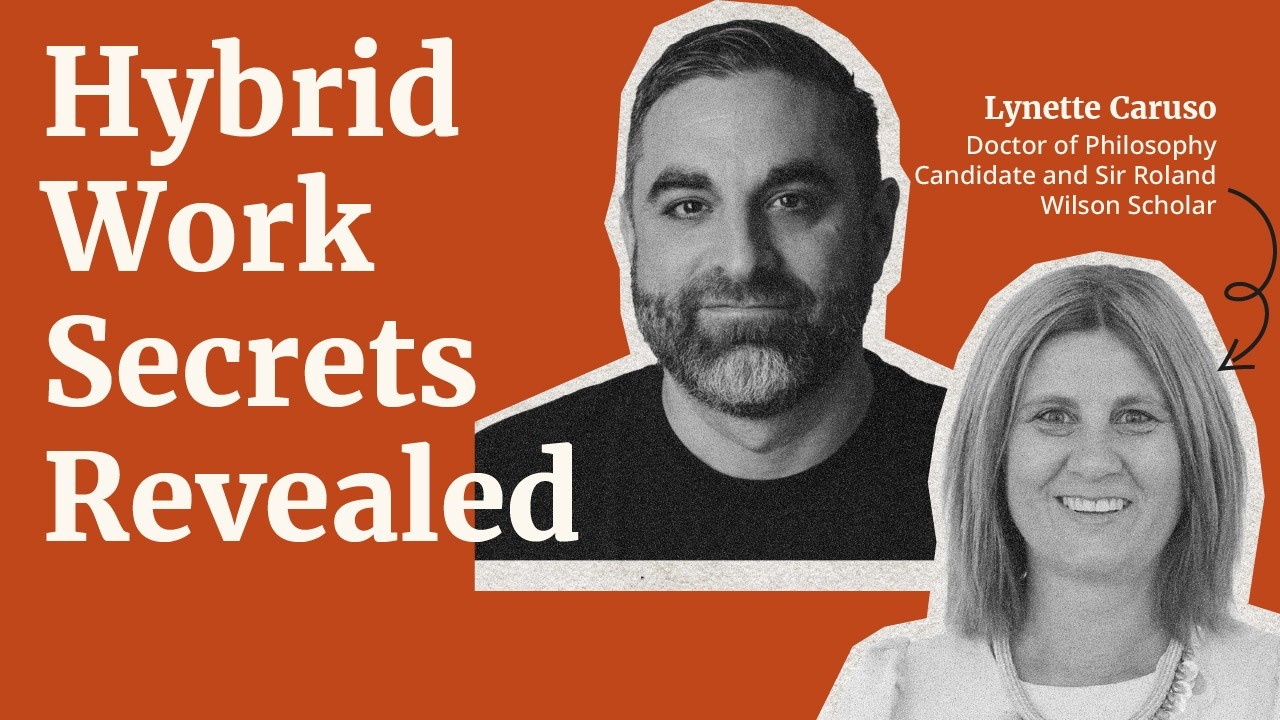
What You’ll Learn
- Why hybrid success has less to do with policy and more to do with culture
- How casual interactions drive trust, knowledge-sharing, and long-term collaboration
- The unintended consequences of hot desking and compliance-driven attendance mandates
- Why managers, not executives, are the real make-or-break factor in hybrid adoption
- How government policy—childcare, commuting, and the right to disconnect—shapes the workplace
Key Takeaways
- Policy ≠ Practice: A flexible policy backed by a rigid culture is just lip service. Without senior leaders role-modeling hybrid work, employees quickly see through the mismatch.
- Coffee Isn’t a Waste of Time: Informal chats aren’t fluff—they’re how teams trade context, spot struggles, and build reciprocity. Kill these moments and you kill cohesion.
- Hot Desking Hurts Teams: Saving money on real estate often costs you in collaboration. If people can’t sit together, there’s little point in dragging them into the office.
- Managers Hold the Line: Forget the glossy policy deck—day-to-day, hybrid lives or dies by how managers set expectations, role-model flexibility, and communicate with their teams.
- No One-Size-Fits-All: There’s no magic “number of days” in the office. Success depends on team interdependence, tenure, and individual needs—but most teams benefit from at least one shared in-office day a week.
Chapters
- [00:00] The broken promise of hybrid equity
- [01:35] Different approaches to hybrid policy
- [04:09] Why coffee chats matter more than KPIs
- [07:44] When flexible-sounding policies fail
- [12:06] Compliance vs. values: shaping team dynamics
- [17:11] Hot desking’s hidden costs
- [22:07] How government policy shapes hybrid work
- [27:43] Where hybrid breaks down: the manager’s role
- [33:19] The myth of a universal hybrid model
Meet Our Guest

Lynette Caruso is a Doctor of Philosophy Candidate at the Australian National University and a Sir Roland Wilson Scholar undertaking research on hybrid work and how teams can operate effectively in this environment. Her research aims to identify what fundamental elements need to be in place at the team, managerial, organisational and legislative/policy levels to support hybrid teams to be high performing, sustainable and healthy. Lynette has over 30 years’ experience managing teams in multiple different settings.
Related Links:
- Join the People Managing People Community
- Subscribe to the newsletter to get our latest articles and podcasts
- Connect with Lynette on LinkedIn
- Sir Roland Wilson Scholar
Related articles and podcasts:
Lynette Caruso: Because they weren't in the office full time, their colleagues who were in the office full time were more likely to get those career development opportunities.
If teams can't be co-located in the office together, then there's no point to them being in the office and people said this to me time and time again, there is no point to the office if I can't be sitting with people and if my team is not in there together.
Everyone just wants to know what is the hybrid model that works, and the reality of it is...
David Rice: Welcome to the People Managing People Podcast — the show where we help leaders keep work human in the era of AI. I'm your host, David Rice.
And on today's episode, I'm joined by Lynette Caruso. She is a doctor of philosophy candidate at the Australian National University and a Sir Roland Wilson Scholar conducting systems level research on hybrid work.
In this conversation, Lynette's gonna share some insights from her field work across government and private sectors, unpacking why some hybrid policies thrive while others quietly fail. We explore the cultural and relational dynamics that shape flexible work from the power of casual coffee chats to unintended consequences of hot desking, and the critical role that managers play in making hybrid work actually work.
If you're wrestling with return to office mandates, hybrid team cohesion, or how to design flexibility that actually works, this episode will give you some evidence-based guidance. So let's just get right into it.
Lynette, welcome!
Lynette Caruso: Thank you. Lovely to be here.
David Rice: Awesome. So I wanna start with something that sounds kind of simple, but maybe is not that simple. Right? So you interviewed people across government and private sectors. What surprises you most about how different organizations approach hybrid work?
Lynette Caruso: So I interviewed three different organizations. I interviewed an organization that had implemented a 50% attendance policy, so that's where they were required to attend 50% per month in the office.
Then I interviewed a organization, two public service organizations, one that had an if not why not policy, and a third organization that had a case by case policy. So if not, why not, is well, let's see how we can make this happen for you. And case by case was look at each individual circumstances and see whether or not we can actually accommodate flexible work.
So it really starts from those approaches. So what really surprises me is the change management approach that those organizations then talk. So they either had a people focused mentality or a business focused mentality. So the 50% organization really had a business focused mentality, was really saying, we've looked at our data says collaboration, connection, engagement, et cetera.
Increases when people are in the office 50% of the time. And so they went down this path of this 50% in office per month, whereas the case by case organization took very much a people focused mentality and that looked at engaging the whole organization in determining what the values of the organization should be, and then implementing those values in hybrid work.
And so then that really cascades down to how hybrid work is implemented in those organizations and whether or not you then have a focus on compliance as occurs in the 50% organization of meeting the 50% requirement. Or you have a focus on how can we fit work around your life. So that's probably the biggest thing that surprised me was their change management approach, which then led to this cultural change within the organizations.
David Rice: As we kind of dig into this you know, just looking at some of what we talked about beforehand and you were saying how relationships are key to hybrid success, why do you believe casual moments like coffee chats have such a big impact on long-term performance?
Lynette Caruso: Yeah, I mean, it's fascinating. I mean, I never could have predicted how important having a coffee was going to be, but it came up so much and in my research I couldn't possibly tell you.
But really what's happening in these coffee chats is a bit like when a journalist interviews a subject, maybe like even me today, they're only asking those questions around who are you? Are you married? Are you single? Do you have a partner? Do you have children? Do you like sports? Do you like movies of particular kind?
What you like to watch on Netflix? This is a big thing, obviously, books, et cetera. So what they're trying to find out is, do we have things in common? And then. When you discover that you have things in common, it tends to make people like each other a little bit more. So that's really important. What they're also doing is looking at, you know, when a person might be available.
So they're finding out, you know, are they in the office three days a week, two days a week? And this changes from week to week according to, you know, people's individual circumstances. And also they're trying to find out what do they know? What's their expertise, what can I ask this person about? And that also changes from day to day depending on if people have, you know, gone off to a training, et cetera, or they've been involved a particular work task that's increased their knowledge in a particular area.
And they're also trying to find out when is the best time to contact people. You might have people who prefer to, you know, be contacting the morning they're morning person. You might have people who prefer to be contacted in the afternoon. They don't get going until they've had that morning coffee. So there's all these different things that they're learning about people, including how they prefer to communicate.
Do they prefer to be contacted via teams messages? Do they prefer to be called? So they're trying to learn all of this information and it changes. Hence why the ongoing coughing chats are really important. Because this week I might be feeling sick, and so I'm going to be online now only two days. I'm only gonna come into the office one day a week, and I'm not gonna come in two.
So it changes. Everything's changing in terms of my knowledge where I am, those sorts of things. So those informal conversations are critical to the team, understanding who they can go to for a problem when they can go to them. So understanding of someone's struggling, et cetera, and the types of questions that they can ask.
It also helps to build in buy-in. So it means that if I've got a relationship with you, we've got, we like the same things on Netflix when we like same sports, whatever it is. You are more inclined to help me and I'm more inclined to help you. So, you know, often kind of coffee is, you know, poo-pooed a bit and gone, oh, they're just wasting time.
You know, they're going out for a coffee. Here they go again. They're going out for a coffee. And in fact, I think it was one organization, I can't remember, it might be Amazon, I can't remember. There's an organization that was looking at having the coffee in the office so that people were basically bound there.
They weren't going anywhere. Actually, you need people to be going somewhere. It's the walk on the way to the coffee. That is an informal opportunity to have these sorts of conversations. So those relationships, those coffee chats are critical to teams being able to function. They carry those relationships from in-person coffee chats to online.
David Rice: I mean, it makes sense. That's what we're all, I think that what we're seeing from the research now, right, is that people are, especially younger professionals, are craving that sort of connection. On a regular basis, and it is, it, I guess it does really make a difference.
Lynette Caruso: Thousand percent. It does.
David Rice: And as we were chatting before this, you said to me that policies are only effective as the cultures that support them.
So I was curious, you know, did you have an example where a flexible sounding policy failed due to a mismatched culture?
Lynette Caruso: Mean I've been really lucky in a way with the organizations that I've interviewed, 'cause I've got the whole spectrum of flexibility. So you know, with the first organization, with the 50%, a lot less flexibility.
Middle organization with an if not why not sounds flexible, but the culture was not. And then the third organization, which had a case by case, which was a very flexible organization. So the one that sounds flexible but isn't really flexible is really, if not, why not? And so what happened there in, as I mentioned earlier, the, if not why not culture was really about, or policy was really about saying, you know, we should make this happen for you and if we can't make it happen, why can't we make it happen?
However, the senior executives at the most senior level in the organization had a view that being in the office was much better and being full-time in the office was much better. So then this kind of attitude and culture cascades right down throughout the whole organization. So this meant then that the next layer down of senior executives were not role modeling hybrid.
They weren't working hybrid because they understood the message from their senior manager that, you know, really full-time in the office was the better way to go. Then what happens then is those senior executives are signaling then to the next level down of managers. That's really not okay to be working hybrid.
So there's an expectation then that there will be someone from each team in the office every day, and managers felt this pressure and expectation. So they'll call in the middle there. So your middle level managers are really caught in the middle. But this tension between senior executive wanting people in the office.
And their staff who were wanting greater flexibility and who from, you know, by all accounts, the policy said, if not, why not? I should be able to, you know, work from home. Why can't I? So they were caught in the middle here and where they could, they tried to accommodate the flexibility of. Policy and tried to meet their staffs working from home.
Needs and staff on the whole generally didn't notice this. So team members themselves didn't generally notice this mismatch until that kind of butted up against that tolerance where that extreme tolerance was for the organization. So really, when it moved to more than two days working from home, staff began to feel this kind of mismatch between the culture and the policy.
Where the organization really didn't want you to be working from home more than two days a week. It also had career development implications. So one manager spoke to me about the fact that because they weren't in the office full-time, their colleagues who were in the office full-time were more likely to get those career development opportunities.
When they by chance did have that opportunity to act at a different level, what would happen is their senior management would say to them, oh, you know, we've got that meeting coming up on Friday. You know, you are gonna be here for that, aren't you? So there were these informal kind of signaling messages given to them about it's important to be in the office.
You can't do this, you know, from home. So that's how that kind of mismatch between policy, you know, policy, that sounds great. If not, why not? Doesn't match the culture of a senior executive that then says, actually I prefer people being in the office. And that cascades all the way down to the team's feeling that as well and not being able to access the full amount of flexibility that's available.
David Rice: Yeah, it just sounds like a recipe for ambiguity to me. Right, because like what qualifies for, why not, you know.
Lynette Caruso: Just satisfaction, right? You know, you're just satisfied because you can't access, what do you think you should be able to access? So yeah, if you're looking at engagement, you know, HR personnel, you orbits, disinterest in, in implications for hr.
If you're looking at engagements as a key factor, you know, people are not gonna be engaged if you have this disconnect between policy and culture.
David Rice: Yeah, absolutely. You studied teams environments where obviously there was different attendance expectations. You had mentioned 50% minimum in office. Then there's the case by case.
What I'm curious about is how does those frameworks sort of shape team dynamics?
Lynette Caruso: Yeah. It's fascinating, really. So like I said, it's kind of dependent on your change management strategy and whether you focused on those values or whether you focused on compliance with the 50%. So if we take the 50% organization, for example.
You know, the original decision was based on increasing connection and collaboration in the office, but as it rolled out, it really didn't focus. Its communication was not focused on that. Its communication was focused on compliance. So it went from announcing this policy straight to compliance with the 50% per month attendance.
And people were able, by the way, to come in whenever they wanted on that 50%. So provided they made 50% in a month, they could come in whenever they wanted. It was flexible. The organization encouraged a team day or a glue day or an anchor day. So when everyone came in together, but it was not mandatory or compulsory.
So what you then saw was people in the organization, in those teams, perhaps coming in for the first two weeks of the month and not coming in for the second two weeks of the month. So missing that whole connection piece altogether. They weren't actually connecting in the office 'cause they were focused just on meeting their 50% compliance.
Or they'd come in and they'd sit in the corner because they had KPIs they needed to meet. So if they were chatting with people in the office, then perhaps they wouldn't meet their KPI. I, so they thought better I sit in the corner and not chat to people. Or they might actually not come in on the same days that their team was in.
In actual fact, the private entity saw an uptick in sick days on days when the team was scheduled to be in together. So the difference of having that kind of a 50% minimum office attendance with a focus on compliance means teams are not really focused on connecting. Another example related to that is within the manager.
Decided, okay, well I've gotta also make sure that my team is coming in this 50% of the time, or I'm going to be penalized. Right? Because the organization was beginning to implement a policy where people's bonuses were affected if they were not coming in 50% of the time. So then a manager decided, well, I'm gonna make my team come in 60% of the time, right?
Because 50% is a bit tricky. Like there's not 50% in a week. We've got a five day week. How do you do 50%, right? It's that two and a half days. You've gotta do two days, one week, three the next week. So, but if I just make my whole team come in three days each week, then I know that we are going to meet the 50% requirement.
In fact, we'll exceed it. But what happened then is the team morale completely reduced and their engagement with the organization reduced. And all they could talk about was how unfair it was for them to have to come in this 60% of the time. So that's how having this focus on 50% minimum office attendance can impact team dynamics.
You know, people are not coming in together, they're avoiding each other. Or you have managers who are over committing to that 50% policy. Can you contrast that with an organization that had a case by case kind of a policy, which was really looking at individual circumstances and how can we meet those individual needs as well as the team needs and the organizational needs.
So it didn't just say, let's make this work for the individual. It also said, let's make this work for the individual team and organization. What happened then is you had lots of people with different arrangements. But the team was supportive of those different arrangements. So people were doing a myriad of different things.
They were going to ballet in the middle of the day, they were going to play sport in the middle of the day. They were able to go drop off their kids or pick their kids up at the end of the day. And all of that was supported by the team because everyone was accessing different arrangements or understood the benefit of these different arrangements for people.
There were those discussions at that team level. It also then changed the individual mindset of people. So individuals themselves started to think, yeah, I really want that person to be able to do what they wanna do because I wanna do what I wanna be able to do. And hybrid really became normalized. There wasn't this expectation that everyone had to be in the office every day.
So you can see how different policies really trickle down to, you know, impacting on team dynamics.
David Rice: So fascinating. I find it really interesting sort of how just like one little change can make such a big difference, you know?
Lynette Caruso: Yeah. It's like a domino effect, isn't it? Yeah. Yeah. The HR person doesn't think their work is important.
It makes a tremendous amount of difference. That change manager approach of changing the values, cascaded all the way down, makes a huge difference.
David Rice: One of the trends we see around especially hybrid work, right, is hot desking, things like, you know, people messing with sort of the modern office layout. And I'm curious if you think from your research, you know, do you feel that those that are hurting or helping the hybrid experience?
Lynette Caruso: In short, yes. So I had lots of my participants talk to me about the impact of hot desking. Now, hot desking is attractive to organizations, right? Because they're trying to reduce their footprint. One of the things about hybrid work, they thought, oh, this is great. We're gonna be able to reduce our footprint, reduce some of our costs here, save some money.
But in actual fact, what's happening is if teams can't be co-located in the office together, then there's no point to them being in the office. And people said this to me time and time again, there is no point to the office if I can't be sitting with people and if my team is not in there together. The reason for that is, is you miss out on those incidental conversations.
So I can't turn around and just say, you know, I've got this question, can you just help me with this? So those sort of incidental questions, you're missing out on those. You also can't tell them if somebody's struggling. So I can see if somebody's got their head in their hands. They might be huffing and puffing a little bit or you know, you see that they're upset.
You can approach them, you can check in on their wellbeing, but if you're not sitting together, you don't have the opportunity to do that. You can also overhear conversations, so you know, two of your colleagues are having a conversation about a piece of work. You might have something that you can contribute to that conversation, and so that helps them with their work because you might come up with an idea that they never thought of.
Or you might store that information for later and go, oh, note to sell something for me to remember when I've got a similar problem later on. So co-location makes a big difference to people. So when you start hot desking and people can't actually be, teams can't be co-located together, you are impacting how the team functions, how it collaborates, how it communicates, and also its team cohesion and how it looks after its fellow members.
Also, some of the organizations had a booking system, so teams could book desks together, but what was happening as one manager was actually staying up until midnight to book the team system. I mean, that's dedication and commitment for you staying up until midnight to be able to book the team in together.
So they were able to sit together, or another team had a booking roster. So each person had their turn at actually booking the team to get booking seats together. What happens is this is an additional cognitive load. It's an additional task that teams are required to do, so it's an extra piece of work for them, and they feel that also hot disking can reduce flexibility.
So let's say you've reduced your footprint. You only now have this certain number of desks available, and that might mean that when I need to change my days because. Something's happened and I've got an appointment where I want to come in because it's really urgent, important meeting that's really done better face-to-face.
It's difficult for me to change those days because there's no desk available. So it actually reduces flexibility and that's something I think organizations haven't really considered. The other thing is because of that reduced footprint. Might be actually encouraging more work from home because I can't come in 'cause there's no desks available.
And there are some people who really prefer to be in the office. There are people who prefer to keep work and home separate, and so I like to be in the office more, but the opportunity for them to be in the office more is reduced without the availability of deaths. Conversely, there are some people who are deciding to stay and work full-time in the office.
'cause it means that they will have a desk allocated to them full-time. So hot desking creates a whole lot of, I guess, unexpected consequences in how teams function and also in how hybrid work functions as well.
David Rice: Yeah, I've heard a few stories of it not being done in a very like intentional way. And it's so now I have no desk.
I have no idea who I'm gonna sit next to. And I am like, I'm not sure why I came in. It almost like defeats the whole purpose of why you thought you were gonna come back in, so.
Lynette Caruso: Yeah. Yeah, exactly. You know, there's some benefit, like if you're sitting next to somebody in your kind of broader work group, there's some benefit of we're networking with that person.
Absolutely. But in terms of on an ongoing basis. The benefits have been co-located with your team, far outweigh that networking opportunity.
David Rice: Now, you took a systems level approach in your research, you know, from the individual all the way to societal forces. How does government policy or public discourse sort of impact the hybrid workplace?
Lynette Caruso: So one of the biggest things that people mentioned to me was commuting. In fact, you know, a lot of people indicated if they had a shorter commute, they probably would go into the office more. So it's not that people don't necessarily like the office environment. They definitely like the work-life balance, by the way.
But the commute is a really big issue for people. So where they have a long commute, this really impacts their ability to attend the office. And commuting is really a transport infrastructure policy, right? So this is where governments can actually influence hybrid work. So if you had a better transport infrastructure, that would probably impact how often people attended the office.
It would also impact people's resistance or reluctance to attend the office. Because it means that they can get home a lot quicker, which is what people are really wanting out of hybrid work, right? So they're wanting more of that home time to themselves to be able to either spend with their children, participate in other recreational activities, or just some downtime.
So if the government's actually invested in infrastructure and transport infrastructure, this would make a huge difference. One of the other things that people spoke to me about was childcare. So here in Australia, governments dictate childcare policy. So people were only able to get childcare three days in a row.
So if I can only get childcare three days in a row, and let's say I'm working part-time, I get my childcare on Monday and Tuesday, and you get your childcare on Thursday and Friday, our ability to actually go in the office to meet and work as a team is significantly reduced. So this is where this kind of broader government policy really impacts how hybrid teams function.
I don't think anyone's really thought about it at this level previously. There's also kind of an, and I think there may have been a similar thing happen in the States as well, but certainly here in Australia. There's been a push to revive cities, right? We call them central business districts. I think you might call them downtowns, but there's been a push to really revive those, you know, businesses have been declining.
We want more people in the office and certainly private entities have felt that push, whether it's impacted their decision making and jury's still out. Certainly they've felt that push other kinds of policies that impact is the right to disconnect. So certainly in different countries around the world, France was the first to implement a, you know, a right to disconnect.
And here in Australia we've implemented that recently. So this means you know that you have a right that, you know, after work hours, you don't need to respond to those messages on your phone that you might be receiving, you know, if you've got teams on your phone or if you've got email on your phone, et cetera.
Because what happened with COVID is we really became contactable 24 7. And so the government introducing a right to disconnect policy helps people to maintain that work life balance and to help draw that line in their teams to say, no, it's not okay to be contacting me after hours. I'm now going to be having family time, or to be able to set those rules within the team about when it is okay and not okay.
So there's some of the things at a government policy level. In terms of the public discourse, not quite on discourse, but an interesting thing that was raised with me that I had never, ever considered was the impact of social media on hybrid teams. I would never have considered this an issue, but one person raised, or a couple of people raised with me, how the increase in the use of social media in society impacts how people communicate in hybrid teams.
So in social media, we've seen a lot of trolling. People saying not very nice things about each other on social media. And often people do that because they're not having those coffee chats, right? They don't have those personal connections. They don't really know those people, so they feel it's okay to not be nice to people you don't know.
And so when people are participating online, they also might feel it's okay. To be a little bit harsher when conflict arises to express their views a little bit more pointedly because you're in this kind of a forum and you don't really have that personal connection with that person. So it's even more of an issue where you have a fully remote team as opposed to a hybrid team who has some degree of personal connection.
So really interesting kind of finding, I think, around how changes in society impact how also teams operate.
David Rice: It's fascinating. Yeah, you brought up a lot of stuff there. I mean, the central business district stuff, I know like San Francisco has done a little bit of work behind that. I think it's really about creating partnerships.
If you can get that and sort of create these mutually beneficial relationships, then you know, it's possible. And I think we're seeing, even when you look at it like on LinkedIn, right, the discourse around remote versus in office versus hybrid, people do sort of have these like really strong opinions.
And say things to each other that I'm like, you wouldn't say that if you were in the office with her. You know, like, yeah. It's fascinating.
Lynette Caruso: Yeah. Yeah, and it's really that personal connection. You know, I don't feel as though we've got anything in common, so it's okay for me to say these things. And I'm not seeing you face to face.
I've, I don't have the same social expectations for me to behave nicely.
David Rice: Now, you said successful hybrid environments. You know, it requires every layer of the org to be aligned on flexibility, whether it's managers, team members, all the way up to executives. I'm curious, where do breakdowns most often happen?
Lynette Caruso: Yeah, I mean, I hate to say it, it's at the manager level, and in saying that it starts from the top, right? So you need to have those senior executives on board. But on a day-to-day basis, it's those managers of the teams that really make hybrid work or break it.
So they need to be role modeling hybrid in the first instance because that signals to their team that it's okay to work hybrid and you can do it effectively. 'cause look at me, I'm in a managerial position and I can make it work. So first of all, they need to be role modeling it. Secondly, they need to be fostering collaboration. And they can do this in a number of ways. So they can do it by creating subgroups.
Now, subgroups are often a bit of an issue in teams. So sometimes you often hear in the, you know, teams literature. That subgroups are bad because you get some people kind of in a little bit of a clique, and they only communicate with those groups and they're not communicating with the whole team. And certainly that happened in my research, but where you use subgroups in a positive way.
For example, in one of my organizations, I had a manager who allocated work to a subgroup, and so then that group works together for a period of time. Then that subgroup disbands. They work together with a different subgroup, and that helps people to get to know each other. It also helps them to work together to support each other, to want to help each other so they learn to collaborate.
Also, if the manager pitches in when it's busy, that also demonstrates collaboration. They go, oh, the manager's helping out. Then, oh, you know, I should help out too. 'cause it's not okay for me to not help out. Then. So, you know, kind of people in a way I guess are not shamed into it, but understand that there's this expectation in the team to collaborate.
They also are really key at fostering team cohesion and the way that they do that. Coffee, right? Social events. Let's all go for coffee. Let's go for lunch. Let's have morning tea to celebrate that particular achievement. So they're pivotal in signaling that it is okay to have these social events.
These social events are critical to helping us to work together as a team, so really important that they foster that team. Cohesion and also communication. Communication is probably the most critical thing for teams at the manager level and for team members themselves. So they need to be fostering that open communication by including everyone in the conversation regardless of where they are.
So if somebody happens to be working from home, then making sure that you dial them into that conversation. If you are in the office, if it was a non-work day for them, make sure that you share the information for them. And then as you do this and your role modeling, sharing information. It then signals to the rest of the team that they should do the same thing.
So you're lightening your workload because then the team will also do this for you. They understand that if they were in a meeting, they need to share that information with the person who perhaps missed out. So really important. I also need to understand how do I communicate? Do I use teams for this particular thing?
Do I use a teams message for this particular message I wanna convey? Should I get everyone together in a team's call? Should I wait for the office for this? Like if it's a, you know, an issue where there might be contention in the team, like there's a little bit of conflict, maybe it's better to do that in the office.
So managers really need to understand what method of communication they use when. They also need to regularly check in with people. I can't tell you how many times people said to me, I wanna hear from my manager. So how often they wanna hear from their manager and how they wanna hear from them is different for different people.
So managers need to understand the individual communication preferences of their team members, but they do want to hear from them. And it might be for some teams that just putting in a team's message, hi, you know, how is everyone? I'm here if you need anything. Right. So some teams that might be enough for other teams, you might need to check in with individuals or check in with some individuals.
That is critical to ensuring a team wellbeing, to ensuring that people are not overloaded so that you can then reallocate work if you need to. Managers also keep setting expectations, so they need to say how often they expect people to be in the office, how they expect the team to communicate, how they expect the team to collaborate.
And also make it okay for team members to speak up when they see something that's perhaps not working. All right? And a really good way to do this is to develop some kind of a team charter or team agreement where the team works together to discuss how they wanna do these things, how often they think they need to be in the office to get their work done, how they wanna communicate, how they wanna collaborate, all of those sorts of things.
So really the key to hybrid work is managers, but I say that knowing that you have to have that organizational culture in place to support managers to work in this way.
David Rice: I guess my final question too would be if there's one myth you wish you could bust about hybrid work, what would it be and what truth did your findings reveal instead?
Lynette Caruso: Yeah, you know, I think everyone would like just a simple solution of like, what is the hybrid model? What works, right? Everyone just wants to know what is it, you know, how many days, where is that sweet spot? How many days should we be in the office? You know, that's what everybody wants to know. And the reality of it is there is no one size fits all model.
It's truly dependent on your particular team. So the specific needs of the team in terms of how interdependent their work is like. And what I mean by that is how much of my work is dependent on you? How much we need to collaborate or not collaborate to get the work done? How long have we been working together as a team?
So you know, when you've got established patterns and norms in place around communication and collaboration, maybe you don't need to be in the office as often. And also each individual team member's needs, you know, dictates how often the team might need to be together or are able to be in together in the office.
For example, you know, childcare. So having said all of that, that there is no one size fits all model. I would still suggest that all teams, regardless of how long they've been working together or how interdependent their work is, still benefit from having at least one day in the office together. Two is great, but at least one day in the office per week.
David Rice: All right. Thank you for giving me a little bit of your time today. I really appreciate it. Before we go, there's a couple things that we always do here. First is I wanna give you a chance to tell people more about where they can connect with you, follow your research, find out more about what you're doing.
Lynette Caruso: Yeah, so people can follow me on LinkedIn under my name Lynette Caruso, and you'll find me as a Sir Roland Wilson scholar, now taking a PhD on hybrid work research.
David Rice: The last thing is we have a little tradition here on the podcast where you get to ask me a question, so I wanna turn it over to you and yeah, you can ask me anything.
Lynette Caruso: Okay. I know you mentioned to me that you actually work fully remote, so I was wondering if you could change one thing about working fully remote, what is it you would change, if anything?
David Rice: I, that's a good question. You know, I really do like working remotely.
You know what? I think it would just be like, I gotta give my current organization credit. They're actually pretty good about this, but I've worked at other places that are terrible about it. And it's just consistency on the tool stack. You know, you work with one team, they've got this set of tools, you work in another team, they've got a completely different project management tool.
They use this other tool. You gotta learn all these different things. And you're like, if we were in an office, there's no way that this would be that this is how this would work. You know what I mean? Everything would be more standardized and I think that is that and the documentation practices.
And again, the current organization I work with is pretty good at this. Maybe it could be a little better, but overall, like the best I've experienced. But one of the nightmares with like previous orgs was just, there was never any documentation for anything. If you were trying to find something, it was really difficult because we didn't have like a sort of intranet of sorts really.
It was just like an a DP. It was, there wasn't much in it, you know? And so. Yeah, I guess that those would be the things I, I don't know. So there wouldn't be things that would change currently. 'cause I think that the, in my current situation, it's really not too bad. But for a lot of organizations, I think that's something, those are areas that need to develop.
In order for remote work to be a better experience.
Lynette Caruso: Yeah, and certainly my participants spoke a lot about technology and the importance of reliable technology and a suite of tools that helps you to be able to collaborate online. So yeah, they're all consistent with points raised by my participants.
So yeah, I'm not surprised.
David Rice: Well, Lynette, thank you so much for joining us today. This was a really good conversation and I think it's, there was a lot of valuable bits in there for the audience, so I appreciate it.
Lynette Caruso: You are welcome. Thank you for having me. I thoroughly enjoyed it.
David Rice: All right, well audience, if you haven't done so already, head on over to peoplemanagingpeople.com/subscribe. Get signed up for the newsletter, you'll get this podcast, you get all our upcoming events, a lot of other newsletters that we're creating, coming straight to your inbox, so get signed up.
Until next time, keep working on your hybrid work.

