

Surveillance, Burnout, and Pickup Lines? The Realities of AI in the Workplace

We’ve reached the point where “AI in HR” isn’t just a buzzword—it’s a mandate. But with every vendor promising a smarter, faster, more predictive future, it’s getting harder to tell the difference between innovation and smoke and mirrors. In this episode, Alana Fallis and I go deep on how to navigate the noise: What should you actually invest in? How do you build real AI readiness, not just compliance theater? And how do you make sure your “data-driven” decisions don’t quietly erode employee trust?
We also tackle the people-and-technology dilemmas that HR leaders are facing right now. From scaling culture without losing soul, to drawing red lines on surveillance and privacy, to the sheer absurdity of AI-generated workplace flirtation—we’re not short on material. These aren’t hypotheticals. They’re real, messy, and urgent. Let’s get into it.

What You’ll Learn
- How to anchor AI investments to strategy rather than hype.
- Why “readiness” is less about the shiny new tool and more about human capabilities.
- The trust boundary in data and analytics: when monitoring crosses into surveillance.
- How structure and scale don’t have to kill culture—but they can, if leaders aren’t intentional.
- Practical guardrails around AI behaviour, policy and ethics in people operations.
Key Takeaways
- Start with your people strategy: Before buying anything, ask: What problem are we solving? What makes us unique? If the tool doesn’t align, it’s probably noise.
- Build for capability, not just tool‑training: You don’t know what jobs you’ll have in five years—but you know what you’ll always need: empathy, coaching, trust, resilience. Those are the ones AI doesn’t replace.
- Scale thoughtfully: Growth isn’t the enemy of culture—it’s faulty design that is. Pair new hires with culture ambassadors, keep storytelling alive, and don’t hand off culture to technology alone.
- Treat employee data as trust capital: If you’re collecting productivity, biometrics, sentiment—stop and ask: Why? Is the employee in the loop? Governance must include them, not just ‘let’s get more data’.
- Policy by principle, not scenario‑by‑scenario: You can’t predict every weird AI‑driven misuse (like romantic Slack bots). But you can embed values—respect, consent, professionalism—and apply them to new tools just as you would to old ones.
- Leadership must model work‑life balance: If you say you support flexibility but leadership keeps Friday evenings and weekend emails alive, you’ve sunk credibility. It’s not just nice to have—it’s business critical.
Chapters
- 0:00 – Intro: What makes AI actually valuable in people strategy
- 1:41 – Cutting through AI hype and choosing the right tools
- 5:35 – Building AI readiness: tools vs. human capabilities
- 9:01 – Scaling culture without losing connection
- 12:42 – Surveillance vs. trust: drawing the data line
- 17:00 – AI-powered flirting on Slack (yes, really)
- 21:15 – Flexibility or burnout? When leadership breaks its own rules
- 24:33 – Wrap-up: What these dilemmas say about the future of work
Meet Our Guest
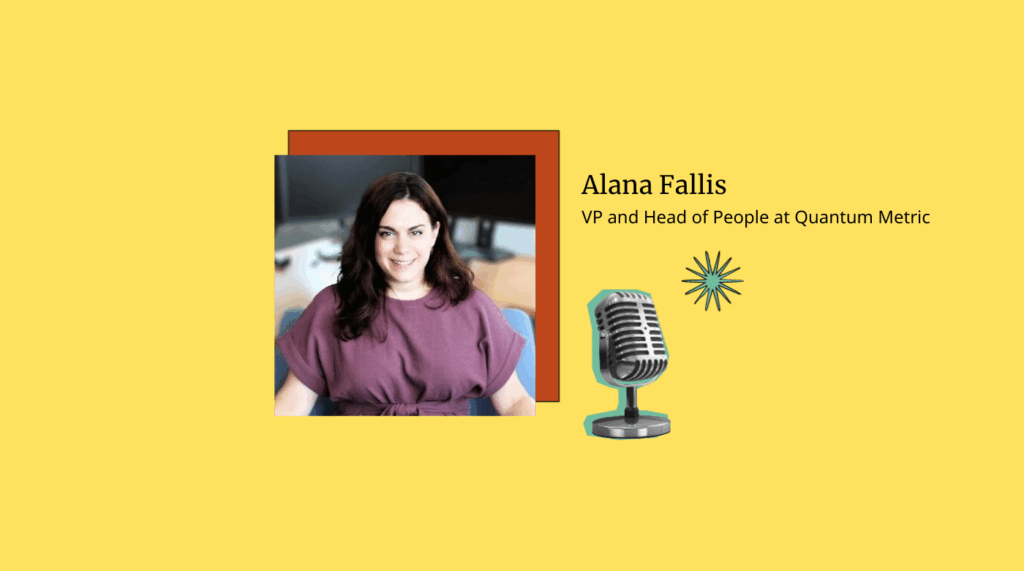
Alana Fallis is the VP and Head of People at Quantum Metric, where she leverages over a decade of dynamic HR leadership across the U.S. and internationally to oversee a global People program and lead a team of international HR practitioners. With deep expertise spanning employee relations, operational and legal HR, people metrics, employee engagement, global benefits, performance management, organizational development, compliance, and DEI—and backed by her certification as a Brain‑Based Coach from the NeuroLeadership Institute—she brings both strategic acumen and human-centered insight to her role. A creative at heart, Alana even authored an adult coloring book titled Intrusive Thoughts in the Workplace, blending art therapy with workplace wit.
Related Links:
- Join the People Managing People Community
- Subscribe to Our AI Signal Newsletter
- Connect with Alana on LinkedIn
- Check out Quantum Metric
- Talk HR to Me
Related articles and podcasts:
David Rice: How can I cut through the hype and make strategic decisions about where AI can genuinely add value to our people strategy?
Alana Fallis: Focusing on what the tenants of your people strategy are. What are you trying to solve for? Making sure that you're solving real problems and not just like getting distracted by the net's splashy thing.
David Rice: I've been asked to develop AI readiness training. Should I be focusing on re-skilling for specific tools or is there a more fundamental shift in how we think about human capabilities?
Alana Fallis: We don't know what jobs are gonna be available in five years, but we know the things that AI can't replace. Human connection and trust and coaching and empathy and compassion.
David Rice: We're collecting productivity metrics, sentiment analysis, even biometric data. How do I protect employee privacy and trust?
Alana Fallis: My friend, I know you did right into this column to tell us so that we could tell you to quit your job, and I'm not gonna do that, but yikes.
David Rice: If this were a relationship, you'd bail. If they start going through your phone, you start to think is the time for me to go?
Welcome to The People Managing People Podcast — a show where we help leaders keep work human in the era of AI. I'm your host, David Rice. And today I'm once again joined by Alana Fallis. She is the head of people at Quantum Metric and the author of our recurring series Talk HR to Me that we might just be turning into a recurring podcast. Because last time we did this, you all responded with a ton of questions and we've got more today and we're both looking forward to it.
Alana, welcome!
Alana Fallis: Thank you. I'm so happy to be back. Yeah, it was so fun to see the questions pour in last time, so keep 'em coming. We love people problem solving together. Let's get into it. Yeah, I'm excited.
David Rice: Absolutely. These are great. Our first question was around AI, says there are countless vendors promising everything from AI powered recruiting to predictive analytics for retention.
How can I cut through the hype and make strategic decisions about where AI can genuinely add value to our people strategy without wasting time or budget on flashy tools that don't deliver?
Alana Fallis: Yeah. I feel like a lot of people feel this way. And it's also interesting that you and I are in seats answering these questions 'cause I, I feel like the voice that I answered the room around AI and HR is like maybe a little bit more sort of like skeptical and slow roles and a lot of my peers who have like indexed all the way in.
So I feel like I'm always likely to add a little bit of skepticism to the conversation. But in any event, so I think a lot of people feel this way. There's so much hype around AI right now and so much sort of directive to incorporate it and make it forefront of your work and solve all of your manual administration problems and all that.
But okay, so the things that I think about when not wasting time or budget on flashy tools and like really making a meaningful investment is. Really focusing in on what the tenants of your people strategy are. What are you trying to solve for? What are you actually trying to leverage these tools to do?
And I think about it like, what are your competitive differentiators? And any AI that you invest in or lean into should either leverage something that you already do well because it's something like it's a competitive differentiator for your company, or fills in a gap that you're not doing well. I don't know.
Just make sure that you're being thoughtful, making sure that you're solving real problems and not just like getting distracted by the next splashy thing. I'll say for myself, when I'm evaluating tools, I'm not willing to pay or pay my company's money for a tool that's in beta. I'll try it for you. I'll pilot it for you and we'll see if it's proven.
But definitely some of these tools have big promises and under-delivering, so don't invest in something that's not proven. That's my sort of first thoughts. What do you think?
David Rice: I agree. We hear this all the time, right? Like I go out, I talk to, you know, chief people, officers, CHROs, whatever. Everybody's kinda saying the same thing.
It's like, first of all, a lot of the tools are marketing a solution that they don't even need. You know what I mean? Like that happens a lot.
Alana Fallis: Totally. Yeah, yeah.
David Rice: It's like I just need like practical uses. I was talking to one woman and she said, you know what? Why don't you just make something that pulls all these data sources into one place and does some insight analysis? You know what I mean?
Alana Fallis: Yeah. Oh my goodness. That's such a point. Yeah.
David Rice: But I, I think it highlights the bigger questions. It's not necessarily which tools should you buy, but like what business problem am I actually trying to solve? Like if retention is the core challenge, then start there. Don't start with a tool that like looks amazing.
Right? And I think the other thing is like you gotta build in some kind of decision framework. Things like, all right, yeah, what's the cost to implement it? What data do we already have and what does this require? Who's gonna own this tool? And like what are we looking for the outcome to be in six months?
Because just like you didn't need 20 different types of software and you ended up cutting your tech stack down, you're not gonna need all these different AI tools in reality in the long term especially.
Alana Fallis: Yeah. Oh, that resonates. Yeah. Yeah.
David Rice: I think if you can find one or two that like integrate with your existing stuff pretty well and you have a process to experiment, evaluate, essentially retire the stuff that doesn't deliver, then I think you're gonna, you're on the right track for where we are right now.
Alana Fallis: I think that's such a great point. And the tech stack fatigue. The building and building and building. If your AI tool does not integrate with my current tool, I don't want it.
I don't wanna just add things to the menu, right? So either what can you let go of that's not serving the organization and what can you make better? But being really thoughtful about not just these like sort of single use ideas. But yeah, I feel like I get pitched a lot of these products like. You know, in my role, and so many of them are not relevant or useful, like it has to integrate with what we're already doing for sure.
David Rice: So it's a common experience from what I can tell.
Alana Fallis: Totally. Totally. Yeah.
David Rice: Let's go to our next question. It says, I've been asked to develop AI readiness training for our workforce, but honestly, I'm not sure what that means or how to prepare people for jobs that might not exist in five years. Our L&D budget is limited.
Should I be focusing on re-skilling for specific tools? Or is there a more fundamental shift in how we think about human capabilities?
Alana Fallis: What does AI readiness really mean? I feel like there's like a sort of buzzwordy component to AI readiness, but if I think about what it means to me, I think it means adaptability specifically in a technology driven environment and the ability to take on new things and learn new skills.
So I think AI readiness is not about one specific tool. I think it's about resilience and receptivity and adaptability as technology continues to change. So, I mean, it's a big ask. Are we rethinking human capability? I think kind of like how technology's going to support us in doing the work more effectively, making sure that we know how to evaluate technology, making sure that we're choosing the right tools.
The thing that was interesting about this question is that we don't know what jobs are gonna be available in five years. It's a really scary and important call out. We don't know what jobs are gonna be available or not available in five years, but we know the things that AI can't replace, which is human connection and trust and coaching and empathy and compassion.
And so I think there's also a space to lean into those skills, like those coaching skills and those relationship building skills. But overall, I think it's less about sitting seat and thinking about what will and won't be available in five years, but just. Building a workforce with readiness to be able to adapt and leverage into the human part of HR.
David Rice: Yeah, I mean that resonates. 'cause I think the adaptability part is the key, right? Like even ChatGPT now versus when it first came out, it's like not even the same tool hardly anymore. You know? You could do like so much more with it than you could then, and so you're gonna. That is the thing, like building that adaptability muscle is the key.
That's what's gonna keep folks somewhat relevant. I mean, the tools are gonna change, the prompt design, data literacy, all of that. Those don't necessarily get old. They have longer shelf lives, Anyways. Critical thinking never expires. So you should probably.
Alana Fallis: Yeah, problem solving. Yeah. Yeah, exactly.
David Rice: Lead into that. And then like in terms of the budget part, you know, I'd focus on transferable capabilities, you know, like how to work alongside automation, how to interpret AI outputs critically. Again, that goes back to the critical thinking piece, but like how to collaborate in hybrid teams. You know, like these things probably will exist in five years.
It's worth hyper focusing in those areas.
Alana Fallis: Also, I think there's something to be said for if you're working with your specific team, you know, the advice I always give my team is to think about what makes them different as an HR practitioner. 'cause those are the things that are gonna be what makes them hireable and makes them promotable.
So leaning into the skills that your team is already good at and just getting really good at them. You know what I mean? What be that executive presence or communication or you know, facilitation. There's a lot of room and space for a human in the workplace still, and I think we should keep that top of mind and try to keep it top of mind for our leaders too.
David Rice: Agreed. Next question is, our company has grown from 50 to 200 employees in two years, and I feel like we're losing the family culture that made us special. Leadership wants to scale everything from policies to processes and benefits, but our surveys are telling me people feel like numbers Now. How do I preserve our humanity while building the structure we need?
Alana Fallis: That's such an interesting question. I deal with this a lot as a person who's always historically worked at startups that like with scale up comes more process and structure, but also comes less like platitude and flexibility and the ability to function like a team of best friends, like doing the work.
I think I would say can you get a sort of focus group of long tenured employees going, or a culture committee of some kind, going meet with people who have been there for the long time and are willing to share these concerns and openly discuss these concerns. And sort of get to the bottom of what exactly the pain point is.
Like they're feeling like numbers, how like they're feeling like they're in the method of communication from the company and the way that processes are structured. Like what exactly is sort of going wrong for them? What are they missing? Are they missing more events? Are they missing more culture? Are they missing more opportunities to connect?
So I would try to see who is willing to share that information with you and respond specifically to that. But I also think there is an element of change management here because. A company that is implementing more process and structure is a company that is getting ready to scale. And something that this question even asked was more benefits like More benefits is great.
That's actually great news, right? So like a company that's growing is a company that is winning and is a company that is being successful. And so maybe there's an element of change management here for these teams about, yeah. So some of these things are different. I used to work for a company that for a while posted its company financials at all hands, and then over time stopped doing that.
People are like, well, where's the transparency? But it's like, well now we're hundreds of people, right? So it's like, here's the information you need, here's how we can continue to create that feeling of community but also growth is good.
David Rice: And I'd say enjoy this challenge while you can. Right. Because we see a lot, we see a lot of companies, you mentioned change management there. We see a lot of companies having to manage change in the other direction.
Alana Fallis: Yeah.
David Rice: You know, where they're having to win down the numbers. So yeah, this is a good problem to have at the end of the day.
Alana Fallis: Yeah.
David Rice: But you do hit that inflection point. I know. I've been a part of orgs where like, yeah, we were like 25 people and then it was, you could kind of experiment and we had like this move fast break things sort of culture and then you get up to like a hundred people and yeah, there's layers of approval and or bureaucracy that kind of form in a larger organization.
And then it just kind of, it is part of the process of growing, right? You're not gonna become a bigger, more successful higher revenue generating org without adding some people, and it's just. I don't think process is the enemy of culture. You know what I mean? It's how you design it.
Alana Fallis: Yeah. You know that's, no, that's a good quote. Quote. I like it. It's true. Right?
David Rice: Blow that one up, put it on your wall.
Alana Fallis: Yeah, exactly. Take it in the office. Yeah.
David Rice: But I mean, you scale, for example, like onboarding, but you keep storytelling.
You pair new hires with culture ambassadors. You use AI tools to sort of capture and share institutional knowledge in different ways. And so I think there's ways to do this, and I think that the technology is going to facilitate us doing this in so many different kinds of ways. But I mean, it's just part of the challenge. Right.
Alana Fallis: Well also throwback too. So the last question is like, make sure that your team, HR team, I'm assuming an HR person wrote this question, but I actually could be wrong, but make sure that your people, leaders, HR or otherwise are front facing as like a cultural ambassador and a change ambassador for these different programs because.
That's like a really key point is like the community building, the relationship building and the storytelling and that culture generation. So make sure that the humans and people, leaders are front and center too. So let's see AI do that. Okay. Let's see AI.
David Rice: No, exactly. You just said it like, when leaders live the culture that they want, it will scale. If they look at HR particularly, and all they see is essentially policies and not like people doing the thing. Then, yeah, you're gonna feel the erosion pretty quickly, you know?
Alana Fallis: Yeah, for sure. For sure.
David Rice: Let's see here. What do we got next? We got, we're collecting productivity metrics from AI monitoring tools, sentiment analysis from internal communications, even biometric data from workplace apps. Oh boy. Well, like we're both already like.
Alana Fallis: Me too. Yeah. Yikes. Yikes. Yeah.
David Rice: But yeah, I'm uncomfortable with the surveillance, but leadership says it's necessary for data-driven decisions. How do I protect employee privacy and trust while meeting demands for AI powered analytics?
Alana Fallis: Ooh, my friend, I know you did write into this column to tell us so that we could tell you to quit your job, and I'm not gonna do that, but yikes.
This wouldn't work for me as a leader in the business, and I would've a really hard time going along with this, as I'm sure you are, which is why you wrote in for advice. I guess what I would do here is really push onto leadership to describe what behaviors we're actually trying to incentivize. What behaviors are we looking to drive?
What are we actually looking to reward? What are we trying to change here, and get really focused and dialed in on those things. I think there are harmonious ways to target behaviors. I don't think there is a really easy or a way that I personally feel comfortable with to monitor productivity. I think we can monitor behaviors.
I think we can't really monitor productivity in a way that feels good to the employee population. If it is something that you ultimately have to go ahead with, you should be really transparent with your team, really transparent about the why and what you're hoping to achieve. And may I even suggest trialing it and then retiring it when we feel that things have reached a better place.
But I don't think I would feel comfortable doing this. I'm sorry to tell you. Sorry to tell you. Yeah.
David Rice: Yeah. No, I mean, this is the definition of a trust issue, right? So yeah. If this were a relationship, you'd bail,
Alana Fallis: totally. No. That's right. That's right. Yeah.
David Rice: Like they start going through your phone you start to think about like, as a time for me to go, right?
So like, I think you have to talk about this as a trust issue and it's, this isn't. This isn't even about data, right? Like we're necessarily what you're collecting. Like I think employees tolerate just like the general population, we tend to tolerate a level of data collection if we believe that it's either ethical or it's transparent.
It's genuinely in our interest. Right? If it is in our interest, people kind of don't care. They'll be like, of course I wanna see ads that, I mean, that's the one everybody hates, right? But.
Alana Fallis: Yeah. Right. Serious for sure.
David Rice: But still like, and I think you've gotta get the governance layer in there. And what I would say is, is like try creating like a data ethics group. That is both leadership and employees together, co-designing what everybody's comfortable with. This way you're at least clear about what you're collecting, why you want it, what's off limits. The employees have a chance to say what's off limits to them.
Like, and maybe that can kind of turn it from surveillance into sort of like a co-designed intelligence system essentially. Right? But honestly if leadership thinks productivity is built on this surveillance I mean that's a cultural red flag, right? So, measure outcomes.
Alana Fallis: Yeah, measure outcomes. No, and to the extent that you're able like influenced a very focused approach here and a very specific approach.
But that was a really good point because we know that, right? Like companies have a right to look at what employees are doing with their equipment and machine, right? We know that it's usually signed some point within your employment agreement process. There is certainly a concern here around data privacy because there is a variety of state laws around like what personal information can be collected or has to be reported on.
And so I'm not an expert, I'm not an attorney, but I would also make sure that this is like up to speed with, you know, your legal team and your security team. So there may be other legal implications that I'll just call that out. But yeah, I, there is a cultural problem. If this is what we've resorted to for sure.
David Rice: It's like one of those where it kinda gives you the willies, right? Like for me personally, like I, I leave my laptop on and then it's like the microphone's always on. So like, is it hearing us talk about like, you know, you know me talking to my son about whatever was talking to my girlfriend about what, like it's.
Alana Fallis: Yeah. I don't like it. I don't like it. That's what I'd say.
David Rice: That data's in there, you know?
Alana Fallis: Yeah, for sure. For sure.
David Rice: We had having the phone around and it's always listening. I think I, it was the other day as we were talking about something and the first ad on Instagram was exactly that. I was like.
Alana Fallis: I know. How is it doing it? I know it's crazy if a friend recommends me something, that thing appears on my Facebook ads the next day, like. Whatever it is, what it is at this point, but we have some agency and autonomy and the relationships, to your point that we choose to cultivate, and that would not be a relationship that I feel comfortable with for my employer. I'd feel weird about that.
David Rice: And I think people are wanting more control over how their data's used and what, how it's collected. Yes. So like, yeah. Yeah. I think that's why I, you know, I feel like because people are invested in that, this is the time to have that conversation to co-design that with them, because there's a lot of people with opinions about this stuff, and.
You can actually probably have a pretty interesting conversation about what people are willing to put up with and what they're not. I think that's worth having.
Alana Fallis: Yeah, I think so too.
David Rice: Alright, the next question. We discovered that one of our employees built a custom beat GPT to coach him on how to flirt with coworkers, and he's been workshopping and sending romantic messages on Slack. HR is manually combing through spreads to find out how many AI generated pickup lines there are.
And whether anyone actually replied how and where do I even add this to policy?
Alana Fallis: Oh my God. I was gooped by this question. I was absolutely gooped by this question. What? What?
David Rice: I was like, wow. I mean, you know, innovation. He's an innovative spirit. He's an innovator.
Alana Fallis: He's an innovator. Oh my God. Okay. Well, to answer the, firstly, this is crazy town bananas, but to answer the que the question at hand, I mean you can't have your AI policy, I think account for every single crazy fringe use case that people do in Cook Up. I think your policy should not speak to every crazy thing people can actually do, but should instead speak to like.
Best practices, usage of the technology, and then examples of misuse. So like it's intended for this. Examples of inappropriate use would be X, Y, and Z. But I don't even think that you need to put this into your policy because it's common sense and it can absolutely rise to the level of harassment if it's pervasive.
So from a policy perspective, outline the intended use and then maybe one or two or three examples of things that are. Prohibited under the policy, but in this case, you just have to talk directly to this person. You should absolutely be writing up this person. I wanna know if any of it worked. I have so many.
Can you follow up reader? If this was you, I need to know what happened.
David Rice: I mean, this is one where like I don't env HR people sometimes. 'cause I you, you see this guy, so it's like this is hysterical to me. Like on the surface this is genuinely funny, but it's also pretty serious, right? It's like as the HR person, no, it could really my problems.
Yeah. You have to address this. We're entering this like weird gray zone, right, where like AI can supercharge some pretty terrible behaviors, things HR policies were never designed to mitigate for or you would've never anticipated. But I think you're right, like you can't list every possible misuse.
Policies essentially should focus on principles, respect, consent, professionalism, boundaries. Whether it's AI, augmented or not, it still violates those and it's a problem.
Alana Fallis: Totally. And I would also be willing to bet that this probably falls under some kind of harassment policy that you have elsewhere in your handbooks and employee documents.
So I think this is not like a specific to how to use this tool policy. It's just like a general principle that you probably have covered in many places throughout like your handbook and stuff. But yeah, I wanna know what happened, let us know.
David Rice: If you're one of the recipients of one of these messages, I'm curious, was it a decent pickup line?
Alana Fallis: Did it work? Did it work? Yeah. Were you more interested after? No. Yeah. People find new and creative ways to do crazy things in the workplace, man. So AI is no exception. So, wow.
David Rice: That was a wild one. I was like, I saw that one come in and I was like, oh, I can't wait for that start.
Alana Fallis: I know. Oh man. Oh man. Yeah.
David Rice: Alright. Final question. I'm struggling with a disconnect between what our leadership says about work-life balance and what they actually expect. We promote flexibility, but managers still schedule last minute Friday evening meetings and expect weekend email responses. How do I address this gap without seeming like I'm not supporting business needs?
Alana Fallis: Oh, this is a tough one because burnout is just so pervasive. Like I work in the tech industry and I think burnout is like a thing that we hear almost every survey we do, almost every employee listening, like there's always this balance between driving exceptional business results and being able to have your team members have a relationship to work that is sustainable and comfortable.
I think it's about implementing some kind of framework, or especially some written guidance about defining what's important, defining working parameters. Here are the circumstances or the occasional seasons in which we may expect you to have to go above and beyond, like if you work for any. Software company, like supporting for a retail brand, for example, black Friday is, oh, like people have to be on, even though it's a day off for many other companies.
Right? So some kind of like best practices framework or working guidelines framework of like, you know, we promote a culture of flexibility. We promote a culture of working when works best for you. There are times that we need all hands on deck and those times are these examples, in which case some late nights may be expected.
As a matter of course, as a matter of day-to-day working course weekend, email responses should not be expected. So in that case, that's something that you need to address. But maybe with partnership with your managers, you can define when we really need it, what's most important, and when we don't. But if your managers, I think, run amuck and just like continue to create a culture where people have to be on 24 7, they'll start to lose people.
And that's what you wanna get ahead of.
David Rice: I would agree. I've been seeing all kinds of crazy stuff lately. The 9, 9, 6 thing that's going around, it just sounds like a nightmare. And then you've got, I saw one the other day, this lady said she's been doing four days of, I think it was like 14 hour days followed by three days off.
So she's like, oh, I got a four day work week. I'm like, yeah, and this is a recipe of you're getting addicted to drugs or something. Like, what are you gonna keep?
Alana Fallis: Yeah, right. My God.
David Rice: I mean, first of all, the word quality is gonna suffer, so this is already a bad business idea in my opinion. Then, yeah, you're just gonna burn yourself out.
I think from the perspective of this question though, when employees hear one thing, they see another. You don't just lose goodwill, right? You lose credibility once we're all sitting around having this trust conversation. But you're eroding credibility, so you've got to weigh up, like what's gonna make every initiative harder?
Well, this is one of those things, when we don't live this value. This is gonna make everything harder. And people are looking out and they're seeing some terrible behaviors, like I'm talking about going around the professional world right now. And they're like, listen, if they, I gotta draw the line somewhere.
So it starts to become sort of like combative and that is not where you want your people to be. So it's, I think it's, you wanna align leadership intent with management practice.
Alana Fallis: Yeah. Yeah, that's a great way to put it.
David Rice: That might mean manager training clear guardrails, you know, holding leaders accountable to the same balance that they expect employees to have.
Those are all things that have to happen and I think you can kind of put a positive spin when you fix this gap. 'cause you don't just improve work-life balance. Right? You actually sort of, basically you're unlocking productivity 'cause you're ensuring people aren't running on fumes. So it's like really focus there.
This is how we're avoiding burnout. This is how we're maintaining productivity, and this is how we're keeping the culture where we want it to be. It's really attractive to people with the skills that we need.
Alana Fallis: There's a real communication and teaching here around a forest for the tree situation. Like you may meet X deadline, but your top talent will eventually burn out and leave, or may have to go on a medical leave.
Do you know what I'm saying? Like you'll see people who really start to suffer, but it always does come from the top. So like the people who really need to model this behavior as the executive team. Who needs to manage those expectations are the executive team, because some managers, maybe they don't, maybe either the executive team is not aware or they're pushing you know, an unfeasible or unsustainable work culture.
But it's probably the former. I mean, in my experience, I find that it's the former.
David Rice: I agree. All right. Well, this was a good round of questions.
Alana Fallis: We got some questions answered today. We knocked a couple off our list. But yeah, keep 'em coming. Give us your updates. If you wrote any of these, like let us know how things resolve. We'd love to know.
David Rice: Yeah, love an update. Keep 'em coming. We'll keep posting the link to the question form, but feel free to, it's out there. It's called Talk HR to Me. You can find the question form me. You can find it on our website on Alana's articles. So please do keep 'em coming. We look forward to it.
Until next time, sign up for the newsletter if you haven't already. Some really cool stuff is going on. And until next time, please keep your AI generated pickup lines out of the workplace.
Alana Fallis: Keep 'em to yourself. Keep 'em to yourself.

