
Why Expertise Is Becoming Cheap—and What Leaders Must Build Instead



If your organization looks successful on paper but feels strangely tense in practice, there’s a good chance fear—not excellence—is quietly running the show. In this episode, David Rice talks with Brave Together author Chris Deaver about how fear disguises itself in high-performing workplaces: polished presentations, perfect metrics, and meetings where nobody laughs—and nobody challenges anything either.
Their conversation explores what happens when organizations reward superhero behavior, visibility over collaboration, and certainty over curiosity. The result is brittle excellence and teams that quietly fracture under pressure. The alternative, Deaver argues, is building cultures of co-creation—where leaders shift from being the smartest person in the room to becoming integrators, connectors, and context builders. In a world reshaped by AI and constant disruption, the real advantage isn’t information anymore—it’s shared wisdom, deep empathy, and the courage to build together.
What You’ll Learn
- How fear quietly becomes the “operating system” in high-performing organizations
- The difference between high standards and high anxiety—and why many teams confuse the two
- Why compensation and promotion systems often reward visibility instead of collaboration
- How AI is commoditizing expertise—and what becomes valuable instead
- The shift from individual heroics to co-creation as the new leadership advantage
- Why psychological safety alone isn’t enough—and how to create true “brave spaces”
- The difference between hard skills, soft skills, and the deeper capabilities leaders now need
- How generational strengths (grit, unity, culture-building) can combine to shape the future of work
Key Takeaways
- Fear can masquerade as excellence.
When nobody laughs in meetings and dissent disappears, you may not have alignment—you may have anxiety. Fear-driven excellence is brittle. One mistake and everything fractures. - The superhero leader quietly taxes the system.
Organizations celebrate lone geniuses and heroic fixes. It works in the short term, but it discourages collaboration and creates fragile systems that depend on individual effort instead of collective capability. - AI is commoditizing knowledge work.
If machines can produce information instantly, expertise alone isn’t the differentiator anymore. What becomes rare is interpretation, context, and wisdom—the ability to synthesize and choose what matters. - The future leader is a co-creator.
Instead of “boss vs. employee,” leaders increasingly operate as collaborators who help maximize the team’s contribution. The value shifts from knowing everything to creating the conditions where great work emerges. - Brave spaces beat safe spaces.
Psychological safety isn’t about comfort or silence. It’s about creating environments where people can say the real thing—the useful disagreement that improves the work. - Deep skills matter more than training programs.
Hard skills get you in the room. Deep skills—like listening, discernment, empathy, and principled decision-making—determine how you show up once you’re there. - Question-led leadership builds alignment.
Great leaders don’t just provide answers—they frame better questions. Expanding the conversation before contracting toward direction creates stronger buy-in and better decisions. - Generational differences can be strategic advantages.
Gen X grit, millennial unity, and Gen Z culture-building instincts can complement each other—if leaders treat them as building blocks instead of battlegrounds. - Leadership starts with the mirror test.
Before asking how to change the organization, great leaders ask a harder question: What can I do differently? - Hope is a leadership practice.
In an era of constant disruption and personal uncertainty, leaders have a simple but powerful responsibility: help people believe it’s still possible to build something better—together.
Chapters
- 00:00 – Fear at Work
- 01:58 – Fear vs. Performance
- 04:07 – Standards vs. Anxiety
- 06:13 – The Superhero Leader
- 08:21 – The Cost of Heroics
- 12:22 – When Expertise Gets Cheap
- 15:46 – The Rise of Co-Creation
- 18:09 – AI and Organizational Disruption
- 21:16 – Safe vs. Brave Spaces
- 25:42 – Performative Vulnerability
- 29:09 – The Rise of Deep Skills
- 34:23 – The Mirror Test
- 40:17 – Leading With Questions
- 44:35 – Creativity in the AI Era
- 47:26 – Generational Strengths
- 52:26 – Leading Through Crisis
- 54:49 – The Case for Hope
Meet Our Guest
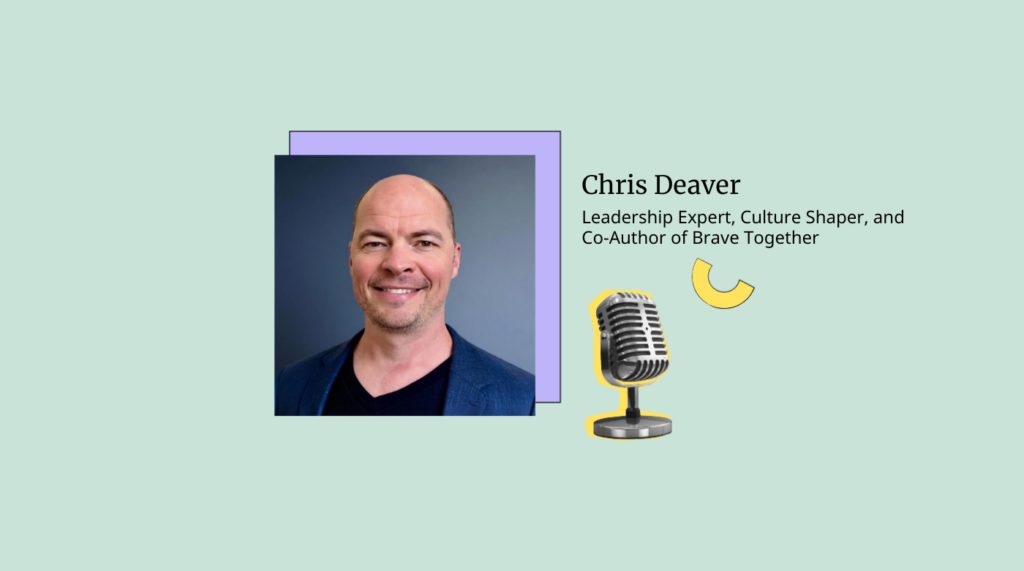
Chris Deaver is a leadership expert, culture shaper, and co-founder of BraveCore, a consultancy dedicated to helping leaders and teams unlock collaboration, creativity, and co-creation in today’s complex work environments. He is the co-author of Brave Together: Lead by Design, Spark Creativity, and Shape the Future with the Power of Co-Creation (McGraw-Hill), a book recognized for its forward-thinking insights on transforming organizational culture. Drawing on experience shaping culture and innovation at iconic companies like Apple and Disney, and as host of the Lead with a Question podcast, Chris inspires leaders to build trust, spark collective intelligence, and design workplaces where people do their best work together.
Related Links:
- Join the People Managing People Community
- Subscribe to the newsletter to get our latest articles and podcasts
- Connect with Chris:
- Lead with a Question podcast
- Check out Chris’ book: Brave Together
Related articles and podcasts:
David Rice: Your metrics are perfect. Your decks are always polished. But nobody ever laughs in meetings. Fear is running your organization, not the obvious kind, not the screaming managers wielding toxicity, and now this fear is masked as excellence. High standards that are actually high anxiety. Teams that talk about collaboration, but never change anything. People showing up on Sunday night, dreading Monday morning.
Today's guest is Chris Deaver, author of the book Brave Together, and we're gonna be talking about the experiences that we're all having right now and how they're shaping our work from what you feel when you see performative vulnerability from leadership to the fact that there's a good chance you'll encounter someone today who is going through some kind of existential crisis right now.
Because it's not just happening at the highest levels, it's not just governments, nations, or world crisis. It's your life. It's my life. It's the person that you just Slacked. We're all in what feels like Whitewater Rapids and team members are flying out of the raft daily. And what makes it worse is that we keep rewarding the superhero behavior, the lone genius, right? The person who takes it all on themselves. It works in the short term, then they get promoted, they get visibility, and then it quietly taxes the system.
So today we're gonna cover how to interrupt fear without lowering standards within your organization, why comp and promotion systems reward visibility over collaboration and what to change about that first. The superhero attacks, so to speak, when capable people think isolation is a strength, how to build culture through deep shared wisdom, deep empathy and shared principles, and why we need to hope again and what that actually means in practice.
I'm David Rice. This is People Managing People. And if your organization looks successful on paper, but nobody actually wants to be there, this conversation shows you how to build something a little bit different.
All right. Well Chris, welcome to the show. It's good to have you.
Chris Deaver: Thanks David. It's great to be here.
David Rice: When we were talking before this, you know, we were talking about this idea of being brave together, that being the kind of organization that we can create, and I think what we are implying here is that fear is the hidden operating system in a lot of workplaces.
Right. I guess what I'm asking to start us off is what does fear look like in high performing org where maybe it's masked as excellence, and then how do leaders actually interrupt it without lowering standards?
Chris Deaver: Yeah, I love that question because innately it implies that most people are after trying to get the job done right, do better, do more with less, especially in the environment we're in with competing against or with AI and teams, really diving into solve that challenge.
And I think for leaders especially, it's, you know, if you're performance driven and you want to get results, the paradox or the challenges that strength or that pursuit can start to get in the way of itself. And so you, you know, by trying to drive towards performance. You know, we all remember the classic like Bobby Knight coach who got a lot of wins.
But after a while that method started to break down, you know, throwing chairs, it turns out at people like doesn't work very well and you had like a Coach K show up who was much more focused on empowerment and autonomy for his players. And I think, hey, maybe there was a time in a season, but I think what we're seeing definitely in today's world is the kind of leaders who empower people to work together.
And what it does, it breaks them outta that system of fear. And you know, when we think about it, that feeling of fear, if you show up, whether in the office or psychologically on a Monday morning or Sunday night, you're preparing for the next day. It's not just a terrible feeling, fear, but it's also a terrible driver towards those results.
And we see this in sports teams too. If they're just afraid it's not gonna work out very well. And so I think. Leader's, number one job is, yeah, I have a focus on winning, of course. But if you do it in a together sense where you're bringing people along for the journey and going up the mountain together, you know, not stepping on each other on the way up, that's gonna really power your team.
David Rice: Yeah. I think we're seeing it right now with the AI stuff, right? Like with people who are reacting outta fear, they're learning it maybe because they've got this fear of obsolescence. I think that is, we're seeing it yields worse results. Right. And I think it's excellence driven by fear always feels brittle.
It's like one mistake and everything fractures right. It's interesting you say it 'cause like I've seen a lot of org where the metrics are great but nobody laughs in meetings. You know? And it can look a, like if you're in an org, can look a lot of different ways, but it can look like polished answers and type decks.
But there's really like no surprises. You know what I mean? There's like no underlying descent ever, like the, you'll hear like people talk about spirit of collaboration, but in a meeting, nobody challenges anything. And it's like, well, that's not actually that coming to life. Right. So there's a difference between high standards and high anxiety.
Chris Deaver: Yeah. That's a great take. 'cause I mean, it is it's anecdotal, but it's true. Right? It's what we really feel and it doesn't help. I think the size and scale of disruption, right? There's been massive layoffs. In fact, a lot of these leaders are afraid for their jobs. There's real fear that they're experiencing on a whole different level than they've ever had.
And you know, boomer generation is retiring, generally X's are kind of taking on a lot of things and you know, they're classically like being part of that generation, you know. Tactician pull levers. Strategic, right. Have a vision of the future, but really try to like solve things that you feel. And then if the sky's falling and it feels a little dystopian, being able to lean in and have grit.
And that's a strength, right? To your point, if you walk down the street, this is the best test to me. And you ask somebody, Hey, you know you wanna join the organization? What's your vision? Execution? They're gonna turn and run the other way. Like they're not gonna have any interest in that. But if you say, Hey, you get to do the best work of your life.
With a team that you really love being around and you know, product services that you love. And that could be any industry. And in that case, and by the way, this is gonna get not just the results or the performance that leaders want, it's gonna be 3, 4, 10 x. We've seen this.
David Rice: That's interesting you called out like the older generation that, 'cause I think like we're seeing this return to sort of like tough, strong man type leadership.
Right. We're also seeing this like superhero mindset. That's like, you know, you've got people operating in silos trying to do it alone. And I'm curious like where does that solo behavior come from? Is it personality? Is it incentives, is it leadership modeling? And if you had to change one system via it, you know, comp, promotion or meeting norms or whatever it is, what would you change first to sort of reward this brave together mentality that you're trying to drive?
Chris Deaver: That's a great question. I, we see it all around, right? And I think part of it is to do with this generational shift. But again, the strengths of say if we're talking Gen X or maybe the tail end of Gen X, you know, raised by wolves, be home by dark, right? Survive that dystopia. Maybe there's probably bullies, there's probably big bosses to pass through, like on every, you know, level of walking to or home from school.
But I think, you know, the strength there is people that can lean in a really tough time and pursue things with hope. But to your point, the risk or the downside can be. The superhero, you know, take it all on. Behaviors can be counter. I mean, what are the Avengers? Without everybody, right? It's a team and I think leaders who can recognize like, I need to max out my contribution, but also how can I help Max the contribution of the team and me as a component of that team.
So I think for leaders it's being able to not say, break out, Hey, be brave. Like you're being brave. That's huge. Great. Because like we need more of that. It's definitely white water rapids and it's not safe canoe trips down the river anymore. But if you're gonna be brave if do it together because yeah, like all the great bands, you know, we saw with Beatles when they broke up, they weren't never as good, right as individuals.
U2 is transcended time, or Coldplay, or look at some of these bands, what they've done. When they've stayed together. And I think that's just more proof that, and by the way, we see it in their business results, I mean, it's like, yeah, that's both things.
David Rice: And we're talking about this at a time where like the system itself of our, of how we work is very fragile because AI's changing everything and sort of, it's easy right now to get into a silo, right?
Like we, we celebrate the hero story so much in our culture, right? It's always like the lone genius, the fixer. It's like cultural mythology. But that superhero behavior, I think like. It gets rewarded in the short term, but over time it quietly taxes the system. You know, I've worked with people who are incredibly capable but actually isolated and they think that's a strength.
It's fascinating how often like leaders unintentionally model that. I'll just do it myself. Kind of behavior. I mean, I actually just talking to somebody about this yesterday, about what's going on in their workplace. And I got thinking about, you know, comp and promotion systems often reward visibility over collaboration.
And then what ends up happening is the culture follows. There's some vulnerability in saying, I don't wanna do this alone, but it's actually like the thing that you've gotta do Now as leaders.
Chris Deaver: These dangers are being exposed on a level and at a pace that we'd never seen before. It's like emperor's new clothes.
And I'll say it like, the irony here is that trying to be a superhero in that way. Now granted, I don't wanna dison, like you gotta make the hero sacrifice, right? And you have to be that kind of leader who embodies the character and the principles that are gonna inspire people into the future. That includes vision and execution.
So you gotta do those things. Not at the cost of these other thing. They're not mutually exclusive. And I think if it's about like this technical stack and delivering what nobody else can do, like, you know, the guy who is just like, Hey, when they call, it's gonna be, you know, the guy in the chair and he is gonna pull it all off and that Then the next day, well guess what?
AI can do that a trillion times better than that person. And so I think the question is gonna be, and look, knowledge work has become commoditized. And in a world where technical is no longer the kind of strength that it used to be, and it's not an excuse, again to ignore that because you have to be deep in the details.
You know, if we talk about any of the successful kind of leaders that, or we consider successful, the Steve Jobs types, you know, Elon or anybody who's in the details of their business, they know it, but they also have had to come to a place to acknowledge, and sometimes this is a journey between the rough leader and becoming a changed leader.
The story arc. And you look at, like Steve Jobs for example. You know he was a rough leader that got fired from his own company. Why? Essentially he was becoming a silo, right? And a lot of those, a-hole behaviors that some people glorify or that he shows up in Hollywood in the movies it has for him.
Unfortunately, it's not the full story, right? The story that happened and the way he was able to truly transform his. Cultures into the future. And look at Apple still one of the most valuable companies in the world, Pixar. It has continued to produce incredible films, and I think the difference was.
When he was in the wilderness, and I've heard this from Ed Capel, who's a friend and a mentor. He was worked for Steve for 26 years. He talks about this in his book, creativity Inc. Is that Steve was able to step back and get humbled and learn about compassion and empathy even though he wasn't still amazing at it.
He was much better at that. And then also this team notion. He recognized that there's power in the team. And so when he came back to Apple, it was about bringing this design team, Johnny, ive those guys and, you know, operations, software, the brain trust that Ed Kamal, you know, at Pixar does. And they did this in such a wonderful, powerful way, but it's not unique to him or to that particular business.
This is true of organizations of the future. It's like, are we gonna try a self-made approach only or are we gonna do it in a shared way? If you're doing shared, there's so much more power in that, and we're talking all the bottom lines, you know, people, profits, impact to the world, all that.
David Rice: When we talked before this you made a sharp point.
You know, if ChatGPT can dump sort of information and consultants are being disrupted, then what we're seeing really is expertise is becoming cheap. So what becomes rare and valuable then? Like if you had to describe the new leadership value prop in one sentence, what is it and what does it require unlearning from people at the top?
Chris Deaver: Yeah. I would say it's co-creation. There's duality about that, which is, but having the muscle memory built in of co-creation and as a leader, instead of thinking in terms of employer, employee, boss, people, it's how can I be a co-creator with my team? What this does is it enables connection, right?
What you described earlier, that feeling that, yeah, we need to prioritize that first five or 10 minutes. Just check in with people like how are you really doing? Right? And one-on-ones in a team setting to the extent that you can. And what that does, it creates space for people. And by the way, usually we think, oh, I don't got time for that.
Or some leaders do they think I don't have time for it. And then what happens is they try to fast forward and they, by ignoring that it takes more time. 'cause to your point, there's a tax on the system. Versus two steps back to go a hundred, you know, 10 steps forward. It's, you know, connection and, you know, collaboration.
Horizontal, right. I think you asking the right question, which is if AI can do all of these things, and by the way, we're only at the tip of the iceberg. We don't know all of the stuff. The next wave of AI is going to be. Literally like it was with bots and factories sitting in and accomplishing all these task oriented things at workflows that any person can otherwise do.
So then the question to your point, becomes what's rare? What's unique? What could make me kind of a unicorn in the system? But overall, what's gonna differentiate us in terms of humanity from this stuff that we've created? I think it is this, these elements, connection, collaboration, and what that leads to is, you know, co-creation.
If you're building stuff together as a team and with AI, it's not an either or, right? I think we have to position these things together and you know, like a great movie like, like with Avatar, they synthesize a technology. They didn't go all 3D. If they did, it wouldn't have been as good. They actually invented cameras that filmed like Zoe Sal's face and then blended it with technology.
And I think that's an analogy to me of you blend the best of AI with yourself and your team. And by the way, your team look at ways to do it as a cross staff, right? The best brain trust, like at Apple with the Camera Brain Trust team, they meet together every week, the representatives from hardware operations, and they sit in a room.
They view themselves as a team. So this is like a cross staff meeting and there's zero ego and there's building blocks on the table. And this creates agility in your organization. It builds these horizontal connections that are cemented because you're gonna have all this technical stuff, and by the way, it's only gonna get more crazy, right?
With all the needs of customers and everything. So then the question becomes is how do you install and instill and ensure. That muscle memory that's so strong, those fibers that are strong in the organization together, because again, to your point earlier, we live in a world of silos and they've been built over many decades in organizations.
And so you have to be really intentional to get this right.
David Rice: I mean, I love where you started there with the co-creation piece because I think like unlearning, the need to be the smartest person in the room might be like the real evolution for a long time, like information was power. Interpretation now feels like the power because information is everywhere, right?
So if everyone has access to the same answers, I think leadership becomes less about knowing and more about discernment, the ability to choose, right?
Chris Deaver: So true.
David Rice: What are we gonna ignore? What are we gonna prioritize? And I think wisdom, it's almost more invaluable than just, you know, intelligence, I'd say.
Like it flips the status hierarchy. Can you be like the calm synthesizer that. Beats the loud expert, or not beats, but you know what I mean, like is That's the role you're playing now?
Chris Deaver: Yeah. It's context, right? It's a story. It's the narrative and the patterns, and these are things that, you know, to this day, AI doesn't do as well as us.
There's a human element to that, and it's really our origin story in terms of humanity, and we've gotten really good at wisdom when we attune ourselves and dial into it. And so I think harnessing that strength. And the timeless principles, right? That can power us as we, you know, look back and you know, the ancient wisdom.
And you know, I think AI at best is approximating that. I would say that now, currently in the future, all these arguments about what the future or debates about what the future of AI is and these concerns have to actually do with it being non principled or not really having a moral center of gravity.
And I think that's something clearly that's in our wheelhouse. And to the extent that not only do we ground ourselves in timeless principles. Also ask ourselves like, what are the first principles of our culture, right? And of our work and of our products and services. And as you shape your first principles, you can start to build a future that is differentiated.
And most organizations either didn't start this way, they talk about values, or they put something on the wall about their vision, but really it's about what the first principles that they embody and culture as a perpetual motion machine. Culture is the great differentiator ultimately. And then that's the culture around us and in our teams and in our organization.
And you know, we're in a weird time too now where things have inverted, right? Where the enterprise wants to be a startup now.
David Rice: I know they wanna run leaner.
Chris Deaver: Yeah. Because they have all this bloat, right? These layers, and they're all these commoditized knowledge working, you know, systems, layers, and frankly people, it's an unfortunate circumstance for a lot of people.
Frankly, it is because. Now it's like, how do we consolidate this? Really just shave off all this stuff? And startups are, I think, in a, in an advantage. This is the great disruption of the organization itself in a very significant way. I don't think we've ever really seen that. And it scares people because we have predominantly probably white collar workers or knowledge workers, you know, across the board, at least here in the United States.
It is a challenging time, but I think for someone, if I'm out there and I am, you know, I think we all are, it's not asking ourselves the question of like, whoa, what shoe's gonna drop next? And just waiting for the sky to fall, I think is, as you're saying, it's like, get positioned and what's that deep wisdom?
You can rely on those deep skills that can harness the power of your hard skills that are technical or amplify them, right? Because if you stack. With those technical skills you described earlier. 'cause they don't go away. Like, if I know engineering and I can help build a rocket, it's like, great, what happens if you stack the ability to collaborate with other people, the best of who can do that as well, and then collaborate with AI to do that even better.
All these things start to stack, but it takes, you know, deep skills and the things we're talking about. I think intuition, compassion for each other and for humanity and with a vision that is. I'd say hard charging or urgent. Right. Urgent.
David Rice: Yeah. I love what you said there about it being right in our wheelhouse.
I just, you know, did an article the other day about, you know, this is really a trust crisis. Like, at the end of the day, I don't think people are scared of the technology. They're scared of the people who are making the decisions around it, who are essentially driving what it does in the world. That's what people are afraid of 'cause they don't trust inherently the institutions and the people who are making those decisions, so it's.
Chris Deaver: Yeah. And rightly so, right? And again, not to diss too hard on, on Gen Xers, 'cause I think this could be any generation or even, you know, the incumbent boomers before there were a lot of lever polar answers for leaders.
Right? Right. When this started to happen with AI, it was like, oh, we're cutting 8,000 jobs. 'cause AI, right? AI's gonna solve this. And there were a lot of assumptions made that we're seeing now may or may not be true, right? Because ultimately you have to have architects or people that are playing the hub or the integrator.
And to your point, the synthesizer and those skills also frankly, weren't always as valued, seeing kind of the gestalt or the big picture and then be able to influence across macro and micro. I wouldn't quite say generalist versus, you know, the other I think this is more, it's broader. It's like be able to influence horizontally and vertically.
And I think that skillset, you know, wasn't always seen in the light that it is now. And I think leaders are coming to a realization that not only do they need that kind of talent, those kind of people, and to shine a light on them, they need to be those kind of people. And that's a very different mindset for a leader.
David Rice: Absolutely. Absolutely. There's a lot of mindset shifts going on, and I think, like we talked before this about sort of how leaders perceive psychological safety, right? Like a lot of them hear that, they interpret it as like comfort. But I think when you're talking about like this idea of brave space where people can say the truth thing, you know, not just the polite.
I'm curious what are the practices that make a brave space real? And what are the red flags that tell you it's turning into either fear-based silence or performative vulnerability?
Chris Deaver: What's helpful for me is just try to simplify this down and you know, 'cause we were in a time, not long ago, just recently really, where it was, to your point about psychological safety.
And I think that's a good thing if it's done well. You know, it was all about safe space, but in the extreme. That can mean to some people, oh, I just need to be, not say anything right? Then they don't voice what is kind of at their core and they're not being brave. And you know, it's not about offending people.
I think the question is how do you raise a safe space into a brave space? And I think the answer to that is simple. It's built inside of us, our mind and our heart, and kind of spirit or principles. What happens often is we either lean into. This is a battle that happens politically. It happens in a lot of topics.
Right. Mind versus heart. Right. And it's like, then we go one extreme or the other. Right? And I would say business has been on the mind extreme for a long time. The science of management. It's science, not art, right? Not humanities. Even though a lot of consulting companies would hire humanities 'cause they gotta balance it out.
But a lot of science, very prescriptive. Right. And to your point about expertise. Vertical silos. Do your job. Task oriented job descriptions. Check, check, check. I just saw a post by Naval where he said like, basically careers are dead. And you know, it's all about like building stuff together essentially.
And I heard this from Thomas Friedman. You know, the world is flat. 20 years ago I was in a conference and they asked him the last question, always remember it. They said, what's the future? And he said, it's writing job descriptions. Why? Because we have to amplify this humanity side, our, the heart side. And, you know, Brene Brown, for example, has taken this heart side and made it a, you know, a whole practice or a business.
I love some of her stuff, but I would say in the extreme, if that's the only answer, you lose the mind side and it's out of balance. And what I mean by that is like, hey, if it's all about everybody showing up as their authentic self all the time, then somebody's gonna offend somebody or somebody's gonna probably say something that is really.
Incongruent with either the subject at hand or whatever's necessary for driving the business forward. And it's not that's the only goal because again, we want connection, but we want it in a way that feels universal or can feel connective like connective tissue. And this happens in the greatest teams.
Right. And again, going back to sports teams, not to overdo the analogy, but you look at like, how do they do it? Well, there's heart. They have a strategy and a plan. They also have a great coach and they follow principles. And so I would say. A brave space is all about how do we amplify the focus on heart having solid connection.
Or deep empathy and mind having that shared wisdom we talked about earlier. And then principles be powered by principle principles tethers this together. If it's just this battle of like, oh, you know, facts don't care about your feelings. It's like, well, feelings don't care about your facts. And we could just go back and forth all day long about who's being offended by who.
It's so pointless, and trust me, we have enough of that. But the tethering power of a principle says, oh, okay. You know what we are about. This North Star, we want to make the best products that enrich people's lives. Okay. And so you have feelings about that. You have feelings about, you know, what's going on in your life.
We all do, and we also have this vision of like, we wanna build stuff together. You know, we have to listen to each other and try to understand and not have ego. And so let's build, you know, like let's get to that state of just being and staying in build mode. And I've seen it, I've seen teams like at Apple or other places.
Where they're doing the, literally the best work of their lives together. And there are people who would otherwise disagree on a lot of topics, like, you know, as far as personal political stuff or whatever. Right. But they don't, they're not focused on that. They're focused on we're human beings and. We wanna make the best things together.
We wanna do our best work together. That's the future.
David Rice: I like what you say, you brought up the whole bring your full self to work thing. And I always think like that's, nobody means that, you know what I mean? Like you don't want me to bring full David to work. It's just gonna be a running series of bad jokes, you know.
But I think like going back to the idea of like performative vulnerability from leaders, like I think it's worse than silence. 'cause two reasons. One, it either looks like progress but isn't. So it creates like false. It just, everything feels like bs. That's really what the second part too, is like, if it feels disingenuous, then I'm, it's gonna undermine my ability to trust whatever the mission is.
And so like, I think like, what I like about the idea of the brave space is that it feels tense sometimes. Yes, there's friction, but it's also pretty clean. The ability to say the true thing in the service of work, the work that needs to be done, that you're all, like you said, you're all trying to build the best stuff of your lives together.
That's maturity, right? It's the difference between being raw and being responsible.
Chris Deaver: We've all felt this, right? We've been in moments where, and again, one of the best tests of like on a reflection to see how we can categorize or label what we've experienced as brave space is flow, right? Like that state of flow that you feel.
And I love the research around this 'cause it's true. Doing the things you love, right? Like playing music or whatever it is for you. Art, painting, you know, reading, playing sports, like where you feel like you're one with that experience. And then when it's with other people, it could be one other person or two or a whole team and you know, especially in a work setting, but you could ask ourselves like, wow, when was the last time?
When was when you felt, when you had that feeling of just you're working as one and you could see it in those teams, right? And again. Not to over reference on the sports analogies, but I love some of these because, you know, these are indicators of where the future is, where you see these, I mean, look at Indiana.
I don't know that I can name a single player on their team, maybe the quarterback, but he was like a two star recruit. Like it got rejected by 139 colleges before going to uc, Berkeley third string. Then he transfers to Indiana, who's the worst team and they come together and yeah, a great coach, granted, right, which tells you what a leader can do as far as influence to shape a culture, but also look at that team.
They don't have what any, would we consider like the rockstar talent that everybody looks to buy that will in their mind solve everything. In fact, Texas Tech did, you know, trust me, my BYU team, they're in the Big 12 conference and that was brutal to lose the Texas Tech and I'm thinking like, why is this happening?
Oh, they had a time window where they spent, you know, a lot of money. These billionaires on NIL. And granted BY, all these teams are doing NIL. So it's like, hey, you know, more power to them. But they lost. They didn't win. Ultimately, Indiana won and you know, still a great team, Texas Tech, but I think what it shows and when you see even in college basketball last year, Florida, Houston, I can't name a single player on any of those teams.
And what it says is, you know, it's not about the rockstar as much as it is building a team that rocks together. They could be stars, but really that rocks and that can do these kind of things. And we felt that, right? And usually it wasn't about like, oh, because we had this one guy on our team. It's like, well, yeah, maybe.
I mean, it doesn't hurt to have Michael Jordan if you have one or Steph Curry, but you may not necessarily need that. I think you can be building incredible things together still.
David Rice: We were talking before this, you drew a line between hard skills and soft skills and what you called like deep skills. That's sort of like you gotta strengthen that core to be.
That brave leader, right? So. If I'm an HR leader listening, what are two to three deep skills you'd actually build and how are you gonna build 'em in a way that isn't just another like training program people end up ignoring?
Chris Deaver: Yeah. Well first, you know, having lived in the world of hr, I would advise as I would myself, don't be Toby from the office. People don't appreciate that. And you know, HR gets a bad rap. It's tough 'cause like so many things look like they're just being thrown over the fence and they look like compliance. And I think for an HR leader, as is true of any other leader in the sense of what we're talking about is, you know, how do you bring creative solutions to the fore?
And not just like, Hey, but help bring people in early and do it co-creatively. Some of the best work I've seen from HR leaders is when they show up with leaders. And they start to shape what they're building, but they do it in a way that the leaders feel ownership and, you know, they're shaping a strategy, a people strategy, you know, talent of the future to, you know, be future ready.
And they're doing it in a way that is not only congruent with that leader. Again, it feels like, wow, we're co-creating this. Or even that, it's theirs right to own. The best work in HR is you become invisible. Right? It's like the antenna team with the iPhone. Their job was, and there's like a hundred of these people, but they would tell me all the time, like the design team with Johnny, ive, they're just like, our job is to be invisible, right?
Like, we wanna create so much like value out of the work we do that the craft, that it's so inspiring. I think that, 'cause again, it's not about the HR program or the expertise, you know where it comes from. It's like, how can I help power this, these leaders and teams and organization forward? I think about it like, what's the next level?
This thing's a triangle. How do you get to the peak? Right? Or a mountain. Because there's always the next level or the next wave. And again, going back to what we were talking about as far as the history of business, if you zoom out or organizations, if you zoom out far enough or work itself, industrial age, manual worker.
Totally disrupted, right? It was by factory bots, et cetera. And you know, we've settled into that, what that world basically starts to look like. Now, that could even change with the robots, right? Yeah. We went from that to information age, which was totally ubiquitous. It's been commoditized, knowledge workers, et cetera.
These went from efficiency as the goal to effectiveness as the goal, and those are still good goals, right? You have to execute, et cetera. But now it's co-creation. All the way, and it's a contextual age, and as you said, it's kind of like a wisdom worker or integrator connection worker where you're partnering with people and you're not just working harder and smarter, you're working creatively together.
And what that does is it powers the other things too, but it does it in an innovative way. I think the innovator's dilemma was true about products when Clayton Christensen posed that. But I think it's more true about cultures themselves and organizations themselves today, and leaders themselves than at any other time.
Right? So it's kind of like this leader's dilemma of, Hey, am I gonna be the guy who. Keeps sticking to what worked the default settings, which by the way is increasingly not working. You also have this entire population of Gen Y and Z who their starting mindset is collective, right? And culture. So like the old notions of, Hey, I'm gonna check the box and you're gonna do what I say and command and control.
It's way out of the question. And you know, you, Hey, good luck with that. You know, they may get in line for a short period of time, but they're gonna be out as soon as they possibly can. And you know, we're in a time where the pendulum swing between employer or employee friendly job market is like, I don't think it's that clean anymore.
It used to be like, oh, it's heavy this way. It's heavy that way. I think it's actually a messy one, but. What is true is the most talented people, the people that are doing the things that we're talking about, the ones that you really want on your team, even though you may not know it, but you do intuitively know it well, they're the ones that are high agency.
What they appreciate is a ton of vision and a ton of execution. A ton of partnership together all the way throughout the journey. My favorite leader of all time, I sat with him and I thought, this guy is the guru. He's just gonna tell me what to do. 'cause I trust him. He'd already built trust, he had the heart thing in place.
And then I asked him like, Hey, what do I do about this situation? And he goes, well, and it, because it was outside of my scope, right? This is above my pay grade. This is him. I'm asking him basically like, what are you telling me to do? He would say to me regularly, he'd do this often. He's like. If you were in my shoes for the day or for the week, like what would you do?
And he meant it. And then I would share that answer and then he'd start to shape that solution with me. And then he'd be like, Hey, I think that sounds good. After I'd start to work on it. He's like, I think that sounds like a good approach. Like what do you think? And I was like, yeah, and I'd just be waiting for permission.
But he was empowering me to do it. And that's leadership. Right. And it made me appreciate him more. And again, going back to the heart, mind spirit, he was converging those things, the principles of empowerment.
David Rice: I like this idea of deep skills. And then as I'm sitting around thinking right now about like skill taxonomies and all these other things, I think it's like worth noting, you know, like hard or soft skills.
They might get you in the room where the really important conversation is happening, but deep skills kind of determine how you behave once you're there. And I think that feels less like training. It feels more like strengthening a muscle. You can't, you're not gonna PowerPoint your way into having courage to be in that conversation.
Right? Like the best leaders that I've seen, they have some level of emotional range, right? They're steady, but they're not flat, right? Like this, the, it's the stuff that shows up. When you're under pressure. And I think that as we think about the skills that we need in the future of our orgs, like that's a big thing for HR to consider is like, how do we build that intentionally?
Because if we don't culture and sort of the ways of working that we have in place, they're gonna build it sort of haphazardly or accidentally.
Chris Deaver: Yeah. Well, and again, the paradox of this, and you're absolutely right, a hundred percent. I think the paradox of this is that for a leader, the first question shouldn't be, how do I show up this way?
That's part of it. But there's a prior question or preface to this, which is, how do I go deep first regularly that I make it a practice we're talking about, like, you know, and so the HR leaders can influence this, but I think influencing it in yourself, right, as a leader, because if you show up this way, so first is like, how do I do that?
Kind of, you know, in things like meditation, prayer. I go deep and I ask myself, we, we talk about in our book, brave Together, available on Amazon, by the way, about the mirror test. The mirror test is this question of what can I do differently? And it implies that I'm looking deeply in my own soul to be a better leader.
And I'm asking it as a genuine question because I truly want to know and I want to do more and better as a leader for others. I think if that's the starting point, there's so much power in that versus, Hey, how can I just show up and pull some levers and influence some people to get stuff done? That's surface.
And again, the paradox of deep is because if you're doing the surface, the input is the output. You're gonna be creating that surface reaction and approach that these other people behaviorally will take down the chain. They'll be saying, how can I just get this done and check the box and move on with my life?
You get, you know, just like they say with the brain, we only use, I dunno if it's true, but it's, I like the concept of we only use about 10% most of the time. Well, you're leaving all that potential energy on the table that could be kinetic. And going back to, if you do it deep as a leader and you hone in on those deep skills and there's a lot of things related to this, you, and it is simple, you know, it's things we know.
Different dimensions of our lives. You know, spiritual is deep meditation, prayer, et cetera. But asking that question of like, how can I be better? You know, physical, you're taking care of yourself, exercise, getting, walking, whatever you do, mental reading, you know, all these things that challenge you and relationships.
And if I'm doing that and I show up as a leader, people are gonna interpret and feel, most importantly feel. 'cause you can't fake, I think what we learned, especially the pandemic COVID, you can't fake any of this stuff. Even though that was already true, right? We had like those polished words and phrases like exec presence, which I always hated because I'm like, what does that even mean?
What the hell does that mean? You know? It's like if I show up, shouldn't I just be me? Like be one, like I learned this from Stephen Covey, like his kids would say the guy that was out there in the world influencing and leaders and stuff, that was him. He was one right when he was at home. It wasn't perfect, right?
Had his moments as a dad. But I think if you're one. And granted, you have to, there's context. You have to deal with things differently in certain situations. Situational leadership, but be one. And when you're one yourself, you can help your team to be one. And the best teams are one. And this helps customers because man, if you have a product or service that feels like you're one with it, those are the kind we love.
You know, whether you're talking about Nike shoes or products or any kind of service, anything in any domain, if there's a sense of love about it. I think that's a good question for leaders to ask, which is like, how can I build a culture that people love? Starting with myself? Like if I show up and I'm like, I'm having a meeting and it's agenda driven, and it's check check the box.
Do I even love that experience? Like, no, my daughter has a great phrase for this. She's like, I don't love that. And it's like a gentle way of saying, I sometimes it's like I hate it, but I think it sounds so maybe Pollyannish, but you're like, love. Really what you're asking is, do I care deeply? And most leaders do.
I think that's the thing too, is like, if you do well, why wouldn't you harness that and direct it in a way that really converts all of this 90% of potential energy into kinetic energy with your team? And it's possible. If it feels like change, it feels hard, sometimes that's okay. And you're not gonna be perfect at it to begin with.
But deep skills are also like listening, right? And asking powerful questions. I mean, you're doing this right now, you've thought deeply about these questions. We're having a conversation that was prepared in advance, and you dropped questions in advance, right? In an email. So I think that's something leaders can do as well.
And they do this at Pixar. They'll send a question out a week in advance. So instead of like just an agenda. You have an agenda, you have a direction where you want to go, but maybe frame a macro question, which is like, Hey, this is really what I, we don't know. And so people come and they're like, they're more prepared 'cause they marinated on that.
And it feels more inclusive of not just inclusive of like a person's voice, but when you show up it's like, Hey, we're gonna have a fun. Even a fun debate. It's gonna be out there. We're gonna do some rock tumbling. We're gonna come up with some good stuff.
David Rice: I thought you gave a good example earlier when you were talking about the leader who kind of pulled you in and they were asking you questions and you figured it out together.
Because I think lead with the question is a very powerful approach, and it does feel very collaborative. But there are moments, right, where like the board wants certainty or the team wants your direction, or the market feels like it's on fire, right? And these, there's these moments where leaders feel like they have to have an answer.
I'm curious, what does question led leadership look like without sounding vague or indecisive?
Chris Deaver: Yeah, there's a time and a place, right? I think the framing, like at Disney imagineers I worked with, I love the approach. They have a what they called expansion and then contraction, and essentially it was like two different meetings.
And it doesn't have to be designed that way, but I love the concept or the principle of the thing. In expansion, it's like, all yes. And like you wouldn't shut down or criticize ideas. It's like, let's just expand all the possibilities and then you get to, you know, contraction. And essentially you could say that's direction.
Like now that we've expanded the room, I like it as two meetings, but sometimes it depends on the context. But to your point, at some point you gotta, it's contraction, it's direction, right? We've had the conversation, we've looked for alignment, and maybe you're gonna come into a conclusion as a leader that.
Maybe counter to some people's opinions, but you've listened to them and they know you've listened to them and everybody feels heard. Everybody's had the talking stick, right? The Native American talking stick. They know I feel heard. And you know what? When people do that, the defenses are down. They're also more likely to lean in, right?
Disagree and commit. We talk about disagree and commit, but I see leaders using that as like a flashcard where it's just like. You didn't disagree and commit when I just came in hot. You're like, well, you came in hot and you didn't even care what I had to say. Right? So again, it may feel like two steps back or five or 10 steps.
And that's because it takes an investment of time, it takes intention to do this well, but when you do and when you're able to air it out first as leaders together and a team, and this could be about a leadership team too. 'cause there's, there can be, you know, egos in those places or just opinions, strong opinions.
But we're all trying to get to a point of view. So how do you get to a shared version? I think creating that kind of brave space where you can, and it takes time, but you don't have to belabor it either. You've put some of the time in, it's like, Hey, we feel pretty good about this. We have some disagreement here.
You can call that out, right? Be like, gotta move forward and here's why. Then you share context, right? The story which is, Hey, here's where the direction we're going. And guys, ladies and gentlemen, I know that there's some still some discussion about this part of it. And I hear you for these reasons, but we gotta do it this way.
Here's why. And I believe that this is the north star for us in this kinda leadership. It's gonna be the future. You know, again, river rafting. We're trusting the guide sometimes, and sometimes you're the guide as a leader. But I think to the extent that as a leader, if you're viewing yourself as a coach, then that helps a lot.
You know, instead of just like the player among the team who's shouting at the team, it's like, yeah, maybe. But you could be, I mean, player coach. Are you inspiring people and yeah, providing a direction that's also a vision, but it has vision baked in, like that's gonna help people.
David Rice: You're right, there is a time and a place, but I think there's also like a difference between asking because you don't know and asking because you're inquiring, right?
So like a powerful question can create alignment just as fast as a rushed answer, or much faster than a rushed answer really. There's a line that I heard once, and I always share this with like my contributing writers when they're creating content is like, certainty is comforting, but clarity is far more useful.
And so like, yes, you can take like this hot take stance and you know, push it with certainty, but just speaking with clarity and like framing the problem correctly before you solve it will create a stronger sense of connection for the reader. And like it's the same thing. 'cause what you're doing as a writer, you're sort of leading a reader through this thing, there's this problem, right?
So I think like leaders need to realize, like you don't always have to provide answers, but you do need to provide direction. And so like inquiry can be very decisive if it's anchored in intention and values in my opinion.
Chris Deaver: Yeah, absolutely. And I think the other thing about being brave in particular, being brave together, like we talk about in the book, it doesn't have to be polarizing necessarily, right?
It just has to be something that, you know, to be true or you know enough, you're approximating right to the best that, that you can, you know the truth. Yeah. And by the way, like in writing something or a piece like, you know, converging on that, you do want there to be a hook, right? But it doesn't have to be like a clickbait thing, and it doesn't have to be pushing people like in one extreme or the other.
I think again. We get so locked in on these extremes and we see sometimes out there, and another phrase that has gone away largely that I'm glad to some extent personal brand. I don't hate it. I think it's important right to be. But why not just be yourself? 'cause if you're trying to artificially contrive something, but I also think like there's power in this collective sense of, and it's an and answer we still have to like have, but having an original voice, and I think in our original voice and being brave in the context of together.
Again, it doesn't have to mean, you know, Hey, I disagree with you. Here's why, you know, or I disagree with this. Or just non-conforming to non-conforming. Now granted, having said all that, we're in a time that the requirements list of the future is a different requirements list of even the most recent past.
And I think there are requirements in that list of like take, like the Sir Ken Robinson talk on TEDx or Ted years ago. It's like still number one, I think. Schools kill cre. Why? Schools kill creativity? I think businesses have killed creativity. And that's painful because creativity is one of the components of the future.
Shared creativity as a team. Imagination, right? As Albert Einstein would say, is more important than knowledge. Why would he say that? Because look, knowledge can get commoditized. It is right now. And knowledge in the cursory sense, right? Of aggregation, of information that humans have produced over time. At best, AI is like.
I'm gathering data from what everybody has produced in the past. That's great. And it can make some conclusions about the future, but it's a consolidation of the status quo if you really think about it. So how are you taking an original point of view? And to your point in writing, I think especially, how do we ensure that we're, and I have to challenge myself with this as a writer too, because it's so much easier to be like, Hey Chad, I call him Chad.
You know, Chad, just spit out this thing and you know, whatever. But like, it's not gonna be as coherent or as powerful as if we're being true to our voice. And if we're true to a collective voice as we're being true to our voice together, there's power in that. And this is true about the kind of impact we all want to have in whatever our business is and whatever we're leading team, organization in HR or any function for that matter.
I think those are the kind of things that really resonate with people.
David Rice: When we talked before this, you had referenced the fourth turning. I love that book. It's so relevant right now. It feels like, you know, this is like definitely something we should all be paying attention to, you know, considering the ideas that are shared in that book.
And it, there's an idea in there like, you know, that different generations bring different defaults. Maybe it's grit or you mentioned with gens Y and z, you know, it's this collectivist mindset, right? And I think the risk that is here, leaders retreat into what worked before, right? My question then is, you know, how do you create a shared, brave leadership culture across generations without turning it into, you know, back in my day and, you know, you don't get it, you don't get it kind of thing.
Chris Deaver: It's a temptation, right? Because it, whenever we get into talk about generations or demographics, it's easy to default into our own kind of autobiography of where we sit, right? I look at it like that's data that informs directionally where we want to go. Where we want to go. Getting back to the being one, and granted there are strengths for each generation, but it's about how do you combine these building blocks?
Gen X, I'd say it's what you said, grit, right? It's the ability to drive towards the direction sky's falling. The river rapids are hitting, you're flying outta the raft. Everybody's flying outta the raft, but you're gonna stick with determination and persistence to see it through with the team. Gen Y is like, Hey, we're all a team here.
Right? Their unity is like extraordinary. That strength. Now again, in the extreme, these things can be problematic. 'cause the Gen X thing can be like, I'm just gonna grit my way through it. I can outlast all of you. It's like, is that helpful to the team? Like you want to go the mountain together? Gen Y in the extreme of unity, it's like, then there's no variety.
So it's like, Hey, we have to, you know. You can't even do this, right? It's like we're all gonna be authentic and oh wait, you said something that offended that per wait, that person. And it just gets crazy. It's like a circus, right? And then Gen Z, I think they wanna solve massive problems that are at scale, but like fast, which is crazy, right?
But like culture, right? So they'll show up in an interview and be like, what's the culture like? Can I change the culture? You're like, and trust me, I think that's something we all want. So the thing is like these things in their ripple effects are affecting us all. But as you said, I think looking at this question, which is how do we combine these strengths into this shared, call it gen, brave, that we're moving in a direction together.
These are all parts and pieces of this collective. And as a culture overall, if it's a person, I like to think about cultures and companies as a person. Disney was very nostalgic. You know, it's older, literally like a hundred something years old, kind of moves slow. So when it acquired Pixar, it was like, oh, okay, I'm feeling young again.
You know, it was starting to infuse that Pixar culture, which is great. Apple was more like, you know, a little older, you know, has kids. It's like got it figured out. And then there's this culture about our lives and about the whatever organization you're in. And I think the question there too is like, how do you know, start to shape that culture of the future with these different elements?
As you said, fourth turning is like we're in the crisis and we're in the crisis phase. If we track with those guys, and by the way, they like predicted like the 2008 crash, like, and no, nobody even noticed them back then. Now it's like, oh, wait a minute. What's this whole thing? Because they're seeing patterns at the macro level over millennia, right?
The secular, the 80 to a hundred years, and then at the micro level of America as a melting pot and. They say like, Hey, this thing's gonna wrap up like early 2030s. But it's crazy until then. So I don't think we're getting out of this like unscathed. I think we're in for another, what is that? You know, seven, you know, give or take years of just some pain.
The beauty of it is that we'll be a rebirth and if we're leaning into, and by the way, as a lot of systems and organizations continue to get disrupted, we're seeing this in politics, right? Governments. Systems that people hadn't questioned at the depths. Speaking of deep, are looking at things and saying, I'm gonna shake this right?
And we're all kind of saying like, oh, wow, that's crazy. That's painful. We've all wanted to do that for a while. And again, partly Gen Z on that one. The good news is if you lean in and you have these elements and the building blocks of culture, really, which is again, shared wisdom, mind deep empathy, heart.
And being powered by Principles Spirit, we talk about this in the book, brave Together. It's like you're gonna be able to shape culture. You'll be a culture shaper. You'll be a future shaper. You're gonna help build that shared future that we all want. And it's not exclusive of those dreams. It's a shared dream.
Because tracking, again generationally, we'll have the culture change we want. We'll have the unity that we want. We'll have the drive towards the grit and the focus on the future that North Star. If you take the boomers, we'll have, you know that I call it performative, but the appearance too. But it'll be based on substance.
David Rice: Well, and all these things are complimentary, right? Like the tension between generations, I mean, gets hyped up a lot. But it doesn't necessarily have to be, it can be a strategic advantage if it's surfaced in the right way. Right? And it's less about age, it's more about adaptability. That's what we're seeing all the time.
You can. Be 60 years old and doing fine in an organization because you find ways to adapt all the time. And so I think like there's somebody that, I can't remember where I heard this, but it said shared standards mattered more than shared style. I always think about that. Like yeah, like you can, there's a million different ways to do whatever it is that's gotta be done.
It's about the standard of quality and like the, how you're gonna approach it and the mindset, all of those things will define your success far more than sort of your technical style or how you did like these small tasks. At the end of the day, most leaders. What you find out throughout your career, right, is like they don't really care how you got there.
Did you get there or not? So it's kind of the, I think we gotta like think about, yes, it does matter how we get there, but we all gotta be a little bit adaptable on. I like that you're talking about principles 'cause it's something that I'm thinking about a lot as well. I think it's a key challenge for leaders during this time.
Chris Deaver: Absolutely. You know, it is hard, and again, we're in the river raft and team members are flying out the river guide's, flying catapulting over the top. But at the end of the day, you get back in and you're better prepared for the next one, for the next rapid. And in fact, you may not even be shaken like that again because you're ready to flow, right?
That shared flow as a team and you're leaning in and being brave and you're better positioned. And I think. I take heart in that because I just find like every day is, there's so much stuff. Just hitting the world is going nuts right now. Right. And it feels crazy. And I'm telling you, we talk to people exec coaching and in any organization, it's so crazy because we'll have conversation where they're like, oh, I'm looking to change jobs.
And they just got there. Or like, oh, I'm getting laid off, or This is happening, or it's like, whatever it is, it's existential. So when we say crisis forth turning, it's not like, see, I think that's the thing that hit me too, is like, it's not just like this concept of, hey, at the highest level, government, nation, country, world crisis. It's like, no, my life.
David Rice: The guy that you pass in the parking lot is like having an existential crisis.
Chris Deaver: Yeah, so I, I heard one time, a wise man said, and I'll just close this, he had said, Hey, if you just bank on the fact that whoever you meet or talk to, and this includes our, the people we work with is going through some kind of crisis right now, probably 80% or plus, maybe more, maybe a hundred percent.
Now, you're probably right. And so how do you treat someone? You know, and this also gets to how we work together, how we treat each other. Then how do you treat someone who's in, in crisis? How do we treat ourselves? We're in crisis. I think that's where, and I'll close with this. One of my favorite moments in a movie I, the movie doesn't particularly stand out to me, but this moment is huge.
Where Dr. X and X-Men days of future, past the future version of him is the world's collapsing, right? Everything's on fire, they're all gonna die. It's the end. And then there's a past version of him who, his world's just fine, right? Everything is fine except he's a wreck. He's going to, it looks like end.
And so this future version cuts through time and says to him, the one message he has is We need you to hope again. And I think if there's a message that we need to hope again and hope in the sense of build this intention, do it every day, right? Start small, but create that momentum in the ways we've talked about and it will power you, your culture, that you just build around you at the depths and it'll expand.
You'll be able to do things you've never done and your team and your organization have never accomplished that are the impossible.
David Rice: Well, Chris, thanks for coming on the show today. I really appreciate it. It's been a good talk.
Chris Deaver: Thank you, David. Really enjoyed it.
David Rice: All right, well, listeners, be sure to check out Brave Together. Also, if you haven't done so already, head on over to peoplemanagingpeople.com/subscribe, get signed up for the newsletter.
And until next time, a little bit of empathy, a little bit of principles, start bringing 'em into your work.