

10 Best Candidate Relationship Management Software of 2026: Reviewed

Best Candidate Relationship Management Software Shortlist


The best candidate relationship management (CRM) software helps HR professionals build stronger connections with candidates, automate repetitive recruiting tasks, and ensure no top talent slips through the cracks.
Instead of juggling spreadsheets, emails, and sticky notes—or relying on outdated tools that create more headaches than solutions—these platforms give you a centralized way to track candidate interactions, nurture relationships, and speed up hiring decisions.
If you’ve ever struggled with losing track of promising candidates, spending hours on manual follow-ups, or evaluating too many similar-looking tools, you’re not alone. That’s why I’ve reviewed and compared today’s top CRM software for recruiters and HR teams, with a focus on usability, integrations, and real-world hiring needs.
With years of experience testing HR software across industries and company sizes, I’ve narrowed down the best options to help you confidently choose the right CRM. Whether you’re upgrading from manual processes or seeking a more powerful system than what you’re currently using, this guide will point you to the tools that make candidate management more organized, efficient, and effective.
Why Trust Our Software Recommendations
Our team has been testing and reviewing software since 2012. As HR experts ourselves, we know how difficult—and important—it is to choose the right software.
For this guide, we evaluated tools using hands-on testing and independent research, scoring tools using our selection criteria. We also draw on insights from industry thought leaders and practicing HR experts.
Our reviews reflect our human editorial judgment, not a sales pitch.
Expert reviewers:
Candidate Relationship Management Software Comparison Table
The table below compares pricing, trial, and demo details for my top candidate relationship management software selections.
| Tool | Best For | Trial Info | Price | ||
|---|---|---|---|---|---|
| 1 | Best for AI-driven candidate enrichment | 14-day free trial + free demo available | From $15/user/month (billed annually) | Website | |
| 2 | Best for programmatic job advertising optimization | Free demo available | Pricing upon request | Website | |
| 3 | Best for enterprise-level hiring solutions | Free demo available | Pricing upon request | Website | |
| 4 | Best for hiring workflow automation | 30-day free trial + free demo available | From $85/user/month (billed annually) | Website | |
| 5 | Best for combining recruitment marketing and ATS | 14-day free trial + free demo available | From $61.25/month (billed annually) | Website | |
| 6 | Best for streamlined recruitment for SMBs | Free trial available | From $75/user/month (billed annually) | Website | |
| 7 | Best for comprehensive talent cloud solutions | Not available | Pricing upon request | Website | |
| 8 | Best for proactive talent sourcing and nurturing | Not available | Pricing upon request | Website | |
| 9 | Best for customizable recruitment marketing | Not available | Pricing upon request | Website | |
| 10 | Best for candidate rediscovery | Free demo available | From $270/10 users/per month | Website |
Best Candidate Relationship Management Software Reviews
Below, I give complete overviews of the top candidate relationship management software. Each review will walk through the pros and cons of each tool, their features, and their best use cases.

Manatal
Best for AI-driven candidate enrichment

Manatal is an AI-driven recruitment software tailored to enhance the hiring process for organizations such as recruitment agencies, small and medium-sized businesses, startups, large enterprises, and freelance recruiters.
Why I picked Manatal: Manatal's AI-driven features enhance candidate relationship management, making it a valuable tool for your recruitment efforts. For example, its candidate enrichment functionality pulls data from various social media platforms, including LinkedIn, to build comprehensive candidate profiles. Additionally, Manatal's AI-powered recommendations for candidate scoring help you prioritize the best candidates by analyzing their profiles and matching them against job requirements.
Standout features & integrations:
Features include candidate sourcing tools, an applicant tracking system, collaboration, reports and analytics, branded career page builder, data privacy compliance, recruitment CRM, email campaigns, and custom pipelines.
Integrations include LinkedIn, Indeed, ZipRecruiter, Google Calendar, Microsoft 365, Gmail, Zapier, Mailchimp, WordPress, Facebook Lead Ads, Microsoft Outlook, and LeadConnector.
Pros and Cons
Pros:
- One-click job posting
- AI-powered features and customizable pipelines
- Customizable career pages
Cons:
- Could offer more robust pipeline reporting
- No self-scheduling tool for candidates
New Product Updates from Manatal

Manatal Adds Candidate Login and Employee Portal to Career Pages
Manatal has added Candidate Login, Internal Employee Portal, and internal job visibility controls for Career Pages. These features help teams simplify applications, support employee mobility, and manage internal hiring workflows. For more information, visit Manatal’s official site.
 .
.
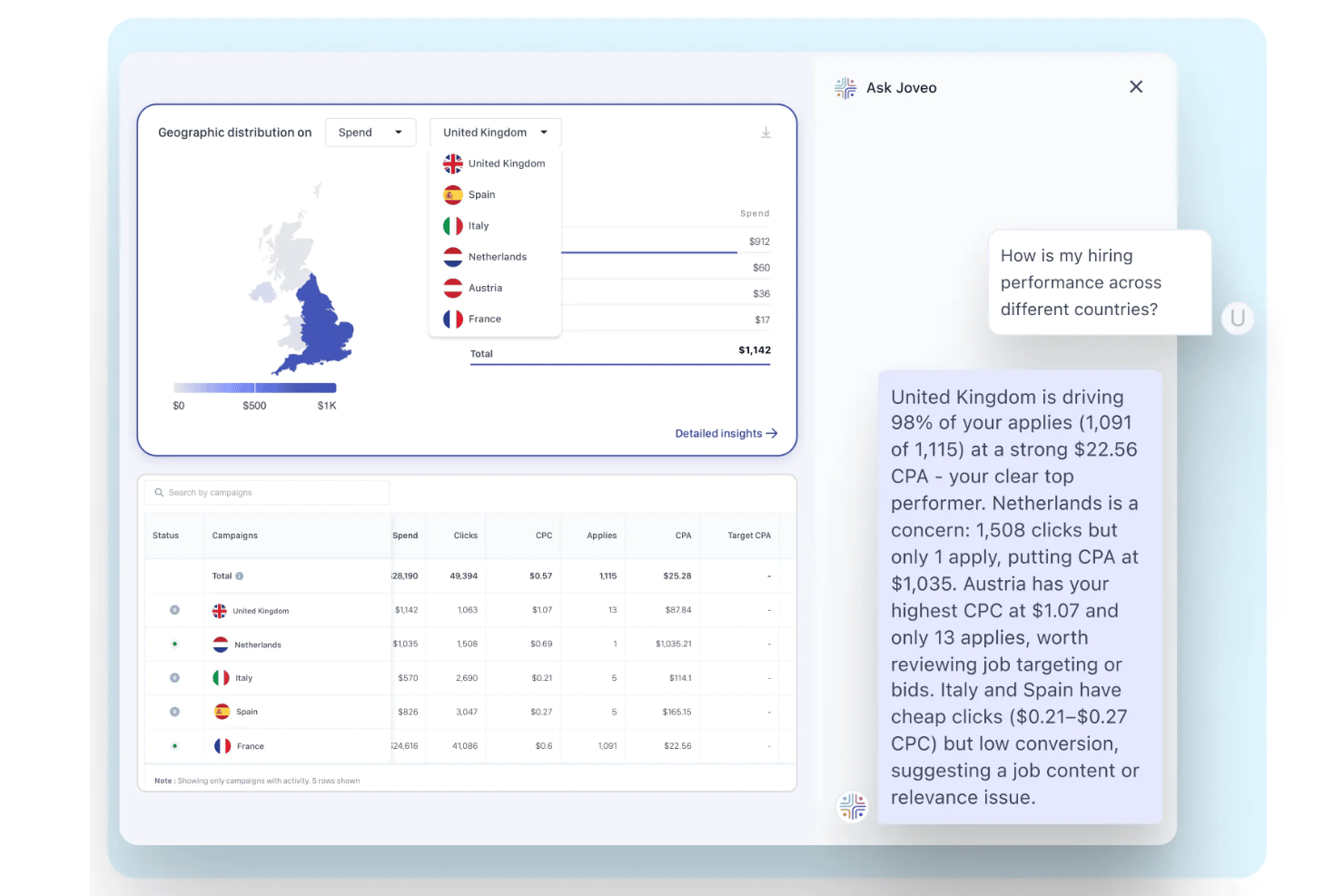
Joveo is a recruitment marketing platform that combines programmatic job advertising, AI-driven candidate nurture campaigns across email and SMS, career site building, and source-to-hire analytics.
Who Is Joveo Best For?
Joveo is a strong fit for enterprise talent acquisition teams, large staffing agencies, and RPOs managing high-volume hiring across multiple job categories and markets.
Why I Picked Joveo
I picked Joveo as one of the best because no other CRM tool on this list ties programmatic ad spend directly to candidate nurture in one platform. When I run an AI Talent Campaign, I describe my hiring goal in plain language and Joveo auto-generates a sequenced email and SMS workflow, then stops outreach the moment a candidate applies or responds. I also get spend, CPC, and CPA data alongside campaign engagement metrics in a single dashboard, which makes source-to-hire attribution genuinely actionable.
Joveo Key Features
- MOJO Career Sites: AI-powered career site builder for creating branded landing pages and application flows.
- ATS integrations: Native connections with 100+ ATS platforms like Workday, Greenhouse, and Bullhorn for streamlined data sync.
- Real-time analytics dashboard: Source-to-hire attribution and pipeline performance tracking across all channels.
- Consent management: Built-in controls for candidate communication preferences, opt-outs, and GDPR compliance.
Joveo Integrations
Joveo offers native integrations with Workday, Greenhouse, Bullhorn, SAP SuccessFactors, Oracle Taleo, Cornerstone, and iCIMS. An API is available for custom integrations.
Pros and Cons
Pros:
- Strong customer support across enterprise rollouts
- AI auto-allocates budget across thousands of job boards
- Spend visibility down to individual publisher level
Cons:
- Less useful as a standalone CRM for passive candidate nurture
- Noticeable learning curve for multi-brand setup

Best for enterprise-level hiring solutions

Greenhouse is an advanced hiring platform for enterprise-level needs, offering scalable workflows and strong tools to streamline hiring from sourcing to onboarding. It excels by providing a complete suite of tools tailored to the complex needs of large organizations, ensuring an efficient and effective hiring processes.
Why I picked Greenhouse: Greenhouse offers strong recruitment features that support scalable hiring processes, such as customizable workflows, advanced analytics, and seamless integrations with a wide range of HR tools. Its collaborative hiring approach and advanced candidate management system ensure efficiency and consistency in high-volume hiring, making it a preferred choice for large organizations.
Standout features & integrations:
Features include scalable workflows, structured hiring processes, and advanced reporting and analytics. It also offers tools for talent acquisition, candidate experience management, and onboarding.
Integrations include LinkedIn, Indeed, Glassdoor, Workday, ADP, BambooHR, Namely, SAP SuccessFactors, Slack, and Microsoft Teams.
Pros and Cons
Pros:
- Strong integrations
- Comprehensive analytics
- Scalable workflows
Cons:
- Complex setup
- Limited to larger organizations
New Product Updates from Greenhouse

Greenhouse Opens Candidate Insights and Talent Matching Assistants to Beta
Greenhouse opens Candidate Insights and Talent Matching assistants to beta for candidate questions and natural-language search. This helps recruiters review candidates and build searches faster. For more information, visit Greenhouse’s official site.
 .
.
Best for hiring workflow automation

Recruit CRM is an AI-driven recruitment software designed specifically for recruitment agencies, combining Applicant Tracking System (ATS) and Customer Relationship Management (CRM) functions to facilitate hiring processes.
Why I picked Recruit CRM: Its ATS spans the entire recruitment process, from sourcing candidates to collecting feedback. What makes it handy is the workflow automation, which lets you tailor hiring processes without needing to code. This means less time spent on repetitive tasks. There's also advanced resume parsing, which speeds up data extraction, and multi-lingual support, making it easier to handle diverse candidate profiles.
Standout features & integrations:
Features include candidate hotlists, email sequencing, task management, meeting scheduling, feedback collection, customizable pipelines, candidate self-service profile updates, and job board postings.
Integrations include Zapier, Integrately, Google Workspace, Microsoft Office 365, LinkedIn, Indeed, Monster, ZipRecruiter, Slack, Trello, Salesforce, and Mailchimp.
Pros and Cons
Pros:
- Good AI-driven features
- Users appreciate the effective reporting capabilities
- Highly customizable workflows
Cons:
- Key features, like workflow automation, are paid add-ons
- The mobile application lacks some features available on the desktop version

Best for combining recruitment marketing and ATS

TalentLyft is a recruitment software that integrates sourcing tools, recruitment marketing, talent CRM software, applicant tracking, and advanced hiring analytics into one platform.
Why I picked TalentLyft: TalentLyft uniquely integrates recruitment marketing with an applicant tracking system, making it a versatile tool for recruiters. This combination allows for a streamlined hiring process, from attracting top talents to tracking their progress. Additionally, its user-friendly interface, automation capabilities, and strong analytics help improve candidate engagement and streamline recruiting efforts.
Standout features & integrations:
Features include applicant tracking system, recruitment marketing, talent CRM, employee referrals, career site builder, social media recruiting, email automation, advanced analytics, customizable templates, and mobile recruiting.
Integrations include LinkedIn, Indeed, Glassdoor, Google for Jobs, Facebook, Twitter, Slack, Microsoft Outlook, Gmail, and Zapier.
Pros and Cons
Pros:
- Advanced analytics
- User-friendly interface
- Comprehensive toolset
Cons:
- Learning curve for new users
- Limited language support

100Hires
Best for streamlined recruitment for SMBs

100Hires is a candidate relationship management software designed for small and medium-sized businesses. It uses AI to attract, interview, and hire the best candidates at a faster rate.
Why I picked 100Hires: 100Hires provides AI-powered recruitment capabilities tailored specifically for SMBs. The software offers advanced AI functionalities like job description generation, candidate ranking, and automated follow-ups, which are important for small to medium-sized enterprises looking to optimize their recruitment processes.
Standout features & integrations:
Features include AI-generated job descriptions, application forms, interview questions, automated interview scheduling, and multi-channel campaigns with automated follow-ups. The software also provides a centralized database for all candidate information and advanced search and filter capabilities to identify the right talents.
Integrations include Gmail, Google Calendar, Zoom, Typeform, Slack, Microsoft Outlook, Twilio, Zapier, Gusto, and ZeroBounce.
Pros and Cons
Pros:
- Multi-channel campaigns
- Automated interview scheduling
- AI-generated job descriptions
Cons:
- Basic reporting capabilities
- Limited customization options


iCIMS Candidate Experience Management is a strong CRM software providing diverse solutions and products for businesses. It includes a suite of tools designed to streamline the recruitment process and enhance the candidate experience.
Why I picked iCIMS Candidate Experience Management: iCIMS Candidate Experience Management stands out for its ability to integrate various recruitment functions into a single, cohesive system. It offers a wide array of features, including marketing campaign automation, career sites, and AI-driven insights, which collectively provide a seamless and efficient recruitment process.
Standout features & integrations:
Features include marketing automation, career sites, digital assistant, and video studio.
Integrations include ADP, Infor, Microsoft Office, UKG, Workday, SAP SuccessFactors, Oracle, LinkedIn, Indeed, and Glassdoor.
Pros and Cons
Pros:
- Multi-channel engagement
- AI-driven insights
- Comprehensive talent cloud
Cons:
- May require extensive setup
- Limited customization in some features


SmartCRM is a recruitment CRM software designed to help businesses proactively source and nurture talent communities. It enables companies to build and manage pools of qualified candidates ahead of hiring demand.
Why I picked SmartCRM: SmartCRM stands out with its focus on proactive talent sourcing and nurturing, which is important for maintaining a steady pipeline of potential candidates. This tool is best for businesses that want to stay ahead in the competitive hiring landscape by continuously engaging with prospective talent.
Standout features & integrations:
Features include building talent pools organized around specific hiring needs, tracking campaign performance, and ensuring compliance with regulatory requirements through a single candidate record from CRM through ATS.
Integrations include LinkedIn, Indeed, Glassdoor, Google for Jobs, Monster, Facebook, Twitter, Slack, Microsoft Teams, and Zoom.
Pros and Cons
Pros:
- Talent pool management
- Compliance tracking
- Proactive talent sourcing
Cons:
- Not ideal for small businesses
- Limited user interface customization


Avature is a candidate relationship management software that offers a wide range of solutions for sourcing, attracting, engaging, tracking, hiring, managing, and retaining candidates.
Why I picked Avature: Avature is known for its exceptional ability to provide customizable recruitment marketing solutions. Unlike other tools, the software stands out due to its flexibility and advanced feature set that allows organizations to create tailored recruitment campaigns. This makes it the best choice for companies looking to personalize their recruitment marketing efforts.
Standout features & integrations:
Features include advanced recruitment marketing tools, customizable landing pages and microsites, and strong automation capabilities.
Integrations include LinkedIn, Facebook, Twitter, Google Analytics, SAP SuccessFactors, Workday, Oracle Taleo, Microsoft Dynamics, Salesforce, and Zoom.
Pros and Cons
Pros:
- Real-time analytics
- Advanced automation
- Highly customizable
Cons:
- Limited user interface customization
- Complex setup


Gem is a candidate relationship management system designed to help companies build hire-ready pipelines by discovering, nurturing, and engaging talent across their network.
Why I picked Gem: Gem provides standout AI-driven candidate rediscovery capabilities, which set it apart from other CRM tools. The software’s ability to leverage AI to suggest search queries and rediscover past candidates makes it a powerful tool for recruiters looking to maximize their existing talent pool. Along with maintaining current and past relationships, this feature helps teams reduce the time and effort spent on sourcing new talent, leading to faster hiring processes.
Standout features & integrations:
Features include AI-driven candidate rediscovery, dynamic talent pool creation, and enriched candidate profiles with automatic data refresh. It also offers advanced tracking of candidate interactions across multiple platforms, providing recruiters with a complete view of each candidate's journey.
Integrations include Greenhouse, Lever, LinkedIn, Indeed, Gmail, Outlook, Slack, Zoom, Microsoft Teams, and Workday.
Pros and Cons
Pros:
- Advanced tracking
- Dynamic talent pools
- AI-driven rediscovery
Cons:
- Complex setup process
- Limited customization in email templates
Other Candidate Relationship Management Software
Below is a list of additional candidate relationship management software that I shortlisted. While they didn’t make the top 10, they’re still valuable and worth further research.
- TextUs
For business text messaging and engagement
- SenseHQ
For automated talent engagement
- Rakuna Recruiting CRM
For campus and event recruiting
- Grayscale
For direct conversational messaging
- BambooHR®
For good HR management features
- Workable
For collaborative hiring features
- Lever
For integrated ATS and CRM capabilities
- Zoho Recruit
For Zoho integration
- SeekOut
For AI-powered talent sourcing
- HireVue
For video interviewing


Related HR Software Reviews
If you still haven't found what you're looking for here, check out these other related tools that we've tested and evaluated:
- HR Software
- Payroll Software
- Recruiting Software
- Employer of Record Services
- Applicant Tracking Systems
- Workforce Management Software
How I Evaluate Candidate Relationship Management Software
I split my evaluation into two layers: the baseline a CRM must meet to qualify—like talent pool segmentation and nurture workflows—and the differentiators that set one platform apart.
Core Functionality (Table Stakes For This List)
When I'm selecting tools for my list, I rank each one on a scale from 0 (does not offer the functionality) to 5 (excels in this area) for each core functionality listed below. Then, I calculate the tool's total score into a percentage. Each tool needs to achieve a minimum total score of 65% to be considered for inclusion.
- Talent Pool Segmentation: I evaluate how well each tool lets you organize candidates into dynamic pools—like separating frontend engineers from backend developers—with filters that auto-update as new candidates enter.
- Multi-Channel Outreach: Reaching passive candidates means meeting them where they are, so I check whether a platform supports personalized email, SMS, and social messaging with engagement tracking.
- Automated Nurture Campaigns: I look for drip sequences that trigger based on candidate behavior, such as re-engaging silver-medalist applicants when a similar role opens six months later.
- Candidate Database & Profiles: A searchable, centralized database with enriched profiles matters here—I evaluate whether interaction history, notes, and resume data roll up into a single candidate view.
- Sourcing & Capture Tools: From career site sign-up forms to browser extensions that pull LinkedIn profiles into the CRM, I check what capture methods each platform offers for building pipelines.
- Engagement Analytics & Reporting: Knowing which nurture campaigns drive actual applications is key, so I look for dashboards that tie outreach metrics to pipeline health and source performance.
Once I have a list of tools that meet this criteria, I consider what sets each platform apart.
Differentiating Factors (What Sets Vendors Apart)
Here's how I compare and contrast different vendors:
Standout Features
AI candidate matching is a major differentiator—I look for tools that automatically surface relevant profiles from your existing database when a new req opens, instead of forcing recruiters to source from scratch. A built-in career site builder also adds real value, letting employer branding teams launch talent network landing pages without needing a developer. Conversational chatbots take this further by engaging career site visitors around the clock and funneling them directly into segmented talent pools.
Beyond Features
ATS integration depth matters a lot here. A CRM that doesn't sync bi-directionally with your ATS creates duplicate records and blind spots, so I check whether platforms offer native connectors to systems like Greenhouse, iCIMS, or Workday. Compliance is another key factor—I evaluate whether tools include built-in consent management and configurable data retention policies, since candidate databases grow fast and privacy regulations vary by region. I also consider scalability, looking at whether a platform fits high-volume hourly hiring teams as well as specialized talent acquisition functions.
How To Choose Candidate Relationship Management Software
As you work through your own unique software selection process, keep the following points in mind:
- User-Friendly Interface: Candidate relationship management (CRM) software should have an intuitive and easy-to-use interface. This ensures that your hiring team can quickly adapt to the new system without extensive training. For example, a user-friendly interface can help recruiters easily navigate through candidate profiles, track application statuses, and manage communication, thereby reducing the learning curve and increasing productivity.
- Customization Options: Every organization has unique recruitment processes and requirements. Look for CRM software that offers customization options to tailor the system to your specific needs. This flexibility allows you to create custom workflows, fields, and reports that align with your recruitment strategy.
- Integration Capabilities: Ensure that the CRM software can integrate with your existing applicant tracking system (ATS), HR management system (HRMS), email platforms, and job boards. This integration facilitates smooth data flow and reduces manual data entry, saving time and minimizing errors.
- Reporting and Analytics: Strong reporting and analytics capabilities are essential for tracking and measuring the effectiveness of your recruitment efforts. Look for CRM software that provides detailed insights into key metrics such as time-to-hire, source of hire, and candidate engagement. These analytics help you identify areas for improvement and make data-driven decisions.
- Data Security and Compliance: Given the sensitive nature of candidate information, data security, and compliance are paramount. Choose CRM software that offers robust security measures such as data encryption, access controls, and compliance with privacy regulations like GDPR and CCPA.
Trends for Candidate Relationship Management Software
Here are some trends I’ve noticed for candidate relationship management software, plus what they might mean for the future. I sourced countless product updates, press releases, and release logs to tease out the most important insights.
- AI-Powered Candidate Matching: AI algorithms are now being used to match candidates with job openings more accurately. This reduces the time spent on manual screening and improves the quality of hires.
- Predictive Analytics: Predictive analytics tools forecast candidate success and retention. This helps HR teams make data-driven decisions and minimizes hiring risks.
- Mobile-First Platforms: Mobile-first platforms allow candidates to apply and communicate via their smartphones. This caters to the increasing number of mobile users and enhances the candidate experience.
- Integration with Social Media: Integration with social media platforms helps in sourcing passive candidates. It expands the talent pool and also provides more data points for candidate evaluation.
- Personalized Candidate Engagement: Personalized engagement tools tailor communication to individual candidates. This increases candidate satisfaction and also boosts the likelihood of acceptance.
These trends are shaping the future of candidate relationship management software. Staying ahead of changes in the human resources industry ensures that organizations can attract and retain top talent in an increasingly competitive market.
What is Candidate Relationship Management Software?
Candidate relationship management (CRM) software is a recruiting tool that helps HR teams and recruiters track, nurture, and engage potential job candidates in one centralized system. It’s used to replace manual processes like spreadsheets and emails, making it easier to build talent pools, automate follow-ups, and keep top candidates engaged until they’re ready to hire.
Features of Candidate Relationship Management Software
When shopping for a new candidate relationship management software, there are some key features you should keep in mind to help you get the most out of your solution. This includes:
- Automated Communication: This feature allows for timely and consistent communication with candidates, ensuring they are kept informed throughout the recruitment process.
- Candidate Database: A centralized database to store and manage candidate information, making it easy to access and update candidate profiles.
- Pipeline Management: This helps in tracking the progress of candidates through different stages of the recruitment process, ensuring no candidate is overlooked.
- Analytics and Reporting: Provides insights into recruitment metrics, helping to identify areas for improvement and measure the effectiveness of recruitment strategies.
- Integration with Job Boards: Seamlessly integrates with various job boards, making it easier to post job openings and manage applications from multiple sources.
- Customizable Templates: Offers pre-designed templates for emails and other communications, saving time and ensuring consistency in messaging.
- Mobile Accessibility: Allows recruiters to access the software from mobile devices, ensuring they can manage recruitment tasks on the go.
- Social Media Integration: Enables sharing job postings on social media platforms, expanding the reach to potential candidates.
- Collaboration Tools: Facilitates collaboration among recruitment team members, ensuring everyone is on the same page and can contribute effectively.
- Compliance Management: Ensures that the recruitment process adheres to legal and regulatory requirements, reducing the risk of non-compliance.
These features are vital for a successful candidate relationship management strategy, as they help streamline the recruitment process, improve communication with candidates, and provide valuable insights into recruitment performance. By leveraging these features, organizations can enhance their ability to attract and retain top talent.
Benefits of Candidate Relationship Management Software
With candidate relationship management software, companies are able to build stronger relationships with potential candidates, improve their hiring efficiency, and create a more engaging candidate experience. But these aren’t the only benefits of this software type. Other perks include:
- Enhanced Candidate Engagement: CRM software allows recruiters to maintain continuous and personalized communication with candidates. This ensures that candidates feel valued and informed throughout the recruitment process, leading to a more positive candidate experience.
- Improved Talent Pool Management: By centralizing candidate data, CRM software enables recruiters to manage and organize their talent pools. This makes it easier to track and analyze potential hires, ensuring that the best candidates are identified and engaged promptly.
- Streamlined Recruitment Processes: CRM software automates many repetitive tasks involved in recruitment, such as sending follow-up emails and scheduling interviews. This not only saves time but also reduces the likelihood of human error, making the recruitment process more efficient.
- Data-driven Insights: CRM software provides valuable analytics and reporting features that help recruiters track key metrics such as time-to-fill, candidate satisfaction, and recruitment ROI. These insights enable organizations to optimize their recruitment strategies and make informed decisions.
- Stronger Employer Branding: By using CRM software, organizations can create a consistent and professional image across all candidate interactions. This helps build a strong employer brand that attracts top talent and fosters long-term relationships with candidates.
By improving candidate engagement, streamlining recruitment tasks, providing data-driven insights, and strengthening employer branding, CRM software helps organizations attract and retain the best talent in a competitive job market.
Costs & Pricing of Candidate Relationship Management Software
Understanding the costs and pricing of candidate relationship software is essential for selecting the right tool for your needs. Below is a table outlining the different plans, prices, and features associated with candidate relationship software.
Plan Comparison Table for Candidate Relationship Management Software
| Plan Type | Average Price | Common Features |
| Free Plan | $0 | Limited candidate tracking, basic email templates, and restricted reporting capabilities. |
| Basic Plan | $20/month | Basic candidate tracking, resume parsing, email templates, and reporting tools. |
| Standard Plan | $50/month | All Basic Plan features, plus advanced analytics, customizable workflows, and integration with job boards. |
| Premium Plan | $100/month | All Standard Plan features, plus AI-driven insights, automated candidate outreach, and multi-user collaboration tools. |
| Enterprise Plan | Custom Pricing | All Premium Plan features, plus bespoke features, dedicated account management, and priority support. |
When choosing a plan, consider your budget, the scale of your recruitment needs, and the level of support you require. This way, you can be sure you’ll find the right software according to your specific needs, all within your given price range.
Candidate Relationship Management Software FAQs
Here are answers to common questions that can clarify how these tools work and help you choose the best option for your needs.
How does candidate relationship management software help in maintaining compliance with data protection regulations?
Candidate relationship management software often includes features designed to help maintain compliance with data protection regulations such as GDPR or CCPA. These features may include secure data storage, consent management, and the ability to easily delete or anonymize candidate data upon request. Additionally, audit trails and access controls ensure that only authorized personnel can access sensitive information.
Can candidate relationship management software assist in diversity and inclusion initiatives?
Yes, candidate relationship management software can support diversity and inclusion initiatives by providing tools to track and analyze diversity metrics within your talent pool. It can help identify gaps in your recruitment process and suggest strategies to attract a more diverse range of candidates. Additionally, CRM software can facilitate unbiased communication and engagement with candidates from various backgrounds.
What are the reporting and analytics capabilities of candidate relationship management software?
Candidate relationship management software typically offers advanced reporting and analytics capabilities. These tools allow you to track key performance indicators (KPIs) such as candidate engagement rates, time-to-hire, and source effectiveness. Customizable dashboards and reports provide insights into the effectiveness of your recruitment strategies, helping you make data-driven decisions to improve your hiring process.
How can candidate relationship management software enhance candidate engagement?
Candidate relationship management software enhances candidate engagement by automating personalized communication and follow-ups. It allows recruiters to send targeted messages, schedule regular check-ins, and provide timely updates on the hiring process. By maintaining consistent and meaningful interactions, CRM software helps build strong relationships with candidates, keeping them engaged and interested in your organization.
How does candidate relationship management software support collaborative hiring?
Candidate relationship management software supports collaborative hiring by providing a centralized platform where team members can share candidate information, feedback, and notes. It often includes features such as role-based access, task assignments, and collaborative evaluation tools. This ensures that all stakeholders are aligned and can contribute effectively to the hiring process, leading to more informed and cohesive hiring decisions.