

Employment Hero Review 2026: Pros, Cons, Features & Pricing


If you’re looking into making a switch to Employment Hero, there’s a good chance your current HR setup isn’t cutting it anymore. Payroll might feel harder to manage than it should be, employee records are scattered across tools, or onboarding new hires takes more time and follow-ups than expected. When those issues start piling up, it’s usually the point where teams begin searching for a more reliable HR software solution.
This review takes a practical look at Employment Hero to help you figure out if it will solve the unique problems your business is facing.
Employment Hero Evaluation Summary

- Pricing upon request
- Free demo available
Why Trust Our Software Reviews
Employment Hero Overview
Employment Hero is an all-in-one HR, payroll, hiring, and employee experience platform designed primarily for small to mid-sized businesses.
It brings together core people operations such as payroll processing, employee records, onboarding, time and leave management, and hiring into a single system, with optional add-ons like Employer of Record and HR advisory services. The platform is especially well-suited for teams that want standardized HR workflows and self-service tools without the complexity of enterprise-grade HR software.
pros
-
Strong payroll and regulatory compliance capabilities
-
Strong fit for SMBs with standardized HR needs
-
All-in-one platform for core people operations
cons
-
Moving data from a previous platform can be time-intensive
-
Strong regional focus may be limiting for some teams
-
Limited flexibility for complex or highly customized HR workflows
Is Employment Hero Right For Your Needs?
Who Would be a Good Fit for Employment Hero?
Employment Hero offers a solution for various industries. This means its features such as payroll automation, HR compliance, onboarding, and employee management, are flexible enough to span a wide range of use cases, like tech, construction, healthcare, and professional services.
-
Software/IT Companies
Best for growing tech teams that need structured onboarding, payroll, and employee records without adding HR overhead.
-
Tech Startups
Well-suited for startups scaling headcount quickly and needing structured onboarding, payroll, and employee records early on.
-
Construction & Manufacturing Companies
Supports payroll, compliance documentation, and workforce management across operational and site-based teams.
-
Hospitality Businesses
Ideal for shift-based teams that need accurate payroll, leave tracking, and employee self-service.
-
Healthcare & Childcare Providers
Built to support onboarding, documentation, and workforce management in care-focused, compliance-heavy environments.
-
Professional & Business Services Firms
Fits agencies, consultancies, and service firms that want simple, centralized HR and payroll processes.
Who Would be a Bad Fit for Employment Hero?
Employment Hero may not be the right choice for organizations with highly complex HR structures, advanced customization requirements, or deep analytics needs. While it serves many industries, its platform is intentionally designed for standardized HR workflows rather than enterprise-grade or highly bespoke implementations.
-
Large Enterprises
Organizations with multi-entity structures, complex approval workflows, or global HR requirements may outgrow the platform.
-
Heavily Regulated or Specialized Compliance Environments
Industries requiring highly specialized regulatory systems beyond standard HR compliance may need more tailored solutions.
-
Advanced People Analytics Teams
Teams that rely on predictive analytics, custom dashboards, or deep workforce modeling may find reporting limited.
-
Highly Customized HR Operations
Businesses with unique HR policies or non-standard workflows may feel constrained by predefined processes.
-
API-First or Developer-Led HR Stacks
Organizations that require extensive custom integrations or automation logic may find Employment Hero less flexible.
-
Enterprises With Established HR Suites
Companies already using mature enterprise HR systems may see limited value in switching to a more standardized SMB-focused platform.
How We Test & Score Our Tools
We’ve spent years building, refining, and improving our software testing and scoring system. The rubric is designed to capture the nuances of software selection and what makes a tool effective, focusing on critical aspects of the decision-making process.
Below, you can see exactly how our testing and scoring works across seven criteria. It allows us to provide an unbiased evaluation of the software based on core functionality, standout features, ease of use, onboarding, customer support, integrations, customer reviews, and value for money.
Core Functionality (25% of final score)
The starting point of our evaluation is always the core functionality of the tool. Does it have the basic features and functions that a user would expect to see? Are any of those core features locked to higher-tiered pricing plans? At its core, we expect a tool to stand up against the baseline capabilities of its competitors.
Standout Features (25% of final score)
Next, we evaluate uncommon standout features that go above and beyond the core functionality typically found in tools of its kind. A high score reflects specialized or unique features that make the product faster, more efficient, or offer additional value to the user.
We also evaluate how easy it is to integrate with other tools typically found in the tech stack to expand the functionality and utility of the software. Tools offering plentiful native integrations, 3rd party connections, and API access to build custom integrations score best.
Ease of Use (10% of final score)
We consider how quick and easy it is to execute the tasks defined in the core functionality using the tool. High scoring software is well designed, intuitive to use, offers mobile apps, provides templates, and makes relatively complex tasks seem simple.
Onboarding (10% of final score)
We know how important rapid team adoption is for a new platform, so we evaluate how easy it is to learn and use a tool with minimal training. We evaluate how quickly a team member can get set up and start using the tool with no experience. High scoring solutions indicate little or no support is required.
Customer Support (10% of final score)
We review how quick and easy it is to get unstuck and find help by phone, live chat, or knowledge base. Tools and companies that provide real-time support score best, while chatbots score worst.
Customer Reviews (10% of final score)
Beyond our own testing and evaluation, we consider the net promoter score from current and past customers. We review their likelihood, given the option, to choose the tool again for the core functionality. A high scoring software reflects a high net promoter score from current or past customers.
Value for Money (10% of final score)
Lastly, in consideration of all the other criteria, we review the average price of entry level plans against the core features and consider the value of the other evaluation criteria. Software that delivers more, for less, will score higher.
Core Features
Payroll Software
Employment Hero’s payroll software automates pay runs, tax calculations, and statutory reporting, helping businesses reduce manual payroll errors and stay compliant.
HR Software (Employee Records & HR Admin)
The HR software centralizes employee records, contracts, documents, and policies in one system. This reduces fragmented data and supports consistent HR processes across teams.
Onboarding Software
Employment Hero’s onboarding tools automate contracts, checklists, and documentation for new hires, helping teams standardize onboarding and reduce manual follow-ups.
Time, Attendance & Leave Management
The platform includes time and attendance tracking alongside leave management, allowing employees to submit requests while managers track hours and balances accurately.
Hiring & Applicant Tracking
Employment Hero provides hiring tools that include job posting, applicant tracking, and candidate management, helping teams move candidates through recruitment in one system.
HR Reporting
Built-in HR reporting tools give teams visibility into workforce data, helping HR and leadership make informed decisions without exporting data across multiple systems.

Standout Features
Employment Operating System (EmploymentOS)
EmploymentOS brings HR, payroll, hiring, and employee experience together into a single platform, reducing the need for multiple disconnected tools. This unified approach is a key differentiator for Employment Hero.
Employer of Record (EOR)
Employment Hero’s Employer of Record service allows businesses to hire employees in other countries without setting up local entities, handling compliance and payroll on their behalf.
Ease of Use
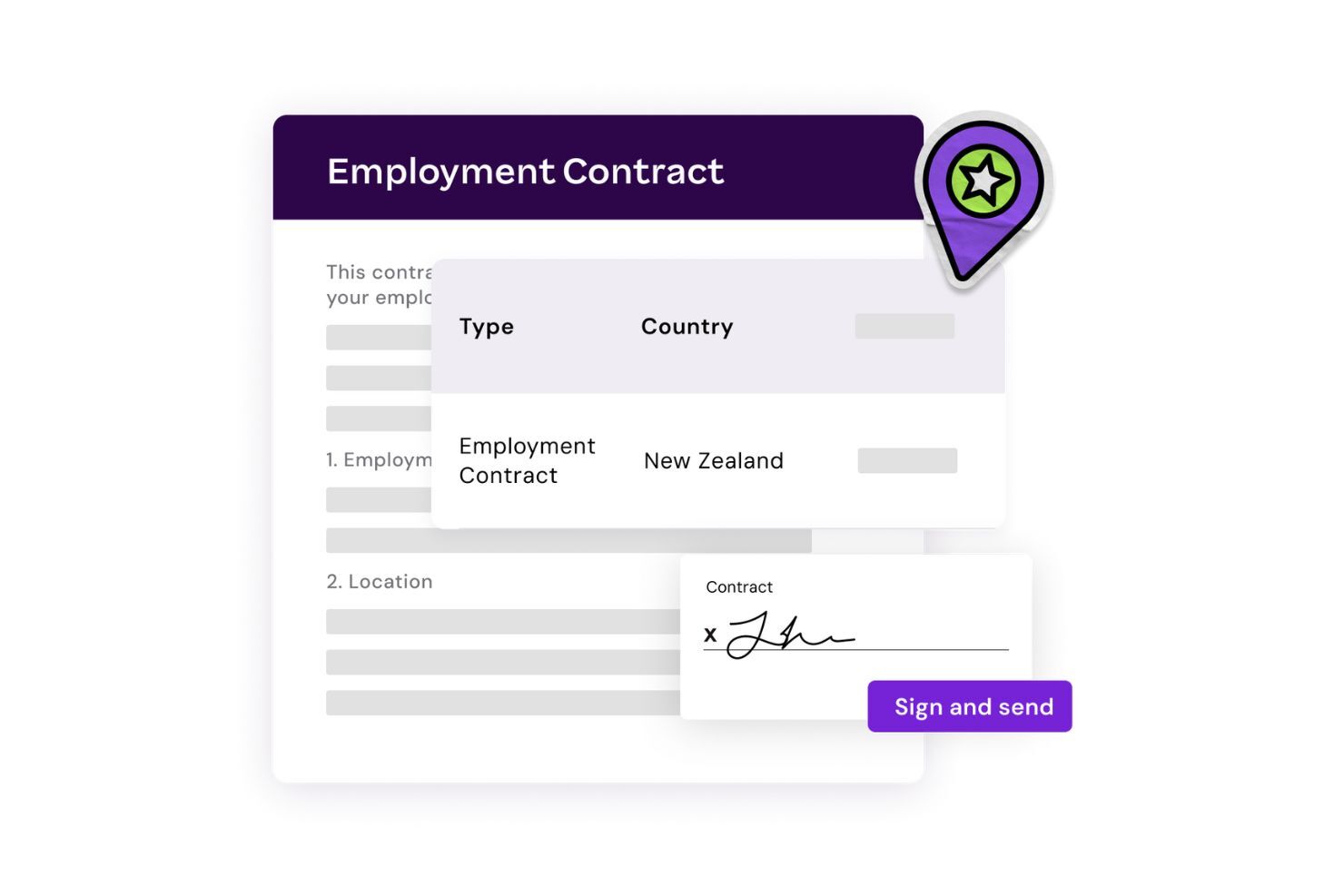
Users frequently describe the software as easy to navigate for day-to-day HR tasks, particularly payroll, leave management, and employee self-service. This centralized approach makes Employment Hero approachable for small to mid-sized teams that want to manage core people operations without relying on multiple disconnected tools or complex HR systems.

Onboarding
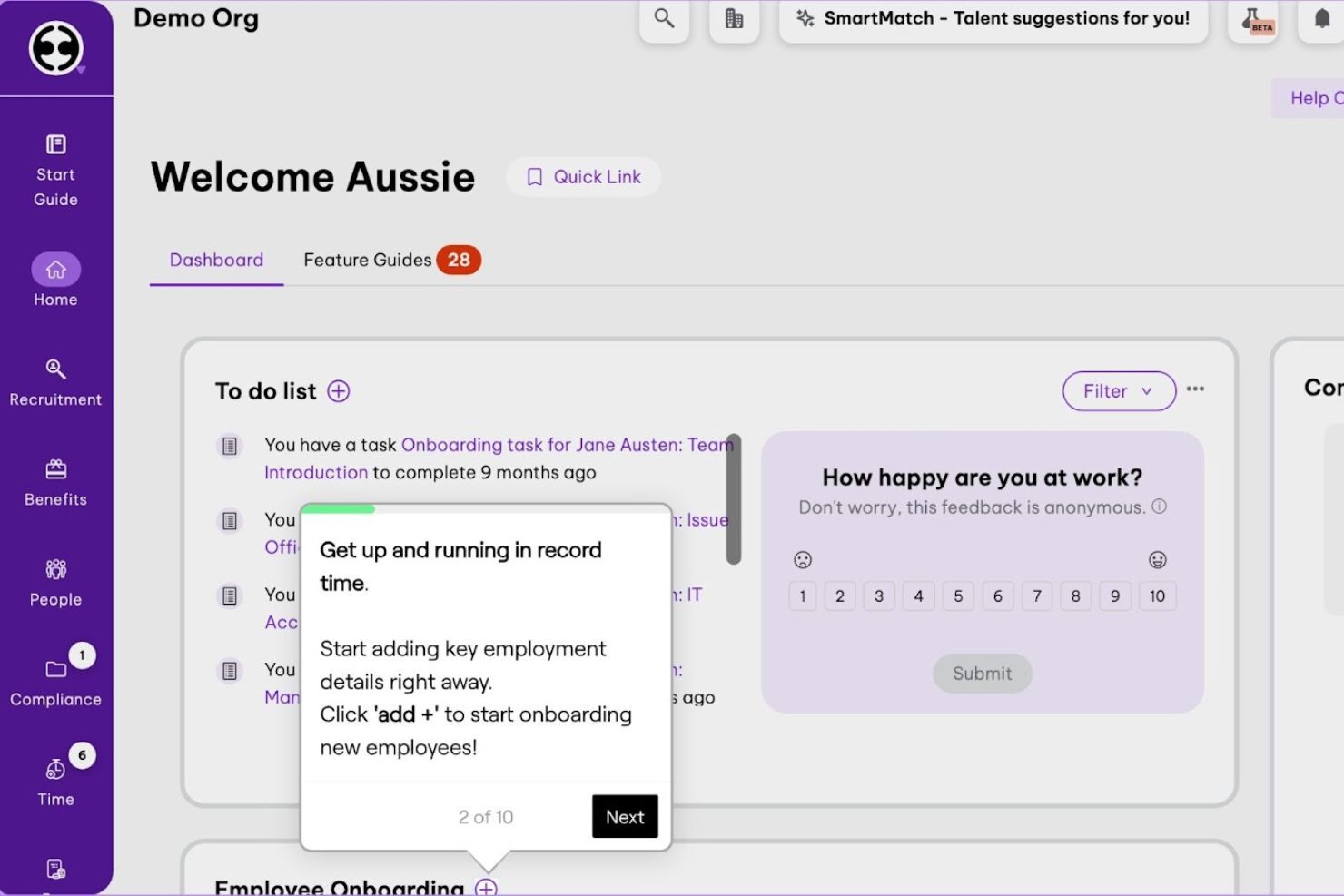
Employment Hero onboards new customers through self-guided resources, including video walkthroughs, an interactive onboarding demo, and practical setup guidance shared through its blog. This self-paced approach helps teams explore core features and configure the platform without relying on dedicated one-on-one onboarding.
Customer Support
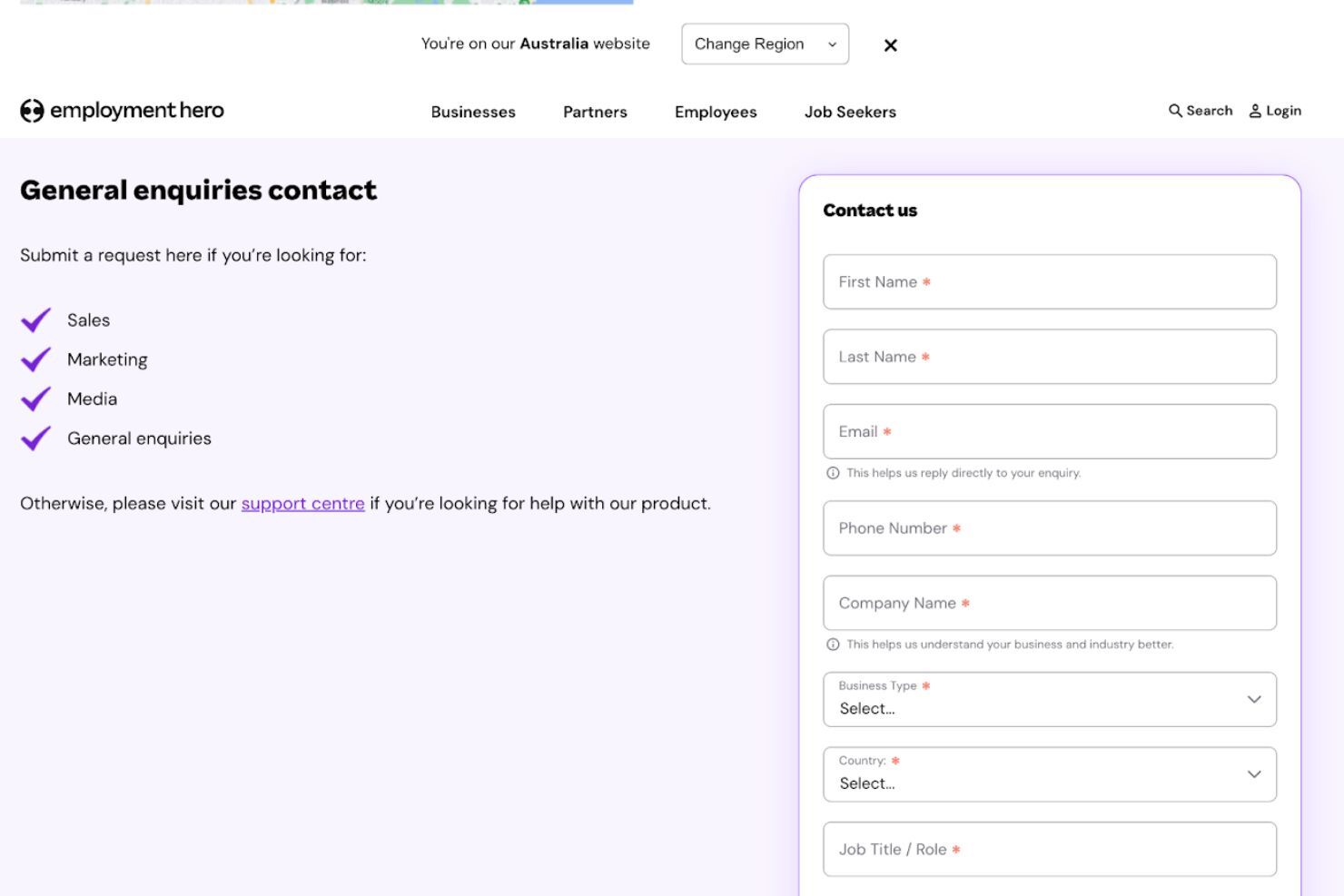
Employment Hero primarily provides support through its online Help Centre, which includes searchable articles, guides, and video resources for HR and payroll topics. Direct assistance is handled through enquiry forms and support tickets rather than real-time channels, so response times can vary. This makes the platform best suited for teams that are comfortable using self-service resources for most support needs.
Integrations
Employment Hero integrates with tools like Xero, MYOB, QuickBooks, Reckon, Deputy, Tanda, Google Workspace, and Microsoft 365. It also offers an API and supports connections through Zapier, enabling connections with additional third-party tools where direct integrations are not available.

Value for Money
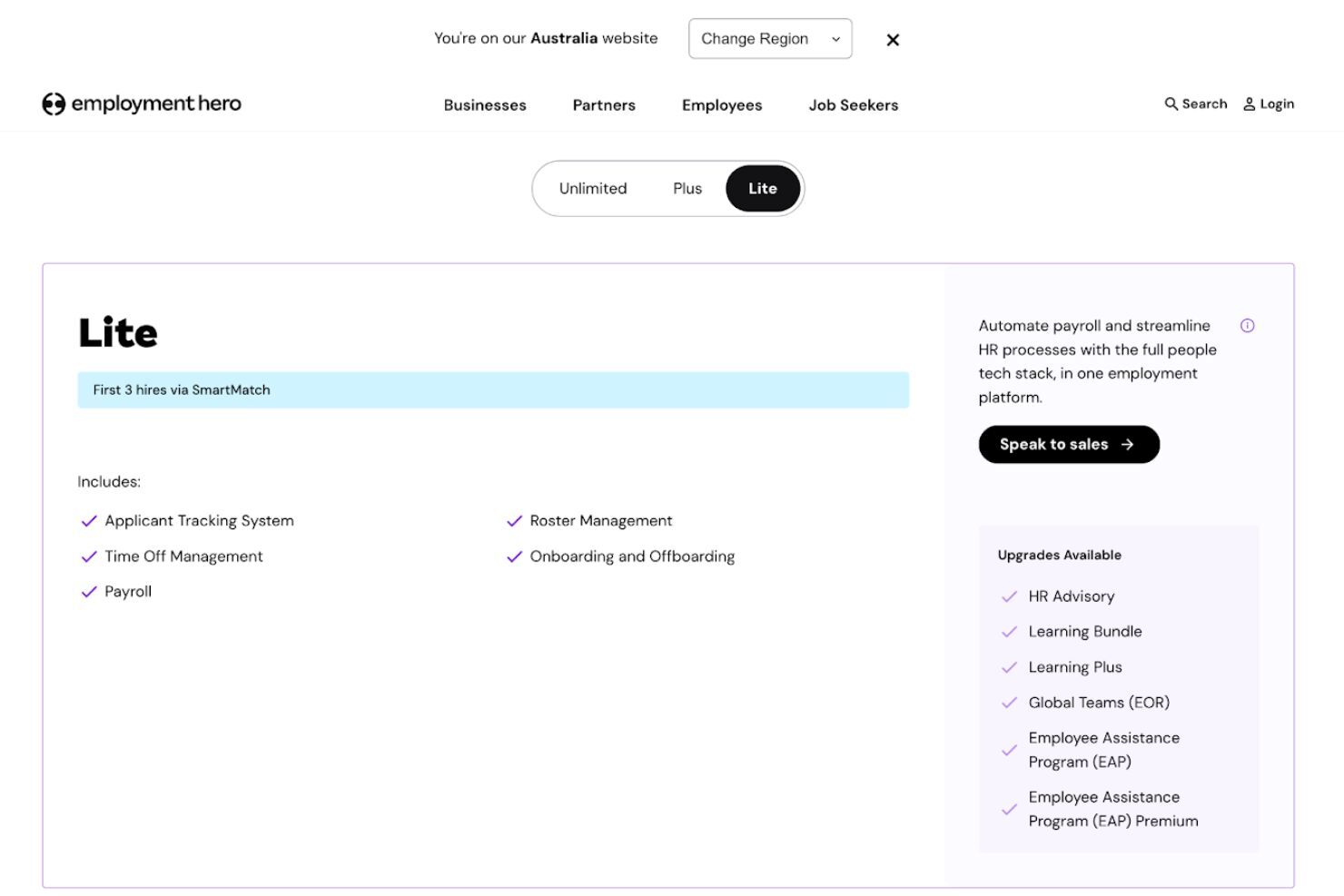
Employment Hero uses a tiered pricing model with Lite, Plus, and Unlimited plans, alongside optional add-ons such as HR advisory, learning, and Employer of Record (EOR) services. This approach lets businesses start with core HR and payroll features and add more as their needs grow, making it suitable for small to mid-sized teams.
- Lite: Covers essential tools like applicant tracking, payroll, time off management, roster management, and onboarding/offboarding.
- Plus: Expands on Lite with more advanced people management and workforce features.
- Unlimited: Provides the full set of Employment Hero’s platform features with added support.
Employment Hero Specs
- 2-Factor Authentication
- API
- Application Tracking
- Attendance Tracking
- Batch Permissions & Access
- Compliance Tracking
- Dashboard
- Data Export
- Data Import
- Data Visualization
- Employee Database
- Employee Engagement
- Employee Incentive Management
- Employee Onboarding
- Employee Training
- Expense Tracking
- External Integrations
- Feedback Management
- Multi-User
- Notifications
- Payroll
- Scheduling
- Self-service Portal
- Timesheets
- Travel Management
- Vacation & Absence Calendar
Employment Hero FAQs
How does Employment Hero handle data security and compliance?
Can Employment Hero support remote teams effectively?
What kind of customer support can I expect from Employment Hero?
Is Employment Hero suitable for a growing business?
How does Employment Hero support employee engagement?
Does Employment Hero have a mobile app?
How does Employment Hero streamline payroll processes?
What resources are available for training new users on Employment Hero?
Employment Hero Company Overview & History
Employment Hero was founded in 2014 by employment lawyer Ben Thompson and Dave Tong with the goal of making employment simpler for businesses and their teams. Headquartered in Australia, the company offers an all-in-one platform covering HR, payroll, hiring, and employee experience. Today, Employment Hero supports over 300,000 businesses globally, with customers across Australia, New Zealand, the UK, Singapore, Malaysia, and Canada.
Employment Hero Major Milestones
- 2014: Founded by Ben Thompson and Dave Tong in Australia.
- 2020: Launched in the United Kingdom as part of its international expansion.
- 2020: Expanded into Singapore and Malaysia (APAC growth).
- 2023: Reached over 300,000 businesses using the platform globally.
- 2024: Announced its acquisition of Employment Innovations (Australia and New Zealand payroll and HR services provider).
- 2025: Entered Canada via the acquisition of Humi, expanding its HR and payroll footprint there.