

NEO vs. Oyster HR: Comparison & Expert Reviews For 2026


Hiring across borders brings challenges around local labor laws, payroll, and compliance. If you’re comparing NEO and Oyster HR, you’re likely evaluating different employer of record (EOR) models to support international hiring without setting up local entities.
While both platforms enable global employment, they take fundamentally different approaches. Oyster HR operates as a traditional, single-vendor EOR platform with built-in HR workflows, while NEO offers a fresh alternative, using a marketplace model that connects businesses directly with vetted local EOR providers. Understanding these differences helps clarify which solution fits your team’s priorities.
In this comparison, I’ll walk you through how NEO and Oyster HR approach global employment so you can see which one fits your team’s way of working.
NEO vs. Oyster HR: An Overview
NEO

Oyster HR
Why Trust Our Software Recommendations
Our team has been testing and reviewing software since 2012. As HR experts ourselves, we know how difficult—and important—it is to choose the right software.
For this guide, we evaluated tools using hands-on testing and independent research, scoring tools using our selection criteria. We also draw on insights from industry thought leaders and practicing HR experts.
Our reviews reflect our human editorial judgment, not a sales pitch.
Expert reviewers:
NEO vs. Oyster HR Pricing Comparison
| NEO | Oyster HR | |
|---|---|---|
| Free Trial | Free plan available | Free demo available |
| Pricing | From $49/user/month | From $699/user/month |
NEO vs. Oyster HR Pricing & Hidden Costs
NEO and Oyster HR use different pricing structures that affect cost visibility and flexibility. NEO charges a platform fee and separates local EOR service fees, which are paid to vetted in-country providers at local market rates. FX conversion costs (typically 0.5 to 1.5%) are disclosed separately, giving teams clearer insight into country-level pricing but requiring comparison by location.
Oyster HR uses bundled, per-employee pricing that includes EOR services within a single monthly fee. The price may include markups on employment services and FX fees. The bundled upfront cost is helpful for simplifying budgeting, but it offers less transparency into how costs are composed. Teams should consider whether they value transparent local pricing or predictable bundled costs when choosing between the two.
NEO vs. Oyster HR Feature Comparison
With NEO’s vendor-agnostic model, you manage international hires through a single platform while working with vetted local EOR providers by country. Its centralized payroll data, contract lifecycle management, and country-specific compliance guidance help you handle employment changes without setting up local entities, which is useful when your team needs to move quickly while staying aligned with local rules.
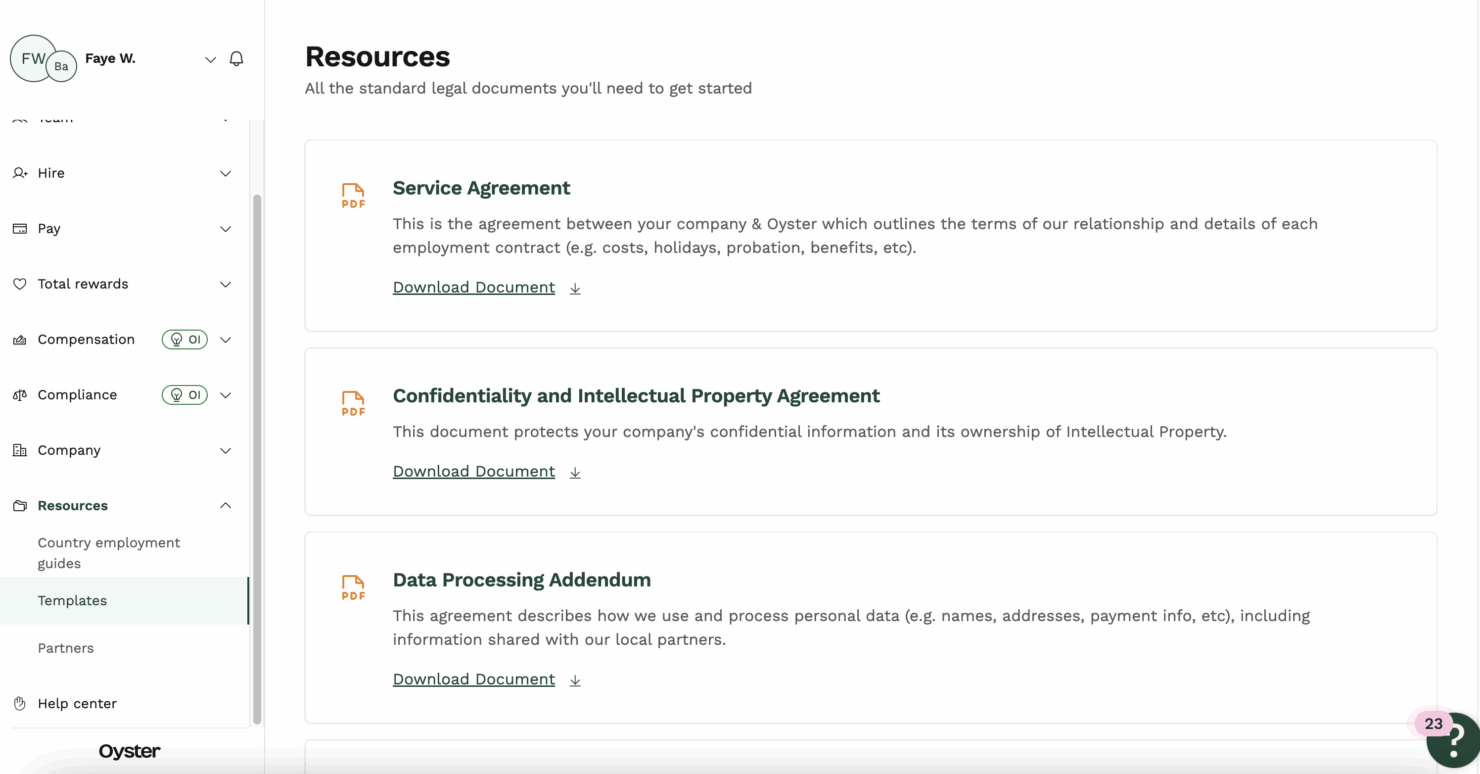
By comparison, Oyster HR’s automated onboarding, multi-country payroll, and in-country HR support are great for teams that want more built-in structure, especially when you’re hiring at scale and need guided workflows for compliance, benefits, and offboarding. While both support global employment, Oyster HR provides a direct, single-vendor approach, whereas NEO keeps things flexible and allows you to choose your EOR partner and pay local rates.
| NEO | Oyster HR | |
|---|---|---|
| API | ||
| Data Export | ||
| Data Import | ||
| Data Visualization | ||
| Employee Database | ||
| Employee Onboarding | ||
| External Integrations | ||
| Multi-Currency | ||
| Multi-User | ||
| Notifications | ||
| Payroll | ||
| Scheduling | ||
| Tax Management | ||
| Timesheets |
NEO vs. Oyster HR Integrations
| Integration | NEO | Oyster HR |
|---|---|---|
| BambooHR | ❌¹ | ✅ |
| Workday | ❌¹ | ✅ |
| HiBob | ❌¹ | ✅ |
| Greenhouse | ❌¹ | ✅ |
| Okta | ❌¹ | ✅ |
| NetSuite | ❌¹ | ✅ |
| QuickBooks Online | ❌¹ | ✅ |
| API | ✅¹ | ✅ |
| Zapier | ❌¹ | ✅ |
¹ NEO does not publicly list native integrations. API access and custom integrations may be available depending on plan and use case.
NEO’s paid plans include access to integrations and an API, but specific native connectors aren’t publicly listed, so you’ll need to confirm what’s available with their team. Oyster HR, by contrast, has prebuilt HRIS and ATS integrations that are useful if your HR work depends on keeping hiring, payroll, and employee data in sync across tools.
NEO vs. Oyster HR Security, Compliance & Reliability
| Factor | NEO | Oyster HR |
|---|---|---|
| Data Privacy | Sensitive workforce data is handled within the platform, but specific encryption standards are not clearly documented in public materials. | Operates under GDPR requirements and states the use of encryption to protect employee and company data. |
| Compliance | Compliance is handled through vetted local EOR partners that manage country-specific employment rules. | Compliance is managed through localized contracts maintained by internal legal and compliance teams. |
| System Reliability | Runs a centralized platform for managing payroll, contracts, and workforce data across countries. | Uses a globally distributed platform designed to support international payroll and employment workflows. |
| HR Guidance | Compliance support is provided through the platform and local partner expertise rather than in-house advisors. | Provides access to in-country HR specialists who advise on local labor laws and employment practices. |
| Regulatory Updates | Employment and payroll changes are reflected based on updates from local EOR partners. | Contracts and compliance processes are updated to reflect regulatory changes in supported countries. |
When it comes to security and compliance, NEO centralizes workforce data and relies on vetted local EOR partners to handle country-specific labor laws and regulatory changes, which keeps risk manageable without heavy internal oversight. By contrast, Oyster HR combines strong data protection with in-house legal expertise and in-country HR specialists who actively update contracts and guide you through local compliance requirements.
NEO vs. Oyster HR Ease of Use
| Factor | NEO | Oyster HR |
|---|---|---|
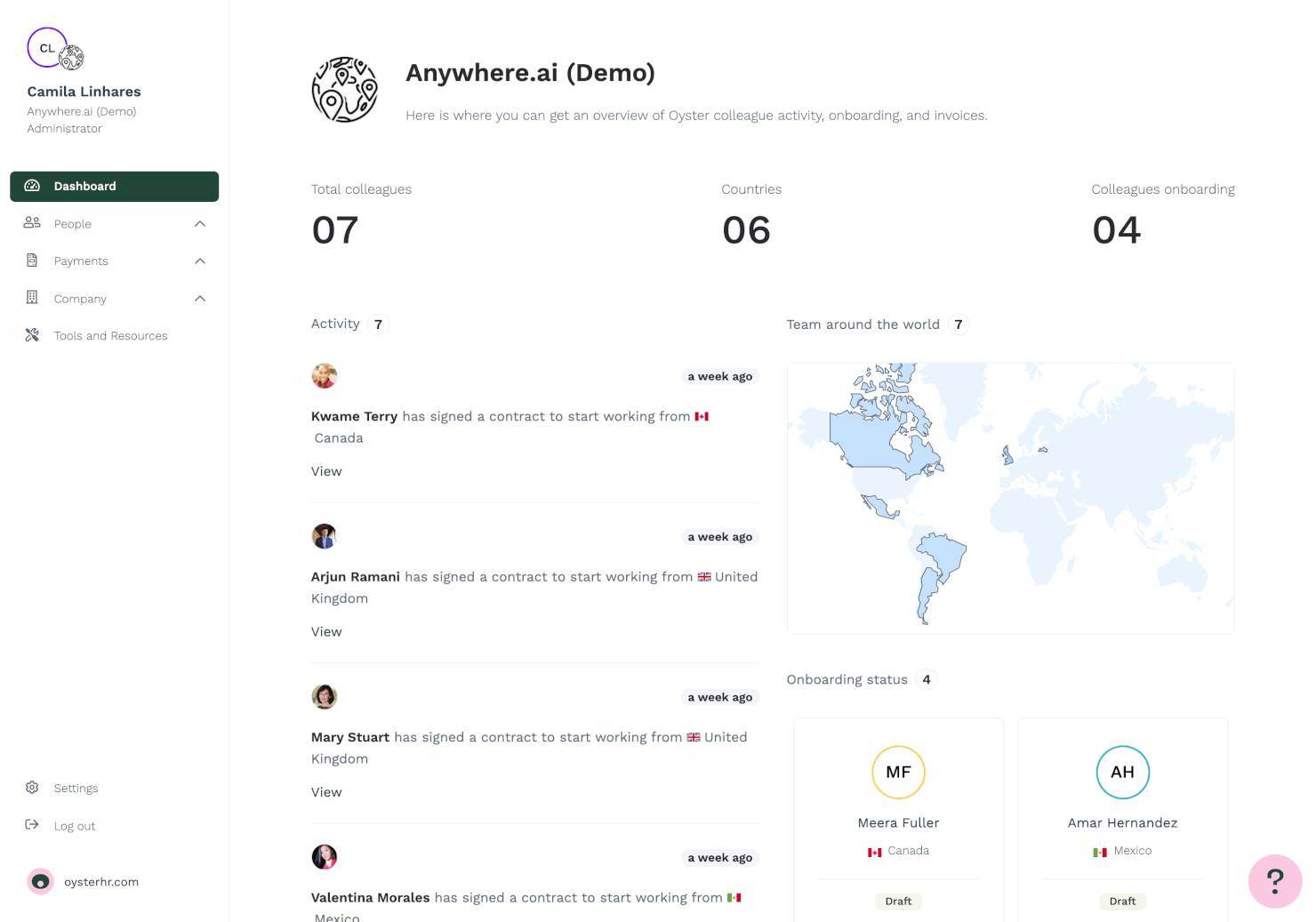
| User Interface | Uses a clean, minimal dashboard focused on core EOR tasks like payroll and contracts. | Uses a polished interface with clearer separation between hiring, payroll, and compliance. |
| Setup | Is quick to access but expects you to configure workflows through exploration and support. | Provides structured setup steps that guide you through early configuration. |
| Onboarding Experience | Doesn’t include formal onboarding guides, so setup relies on self-navigation and support. | Includes guided onboarding flows and in-platform prompts for key actions. |
| Workflow Guidance | Keeps workflows lean but may require extra clicks to surface detailed information. | Uses guided workflows that reduce guesswork for common HR tasks. |
| Customer Support | Support is primarily handled through a contact form and account-based assistance for paid plans. | Offers more hands-on support, including access to HR specialists for country-specific needs. |
NEO is easy to use if you prefer a lightweight platform and are comfortable setting things up with minimal guidance, though the setup can feel hands-off unless you’re on a paid plan with added support. By comparison, Oyster HR may feel easier for day-to-day HR work if you want clearer workflows, guided onboarding, and more support built directly into the experience. Additionally, if you don't want to spend time choosing which local EOR provider to work with, Oyster's traditional single-vendor approach may make the overall process feel a bit more streamlined (though less flexible than NEO).
NEO vs Oyster HR: Pros & Cons
NEO
- Lower-cost structure than bundled EOR platforms by connecting you with local providers at market rates.
- No vendor lock-in by country—NEO’s model lets you switch EOR providers any time.
- Payroll data consolidation, onboarding, contracts, and compliance are handled in one place, which keeps global hiring organized.
- Teams need to evaluate and select local EOR partners rather than relying on one default provider, which can add a small amount of upfront planning.
- Though providers in NEO’s marketplace are vetted, service quality may still vary by country.
- Not an all-in-one solution if you’re looking for more advanced HR features built in, like performance management, engagement, and learning and development.
Oyster HR
- Onboarding: Oyster HR simplifies the onboarding of new hires with compliant employment contracts and digital signing.
- Benefits management: Oyster HR provides localized benefits packages that are customized for each employee's country.
- Payroll processing: Oyster HR handles all aspects of global payroll, including taxes, deductions, and payments made in local currencies.
- Limited countries: Oyster HR supports hiring employees in 180 countries, fewer than other global EOR providers.
- No PEO option: Oyster HR only offers employer-of-record services and does not provide a professional employer organization (PEO) co-employment model.
- Separate platform: Oyster HR is a standalone platform that does not directly integrate with some popular HR and payroll systems.
Best Use Cases for NEO and Oyster HR
NEO
- Global Employers Well-suited for companies hiring employees across multiple countries that want compliant employment without opening local entities or paying bundled EOR platform premiums. By connecting employers directly with vetted local providers, NEO offers clearer cost visibility and more flexibility than traditional single-vendor EOR platforms.
- EOR Providers EOR providers can use NEO as an underlying infrastructure to manage employment operations, payroll coordination, and compliance across regions. Rather than building proprietary systems, providers can rely on NEO’s platform to standardize workflows while maintaining direct relationships with their clients.
- Managed Service Providers Managed Service Providers (MSPs) benefit from NEO’s marketplace model when supporting distributed workforces across multiple countries. The platform helps MSPs centralize payroll and compliance oversight while working with local employment partners instead of maintaining in-house expertise in every jurisdiction.
- Staffing Teams Staffing and recruitment firms can place international hires more efficiently by leveraging local EOR partners through NEO. Contracts, payroll coordination, and compliance are managed centrally, reducing friction when expanding placements across new countries or clients.
- Finance & Procurement Teams Finance and procurement teams benefit from NEO’s transparent cost structure, where local employment fees, FX conversion costs, and platform fees are clearly separated. This makes it easier to forecast global payroll spend, compare providers by country, and avoid the opaque pricing common with bundled EOR platforms.
- Scaling Organizations (Small to Large) NEO works well for smaller teams getting started with international hiring, thanks to its free platform access for up to three employees. This makes it possible to access global employment at local rates and smaller FX fees without upfront platform costs. As headcount grows, larger organizations can benefit from the same marketplace model at scale with a modest platform fee, where pricing transparency, provider flexibility, and custom integrations support more complex global hiring needs.
Oyster HR
- Remote teams Oyster HR makes hiring and paying remote workers in over 180 countries hassle-free while complying with local employment laws.
- Startups Oyster's self-service platform and transparent pricing are well-suited for fast-moving startups looking to scale their global team quickly.
- HR departments Oyster's dashboard gives HR teams visibility into their global workforce for headcount planning, payroll, and people analytics.
- Tech companies Software and tech firms with geographically distributed teams find Oyster's automated compliance, payroll, and benefits administration across 180+ countries very helpful.
- Fast Growth Companies experiencing rapid headcount growth globally can use Oyster to onboard new hires in days instead of months.
- Emerging markets Oyster HR simplifies hiring with a global network of pre-screened, market-savvy candidates.
Who Should Use NEO, and Who Should Use Oyster HR?
From my perspective, NEO is a strong fit if you want a flexible way to hire internationally without setting up local entities or getting locked into a single global EOR. Its vendor-agnostic global marketplace gives you visibility into local costs and the freedom to work with vetted in-country providers, while using one platform to manage payroll and compliance. This works well for global employers, staffing teams, MSPs, and finance-led teams that prioritize cost clarity, speed, and paying people correctly over paying premium prices for advanced HR features or deep integrations.
On the other hand, Oyster HR is a stronger fit if your HR team manages fast-growing or remote-first teams and wants more structure built into the platform while only relying on a single EOR provider. It works well when you value guided onboarding, automated compliance, and benefits management. If your team doesn't want to choose their own partners, wants everything bundled into one platform, and doesn't mind paying a bit more of a premium price, Oyster would be a good fit for you.
Differences Between NEO and Oyster HR
| NEO | Oyster HR | |
|---|---|---|
| Approach | Provides a vendor-agnostic approach, connects you with vetted local EOR partners that act as the legal employer by country. | Acts as the primary EOR in supported countries. You are locked into one vendor. |
| Compliance | Relies on local EOR partners to apply and maintain country-specific labor law compliance. | Uses localized contracts and automated workflows to support country-specific compliance. |
| Feature Depth | Focuses on payroll data consolidation, contracts, compliance, and employee records without deep HR program tooling. | Includes broader HR workflows like onboarding, benefits administration, and offboarding. |
| Integrations | Does not publicly list native integrations and requires confirmation of APIs or connectors with the team. | Publicly lists prebuilt integrations with HR and payroll systems for data syncing. |
| Pricing Model | Separates platform fees, local EOR service fees, and FX costs for country-level visibility. | Uses bundled per-employee pricing that includes EOR services with potential hidden markups (like FX fees). |
| Visit NEOOpens new window | Read Oyster HR ReviewOpens new window |
Similarities Between NEO and Oyster HR
| Contract Management | Both support country-specific employment contracts, helping you manage localized hiring paperwork across regions. |
|---|---|
| Hiring Model | Both let you hire international employees without setting up local legal entities, reducing legal and administrative overhead. Keep in mind that the approach each platform takes is different: NEO provides a vendor-agnostic global marketplace for you to choose your EOR partner, while Oyster is a single-vendor EOR provider. Either way, the end goal is to hire global employees without setting up local entities. |
| Payroll | Both support paying employees across countries while handling local payroll rules and payment requirements. |
| Scalability | Both are built to support growing global teams, making it easier to add new countries and hires as your workforce expands. |
| Visibility | Both provide a single platform for managing employee records, contracts, and employment status across countries. |
| Visit NEOOpens new window Read Oyster HR ReviewOpens new window | |