YunoJuno Review: Pros, Cons, Key Features and Pricing



YunoJuno is a freelancer management system for companies that hire, contract, and pay independent workers at scale across multiple regions. I'd consider it if your team needs a single system to source vetted freelancers, run compliant contracts and IR35 assessments, and handle global payments without stitching together separate tools. Compared to something like Fiverr Enterprise, YunoJuno leans harder into contractor compliance and worker classification, which makes it a better fit if your legal and finance teams want tighter guardrails around how freelancers are engaged and paid.
YunoJuno Evaluation Summary

- Pricing upon request
- Free plan available
Why Trust Our Software Reviews
Our team has been testing and reviewing software since 2012. As HR experts ourselves, we know how difficult—and important—it is to choose the right software.
For this guide, we evaluated tools using hands-on testing and independent research, scoring tools using our selection criteria. We also draw on insights from industry thought leaders and practicing HR experts.
Our reviews reflect our human editorial judgment, not a sales pitch.
Expert reviewers:
YunoJuno Overview
If you’re judging freelancer engagement and management systems on compliance, contract handling, and global payments, I think YunoJuno deserves a spot on your shortlist. Its automated IR35 assessments, integrated onboarding, and strong freelancer vetting outperform many basic directories or generic procurement tools. The interface feels modern and is easy to navigate, especially for teams new to scaling contract work. Pricing is best suited to organizations managing a meaningful contractor base rather than those engaging only one or two freelancers. I’d recommend YunoJuno for midsize to large teams with legal or finance stakeholders who value compliance as much as sourcing talent.
pros
-
Automated IR35 and compliance checks built into contracts
-
Global payment handling for freelancers in multiple currencies
-
Vetted freelancer marketplace with pre-screened talent profiles
cons
-
Pricing is high for teams with few freelancers
-
No built-in time tracking or project budgeting features
-
Limited support for complex approval or custom workflow setups
-

Justworks
Visit WebsiteThis rating combines scores from multiple user review sites to reflect overall customer sentiment about the product.4.6 -
Small Improvements
Visit WebsiteThis rating combines scores from multiple user review sites to reflect overall customer sentiment about the product.4.3 -
HiBob
Visit WebsiteThis rating combines scores from multiple user review sites to reflect overall customer sentiment about the product.4.5





How We Test & Score Our Tools
We’ve spent years building, refining, and improving our software testing and scoring system. The rubric is designed to capture the nuances of software selection and what makes a tool effective, focusing on critical aspects of the decision-making process.
Below, you can see exactly how our testing and scoring works across seven criteria. It allows us to provide an unbiased evaluation of the software based on core functionality, standout features, ease of use, onboarding, customer support, integrations, customer reviews, and value for money.
Core Functionality (25% of final score)
The starting point of our evaluation is always the core functionality of the tool. Does it have the basic features and functions that a user would expect to see? Are any of those core features locked to higher-tiered pricing plans? At its core, we expect a tool to stand up against the baseline capabilities of its competitors.
Standout Features (25% of final score)
Next, we evaluate uncommon standout features that go above and beyond the core functionality typically found in tools of its kind. A high score reflects specialized or unique features that make the product faster, more efficient, or offer additional value to the user.
We also evaluate how easy it is to integrate with other tools typically found in the tech stack to expand the functionality and utility of the software. Tools offering plentiful native integrations, 3rd party connections, and API access to build custom integrations score best.
Ease of Use (10% of final score)
We consider how quick and easy it is to execute the tasks defined in the core functionality using the tool. High scoring software is well designed, intuitive to use, offers mobile apps, provides templates, and makes relatively complex tasks seem simple.
Onboarding (10% of final score)
We know how important rapid team adoption is for a new platform, so we evaluate how easy it is to learn and use a tool with minimal training. We evaluate how quickly a team member can get set up and start using the tool with no experience. High scoring solutions indicate little or no support is required.
Customer Support (10% of final score)
We review how quick and easy it is to get unstuck and find help by phone, live chat, or knowledge base. Tools and companies that provide real-time support score best, while chatbots score worst.
Customer Reviews (10% of final score)
Beyond our own testing and evaluation, we consider the net promoter score from current and past customers. We review their likelihood, given the option, to choose the tool again for the core functionality. A high scoring software reflects a high net promoter score from current or past customers.
Value for Money (10% of final score)
Lastly, in consideration of all the other criteria, we review the average price of entry level plans against the core features and consider the value of the other evaluation criteria. Software that delivers more, for less, will score higher.
Core Features
Automated IR35 and Compliance Checks
YunoJuno automatically runs IR35 assessments and embeds compliance workflows into every contract. This reduces the risk of misclassification and keeps your business aligned with changing regulations.
Freelancer Marketplace With Vetted Talent
The freelancer marketplace includes pre-screened profiles across multiple disciplines, so you can find qualified candidates faster. Only freelancers who meet strict criteria appear in search, which minimizes hiring risk.
Integrated Contract Management
YunoJuno lets you create, approve, and store all freelancer contracts in one place. Custom templates and e-signatures make onboarding new workers straightforward for both legal and HR teams.
Centralized Payment Processing
You can handle multi-currency payments to freelancers worldwide from a single dashboard. YunoJuno manages invoicing, payment schedules, and tax documentation to simplify cross-border work.
Onboarding and Documentation Collection
Collect IDs, certifications, and compliance documents directly through the platform. The process ensures all freelancers are vetted and documents are maintained for audit readiness.
Project and Assignment Tracking
Assign freelancers to projects and track their active contracts from one interface. This gives HR and finance a clear view of freelancer workloads and contract timelines.
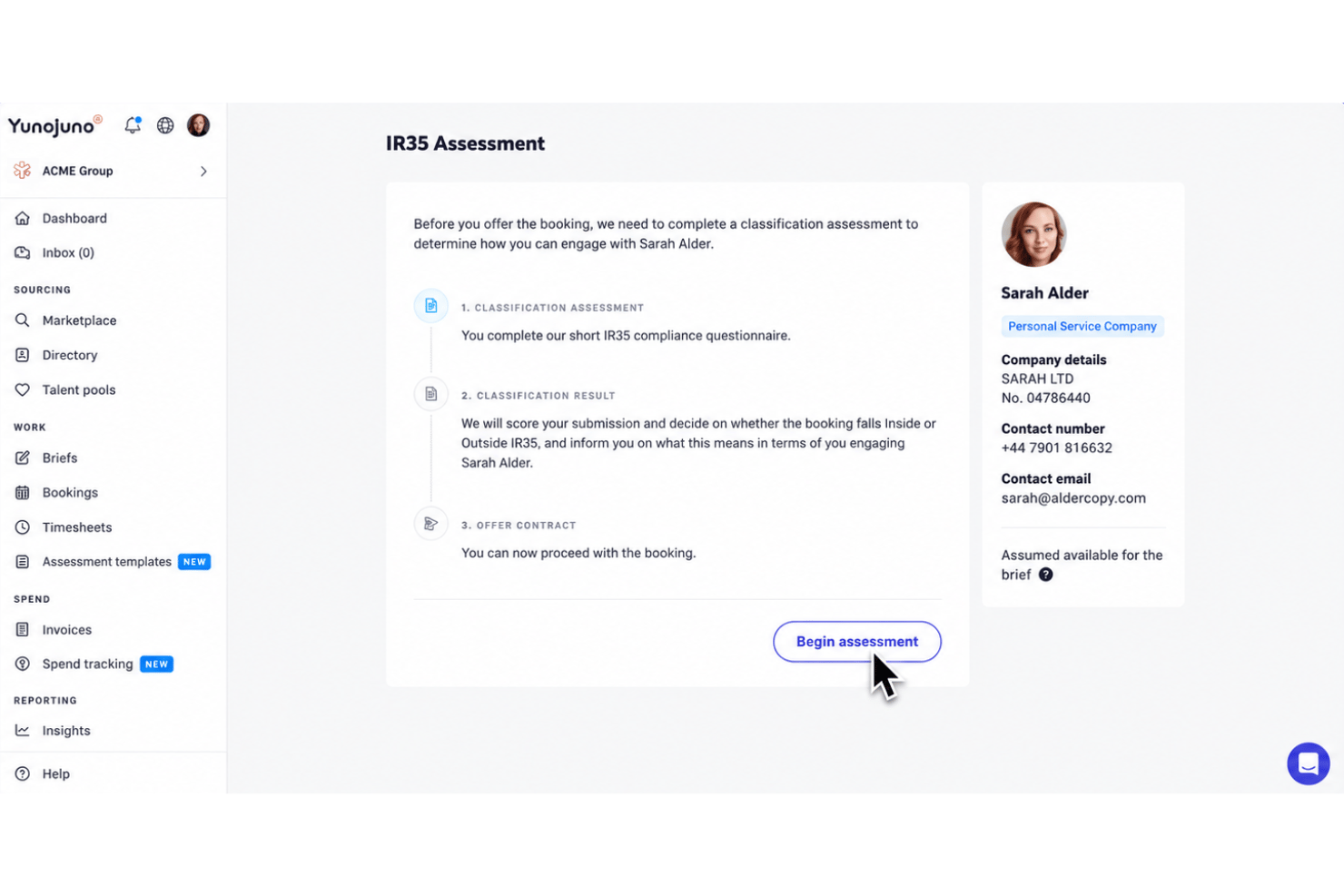
Ease of Use
YunoJuno is easy to navigate, with a modern interface and guided workflows that help new users set up contracts, run compliance checks, and manage payments quickly. I think legal and HR teams will appreciate features like built-in document collection and centralized payment dashboards, which reduce manual steps. Users say that onboarding is straightforward, and the freelancer marketplace search feels intuitive, making it easier to find and engage qualified talent without extra training.
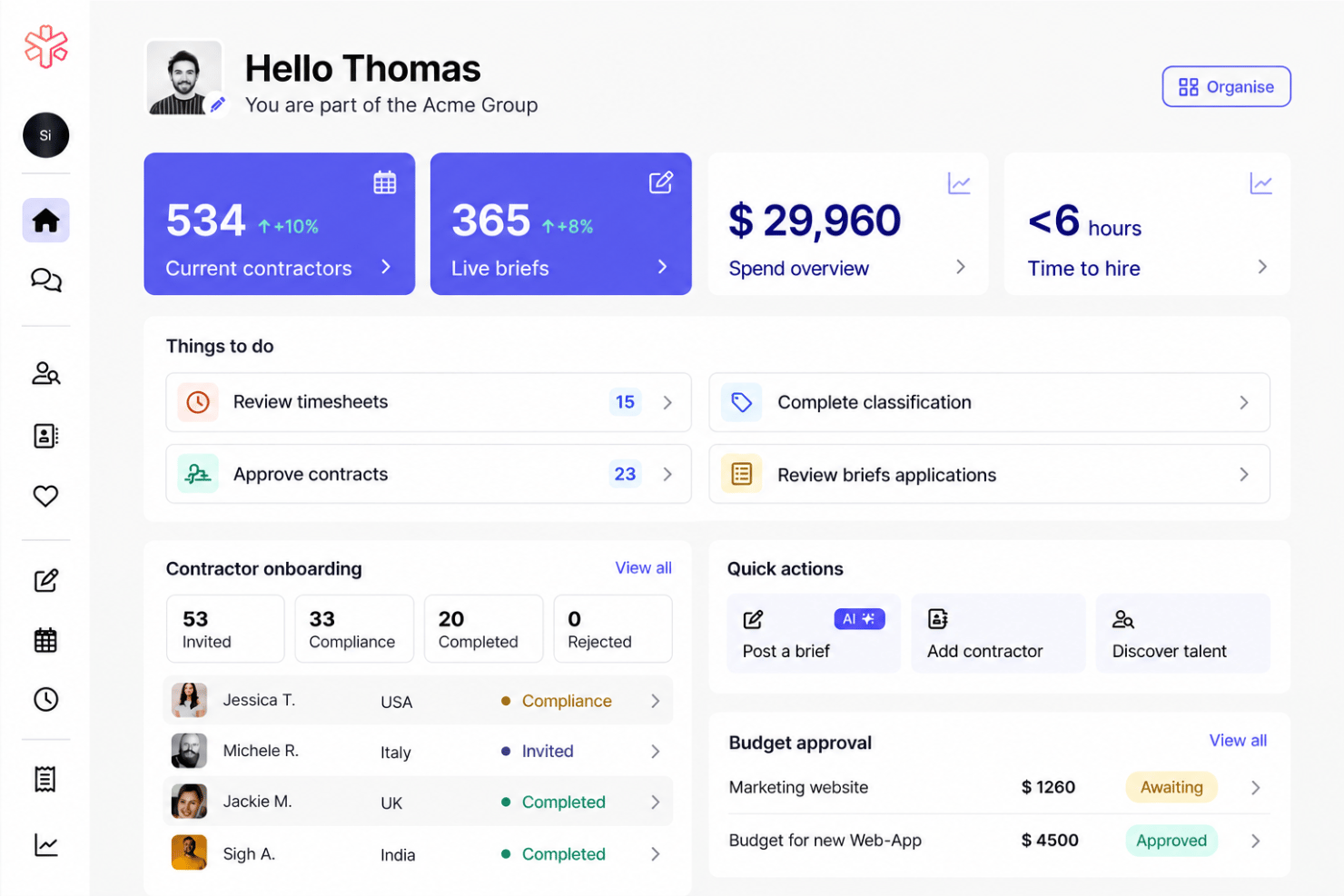
Integrations
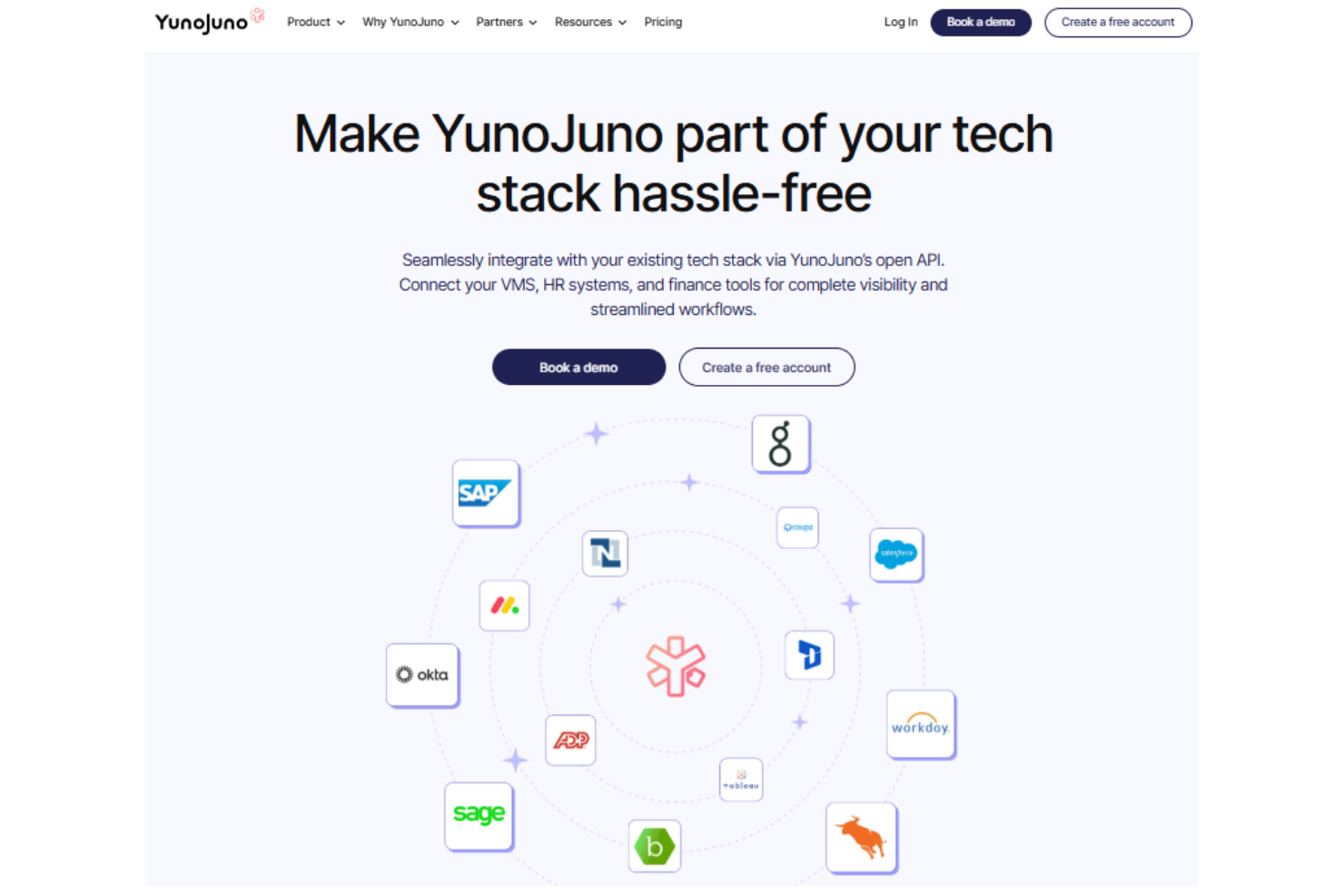
YunoJuno integrates with Salesforce, Okta, ADP, Workday, SAP, Netsuite, Bullhorn, Tableau, and Sage, among others.
YunoJuno also offers an open API and supports connections with select third-party integration tools.
YunoJuno Specs
- 2-Factor Authentication
- Access Management
- API
- Approval Workflows
- Audit Management
- Balance Sheet
- Billing/Invoicing
- Budgeting
- Calendar Management
- Compliance Tracking
- CRM Integration
- Dashboard
- Data Export
- Data Import
- Data Visualization
- Document Management
- Employee Training
- Expense Tracking
- External Integrations
- Forecasting
- History/Version Control
- Incident Management
- Multi-Currency
- Multi-User
- Notifications
- P&L
- Policy Management
- Real-time Alerts
- Regulatory Alerts
- Risk Assessment
- Scheduling
- Tax Management
- Workflow Management