
The AI Layoff Scapegoat: Why Companies Are Using Tech as Cover Story


AI-Driven Layoffs: Many companies use AI as a cover for layoffs rooted in budget pressures rather than automation.
Trust Erosion: Framing layoffs as AI-driven creates a trust deficit among employees when reality does not match claims.
Productivity Gap: Current productivity levels suggest AI is not driving significant workforce reductions or efficiency gains.
Honest Communication: Leaders should acknowledge budget constraints directly to maintain trust and facilitate smoother transitions.
When 59% of hiring managers admit they emphasize AI in layoff announcements because it "plays better with stakeholders" than admitting financial constraints, we've crossed from narrative spin into strategic deception.
A December 2025 Resume.org survey of 1,000 U.S. hiring managers reveals what many suspected: AI has become corporate America's preferred excuse for workforce reductions that have little to do with automation and everything to do with traditional cost-cutting.
The gap between perception and reality is stark. While companies publicly cite AI as a driver of layoffs, only 9% report the technology has actually replaced roles entirely. Meanwhile, Oxford Economics found that AI-related job cuts accounted for just 4.5% of total U.S. layoffs in the first eleven months of 2025, roughly 55,000 positions. Job losses attributed to standard market and economic conditions reached 245,000 during the same period, four times higher.
Companies are restructuring, which is perfectly normal. The question many analysts have, however, is why the need for the dishonesty around why they're happening? And what will be the long-term credibility damage that follows from AI-driven organizational flattening?
The Stakeholder Spin
The Resume.org data shows 17% of companies explicitly blame AI for layoffs when financial constraints are the actual driver. Another 42% admit they "somewhat" use this framing. Combined, nearly six in ten hiring managers acknowledge using AI as convenient cover for decisions rooted in budget pressures, revenue uncertainty, or past overhiring.
This approach makes intuitive sense from a communications standpoint. Telling investors and employees that a company is cutting costs because of weak demand signals financial distress. Framing the same cuts as AI-driven transformation suggests forward-thinking strategy and efficiency gains. One narrative sounds defensive, the other sounds proactive.
But the distinction between explaining and deceiving is collapsing. When half your workforce knows the AI explanation is theater while the other half believes it, you've created a trust problem that outlasts any quarterly earnings call.
Employees who survive layoffs and then watch those same roles refill under different titles, or see their workload double without corresponding AI tools to help understand exactly what happened.

The Reality Execs See
Lacey Kaelani, co-founder of job search engine Metaintro, sees the pattern clearly in labor market data.
AI is not completely eliminating roles, but instead restructuring roles and therefore slowing hiring for some jobs. What’s actually happening is that companies are utilizing ‘AI’ as an umbrella for traditional cost reductions, not replacing employees who leave, and increasing workload for current employees.

Cheryl Yuran, CHRO at Absorb Software, describes a similar reality from the operational side.
What we’re seeing is hiring slowdowns and talent redistribution, not workforce shrinking. Yes, companies using AI are finding efficiencies in nearly every role, especially in well-defined, repetitive task roles. But some of those reductions are being offset by upleveling talent to focus on work they wouldn’t normally have the time for.

Pranav Dalal, CEO of Office Beacon, points to the workload reality that the AI narrative often obscures.
From the ground level, what we’re seeing with AI is not role elimination but rather the flattening of headcount growth and the under-recognized shift in workload. The automation of work is happening, but judgment and execution are very much human-owned. In many instances, what we’re seeing with hiring growth is that we’re actually experiencing an increase in workload and stress on existing teams.

This is the disconnect that makes the AI scapegoat strategy so damaging. Companies announce transformative automation while employees experience intensified workloads without the promised productivity tools. The gap between narrative and reality becomes impossible to ignore.
There's another factor few execs will mention, but one which Diane Brady, Fortune's Executive Editorial Director recently raised. CEOs tie layoffs to AI to motivate remaining employees to adopt it.
While this sort of tactic can prove toxic, it's what some leaders seem to consider the best way to inspire and motivate during uncertain times.
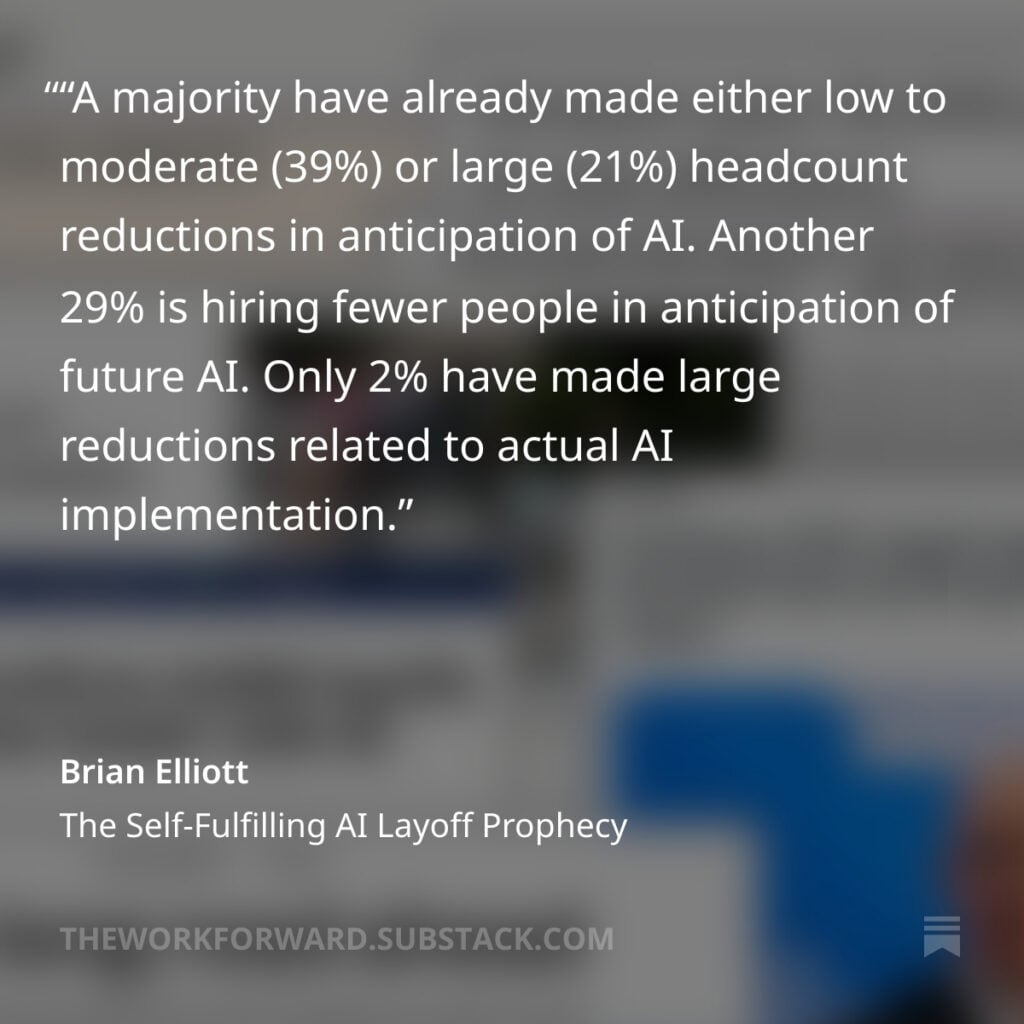
You might be tempted to believe that the trend of citing AI as the reason for layoffs is simply down to executives belief that it will drive efficiency into the future. But as Brian Elliott reveals on his substack, the belief in AI efficiency may be out stripping reality, but it's not what's driving layoffs.
When Aggressive AI Narratives Backfire
In 2025, Klarna provided one of the most high profile cautionary examples of what happens when companies commit fully to the AI transformation narrative without the substance to back it up. The Swedish fintech company announced aggressive AI-driven headcount reductions, positioning the move as necessary automation. The reality proved more complicated.
"They went all in into generative AI," says Kenneth Corrêa, author of Cognitive Organizations. "When they saw the technology, they said, okay guys, this is gonna save us, we're gonna lay off everybody. But then it kicked back because they realized that AI is not going to be able to deal with 100% of the customer service situations."
Klarna eventually shifted to what Corrêa describes as a more balanced approach, an 80-20 split where AI handles routine inquiries while human agents manage exceptions and complex cases.
The company had to reverse course, demonstrating that the original AI narrative didn't match operational reality. That kind of public reversal damages credibility with both investors and employees.
The Productivity Test
Oxford Economics offers a straightforward test for whether AI is actually driving workforce reductions. If machines were replacing humans at scale, output per remaining worker should skyrocket. Instead, productivity growth across major economies remains weak and volatile, suggesting AI adoption is still largely experimental rather than transformational.
The Resume.org survey supports this. While 45% of companies report AI has partially reduced the need for new hires, another 45% say the technology has had little to no impact on staffing levels. Most organizations are using AI to slow hiring, not eliminate existing positions.
The disconnect creates a peculiar moment where companies announce workforce reductions citing AI capabilities while simultaneously reporting that AI hasn't materially changed their labor needs. The math doesn't work unless you understand the real variable: budget constraints masquerading as technological progress.
The Corrosive Effect of AI Scapegoating
Yuran describes the long-term damage to trust this way.
The gap becomes unmanageable when organizations don't realize the AI savings they claimed and operations falter and trust erodes. That's AI scapegoating, and it's corrosive. It fuels unnecessary fear around the technology, which slows the very adoption that could help your organization thrive.
David Jones, a labor market economist and CEO of Mercer Assessments, points to trust as the recurring challenge in organizational change in recent years.
With all the layoffs that have gone on, all the changes within organizations, people’s roles are changing. You’re asking them to trust you when they look out in the market and see a lot of reasons not to. A lot of leaders don’t communicate very well. They don’t communicate a grander vision or sense of community within the organization.

When companies use AI as an all-purpose explanation for workforce decisions, they sacrifice the credibility needed for legitimate change management. Employees become skeptical of all transformation initiatives, not just the ones dressed up in AI theater language. The resulting resistance makes future changes harder to implement, even when those changes are genuinely necessary.
What Boards Should Demand
For boards and CEOs, the temptation to frame cost-cutting as innovation is understandable. Shareholders respond positively to efficiency narratives. Media coverage of "AI transformation" generates better headlines than "financial belt-tightening." Stock prices often rise after restructuring announcements that cite automation and efficiency gains.
The long-term cost is credibility. When a company claims AI is driving workforce changes but can't demonstrate corresponding productivity gains, questions follow. When those same companies later acknowledge they're rehiring for similar roles or that AI handles only a fraction of the work initially promised, the AI narrative collapses.
Genuine AI-driven restructuring has specific markers.
- Productivity per employee increases measurably.
- The company invests in new AI infrastructure alongside workforce reductions.
- Remaining employees receive training and tools that demonstrably change how work gets done.
- The organization can point to specific workflows that no longer require human intervention.
Cost-cutting disguised as AI transformation lacks these elements. Workforce reductions happen without corresponding technology investments. Remaining employees absorb work previously done by laid-off colleagues with minimal new tools. When pressed, management struggles to identify which AI capabilities replaced which roles.
The Path to Honest Communication
Yuran is direct about what leaders owe their organizations when it comes to restructuring.
People leaders have a responsibility here. We need to explain the real reasons. If we're changing role expectations, we need to be specific about what's different and why. And we need to back that up with investment—personalized upskilling, mentorship, coaching—so employees can navigate these transitions rather than feel left behind by them.
Budget constraints are legitimate business realities. Acknowledging them directly allows for honest conversations about company health, market conditions, and strategic priorities.
Disguising those constraints as technology-driven transformation creates a credibility gap that grows wider each time the explanation fails to match observable reality.

