
AI Super Bowl Ads Tell Their Own Story About Industry Priorities

![[OPT 2] IMG PMP – Editorial – AI Super Bowl Ads-73191](https://peoplemanagingpeople.com/wp-content/uploads/sites/3/2026/02/OPT-2-IMG-PMP-–-Editorial-–-AI-Super-Bowl-Ads-73191-792x446.jpg)
Ad Saturation: AI companies dominated Super Bowl advertising, with 23% of commercials focusing on consumer-driven chatbot services.
Market Shift: The AI industry's pivot from enterprise transformation to consumer marketing reflects a struggle to monetize innovations.
Public Responses: Viewer backlash suggests exhaustion with vague promises, highlighting a disconnect between AI companies and real workforce concerns.
Job Displacement: There was no acknowledgment of potential job losses in AI advertising, raising concerns about the industry's impact on employment.
Remember when crypto companies spent the 2022 Super Bowl convincing us that buying digital monkey pictures was the future of finance?
Larry David's FTX ad dismissed every innovation from the wheel to the moon landing with "It's too far!" It was one of the best-received commercials that year. By the next Super Bowl, Sam Bankman-Fried had been arrested.
Sunday night gave us the 2026 version: AI companies spending an estimated $100+ million to convince us their chatbots can help us remember birthdays, redecorate bedrooms, and find workout advice. Problems no one has really.
By the end of the first quarter, NFL fans were already rage-tweeting. "The AI ads are PISSING ME offf omg the commercials suck this year everything sucks," summed up the vibe. Another viewer nailed it: "Oh, the 54th AI commercial. Neat."
While the public grew bored hearing about the technology, every CHRO, COO, and CEO watching should have noticed something else. The AI industry just showed its entire hand, and it wasn’t the hand you thought they were playing.
The Numbers Tell the Story
Twenty-three percent of all Super Bowl commercials focused on AI. Fifteen out of 66 ads. OpenAI. Anthropic (with two ads before the first quarter ended). Google. Meta. Amazon. Microsoft. Plus startups you've never heard of.
When an industry spends $8-10 million per 30-second spot to reach the masses, they're not marketing to you anymore, they're marketing around you. In this case, that means they've given up on selling enterprise transformation and pivoted to consumer adoption as a Hail Mary.

The Meltdown That Revealed Everything
The most telling moment wasn't in the ads themselves but in OpenAI and Anthropic's very public Super Bowl fight.
Anthropic's ad featured a gym bro bot suddenly pivoting mid-conversation to push "Step Boost Maxx" insoles for "short kings." The tagline? "Ads are coming to AI. But not to Claude." A direct shot at OpenAI's January announcement about testing ads in ChatGPT.
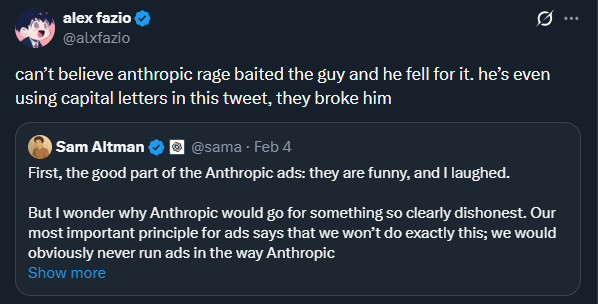
Sam Altman had feelings about it. In a 500+ word response posted days before the ads even aired, he delivered a masterclass in defensive corporate communications that tells you more about where AI companies are than any commercial could.
"First, the good part of the Anthropic ads: they are funny, and I laughed."
When someone starts with "First, the good part," you're about to witness a meltdown or a murder. Nobody in the OpenAI C-suite laughed is my guess.
"But I wonder why Anthropic would go for something so clearly dishonest... We would obviously never run ads in the way Anthropic depicts them. We are not stupid and we know our users would reject that."
Anthropic's ad showed a chatbot interrupting a conversation to sell shoe insoles. OpenAI announced they're putting ads in ChatGPT. That's not dishonest, that's showing the thing you said you were going to do. And the "we are not stupid" defense? Why not just scream “I’m not mad” into the void while you’re at it?
"More Texans use ChatGPT for free than total people use Claude in the US."
Sir, this is a Wendy's. Also, why Texas specifically? This is giving "my dad can beat up your dad" energy.
"Anthropic serves an expensive product to rich people."
ChatGPT Pro costs $200/month. Claude Pro costs $20/month. I’m no data scientist, I’m trying to stay in my lane here, but one of these numbers is significantly larger than the other.
"One authoritarian company won't get us there on their own, to say nothing of the other obvious risks. It is a dark path."
We've escalated from "funny ads" to "AUTHORITARIAN DARK PATH" in approximately 400 words. Anthropic made a joke about ads. Altman responded like they'd declared war on democracy itself.
What the Meltdown Actually Reveals
Altman's response tells you everything about where these companies are.
When your CEO spends Super Bowl week rage-tweeting about a competitor's ad strategy, you're not focused on helping organizations navigate workforce transformation. You're focused on market share in a commoditized chatbot space.
The defensiveness around ads reveals the core problem. These companies have spent hundreds of billions building AI systems, and now they need to figure out how to make money from them. Enterprise sales are hard. Consumer subscriptions are limited. So... ads?
Every time these companies get criticized, they pivot to "democratization" and "access" and "builders." It's the get-out-of-jail-free card for any business decision. Running ads? Yes, but it's for democracy. Raising prices? Sustainable access. Blocking competitors? Protecting the ecosystem.
The Celebrity Danger-Washing
Amazon's ad perfectly captured the strategy. Chris Hemsworth spends 60 seconds joking about Alexa+ trying to kill him—closing the garage door on his head, shutting the pool cover while he's swimming. Celebrity-studded satire mocking legitimate safety concerns while conveniently ignoring actual dangers.

This is the exact crypto playbook. Massive Super Bowl saturation, celebrity endorsements, vague promises of revolutionizing everything, carefully avoiding any discussion of actual AI risks, and CEOs having public meltdowns when criticized.
When industries resort to Super Bowl blitzes and tweet storms, it's usually because the enterprise value proposition isn't landing. Crypto couldn't get institutional adoption, so they went straight to consumers. AI companies are doing the exact same thing.
What They're Not Addressing
You know what didn't appear in any of these ads or in Altman's manifesto? Any acknowledgment of job losses or the economic disruption mass unemployment would bring.
Google's ad showed a mom and son using AI to "envision and design their new home" by uploading photos of bare rooms. Meta showed Spike Lee, Marshawn Lynch, and iShowSpeed using Oakley Meta glasses for "Athletic Intelligence" - filming dunks, skydiving, and chasing planes. OpenAI showed hands sketching and designing with the tagline "You Can Just Build Things."
Again, these solve problems that don't exist (who struggles to imagine bedroom decor?) or replace activities that are good for human development (a kid learning to visualize and problem-solve).
Nowhere did anyone address the question keeping executives up at night: What do we do with our workforce when AI can do 30-40% of knowledge work?
OpenAI's CMO insisted they "shot the ads with real people, on film, who use our tools" and that "people are actually the hero." Except the entire point of enterprise AI is that you need fewer people to do the same work. That's not people being heroes. That's people being optimized out of existence while you tell them they're the main character.
The Viewer Backlash as Preview
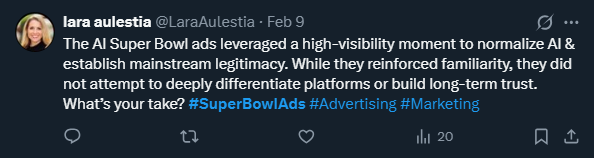
The fact that viewers were exhausted by AI ads before the first quarter ended isn't just about advertising fatigue. It's a preview of what's happening inside organizations.
People aren't resistant to AI because they don't understand it. They're exhausted because they're being sold vague promises without operational frameworks. They're tired of being told they're "heroes" and "builders" while watching their roles get automated. They're done with celebrity testimonials when they need implementation guidance.
Your employees are feeling exactly what those X users felt. And they're feeling what everyone watching Altman's meltdown felt: these people are more concerned with fighting each other than helping us.
What This Means
The tech companies have moved on from helping businesses with transformation. They're fighting each other over consumer market share, investor returns on hundreds of billions in capital, and winning arguments on social media. Not exactly the AI theater we expected to see this week, but the game didn't exactly deliver many thrills either, leaving the halftime show to do the heavy lifting.
They're no longer concerned with organizational transformation frameworks, workforce transition strategies, manager evolution pathways, trust and change management, or defining what work remains meaningfully human.
That's your job now as much as it ever was and if you think they’re designing solutions to help you navigate that reality, think again.
Sunday night's AI saturation made it crystal clear, they've pivoted to consumer adoption because enterprise transformation is complicated, slow, and requires acknowledging uncomfortable truths about job displacement.
Your competitive advantage is being a good steward while others fumble through AI adoption and bleed talent. You can be the organization that figures out the human side of this transformation.
Mid-market companies face unique challenges—you can't scale down Google's approach. You need frameworks built for organizations where every role matters and you can't afford to get this wrong.
The Super Bowl AI blitz was supposed to convince us we're entering an exciting new era. Altman's defensive manifesto was supposed to position OpenAI as the democratic choice.
Instead, they revealed a messaging crisis. Tech companies don't know how to talk about what they've built because they don't want to acknowledge what it actually does.
You have to look your workforce in the eye and navigate this transformation anyway. So while Altman writes about "dark paths" and Anthropic dunks on business strategies, you've got actual work to do: building trust architecture, evolving manager roles, defining skills-based organizations, and figuring out what makes human work irreplaceably valuable.
The clarity is the gift. If you didn’t know before, you now know exactly where you stand now.

