

Cost Of PEO Services: A Complete Guide


The average cost of a PEO service is about $100–$120 per employee per month or ~3%–6% of total gross payroll, depending on company size, services included, and industry risk level.
The total cost of a professional employer organization (PEO) can include payroll administration, benefits management, workers’ compensation, compliance support, onboarding fees, and optional HR services.
This guide breaks down average PEO pricing, hidden costs, pricing models, and how PEO costs compare to in-house HR management.

PEO Services Cost Calculator
Use People Managing People's cost calculator to estimate the price of PEO services for your business:
How PEO Pricing Works
Professional employer organizations (PEOs) use various pricing models to charge for their services, including:
- Per-employee fees: A set fee per employee per month, which can range from $50 to $150 per employee.
- Percentage of payroll: Charging a percentage of the total payroll, typically ranging from 2% to 12%.
- Flat fees: A fixed monthly fee per employee for the PEO services. This model emphasizes transparency and clarity, helping clients understand exactly what they are paying for without any hidden costs.
Example: A company with a $1,000,000 annual payroll might pay $20,000 to $120,000 annually under a percentage of payroll model. Alternatively, if they have 50 employees, they might pay $2,500 to $7,500 per month with a per-employee fee model. Here's an overview of the models:
| Pricing model | Typical cost | Best for | Pros | Cons |
|---|---|---|---|---|
| Per-employee-per-month (PEPM) | $40–$160/employee | Small businesses | Predictable pricing | Less flexible |
| Percentage of payroll | 2%–12% of payroll | Growing teams | Scales with payroll | Costs rise with salaries |
| Flat monthly fee | Custom pricing | Stable headcount | Budget consistency | Less common |
What Does The Total PEO Cost Cover?
The total cost of PEO services covers a number of different fees:
1. Administrative fee
This covers core services like payroll, HR support, tax filing, and compliance. It's usually charged as a percentage of payroll (2–12%) or a flat rate per employee per month ($40–$160).
2. Benefits administration fee
PEOs manage employee benefits like health insurance, dental, and retirement plans. This may be bundled into the admin fee or charged separately, depending on the provider.
3. Workers’ compensation insurance
PEOs secure and manage your workers’ comp coverage, often at lower group rates. Costs vary by your industry and risk profile.
4. Unemployment insurance and employer taxes
You reimburse the PEO for state and federal unemployment taxes and other employer tax obligations. They handle the filings and compliance on your behalf.
5. Onboarding or setup fee
Some PEOs charge a one-time fee (often $500–$2,000) to cover initial implementation and account setup. Others may waive this depending on contract length or team size.
6. Optional add-ons
These include services like background checks, learning management systems, or custom HR consulting. Add-ons are typically priced separately and can vary widely.
Setup, Implementation, and Platform Costs
While the monthly administration fee gets most of the attention, it is rarely the full cost of working with a PEO. There are also expenses tied to getting the relationship up and running, supporting it internally, and filling any gaps in what the PEO actually handles.
- Setup and implementation: Most PEOs charge an upfront setup fee, often around $500 to $2,000. You should also account for the internal time spent moving employee data, connecting systems, reviewing policies, and testing payroll before launch.
- Training and transition time: HR teams often spend the first few weeks answering employee questions, helping managers learn new workflows, and fixing small issues that only surface once the system is live. That time has a real cost, even if it never appears on an invoice.
- Technology fees: Some PEOs charge separately for access to their HRIS, reporting tools, mobile apps, or employee self-service features. Check whether these are included in the administrative fee or added on top.
- Services outside the PEO’s scope: A PEO can handle a lot, but it will not replace every HR function. You may still need internal or outside support for executive recruiting, compensation strategy, complex employee relations, labor relations, or highly customized performance management.
- Extra vendor costs: If the PEO does not cover a service your team needs, you may end up paying for another tool or specialist alongside it. This is why I would compare providers based on total coverage, not just the quoted monthly rate.
Contractual Obligations and Exit Costs
A PEO contract can be harder to unwind than it looks, so do not just check the monthly price and move on. Before signing, look closely at what happens if the relationship stops working.
- Check the minimum term: Many PEO contracts run for 12 to 24 months. Confirm whether the agreement auto-renews and how much notice you need to give before the renewal date.
- Ask what early termination actually costs: Do not settle for language like “fees may apply.” Ask the provider to show you the exact termination formula, including whether you would owe remaining administrative fees, a fixed penalty, or other charges.
- Look for offboarding fees: Some contracts include separate charges for data exports, final payroll processing, benefits administration, or other transition work. Get those costs in writing before you sign.
- Find out how you get your data back: Confirm what employee, payroll, tax, benefits, and compliance records you can export, in what format, and how quickly the PEO provides them after termination.
- Plan for replacement systems: Leaving a PEO may mean replacing payroll, HRIS, benefits administration, time tracking, or compliance tools that were bundled into the service.
- Budget for the internal transition: Your HR and payroll teams will likely need time to rebuild workflows, move data, test new systems, retrain employees, and keep payroll running during the changeover.
Potential Hidden Fees
Whenever contracting any service as a business, it’s important to be fully aware of all the potential costs involved. Some “hidden” or extract costs to be aware of when contracting a PEO include:
- Setup or termination fees: Some PEOs charge a one-time onboarding fee ($500–$2,000) or early termination fees if you leave the contract early.
- Benefits markups: The PEO may bundle benefit costs in a way that hides markups on health plans or insurance premiums.
- Workers’ comp premium audits: If your payroll estimates are off, you might owe more at year-end during audits—especially in higher-risk industries.
- Add-on services: Things like background checks, employee training, recruiting support, or HR software features might not be included in your base fee.
- Annual increases: Admin fees or benefits costs can rise each year—check your contract to see if there are caps or notification periods.
- Minimum charges: Some PEOs charge a minimum monthly fee even if your headcount is small, which can be pricey if you have part-time or seasonal staff.
8 Factors That Influence PEO Costs
Several factors can influence the cost of a PEO:
- Industry: Industries with higher regulatory requirements might incur higher costs due to the need for specialized compliance services.
- Company size: Larger companies may receive volume discounts, reducing per-employee costs.
- Location: Local labor laws and market conditions can impact pricing.
- Specific services required: Customized service packages or additional services beyond the standard offerings can increase costs.
- Payroll taxes: PEO costs often include handling payroll taxes, which can relieve businesses from these responsibilities and potential additional costs.
- Employee turnover: Businesses with high turnover rates may incur higher onboarding, payroll processing, and administrative costs due to the constant need to manage new hires, terminations, and benefits changes.
- Compliance and HR support: Companies with more complex HR requirements may pay higher fees for additional compliance support, HR consulting, risk management, or legal guidance.
- Employee benefits complexity: PEO pricing may increase if your company requires more competitive or customized employee benefits packages
Do PEOs Save You Money?
Using a PEO can save you money, but it depends on your current setup and growth plans. Here’s how a PEO might save you money:
- Better benefits at lower rates: PEOs can group together to access big-company health plans, often at reduced premiums.
- Fewer compliance mistakes: Avoid costly fines or legal issues from misclassified employees or tax errors.
- Reduced HR headcount: Instead of hiring in-house HR staff early on, the PEO handles it for a fraction of the cost.
- Lower workers’ comp rates: PEOs often negotiate group discounts based on their pooled clients.
- Time = money: You and your team spend less time on admin and more time growing the business.
When PEOs May Not Be Worth The Cost
But it might not save money if:
- You already have good rates or internal HR support
- You don’t fully use the services included
- You’re paying for add-ons you don’t need.

PEO vs. In-House HR: Which One Should You Choose?
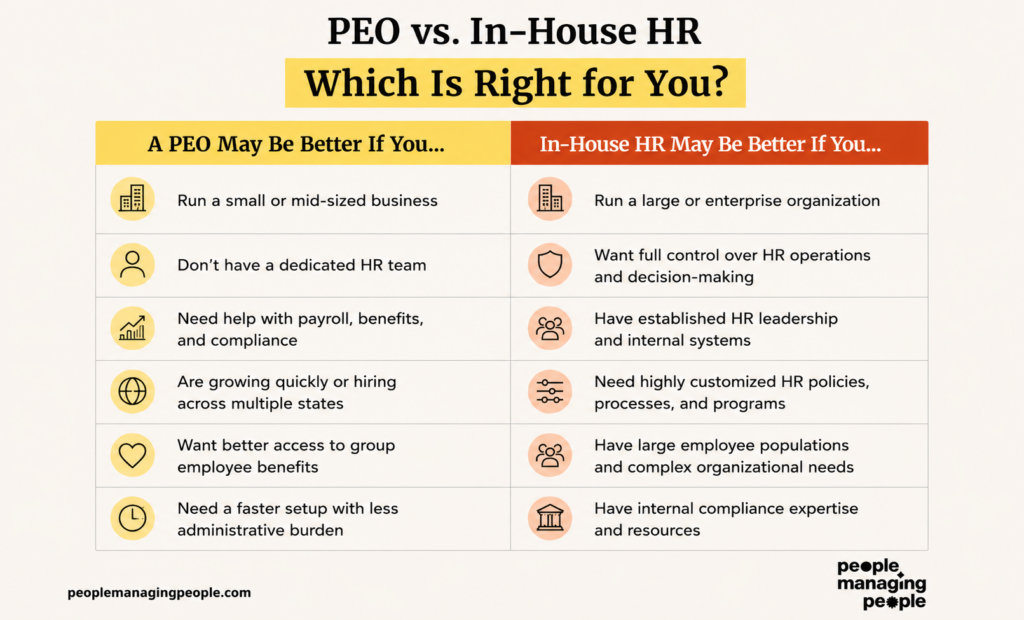
Choosing between a professional employer organization (PEO) and an in-house HR team depends on your company size, growth stage, budget, and level of HR support needed.
PEOs are often used by smaller and growing businesses that want outsourced HR support, while in-house HR teams are typically better suited for larger organizations that need more control and customization. Here's how they differ:
| Element | PEO | In-House HR |
|---|---|---|
| HR Support Model | Outsourced HR and compliance support | Fully internal HR management |
| Payroll Management | Included | Managed internally or through payroll software |
| Benefits Administration | Included or managed by PEO | Managed internally or through brokers |
| Compliance Support | Included | Handled internally or through legal advisors |
| HR Technology | Usually included | Requires separate HR software purchases |
| Employee Onboarding | Supported by PEO | Managed internally |
| Scalability | Easy to scale as headcount grows | Often requires additional HR hires |
| Customization & Control | Less flexible | Full control over HR processes and policies |
| Cost Structure | Typically $100–$150 per employee/month | HR salaries + software + benefits admin costs |
| Best For | Small businesses and growing companies | Larger organizations with mature HR operations |
| Multi-State Compliance | Often easier to manage | Requires internal compliance expertise |
| Employee Experience | Standardized processes and tools | More customizable employee experience |
| Implementation Speed | Faster to implement | Slower to build internally |
| Long-Term Cost Efficiency | Often better for smaller teams | Often more efficient at larger scale |
Whether a PEO or internal HR team is a more cost-effective option really depends on your unique circumstances and is quite hard to quantify.
PEO vs. EOR: Cost Comparison
A PEO works through a co-employment model, meaning your company must already have a legal entity where employees are located. An employer of record (EOR), on the other hand, becomes the legal employer on your behalf, allowing companies to hire employees without opening a local entity.
In general, PEOs are usually more cost-effective for domestic businesses that already have a legal entity and want HR support. On the other hand, the costs of EOR are higher because they legally employ workers on your behalf in other countries or jurisdictions.
| Cost Element | PEO | EOR |
| Typical Pricing Model | Percentage of payroll or per-employee fee | Per-employee monthly fee |
| Average Monthly Cost | ~$100–$150 per employee/month | ~$199–$650+ per employee/month |
| Best For | Domestic HR outsourcing | International hiring and expansion |
| Legal Employer | Shared co-employment model | EOR |
| Entity Requirement | Company must have local legal entity | No local entity required |
| Setup Costs | Lower overall | Higher due to global compliance infrastructure |
| Geographic Coverage | Usually single-country | Multi-country/global |
| Compliance Complexity | Lower | Higher due to cross-border employment laws |
Best Practices to Maximize Value from PEO Services
Lastly, some tips for getting the best value from your PEO service.
- Be clear on what’s included: Understand exactly what services are bundled (e.g., payroll, compliance, benefits) and what costs extra. Ask for an itemized breakdown.
- Leverage buying power: Use the PEO’s access to large-group benefit rates to offer more competitive packages to your employees—this can be a game-changer for hiring and retention.
- Use them as a compliance safety net: Rely on the PEO for help with employment law, tax filings, and risk management—especially if you operate in multiple states.
- Tap into HR expertise: Don’t just use the PEO for admin—get their advice on policies, employee relations, terminations, or performance management when needed.
- Negotiate when you renew: If your needs change or you’ve grown, renegotiate terms or shop around—you may qualify for better rates or upgraded services.
FAQs
Is a PEO worth the cost?
A PEO can be worth the cost for companies that want to:
- Reduce HR administration
- Improve compliance support
- Access better employee benefits
- Simplify payroll management
- Support rapid business growth
The value depends on how much HR support your business needs and whether you fully use the services included in the PEO agreement.
Can a PEO help reduce employee benefits costs?
Yes. Many PEOs provide access to large-group health insurance and benefits plans that smaller businesses may not qualify for independently. This can help companies offer more competitive employee benefits at lower rates.
What size company benefits most from a PEO?
PEOs are often most beneficial for:
- Small businesses
- Startups
- Growing companies
- Businesses without dedicated HR teams
- Multi-state employers
Larger enterprises with established HR infrastructure may benefit less from the PEO model.
Is a PEO cheaper than hiring an internal HR team?
Yes, for many small and mid-sized businesses, a PEO can be more cost-effective than building a full in-house HR department.
PEOs combine payroll, compliance, benefits administration, and HR technology into a single service, reducing the need for multiple HR hires and software subscriptions.
Are PEO fees tax deductible?
Yes, in many cases, PEO fees are considered legitimate business expenses and may be tax deductible. This can include administrative fees related to payroll, HR management, benefits administration, and compliance support.
However, tax treatment can vary depending on the structure of the agreement and your business location, so companies should consult a tax professional for guidance.

