Global Employee Onboarding: Process, Best Practices, & Tools


Global onboarding isn’t just about sending a welcome email and sharing company policies—it’s about understanding the unique needs of employees from different countries and helping them feel connected from day one. As someone who has designed and improved onboarding programs for international teams, I’ve seen firsthand how cultural nuances, local regulations, and communication styles can impact a new hire’s experience.
In this article, I’ll share real-world examples, practical tips from onboarding experts, and proven strategies for overcoming challenges like time zone differences, cross-cultural communication, and local compliance. Whether you’re expanding into new markets or hiring remote talent abroad, these expert-backed approaches will help you build a global onboarding process that truly works.
What is Global Employee Onboarding?
Global employee onboarding is the process of integrating international hires into your organization while accounting for differences in culture, language, compliance requirements, time zones, and remote work environments.

Done well, it helps employees feel confident, connected, and productive faster—regardless of where they’re located.
Importance Of Onboarding For International Workers
Here’s why effective global onboarding matters:
- Accelerates productivity: Gives international hires the training, tools, and context they need to ramp up faster.
- Improves retention: Helps employees feel welcomed, supported, and connected from day one.
- Reduces compliance risk: Ensures country-specific payroll, tax, benefits, and employment documentation are handled correctly.
- Strengthens culture alignment: Creates a more consistent employee experience across distributed teams.
- Improves communication and collaboration: Helps global employees navigate language differences, workflows, and team expectations more effectively.
- Supports long-term employee growth: Clarifies performance expectations, career paths, and opportunities for development early on.
Key Elements of the Global Onboarding Process
Here are the core components of an effective global employee onboarding process:
| Component | Why It Matters | Example |
|---|---|---|
| Consistent onboarding framework | Creates a standardized experience across locations | A company-wide 30-60-90-day onboarding plan |
| Local adaptation | Helps personalize onboarding to feel relevant and compliant in each region | Localized HR policies and translated materials |
| Compliance and legal setup | Reduces legal and global payroll risks | Country-specific tax forms and benefits enrollment |
| Cultural onboarding | Improves collaboration across global teams | Cross-cultural communication training |
| Role-specific training | Helps employees ramp up faster | Tool walkthroughs and workflow training |
| Technology and onboarding tools | Streamlines onboarding across distributed teams | HR software, onboarding software, LMS platforms, and e-signature tools |
| Mentorship and support | Gives employees a reliable point of contact | Assigning a local onboarding buddy or mentor |
| Feedback and progress tracking | Helps improve onboarding effectiveness over time | New hire surveys and 30-day check-ins |
| Ongoing integration | Supports long-term engagement beyond the first week | Regular manager check-ins during the first 90 days |
Global Employee Onboarding Process (Step-by-Step)
A successful global onboarding process should balance consistency with local flexibility. While every employee should receive the same core onboarding experience, you’ll also need to adapt for regional compliance requirements, cultural differences, and remote collaboration.
Here’s a step-by-step framework you can use to onboard international employees more effectively.
1. Prepare Employment Contracts And Compliance Documents
Before onboarding begins, make sure all country-specific employment requirements are in place. This includes contracts, tax forms, benefits enrollment, work authorization documents, and mandatory policies.
Compliance mistakes during onboarding can create payroll, tax, and legal risks later on—especially when hiring across multiple countries.
For example, onboarding requirements in Germany or France may look very different from those in the United States or Canada.
2. Set Up Payroll, Equipment, And Technology Access
Nothing creates a poor first impression faster than a new hire starting without access to the tools they need.
Before day one, ensure employees have:
- Payroll setup completed
- Company devices shipped and configured
- Email and communication platform access
- VPN and security credentials
- Access to role-specific software and systems
For remote international employees, shipping delays and time zone differences can slow onboarding quickly, so preparation matters.
3. Deliver Preboarding Materials
Preboarding helps reduce first-day confusion and gives employees time to familiarize themselves with your organization before onboarding officially starts.
Preboarding materials might include:
- Welcome videos
- Organizational charts
- Employee handbooks
- Training schedules
- Introductions to managers and teammates
- FAQs about benefits, payroll, or company policies
Strong preboarding creates a smoother transition into onboarding because employees arrive with more context and fewer administrative questions on day one.
4. Introduce Company Culture And Expectations
Global employees need context beyond their job responsibilities. They also need to understand how your organization communicates, collaborates, and makes decisions.
During onboarding, explain:
- Company mission and values
- Communication norms
- Meeting expectations
- Collaboration tools and workflows
- Performance expectations
- Working hours and availability guidelines
5. Conduct Role-Specific Training
General onboarding should be paired with practical, role-based training that helps employees contribute quickly.
Depending on the role, this may include:
- Tool walkthroughs
- Workflow documentation
- Process training
- Product education
- Shadowing sessions
- Recorded async training modules
For global teams, asynchronous training resources are often more scalable than relying entirely on live sessions across time zones.
6. Assign An Onboarding Buddy Or Mentor
One of the easiest ways to improve the onboarding experience is to give new hires a dedicated support person.
An onboarding buddy or mentor can help employees navigate company culture, ask informal questions, build relationships faster, understand internal processes, and feel less isolated.
This is particularly valuable for international employees who may be adapting to unfamiliar workplace norms.
7. Schedule Regular Check-Ins During The First 90 Days
Onboarding shouldn’t end after the first week.
Regular check-ins help managers identify challenges early, answer questions, and reinforce expectations during the employee’s transition period.
Many organizations schedule formal checkpoints at 30, 60, and 90 days.
These conversations can cover workload, training progress, team integration, and overall employee experience. They also create opportunities to gather feedback and improve your onboarding process over time.
7 Global Onboarding Tips And Best Practices
Here are some best practices for global onboarding to ensure a smooth and effective experience for international hires:
1. Standardize the Core Onboarding Framework
Develop a consistent onboarding framework that covers company values, communication expectations, workflows, and training standards while still allowing for local and role-specific adaptations.
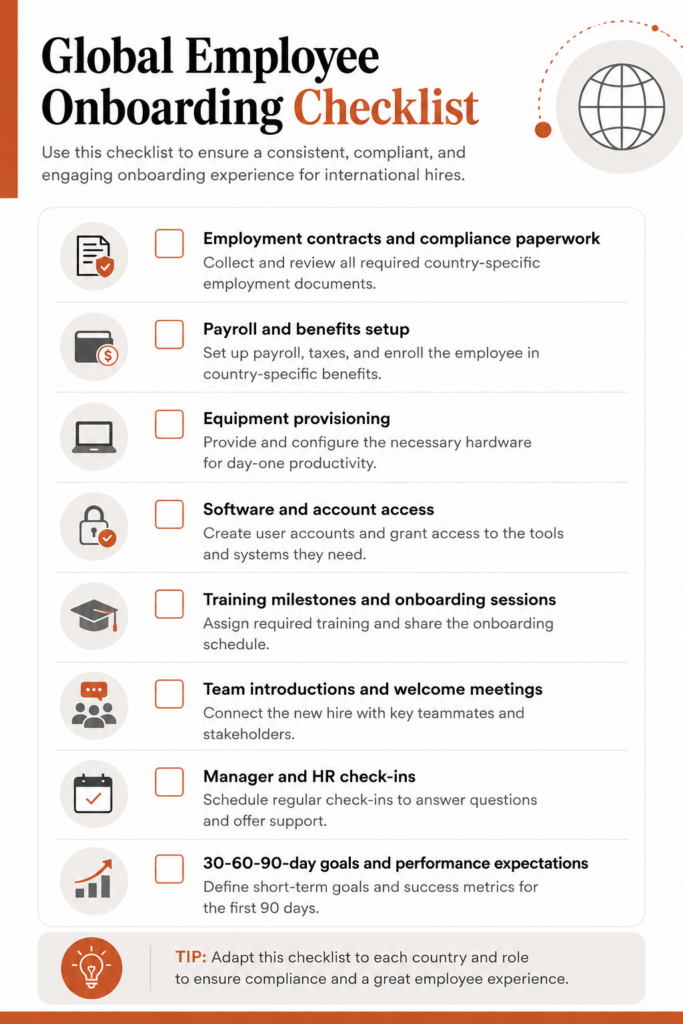
One of the simplest ways to improve onboarding consistency is to create a standardized onboarding checklist for HR teams and managers. This helps ensure important onboarding steps don’t get missed across countries, roles, and time zones.
- Employment contracts and compliance paperwork
- Payroll and benefits setup
- Equipment provisioning
- Software and account access
- Training milestones and onboarding sessions
- Team introductions and welcome meetings
- Manager and HR check-ins
- 30-60-90-day goals and performance expectations
2. Train Managers to Support Global Employees
Even well-designed onboarding processes can fail if managers aren’t equipped to support international employees effectively.
Global managers often need to navigate:
- Time zone coordination
- Language differences
- Async communication
- Different workplace expectations
- Regional holidays and work schedules
Provide managers with clear onboarding responsibilities, communication guidelines, and check-in frameworks so international employees receive a more consistent experience across teams.
3. Create More Opportunities for Human Connection
Remote global onboarding can easily become transactional if every interaction is limited to training sessions and documentation.
One of the best ways to improve onboarding is to intentionally create informal relationship-building opportunities. Depending on your budget and team structure, this could include:
- Virtual coffee chats
- Team social events (in-person or virtual)
- Cross-functional introductions
- Small-group onboarding sessions
- Optional in-person meetups
Employees are far more likely to feel engaged when they build relationships early.
4. Keep Updated on Local Laws and Regulations
Global employment laws change frequently, and onboarding requirements can vary significantly between countries.
Stay informed about:
- Employment classifications
- Payroll regulations
- Tax documentation
- Mandatory training and policies
- Benefits requirements
- Data privacy laws
I’ve found that staying current requires ongoing education, especially if you’re hiring across multiple regions. Many HR leaders rely on industry newsletters, podcasts, webinars, and HR conferences to keep up with changing regulations and global hiring trends.
If managing international compliance internally becomes too complex, partnering with an employer of record (EOR) provider can help reduce administrative burden since they typically handle local employment compliance on your behalf.
5. Design Onboarding for Async and Remote Collaboration
One of the biggest mistakes I see in global onboarding is assuming everyone can attend the same training sessions at the same time.
To avoid scheduling friction, meeting fatigue, and inconsistent onboarding experiences across regions, make onboarding resources accessible on demand whenever possible.
For example, you can create recorded training sessions, process documentation, internal wikis, FAQ hubs, and self-paced learning modules to give international employees more flexibility to learn in their own time zone and revisit information later when they actually need it.
6. Incorporate a Global Welcome Program
If feasible, host a global orientation session that brings together new hires from different locations. This can foster a sense of community and help them feel connected to the larger organization.
7. Measure Global Onboarding Effectiveness
It’s important to track whether your onboarding process is actually helping employees ramp up successfully. Using methods such as onboarding surveys and stay interviews, collect feedback from international hires about their onboarding experience to identify areas for improvement. Beyond this, look at metrics like:
- Time to productivity
- Early turnover rates
- Employee engagement scores
- Training completion rates
- New hire satisfaction
- Manager feedback
Common Global Onboarding Challenges (And How To Avoid Them)
I’ve found that global onboarding challenges usually happen when organizations try to scale too quickly without adapting processes for distributed teams and regional differences.
Here are some of the most common mistakes to avoid:
| Challenge | Why It’s A Problem | How To Avoid It |
|---|---|---|
| Treating every region the same | Employment laws, communication styles, and workplace expectations vary significantly across countries. | Standardize the core onboarding experience while allowing for local adaptations. |
| Ignoring time zone coordination | Scheduling onboarding entirely around one region can frustrate international employees and create meeting fatigue. | Use async onboarding resources, record sessions, and rotate meeting times when possible. |
| Overloading new hires with information | Employees retain less when onboarding is condensed into the first few days. | Spread onboarding across the first 30-90 days and prioritize essential information first. |
| Failing to localize onboarding materials | Translated materials may still feel confusing or culturally disconnected. | Adapt examples, policies, and communication styles for different regions and audiences. |
| Weak communication during remote onboarding | Remote employees can feel isolated or unsure where to go for support. | Create clear onboarding schedules, regular check-ins, and centralized documentation. |
| Assuming managers understand local compliance requirements | Managers may unintentionally create legal or policy inconsistencies across regions. | Provide managers with onboarding guidance, compliance training, and HR escalation paths. |
Global Employee Onboarding FAQ
What’s the difference between global onboarding and standard employee onboarding?
Standard onboarding typically focuses on integrating employees within one country or region. Global onboarding adds additional complexity, including international compliance requirements, cultural differences, language barriers, remote collaboration, and multi-country payroll or benefits setup.
How long should a global onboarding process last?
While administrative onboarding may only take a few days, most organizations extend onboarding over the employee’s first 30, 60, or 90 days. This gives international hires more time to adapt to company culture, workflows, and distributed team dynamics.
Who should be involved in global employee onboarding?
Global onboarding usually involves collaboration between HR, hiring managers, IT teams, payroll providers, legal or compliance teams, and sometimes employer of record (EOR) partners. Many organizations also involve onboarding buddies or mentors to support employee integration.
What documents are typically required during global onboarding?
Requirements vary by country, but common onboarding documents include:
- Employment contracts
- Tax forms
- Identification and work authorization documents
- Payroll and banking information
- Benefits enrollment forms
- Confidentiality and data privacy agreements
Subscribe To The People Managing People Newsletter
For more on international onboarding and other talent management strategies, subscribe to our weekly newsletter for HR and business leaders. You’ll receive all our latest content to help you grow in your career and make greater impact in your org.