International Strategy: Complete Guide + Examples


International strategy is not just a sales or a market-entry decision. For people leaders, international expansion also raises questions about hiring, compliance, payroll, benefits, employee support, and how much local adaptation your organization can realistically manage.
Use this guide to understand what an international strategy is, when it works, when it does not, and how to build one in a way that supports both business growth and your people operations.
What Is An International Strategy?
An international strategy is a business expansion approach where a company sells its existing products or services in foreign markets while keeping most decision-making, product development, and core operations centralized in its home country.

In general business conversation, “international strategy” is sometimes used broadly to describe any plan for doing business outside a company’s domestic market. In international business strategy, however, it usually refers to a specific model: a home replication strategy.
What is a Home Replication Strategy?
A home replication strategy is when a company takes what already works in its domestic market and exports it abroad with limited adaptation. The product, brand, operating model, and management structure remain largely the same. The company may sell through distributors, ecommerce, licensing, franchising, partners, or direct exports rather than building fully localized subsidiaries from day one.
For example, a software company might develop its product, pricing model, and core customer support processes in the U.S., then sell the same product into Canada, the U.K., and Australia with only minor changes to language, billing, or compliance workflows.
The main idea is simple: expand internationally by leveraging existing strengths rather than rebuilding the business for every market.
That makes international strategy attractive for companies that want to test demand, grow revenue, and build global brand recognition while keeping cost and complexity under control.
International Strategy vs Global, Multidomestic, And Transnational Strategies
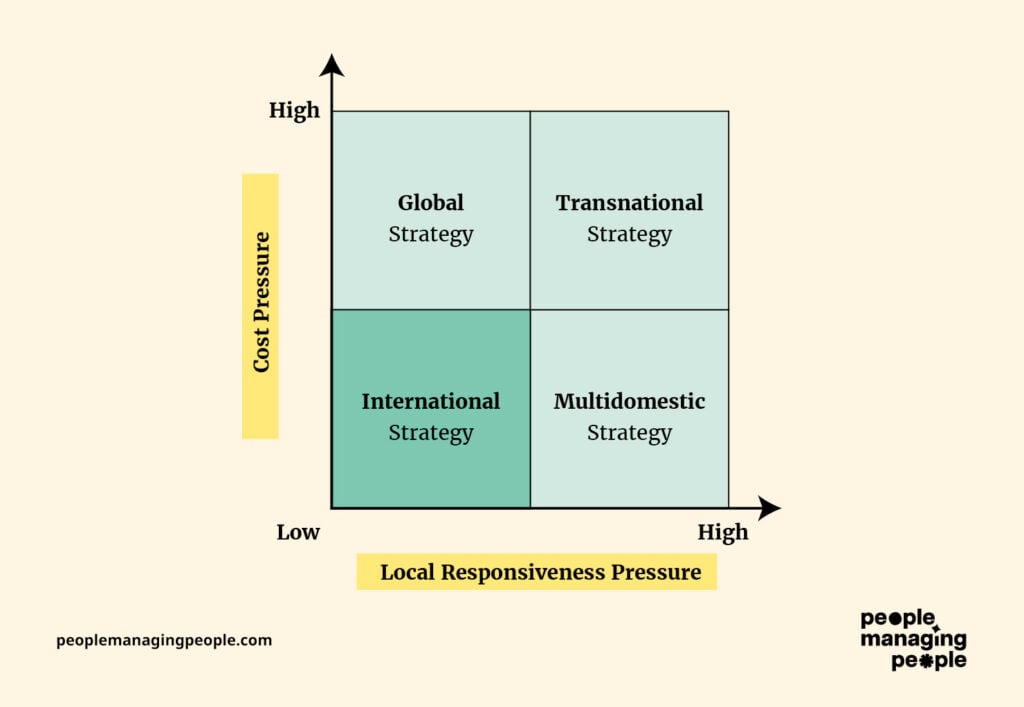
International strategy is one of several ways companies can expand across borders. The right model depends on how much the company needs to centralize operations and how much it needs to adapt to local markets.
Two factors matter most:
- Global integration: How centralized and consistent the company’s operations are across markets.
- Local responsiveness: How much the company adapts its products, services, employment practices, marketing, and operations to each country.
Here is how international strategy compares with other common international business strategies.
| Strategy | How it works | Best for | Main tradeoff |
| International Strategy | The company sells existing products or services abroad while keeping core operations centralized in the home country. | Companies testing international demand with limited local adaptation. | Companies are testing international demand with limited local adaptation. |
| Global Strategy | The company standardizes products, services, and operations across many markets to maximize efficiency and scale. | Companies with products that can be sold similarly across countries. | Cost-efficient, but may miss local preferences or expectations. |
| Multidomestic Strategy | The company adapts products, services, and operations to each local market. Local teams often have more autonomy. | Companies operating in markets with strong cultural, regulatory, or customer differences. | Locally relevant, but more expensive and complex to manage. |
| Transnational Strategy | The company balances global efficiency with local responsiveness, combining centralized capabilities with local adaptation. | Mature global companies that need both scale and local market fit. | Powerful, but difficult to execute well. |
An international strategy usually works best when the company can sell its existing offering abroad without making major country-specific changes. It is often a first step into global expansion rather than the final operating model.
As international growth becomes more complex, companies may shift toward a global, multidomestic, or transnational strategy.
When An International Strategy Makes Sense
An international strategy can be a smart move when your organization wants to explore international growth without committing to a fully localized presence in every market.
It makes the most sense when:
- Your product or service requires little adaptation across countries.
- Your brand, expertise, or product design is strongly associated with your home market.
- You want to test international demand before opening local offices or subsidiaries.
- You can serve customers through ecommerce, distributors, partners, licensing, franchising, or direct exports.
- Your leadership team wants to keep decision-making centralized.
- You want to control costs while validating new revenue opportunities.
- You do not yet need large in-country teams.
- Your operational model can support customers across borders.
This approach is especially useful for companies in the early stages of expansion. Instead of hiring teams in multiple countries, building local HR infrastructure, and tailoring every process to each market, the company can start with a lighter model and learn as it grows.
For people teams, that usually means supporting international expansion without immediately building a full local HR function. The work may begin with contractor policies, partner support, compliance research, global mobility considerations, or a small number of international hires through an employer of record.
7 Benefits Of An International Strategy
An international strategy can be a practical starting point for companies that want to expand abroad without overcomplicating operations too early.
Here are the main benefits.
1. Lower-risk market entry
International strategy allows companies to test foreign markets without immediately building full local operations.
Instead of opening offices, hiring large country teams, or redesigning the product for each region, the company can start by selling what already works at home. This makes it easier to learn whether there is demand before committing major resources.
2. Cost efficiency
Because the company keeps core operations centralized, it can avoid many of the costs associated with local subsidiaries, country-specific product development, and duplicate support functions.
For people teams, this may also mean a slower, more deliberate approach to international hiring. Rather than building HR infrastructure in every country from the start, the organization can decide where local talent is genuinely needed.
3. Brand consistency
An international strategy helps companies maintain a consistent brand identity across markets.
This is especially useful when the brand’s value comes from its home-country reputation, design, expertise, or origin story. Customers may want the same product, experience, or brand promise that made the company successful in its domestic market.
4. Operational simplicity
Keeping decision-making, product development, and major processes centralized can make international expansion easier to manage.
The company can use one playbook instead of creating separate operating models for every country. This simplifies leadership, reporting, training, and internal communication.
5. Leverages existing strengths
International strategy lets companies expand by using capabilities they have already built.
That could include a successful product, strong brand, proven marketing approach, efficient production process, or specialized expertise. Rather than reinventing the wheel, the company applies its domestic advantages to new markets.
6. Economies of scale
If the company can produce, develop, or deliver the same offering across multiple markets, it may be able to reduce costs per unit or per customer.
This is one reason international strategy can work well for software, manufacturing, consumer goods, education, media, and other models where the core product can travel across borders without major changes.
7. Faster time to market
Because the company is not waiting for extensive localization or full local operations, it can enter new markets more quickly.
That speed can be useful when the goal is to test demand, respond to competitive pressure, or capture early international interest.
What International Strategy Means For HR And People Teams
International strategy often sounds like a business development or market-entry topic. But once a company starts operating across borders, the people implications arrive quickly.
Even if the company does not plan to open local offices right away, people teams may need to support new hiring models, cross-border compliance, international contractors, distributed managers, and employees working across different legal and cultural environments.
Here is what HR and people teams should pay attention to.
Hiring usually stays lean at first
Companies using an international strategy often avoid building large in-country teams during the early stages of expansion. Instead, they may rely on headquarters staff, distributors, agencies, local partners, contractors, or a small number of remote employees.
That can keep costs lower, but it also requires clarity. People teams should know who is doing the work in each market, how those workers are classified, who manages them, and what risks the arrangement creates.
For example, using contractors in another country may seem simple at first, but worker classification rules vary by jurisdiction. If a contractor functions like an employee, the company may create legal or tax exposure.
Compliance starts before you open an office
A common misconception is that international compliance only matters once the company creates a local entity. In reality, compliance questions can emerge much earlier.
People teams may need to think about:
- Worker classification
- Local employment laws
- Payroll and tax obligations
- Benefits expectations
- Immigration and visa rules
- Data privacy requirements
- Intellectual property protection
- Health and safety obligations
- Local contract requirements
The exact level of risk depends on the country, the type of work, the business model, and whether the company is hiring employees, contractors, partners, or vendors.
Support needs may expand before headcount does
International expansion can create support needs before the company has local teams in place.
Customers, partners, and workers in new markets may need:
- Documentation in local languages
- Support across different time zones
- Localized onboarding materials
- Clear escalation paths
- Region-specific FAQs
- Training for managers leading distributed teams
- Guidance on communication norms and working hours
This is where people operations, learning and development, and internal communications can add real value. A company may not need a full local HR team yet, but it still needs systems that help people work effectively across borders.
EORs can help you bridge the gap
If the company wants to hire employees in another country without setting up a local entity, an employer of record may be useful.
An EOR legally employs workers on the company’s behalf in a foreign country and typically handles local payroll, employment contracts, statutory benefits, and compliance administration. This can help companies test international hiring while avoiding the cost and time required to establish a local subsidiary.
That said, an EOR is not a strategy by itself. It is a tool that supports a broader expansion plan. People leaders should still understand where the company wants to hire, why those roles need to be local, how long the arrangement will last, and when it might make sense to create a local entity instead.
How To Create An International Strategy
An international strategy should help your company expand into new markets while keeping costs, complexity, and risk under control.
Here are the key steps.
1. Define your expansion goals
Start by clarifying why the company wants to expand internationally.
Common goals include:
- Reaching new customers
- Diversifying revenue
- Extending the life of an existing product
- Using excess production or service capacity
- Building global brand recognition
- Following existing customers into new markets
- Testing demand before making a larger investment
Be specific about what success looks like. That might include revenue targets, customer acquisition goals, partner signups, market share, brand awareness, or proof that the company can serve customers successfully in a new region.
2. Identify suitable markets
Not every market is a good fit for an international strategy. Look for countries where your existing offer can succeed with limited adaptation.
Consider:
- Demand for your product or service
- Language compatibility
- Cultural similarities
- Customer buying behavior
- Economic and political stability
- Competitive landscape
- Ease of doing business
- Distribution options
- Payment methods
- Legal and regulatory requirements
- Talent availability if hiring may be needed later
The best first market is not always the biggest one. It is often the market where your company can learn quickly with manageable risk.
Tip: Tools like the World Bank’s Doing Business Index or trade data can help here.
3. Assess operational and people readiness
Before entering a new market, assess whether the organization can actually support international demand.
Ask questions like:
- Can we sell, ship, deliver, or support the product across borders?
- Can our customer service team handle different time zones or languages?
- Do our finance systems support international payments, currencies, and tax requirements?
- Do our contracts and terms work in the target market?
- Do we understand the data privacy requirements?
- Will we need employees, contractors, partners, or an EOR?
- Can managers support distributed or cross-border workers?
- Do we have enough internal capacity to serve this market well?
This step is where HR, legal, finance, operations, and go-to-market teams should work together. International strategy may be centralized, but it should not be planned in a silo.
4. Choose your entry model
A home replication strategy usually uses relatively light market-entry methods.
Common options include:
- Direct exporting
- Selling through distributors
- Ecommerce
- Licensing
- Franchising
- Agents or local partners
- International marketplaces
- Remote sales or customer success support
- Hiring a small number of local employees through an EOR
The right entry model depends on the product, market, customer expectations, and level of control the company needs.
For example, ecommerce may work for a consumer product, while a B2B software company may need local implementation partners or regional customer support.
5. Decide what stays centralized
International strategy depends on centralization, but leaders still need to define what that means in practice.
Decide which functions will remain controlled by headquarters, such as:
- Product development
- Brand strategy
- Pricing
- Marketing strategy
- Finance
- Legal
- HR policy
- Technology
- Customer support standards
- Vendor management
Then identify where limited local adaptation is allowed. Even in an international strategy, some flexibility may be necessary for language, payment methods, contracts, support hours, documentation, or compliance.
Think of it as running the business globally from headquarters while making enough practical adjustments to operate responsibly in each market.
6. Build minimum viable local support
Even if the product does not need much localization, the customer and employee experience might.
Depending on the market, you may need:
- Localized website pages
- Translated help documentation
- Local payment options
- Clear shipping, returns, or service policies
- Multilingual customer support
- Regional partner support
- Local legal or tax advice
- Country-specific onboarding materials
- Manager guidance for cross-border work
The goal is not to build a fully localized operation immediately. The goal is to provide enough support that customers, partners, and workers can succeed.
7. Address legal, tax, employment, and data requirements
Do not leave compliance until the end.
Before launching, review the requirements that apply to your target market. These may include:
- Import and export rules
- Tariffs, duties, and taxes
- Local contract requirements
- Consumer protection rules
- Trademark and intellectual property protection
- Data privacy laws
- Employment law
- Worker classification
- Payroll obligations
- Benefits requirements
- Immigration or visa rules
If the company plans to hire overseas, involve legal counsel, tax advisors, and HR early. An EOR may be useful for initial hires, but it should be evaluated alongside the company’s long-term market plans.
8. Monitor performance and know when to adapt
International strategy should be treated as a learning model, not a set-it-and-forget-it plan.
Track indicators such as:
- Sales volume
- Revenue growth
- Customer acquisition cost
- Customer satisfaction
- Support volume
- Return rates or implementation issues
- Partner performance
- Compliance issues
- Hiring needs
- Employee or contractor experience
- Market-specific product requests
Use that data to decide whether to continue, pause, exit, or localize further.
If a market performs well but requires more local support, that may be a sign to move beyond international strategy and consider a multidomestic or transnational approach.
When An International Strategy Does Not Work
International strategy is not the right fit for every company or market. It can create problems when the business underestimates how different local customer expectations, regulations, employment norms, and competitive conditions really are.
An international strategy may not work well when:
- Customers expect products, services, or support to be highly localized.
- Local regulations shape how the product or service must be delivered.
- Employment law, tax, payroll, benefits, or data privacy requirements are complex.
- The company needs local sales, implementation, customer success, or support teams to compete.
- Local competitors have a strong cultural, pricing, or distribution advantage.
- The existing product does not fit local language, payment, accessibility, or service expectations.
- Headquarters teams cannot support international customers across time zones.
- Leaders are ready to build long-term local operations instead of testing demand.
The danger is assuming that success in the home market will automatically translate abroad. Sometimes it does. Often, it needs help.
A company might start by selling the same product internationally, only to discover that local customers need different onboarding, payment methods, service hours, documentation, integrations, languages, or support channels.
That does not necessarily mean the expansion failed. It may mean the company has outgrown a pure international strategy and needs to move toward a more localized model.
Risks And Limitations Of An International Strategy
The same things that make international strategy efficient can also make it risky. A centralized model is easier to manage, but it can become too rigid if local markets need more adaptation than expected.
Here are the main risks to watch.
Weak local market fit
A product that succeeds in one country may not automatically succeed elsewhere. Local preferences, buying habits, cultural norms, pricing expectations, languages, and service standards can all affect adoption.
If the company ignores those differences, it may struggle to gain traction.
Compliance blind spots
International expansion introduces legal, tax, privacy, and employment considerations. Even a lean market-entry model can create compliance risk if the company sells, hires, stores data, or contracts across borders without proper advice.
People teams should be especially cautious when hiring or engaging workers in countries where the company has not operated before.
Overloaded headquarters teams
Centralization can keep operations simple at first, but it can also put pressure on headquarters teams.
Sales, support, finance, legal, HR, and operations may all be asked to serve new markets without extra capacity, local knowledge, or time-zone coverage. Over time, this can create bottlenecks and poor customer or employee experiences.
Limited local insight
Without local teams or advisors, leaders may miss important signals from the market. They may not understand why customers hesitate, what competitors are doing differently, or how local employment expectations affect hiring.
This can slow learning and make the company less responsive.
Difficulty transitioning later
International strategy is often a starting point. If the company grows successfully, it may need to evolve toward a more localized operating model.
That transition can be difficult if the organization has not planned for it. Leaders should define what would trigger a shift, such as revenue thresholds, customer demand, support volume, hiring needs, or regulatory complexity.
Top International Strategy Examples
Many well-known companies have used international strategy, especially during earlier stages of global growth. In practice, companies often evolve over time, so these examples are best understood as moments or elements of international strategy rather than permanent, pure models.
1. Nike: U.S.-designed products sold globally
Nike’s earlier international expansion relied heavily on U.S.-designed footwear and sportswear sold into foreign markets.
Why it fits international strategy: Product development and brand control were centralized, while the company expanded global demand for products that had already succeeded in its home market.
How it evolved: As Nike scaled, it added more localized marketing, partnerships, athlete sponsorships, and region-specific campaigns, moving closer to a transnational model.
2. Microsoft: centralized software development, global distribution
Microsoft has long developed major software products centrally while distributing them to customers around the world.
Why it fits international strategy: Core products such as Windows and Office could be sold internationally with the same underlying functionality, allowing Microsoft to scale through centralized product development.
How it evolved: Microsoft also localizes language, compliance, cloud infrastructure, and enterprise support, so its broader global model is more complex than a pure home replication strategy.
3. Harley-Davidson: exporting an American brand identity
Harley-Davidson sells motorcycles internationally while leaning heavily into its American heritage and brand identity.
Why it fits international strategy: The appeal of the product is closely tied to the company’s home-country identity, making brand consistency a strength rather than a limitation.
How it evolved: As with many global brands, Harley-Davidson still has to navigate local regulations, distribution, pricing, and customer expectations in different markets.
4. Netflix: early expansion with a familiar platform model
In its earlier international expansion, Netflix entered markets such as Canada and parts of Europe with a platform experience that was similar to its U.S. service.
Why it fits international strategy: Netflix could use its existing technology platform, user experience, and operating model to scale quickly across borders.
How it evolved: Over time, Netflix invested heavily in local content, regional licensing, subtitles, dubbing, and country-specific programming, moving well beyond a simple international strategy.
5. IKEA: Swedish design exported abroad
IKEA’s international growth was built around a distinctive Swedish design identity, flat-pack furniture model, and warehouse-style retail experience.
Why it fits international strategy: The company replicated a successful home-grown concept across multiple countries while preserving a consistent brand and operating model.
How it evolved: IKEA has also adapted to local markets through store formats, food offerings, product adjustments, and regional operations.
International Strategy Checklist
Before choosing an international strategy, confirm that your organization can answer these questions.
Market fit
- Is there demand for our existing product or service in the target market?
- Can the product succeed with limited localization?
- Do customers understand the value proposition?
- Are there local competitors with stronger market fit?
Operating model
- Which functions will remain centralized?
- What local support will be required?
- Can headquarters handle international sales, service, and operations?
- Do we have the systems to manage international payments, contracts, and support?
People and compliance
- Will we need employees, contractors, partners, or an EOR?
- Do we understand local employment and worker classification rules?
- Are payroll, tax, benefits, and data privacy requirements clear?
- Can managers support people working across borders and time zones?
Risk and adaptation
- What risks could make this market harder than expected?
- What metrics will tell us whether the strategy is working?
- What would trigger a shift to a more localized strategy?
- Who owns the decision to continue, adapt, or exit?
If you cannot answer these questions yet, the next step is not necessarily to stop expansion. It is to slow down enough to validate your assumptions before committing more resources.
Bonus: Don’t forget the legal side
- Understand tariffs (hot topic currently), taxes, and customs duties
- Register trademarks internationally if needed
- Know data protection laws (like GDPR)

International Strategy: A Practical First Step Into Global Expansion
An international strategy can be a smart first step for organizations that want to expand beyond their home market without immediately building complex local operations.
By leveraging existing products, processes, brand equity, and centralized decision-making, companies can test demand, enter markets faster, and control costs while they learn.
But international strategy works best when leaders understand its limits. What travels well in one market may need adaptation in another. Customer expectations, local competitors, regulations, and employment requirements can quickly change the level of complexity.
For HR and people teams, the goal is to help the business expand without creating avoidable risk. That means asking early questions about hiring models, worker classification, compliance, payroll, benefits, manager support, and the employee experience.
The best international strategies do not just ask, “Can we sell this abroad?” They also ask, “Can we support this market responsibly if it works?”
Subscribe To The People Managing People Newsletter
For more advice on international strategies and hiring globally—subscribe to our weekly newsletter for HR and business leaders. You’ll receive all our latest content to help you grow in your career and make greater impact in your org.