

Fewer Jobs, Higher Pay: The AI Compensation Paradox

Kyle Holm has spent 25 years advising companies on compensation, and right now he’s watching the logic of corporate hierarchy break in real time. Not because executives suddenly discovered organizational theory, but because AI is collapsing the distance between capability and influence. The old model—slow progression through management layers, credential accumulation, carefully staged promotions—is running into a technology that rewards direct value creation instead. And executives are noticing.
In this conversation from Transform Las Vegas, Kyle and David unpack what happens when AI-native companies stop hiring “mid-level” talent altogether, why compensation systems built on titles and tenure are struggling to keep up, and how the next generation of workers may leapfrog traditional career ladders entirely. It’s a conversation about compensation on the surface, but underneath it’s really about power: who gets heard, who creates leverage, and who gets left behind when organizations flatten faster than expected.

What You’ll Learn
- Why AI-native companies are increasingly structured around senior talent and highly capable junior talent—with the middle layer shrinking fast
- How AI is changing compensation strategy beyond simply “paying premiums” for technical skills
- Why companies may spend less on entire functions while paying top performers significantly more
- The difference between role-based compensation systems and emerging skills-based models
- Why compensation professionals are pushing for more data-driven decision-making instead of relying on “art”
- How AI is accelerating organizational flattening by reducing management gatekeeping
- Why career growth in the AI era may depend more on adaptability and risk tolerance than credentials
Key Takeaways
- AI fluency is quickly becoming table stakes, not a specialty
Most workers are not building LLMs. They’re expected to use AI to improve how they work. The distinction matters. Companies aren’t treating AI capability like an exotic certification anymore; increasingly, it’s viewed more like knowing how to use spreadsheets or the internet. Optionality disappears fast once a tool becomes infrastructure. - The middle of the org chart is under pressure
Kyle points to a growing divide at AI-native companies: senior operators and highly capable juniors, with fewer traditional mid-level roles in between. Why? AI reduces the need for coordination layers and accelerates how quickly junior talent can produce meaningful output. - Compensation growth may become less linear—and more volatile
The old progression model assumed gradual movement through structured management levels. But if organizations flatten, compensation jumps could become far more uneven. Workers who can directly leverage AI tools may create outsized value quickly, while others stall in roles that no longer scale. - Companies may shrink teams while increasing pay for top contributors
Product organizations are a good example. AI-enabled product professionals may command higher compensation individually while total team spend decreases because fewer people are needed overall. It’s one of the stranger dynamics emerging right now: higher individual value creation alongside smaller headcounts. - Compensation systems are still surprisingly primitive
Despite decades of HR software, compensation management often remains fragmented, manual, and heavily dependent on judgment calls. Kyle argues the “compensation is more art than science” mindset has become a convenient excuse for poor data integration and slow decision-making. - CEOs increasingly want unfiltered access to ideas
One of the sharper moments in the conversation comes when Kyle says his CEO probably wants to hear more from his AI-native college-age daughter than from another management PowerPoint deck. Harsh? Maybe. But it reflects a broader shift: executives want direct insight from people closest to emerging technology, not sanitized summaries traveling through four layers of approval. - Career goals built entirely around compensation are fragile
Kyle makes a distinction between destination goals and journey goals. Compensation is downstream of capability, relationships, adaptability, and risk tolerance. In volatile environments, optimizing only for salary can become a dead-end strategy if your skills stop compounding.
Chapters
- 00:00 — AI and the collapse of hierarchy
- 02:21 — AI’s impact on compensation
- 03:06 — AI skills become mandatory
- 04:06 — Smaller teams, higher pay
- 05:14 — HR’s blind spot on comp
- 06:35 — The science of compensation
- 07:58 — The disappearing middle layer
- 09:41 — Skills over credentials
- 10:59 — Rethinking compensation goals
- 12:14 — Why risk-takers win now
Meet Our Guest
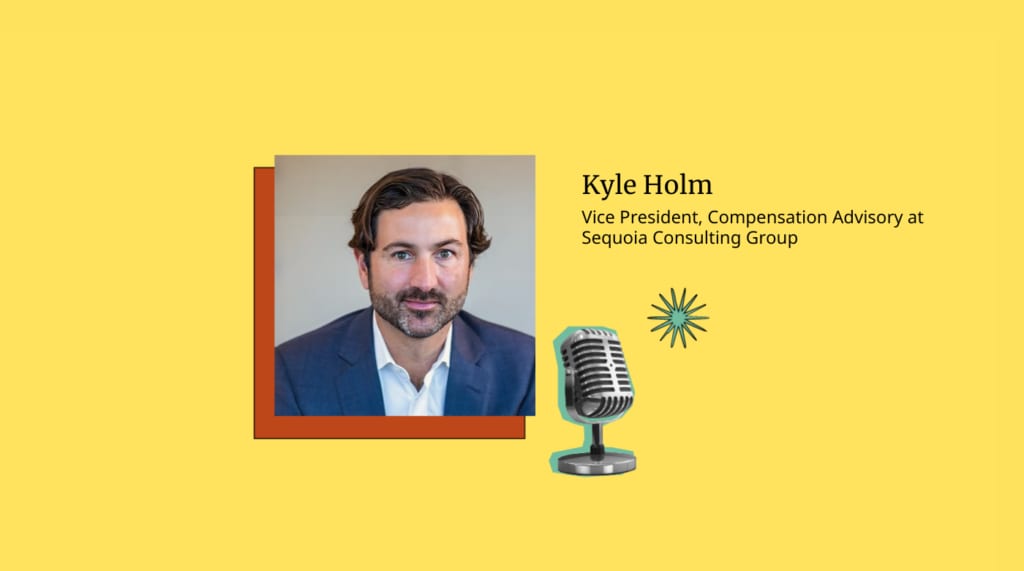
Kyle Holm is Vice President of Compensation Advisory at Sequoia Consulting Group, where he advises organizations on compensation strategy, pay equity, executive compensation, and workforce rewards programs that support business growth and talent retention. With deep expertise in total rewards, compensation benchmarking, and people strategy, Kyle partners with high-growth and enterprise companies to design data-driven compensation frameworks that balance competitiveness, fairness, and organizational performance. He is a trusted advisor to HR and business leaders navigating evolving compensation trends, workforce expectations, and the future of work.
Related Links:
- Join the People Managing People Community
- Subscribe to Our AI Signal Newsletter
- Connect with Kyle on LinkedIn
- Visit Sequoia Consulting Group
Related articles and podcasts:
David Rice: Kyle Holm's boss doesn't want to hear his PowerPoints anymore. The CEO wants to hear from Kyle's daughter instead. She's a junior in college, and she's vibe coding, and she's going to rise to positions that used to take years to reach because she knows how to channel the technology. On today's show, you're going to hear a conversation that I had at Transform in Las Vegas recently with Kyle Holm from Sequoia Consulting Group.
Kyle's been a compensation advisor for 25 years, and he's watching something shift that most people aren't ready for yet. The middle layer of compensation growth is disappearing. At established companies, mid-level employees are using AI to get better. At AI-native companies, there is no mid-level. It's senior people and junior people.
That's it. And these management hierarchies are going to collapse faster than anyone expects because CEOs aren't going to let ideas get filtered through multiple layers of management anymore. Product teams are already feeling it. Product professionals who know how to use AI are making more money, but product teams overall are getting smaller.
So total spend on product is probably going down even while individual compensation goes up. It's a weird dynamic where the people who figure it out get paid more, but there are fewer of them. Oh, and those AI skills everyone's paying a premium for? It's not really a thing. There are only a few people actually building LLMs.
For everyone else, AI skill development is just a responsibility that we have now. It's not a choice. If you're not skilled in this, you probably will not keep doing what you do. We're moving from a role-based economy to a skills-based one. Less about checking boxes and showing credentials, more about can you harness this technology to add value or can't you?
So today, we're going to cover why the middle management layer is vanishing at AI-native companies and probably coming for everyone else; why compensation is more art than science and why that needs to change; skills-based versus credential-based pay in the AI era; and why compensation goals should be journey goals, not a destination.
I'm David Rice. This is People Managing People. And if you've been thinking about your career in terms of steady progression through management layers, this conversation might change how you're planning the next few years.
All right, well, I'm here with Kyle Holm from Sequoia. Kyle, welcome.
Kyle Holm: Thank you. Thanks for having me.
David Rice: Absolutely. So when it comes to Transform and we're talking compensation, what's on your mind these days?
Kyle Holm: I mean, I think the main thing on my mind is that AI is impacting compensation in all kinds of different ways. When you think about native AI companies and the amount that they're paying people, when you think about AI at existing kind of established companies and what it's doing to existing roles, how it's changing product teams and engineering teams, yeah, there's a lot to do with compensation and what's happening.
David Rice: I think for a lot of people maybe when they think about compensation, they just think about, like, well, people are paying a premium for AI skills, right? But I'm curious, like, what you're saying. What are some of the more, like, concerning or maybe even exciting things that are happening around payroll or compensation in AI?
Kyle Holm: Yeah. I mean, I think one of the things you said, they're paying a premium for AI skills. I mean, reality is, like, there's only a few people that are actual AI developers creating the LLMs. Those are... Right? The, that's not... The AI skill development is sort of like a responsibility I think we a- Yeah ... all have.
And so that really is not necessarily a choice. Yeah. Like, you gotta do it. Yeah. Otherwise, you probably won't have a job. You know, if you're not- Yeah ... if you're not skilled in this, if you don't know how to make yourself better with it, you probably won't be able to just keep doing what you do. You know, I'm old enough that compensation surveys used to be in binders.
They moved from binders onto, you know, the internet and onto a computer. But, like, if I was like, "Oh, I only work in binders," I wouldn't be doing this anymore.
David Rice: Yeah. Tell me a little bit, like, 'cause, you know, it's changing, like, how we model things operationally. You know, it's just changing the way that we think about approaching HR and operations.
So- Yeah ... what are some of the things that are going on around compensation modeling in itself?
Kyle Holm: Yeah. Compensation modeling, there's a few different aspects to compensation modeling. There's your merit increase, you know, and that's pretty basic around, you know, how much are you gonna increase, what are you looking for adjustments.
Then, you know, there's the hiring plan, which takes into account compensation modeling, 'cause for everybody you h- every person you hire, they've got a, an expected, you know, cash and equity range. I think that's the area where AI is having the biggest impact. 'Cause companies are kind of going in two directions.
One is there's a premium, like you said, for- Yeah ... people that are capable in AI, so we have to pay more than maybe we thought. But then there's also a, well, wait a second, we have people in-house who have used AI in a way that makes it we don't have to hire that role. Yeah. So you have this kind of weird thing where, like, if I were to take product, for instance, where product professionals who know how to use AI to make it better are gonna be paid more, but product teams in aggregate are probably gonna be smaller.
So how much we're spending on product overall is probably going down, but the people that figure it out are gonna be making more money.
David Rice: Yeah. It's interesting, 'cause we're, you know, we're here at this HR conference, and when we talk about AI and HR, I think a lot of people think of things like performance management, recruiting, maybe even, like, you know, automating the employee, you know, inquiries, like handbook stuff.
A lot of people aren't really, like, thinking about their approach to comp necessarily. I- Yeah ... at least that's my impression. Does that hold true? And like ...
Kyle Holm: Well, no, not for us. That's what we do. Right, right. We help companies, you know, operationalize and get the most out of their people investment, and a big part of that is where can AI find those efficiencies- 'Cause at the end of the day, the people team and the finance team just wanna be more strategic.
Right. And there are a lot of areas in terms of the delivery and the design and the benchmarking of compensation that AI can really help out and sort of streamline things. So the kinda crazy thing about compensation is that even the first wave of software that, you know, we've been living through for the last 20 years didn't really impact compensation that meaningfully.
Sure, there are some workflow softwares that have bumped up here and there, but they're still running, run by the same people, and they're not really integrated into the overall spend. And so that's really where the opportunity is for AI, is to really pull things together in a meaningful way and start to get way more strategic around the ROI that you're getting on your comp spend.
David Rice: One of the things I've noticed is, like, especially with HR people, there's a tendency to either not trust outputs or to kinda question, like, all of the data that they're putting into it, right? Yeah. How are you kinda, like, consulting with clients on what they're doing with the software essentially?
Kyle Holm: Yeah. I think as comp advisors, as comp professionals, people always say there's an art and a science.
And there is, right? Because it's not like a stock price, right? Right. What a human being is paid for a role, there's all kinds of factors that come into it. Unfortunately, we've also been in a time where data is actually harder to find because you have to pay for it or it- Yeah ... it's not aggregated correctly.
And so I think a lot of comp professionals and a lot of comp advisors have actually gone way too far in the, "Oh, it's an art more than it's a science," and haven't actually said, "Well, no, the landscape has changed. Let's go find where the data is, pull it out, so that we can get more science and less art."
Yeah. So that's what we're pretty passionate about, is we're data agnostic, but we don't wanna tell our clients that it's actually more art. We wanna say, "It's harder, but we're gonna go find the science," because at the end of the day, when they spend so much time, like you said, not believing a number or, you know, going back and forth, they're actually avoiding making the decisions they need to make.
Yeah. And it's just g- it goes too slow.
David Rice: What's something that, you know, I think maybe... I always ask anybody this about whatever area they're in, right? Yeah. But, like, what's something that you see six months to a year kinda coming down the road that a lot of people aren't maybe thinking about that you would kinda warn them about?
Yeah. There's something you're gonna wanna consider.
Kyle Holm: Yeah. Well, the large established companies, kinda the middle layer of your employee base, is using AI to get better. Right. Right? At the AI native companies, it's like senior people and junior people, right? There's no, like, mid-level experience. And my daughter's a junior in college, and she's here at Transform.
When I think about, you know, what my boss wants to hear about, right, it's probably not- What I've got going on, it's probably more about what my daughter is doing with AI and, you know, she's vibe coding and doing all of these things Yeah And the thing that I think that's gonna happen sooner rather than later is these management organizational hierarchies, they're just gonna go away in a way that I don't think folks are necessarily ready for.
But if I'm the CEO of a company, like my boss, I wanna know what Tessa's saying versus what Kyle's PowerPoints. Right. And I'm not gonna let her go through multi-layers of management to get to me, you know, to get him the ideas. So that is sort of that reckoning that I, I feel like people are worried about, and I don't think it's gonna be a bad thing.
Yeah. I just think it's gonna happen much faster because people, and it's gonna be young people probably more than, you know, more people later in their careers, that are using this technology to find value are just gonna rise and they're, you know, they're gonna sort of find themselves in positions that probably took years to get to as they sort of channel the technology and the capability.
David Rice: It's interesting, you just mentioned, like, the two layers. And when I think about compensation, right, normally you'd have that middle layer, and there's, like, a steady growth path of your compensation- Yeah, exactly ... across that- Yeah ... journey. What does that look like then when there's only ... Is this, like, do you go from making 80,000 to 200,000 or, like, what?
Kyle Holm: I mean, yeah. I mean, that, like, that is I ... Yeah. I think we will see that kind of ... Because what's happening now is it's less about a role, you know, or your education, 'cause what you learn in college kinda is, like, is meaningless. Yeah, by the time you get there, it's outdated. Yeah, exactly. You learn how to work hard.
Yeah. You know, you learn, you know, you, there's great value in, in what you learn, but, like, what we're entering now is much more of a skills-based economy. Yeah. Not what you described as, like, a hierarchy where, like, I'm checking off boxes, I'm showing capabilities. I'm like, "Oh, I'm getting credentialed."
Well, if my credential and my ability to add value can be just harnessed in how I'm able to, you know, use this technology, well, then I'm gonna get paid based on the value that I'm bringing and not on- Yeah ... some sort of merit-based system that, you know, has ... Maybe I had, like, a crappy manager for a while, and you know, like, all of this stuff that it's just you kinda get to, people are capable of doing it or they're not.
David Rice: So I guess my last question for you, and I'll let you go, but- Yeah ... is, like, if somebody's got compensation goals in their career for the next, like, two to three years, and they wanna hit these benchmarks, sorta like what's your advice to them for- Yeah ... how to think about that? Because, like, to your point, it is changing, and maybe the expectations have to shift with it.
Kyle Holm: Yeah. So I've been doing, I've been a compensation advisor for 25 years. I actually think when people set compensation goals, that's actually not a great way to go about it. You're actually setting, like, a destination goal- ... instead of a journey goal. Yeah. And you're gonna get paid based on your capabilities and your risk tolerance.
You know, are you willing to learn new skills, and are you willing to take risks? And so, you know, if somebody has a compensation goal, then I would unpack that to say, "Well, if you've got a really big goal, you're gonna have to take more risk, and it's g- gonna likely... If you've got a smaller goal, you know, you might be able to you know, chunk your way there."
But, you know, I truly believe that it's really about the skillsets that you can pick up, the relationships that you can build, and, you know, that will then provide you the opportunities that'll get you to that compensation goal.
David Rice: Yeah, I would agree. I w- I was thinking about this the other day as some of the sessions were going on, and I was thinking to myself, like, we are definitely coming into an era that's, like, built for the risk-takers.
Yeah. You know? I mean, it always is that way to some extent, but-
Kyle Holm: Yeah, exactly. It's always been that way. And you know what the cool thing is that I think prior iterations, and I'm old enough to have been, like, through the dot-com boom and all that. Yeah. Prior iterations, it was the risk-takers, but it was really hard to get into position- Yeah to be a risk-taker.
David Rice: Yeah, exactly.
Kyle Holm: Right? Like, there was a lot of gates, you know, that- Gatekeeping and, yeah ... gatekeeping to, to get into that position. It's much more wide open now, right? I mean, it's much- Anybody can do it, really ... more wide open now. Yeah. Yeah. Exactly, and I think that's why it's so exciting to have these native AI companies with 20-year-olds, and they're sleeping in their office. It's cool.
David Rice: Yeah, it's an interesting time. Yeah. Interesting time to be young and try experimenting. Yeah. You know?
Kyle Holm: It's very cool. Yeah. Yeah.
David Rice: I'm a little jealous in w- in some ways. Yeah.
Kyle Holm: I'm very jealous.
David Rice: Maybe it's just the youth, or maybe it's the risk. I don't know. Yeah. Very jealous. Well, Kyle, it was nice to have you on. I really enjoyed chatting.
Kyle Holm: Yeah. Thanks for the time.
David Rice: Listeners, take those risks. It's gonna pay off.
Kyle Holm: Yeah.

