

Why AI Transformation Starts With Organizational Clarity


AI transformation has a funny way of becoming an organizational X-ray. The companies getting real value from it aren’t necessarily the ones buying the most tools or burning the most tokens. They’re the ones that understand what they’re trying to accomplish, what excellence looks like, and which problems are actually worth solving.
In this episode of People Managing People, David Rice speaks with Zapier’s Chief People and AI Transformation Officer, Brandon Sammut, about why AI ROI starts with organizational clarity, how to build experimentation that survives contact with actual workloads, and why adoption eventually needs to give way to impact. They also explore AI coaching, the growing value of judgment and wisdom, and why the best employers may increasingly be defined by how much more capable people become while working there.

What You’ll Learn
- Why organizational clarity is a prerequisite for meaningful AI transformation
- How to move from individual AI experimentation to standardized team workflows
- Why AI adoption is useful as an early indicator—but insufficient as a measure of impact
- What experimentation requires beyond simply telling employees to “innovate”
- How AI changes the value of expertise, judgment, wisdom, and influence
- Why managers still own clarity, resource allocation, and employee development—even with AI
- How transparency about uncertainty can strengthen confidence rather than undermine it
- Why employee development could become a defining part of the employer value proposition
Key Takeaways
- Start with the problem, not the technology. AI is a means, not a strategy. Before asking what AI can do, leaders need clarity about what the organization is trying to achieve and where excellence actually matters.
- Experimentation needs protected resources. Telling an entire team to experiment while expecting everyone to maintain their existing workload is basically preschool soccer: lots of movement, not much coordinated progress. Give a small group a meaningful problem, dedicated time, and clear stakes.
- Make failed experiments safe to discuss. The point of experimentation isn’t to produce an uninterrupted string of successes. Leaders have to demonstrate through their behavior that unsuccessful prototypes—and the sharp edges they reveal—are useful information.
- Stop confusing AI usage with business impact. Adoption matters early because it creates experimentation and learning. Eventually, the scoreboard needs to return to outcomes the business already cares about: customer satisfaction, new-hire success, product reliability, sales performance, and other meaningful measures.
- Turn individual breakthroughs into institutional knowledge. One employee developing a brilliant AI workflow is useful. A whole team adopting a proven “golden path” is transformation. Organizations need to capture context, workflows, tooling, and learning so improvements don’t remain trapped in somebody’s notebook or Slack history.
- AI makes wisdom more valuable, not less. When access to information becomes abundant, knowing facts is less differentiating. Judgment, taste, reliability, accountability, and the ability to orchestrate people around difficult problems become more important.
- Management is shifting from controlling work to creating conditions for it. Managers still need to provide clarity, allocate resources, and develop people. AI can give them leverage across all three, but it doesn’t eliminate their accountability for any of them.
- Name uncertainty instead of corporate-speak-ing around it. Employees can see layoffs, competitive pressures, and disruption happening around them. Pretending those realities don’t exist doesn’t create confidence. Leaders build trust by naming hard things openly and helping teams understand what they intend to do about them.
- Make people more capable while they’re with you. The strongest employer value proposition may increasingly be developmental: people should be able to look back at their time with an organization and see that they became substantially better prepared for the next decade of work.
Chapters
- 00:00 — AI ROI Starts With Clarity
- 03:13 — Finding High-Value AI Work
- 04:59 — Why Experimentation Fails
- 08:50 — Rewarding Learning
- 10:04 — The AI Pressure Test
- 12:30 — AI Costs and ROI
- 14:05 — Managing AI Usage
- 17:10 — Scaling AI Across Teams
- 18:37 — From Adoption to Impact
- 21:17 — Knowledge vs. Wisdom
- 24:58 — Managing With AI
- 25:42 — AI Coaching at Zapier
- 29:15 — Leading Through Uncertainty
- 31:42 — Developing Better People
- 34:24 — Closing Thoughts
Meet Our Guest
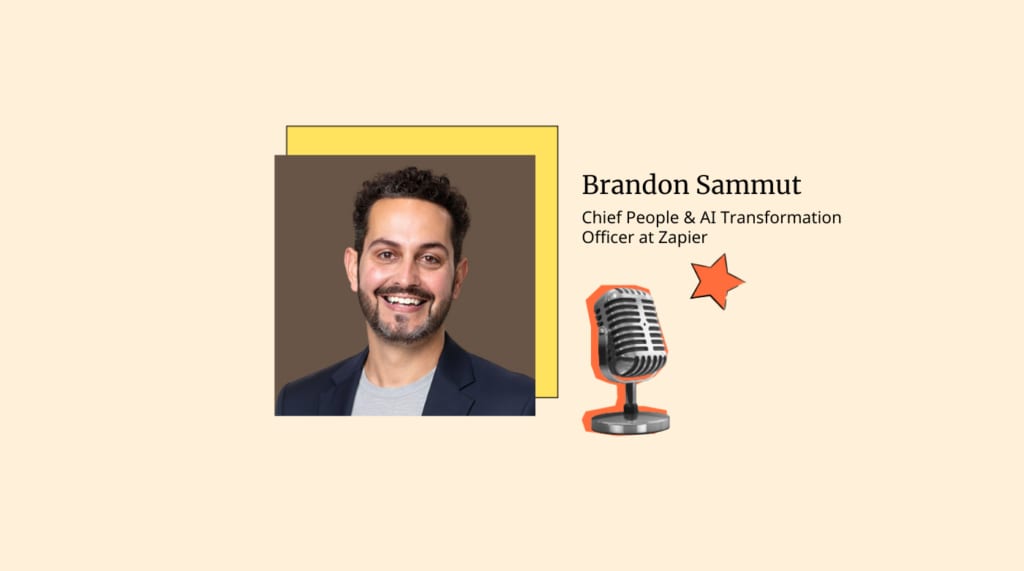
Brandon Sammut is the Chief People & AI Transformation Officer at Zapier, where he leads the company’s People function and organization-wide AI transformation strategy. With a background spanning talent, operations, education, venture capital, and business development, he focuses on building high-performing teams and reimagining how people work alongside AI. Before joining Zapier, Brandon served as Chief People & Culture Officer at LiveRamp and held roles at Teach For America, Owl Ventures, and Boston Consulting Group. He holds an MBA and a Master’s in Education from Stanford University.
Related Links:
- Join the People Managing People Community
- Subscribe to the newsletter to get our latest articles and podcasts
- Connect with Brandon on LinkedIn
- Check out Zapier
Related articles and podcasts:
David Rice: The ingredients for getting ROI from AI have very little to do with the technology. That's not a hedge. It's what today's guest has learned from building at Zapier and talking with over a hundred and fifty operators across industries. Everyone's asking the same question: What's most worth doing with AI? And you can't answer that without organizational clarity. What are we actually trying to do here? What does excellence require? If a team is anything short of total clarity on those questions, that's where to start, not with the tools.
On today's show, I'm chatting with Zapier's Chief People and AI Transformation Officer, Brandon Sammut, about what separates organizations actually getting value from AI from the ones still spinning their wheels. It keeps coming back to fundamentals. People are watching competitors lay off workers. There's fear and uncertainty everywhere. And the leaders creating conditions where good work emerges are the ones naming that openly, not sugarcoating it, not pretending like there's a perfect answer.
So today we're covering why clarity of purpose matters more than AI strategy, what real experimentation requires and why it keeps failing, how AI coaching is changing how people receive feedback, and why the best employers of the next decade will be known for how they develop people.
I'm David Rice. This is People Managing People. And if your organization is still leading with the technology instead of the clarity behind it, this conversation shows you what's getting in the way. Let's get into it.
Brandon, welcome to the show.
Brandon Sammut: Hey, David. It's good to be with you.
David Rice: There's a lot of discussion about AI transforming organizations, but, you know, sometimes I wonder if we're giving the technology almost too much credit.
It seems like AI exposes things that were already true about a company in a lot of cases But it does help you build new ways of working together without humans doing a lot of the redesign work. I'm curious, when you look at organizations that are succeeding in AI transformation, what are they changing about how people work together that others are missing?
Brandon Sammut: David, I would tell you, I agree with your premise that a lot of the ingredients for getting ROI from AI have little to do with the technology. We can start there. What I mean by that, and this is partly by virtue of what we're learning at Zapier, partly by virtue of having talked with over 150 other operators building companies of all types, like all over the world, not just in tech.
I talked with a, a peer at a logging company earlier this week. You know, the AI opportunity is for everyone, but what's required to make it real starts with things that don't have anything to do with the technology, and one of the most fundamental ingredients, if you really think about it, is leaders being clear about what it is that they and their companies are trying to do in the first place.
And, you know, the reason I can't unsee that is because AI is a technology, and as a technology, it's a means of getting something done. And so you can do a lot of stuff with AI, and to some degree, that's beside the point. The question that a lot of leaders are thinking about right now is, what's most worth doing with AI?
And to answer that question, you do have to have a lot of organizational clarity around what is it that we're really trying to do here as a team, and what does excellence require? And if a team in this moment is anything short of total clarity on that question, you know, that's the place to start.
David Rice: It's interesting you say that, and I think that is a big part of the challenge for a lot of organizations.
The leadership team, they wanted this technology. They want the competitive advantages, but then they don't actually know what to do with it in a lot of cases. And I'm curious, are you starting to see that change? Because we're now Three and a half years into this conversation . Obviously, the tech has changed quite a bit in that time.
Are you starting to see leaders really get more of a clear idea of what's high value, what's the necessary work to do with AI?
Brandon Sammut: I think it's starting to happen. Yep, and if you can believe it, David, it has been, at this point, almost four years, not quite, three and three quarters years since ChatGPT 3.5 launched, which is one-- I think one of the first editions that really captured public attention.
So yeah, it, it really has been the better part of four years at this point. And yes, yeah, I'm seeing what you're seeing. You know, the making use of AI starts with clarity of purpose, like we were talking about earlier. It does also require what you're pointing at too, which is, you know, you could call art of the possible, 'cause it kinda gives you a sense of supply and demand, you know?
It's like where are we demanding excellence of ourselves where we're not great yet? And then what is the supply of ideas or new ways of working that we can put together to actually get from good to exceptional? And in some cases, folks are just getting a better sense, partly through just what people are sharing, talking with peers, and what have you.
I think this is one of those times when the way work works is shifting so quickly that for operators, you know, folks building things like you and me and many of the folks that are listening, the benefits of spending time outside the four walls of our organizations, talking with peers, reading up on what others are doing or thinking, that is even more beneficial now than typically because we stand to learn a ton from what's going on outside of our company.
David Rice: Absolutely. It's every leadership team will say that they want innovation, right? Every company says they want people experimenting with AI But I talk to some leaders and it, it's, you know, they're having a hard time with employees being hesitant to try things, to share failures, to challenge the existing way of doing things.
I'm curious why, in your opinion, is experimentation so difficult when the organization claims to value it in all of these cases?
Brandon Sammut: There are a couple things. One, coming back to where we started a minute ago, great experimentation requires a strong hypothesis, and a strong hypothesis should be grounded in a question that the organization really needs to answer.
So sometimes where I see experimentation fall down is that either the, the question that a hypothesis should be formed around is unclear, so it's like experimentation towards what end, you know, it needs to be really crisp. And then the stakes of success need to be pretty high. There are all kinds, you know-- On the people team at Zapier, for example, such a, such a talented people team at Zapier.
You know, we could point ourselves at experimenting to solve just about any conceivable talent or culture-related problem. Not all of those are a particularly great use of the team's time and energy. And so it's like clarity of not just what questions can be answered, but what questions are most worth answering.
So it starts there 'cause then that helps with the strength of the hypothesis and the wherewithal to keep pushing. You know, I think a lot of what organizations are, are having a hard time w-right now with, with AI is that it's like crossing a chasm. You're trying to figure out how to make a bridge from one side of a chasm to another.
It takes a lot of work to build the bridge, and then you gotta walk across it to the other side. Meanwhile, on this side of the chasm, you've got a business to run the way we're doing it today, and this creates competing priorities. And so, you know, anything short of a true we-have-to-figure-this-out-together level priority is gonna end up on the side of the desk.
Now, one way organizations can help with this as part of a strong culture of experimentation is to ring-fence people and resources to do the experimentation. So rather than just calling an entire team ambiguously into experimenting, or even if you're clear. Let's say on a talent acquisition team of 10 people, we say, "Hey, we've got a big problem with application volumes going way up because everyone's using AI to apply to jobs, and as a result, we're not able to screen a meaningful fraction of the applicants.
We think we're missing gems along the way. We're not getting back with candidates as quickly as we commit to. We need to solve that problem." And sure, maybe AI can be part of that. Well, that's great. But if I was a talent acquisition leader and I just said that to my 10 folks on the team, I'm gonna get preschool soccer.
Everyone's gonna be running around on their own trying to figure that out. A better approach to experimentation might be saying, "Hey, we need two people of this group of 10 to team up for 30 days And show us the new way. Show us how to solve this problem, and we're gonna ring-fence twenty hours a week for each of you, so forty hours total per week.
That's the investment we're willing to make as a team. But instead of asking all of you to think about it, which means no one's really thinking about it deeply, I'm gonna ask two, right? You could choose folks based on skills. You could take volunteers, which sometimes is great unless there are big skill gaps 'cause you get folks who are just really motivated about figuring out how to solve that problem.
Those are two things. And then the last one just has to do with what happens when the experiment doesn't work. So that's more around culture of psychological safety within experimentation. The organizations that don't have confidence-inspiring answers to that question can also end up with a, kind of a hard time in the last mile of experimentation, which is reporting results.
Because it needs to feel something short of super risky to talk about the things that didn't work. Even if overall it was a relative success, you gotta be able to talk about the five sharp edges that the team's gonna need to know if we're gonna scale that practice.
David Rice: I'm glad you said the stakes piece because I think some people think, well, we'll have successful experiments if we're doing this right, and that's not the only measure, right?
And I think part of what happens if you find that you're having a ton of successful experiments, I would ask, are you actually experimenting big enough? You know, 'cause I think there's a difference there and... But, you know, we celebrate innovation in hindsight, right? In the moment, experimentation often looks inefficient, messy, occasionally wasteful.
I wonder, you know, if managers are still rewarding predictability over learning, are employees gonna optimize for safety over time?
Brandon Sammut: I think it's really important for leaders to answer to that explicitly, and then for our behaviors in those moments to reflect what we're saying. So, you know, when a member of my team goes out and prototypes something, you know, within an area that we've already identified we really want to figure out, and the thing they tried doesn't work, how does our people leadership team and I...
Like, how do we show up within that? What gets said? What do we do? What do we not do? How is that person left feeling? The cool thing about that is, you know, there's things to be aware of so that you don't compromise a culture of experimentation, but the opposite is true. Every time something like this happen is an opportunity to reinforce a really positive culture around this as well.
David Rice: You know, you go back a year or so I would think about some of the events we were doing at the time, and a lot of folks were saying that they were having struggles with trust, especially after, be it layoffs or whatever it was that had unfolded. There's a bunch of things driving disengagement, right?
But trust, knowledge sharing, and decision-making before AI became the center of their focus. So when you introduce this technology, and it really depends on all three, right? I'm curious, you know, what are the consequences of trying to scale AI across an organization that hasn't solved the basic operating challenges of having it?
Brandon Sammut: There is a lot of what's old is new again here, and the thing you just made me think about, David, is it is hard to scale just about anything in life on a shaky foundation. It is hard to scale anything on a shaky foundation. And, you know, a lot of, you know, our operator peers are finding that this whole AI wave is effectively a org health pressure test, whether it's on organizational clarity, culture of experimentation or psychological safety, trust in management.
If we have been thin or shaky on any of those places, now it's, you know, really coming back. It feels more obvious now because on top of all of that, we're now trying to redesign how many parts of our work work.
David Rice: Yeah, it's funny. I was thinking about, I was-- You said the shaky foundation piece, and I was thinking about this actually last week when I saw, I saw on social media there was, like, a clip of Mom Dani talking about that building in New York where they never got the foundation right, and it's slowly starting to tip.
So I thought that's actually a little bit of an analogy right there for organizations 'cause they start to scale, but if you're not doing the things along the way to make this work on a foundational level, you know, you end up like this building, right?
Brandon Sammut: Isn't that the truth? I mean, there are so many lessons or examples we can learn from other eras of history, big technological waves, or even just from the work of trying to do something that matters anywhere, including in, you know, something like construction.
David Rice: Yeah. I, I think it's interesting too 'cause you know, you'll have two organizations that can buy the exact same tools, and they end up with massively different outcomes, and it's really just comes back to the basics of this, things that they may have ignored for years in terms of operational infrastructure.
I think now we're actually seeing because the ROI conversation keeps becoming more intense for a lot of executives, right? So I think we are seeing more and more analysis of this at least.
Brandon Sammut: Yeah. The cost stuff's coming up, isn't it? Or I should say the ROI conversation is popping right now, in part because at the very least, the denominator of the ROI equation, right, the, the costs are scaling quickly for a lot of companies, huh?
David Rice: Yeah. I mean, well, I just saw, read the other day that a lot of companies' AI costs have outweighed what they were spending on employees And I'm thinking, "That doesn't make a lot of sense." I'm sure it will, will get cheaper eventually, but yeah, right now I don't know if it's worth it.
Brandon Sammut: Yeah. What's your take on AI usage leaderboards or, or maybe-
David Rice: Token maxing?
Brandon Sammut: Token... Well, yeah, there's token maxing, and then there's the antithesis of token maxing, which are, like, kinda like hard caps on AI usage, right? So we're seeing companies on either end of the spectrum right now.
David Rice: Yeah, I think it just shows, like, how much context is missing from the conversation because would I wanna limit the usage necessarily of somebody who's doing some really creative and outside-- It's like thinking outside the box, whether they're taking on new things, they're maybe opening up new avenues for the business.
No, I don't wanna limit that person. But when you know, how am I supposed to monitor that and grade that in an organization that has, let's say, 25,000 employees? That's a huge challenge. And so I wonder what we'll see with that. I, I'm glad that the token maxing thing got so much attention 'cause I'm like, that is not a productive use of this technology and puts us in a position where I think a lot of people just start to passively let go of what they do or let go of how they think they add value and accept when they're in that environment.
Brandon Sammut: It's fascinating. Do you wanna hear how we're thinking about it at Zapier?
David Rice: Absolutely.
Brandon Sammut: For this, I'll give credit to Carly Gilardi. Carly Gilardi's the, our head of AI operations and infrastructure at Zapier, and she's effectively the head of our kind of center of excellence for AI transformation inside Zapier.
I work really closely with her. She started on the people team, matter of fact, over four years ago, and now she has this big job. And this is one of the things that she and the working group were figuring out in the first half of the year. You know, we also saw our cost scaling. Now we saw all the ways we're using AI, you know, to produce results also scaling.
So the cost scaling by itself wasn't like a canary, but we had some wonderings about things like model selection. Now eventually honestly, including in the Zapier product, like you'd like to see a day where based on kind of the investment level you're willing to make in a given period of time and the work you're doing, where whoever you're working with AI can throttle or match the job to be done with the most efficient model.
Efficient in terms of whether that's speed and cost, or mainly cost, or mainly speed, or whatever, you know, w- quality, whatever the case may be, whatever y- your optimization function is, but we don't have any of that today, right? So right now it's up to individuals to understand the relative pros and cons of different models and make sure they have the right model plugged in for the right job.
And that's what we, Carly and the team, wanted to solve in the first half of the year. And so we didn't do leaderboards, and we also didn't do caps. What we did do is we set up-- we ingested AI usage data from all the places where folks use AI at the company, which includes Zapier, Anthropic products, OpenAI products, a couple other products, and put it all into a, a single kind of data lake.
And then we created a series of automated dashboards that everyone gets like a DM in Slack at the top of every month. That's your own personal AI usage report. Now, here are two cool things about it. One, it's not in public and there are no leaderboards, so they're not ranking you against other people. I think that's really important for this.
Two, it doesn't just describe your usage from the past month, it makes recommendations. So for example it might say I'm a benefits analyst at Zapier. I get my monthly usage report. Let's say for whatever reason, turns out maybe I wasn't, wasn't looking very carefully. I, I had Fable. I used Fable for everything last month.
Now, this usage reporting has context on the jobs in the company, so it might say, "Hey, as part of your benefits role, are you building a rocket to Mars? Because if not, you know, you probably don't need Fable to do many parts of the benefits analyst job. In our experience, Sonnet will probably work well.
You'll maybe try Sonnet, and we'll check in in a month." And it keeps track of the recommendations it's making and can then tune next month's recommendations based on that. So it's both descriptive and prescriptive, but without setting hard caps. We do actually now have a cap on usage, but it's to protect runaway spend, like unintentional, and folks can get their cap lifted just by putting a quick message into a Slack channel.
So it's not meant to curb usage. It's just meant to prevent the kind of low but meaningful probability of, you know, runaway agents or, or even malicious actors who took a key and are now running a bunch of their own stuff.
David Rice: One of the things I've noticed is there's individual employees are becoming incredibly productive with AI, right?
But those gains, they're not always spreading across teams, across the organization, and when we think about sort of peer learning or collective learning proving a little bit harder in some ways than individual learning, it's really a culture question What have you all done to stand some of that up and to really encourage that?
Brandon Sammut: Well, we're now about two weeks into the second half of 2026, and our number one focus outside of specific like new ways of work, we have three new ways of working with AI that we're focused on. But in terms of just an overall pattern of building with AI that we're-- it's our number one focus, is bridging from great individual usage of AI to more team-wide standard ways of working with AI.
You know, at this point, we've done plenty of experimentation, prototyping, and so on. Most every team is starting to get a sense of this is the golden path we're using AI to do this in recruiting or growth marketing or customer support. And so what you'll see most of Zapier focused on in the back half of this year is circling those golden path, new ways of working with people in AI, and then making sure that everyone doing that work at the company has the context plugged in, the tooling set up, and any additional just like personal, you know, team-level talent development that's needed for entire teams to start working that way.
David Rice: That's interesting 'cause I mean, you know, if AI workflows, they live in one person's notebook or their Slack notes, instead of becoming institutional knowledge, you, you've improved one employee, but there's some follow-up work that has to get done to, to make that spread. Have you seen a lot of organizations start going beyond measuring adoption?
Because I think that's part of this conversation. We've seen so much measurement of adoption, so much measurement of usage. What is the metric that's like-- and maybe those are, you know, important. You need to get-- have that context, but what are some of the metrics that you're most interested in terms of what they tell you?
Brandon Sammut: Zapier has been making, you know, a pretty big investment in AI for three and a quarter years now, and here's what I've learned about like adoption versus impact. It was very helpful for Zapier to focus on adoption early in the journey because adoption was required for experimentation and learning. So adoption is important as a leading indicator of the depth and breadth of experimentation and learning, like developing that art of the possible and some of the skills within the organization.
That's why adoption is worth measuring. But it's just one half of the equation, 'cause at the end of the day, to your point, David, all of that adoption and all of that experimentation and learning is in service of helping the organization be extraordinary, right? Take big steps forward in our effectiveness, however we define that, which comes back to our point about being clear about what is it we're really trying to do here as a company.
Now, these days, you'll find Zapier doesn't do any regular reporting at this point on adoption. We know we have 100% adoption. We look for AI fluency when we're hiring at the company. We focus on it in onboarding, which we redesigned about a year and a half ago. We are spoiled for adoption. We have plenty.
We are almost entirely focused at this point on impact. Just, you know, in the KPIs or the measures for impact, almost without exception, are existing measures of success that lived within the organization. It's things like how quickly do we answer customers' questions, and how satisfied are they with the answers to those questions?
What is the average or median level of success for a new hire 90 and 180 days out? How reliable is the product? What's the uptime for various aspects of the product facing the customer? What is the average or median quota attainment of a sales rep? If you think about you're like, "Huh," we cared about all of that stuff before AI, right?
So it kinda gets back to our point from earlier, is like AI is a means of getting something done. It doesn't typically change what we want to be great at. It is influencing our thinking about how great we can be at those things.
David Rice: We've had some previous guests on the show, you know, they come on, and they've talked about how historically expertise was often tied to having answers, and now suddenly AI gives everybody access to answers, whether or not those are entirely accurate or in context is another matter.
But it gives everybody access to information in a different way. I'm curious, how do you think that changes how influence and credibility and status work inside the organizations, not just for leaders, but also how individual contributors build that over time?
Brandon Sammut: David, that is a neat question. I don't think anyone's asked me that.
Okay, I wanna hear your thoughts on this after I share a couple things too. For me, one thing that's very clear on this topic is that the benefits of this trend accrue to organizations for sure, right? It's always been a risk for organizations when expertise is siloed, and really just lives with a couple people who know how to do this.
I remember at my last company, we had a couple engineers, and they were the only people in the whole organization that knew, like, how this particular part of the, the architecture of the product worked, and as a result, they were, you know, effectively untouchable. And it's like, hey that's not super healthy or high-functioning for anyone in, in that equation.
So there's, there's a bit of this democratization. You know, the internet did a lot to democratize access to knowledge, and AI is supercharging that.
David Rice: Yeah, I think the whole expertise thing, I think part of what it meant was having access to scarce information, right? 'Cause like you said, the internet made it possible for...
I mean, information's been abundant for a while, but that sort of information or interpretation that nobody else has, you're seeing it through your specific lens or through a different point of view, I think maybe influence shifts at that point. And I see this in my own work a lot of times. It's less about me saying, "Well, this is the kind of stuff that we have to create."
It's more about me now asking different questions to get to where I can exercise judgment over new ideas, new ways of doing things, new stuff that we've never done before, and then connecting those ideas across disciplines. I, I always come back to, you know, we say the orchestrator, right? I think that is going to be around for a bit just because everybody talks about you know, "Are we all gonna lose our jobs?"
And I'm like, "No, not right away, not if you know how to orchestrate at least." And then you can read the tea leaves and see where that goes, but it's something that I, I've been advising like all my colleagues to you know, make sure you do this because Okay, it commoditizes knowledge, but what it actually does is increase the value of wisdom, and that is gonna continue, I think.
You know, and that, that goes wisdom not just for the work, but through the-- about the people that you're working with and how to get the most out of them or how to help them see where they're, you know, I'm gonna say falling short, but where they have opportunities they haven't explored.
Brandon Sammut: Yeah. Wow. Folks should write that down.
I like how you framed that, David. It's that difference between, you know, knowledge and wisdom. You could do a whole episode just on that, David. Knowledge and wisdom, they are not the same thing. You know, the other thing you get me thinking about, David, are, you know, there's a lot of what's old is new again here in terms of what is or ought to be most valued in organization, and you named a couple of those other things.
So in addition to this notion of genuine wisdom, judgment, or taste, as it's called sometimes, there's also just the massive benefits to an organization of being trustworthy, of being reliable, of being accountable, of being able to influence without authority to get a group of folks together and go get a big, scary thing done together.
You know, in this moment, with the pace at which things are changing or what have you, those things become more important, not less important, AI or otherwise.
David Rice: I agree. You know, for a long time, managers were largely responsible for directing work, and, you know, we're seeing flattening of orgs and increasingly employees are figuring out their own workflows in a lot of cases, or they're building automations.
They're working alongside AI in ways that leadership can't necessarily always see. I'm curious, you know, what does effective management look like in that environment? And, you know, what are some of the biggest challenges for that group in terms of understanding how they can get more out of people, but in a way that is sustainable and has an impact over the long term, not just immediately we automated this process, okay, great, but that was probably inevitable anyway.
Brandon Sammut: Oh, you, you bet. I mean, this is really interesting. I've always thought that people managers have three unique jobs or three unique accountabilities. The first one is providing clarity to the team. What are we doing here? What does great look like? Two is allocating resources, right? Making decisions about who's doing what or, you know, an investment level for some type of technology or what have you.
And the third unique accountability of managers is coaching and developing the team itself. Now, people managers can now use AI to help them with all three of those accountabilities, but I haven't seen an example yet where AI can replace the manager's unique role in delivering on any of those three capabilities.
What that might mean over time in certain cases is that an individual people manager can manage more people, in part through getting leverage from AI. For example- Honestly, some of the best developmental coaching I've received in the first half of the year came from a coach that Courtney Hickey, our head of executive operations at Zapier, she wrote a coach for our exec team that listens in on our exec meetings and uses an existing framework.
It's the Patrick Lencioni five dysfunctions of a team framework, which our exec team has been working with for five years now. So this is-- We're already fluent in this framework. We know it. We believe in it. We use it to, you know, coach each other up and improve the, the health of our executive team. And yeah, she wrote a coach that listens in our exec meetings, and in Slack, immediately after the meeting, provides a coaching summary.
It has a overall summary on how we showed up as a team using the five dysfunctions framework as the core lens. It then provides individual feedback on how each of us showed up, and then it chronicles all of that week after week after week, so it can start pulling out themes, things that we are getting better at as a team, things that we are not yet getting better at as a team.
It's specific, and it's universal. No one's getting picked on. There's feedback in there. There's, there's recommendations for everybody. And then the other thing I'm finding on top of that, in some cases, I talk with our peers, and as I think about my own experience with that coach, gosh, that feedback is trained to be biting.
It's some of the most biting feedback I get in a month. It's all-- it's coming there. I find that a lot easier to receive from a coach that's trained on a framework or a set of values that I already am bought into than if Wade, my boss, you know, every week was like, "Hmm, yeah, yeah." It's like, it's so-- It's just a human behavior thing.
It's the same feedback. It's worth my attention no matter who's giving it. But for whatever reason, we're seeing that folks are especially receptive to constructive feedback when it's delivered by a coach that's trained on something that they are already bought into.
David Rice: I've heard the same thing, and it's like you gotta be transparent about how you're using it.
That's a huge part of shaping the perception of what's gonna, what's gonna come from it. And I think the, the changes from, for managers now, you're not directing work so much. You're trying to create the conditions where good work can emerge, and it's much less controlling model of leadership and management, which is, I think, welcome by most employees, but obviously is something that for a lot-- some cultures is gonna be more transitional.
The transition will last longer because you-- if you've been doing something the same way for, say, decades, habits are hard to break, right? The tool might give you a whole bunch of ways to do it, but the muscle is there to do that thing. When you look ahead and you think AI is going to be a force in how organization structure work That-- Is there anything that, you know, most leaders aren't paying enough attention to right now in terms of where we're at and the way things are shifting?
Brandon Sammut: Yes. I mean, and this is kind of guidance for myself as much as it is anyone else. You know, the, the ways that AI can improve how we work, the quality of the work, and hopefully the experience for people doing the work, I believe in that. But it's not gonna happen on its own. It requires incredible levels of thoughtfulness and humility and experimentation to figure that out.
So that's really interesting on the AI side. But my feedback for myself on this topic is that at the end of the day, all AI aside, our teams need a lot of help right now on the things that you and I talked about earlier They need help holding the plot on what it is we're trying to do. You know, the pace of change in a lot of organizations right now is very high, and the level of competition in a lot of these industries that we're playing in and building companies within is also unusually high.
And our people know that too. Our people see some of their you know, companies in our competitive set, you know, laying off workers. And there's just a lot of fear, uncertainty, and doubt out there, and that can't help but influence how people think about their work in our organizations. And so I believe deeply in everything we've talked about as it relates to the AI opportunity and how it can make work better for people.
And there are just some fundamental things that, you know, leaders like you and me need to stay incredibly focused on in this moment, which is, you know, making sure that we're maintaining focus and a sense of purpose for every single person in our organization, that we're being really clear about the challenges facing our organization.
Sometimes as leaders, we think that's gonna make people nervous or make people afraid. No. Our people know, generally speaking, what the risks and the issues are. It can, and often does, inspire confidence when people see their leaders naming that all openly and talking about how they're thinking and feeling about it and how they're thinking about the company's opportunity within all of those challenges.
This is a classic leadership thing, and I've, I've fallen in this trap over and over again. I work on this. I'm getting better at it, where it's like you see a hard thing, be the first one to name it. Don't sugarcoat it. Don't pretend there's a perfect answer unless you really believe there is one.
It can just be really healthy to name that for the team 'cause then they're more likely to talk about it, the shape of it, or if they have an idea. You know, it's the farthest thing from wallowing in, in uncertainty, right? It's, it's healthy to name it, gets you closer to making a plan to hurdle it, and that would be, you know, one of my biggest encouragements for anyone that's building right now.
David Rice: I've heard you talk about when we speak about employee experience, we often talk about it's something that organizations provide to an employee. But it seems you know, you're kinda suggesting here that the most compelling organizations in the years to come, they're not just employers.
They're actually gonna change people. That's obviously a much higher bar than engagement or satisfaction, but when you look at what Gen Z's going through, you look at what new grads are going through, right? Just all this struggle to find work and this constant sort of existential questioning about "Well, what am I gonna do?"
Or, "What is my purpose?" And I think that you're right about that. Like We have to think about shaping people in a different way 'cause I-- that will keep them relevant, and that will keep them challenged and engaged. So man, I don't know. Maybe in the be- the future, the best employers, you know, they're not of- known for salary or being a great, shiny thing on your resume.
They're known because they help-- generally, when folks leave there, they're better versions of themselves. They're more capable. They're more confident.
Brandon Sammut: I think that's right. I think the other thing that's just very real on this moment is that the, you know, wherever folks are spending the next few years of their career is gonna have a lot of influence on their opportunities for many, many years after that.
And so for those of us building companies gosh, I really wanna be able to answer to that. I wanna be able to wake up and say "Gosh, I really believe Zapier is a great place for folks to be spending, you know, the next few years of their career because of how deeply we're investing on these new ways of working."
I look at the people team at Zapier to a person they are becoming absolutely elite in the way-- kind of the future-facing way to do talent acquisition or total reward strategy or people technology and people analytics. It's remarkable, and I-- it just, I think, makes me feel great, but that's not really the point, right?
I think that's-- We wanna be able-- any of us as leaders wanna be able to answer to that. Now it also, by the way, in addition to being just a really great thing to do or to make possible with the team is, you know, for companies that become known for being one of those places where folks are being deeply invested in and they have-- there's just-- their grow-- rate of growth is really high, especially right now, that becomes part of your employer value proposition and, you know, becomes a point of attraction into the company, especially just at least speaking for software right now.
Building software right now, it is wow. It is incredibly heady, you know, difficult stuff, and I think, you know, people know that. I don't, I don't th-think, you know, largely, you know, folks are looking for easy street or an easy next place to work. I do think folks are demanding that the next place they go or even the next job they have at their current company is one where they're gonna learn a lot about the things that matter, you know, for the next ten-plus years of their career.
David Rice: Absolutely. I couldn't agree with you more. Well, Brandon, it's been great having you on the show today. I really enjoyed our conversation.
Brandon Sammut: As always, David. Let's do it again sometime.
David Rice: Well, listeners, if you haven't done so already, head on over to peoplemanagingpeople.com/subscribe. Get signed up for the newsletter.
Sign up for AI Signal. We've got one executive briefing coming out every week that gives you something to think about. Not that you need any more to think about, but it'll also provide, you know, tools, advice, things like that. Be sure to get signed up for that.
And until next time, remember, you're shaping an experience and possibly people along the way.


