

Your Employees Stop Thinking The Moment They Feel Unsafe

What if the leadership skills we’ve spent decades rewarding are no longer the ones that matter most?
In this conversation, mediator, peacemaker, and author Douglas Noll argues that AI is making critical thinking, emotional intelligence, and human connection more valuable—not less. As technology takes over more analytical work, leaders who can regulate trust, create psychological safety, and keep people engaged will have a growing advantage.
Doug challenges some of the deepest assumptions in modern management, including the idea that people are primarily rational actors. From emotional contagion in the workplace to the three questions every nervous system is constantly asking, this discussion explores why leadership in the AI era may be less about technical expertise and more about understanding human behavior.
What You’ll Learn
- Why AI increases the value of critical thinking and broad-based learning
- The limits of technical expertise in an AI-enabled workplace
- Why emotional intelligence may become the defining leadership differentiator
- How assumptions about rationality continue to shape management practices
- The role psychological safety plays in productivity and performance
- How trust influences engagement, retention, and decision-making
- Why emotional contagion spreads through organizations faster than leaders realize
- The three questions employees unconsciously ask every leader they encounter
Key Takeaways
- AI needs human judgment
AI can generate answers in seconds, but it still makes mistakes. The real advantage comes from knowing how to question, refine, and improve what it produces. - Expertise still matters
AI can accelerate the work, but it can’t replace experience. The people who get the most value from AI are the ones who know what good looks like. - People lead with emotion
Despite what many leadership models assume, people aren’t purely rational decision-makers. Emotions play a central role in how people think, act, and respond at work. - Trust fuels performance
Employees perform better when they feel safe, trusted, and valued. Leaders who create that environment unlock higher engagement and productivity. - Empathy is a practical leadership skill
Empathy isn’t about being soft or lowering standards. It’s about understanding people’s experiences so you can lead them more effectively. - Your presence shapes the room
People often react to a leader’s mood before they react to their message. Stress, confidence, and calmness can spread quickly through a team. - Human skills are becoming the differentiator
As AI takes over more analytical work, emotional intelligence becomes more valuable. Leaders who can build trust, create safety, and connect with people will stand out.
Chapters
- 00:00 — Why Human Skills Matter
- 01:48 — Meet Douglas Noll
- 02:28 — AI & Critical Thinking
- 06:18 — Expertise in the AI Era
- 09:50 — Leadership Challenges
- 10:41 — The Rationality Myth
- 13:43 — The Problem with Jargon
- 16:56 — How We Think
- 20:11 — Nervous System Leadership
- 21:24 — Trust & Safety at Work
- 23:13 — The Empathy Paradox
- 24:41 — Why Leaders Avoid Emotion
- 28:05 — Three Questions Every Employee Asks
- 29:36 — Emotional Contagion
- 31:49 — Emotional Intelligence as the Edge
- 33:06 — Legacy & Leadership
- 33:38 — Closing Thoughts
Meet Our Guest
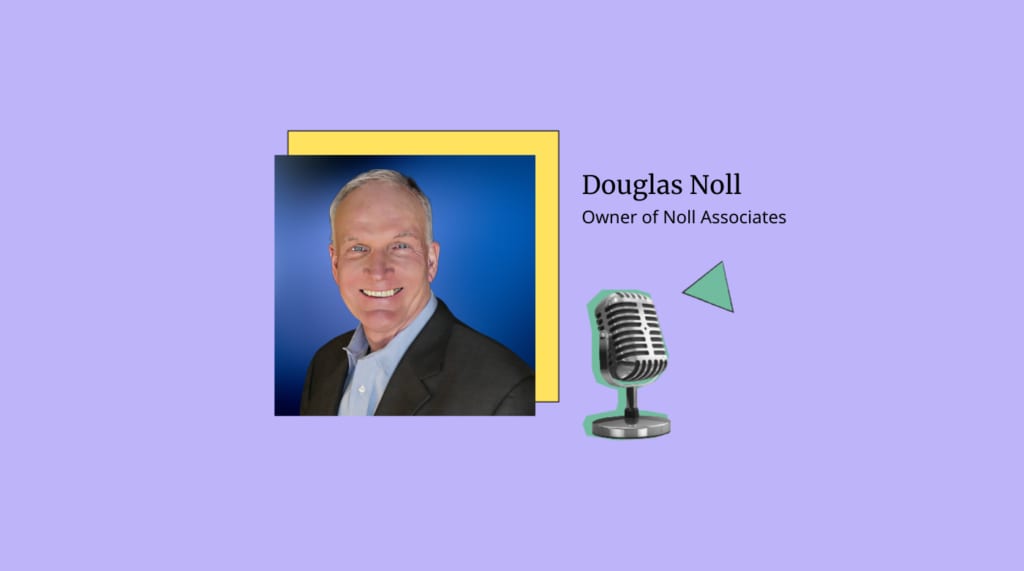
Douglas E. Noll is the owner of Noll Associates and an internationally recognized lawyer-turned-mediator, peacemaker, and conflict resolution expert. After a successful career as a trial attorney, he dedicated his work to helping people resolve deeply entrenched conflicts through empathy, emotional intelligence, and practical communication techniques. An award-winning author of books including De-Escalate and Elusive Peace, Douglas has trained professionals around the world in mediation and conflict management and is widely known for his innovative approach to transforming hostility into constructive dialogue.
Related Links:
- Join the People Managing People Community
- Subscribe to the newsletter to get our latest articles and podcasts
- Connect with Douglas on LinkedIn
- Check out Douglas’ website
- Visit Noll Associates
Related articles and podcasts:
David Rice: Douglas Noll says most leaders are negative 100 on the emotional intelligence scale. On a scale where 10 is high and 1 is low, most leaders are operating under assumptions about human behavior that simply don't exist anymore. On today's show, I'm talking with Noll, a mediator, peacemaker, and author, about why liberal arts thinking is becoming more valuable with AI, not less, and why the skills we've emphasized for 30 years aren't what's going to differentiate leaders anymore.
Because there's a darker pattern playing out in workplaces right now. People walk into meetings wondering what their CEO's mood is like today. Emotional contagion spreads through organizations faster than light. And when your CEO enters the room with certain body language, the tension becomes palpable.
You, as an employee, can't remember anything else from that meeting. Your prefrontal cortex went offline. Your unconscious brain starts asking survival questions. And if you don't like the answers, you spend all your resources in self-protective mode. You develop cynicism. You might even dismiss 90% of what leaders say.
Noll calls this nervous system leadership. And as AI takes over more analytical and technical work, this becomes the differentiator. Not your MBA from Harvard, your ability to keep people's prefrontal cortex online. So today, we're going to cover why critical thinking matters more than technical skills in the AI era, the three questions every unconscious brain is asking leaders, emotional contagion and why "What's his mood today?" creates a toxic environment, why most leaders are unprepared for emotional intelligence as their differentiator.
I'm David Rice. This is People Managing People. And if you've been assuming technical expertise is what's going to carry you through this transformation, this conversation might shift your entire framework. Let's get into it.
All right. Well, Doug, welcome to the podcast. It's good to have you.
Douglas Noll: Thanks, David. For everybody that's listening, one of the most important things that you can do for somebody like David, and myself 'cause I'm a podcaster too, is go to Spotify or Apple or wherever you are, five-star review.
Do it right now. Don't wait.
David Rice: Would love it. Would love it.
Douglas Noll: Make, make that happen, folks, because that's the only way podcasters get visibility.
David Rice: Absolutely. Where I wanted to start our conversation today is you said something in our pre-call that I hear quite a bit recently, right? And that's that AI is gonna make liberal arts thinking more valuable and not less, which, maybe flies in the face of what was the popular belief five, six years ago, right?
And it feels right, but it's also counterintuitive for that reason, given how much we've emphasized technical skill over the last thirty years. And if you look at what people think they're hiring for, there's still, I think, some confusion about this, where-- about what they'd wanna see in candidates.
So I, I'm curious from your perspective, what are we getting wrong about what it actually takes to use AI well?
Douglas Noll: The inability to think critically. I use AI every day, and I watch people use AI, and I see the content they produce, and it's junk because they don't understand what A-AI is, they don't understand how it works, and most importantly, they don't know how to ask questions.
And they don't know how to correct AI. I mean, I can't tell you how many times on Claude or Gemini or ChatGPT I've entered into a conversation, asked for information, read the information, and say, "You are wrong." I did it, I d- I did it again today. I said, "That is just flat wrong. You know better. Go back and check it."
And they come back, "Oh, I'm so sorry, I..." You know what I mean? You've got to have really strong critical thinking skills, and the only way you're gonna get really good critical thinking skills that gives you a broad perspective is through a liberal arts education. Because the idea of a liberal arts education is to challenge you with ideas from all kinds of different academic disciplines and force you to puzzle through really hard stuff and think about it.
And the liberal arts education gives a young person, eighteen to twenty-two- Ideally, it gives them a broad introduction to all of the thought of humankind over the last four thousand years. You don't get that when you go into it as a computer science or an engineering major. You're focused on one thing, and that's really how to code or how machines work, and that's insufficient today.
That was really important to build the technology that we have today. But using the technology is gonna require a completely different set of skills. And if you don't know how to think and you don't know how to ask questions and you don't know how to draw from different strands of knowledge in terms of how you're interacting with AI, and you don't know how to discern crap from truth, AI is just gonna produce junk for you.
David Rice: Yeah, absolutely. Well, I mean, which-- I, I hear so much complaining about AI slop now. It's- That's right ... it's everywhere.
Douglas Noll: We all, we're all, we're all suffering from it.
David Rice: Yeah. You're right, though. You just have to question it. You have to constantly like push and prod and poke at it till you get what-- something you feel really actually, okay, that's actually pretty good.
Douglas Noll: Yeah.
David Rice: Yeah, I mean- 'Cause it can be good.
Douglas Noll: Yeah. I, I, I treat AI like a not-so-bright graduate assistant. Trust but verify.
David Rice: Yeah. That's funny too 'cause I can remember, being in school, and I'd say, "Well, I'm gonna get my, my journalism or my mass communications degree." And they'd go-- I'd get a lot of people to go, "Well, all right, that's not a very good, choice."
And I was always like Well, it's, it's what I'm good at, but then I'm like looking at it now, I'm like, "Was it not a good choice, actually?" And I knew a lot of people that were, like, getting anthropology degrees, and they said that their parents would be like, "Ugh."
Douglas Noll: This is the problem. People think that going to college is like going to trade school, like you're getting some kind of vocational training, and that is not its purpose.
You don't go to college to learn a trade. Anthropology is a fantastic major. So is philosophy. The idea is to get exposed to ideas that are difficult, to force your mind to grow. That's the whole idea. Learn how to learn. That's the whole purpose of an undergraduate education.
David Rice: Well, it's funny 'cause, I'm in this period where I'm telling people, "You gotta have more of a philosophical mindset when it comes to this stuff." You shared an example where you used AI to generate a strategic roadmap in just minutes, something that, years ago would've taken days, maybe weeks.
Douglas Noll: If I could do it at all.
David Rice: Yeah, or if you could even do it, right? And I, I feel that way sometimes too. I'm like, "Well, I never would've been able to do this any other way."
And when tools suddenly kinda give us that kinda leverage, I'm curious, what happens to how we think about expertise in particular and how we value that work?
Douglas Noll: Well, that's an interesting question. I think that the key is I could not have produced that document without the expertise that I had. I had to input the raw data that I had, and I had to prompt it to act in a certain way.
And so in this particular case, it was the end of a three-day mediation with a billion-dollar company, the stakeholders of a billion-dollar company, and they had come up with some rough ideas about how they wanted to solve the problems that we were confronted with. And so I took all of my notes and the rough ideas, and I think I used Gemini, and I said, "Imagine that you are the world's greatest facilitator, and in this three days, these-- this is all that's happened.
Produce a roadmap and plan and budget to show these people how to achieve what it is that they need to achieve for the conflicts to go away." Enter. Boom. There it is. I look at it, and like just stunned. A beautiful Word document and colors and headlines and everything. I mean, it was really, really good.
I had to do a few small edits, but nothing dramatic. And I think what it does is it takes my expertise and multiplies it by orders of magnitude. I can do things now that I would never be able to do. I can do things by myself that would take a team of dozens to do. And that's-- what that does is it just makes those people who are good beyond good.
And now the implications are how do you charge for something like that? I mean, as part of-- that was all included in my fee, so it wasn't any big deal. But, lawyers, for example, are having a huge problem trying to figure out, how do I bill for something now that I can get an answer to in three minutes that is better than any associate can get for me?
It would have taken weeks or months to get this work. It would have cost twenty-five thousand dollars, and in five minutes I've got a-- the best answer I've ever seen. How do I bill a client for that? I think what's happening is that we have to get away from the idea that our time is valuable and approach the idea that our experience, our knowledge, and our ability to extract knowledge, especially using AI, is what's valuable You pay me to help you solve your conflict.
I'm gonna save you millions of dollars. What do you care what it costs? What do you care how much time it takes? Obviously, if it's the quicker the better. But if I've got the expertise and I can make it happen, and I can save you millions of dollars in lost productivity, you really don't care.
David Rice: Well, that's interesting, too, because if we stop thinking of our time as, in terms of value, maybe employers are more likely to give it back. In some ways-
Douglas Noll: I doubt it ...
David Rice: I doubt it.
Douglas Noll: There are too many stakeholders. That, that's one of the another huge conversation we could have about the distribution of wealth and how skewed it is. But no, they're driven by shareholder value, company value, stuff like that. I mean, they're not gonna give money back to the employees. They should, but they won't.
David Rice: I say it half-jokingly just because, the sort of promise of AI was always like, "It's gonna save you tons of time, and you, you're gonna be able to do all these other things," and-
Douglas Noll: I'm reading that that's not happening.
David Rice: Yeah, from what I've experienced and everybody that I've talked to, that is not how it's gone.
So that's why I kinda made that joke.
Douglas Noll: Well, I think it's partly because-- I mean, think about it. Think about if you're a leader and you're not a strong critical thinker, you have a technical background, maybe an engineering background, and you've haven't learned how to think like a liberal arts person might think, that anthropology major, then how are you gonna lead people?
How are you gonna model the behaviors that people need to have in order to use AI effectively? Or how are you even gonna know how to hire somebody who otherwise wouldn't fit your model as a perfect employee, but who has the critical thinking skills needed to exploit the advantage of AI?
David Rice: When we were talking before this, you kinda pointed out to me that one of the things that a lot of people, particularly in technical roles, are experiencing is a lot of fear, anxiety, even grief right now about how AI is reshaping their work and the reality that they prepared for, right?
Douglas Noll: That's right.
David Rice: I think most leadership models, they still assume people are rational 'cause they haven't been paying attention. But my question would be: What is the cost of that disconnect in particular?
Douglas Noll: We're seeing it. Low productivity, toxicity, low retention, quiet quitting. That is the cost.
It's the lost productivity because people are disengaged because they have leaders that can't connect with them at any kind of a level. This model of rationality that's been around for a while is a myth. There is no such thing as rationality. There never has been There is no science to support the idea that human beings are rational.
All the science supports the idea that we're emotional. In fact, we can't even make decisions unless we're emotional. Every decision is emotional. Every behavior is emotional. I mean, the, the neuroscience really became clear on this back in the 90s with Damasio's work, but it's gotten even clearer as time goes on.
And if you-- When people challenge me about that, I say, "Well, give me a def-- what do you mean by rationality?" The classical definition is from rational choice theory with von Neumann and Morgenstern back in 1948 when they published their book on game theory, and they developed this thing they call rational choice theory.
And that got stuck in the business schools, and everybody began being taught that human beings are-- we live to maximize utility. Absolutely false. We do not. And there's study after study after study that shows we are not utility maximizers. Herbert Simon, economist 1950s, got a Nobel because he came up with the word satisfice.
We have bounded rationality at best, and we can never make rational decisions. At best, we can make decisions that satisfice us. And, he got the Nobel for that. And then you get into Kahneman and Tversky's work and, but now behavioral economics with Dan Ariely, and neuroeconomics, Paul Zak and all people in his field.
And just field after field after field that's studying this shows us that rationality is a myth. And the reason that's important is because if you go all the way back to William Whyte's The Organization Man in 1956, where he just shows the sociology of the corporate man, and we see that it's totally inhuman.
Suppress emotions. Be tough. Don't let them see you sweat, and it, it really-- that model was the White Anglo-Saxon male fitting into the organization. And when you act that way, when you fit into the model, the corporate model that William Whyte was describing, nobody will follow you. You become somebody to be avoided rather than followed.
I mean, even the US military gets this. I mean, I think the, the United States military is probably the premier leadership development organization in the world, and they spend tons of time teaching people in the service how to be leaders. Even privates in the Marine Corps are taught to be leaders because, hey, if the chain of command is wiped out, guess what, dude, you're in charge.
You better, you better know what you're doing. But corporate America will not spend any time on that. They don't spend money on that, and they just rely on these old myths and conventional wisdoms around leadership that don't work anymore. Well, if they ever worked in the past.
David Rice: It's interesting. I, I hear I think it was Jensen Huang this last week was saying that the future belongs to the neurodivergent.
I think I've heard Sam Altman and some other-
Douglas Noll: I don't know about that.
David Rice: Yeah, I don't know about that either, but I'm wondering why they're saying that and if they're tying that to a perceived relationship with emotion versus rationality or-
Douglas Noll: No. I think that's another one of those identity statements that falls in the realm of political correctness And so we come up with this term neurodivergent.
What the heck does it mean to be neurodivergent? What does it mean to be neural non-divergent? I mean, I, I mean, these are all words that people come up with that don't have any meaning. Like the word social justice. That has no meaning. Nobody can define what that is, just like nobody can define what rationality is.
And people come up with these phrases to sound smart or to sound like they know what they're talking about, and when you go down underneath it, you can see that it's just, it is what it is, meaningless.
David Rice: There's a lot of that in our language,
Douglas Noll: and people make up this jargony language to make, make themselves look smart, and they're not.
And the moment... I call it out. Whenever I'm in a meeting and somebody gets jargony on me, I'm like, "Wait, wait, wait, wait. You just used this phrase blah, blah, blah. What does that mean?" "Well, of course, everybody knows what it means." "No, I don't, and I've got two graduate degrees, so please educate me. I'm just a poor country lawyer. You just tell me what that means."
David Rice: Another one that's the one that I keep hearing all the time, and I think it's AI-generated, to be honest, but it's a turn of phrase that I just keep hearing in everything, and everybody keeps talking about somebody who's saying the quiet part out loud.
Douglas Noll: The quiet part out loud. Oh, that's been around. That phrase has been around for a long time.
David Rice: Yeah, but I don't remember it being used so heavily.
Douglas Noll: Well, probably not.
David Rice: And I'm just thinking to myself a lot of what people are describing, I'm like, "Was he ever quiet about that?" Or And he's saying it out loud.
Douglas Noll: I don't know why that phrase would be used 'cause I don't know what people are referring to when they use that phrase. Typically, it's been used to talk about subjects that are taboo to talk about in, in public discourse or where there has been some sort of social restriction or norm that says we can't talk about this stuff.
David Rice: The problem I'm having recently is I'm like, except they are talking about it. They've been talking about it. Yeah. They've been pretty honest about it the entire time, so why are we using this phrase, I don't know. And it's a misappropriation of it, I guess- Yeah ... rather than a straightforward meaninglessness.
But yeah, I hear you, though. There's just tons of stuff in our language where we just, we love to grasp onto a term, and I think it's comforting to like-
Douglas Noll: Well, yeah, if you can name it, then you can understand it. But people mask understanding by using these phrases and terms and words and that they really don't know what it means.
But by naming it, they think they know what it means, or they, it feels like they know what they mean. And they don't. And so in my work, clarity is everything. Sometimes you wanna have constructive ambiguity, but most of the time you need clarity. And most conflict arises because of lack of clarity, lack of listening, lack of understanding.
So I usually don't let that stuff slide when I'm in the room.
David Rice: It's interesting, like you saying that, rationality is not real. It challenges the things that we're taught to believe, how we're educated because, I mean, if you remember my courses in logic and reasoning, like-
Douglas Noll: Okay, let, let's, let's be clear.
You-- We've got courses in logic and reasoning and critical thinking, all of which are very important tools, but that's not rationality.
David Rice: I think when you're in it, you're thinking like you're developing your rationality through that.
Douglas Noll: You're developing the deliberative thinking. Our brain is roughly divided into three types of thinking.
We've got what Kahneman called System One or autonomous thinking. That's the fast, intuitive decision-making that we make every day most of the time. And then we've got algorithmic thinking, which is how we use rules and procedures and processes to step through to make decisions. And then we've got System Two, which is the clear kind of thinking where we're really solving problems.
Scenario building, for example, predicting or forecasting into the future, stuff like that Those are all forms of thinking, some more deliberative than others. That's what we're actually doing. And when we engage in education, we're learning how to refine these thinking processes that we are gifted with through our biology and strengthening those processes, and that part of the brain is called the task-focused brain.
So what's really interesting is the other part of our brain is called the default mode or social mode. That's the part of the brain that we use for interaction back and forth. You can't have one on... You can't have them both on at the same time. You're either in task-focused mode or you're in default mode.
So David, think about this. You're working at your computer, you're working on a really hard problem, mm, something coming on, and somebody comes in and interrupts you. What do you feel in that split second? Annoyance. Pissed off. "What are you doing interrupting me?" And, and it's a jolt because it takes a second or two to move from task-focused to social, and you have to be in social mode in order to communicate, to say anything.
So our education system teaches us how to develop our task-focused mode really, really well. It does a crummy job at teaching us how to be in social mode. We don't learn empathy. We don't learn how to listen. We don't learn how to de-escalate people. We don't learn about emotional intelligence. We don't learn how to...
emotional competency. We don't learn any of that stuff formally. If we get it at all, it's by osmosis, and that is a big problem in our educational system. And it goes back to the fact that in the 19th century, the people that were developing the educational system that we have today were assuming that six-year-olds were rational beings.
Not six-year-olds. And we all know that's just silly. When you look at the educational system, it is making some fundamental assumptions about humans, especially human children, that simply are not true. And it carries through all the way into graduate school. I'll just say that in business, to your point, to the people who are listening to this show, the beauty about abandoning rationality is that you get to see humans for who they really are.
And all this chaos that you would see when you're assuming people are rational, "Oh, they're just irrational," that chaos goes away because you can see people for who they really are, just emotional beings having an emotional moment. No big deal. I know how to handle that. Easy-peasy. And that's the liberation that comes when we abandon rationality and, and we abandon reason in relationship.
David Rice: Yeah, I mean, that's interesting 'cause I think for a lot of leaders, what I find is when I, I talk and I say things along this... going down this road, they start getting a little uncomfortable, right? Start moving around in their seat a little bit, right? 'Cause this isn't what they learned in business school.
Douglas Noll: This goes completely against their upbringing and their training. Of course it's gonna make them uncomfortable. But the problem is what they have right now isn't working, and it never has worked. So we have to learn a new way of being, and then everything changes, and life becomes a lot easier, and managing people becomes really easy Because we're learning how to engage in nervous system leadership.
You walk into a room, you got a bunch of nervous systems in this room. You gotta regulate them. Otherwise, their threat systems are gonna go on and they're gonna shut down and nothing's gonna happen. Every microsecond, our brain is asking three questions: Am I safe? Can I trust you? Do I matter to you? If you're not answering, getting yeses to those questions, you've got shut-down people who can't think anymore.
David Rice: For leaders that sort of accept-- If they actually accept this premise, what are some of the biggest benefits that they'll see out of seeing people this way and understanding them this way?
Douglas Noll: The first thing that's gonna happen is you're gonna have high levels of trust. People will trust you. And when they trust you, when you ask them to do stuff, they'll do it because they trust you.
They know that the risk of betrayal is very, very low. The other thing that happens is you build psychological safety. And I know there's been a lot written about psychological safety. This is work on-- based on Amy Edmondson's work at Harvard. But most people don't even know what psychological safety is, nor do they know how to create it.
But the evidence is clear from Edmondson's work and Project Aristotle at Google. When you create psychological safety, the productivity of your team goes through the roof. But if you don't have psychological safety, productivity drops So as a leader, you're interested in productivity. Why? Because when people are producing, that means they are creating value.
And when they're creating value, that means the entity becomes more valuable. Shareholder value goes up, public company stock market value goes up. And that's, how a lot of leaders will measure success is how valuable is this company now that I've been here? So people are the main assets, and those are nervous systems, and they've got to be managed as nervous systems, not as rational actors.
And when you get it through your head that this is the right way to be, you ha- don't have retention problems anymore. You don't have productivity problems anymore. Toxicity goes away. People wanna work. They don't mind working hard. They love it because it, it creates meaning for them. And they're willing to work for you because they know that they matter to you, because you told them that, and you've demonstrated they matter.
I mean, the benefits are, are incredible. And yet, to your point, leaders are afraid of exercising empathy, which is the primary skill that develops all this, because they're afraid it makes them weak. When empathy is the single one determinant skill that determines success in leadership. That's the empathy paradox.
David Rice: They think it makes them look weak. Or the other thing I think that sometimes drives that discomfort I was referring to is a little bit of a ego thing where it's like they start thinking, "Well, are you assuming that I don't have that?" It's almost like you're attacking their person.
Douglas Noll: Because our society, our culture assumes that if we're successful people, we have the ability to demonstrate empathy, which is a false assumption.
Empathy is a learned skill, and you have to learn how to do it. It's the learned ability to recognize and name the emotional experience of another human being from that person's frame of reference. That is empathy. Nothing else is empathy. Walking a mile in another person's shoe, that is not empathy.
Feeling what somebody else is feeling, that is not empathy. It's sympathy, if anything. But the common definitions of empathy are incorrect. And when you use the correct definition of empathy, it's precision. It's leadership precision, having this precise definition that you can identify it, you can measure it, you can teach it, you can replicate it, and you can duplicate it.
That's when you start seeing the changes. But again, we have a lot of bad information out there, and it's been floating around for a long, long time, and it's just really hard to dislodge.
David Rice: There's this paradox you talk about where leaders want outcomes like performance and retention, but then avoid empathy because they think it, even makes them look weak, or like we discussed-
Douglas Noll: Or it makes them uncomfortable, to your point.
David Rice: Makes them uncomfortable, where does that belief originate from?
Douglas Noll: The belief originates from a cultural belief that emotions are bad. Emotions make us weak. Emotions are irrational. Emotions are feminine and soft and kumbaya and squishy and And that belief started back with the Greeks. Plato wrote about it.
Aristotle said, the only th- the difference between human beings and other animals is the capacity for reason. Immanuel Kant, the great German philosopher, said, "Emotions are bad. Reasoning is good." So we have this long history of philosophy and theology telling us that rationality is good and emotions are bad.
And from the perspective of the ancients, that made sense because whenever you see bad things happen, typically it was 'cause people were emotional. And so emotions were always associated... The passions even, would drive people to do crazy things. And that was the observation, and so the conclusion that was drawn was that emotions are bad.
We need to suppress them. We need to repress them. And that followed all the way through history to where we are today. And today, parents will unconsciously invalidate their children's emotions. I mean, you can remember you were three years old, running around outside, fell down, skin your knee, starts to bleed, you start crying.
What were you told? "Don't cry. Tough it up. Rub dirt on it. It doesn't hurt." You were denied your emotional experience of feeling pain, being scared, and feeling embarrassed about the whole thing. None of us had the experience of learning how to manage our own emotions. We were told to suppress our emotions as children.
And so by the time we're six or seven, we learn that the universe is a emotionally unsafe place to be, so we shut down, and we project a persona of competency appropriate to our age. But inside, we have all of these emotions that we don't understand and can't process because we've been taught it's bad to do that, and that carries us into adulthood.
And so now you're a leader, and you've got a group of people, and guess what? You got a group of people together, you're gonna have a lot of emotion because it's all nervous system management. And you're uncomfortable with emotions because that's the way you were brought up, and now you got all these emotional people here that you gotta figure out how to motivate and keep moving.
And the last thing you wanna do is go into the messiness of stuff that you've never learned how to manage because nobody taught you. In fact, people told you, "Don't manage that stuff." And in fact, ignored it. It doesn't exist. It's evil.
David Rice: Yeah.
Douglas Noll: That's where all this stuff comes from. And I can tell you, as a professional peacemaker, that that has caused more damage than you can possibly imagine, whether it's in personal relationships or divorces or...
I saw it. I worked in maximum security prisons for 10 years training murderers to be peacemakers, and every single one of those persons was emotionally abused. Horribly emotionally abused. I could tell you some horrible stories. Babies are not born as murderers. They're bred to be murderers, and it's all about emotion.
So the antidote is to master emotions, and it, it's really easy. It's not that hard , and it's not painful And it doesn't take much time. You can master this stuff in about the same amount of time it took you to learn how to ride a bicycle. Six to eight weeks. Our brains are hardwired to do this.
We're just fighting ourselves when we resist the idea that we're emotional beings. It's effortless. Imagine never having a fight or argument again in your life with anybody. That's the gift that is out there for those who want it.
David Rice: They use this phrase, nervous system leadership, which is, an interesting way to think about this.
And I-- we've done some episodes recently. We've had folks on talking about how to recalibrate and get your nervous system in a place where you can function better as a leader. But, if I'm a leader walking into a room and I'm thinking about how I'm influencing the nervous systems of the people around me, in some ways, why does it-- why does that matter more than what I say?
Douglas Noll: Because the moment people's threat detection systems go off and they start answering no to those three questions, their prefrontal cortex shuts down and they can no longer process. They can no longer engage in deliberative thinking. That meeting is going nowhere. Decisional velocity comes to a screeching halt, and information that you're trying to convey doesn't get...
It, it-- people won't-- can't hear it. They won't listen to it. Their unconscious brain is spending all its resources in self-protective mode. So you wanna have a meeting that's productive, and you wanna have-- get people to make decisions and take accountability for their work, you've gotta make sure that their prefrontal cortex is online.
That's nervous system leadership. You've gotta minimize the threat response. You've gotta make sure those three questions are being answered yes all the time. Can I trust you? Am I safe? Do I matter to you? If you're not doing that, that's foundational leadership. If you're not taking steps to do all of that, the rest, you can have an MBA from Harvard and it's not gonna do you any good.
David Rice: Absolutely. Couldn't agree more. I, I'm thinking of couple of meetings in particular from years ago, but I can remember the way the CEO entered the room.
Douglas Noll: Just the body language.
David Rice: The, the tension was, like, palpable, and I can't remember anything else that was said in that meeting in the long run.
Douglas Noll: That's exactly right. And there's, one of the things that we communicate in-- at a whole bunch of different levels. One of the fastest ways that humans communicate, all mammals communicate, is through a process known as emotional contagion. Where emotional signals are sent through body language faster than words or anything else, and we pick up on it instantaneously.
And as soon as we see a leader stressed or anxious or angry or whatever, we pick up on it instantly, and it spreads throughout the group. You've heard stories of saying, "Well, how-- what's his mood like today?" People wanna know what the mood-- because that mood or that, whatever is that person is feeling, is contagious across the organization, and it spreads faster than light.
Nervous system leadership is the key to success because you can prevent that contagi-- that negative contagion from occurring.
David Rice: The experience of that, though, I'm curious, do you think as we get older, it's not that we... I guess, do we become a little bit more numb to it? Or-- Because I think when I think of myself as a young professional, I was very sensitive to that.
And, and I think about what some of the young professionals are dealing with right now from leaders. I, I don't envy them because... Is it that we get numb, or is it that we just learn how to navigate those complex situations a little bit better through experience?
Douglas Noll: I would say it's a combination of those, and it's cynicism.
David Rice: Is it healthy cynicism then?
Douglas Noll: Well, may-- it's a self-protective cynicism because we're learning we can't trust the people that are leading us, and I don't matter to them, and I am not safe with them. So I'm gonna spend my energy protecting myself. And I'm gonna just miss ninety percent of what you say. Doesn't matter.
David Rice: As AI takes over more of the sorta analytical and technical work the, the human side of leadership, it's just gonna become more and more important, not less.
Douglas Noll: Critical.
David Rice: My question to you is How prepared would you say most leaders are for a world where emotional intelligence is actually their differentiator?
Douglas Noll: I'm gonna make a really broad, overgeneralized statement here based on a very broad reading, but with not a lot of specific data. I would say that on a scale of one to ten, with one being low and ten being high, where most leaders are at a negative one hundred.
David Rice: Negative, huh?
Douglas Noll: People are operating, they're operating under assumptions of human behavior that don't exist.
They have not kept up with the science, not that they had any reason to. But there's plenty of literature out there now that is explaining this stuff. I just read a book the other day called Neuroselling, the, the neuroscience of decision-making in the sales process. Brilliant book. It was interesting 'cause it recapitulated everything that I teach in my graduate class.
The literature is out there if people wanna take it and read it, and it's accessible. I mean, you don't have to be a brain scientist to understand this stuff. But it's like penetrating hardpan, heavy, heavy clay soil. Getting through that clay soil is really hard. But those who do, those who are able to break out of that clay and learn this stuff, just, they're head and shoulders above their peers in terms of their leadership performance.
David Rice: They're taking people on a journey with them, which is-
Douglas Noll: That's right. And people wanna go with them because they feel safe, trusted, and they matter.
David Rice: When we think about our lives in the long run and just the bigger picture, it's far more interesting and rewarding than whatever the P&L sheet said.
Douglas Noll: The legacy we leave or the people that we grow behind us, that's the legacy we leave. I mean, I think about the legacy I left in those prisons. Eight hundred people in California, life sentences, graduate from our program, released on parole. Not one of them has reoffended. I mean, that's a legacy.
David Rice: The power of purpose right there.
Well, Doug, it's been good having you on the show. I really enjoyed the chat.
Douglas Noll: Thanks, David. It's been fun. What a great conversation. Asked some great questions.
David Rice: That's my strong suit, is questions.
Douglas Noll: I wanna let people know where they can reach me. I put a page up on my website for your audience. Nobody else gets this page except for your people, and it's dougnoll.co/people.
David Rice: Love it. Well, hey, you gotta love a special offer, folks. Definitely take advantage of that.
Douglas Noll: There's some free stuff, and you can join my Substack, so it's pretty cool.
David Rice: All right. Well, yeah, check Doug out. Sign up for his Substack. Get signed up for our newsletter. Make sure you're getting all, all the latest straight to your inbox. I'm in the middle of conference season, so there's gonna be a lot of stuff coming out.
But until next time, think about the bigger picture and the legacy that you are leaving.

