

The Recruiting Identity Crisis: 8 Contradictions That Prove Nobody Knows What They’re Doing


AI Skills: Boards prioritize AI expertise while TA leaders emphasize critical thinking, creating a strategic mismatch.
Automated Screening: 95% of screening is automated, but candidates distrust the fairness and transparency of such systems.
Skills-Based Hiring: "Skills-based hiring" is trending but lacks clear definitions and tools to effectively implement.
AI Bias: AI's promise to eliminate bias in recruiting is overshadowed by legal challenges highlighting discriminatory outcomes.
Talent Advisor Role: Recruiters are labeled 'talent advisors' yet still judged by traditional metrics like time-to-fill.
Recruiting in 2026 feels like following a GPS that's lost its mind.
You know the experience. You're driving a route you've taken a hundred times and the GPS suddenly recalculates — no construction, no traffic, no reason — and now it wants you to take three right turns through a subdivision to end up exactly where you were already headed. Or it routes you to a pin that's supposed to be a store and you arrive at an empty lot.
That's recruiting right now. The tools are more sophisticated than ever. The system is confident. It speaks in a voice of calm authority. And it is sending people in directions that don't make sense while everyone in the car pretends this is fine because the technology is supposed to know better.
AI use in HR nearly doubled in two years. Screening is almost entirely automated. TA leaders have been told by consultants, conference speakers, and at least three LinkedIn thought leaders per day that they're now "strategic talent advisors." And yet nobody can agree on what to hire for, how to evaluate candidates, or whether the tools they just bought are actually helping or quietly routing everyone through the subdivision.
The contradictions aren't random. They form a pattern. The recruiting function is caught between what it was built to do and what the moment demands, and the gap between those two things is widening by the quarter.
As I talk to recruiters, some things have become clear, including a list of contradictions that prove recruiting is having a full-blown identity crisis. If you're a CEO, COO, or CHRO, at least three of these are happening under your roof right now. Possibly all eight.
1. Boards want AI skills. TA leaders want critical thinking. Neither is wrong.
Here's a fun exercise: ask your board what they want in every new hire for the next three years. Then ask your talent acquisition leader. Compare notes.
According to Korn Ferry's 2026 TA Trends report, 73% of talent acquisition leaders rank critical thinking as their number one recruiting priority. AI skills? Fifth. Meanwhile, 94% of CEOs and CHROs surveyed by IDC identify AI as their top in-demand skill for 2025-2026.
This isn't ignorance on either side. It's a genuine philosophical split about what makes someone valuable when the tools change every six months. And in practice, the split produces real dysfunction.
Many organizations are eager to make themselves ‘AI-ready’ but can’t define the specific roles or capabilities they need. We’ve had many conversations with company leaders where they say they want to add AI expertise across their business but can’t provide more than vague job descriptions, and have expectations that conflict with the realities of the current talent market.

The board is looking at competitive positioning. They want people who can deploy AI, build with AI, and talk about AI in earnings calls.
The TA team is looking at durability. They want people who can evaluate AI output, spot when it's wrong, and make judgment calls the models can't. And the hiring manager sitting between them is getting a job description that tries to be both and ends up being neither.
The irony is that critical thinking is the skill that makes AI skills actually useful. As Korn Ferry's report puts it: anyone can learn to use ChatGPT in a few weeks, but knowing when it's giving you unreliable information requires exactly the kind of thinking that can't be automated.
What this means for your business: Your board and your TA team are optimizing for different time horizons. Someone — probably you — needs to reconcile them before it turns into a hiring strategy that contradicts itself on every job posting.
2. Screening is 95% automated. Candidates have never trusted it less.
Let that stat sink in for a moment. Most estimates have initial candidate screening as now being approximately 95% automated. That's nearly every resume, every application, every first-pass evaluation handled by software before a human ever sees it.
And candidates know it. A Gartner study found that only 26% of applicants trust AI to evaluate them fairly. That's three-quarters of your candidate pool walking into a process they fundamentally don't believe is fair.
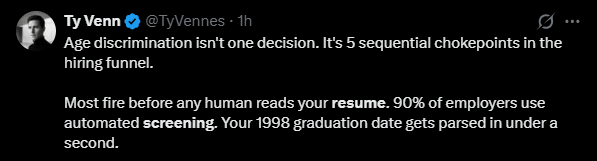
Companies automated screening to be more efficient and, in theory, more objective. Candidates experience it as a black box that rejects them for reasons nobody can explain, because in many cases, nobody actually can explain them.
The trust gap isn't just a candidate experience problem. It's a brand problem. Studies have found that transparency about AI use makes applicants 4.7 times more likely to feel comfortable with the process. But most companies aren't anywhere close to that level of disclosure. They're running opaque algorithms and wondering why their Glassdoor reviews mention "black hole applications."
The candidate experience is your brand. When you have a recruiter or leader who is okay with ghosted candidates, faulty application processes, and an ATS that can’t keep up, those are opportunities for your reputation to take a hit.

What this means for your business: You're spending on tools that may be actively damaging your employer brand with the candidates you most want to attract. A dehumanized screening process can be the difference between landing a great hire and losing them to a competitor who actually returned their email.

3. Everyone wants "skills-based hiring." Almost nobody can define the skills.
"Skills-based hiring" has officially reached buzzword escape velocity. It was a major theme at Davos 2026, where business leaders described breaking work into skills, projects, and outcomes rather than relying on fixed roles. It showed up in every major HR analyst report. It is, by consensus, the future.
There's just one problem.
According to IDC, 40% of IT leaders struggle with fragmented, inconsistent skills development across their organizations. They can't assess what skills their current employees have, let alone screen external candidates for them. The taxonomy doesn't exist. The measurement tools are immature. The definitions change depending on who in the organization you ask.
The dirty secret of "skills-based hiring" in practice? Most companies just swapped the word "requirements" for "skills" on their job postings and called it transformation.
Nearly every organization we work with says they want to move toward skills-based hiring," says Erhard. "But most hiring processes are still structured around traditional evaluation criteria like job titles and years of experience. Even if a job description says it's 'skills-based,' the screening process often filters candidates using the same signals.
Hiring managers lack the tools or training to evaluate skills consistently, and most organizations haven't done the role design work needed to define what they're actually looking for.
"It ends up as more of a branding exercise than a fully implemented hiring strategy," Erhard said.
Korn Ferry's data shows talent matching is moving toward career trajectory signals and demonstrated capability rather than keyword matching. That's the right direction. But the gap between that vision and what's actually happening on most careers pages is enormous.
What this means for your business: If your "skills-based hiring" initiative amounts to new labels on old processes, your candidates know it and so do the analysts your board reads. The shift requires rebuilding how you define work, not just how you post about it.
4. AI was supposed to eliminate bias, but it's more known for lawsuits at the moment.
Part of the pitch for AI in recruiting was fairness. Remove the subjective human interviewer, the argument went, and you remove the bias. Let the algorithm evaluate candidates on merit.
The courtroom is telling a different story.
Mobley v. Workday is challenging whether AI-driven screening tools produce discriminatory outcomes in violation of federal employment law.
A class action against Eightfold AI raises similar questions. New York City's Local Law 144 still requires annual bias audits and candidate notifications before companies can use automated employment decision tools.
And the EU AI Act, which took effect in August 2025, classifies hiring algorithms as "high-risk" AI, subjecting them to a battery of transparency and audit requirements.
Companies adopted AI partly to reduce bias, and now face litigation because the algorithms inherited, or amplified, the same biases from historical hiring data. The models learned from decades of human decisions, and it turns out decades of human decisions were not a model of fairness.

What this means for your business: If your AI screening tool is producing disparate outcomes and you haven't audited it, you're not just exposed, you might not even know you're exposed. Ask your vendor about their bias audit results. If they hesitate, that's your answer.
5. Recruiters are told to be "talent advisors." They're still measured on time-to-fill.
This is perhaps the cruelest contradiction on the list because it happens inside the same organization, often inside the same performance review.
The aspirational narrative heard at every HR conference and written into every recruiter job description update in the last 18 months goes like this: "the modern recruiter is a strategic partner. They coach candidates through career decisions. They advise hiring managers on talent strategy. They consult on workforce planning. They are, in short, elevated."
Then the dashboard loads, and they're still measured on time-to-fill, cost-per-hire, and requisitions closed per quarter. The metrics haven't changed. The comp model hasn't changed. The daily pressure to move candidates through the funnel at speed has not changed.
Erhard sees the same disconnect.
When you tell someone their job has been fundamentally reimagined but then measure them on exactly the same things, you haven't transformed their role. You've given them a more stressful version of the same job with a fancier title.
What this means for your business: If you haven't changed how you measure your TA team, you haven't actually changed their role and they know it. The misalignment between aspiration and measurement is a retention risk for your best recruiting talent, who will leave for organizations that mean it when they say "strategic."
6. Companies cut entry-level roles, then wonder why they can't find mid-level talent.
According to Korn Ferry, 37% of organizations plan to replace early career roles with AI. An IDC survey found that 66% of enterprises expect to slow entry-level hiring. The math is straightforward: if AI can handle the work junior employees used to do, why pay for junior employees?
The math is also dangerously incomplete.
Those entry-level roles weren't just task execution. They were talent pipelines. They produced mid-level professionals, future managers, and the institutional knowledge holders who keep organizations functional during transitions. When you stop feeding the bottom of the pipeline, the middle empties out in three to five years.
IBM's CHRO Nickle LaMoreaux is betting the opposite direction. The company announced it's tripling entry-level hiring, including for roles like software developers that conventional wisdom says AI can replace. The logic is that the companies three to five years from now that are the most successful will be those that doubled down on entry-level hiring during this period of disruption.
And the pipeline math gets worse collectively. When everyone cuts junior roles simultaneously, the pool of experienced mid-level talent shrinks across the entire market, and poaching from competitors gets more expensive for everyone at the same time.
What this means for your business: This is a strategic planning question masquerading as a hiring decision. The savings from eliminating entry-level roles are immediate and visible. The cost is a thinning leadership pipeline, more expensive external hiring, and weaker institutional knowledge, all of which shows up later when it's harder to fix.
7. Half the workforce uses AI to apply. The other half uses AI to screen.
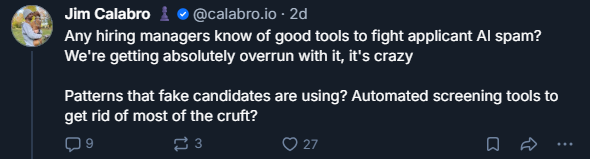
An NBER field experiment found that job seekers using algorithmic resume assistance were hired 8% more often. MIT Sloan reports recruiters are adapting their interview techniques because candidates now use generative AI to prepare. On both sides of the hiring table, AI is now a participant.
Which creates an increasingly strange dynamic: AI-written applications are being evaluated by AI screening tools, and the humans on both sides are becoming spectators in a process that was ostensibly designed to connect them.
Candidates use ChatGPT to tailor their resumes. AI screening tools evaluate those resumes for keyword fit and inferred capability. Candidates use AI to prepare for interviews. Interviewers use AI-generated scorecards.
At some point, you have to ask: what is this process actually evaluating? The candidate's qualifications? Or the quality of their AI tools?
The arms race has a particularly weird quality at the entry level, where candidates have the least experience to differentiate themselves and therefore lean hardest on AI to fill the gap, which means the screening tools are evaluating AI-polished versions of thin resumes, which tells you approximately nothing about the person behind them.
What this means for your business: The hiring process is becoming a proxy war between AI tools. If your evaluation methods can't cut through AI-enhanced applications to assess actual capability, you're essentially sorting by "who has the best AI subscription" which is probably not what your hiring managers had in mind.
8. Companies tightened RTO mandates. Then asked recruiters why the talent pool shrunk.
This one doesn't require a PhD in organizational behavior to diagnose. It just requires talking to a recruiter for five minutes.
According to Korn Ferry's 2026 survey, more than half of TA leaders say office mandates make recruiting harder.
The dynamic is textbook. Executives lay down an RTO mandate that requires five days in-office, competitors offer hybrid or fully remote, and TA teams are caught between a policy they didn't set and a candidate market that punishes it.
The same leaders who insist on "top talent only" are simultaneously narrowing the aperture on who will even consider the role. A rigid location policy doesn't just eliminate remote-preferring candidates, it eliminates everyone outside commuting distance, everyone with caregiving responsibilities that require flexibility, and everyone who has tasted schedule autonomy and refuses to give it back.
The contradiction is especially visible in industries competing for the same specialized talent. If your competitor offers hybrid and you don't, you're not losing candidates to a better offer, you're losing them to a more flexible one. That's a different problem, and in many ways a harder one to justify to the people who left.
What this means for your business: If you've tightened your office policy and your TA team is struggling to fill roles, the two things are almost certainly connected. You don't have to offer full remote to compete, but pretending location policy has no impact on your talent pipeline is a choice your competitors are happy to watch you make.
The Identity Crisis is the Transition
These eight contradictions aren't bugs in an otherwise functional system. They're symptoms of a recruiting function being rebuilt in real time under pressure, without consensus, and while the people doing the rebuilding are also trying to fill 47 open requisitions by end of quarter.
Companies whose leaders have the honesty to name these contradictions out loud and the patience to work through them with their teams will fare better during this period, but that’s not to say it will be without further struggle.
Because this only happens if someone in the C-suite is paying attention to what's actually happening on the ground instead of the conference keynote version of recruiting.
Identity crises, painful as they are, tend to resolve into something stronger if leadership has the patience and courage to see them through.