


NEO vs. Deel: Comparison & Expert Reviews For 2026


When managing a global workforce becomes complex—especially across payroll, compliance, and country-specific rules—EOR platforms can help simplify international hiring. NEO and Deel are often compared, but they take fundamentally different approaches. Deel operates as a traditional, single-vendor EOR platform, while NEO uses a marketplace model that connects businesses directly with local EOR providers. Understanding these differences is key to choosing the right solution for your team.
If you’re weighing which one fits your team best, I’ve broken down how they compare so you can make a more informed decision.
NEO vs. Deel HR: An Overview
NEO

Deel HR
Why Trust Our Software Recommendations
Our team has been testing and reviewing software since 2012. As HR experts ourselves, we know how difficult—and important—it is to choose the right software.
For this guide, we evaluated tools using hands-on testing and independent research, scoring tools using our selection criteria. We also draw on insights from industry thought leaders and practicing HR experts.
Our reviews reflect our human editorial judgment, not a sales pitch.
Expert reviewers:
NEO vs. Deel HR Pricing Comparison
| NEO | Deel HR | |
|---|---|---|
| Free Trial | Free plan available | Free demo available |
| Pricing | From $49/user/month | From $5/employee/month |
NEO vs. Deel Pricing & Hidden Costs
NEO and Deel use different pricing structures that can affect costs as teams scale. NEO separates platform fees from local EOR service fees, which are paid at local market rates to vetted in-country providers. FX conversion costs are disclosed separately, rather than bundled into a single monthly fee. This model offers greater cost visibility but requires comparing country-level pricing.
Deel uses a bundled pricing model, where EOR services, platform access, and FX costs are typically combined into a per-employee fee. This approach can be easier to forecast upfront, but may result in higher total costs over time, particularly for teams hiring across multiple countries or at scale. Teams should compare country-specific costs and consider whether transparency or predictability is the higher priority.
NEO vs. Deel HR Feature Comparison
NEO is a global employment marketplace platform built to centralize payroll data, contracts, onboarding, and compliance without requiring companies to set up local entities. Rather than acting as the employer itself, NEO coordinates employment through vetted local EOR providers while giving teams one system to manage employment workflows, payroll data, and compliance visibility across countries. This approach works well for organizations that want flexibility at the country level without adopting a full HR suite.
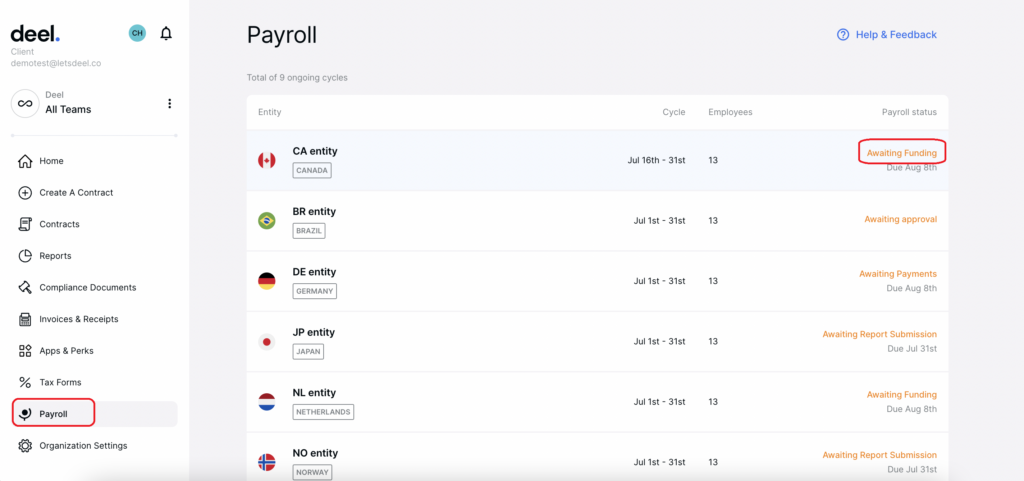
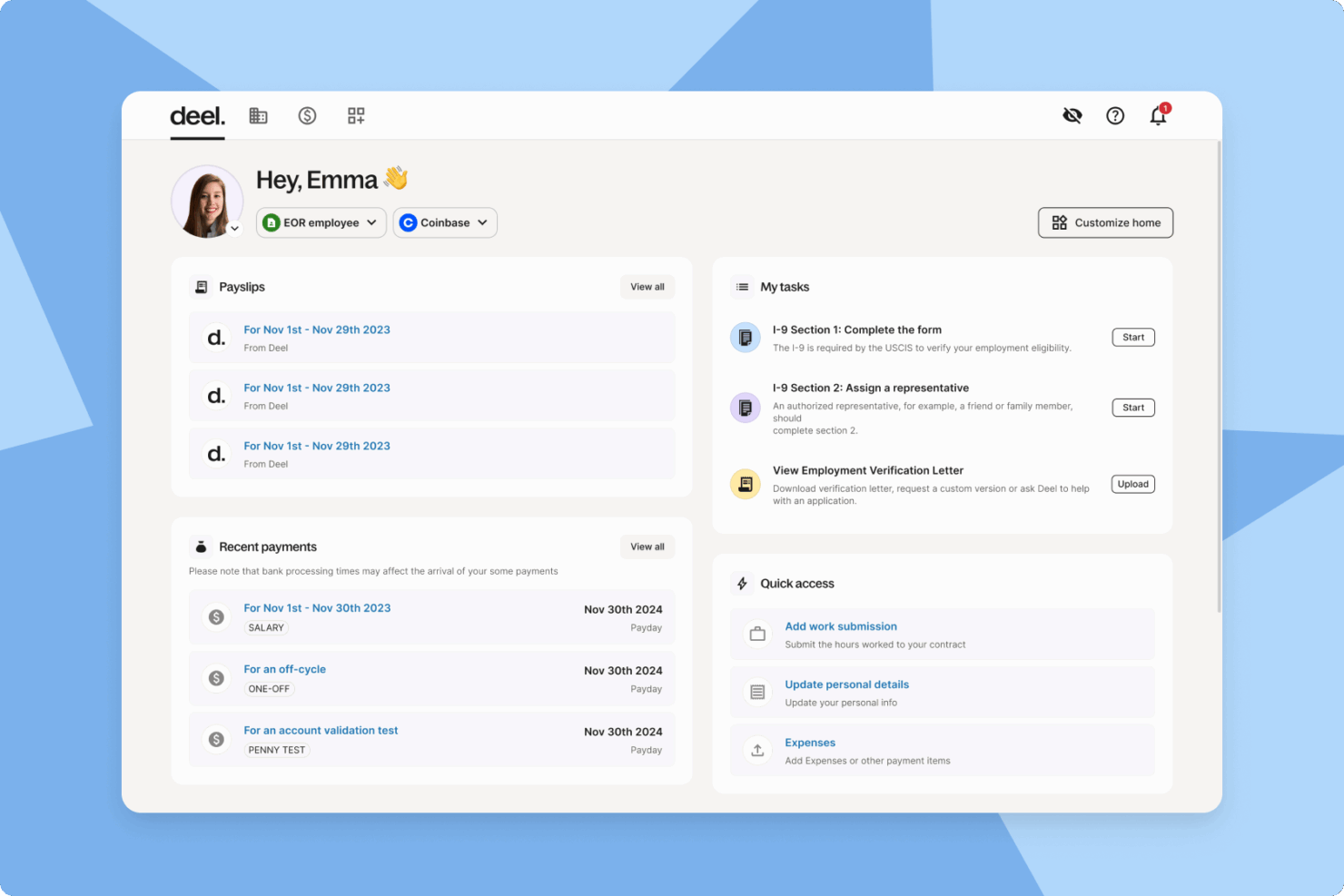
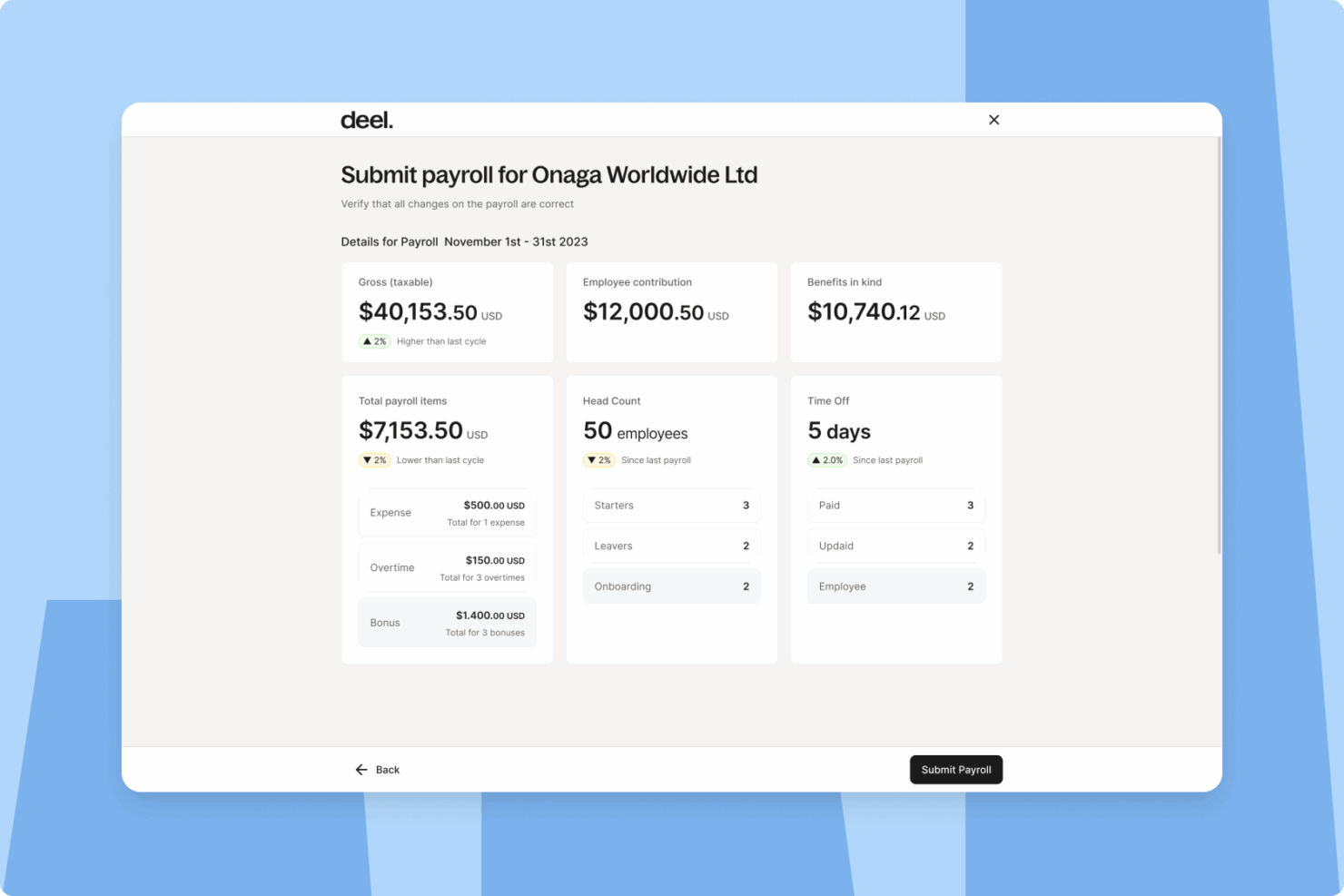
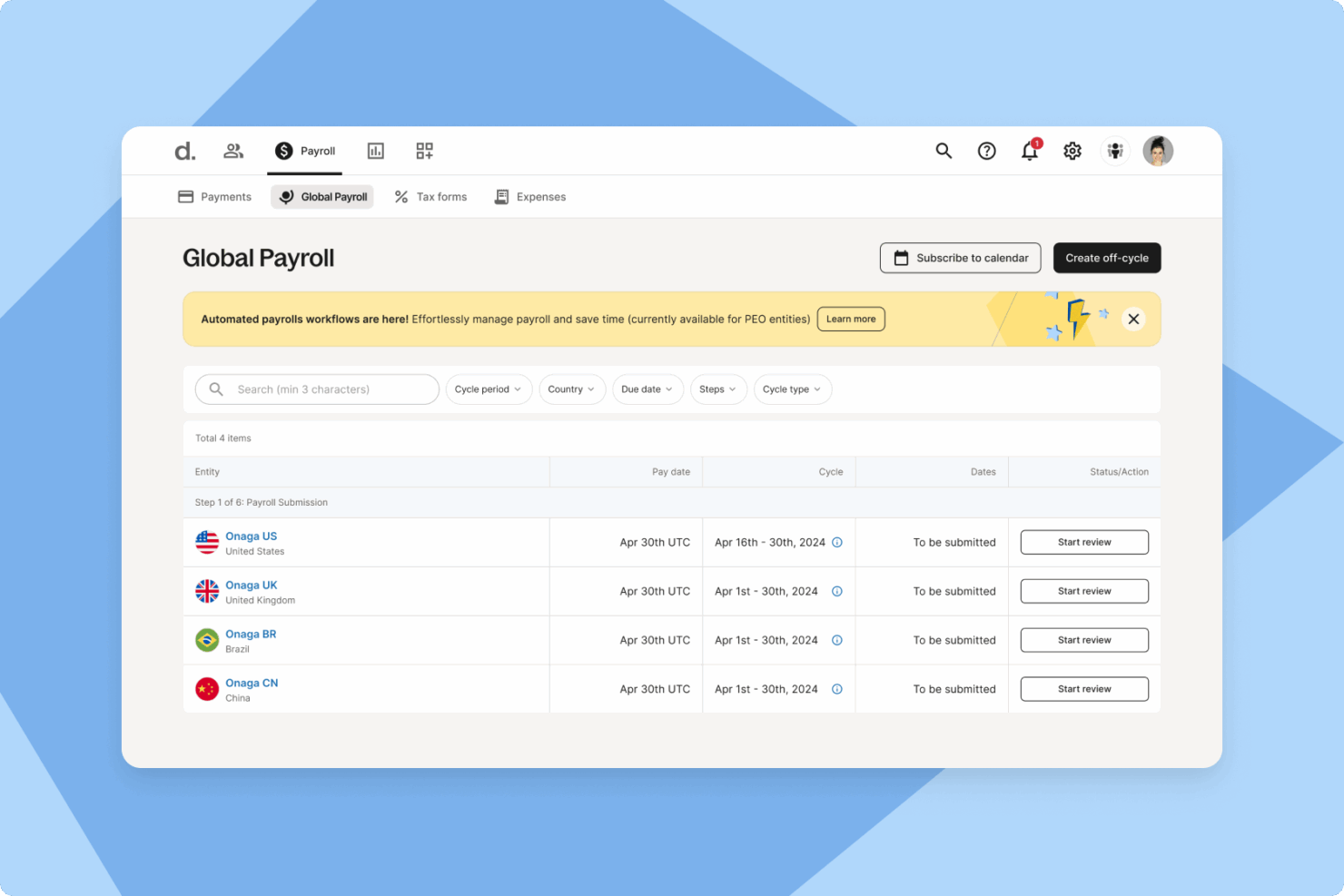
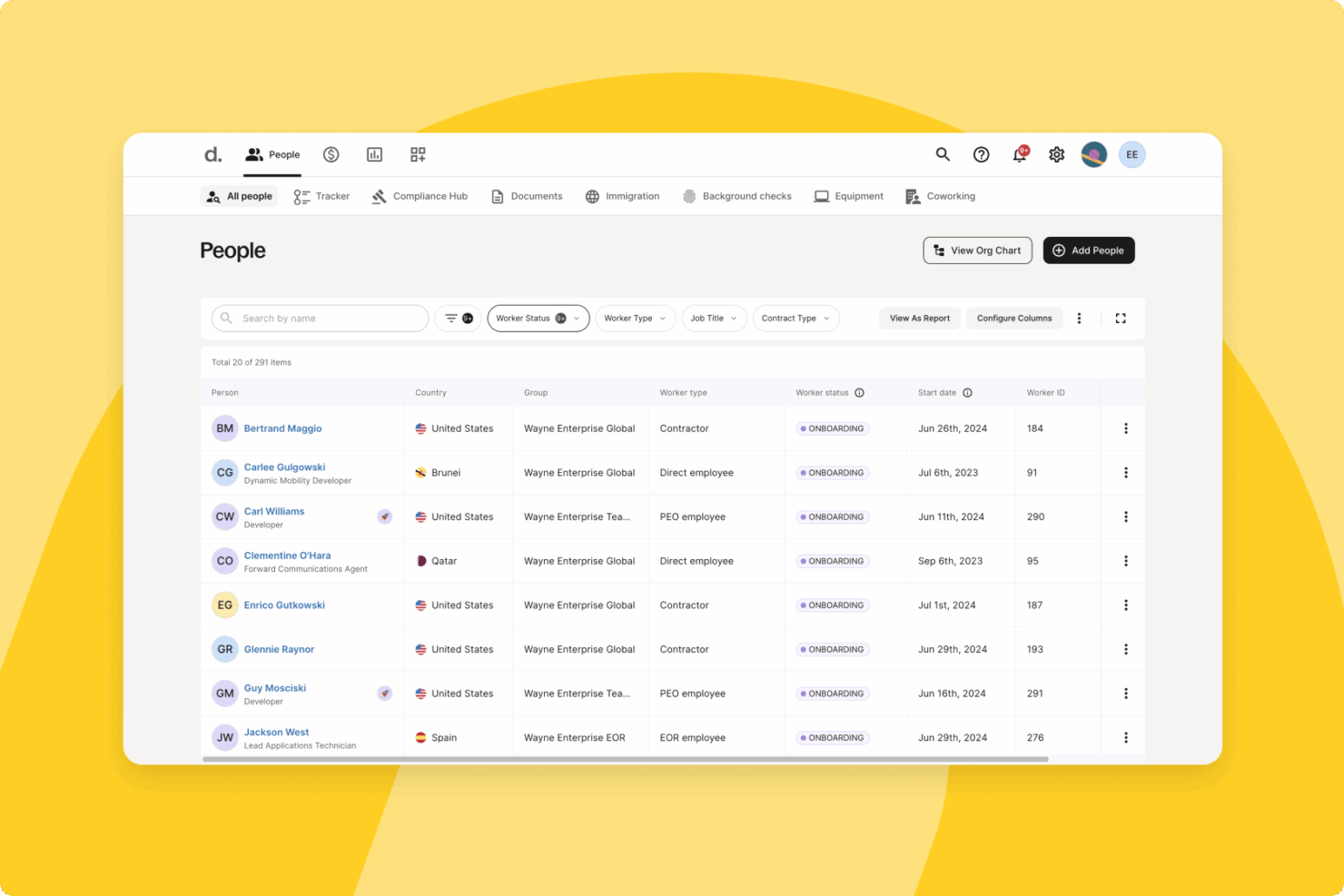
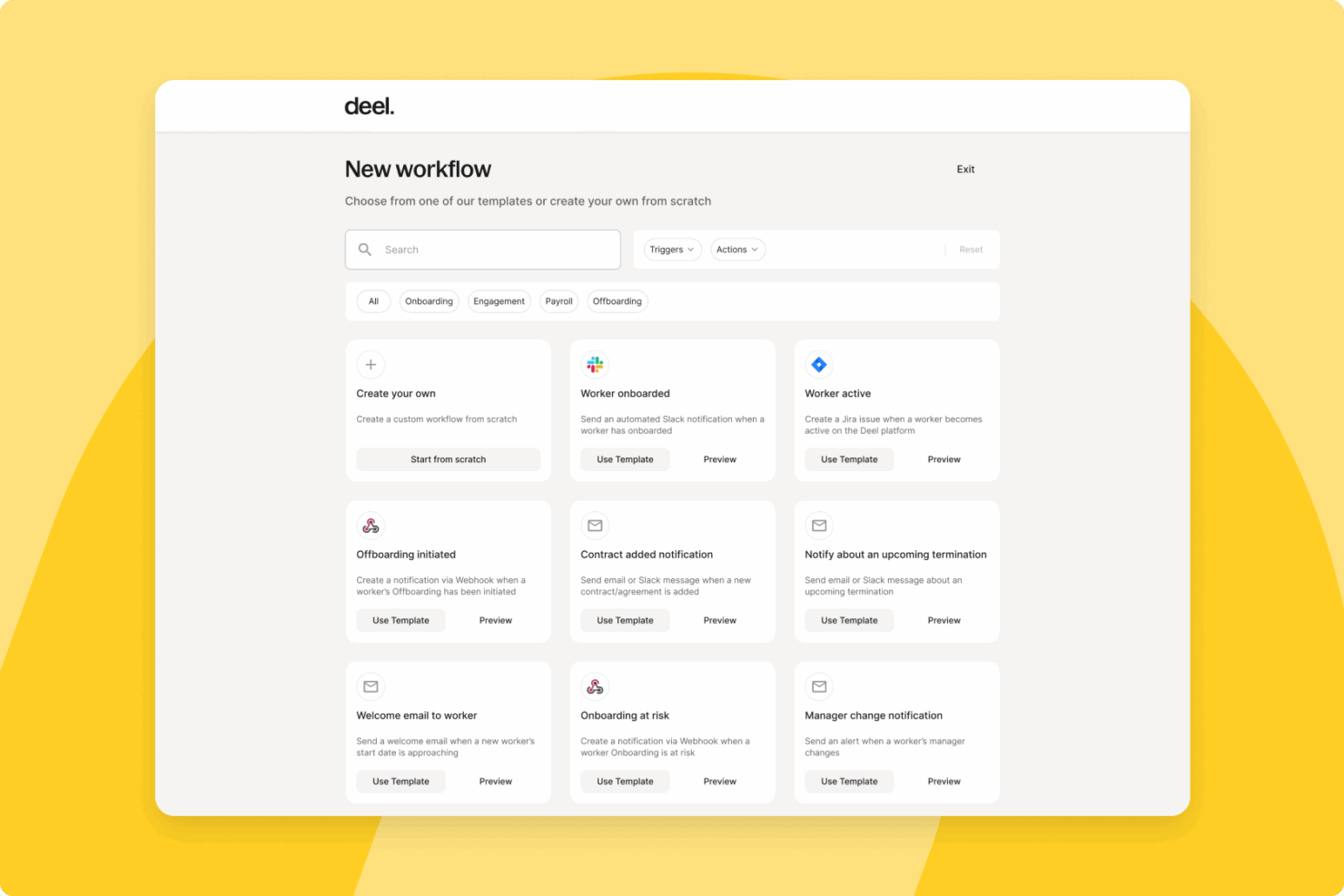
Deel operates as a traditional, single-vendor EOR platform that combines employment, payroll processing, and compliance into a unified system. In many countries, Deel acts as the employer of record through owned or directly controlled entities, while in others it works with local partners under. Overall, its platform takes a more all-in-one approach, operating as a full HR suite, with payroll, tax handling, built-in compliance, learning management, and broader workforce management features. It’s also particularly strong with its embedded AI features and autonomous agents.
| NEO | Deel HR | |
|---|---|---|
| API | ||
| Dashboard | ||
| Data Export | ||
| Data Import | ||
| Data Visualization | ||
| Employee Database | ||
| Employee Incentive Management | ||
| Employee Onboarding | ||
| Expense Tracking | ||
| External Integrations | ||
| Feedback Management | ||
| Multi-User | ||
| Notifications | ||
| Payroll | ||
| Scheduling | ||
| Timesheets | ||
| Travel Management | ||
| Vacation & Absence Calendar |
NEO vs. Deel Integrations
| Integration | NEO | Deel |
|---|---|---|
| BambooHR | ❌¹ | ✅ |
| Workday | ❌¹ | ✅ |
| HiBob | ❌¹ | ✅ |
| Greenhouse | ❌¹ | ✅ |
| Ashby | ❌¹ | ✅ |
| Workable | ❌¹ | ✅ |
| NetSuite | ❌¹ | ✅ |
| QuickBooks | ❌¹ | ✅ |
| Xero | ❌¹ | ✅ |
| Slack | ❌¹ | ✅ |
| API | ✅¹ | ✅ |
| Zapier | ❌¹ | ✅ |
¹ NEO supports API webhooks and integration capabilities, but specific native integrations are not publicly documented and may vary by plan.
NEO and Deel take different approaches to integrations. NEO’s integrations may be available via API or custom setup, but native integrations are not publicly listed. Deel, by contrast, clearly documents a wide range of native integrations and supports APIs and Zapier, making it easier to sync data across existing HR, finance, and payroll systems if your team relies on a broader tech stack.
NEO vs. Deel Security, Compliance & Reliability
| Factor | NEO | Deel |
|---|---|---|
| Data Privacy | Employee and payroll data handling is outlined in the privacy policy, but encryption standards are not publicly detailed. | GDPR compliance and standard security practices are documented for protecting sensitive data. |
| Compliance | Local labor law compliance is handled through vetted EOR partners in each country. | Employment contracts and processes are kept aligned with local regulations in supported countries. |
| Platform Reliability | A centralized platform is used to manage global workforce data and employment workflows. | A unified system supports global payroll and compliance operations. |
| User Authentication | Two-factor authentication is not clearly documented in public materials. | Two-factor authentication is supported to help secure account access. |
| Regulatory Updates | Local partner expertise is used to reflect changes in labor laws and payroll rules. | Deel supports updates to employment terms and processes as local regulations change. |
NEO focuses on centralizing sensitive employee data and relying on vetted local partners to handle compliance and legal requirements by country. Deel places greater emphasis on platform-level security controls, such as account protection and built-in compliance tracking, which give you greater visibility into regulatory changes. As an HR professional, the right choice depends on whether you prefer partner-led compliance or more security features built directly into the platform.
NEO vs. Deel Ease of Use
| Factor | NEO | Deel |
|---|---|---|
| User Interface | A clean, simple interface focused on core EOR workflows like payroll and contracts. | A straightforward dashboard that makes it easy to access hiring, payroll, and compliance tools. |
| Onboarding Experience | Formal onboarding guides aren’t provided, so setup relies on self-navigation and support. | Guided onboarding flows and in-platform prompts help you get started. |
| Setup | Setup is simple if you’re comfortable exploring the platform independently. | Initial setup is structured and designed to reduce manual configuration. |
| Workflow Navigation | Workflows are straightforward but may require more manual steps to reach detailed views. | Workflows are more guided, with clearer paths between hiring, payroll, and compliance tasks. |
| Support | Support is handled through direct requests and account-based assistance on paid plans. | Customer support is available through documented support channels, including email and in-platform help. |
From my perspective, NEO is easiest to use if you want a clean, no-frills interface for managing global employment through local EOR partners and prefer support-led guidance over in-product walkthroughs. While Deel offers more built-in structure and prompts, NEO’s simpler layout can feel more efficient once you’re familiar with the workflow and don’t need constant guidance baked into the platform.
Due to their fundamentally different approaches to global employment, it may take more time to select an EOR partner through NEO (though the flexibility ensures you can scope for better rates and service delivery). On the otherhand, because Deel's EOR model is a single-vendor EOR platform, you can skip the selection process (but keep in mind that this means you're tied down to only one option).
NEO vs Deel HR: Pros & Cons
NEO
- Lower-cost structure than bundled EOR platforms by connecting you with local providers at market rates.
- No vendor lock-in by country—NEO’s model lets you switch EOR providers any time.
- Payroll data consolidation, onboarding, contracts, and compliance are handled in one place, which keeps global hiring organized.
- Teams need to evaluate and select local EOR partners rather than relying on one default provider, which can add a small amount of upfront planning.
- Though providers in NEO’s marketplace are vetted, service quality may still vary by country.
- Not an all-in-one solution if you’re looking for more advanced HR features built in, like performance management, engagement, and learning and development.
Deel HR
- Deel excels in managing global payroll compliance, ensuring your team adheres to local labor laws.
- It simplifies contractor and employee payments in over 120 currencies, reducing administrative hassle.
- Built-in legal and tax compliance tools make international hiring less risky for your business.
- Deel can be pricey for small teams or startups with limited hires.
- Customization of reports and workflows is limited compared to more robust HR systems.
- Service may vary depending on the region.
Best Use Cases for NEO and Deel HR
NEO
- Global Employers Well-suited for companies hiring employees across multiple countries that want compliant employment without opening local entities or paying bundled EOR platform premiums. By connecting employers directly with vetted local providers, NEO offers clearer cost visibility and more flexibility than traditional single-vendor EOR platforms.
- EOR Providers EOR providers can use NEO as an underlying infrastructure to manage employment operations, payroll coordination, and compliance across regions. Rather than building proprietary systems, providers can rely on NEO’s platform to standardize workflows while maintaining direct relationships with their clients.
- Managed Service Providers Managed Service Providers (MSPs) benefit from NEO’s marketplace model when supporting distributed workforces across multiple countries. The platform helps MSPs centralize payroll and compliance oversight while working with local employment partners instead of maintaining in-house expertise in every jurisdiction.
- Staffing Teams Staffing and recruitment firms can place international hires more efficiently by leveraging local EOR partners through NEO. Contracts, payroll coordination, and compliance are managed centrally, reducing friction when expanding placements across new countries or clients.
- Finance & Procurement Teams Finance and procurement teams benefit from NEO’s transparent cost structure, where local employment fees, FX conversion costs, and platform fees are clearly separated. This makes it easier to forecast global payroll spend, compare providers by country, and avoid the opaque pricing common with bundled EOR platforms.
- Scaling Organizations (Small to Large) NEO works well for smaller teams getting started with international hiring, thanks to its free platform access for up to three employees. This makes it possible to access global employment at local rates and smaller FX fees without upfront platform costs. As headcount grows, larger organizations can benefit from the same marketplace model at scale with a modest platform fee, where pricing transparency, provider flexibility, and custom integrations support more complex global hiring needs.
Deel HR
- Tech Startups Deel simplifies compliance and payroll for startups aiming to hire talent across borders without establishing local subsidiaries.
- Remote Teams Your remote team can easily manage global payroll and compliance, reducing the administrative burden on HR.
- Consulting Firms Deel’s legal compliance tools are invaluable for consulting firms with international projects and contractors.
- Small to Medium Enterprises SMEs benefit from Deel’s ability to handle diverse currencies and reduce tax compliance risks.
- IT Companies IT companies can leverage Deel’s tools to manage international developers and contractors efficiently.
- Global HR Departments Deel assists HR departments in managing international employee and contractor payments, ensuring compliance with local laws.
Who Should Use NEO, and Who Should Use Deel?
If you’re looking for a flexible way to hire internationally without relying on a single global employer of record, NEO can be a strong fit. It works well if you want visibility into local employment costs, access to vetted in-country EOR providers, and a straightforward platform to manage payroll and compliance without layering on a full HR suite. NEO is also ideal if you want to avoid premium markups of traditional EOR providers. You pay local EOR partners directly at a local rate, access lower FX fees, and pay a small platform fee (once you hit 4 employees).
If you prefer a more guided, all-in-one platform for global hires and don't mind paying more for a single-vendor EOR provider, Deel may be the better option. It’s a good fit if your HR team values built-in compliance tools, structured onboarding, and integrations that connect easily with your existing systems. Deel works best when you want more automation and visibility across global employment, especially as your remote team scales.
Differences Between NEO and Deel HR
| NEO | Deel HR | |
|---|---|---|
| Approach | Works as a marketplace, connecting businesses directly with vetted local EOR providers and coordinating employment through a centralized platform. | Acts as a traditional EOR platform, employing workers through owned entities or controlled partners under a standardized model. |
| Integrations | Keeps most global employment work centralized inside the platform, with limited publicly documented integrations. | Offers a wider range of native integrations with HR, finance, and accounting tools. |
| Platform Scope | Concentrates on core EOR infrastructure—payroll data consolidation, contracts, onboarding, and compliance—rather than extending into broader HR or talent management workflows. | Extends beyond EOR into adjacent areas such as learning management, device management, org planning, and workforce reporting. |
| Pricing Model | Separates platform fees, local EOR service fees, and FX costs, providing visibility into country-level pricing and provider selection. You pay local EOR service fees, a small FX fee (0.5 to 1.5%) and a platform fee once you reach 4 employees. | Uses bundled per-worker pricing that typically combines EOR services, platform access, and FX (with potential significant markups) into a single fee. |
| User Support | Relies more on self-navigation, with support assisting when needed. | Uses guided onboarding, prompts, and automation to move you through tasks. |
| Visit NEOOpens new window | Read Deel HR ReviewOpens new window |
Similarities Between NEO and Deel HR
| Compliance | Both help you stay aligned with local labor laws by handling compliant contracts, payroll rules, and statutory requirements in each country. |
|---|---|
| Ease of Use | Both platforms feature user-friendly interfaces, making it easy for your team to manage HR tasks efficiently. |
| Hiring Model | Both support hiring employees in countries where you don’t have local entities, removing the need to set up foreign subsidiaries. However, NEO does this by giving you access to vetted, local EOR providers, while Deel provides a single-vendor option. |
| Payroll | Both support paying international employees across countries, with centralized visibility into payroll and payment status. |
| Visibility | Both give you a single place to view employee details, contracts, and employment status across regions. |
| Visit NEOOpens new window Read Deel HR ReviewOpens new window | |