
Tarmack Review: Pros, Cons, Features and Latest Pricing Info



Tarmack is an employer of record for companies that need to hire and pay full-time employees in countries where they don't have a legal entity. It's worth considering if you're scaling a global team and want more pricing transparency than Deel typically offers, especially when your headcount is spread across a smaller number of markets. I'll walk through what Tarmack does well, where it has limits, and who's going to get the most out of it.
Tarmack Evaluation Summary
- Pricing upon request
Why Trust Our Software Recommendations
Our team has been testing and reviewing software since 2012. As HR experts ourselves, we know how difficult—and important—it is to choose the right software.
For this guide, we evaluated tools using hands-on testing and independent research, scoring tools using our selection criteria. We also draw on insights from industry thought leaders and practicing HR experts.
Our reviews reflect our human editorial judgment, not a sales pitch.
Expert reviewers:
Tarmack Overview
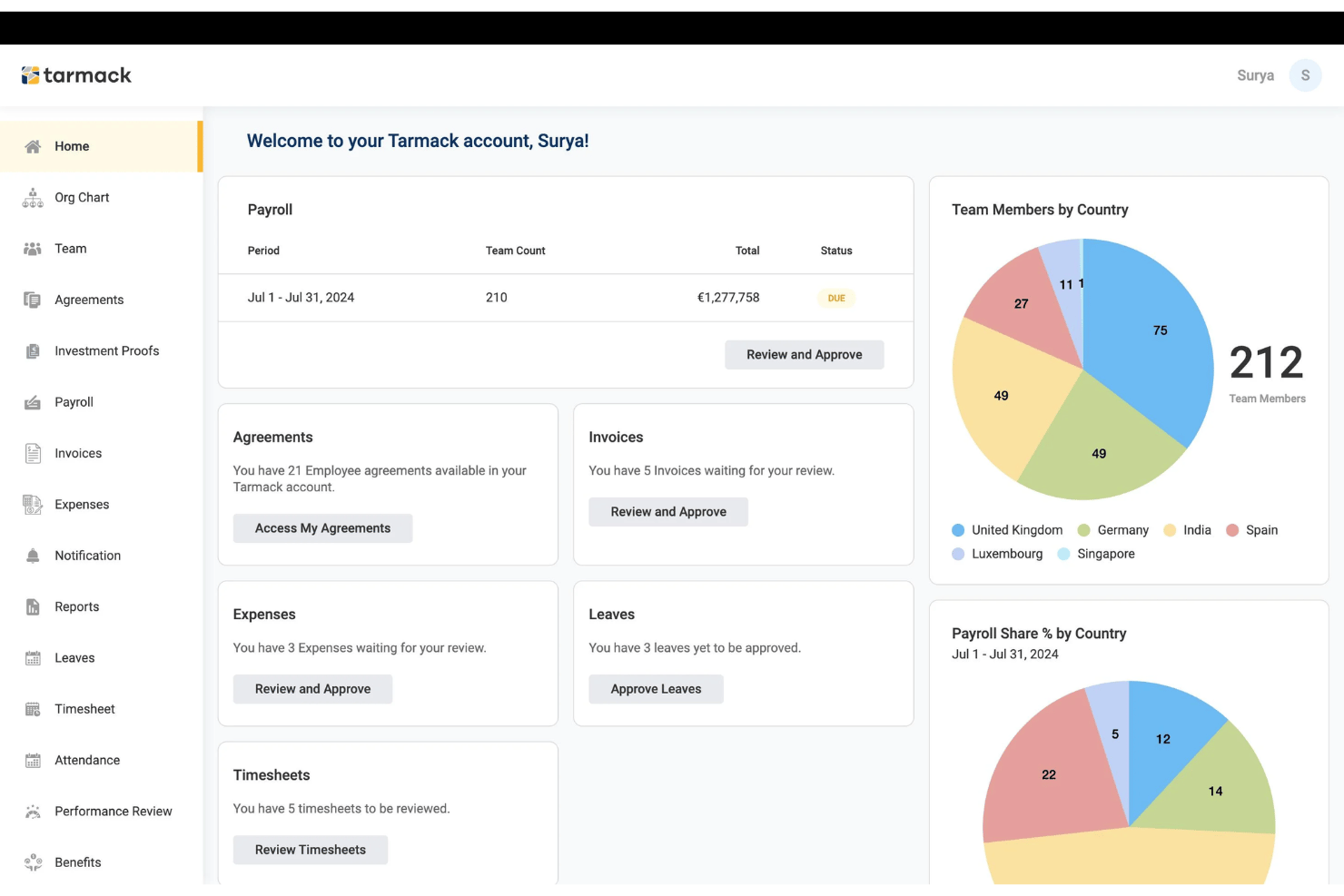
In my experience, Tarmack offers an all-in-one EOR solution with intuitive onboarding and strong compliance tools, making it a top pick for HR teams scaling globally. I’d judge its customer support as highly responsive and its dashboard easy to navigate, though pricing may be less flexible for smaller teams. If you’re selecting software for fast-growth startups or distributed companies prioritizing local compliance and straightforward processes, I think Tarmack’s direct integrations and hands-on support are hard to beat, even if some advanced analytics features are still catching up to the competition.
pros
-
Fast global onboarding for employees in multiple countries
-
Dedicated account managers offer hands-on HR support
-
Clear breakdown of local tax and compliance requirements
cons
-
Fewer self-service payroll options than some competitors
-
Limited advanced analytics and workforce reporting tools
-
Lack of native external integrations.
-

Justworks
Visit WebsiteThis rating combines scores from multiple user review sites to reflect overall customer sentiment about the product.4.6 -
Prevue Assessments
Visit WebsiteThis rating combines scores from multiple user review sites to reflect overall customer sentiment about the product.4.6 -
Small Improvements
Visit WebsiteThis rating combines scores from multiple user review sites to reflect overall customer sentiment about the product.4.3




How We Test & Score Our Tools
We’ve spent years building, refining, and improving our software testing and scoring system. The rubric is designed to capture the nuances of software selection and what makes a tool effective, focusing on critical aspects of the decision-making process.
Below, you can see exactly how our testing and scoring works across seven criteria. It allows us to provide an unbiased evaluation of the software based on core functionality, standout features, ease of use, onboarding, customer support, integrations, customer reviews, and value for money.
Core Functionality (25% of final score)
The starting point of our evaluation is always the core functionality of the tool. Does it have the basic features and functions that a user would expect to see? Are any of those core features locked to higher-tiered pricing plans? At its core, we expect a tool to stand up against the baseline capabilities of its competitors.
Standout Features (25% of final score)
Next, we evaluate uncommon standout features that go above and beyond the core functionality typically found in tools of its kind. A high score reflects specialized or unique features that make the product faster, more efficient, or offer additional value to the user.
We also evaluate how easy it is to integrate with other tools typically found in the tech stack to expand the functionality and utility of the software. Tools offering plentiful native integrations, 3rd party connections, and API access to build custom integrations score best.
Ease of Use (10% of final score)
We consider how quick and easy it is to execute the tasks defined in the core functionality using the tool. High scoring software is well designed, intuitive to use, offers mobile apps, provides templates, and makes relatively complex tasks seem simple.
Onboarding (10% of final score)
We know how important rapid team adoption is for a new platform, so we evaluate how easy it is to learn and use a tool with minimal training. We evaluate how quickly a team member can get set up and start using the tool with no experience. High scoring solutions indicate little or no support is required.
Customer Support (10% of final score)
We review how quick and easy it is to get unstuck and find help by phone, live chat, or knowledge base. Tools and companies that provide real-time support score best, while chatbots score worst.
Customer Reviews (10% of final score)
Beyond our own testing and evaluation, we consider the net promoter score from current and past customers. We review their likelihood, given the option, to choose the tool again for the core functionality. A high scoring software reflects a high net promoter score from current or past customers.
Value for Money (10% of final score)
Lastly, in consideration of all the other criteria, we review the average price of entry level plans against the core features and consider the value of the other evaluation criteria. Software that delivers more, for less, will score higher.
Core Features
Global Hiring and Onboarding
Tarmack lets you hire and onboard employees in over 150 countries. HR teams can issue compliant contracts fast—no need to establish local entities.
Payroll Management
You can process global payroll in local currencies with automated tax deductions. Payroll processing and payment scheduling are managed for every geography, so your team stays accurate without manual reconciliations.
Benefits Administration
Tarmack offers access to compliant local employee benefits packages, including healthcare and insurance. HR can provide region-appropriate plans without extra negotiations.
Localized Agreement Management
Tarmack helps teams manage employment agreements across different countries with support for local compliance requirements. This makes it easier to handle contracts, worker documentation, and jurisdiction-specific employment terms in one platform.
Expense Management
Employees can submit expenses for local approval and reimbursement directly through the platform. This makes international expenses as easy to track as domestic ones.
Dedicated HR Support
You get a dedicated account manager for every region supported. This provides direct expert help for onboarding, legal questions, and ongoing HR needs.
Ease of Use
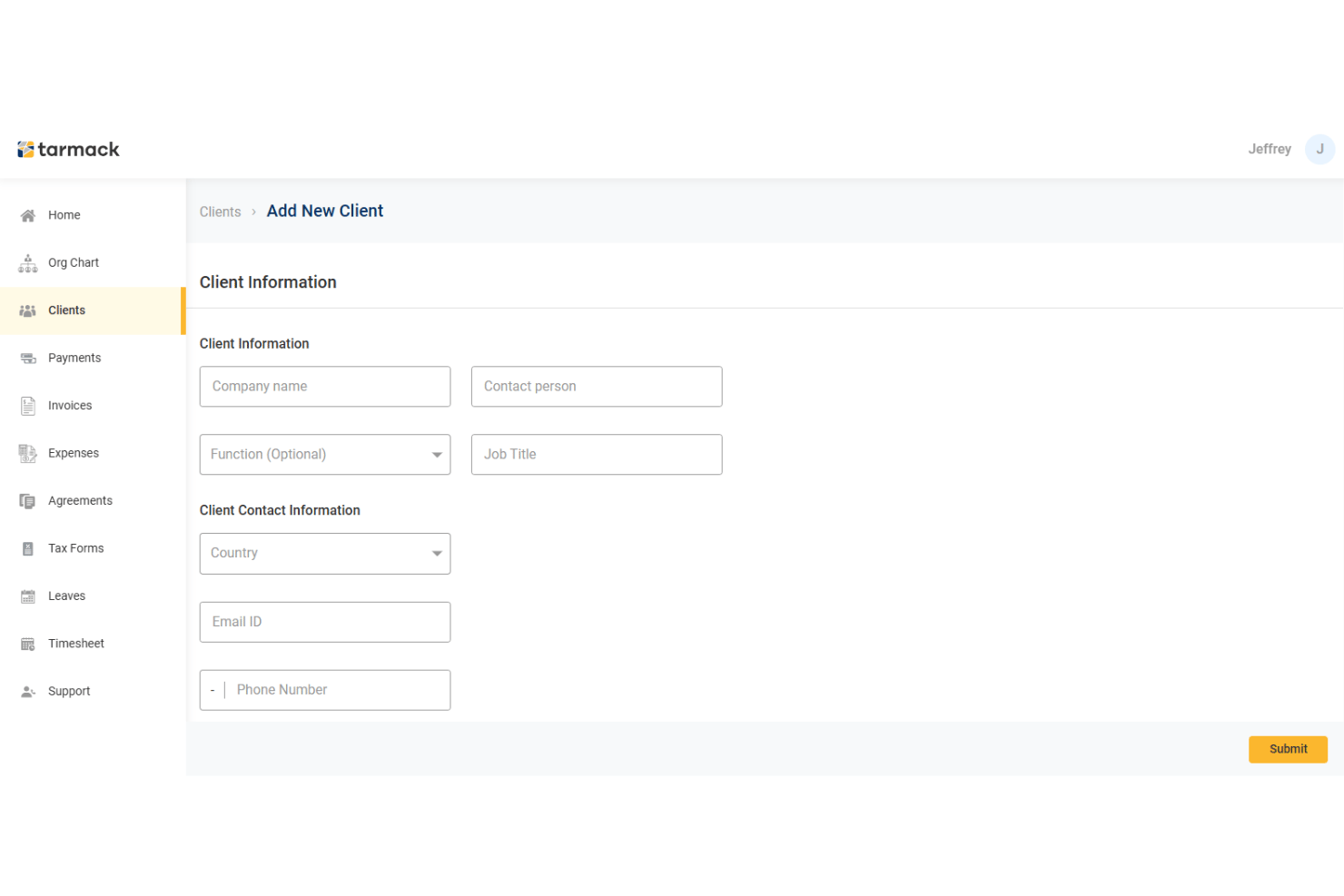
Tarmack’s interface is noticeably clear, helping HR teams navigate onboarding, payroll, and documentation with little friction. I’ve seen user reviews highlight the intuitive dashboard and helpful prompts for local compliance steps. New users get hands-on guidance, making it quick to launch international hires or process payroll without confusion.
Integrations
Tarmack does not publicly list specific native integrations. Though, they do support connections with HR and accounting systems and offers custom integrations based on business needs.
Tarmack does not publicly document an API or connections with third-party integration tools.
Tarmack Specs
- 2-Factor Authentication
- 360 Degree Feedback
- API
- Application Tracking
- Attendance Tracking
- Batch Permissions & Access
- Compliance Tracking
- Dashboard
- Data Export
- Data Import
- Data Visualization
- Employee Database
- Employee Engagement
- Employee Incentive Management
- Employee Onboarding
- Employee Training
- Expense Tracking
- External Integrations
- Feedback Management
- Multi-User
- Notifications
- Payroll
- Performance Appraisal
- Scheduling
- Time Management
- Timesheets
- Travel Management
- Vacation & Absence Calendar