

Career development courses range from leadership programs to technical skill-builders, and choosing the right one depends entirely on your goals. I rounded up top options across different focus areas so you can find training that fits your current role, your next one, or the gap between them.
The 15 Best Career Development Courses
Below are my summaries of the best career development courses. My reviews offer a look at each course's learning objectives, best fits, cost, and more.
1. NCDA Facilitating Career Development Training and Certification Program - NCDA
Best for: Career coaches earning a CCSP or GCDF credential
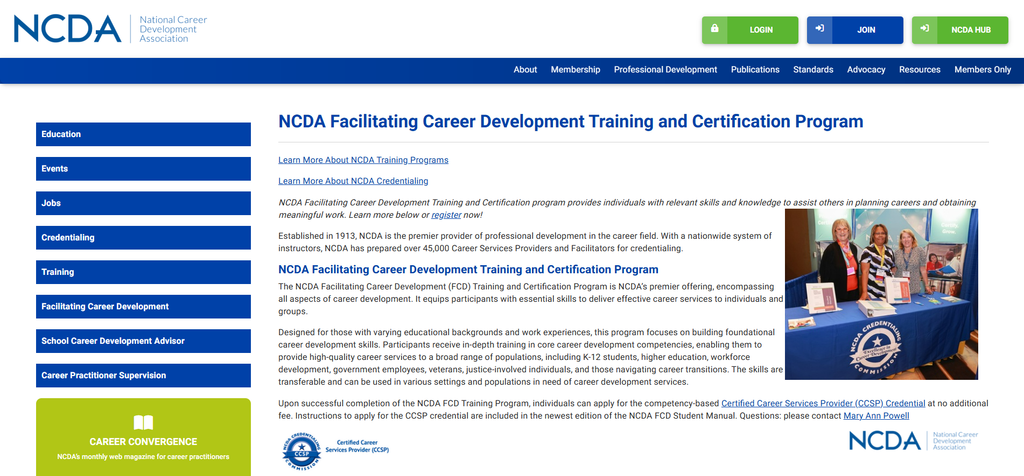
The NCDA's Facilitating Career Development (FCD) program is an instructor-led training designed to prepare professionals to guide others through career planning and job search. It leads to two recognized credentials: the CCSP and GCDF.
What you'll learn: You'll build competency across career development models, assessment, labor market information, employability skills, ethics, and program management for client-facing career services roles.
Course details:
- Format: Live virtual or in-person delivery through NCDA-registered instructors; most online sections use Zoom or similar platforms alongside an LMS
- Duration: Minimum 120 instructional hours; course length varies by instructor, typically spanning 2–15 weeks
- Level/prerequisites: Prerequisites not specified; designed for individuals with varying educational backgrounds and work experience
- Price: $1,050–$1,550 USD per learner (varies by instructor; student manual may be an additional $250–$275 if not included)
- Certificate/credits: CCSP (Certified Career Services Provider) credential from NCDA at no additional fee upon completion; GCDF (Global Career Development Facilitator) credential eligibility via CCE; some instructors offer college credit or CEUs
Considerations: Pricing and scheduling are set independently by each NCDA-registered instructor. The experience, format, and what's included in the fee can vary depending on who you train with.
2. Talent Management & Succession Planning Certificate Program - AIHR
Best for: HR professionals building succession planning programs
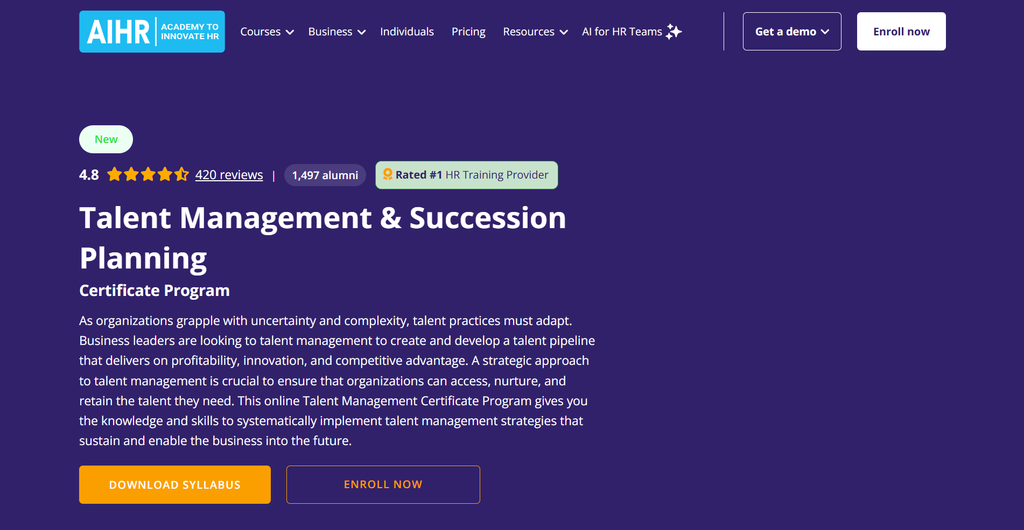
AIHR's Talent Management & Succession Planning Certificate covers strategy, succession pipelines, and retention in one program. SHRM, HRCI, and HRPA accredit it, so it counts toward recertification while building a specialization hard to find in a single course.
What you'll learn: You'll develop talent demand forecasting, succession pipeline mapping, retention-risk analysis, EVP development, and culture-change skills across a 13-module curriculum with a capstone project.
Course details:
- Format: 100% online, self-paced; English language
- Duration: ~36 hours of instruction; suggested 12 weeks at 3 hrs/week; 12 months' access included
- Level/prerequisites: Professional level; no prerequisites listed
- Price: $1,125 USD per learner (standalone); $1,850 USD for Full Academy Access, which includes all 17 certificates and 85+ courses
- Assessment: Capstone project and final exam required for completion; unlimited exam retries
- Certificate/credits: Digital completion certificate; 26 SHRM PDCs, 26 HRCI (General) Business credits, and 25 HRPA PDCs
Considerations: Standalone enrollment opens every two months, so depending on timing, you may wait up to two months before you can start.
3. Global Career Development Facilitator (GCDF) - Center for Credentialing & Education
Best for: Workforce professionals earning a CCSP or GCDF credential
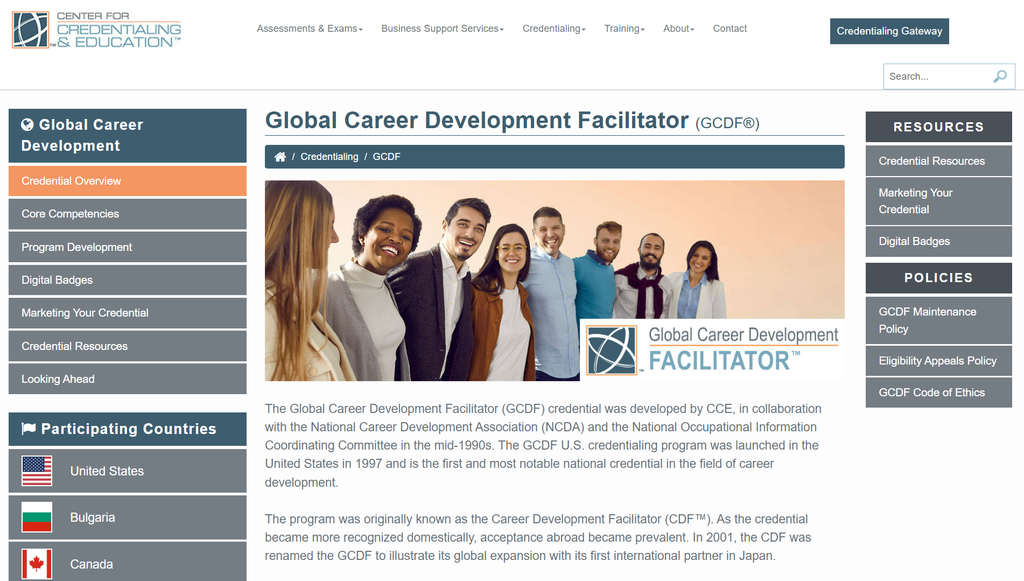
The GCDF, issued by the Center for Credentialing & Education (CCE), is the leading credential in career development facilitation. It's built for practitioners who help others navigate career transitions, structured around 12 core competency areas across a 120-hour training program.
What you'll learn: You'll develop skills in career facilitation, labor market research, formal and informal assessment, job search strategy, working with diverse populations, and program management.
Course details:
- Format: Varies by training provider; live, virtual, on-demand, and blended options are available through CCE's Registered Credential Training Providers (RCTPs)
- Duration: Minimum 120 hours of training through a CCE-approved RCTP; work experience requirements also apply (see Level/prerequisites)
- Level/prerequisites: Requires verified career development work experience (1,400–5,600 hours, depending on highest completed level of education) and documentation of your degree
- Price: $100 USD application fee to CCE; $40 USD annual maintenance fee; training provider fees vary and are not published by CCE
- Certificate/credits: GCDF credential awarded by CCE, valid for 5 years; recognized in 23 countries; renewal requires 75 continuing education hours and an annual $40 USD maintenance fee
Considerations: Training costs are set by individual RCTP providers and not disclosed on CCE's site, so the total cost of earning the GCDF will vary depending on which approved provider you choose.
Have an account? Log In
4. Learning & Development Certificate Program - AIHR
Best for: L&D professionals designing AI-informed learning strategies
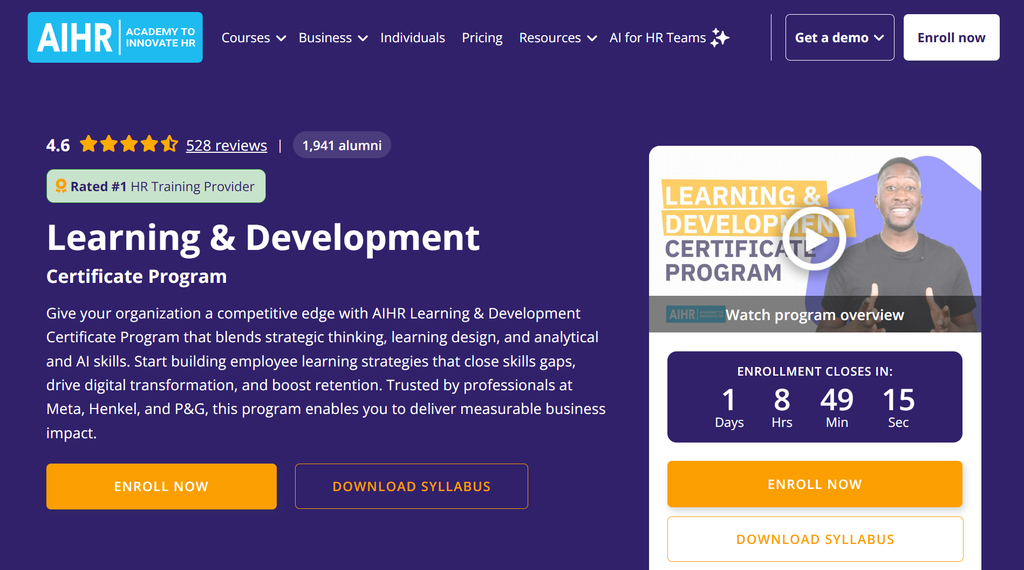
AIHR's Learning & Development Certificate Program is a self-paced online course covering the full scope of L&D practice—from strategy and digital learning design to analytics and AI. It's one of the few certificates that combines all of these areas in a single accredited program.
What you'll learn: You'll build an L&D strategy, design digital learning experiences, conduct a skills gap analysis, measure learning ROI using analytics, and use AI tools to produce learning content.
Course details:
- Format: 100% online, self-paced; English language
- Duration: ~40 hours of instruction; suggested 12 weeks at 3 hrs/week; 12 months' access included
- Level/prerequisites: Professional level; no prerequisites listed
- Price: $1,125 USD per learner (standalone); $1,850 USD for Full Academy Access, which includes all 17 certificates and 85+ courses
- Assessment: Capstone project and final exam required for completion; unlimited retries
- Certificate/credits: Digital completion certificate; 24 SHRM PDCs, 24 HRCI (General) Business credits, 30 HRPA PDCs, and ATD credits
Considerations: Standalone enrollment opens periodically, so depending on timing, you may need to wait before you can start.
5. Goodwill® Career Coach and Navigator Professional Certificate - Goodwill Industries International (via Coursera)
Best for: Beginners breaking into career coaching without a degree
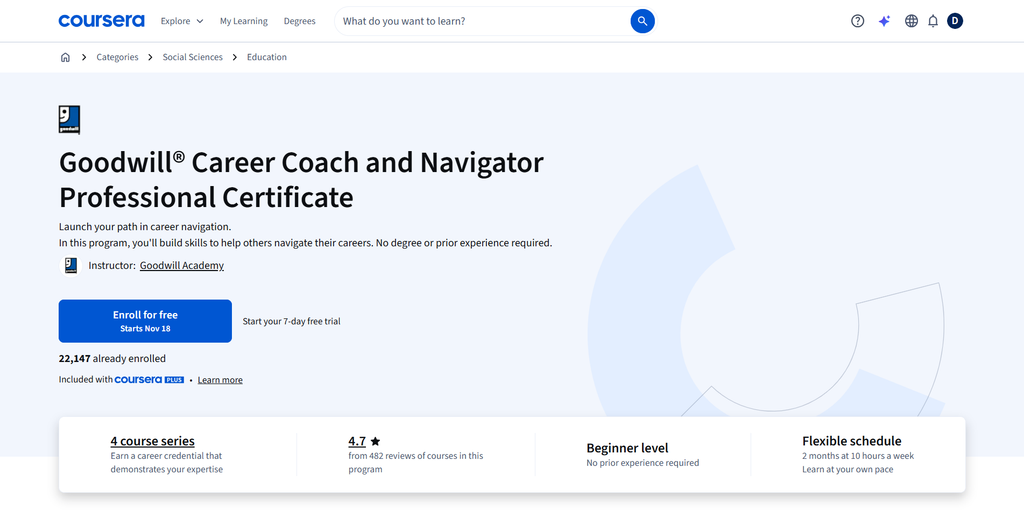
Goodwill Industries International built this Coursera certificate on 120+ years of workforce development practice. It's one of the few ICF-accredited coaching credentials designed for beginners—no degree or prior experience required.
What you'll learn: You'll conduct client intake and skills assessments, build career action plans, apply human-centered coaching techniques, support clients through job transitions, and develop community referral partnerships.
Course details:
- Format: 100% online, self-paced; accessible via web or mobile
- Duration: ~69 hours across 4 courses; estimated 2 months at 10 hrs/week
- Level/prerequisites: Beginner; high school diploma or GED required; no prior experience needed
- Price: $49 USD/month (Coursera subscription); included with Coursera Plus at $239/year; financial aid available
- Assessment: Scenario-based activities, projects, and a capstone project in the final course
- Certificate/credits: Professional Certificate from Goodwill Industries International; ICF-accredited program with credits applicable toward ICF credential renewal
Considerations: Pricing is subscription-based, so your total cost depends on how quickly you complete all four courses.
6. Learning and Development - HRCI (via Coursera)
Best for: New HR professionals learning L&D fundamentals for aPHR prep
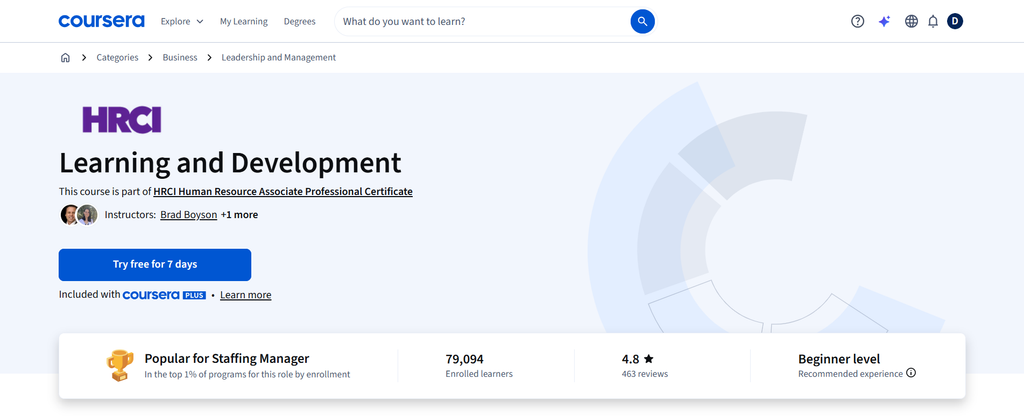
HRCI's Learning and Development course covers training design, delivery, and evaluation fundamentals. It's part of a five-course professional certificate that prepares you for the aPHR exam and carries an ACE® credit recommendation.
What you'll learn: You'll conduct a training needs analysis, apply the ADDIE instructional design model and Kirkpatrick evaluation framework, design training programs, and calculate training ROI.
Course details:
- Format: 100% online, self-paced; accessible via web or mobile
- Duration: ~16 hours across 4 modules; estimated 2 weeks at 10 hrs/week
- Level/prerequisites: Beginner; no degree or prior HR experience required
- Price: Included with Coursera subscription (~$49 USD/month) or Coursera Plus ($239 USD/year); financial aid available
- Assessment: AI-graded assignments, a peer review, and an applied training design project in the final module
- Certificate/credits: Shareable career certificate from HRCI; ACE® recommended for potential college credit at participating institutions
Considerations: If your goal is aPHR exam preparation, this single course won't be enough—you'll need to complete all five courses in the HRCI Human Resource Associate Professional Certificate series.
7. SHRM People Manager Qualification (PMQ) - SHRM
Best for: New managers transitioning from individual contributor roles
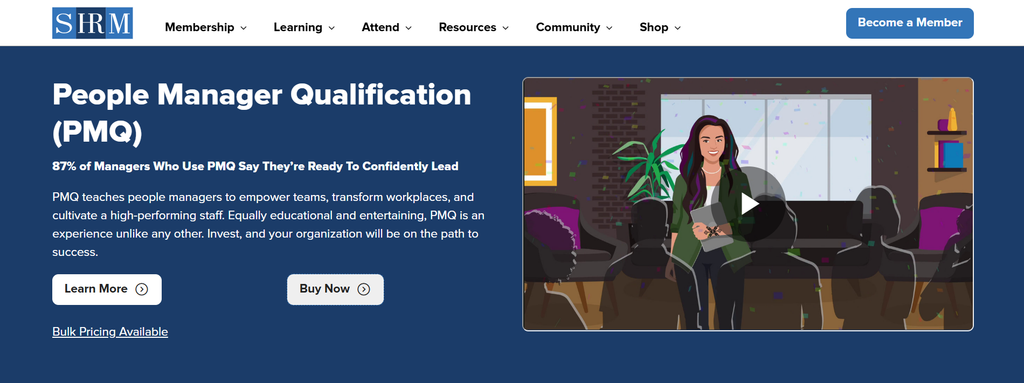
SHRM's PMQ teaches people management through a binge-style streaming-series format with interactive scenarios across 30 modules. It's one of the few management programs that awards a named qualification from HR's most widely recognized professional organization.
What you'll learn: You'll apply structured feedback and performance tools, navigate critical conversations, lead compliant hiring processes, build inclusive team cultures, and set and track employee goals.
Course details:
- Format: 100% online, self-paced; interactive streaming-series episodes with gamified exercises and scenario-based activities
- Duration: 10–13 hours of instructional content, including the final assessment; 12-month access window from purchase date
- Level/prerequisites: Foundational; no prerequisites; SHRM membership not required
- Price: $995 USD per learner (non-member); $895 USD for SHRM members; bulk pricing available on request
- Assessment: Self-paced assessment at the end of each season; final cumulative behavioral assessment required to earn the PMQ designation
- Certificate/credits: SHRM PMQ designation; digital badge via Credly; digital certificate of achievement; 16.5 SHRM PDCs for SHRM-CP or SHRM-SCP holders
Considerations: You have 12 months from purchase to complete the program, so if your schedule is unpredictable, factor that window into your decision before enrolling.
8. Human Resources Management Certificate - eCornell
Best for: HR career changers who want a full Ivy League credential
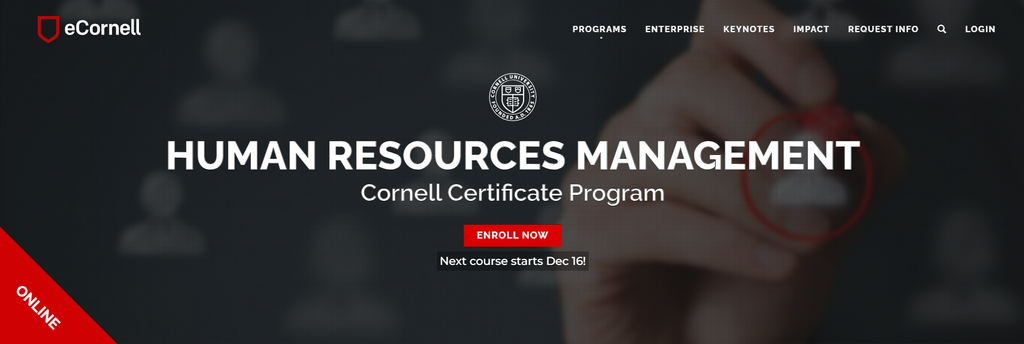
eCornell's Human Resources Management Certificate covers the full breadth of HR—seven courses taught by Cornell ILR School faculty, one of the most respected programs in the field. The cohort-based format with personalized feedback sets it apart from self-paced alternatives.
What you'll learn: You'll manage performance systems, apply coaching frameworks, navigate labor relations, design training programs, and build compensation strategies aligned to organizational goals.
Course details:
- Format: 100% online, cohort-based; facilitated discussions, optional weekly live Zoom sessions, and real-world projects; fewer than 35 learners per cohort
- Duration: 4 months; 3–10 hours per week across 7 courses; new cohorts start every two weeks
- Level/prerequisites: Designed for HR professionals with under 5 years of experience and career changers; no specific prerequisites stated
- Price: $3,900 USD upfront, or 7 monthly payments of $608 USD per learner; promotional discounts may apply
- Certificate/credits: Cornell ILR School certificate; 80 SHRM PDCs; 80 HRCI recertification credit hours; 8.0 CEUs; two-year HR Symposium LIVE membership included
Considerations: This is the most expensive option on this list—it's worth the investment if you need breadth across the full HR function. A narrower, lower-cost course may serve you better if you're developing skills in one specific area.
9. Talent Management Principles - Association for Talent Development
Best for: HR pros recertifying across APTD, CPTD, HRCI, and SHRM
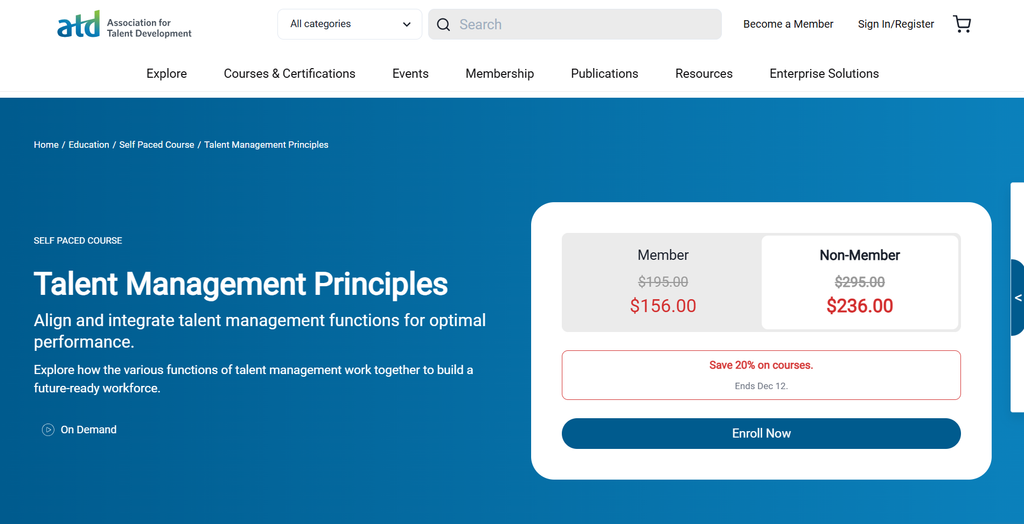
Talent Management Principles is a course from the Association for Talent Development (ATD). It's a quick-start resource for HR and talent development professionals who need a structured overview of how talent management functions work together.
What you'll learn: You'll map how talent acquisition, development, retention, and deployment connect as a system, strengthen HR-TD collaboration, and apply workforce planning strategies to build a more engaged workforce.
Course details:
- Format: 100% online, self-paced, on-demand; accessible 24/7
- Duration: ~45 minutes
- Level/prerequisites: Beginner/foundational; no prerequisites mentioned
- Price: $295 USD per learner (non-member); $195 USD (ATD member); included in ATD Professional Plus membership at $479 USD/year
- Certificate/credits: ATD Certificate of Completion; CEUs; 0.75 recertification credits each for APTD, CPTD, HRCI, and SHRM
Considerations: At ~45 minutes, this course provides a principles-level overview rather than a deep dive—if you're looking to build hands-on skills in any one talent management discipline, a longer course will serve you better.
10. Human Resource Management: HR for People Managers Specialization - University of Minnesota (via Coursera)
Best for: New managers building a full people management foundation
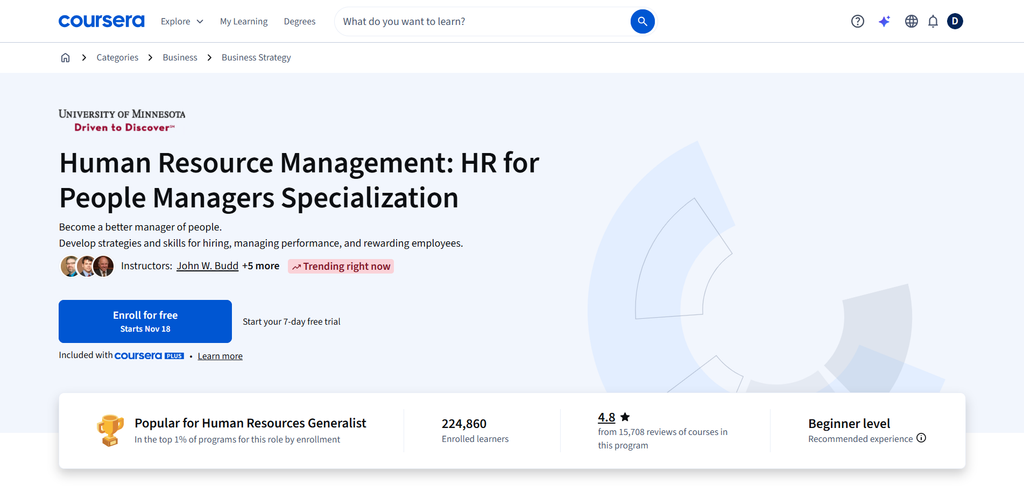
This five-course specialization from the University of Minnesota, hosted on Coursera, covers HR fundamentals for people managers. It's research-informed and built around practical application, culminating in a capstone project you apply to a real workplace.
What you'll learn: You'll learn to recruit and hire employees, set clear performance expectations, deliver constructive feedback and appraisals, design compensation structures, and navigate the US legal context for managing people.
Course details:
- Format: Fully online, self-paced; flexible schedule with new cohorts starting approximately every two weeks
- Duration: Approximately 2 months at 10 hours per week; 5 courses totaling roughly 92 instructional hours, including a capstone
- Level/prerequisites: Beginner; no prior HR experience required; at least two years of college experience is recommended but not required
- Price: Included with Coursera Plus (from $239 USD/year per learner); individual course pricing not published; financial aid available
- Assessment: Quizzes, graded assignments, and a peer-reviewed capstone project applying HR strategies to a real work group
- Certificate/credits: Shareable career completion certificate from the University of Minnesota, issued via Coursera; no university credit awarded
Considerations: The compensation and legal content references US pay regulations specifically, so learners outside the US may find parts of the curriculum less directly applicable to their context.
11. Career Navigator: A Manager's Guide to Career Development - Udemy
Best for: Managers who want a free framework for career conversations
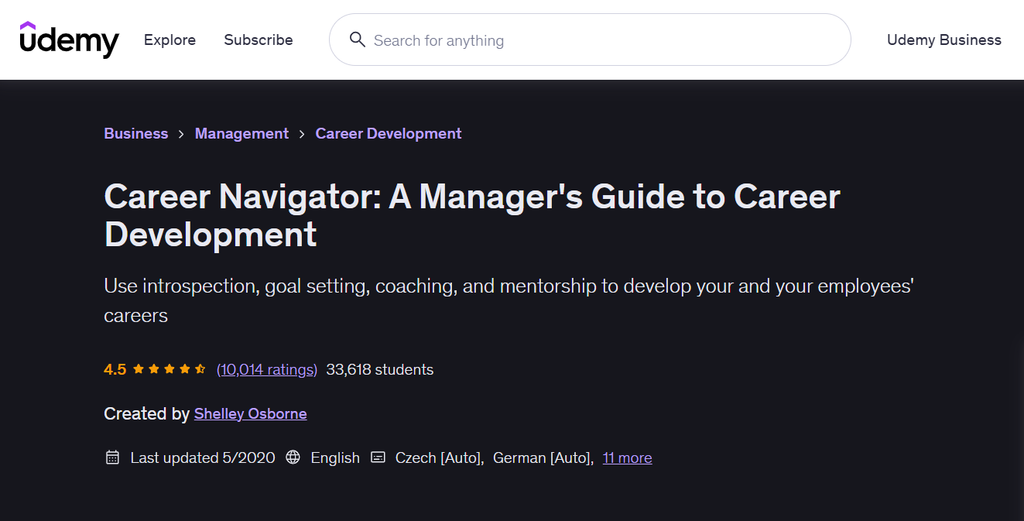
Career Navigator is a free Udemy course by Shelley that walks managers through methods for career development conversations with direct reports, while also helping you clarify your own career direction.
What you'll learn: You'll map career paths, use the Peak Experiences activity to identify values and motivators, apply the GROW model to set goals, and practice active listening techniques for coaching conversations.
Course details:
- Format: 100% online, self-paced, on-demand on Udemy; includes 9 downloadable worksheets and templates
- Duration: ~48 minutes of on-demand video across 17 lectures
- Level/prerequisites: Beginner; no prerequisites; having direct reports is recommended to get the most out of the course
- Price: Free
- Certificate/credits: Free Udemy courses don't include a certificate of completion; no professional recertification credits
Considerations: This course is an introduction to the framework rather than a coaching skills builder, so expect to apply the methods yourself through real conversations after completing it.
12. Talent Management and Career Development - MindEdge
Best for: Credentialed HR pros renewing ATD, HRCI, or SHRM credits
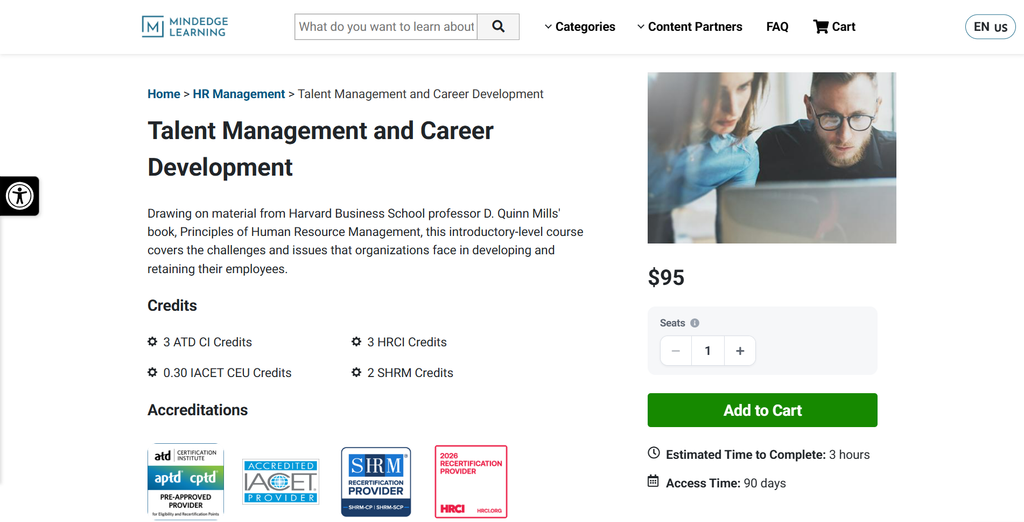
MindEdge's Talent Management and Career Development is a short, affordable course grounded in Harvard Business School material. It earns recertification credits across four bodies—ATD, HRCI, SHRM, and IACET—making it a time-efficient option for HR professionals tracking continuing education.
What you'll learn: You'll describe the career life cycle, evaluate skill gaps through training needs analysis, apply managerial coaching techniques, and design leadership development approaches.
Course details:
- Format: 100% online, self-paced; includes interactive activities and real-world case studies; mobile-compatible
- Duration: ~3 hours of learning; 90-day access window from purchase
- Level/prerequisites: Introductory; no prerequisites specified
- Price: $95 USD per learner
- Certificate/credits: 3 ATD CI Credits, 3 HRCI Credits, 2 SHRM Credits, and 0.30 IACET CEUs
Considerations: The 90-day access window is fixed from purchase, so plan to complete the course within that period—there's no indication of extensions being available.
13. Introduction to Career Coaching - Alison
Best for: HR pros pursuing CPD-accredited career coaching skills
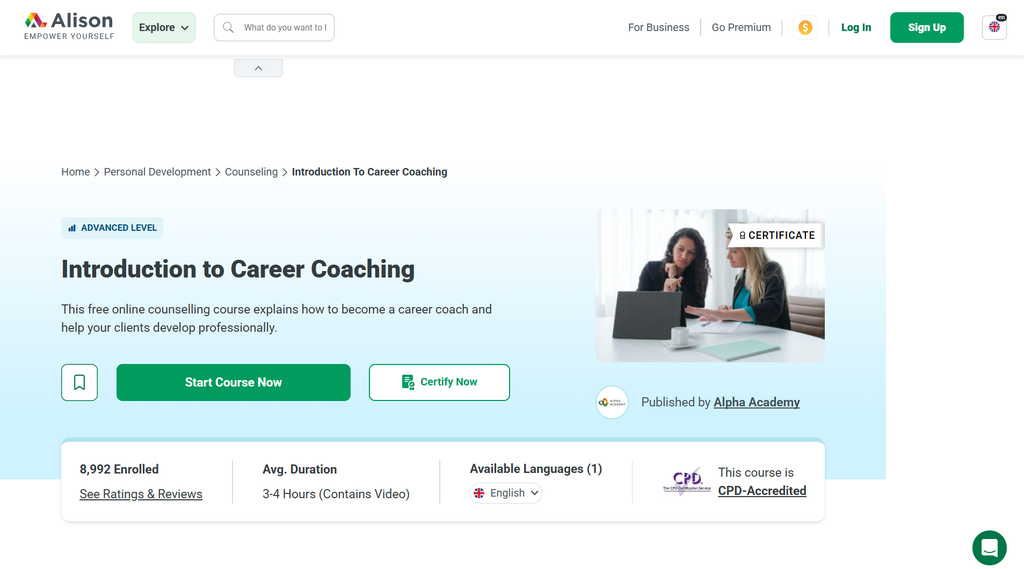
Introduction to Career Coaching is a free, CPD-accredited Alison course by Alpha Academy. It focuses on the practitioner side of career coaching—covering principles, client relationships, and communication skills for those who want to coach others professionally.
What you'll learn: You'll learn core coaching principles, distinguish coaching from mentoring, build client confidence and relationships, and learn the basics of setting up a coaching practice.
Course details:
- Format: Self-paced online; includes video content; accessible via web browser and Alison mobile app with offline download
- Duration: 3–4 hours; no completion time limit
- Level/prerequisites: Advanced; no prerequisites specified
- Price: Free to learn; optional CPD certificate available for purchase (~€21–€37)
- Assessment: Must score at least 80% on course assessments to earn a certificate
- Certificate/credits: CPD UK-accredited certificate (paid); free Learner Record available as an alternative; no SHRM, HRCI, ATD, or IACET credits
Considerations: One module covers UK employment law, which is most relevant to learners coaching clients in the UK.
14. Career Management - Fundação Instituto de Administração (via Coursera)
Best for: Managers who coach teams and plan their own career paths
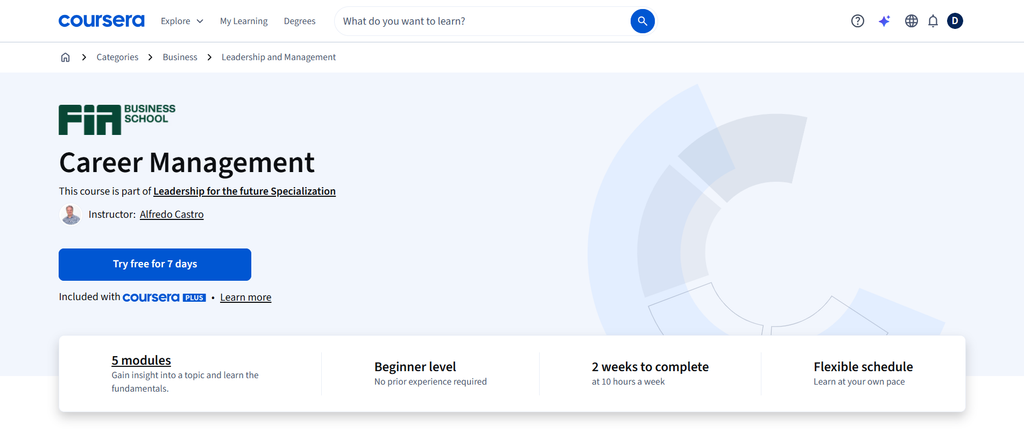
FIA Business School's Career Management on Coursera covers both personal career planning and the skills to coach and mentor others—a combination that makes it useful for managers who wear both hats.
What you'll learn: You'll develop a personal brand, apply whole-life career planning frameworks, distinguish coaching from mentoring, and explore employer branding and employee engagement strategies.
Course details:
- Format: Self-paced online; includes video lectures, readings, peer-reviewed assignments, discussion prompts, and recorded live sessions
- Duration: ~24 hours of content; suggested pace is 2 weeks at 10 hours/week; no fixed deadline
- Level/prerequisites: Beginner; no prerequisites required; business experience noted as helpful
- Price: Included with Coursera Plus ($239/year or $59/month); audit access may be free, but graded assignments and the certificate require a paid subscription
- Assessment: 9 graded assignments, including peer-reviewed work
- Certificate/credits: Shareable Coursera completion certificate; no SHRM, HRCI, ATD, or IACET recertification credits
Considerations: This course is part of a four-course specialization, so the certificate requires completing the full Leadership for the future program—not just this course alone.
15. Career planning: Your career, your life - Macquarie University (via Coursera)
Best for: Mid-career professionals ready to reinvent their career path
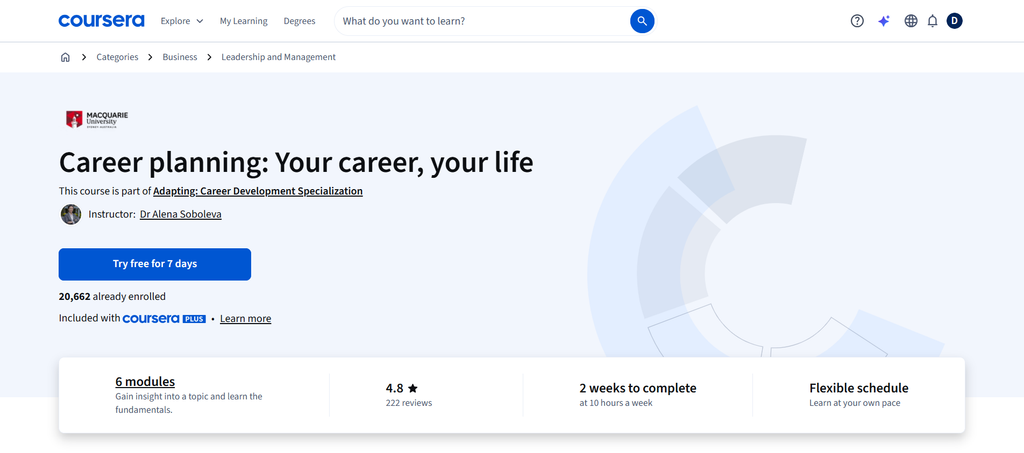
Macquarie University's Career Planning on Coursera walks you through the full arc of career development—from self-assessment and exploration through networking, job search, and building long-term career capital.
What you'll learn: You'll assess your career identity, explore career paths, align your values and goals, build networking and job search skills, and develop a personal brand to navigate long-term career change.
Course details:
- Format: Self-paced online on Coursera; includes video lectures, readings, graded assignments, and discussion prompts
- Duration: ~17 hours across 6 modules; no fixed deadline; suggested pace is 2 weeks at 10 hours/week
- Level/prerequisites: Beginner; no prerequisites required
- Price: Included with Coursera Plus ($239/year or $59/month); graded work and the certificate require a paid subscription; audit access may be free
- Assessment: 12 graded assignments across 6 modules
- Certificate/credits: Shareable Coursera completion certificate; no SHRM, HRCI, ATD, IACET, or CPD professional recertification credits
Considerations: This course doesn't offer SHRM, HRCI, ATD, or CPD recertification credits, so if continuing education credit is a requirement for your role, you'll need to look elsewhere.
More Articles
How to Choose a Career Development Course
Start by identifying what you're actually trying to solve. Are you planning your own next move, building coaching skills to support your team, or earning continuing education credits for a credential renewal?
- Match the curriculum to your direction. A course focused on personal branding and self-assessment serves a different need than one covering employer branding, employee engagement, or how to coach others. Check the module list—not just the title—before enrolling.
- Be honest about your time. These courses range from under an hour to 24 hours or more. A 17- or 24-hour course will stall if you can't protect consistent study time. If your schedule is unpredictable, a shorter or more modular option is often a better bet.
- Check whether credits are required. If you're renewing a credential like SHRM-CP, PHR, or a CPD-accredited certification, verify that the course actually awards the credit type you need. A shareable Coursera certificate and a CPD-accredited credential are not the same thing.
- Look at how learning is assessed. Passive video-only formats suit some learners, but if you want to apply what you're learning—through peer-reviewed assignments, reflection exercises, or practical tools—filter for courses that include those elements.
- Factor in the full cost. "Free" courses often require a paid subscription to access graded work or earn a certificate. Add up the actual cost—platform subscription, certificate fee, or both—before committing.
- Consider your audience. If you're developing others, look for courses that address coaching and mentoring explicitly, not just career planning in general.
Career Development Courses FAQ
Can a career development course help if you're changing industries?
Yes. A course can help you identify transferable skills, explore new roles, and plan how to fill skill gaps—but it won’t replace researching the target industry or gaining relevant experience. Think of it as a framework for structuring your transition, not a substitute for doing the legwork of building industry knowledge and connections in your new field.
Will completing a career development course lead to a job or promotion?
No course can guarantee a job or promotion. What it can do is give you useful skills and a clearer plan. You’ll still need to apply what you learn through actions like networking, building experience, and pursuing suitable opportunities. The course gets you ready—you still have to do the work.
Do employers recognize online career development certificates?
Recognition varies by employer and certificate. A certificate may signal initiative or completed learning, but it isn’t a formal qualification or professional credential. Check the job requirements you’re targeting, and when possible, focus on demonstrating the skills you gained rather than leading with the certificate itself.
How can you tell whether a course is helping your career?
Set a practical goal before you start—clarifying your next role, improving a job-search skill, or creating a development plan. After completing the course, assess whether you’ve made real progress toward that goal and identify one concrete next step. If you can’t name a tangible change, the course may not have been the right fit.
Additional Resources
Explore more ways to grow your skills and prepare for future career opportunities:
- Get fresh career insights from these personal development podcasts
- Map out your goals with a professional development plan
- Stay competitive with tips on future-proofing your career
- Strengthen your leadership skills with executive development courses
- Discover workplace insights in this interview with Liz Lockhart
What’s Next?
To stay up to date on the latest in people management, subscribe to our newsletter for leaders and managers. You’ll receive insights and offerings tailored to leaders and HR professionals straight to your inbox.


