

What We’re Asking of the Managers Who Don’t Get Cut


Flattening Impact: Reducing management layers can lead to overwhelming workloads for remaining managers with more direct reports.
Coaching Gap: Managers need to provide more support post-restructuring, but often lack the capacity to do so effectively.
Emotional Burden: Surviving managers absorb grief and stress from layoffs, impacting their ability to lead effectively.
There is a version of the restructuring story that organizations tell very well. You’ve heard by now that fewer layers and leaner structure are the way to go. AI handling the administrative surface area that once justified middle management.
The org chart gets cleaner, the leadership team feels decisive, and the press release, if there is one, talks about positioning for the future.
What happens next gets less attention.

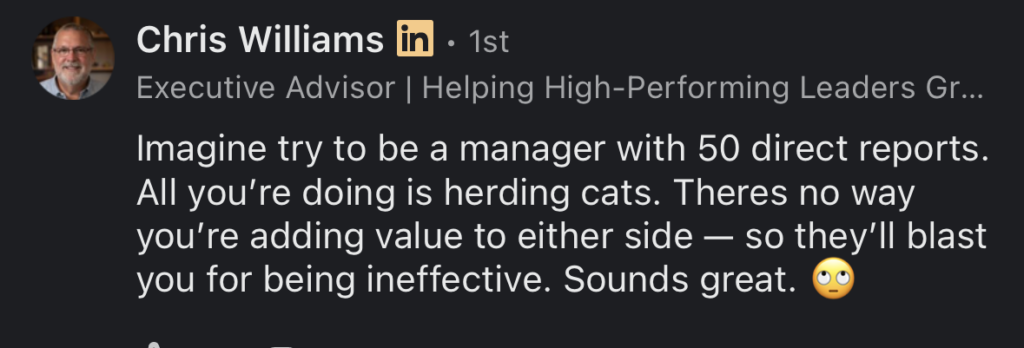
Somewhere in that newly flattened organization, a manager who used to run a team of eight is now running a team of fifteen. Her one-on-ones, which she used to do weekly, are now biweekly at best.
She's still expected to develop her people, still expected to catch performance issues early, expected to hold the culture of her team together. She's also absorbing the anxiety of people who watched their colleagues get let go and are wondering, with varying degrees of subtlety, whether they're next.
And she's doing all of this while figuring out, on her own timeline, what her role even means now that several of the things she used to manage are being handled by tools she's still learning. She was not promoted into this, the job simply expanded around her.
One Decision Short
The case for flattening organizations is real and, in many contexts, sound.
Research has consistently shown that excess management layers slow decisions, dilute accountability, and create coordination overhead that compounds as companies grow.
AI genuinely is absorbing work that used to require managerial involvement. Things like scheduling, status updates, performance data synthesis, some forms of low-stakes communication. There are legitimate reasons to have fewer managers than companies had five years ago.
But the decision to reduce management layers and the decision about what to do with the managers who remain are two separate decisions, and leaders from most organizations I speak to have only made the first one.
Span of control is the technical term for how many direct reports a manager has. In most established frameworks, the recommended ceiling for managers doing real developmental work sits around eight to ten people.
Beyond that, the cognitive load of tracking individual performance, maintaining genuine relationships, and catching problems before they become crises starts to exceed what a single person can reliably hold.
This isn't a soft concern. Gallup has found that managers account for at least 70% of the variance in employee engagement scores. That number doesn't move because you added seven people to someone's team.
Gartner has documented for years that managerial effectiveness drops measurably as span increases without corresponding support.
Organizations now routinely asking managers to carry fifteen, eighteen, sometimes as many as twenty direct reports aren't just stretching a resource, they're changing the job entirely, without changing the title, the compensation, or the expectations attached to it.
Where Have All the Coaches Gone?
The coaching gap is where this becomes most visible.
Employee development didn't get less important when companies got flatter. In many cases it got more important, because the people left on teams are being asked to operate with greater autonomy, broader accountability, and faster feedback loops than their previous role required.
They need more from their managers, not less. They need someone who understands what they're working on, can help them navigate ambiguity, and will tell them the truth about how they're doing before the performance review makes it official.
A manager with fifteen direct reports and no structural relief cannot do this at scale. They can do it for the people who demand it loudest, or for the people in visible roles, or for whoever happened to schedule time with her this week.
The others get the version of development that fits between meetings, be it a quick word in Slack or a vague "you're doing great" in a one-on-one that ran long because three other things came up first.
Managers are Absorbing Grief Too
Then there's a layer underneath the operational problem that's harder to name but just as real. The managers who survived a restructuring didn't just absorb more direct reports. They absorbed more grief.
They were there when the announcements happened. They watched people they hired, or trained, or stayed late with, clean out their desks. In some cases, they delivered those conversations themselves. They went home that night and came back the next morning and were expected to project steadiness to a team that was scared and watching them closely for signals about what was true.
That kind of sustained emotional labor doesn't metabolize quickly. Psychologists who study organizational trauma have documented the secondary stress that managers carry after workforce reductions, including guilt, hypervigilance, and a sort of performance anxiety about whether their team will hold together.
These managers are often the last people to say they're struggling, because they've been told, implicitly or explicitly, that their job is to hold things together. Saying it out loud feels like a failure of the job.
What We Owe Managers
There's a version of this story that ends with a list of what companies should do, and if you want that list, it's not complicated.
- Reduce spans of control to something that is actually manageable for a human
- Give managers real time for development work
- Build genuine support structures rather than asking them to find resilience in themselves.
Those things are all true.
But the more honest thing to say is that most organizations aren't going to do those things in the next quarter, because they just spent significant energy and political capital on a restructuring they've publicly defended as the right move.
Reversing course on span of control, or investing significantly in manager support, requires admitting that the first decision created a problem the organization hasn't fully accounted for.
What leadership actually owes the managers still standing is harder than a program or a policy. It's honesty. It's the acknowledgment that what's being asked of them is genuinely difficult, that the role has changed in ways that weren't fully communicated, and that the organization is watching for signs of strain rather than waiting for the system to break.
The biggest risk to organizational health right now is the assumption that the people left behind are fine because they're still there.
Staying isn't the same as thriving and a manager who is depleted, doing less development work, making faster decisions with less information, pulling back from the emotional labor because there's no margin left for it, doesn't look like a problem until the numbers show up.
Engagement drops, turnover increases, high performers start to leave and, when someone finally does an exit interview, names their manager, who was herself the casualty of a decision made two levels above her.
By then, the org chart looks clean and the decision looks like it worked.
The managers who didn't get cut are carrying something most organizations just don’t talk about, but should. Not because naming it fixes it, but because you cannot design support for a problem you're pretending doesn't exist.
These are the people your organization bet on when it decided to run leaner. They deserve to know that the bet was noticed, that the weight is understood, and that someone in leadership is thinking about what they need to succeed, not just what they need to deliver.

