Did you know that almost 50% of top talent will leave an organization within two years? What’s worse, some data suggests that a lot of them would choose to stay if they were given the right learning and growth opportunities.
In this episode, host Becca Banyard is joined by Alexandra Levit—Founder and CEO of Inspiration at Work—to discuss how to utilize artificial intelligence to lower employee turnover, avoid layoffs, and empower your employees to grow in their careers and develop their skills.
Interview Highlights
- Alexandra's background and what she does at Inspiration at Work [1:20]
- Alexandra is a business and workplace author, speaker, consultant, and futurist.
- Futurist: a person who looks at trends and signals that are percolating up through the market, society, business, and tries to make an educated guess about what has the greatest potential for disruption.
- At Inspiration at Work, they look at the workforce specifically.
- They look two to five years out, sometimes even as far as 10 years, and try to determine what the workforce is going to look like.
- They help organizations and their employees try to be prepared for what's coming next when it comes to the future of work.
- They also do consulting and writing.
- They base their forecasts on what's happened in the past, what they see happening around us, and try to do the best they can to be prepared for what's coming next.
- Alexandra is a business and workplace author, speaker, consultant, and futurist.
- Alexandra's view of AI [3:11]
- AI: the use of a computing platform to mimic types of intelligence that are used by humans.
- AI in the context of her book, Deep Talent, is specifically about types of talent intelligence that are using deep learning.
- Deep learning is using an AI-based algorithm to assess something called “skills adjacency”.
- How artificial intelligence makes work more meaningful to people and some real life examples [5:26]
- Alexandra recently released a book called “Deep Talent: How to Transform Your Organization and Empower Your Employees Through AI”.
- The reason they decided to write the book is that they think that the world is this unique societal, technological inflection point.
- Pre pandemic: we're ready to empower employees to pursue careers that are meaningful to them. At the same time, business leaders are saying that recruitment and development of talent are their top challenges within the organization.
- There are talent shortages, long hiring times, and higher turnover.
- Post pandemic: there’s a lot of difficulties with managing employee expectations. Employees want to work in a very specific type of environment. They’re not going to put up with work environments that aren't palatable to the way they want to work.
- There are some shuffling of priorities and some friction going on now. Data says that nearly 50% of top talent leaves an organization within two years. On the flip side, we see that most individuals would happily stay with an organization if they were given the right learning and growth opportunities.
- Alexandra recently released a book called “Deep Talent: How to Transform Your Organization and Empower Your Employees Through AI”.
What AI does is it holds a promise of being able to tell us what employees can do next.
Alexandra Levit
- One real world example that Alexandra shares is AI technology in governments.
- The most innovative implementations of AI are actually being done by state governments.
- Both the state of New York and the state of Indiana are among others that are leading the charge to match the skills of their unemployed people with the jobs that are available to keep their talent in the state, and at the same time lower the unemployment rate.
- How AI can be used to retain employees in situations where companies are seeing their top talent leaving after two years [10:36]
- A really important part of this is using your knowledge of skills adjacencies to regularly profile your workforce. And be able to get a much broader understanding of the skills that your employees have and the skills that you are needing, not just now, but in the immediate future and in the long term future.
- Developing skill profiles for different roles is something that AI can help you do. You can do that and do your workforce planning by using a talent intelligence platform.
- It's in an organization's best interest to have people with as broad a skills bench as possible, because we never know when the next disruption is coming.
- In fact, the smartest companies during the pandemic didn't lay off people, they just redeployed them.
- The smart way to run a company these days is not to lay off really good people and then worry about having to get them back later on.
- If you use talent intelligence to move people around, get people doing different types of things, hold onto them—that solves the problem of people leaving after two years because they don't have enough opportunity.
- Re-skilling them, up-skilling them, giving them additional opportunities—they're probably going to stay within your organization longer.
Some of the biggest barriers to internal moves are managers who don't want to let go of their people.
Alexandra Levit
- If done in the right way, talent intelligence can really put opportunities out there, help everybody understand why it's for the best, and really just do many good things at once.
- What led Alexandra to write the book "Deep Talent" [16:12]
- She's been noodling on the problem of the skills gap for a better part of a decade. She always seem to be hearing about layoffs.
- The matching problem between the right talent and the right jobs is something that no one can come up with a solution for.
- Alexandra met Ashutosh and Kamal from Eightfold. They have this technology that allows artificial intelligence to be used to help solve this problem and she was very intrigued.
- Alexandra's message as both an author and a futurist is always, “Let's help as many people as possible, live as meaningful lives as possible.”
- How can we find the right careers, the most meaningful careers for as many people as possible? And she viewed the book with Ashutosh and Kamal as a way to do that.
- She's been noodling on the problem of the skills gap for a better part of a decade. She always seem to be hearing about layoffs.
- Some other ways AI is revolutionizing organizational culture [19:24]
- AI is increasingly being used to augment human participation in the workforce.
- There is a lot of buzz around ChatGPT and similar chatbot technologies out there right now.
- Whenever you insert a piece of AI into a traditionally human-driven process, you need a human being to create it, to manage it, to fix it when it breaks, to redeploy it, and then to explain to decision makers how it works.
- ChatGPT cannot write PR pitches like real PR people can.
- AI can do so many things, but there still needs to be human oversight whenever an implementation is launched.
- Alexandra’s thoughts on ChatGPT and how it’ll impact the future of work [23:22]
- She wouldn’t consider ChatGPT to be super advanced compared to other chatbots.
- ChatGPT uses natural language processing to put together sentences or thoughts using language. It learns from what it knows about what you've already said, what it's read.
- It doesn't think on its own.
- It can't hold a conversation.
- There's something called the Turing Test that was done way back to tell if something's a robot or if it is indistinguishable from a human.
- To Alexandra, ChatGPT does not pass that test.
- Everyone needs to be thinking what additional skill set do I need to develop so I can be gainfully employed when certain aspects of my job are taken over by machines.
- Machines are going to become increasingly sophisticated and there will come a day when they get smarter and smarter and are able to take over different human tasks.
- Are we there today with ChatGPT? No. ChatGPT is not that smart, and can't really do that much. Chat bots in general can't really do that much, but they're going to get better.
- Things that keep employees happy in the workplace [27:59]
- New challenges.
- The ability to learn.
- The ability to grow and to feel like you're valued and appreciated.
Meet Our Guest
Alexandra Levit is the founder and CEO of Inspiration at Work, a woman-owned futurist consulting business with the goal of preparing organizations and their employees to be competitive and marketable in the future business world. A nationally syndicated columnist for the Wall Street Journal who currently anchors The Workplace Report, Alexandra has authored several books, including the bestsellers They Don’t Teach Corporate in College, Humanity Works: Merging People and Technologies for the Workforce of the Future, and Deep Talent: How to Transform Your Organization and Empower Your Employees Through AI.
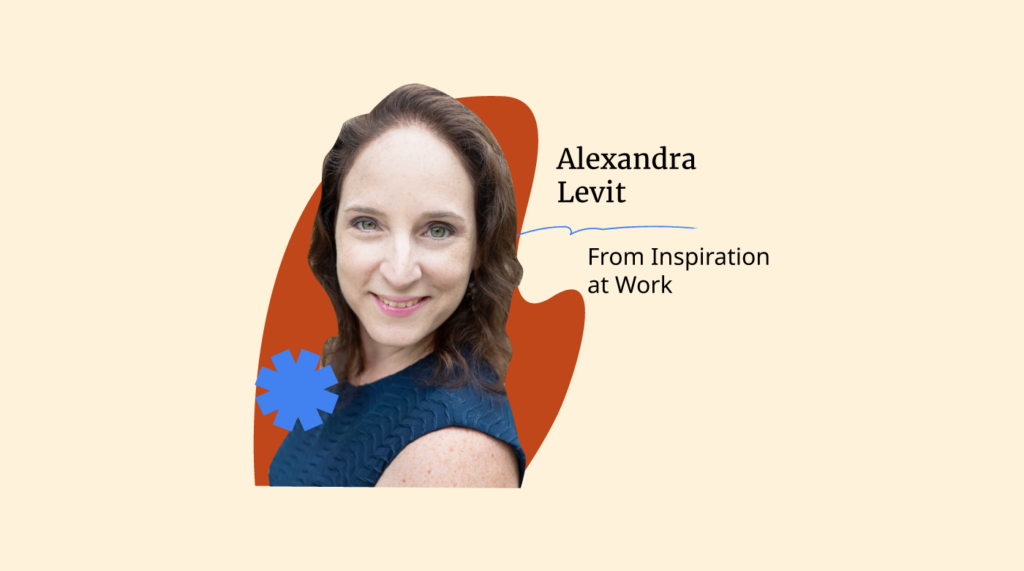
We help organizations and their employees try to be prepared for what's coming next when it comes to the future of work.
Alexandra Levit
Related Links:
- Join the People Managing People Community
- Subscribe to Our AI Signal Newsletter
- Connect with Alexandra on LinkedIn
- Learn more about Inspiration at Work
Related articles and podcasts:
Read The Transcript:
We’re trying out transcribing our podcasts using a software program. Please forgive any typos as the bot isn’t correct 100% of the time.
Becca Banyard: Did you know that almost 50% of top talent believe in organization within two years? And what’s worse? Some data suggests that a lot of them would choose to stay if they were given the right learning and growth opportunities.
Welcome to the People Managing People Podcast. We are on a mission to build a better world of work and to help you create happy, healthy, and productive workplaces. I’m your host, Becca Banyard.
In today’s episode, we are discussing how artificial intelligence is being used to create better and happier workplaces. You’ll learn about some new and exciting ways AI can help you lower employee turnover, avoid layoffs, and empower your employees to grow in their careers and develop their skills.
My guest today is Alexandra Levit. She is the Founder and CEO of Inspiration at Work. She’s an international best-selling author, columnist at The Wall Street Journal and a workplace futurist.
Alexandra, welcome to the show. It’s so great to have you here today. We are going to be diving into a super relevant topic, which is artificial intelligence in the workplace.
But before we get started, why don’t you just tell our listeners a little bit about who you are and what you do at Inspiration at work?
Alexandra Levit: Sure. Well, it’s great to be here. My name is Alexandra Levit. I’m a business and workplace author, speaker, consultant, and futurist. And futurist is a word that some people tend to find a little bit intimidating, but all it really means is that it’s a person who looks at trends and signals that are percolating up through the market, through society, through business, and tries to make an educated guess about what has the greatest potential for disruption.
So at Inspiration at Work, which is my organization, we look at the workforce specifically. And we tend to look two to five years out, sometimes even as far as 10 years, and try to determine, okay, well, what is the workforce going to look like? And we help organizations and their employees try to be prepared for what’s coming next when it comes to the future of work.
And so we do all sorts of things. We do consulting, we do writing. And really we just do what we can to really help when we don’t make predictions, we don’t have a crystal ball. But really we just look at the world around us and we base our, what are called forecasts on what’s happened in the past, what we see happening around us and just try to do the best we can so that we can be prepared for what’s coming next.
Becca Banyard: Amazing. That sounds so interesting. If we had more time today, I would be so interested to hear what you forecasted. Well, I guess you said not forecasting, but what you thought of the pandemic and the great resignation and all of those things. But yeah, that’s a conversation for another time.
So in terms of AI, this word artificial intelligence can mean a wide range of things. So for the sake of our conversation today, I just wanted to start off on the right foot and ask you what you’re referring to when you use the term AI? I know it can be robots, chatbots, automations, a whole wide range of things. So, what are you thinking of when you say the word AI in terms of this conversation and what types of AI tools come to mind for you?
Alexandra Levit: Well, it’s a great question. I think that when we’re having a conversation like this, we absolutely have to level set what we mean by AI. And AI really just means the use of a computing platform to mimic types of intelligence that are used by humans. And when we talk about artificial intelligence in the context of the book, Deep Talent—that we’re talking about, we are talking about specifically types of talent intelligence that are using deep learning.
So deep learning is using an AI-based algorithm to assess something called skills adjacency. So if you are good at skill A, you’re also likely to be good at skill B. So let’s say if you’re good at Algebra, an AI-based algorithm will be able to really look at a very wide range of internal or external data that’s out there in the world. And kind of look at that to assess different patterns to say, okay, well, we know that because you’re good at algebra, you’re also likely to be good at calculus.
And the reason that’s so powerful is because as human beings, we don’t have the ability to necessarily make those inferences readily. But artificial intelligence does. It can take data from all of the sources in the world that are at our fingertips and say, okay, well, we know because you’re good at skill A, that you might also be good at skill B. And that’s using a type of artificial intelligence called deep learning to make these inferences.
And it’s really actually quite exciting. But you’re right in that artificial intelligence can span a really wide range of different types of technologies. And it, when it comes to this specific topic, the Deep Talent book that we’re gonna be talking about. We’re talking about using natural language processing and deep learning to do a very kind of specific type of tasks that involves working with skills.
Becca Banyard: That’s really cool. Man, it’s amazing the times we live in these days.
Alexandra Levit: Cool, right?
Becca Banyard: Yeah. All that’s possible with computers and technology and everything. It’s really cool. So you mentioned just a moment ago, Deep Talent, and this is a book that you recently released. The full title is Deep Talent: How to Transform Your Organization and Empower Your Employees Through AI.
So my next question for you is, how can artificial intelligence make work more meaningful to people? And what are some real life examples of this?
Alexandra Levit: It’s absolutely a great question. And I think that the reason that we decided to write this book is that we think that the world is really kind of this unique societal, technological inflection point.
With the pandemic, we’re ready to empower employees to pursue careers that are meaningful to them, that they can pursue things that are their choice within the organization instead of necessarily being told what they’re going to do next. At the same time, we’re seeing that business leaders are saying that recruitment and development of talent are their top challenges within the organization.
We’re seeing talent shortages, long hiring times, higher turnover. And then the post pandemic period is seeing a lot of difficulties with managing employee expectations. Employees are saying we wanna work in a very specific type of environment. We are not going to put up with work environments that aren’t palatable to the way we want to work.
And so we’re seeing some shuffling of priorities. There’s some, to be honest, there’s some friction going on now. And when we look at the data, we see that nearly, pretty much 50% of top talent leaves an organization within two years. But then when we look at the flip side of that, we see that most individuals would happily stay with an organization if they were given the right learning and growth opportunities.
Unfortunately, that often doesn’t happen. And that as a workforce grows, as organizations get bigger and bigger, they actually lose track of what their employees are capable of doing. They don’t know what skills their employees have accumulated while they’re at a particular job. They don’t know what skills their employees are equipped to master next.
They don’t know how certain skills can be used to grow individual careers. So what AI does, and this kind of touches a little bit upon what we talked about a few minutes ago, is that it holds a promise of being able to tell us what employees can do next. The jobs are there, the people are there, and so it’s a matter of being able to unearth the right matches between the people that you know have talent and loyalty to your organization and the critical jobs that you need to fill.
And AI is capable of helping us do that. And what’s really cool is that this is, as you, you touched upon, this is actually capable of being done today. I have, you know, several real world examples if you would like me to share, but it’s being done in governments. This is one of my absolute favorite examples, just because normally when we talk about real world examples, we talk about super innovative tech companies that are kind of leading the charge about how to use these new and really hot technologies.
And one of the things that I’m most proud of about how this technology is being deployed, at least here in the US, is that some of the most innovative implementations are actually being done by state governments.
And when we think about state governments, we usually think that they’re kind of behind the eight ball, that they’re not quite, you know, up to par when it comes to doing things in sort of a cutting edge way. And we have both the state of New York and the state of Indiana, among others that are really leading the charge to match the skills of their unemployed people with the jobs that are available in that state to keep their talent in the state, and at the same time lower the unemployment rate in that state. So you really are killing two birds with one stone. I know this answer was full of lots of cliches, and I do apologize.
Maybe if I were using AI, I would not need to have so many verbal cliches in this answer. But all I’m trying to say is that, really, I’m just incredibly proud of these implementations. I mean, I had nothing to do with them. But it is just, it’s an amazing thing when state governments are willing to take a chance on technology and say, Hey, you know what?
We have a goal and that’s that we’ve got a bunch of people that are unemployed in our state. We have organizations that are ready to employ them within our state. So if we can use this technology to solve both of these problems at once, then why not give it a shot? And they did so, and as a result, they were able to solve both problems.
And I’m sitting here today using them as case studies because they did that. And the wonderful thing about governments is that they can help a lot of people at once. And when you do things through a government, you can and this is one of the reasons that Ashu and Kamal at Eightfold did target governments, is they recognized the ability to scale the help that they were giving people and the ability to make change on a massive scale much more significantly than if you were to start, let’s say, at a small company.
And by doing that, I think that that was a really smart strategy.
Becca Banyard: Wow. So good. So many really interesting tidbits in there. I’m curious, so you mentioned how the government was helping people get jobs, become employed. But for, you companies that are seeing their top talent leaving after two years, or people, you know, their talents leaving because they didn’t get the learning and development support that they needed.
How can AI be used in those situations to retain the employees?
Alexandra Levit: That’s a really good question too. I think that a really important part of this is using your knowledge of skills adjacencies to regularly profile your workforce. And be able to get a much broader understanding of the skills that your employees have and the skills that you are needing, not just now, but in the immediate future and in kind of the long term future.
I mean, we tend to not look too far out. Mean, just like futurists tend to not look too far out. I mean, I think in skills planning for the future, you have to be somewhat near term because we don’t really know. I mean, there could be skills that we, we haven’t even heard of that are gonna be necessary in 10, 15 years.
But I think developing skill profiles for different roles is something that, that AI can absolutely help you do. Using a talent intelligence platform, you can absolutely do that and do your workforce planning. And by understanding what the skills are that you’re going to be needing in your organization, and then understanding simultaneously what the people within your workforce are capable of doing next.
And in fact, what they will do next. Based on, again, scrubbing that data from billions of career profiles around the world, you can very accurately say, Hey, I know that most people who are in this type of job are likely to want to do this next type of job. In the future, you can start proactively training them to move around the organization.
And in fact, it’s in an organization’s best interest to have people with as broad as skills bench as possible because we never know when the next disruption is coming. And in fact, the smartest companies during the pandemic, they didn’t lay off people, they just redeployed them.
And we saw this happening everywhere where organizations had, all of a sudden they would have one department that was really slow because they weren’t being utilized during the pandemic. Maybe business was just different then because of different things that were needed. So rather than give up a really good person or really good group of people, they would redeploy them into a different function.
And then when that function picked up again, they would deploy them back. And that is really the smart way to run a company these days is not to lay off really good people and then worry about having to get them back later on. I mean, the airlines have seen this already happening when they laid off tons of people during the pandemic, and now there’s a huge labor shortage in the airlines.
Well, it would’ve been better if they could have had a broader bench of skills so they could have held onto those people, redeploy them in other areas, and then kept them. And now they wouldn’t have a labor shortage. Well, so if you use talent intelligence to move people around, get people doing different types of things, but hold onto them, and that by the way, solves the problem of people leaving after two years because they don’t have enough opportunity.
Well, if you’re re-skilling them, upskilling them, giving them additional opportunities, they’re probably gonna stay within your organization longer. And everybody’s gonna be happier. But again, it helps to have the knowledge of what they’re capable of doing. And by the way, this is news to everyone. It’s not just the leaders who get information from this.
It’s the leaders, it’s the, it’s HR, it’s the individuals themselves. A lot of times it’s news to the person themselves. Hey, I had no idea that because I’m good at algebra, I might also be good at calculus. A lot of times it’s very empowering for a person to say, wow. I mean, I didn’t have this kind of education.
I had no idea I could do this. And it’s great if they’re like, wow, this is really cool that I could potentially do this. It’s empowering to people. It gives people a sense of self-efficacy. It gives people a sense of confidence, like especially people who might not have had the level of education.
Maybe they were underestimating themselves. And they feel really, we saw this in, to go back to the US state governments, we saw this a lot with people who were working at, let’s say, convenience stores. And thought that was gonna be their fate for the rest of their lives as they would work in a convenience store.
And they realized, wow, while working at a convenience store, I actually learned all of these skills. I had no idea could be deployed elsewhere. And they were like, Hey, I could actually go work at a hospital now. Who knew? And it was really cool. And by the way, it’s also helpful for managers because some of the biggest barriers to internal moves are managers who don’t wanna let go other people.
Who are very shortsighted about it and say, oh, I don’t think I wanna support this internal move because I don’t wanna lose my person, cuz that person’s really good. And by seeing how an internal move is actually better for the organization, maybe you don’t have to lose that person. Maybe that person can still work with you while doing something else, taking on a different challenge.
So it kind of helps everybody. And I think it also just democratizes opportunity. If done in the right way, talent intelligence can really just kind of put the opportunities out there, help everybody understand why it’s for the best, and really just do many good things at once. So I think it’s probably just a great thing to have across the board.
Good question though.
Becca Banyard: Yeah. So good. So I just wanna loop back to your book. So what led you in the first place to write this book? Yeah, what was the path, the journey to the decision to write the book?
Alexandra Levit: That’s a good question. So your questions are all really good. I mean, I would say that I’ve been noodling on the problem of the skills gap for probably a better part of a decade. And it’s always been very frustrating to me that there just seems to be, first of all, I always seem to be hearing about layoffs.
We’re laying all these people off, and yet we seem to never be able to find the right people for the right jobs. So this matching problem between the right talent and the right jobs just seems to be something that no one can come up with a solution for.
And, so when I met Ashu and Kamal, and they have this technology with Eightfold that allows artificial intelligence to be used to help solve this problem, clearly I was very intrigued. And I loved that they had so many early successful use cases that could be very eloquently described that we actually had something that we could go out and give practical advice about.
So it wasn’t just theoretical. It wasn’t like, well, you know, you could do this. It was, this technology’s available today and here’s how you do it. Like we could actually tell people this is what’s underneath the hood of talent intelligence. So I really appreciated the ability to be able to give a solution. Because I’ve done tons and tons of writing over the years, and some of that writing is more theoretical than others.
And I think in the space of when you’re a futurist, a lot of what you do is speculative and it involves things that might happen and are likely coming, and here is something that’s already here. So it’s something that’s already being done. There are implementations all around the globe and we give people, I hope, a really practical roadmap for getting started and to not be afraid either.
Like, this isn’t something that you have to fear or, you know, you don’t have a business case for. It’s something that people have already done very successfully and it’s not going to cost an arm and a leg to get a small pilot going. And really, what do you have to lose? So that’s what attracted me to being able to write about it and get the word out.
And really again, my message as both an author and a futurist is always, like, let’s help as many people as possible. Live as meaningful lives as possible. And in my area, that’s work, right? So, how can we find the right careers, the most meaningful careers for as many people as possible? And I viewed this book with Ashu and Kamal as a way to do that.
Becca Banyard: Amazing. I love that. I, it makes me think just of us at People Managing People is we really try to create content that’s not just the what, but the how. How can you do this? How can you implement this in your own organization, in your own work practice, in your own career?
Alexandra Levit: Right. You guys are doing the exact same thing. You have the exact same mission.
Becca Banyard: Amazing. I love it. So we’ve already talked a bit about how AI is revolutionizing organizational culture in terms of decreasing unemployment or keeping employees in a workplace that they otherwise may have left because they didn’t see where they could grow into new roles.
What are some other ways that AI is revolutionizing organizational culture?
Alexandra Levit: Well, I think that you know, we see AI increasingly being used to, I don’t wanna say, to augment human participation in the workforce. I mean, I never liked to use the word replace. I don’t think AI is at a point where it can replace human participation in the workforce.
I know there is a lot of, for example, to be very timely. There is a lot of buzz around ChatGPT and similar chatbot technologies out there right now. I mean, one of the things I always feel like I have to be a drum to whenever I’m talking about this topic is, whenever you insert a piece of AI into a traditionally human-driven process, you need a human being to, to create it, to manage it, to fix it when it breaks, to redeploy it, and then to explain to decision makers how it works.
So that is a lot of people that need to be involved in the oversight of AI technologies. And when you do not have those people involved, chaos ensues. And I just have an example of this that happened today, actually.
I write a column for the Wall Street Journal. Some listeners might be familiar with that. It’s called The Workplace Report. And I had some PR people pitching me today with ChatGPT. They were using the chatbot, ChatGPT to craft PR pitches. But nobody, they were using real PR people’s email addresses, but no actual human PR people were reading the pitches that ChatGPT was writing before they were sending them out.
Well, unfortunately, ChatGPT cannot write PR pitches like real PR people can. And the pitches made no sense. Well, I’m receiving these and I’m not getting a very good impression of these PR people. Because the pitches make no sense and it’s clear to me that ChatGPT wrote them. And I’m annoyed because I had to open my email and waste time reading this. So, I mean, this is an innocuous example, but you really have to think about the fact that your company is liable for any bad behavior that is conducted by AI. It’s not the vendor’s fault.
It’s not whoever the software is that’s selling you the chat bot. They’re not the ones that are liable for bad behavior that might be illegal, that might be discriminatory, that might get you into legal trouble. And this is actually one of my big concerns right now. Is that there are all kinds of AI implementations that are happening on multiple fronts.
It can be in all different spheres of the workforce, and we are not having proper human oversight of these technologies. There are ethical and legal concerns associated with this. And we’re just kind of letting these technologies run amuck and we’re thinking that they can replace people when they’re just not there yet.
And I think it’s gonna be a while before they are there. So anyway, that’s my big soapbox speech on that for today. But yes, I think there are many implementations that can be used. There are many, AI can do wondrous. I mean, hey, I just wrote a book on how wonderful AI is.
I think it can do so many things. But I do think that there needs to be human oversight whenever an implementation is launched, for sure.
Becca Banyard: Yeah. That’s so good. I’m so glad that you brought that point up. Cuz even as somebody who’s not an AI expert, I think that’s really important. And I’m so glad that you brought up ChatGPT, because if you didn’t, I would. As I’m sure everybody listening knows the release of ChatGPT has made the internet go bananas.
I actually would love to just take a moment to chat about ChatGPT a little bit more. In terms of the future of work, how do you see ChatGPT influencing the future of work and the future of organizations?
Alexandra Levit: Well, like other chatbots, I mean, ChatGPT isn’t unique in that.
It’s not what I would consider to be super advanced compared to what’s already out there. I mean, ChatGPT is a chatbot, so it uses natural language processing to put together sentences or thoughts using language. You know, and it learns from what it knows about what you’ve already said, what it’s read.
And the reason that I’m saying it’s not super revolutionary is it doesn’t “think on its own”. It can’t really hold a conversation, I would say. That sounds like a human who would come up with kind of unique thoughts that are coherent, I would say. I mean, there’s something called the Turing Test, you know, that was done way back when, which there’s like, can you tell if something’s a robot or is it indistinguishable from a human?
And to me, ChatGPT does not pass that test. I’m like, when I’m reading it, I can absolutely tell it’s not a person. Like, it just doesn’t ring true to me. I mean, not everyone thinks that. Some people are like, oh, I could, that sounded just like a person to me. I mean, it just does not at all sound.
And similarly when you deal with a customer service chat bot, most people can tell that it’s just, it’s a bot. That it’s not a person. And I, I just don’t think I’m a little perplexed why people are so entranced with ChatGPT in particular, because to me it doesn’t seem anywhere near a revolutionary advancement on some previous technology.
But with that said, I think at some point soon there will be a leap where it will be super good. And I think that as the years go by, we are going to have to contend with increasingly sophisticated technologies that do engage and replace more and more types of human tasks. And I think that what people do need to do, and I’ve been saying this for years, you need to look around corners and see what are the aspects of your own role that are most vulnerable to automation, and how can you evolve your career to stay on top of those.
So for example, let’s say you’re me and you’re a columnist for the Wall Street Journal. And you are looking around the corner and you’re saying, gee, I think ChatGPT might get sufficiently sophisticated in the next five years where they can write my column. Now today, ChatGPT can’t write my column.
In three years, maybe it can. Now, is the Wall Street Journal gonna let ChatGPT go out by itself without someone editing it? No, probably not. So where do I need to evolve my career to still have a job in five years? Well, I probably need to learn the editing skill in addition to the writing skill so that I can be the human oversight for the machine that’s eventually taken over my job.
So that’s an example. Everyone needs to be doing that now. Everyone needs to be thinking, what additional skill set do I need to develop so I can be gainfully employed when certain aspects of my job are taken over by machines? And that’s just kind of the reality.
So yes, machines are gonna become increasingly sophisticated and there will come a day when they get smarter and are able to take over different human tasks. Are we there today with ChatGPT? No. ChatGPT is not that smart, can’t really do that much. Chat bots in general can’t really do that much, but they’re gonna get better.
I mean, that’s just inevitable. So, but it will, we are still gonna require human oversight always. I really do not see a time anytime soon when these machines are just gonna be able to do everything independently. It’s just not in our near future. So, you know, we’re gonna have to be the oversight.
We’re gonna have to be the judgment, we’re gonna have to be the personal touch. And so those are skills that people are going to need to hone and develop. So that there will be a time, a, a role for humans always. And that’s gonna be the part, that if you’re, let’s say a software engineer, you can’t rely on your programming skills anymore.
Can’t rest on those laurels. You’re gonna have to develop some interpersonal skills too. And I would tell everybody who’s rested on those for 25 years or whatever, those days are numbered. It’s time to become a little bit more well-rounded.
Becca Banyard: Right. Yeah. Before Skynet takes over.
Alexandra Levit: Exactly.
Becca Banyard: Okay, so we do need to wrap up, but I just have one last question for you. And this is something I’m asking all my guests.
So what do you think is the number one thing that keeps employees happy in the workplace?
Alexandra Levit: The number one thing is new challenges. The ability to learn, the ability to grow and to feel like you’re valued and appreciated. I mean, that’s more than one thing probably, but I think it’s all connected. I mean, I think that just feeling like your work is appreciated and that you are growing and that your contributions are meaningful to yourself and to the organization, I think is it’s more important than, you know, whether you’re just getting an increase in salary or, you know, I think just feeling like you’re a part of something bigger than yourself.
Becca Banyard: So good. I love that. Well, Alexandra, it has been a pleasure having you on. I’ve really enjoyed this conversation.
Alexandra Levit: Me too.
Becca Banyard: If we had more time, I could ask you so many more questions, but maybe we’ll have to do another episode in the future. But thank you again for coming on.
For folks who are listening and who wanna get in touch with you or keep up with what you’re doing, how can they reach out? How can they stay in tune with your work?
Alexandra Levit: Sure. Please feel free to visit me at alexandralevit.com. Check out our book, Deep Talent and let’s see.
I mean, I’m on Twitter @alevit. LinkedIn is also good too and we would love to hear what people think and I would be happy to come back anytime, Becca.
Becca Banyard: Amazing. Love that.
All right, well to our listeners, thank you so much for listening. Be sure to like and subscribe to keep up to date with all of our new episodes and we’ll talk to you soon. Have a great day!