
26 Best Paycor Alternatives Reviewed in 2026

Best Paycor Alternatives Shortlist
Here's my pick of the 15 best software from the 26 tools reviewed.


The best Paycor alternatives will help you manage payroll, HR, and workforce operations while offering different strengths in customization, scalability, or pricing to better suit your organization’s needs.
Paycor is a well-respected HR and payroll system that’s especially popular with small and mid-sized businesses. While certainly a great option, it’s worth shopping around to ensure you’re getting the best solution for your specific needs.
Drawing from my previous experience as a payroll administrator, I've tested and reviewed various solutions to bring you an unbiased list of Paycor alternatives.
Why Trust Our Software Reviews
We’ve been testing and reviewing HR management software since 2019.
We’ve tested more than 2,000 tools for different HR management use cases and written over 1,000 comprehensive software reviews.
As HR experts ourselves, we know how critical and difficult it is to make the right decision when selecting software.
Learn how we stay transparent & check out our software review methodology.
Best Paycor Alternatives Summary
This comparison chart summarizes pricing details for my top Paycor alternatives selections to help you find the best one for your budget and business needs.
| Tool | Best For | Trial Info | Price | ||
|---|---|---|---|---|---|
| 1 | Best for bundled HR and payroll services | No free trial available | From $8/user/month + $50/month | Website | |
| 2 | Best for international payroll and compliance | Free demo available | From $5/employee/month | Website | |
| 3 | Best for budget-friendly global hiring | Free demo available | From $99/employee/month | Website | |
| 4 | Best for intuitive payroll automation | Free plan + free demo available | From $49/month + $6/user/month (billed annually) | Website | |
| 5 | Best for centralized employee data management | Free 7-day trial | From $10/user/month | Website | |
| 6 | Best for accurate time-to-payroll integration | 30-day free trial | From $50/month | Website | |
| 7 | Best for IT and HR integration | Free demo available | Pricing upon request | Website | |
| 8 | Best for local and deskless teams | Free demo available | From $4/user/month + $50/month | Website | |
| 9 | Best for medium to large businesses | Free demo available | Pricing upon request | Website | |
| 10 | Best for performance management tools | Free 30-day trial + free demo available | From £5/employee/month | Website | |
| 11 | Best for payroll and benefits integration | Up to 6 months free | Flat user pricing, upon request | Website | |
| 12 | Best for comprehensive HR suite | 30-day free trial | From $10/user/month | Website | |
| 13 | Best for large enterprises | Free demo available | Pricing upon request | Website | |
| 14 | Best for scalable solutions | Free demo available | Pricing upon request | Website | |
| 15 | Best for talent management features | Free demo available | Pricing upon request | Website |


-

Checkr
Visit WebsiteThis is an aggregated rating for this tool including ratings from Crozdesk users and ratings from other sites.4.5 -
Kudoboard
Visit WebsiteThis is an aggregated rating for this tool including ratings from Crozdesk users and ratings from other sites.4.8 -
Native Teams
Visit WebsiteThis is an aggregated rating for this tool including ratings from Crozdesk users and ratings from other sites.4.6


Best Paycor Alternatives Reviews
Below are my detailed summaries of the best Paycor alternatives that made it onto my shortlist. My reviews offer a detailed look at the key features, pros & cons, integrations, and ideal use cases of each tool to help you find the best one for you.
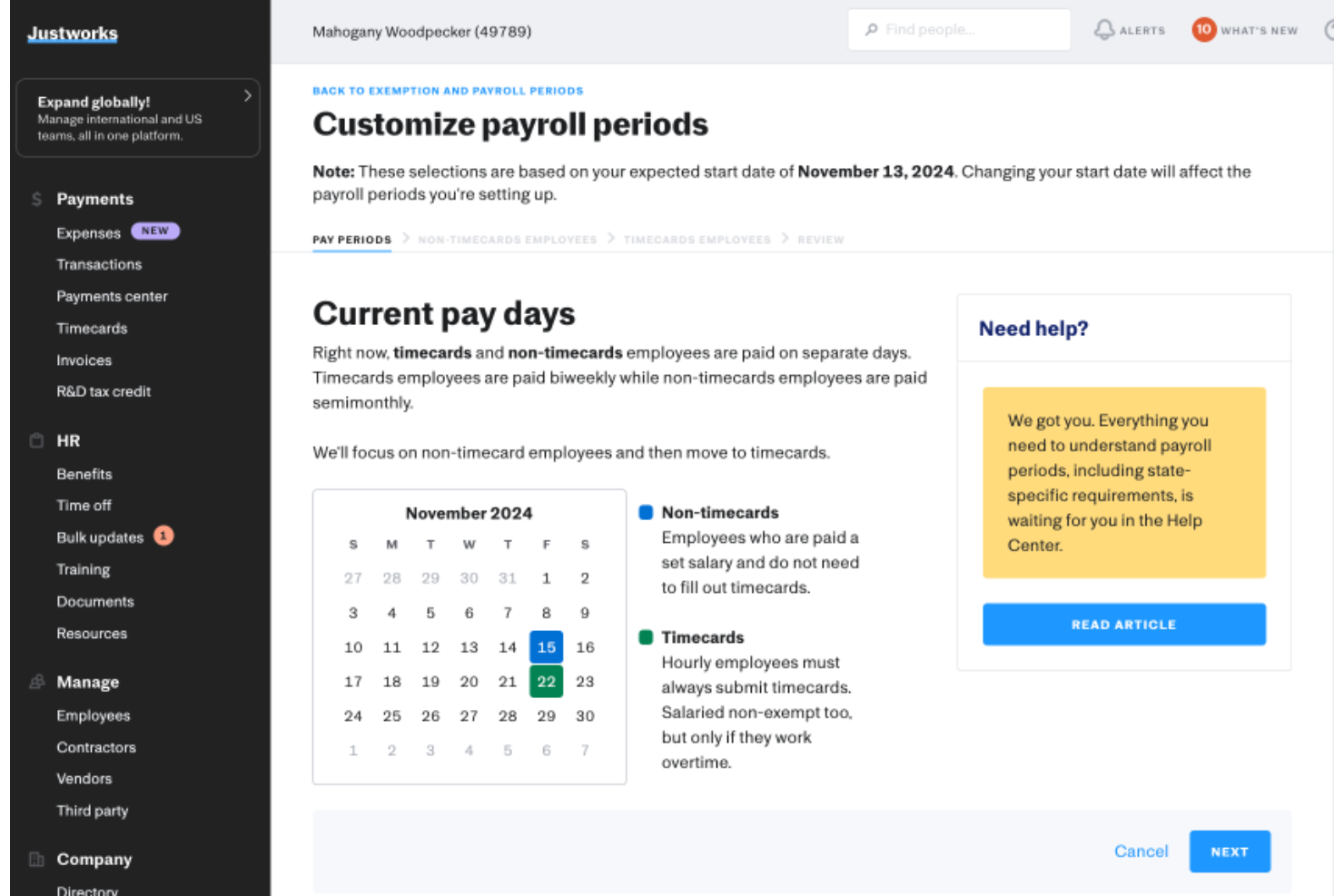
Justworks is designed to appeal to small and medium-sized businesses looking for efficient HR and payroll solutions, making it a strong option for bundled HR and payroll services. With its focus on simplifying complex administrative tasks, Justworks can help you manage payroll, benefits, and compliance in one platform. If you're seeking a solution to streamline HR functions while staying aligned with labor laws, Justworks offers a user-friendly system that can support your team.
Why I Picked Justworks
I picked Justworks because it offers bundled HR and payroll services that simplify day-to-day workforce management for growing businesses. It brings payroll, benefits administration, and compliance support into one platform, helping teams handle essential HR tasks without juggling multiple tools. For companies transitioning from Paycor, this setup can make it easier to manage employee pay, benefits enrollment, and labor law requirements in a more organized way.
Justworks Key Features
In addition to bundled HR and payroll services, Justworks offers:
- 24/7 Support: Provides round-the-clock assistance for any HR-related queries.
- International Payroll Capabilities: Supports businesses with global operations.
- Benefits Administration: Manages health, dental, vision, and retirement benefits in one place.
- Compliance Support: Helps handle filings, onboarding documents, and required workplace policies.
Justworks Integrations
Integrations include QuickBooks, Xero, BambooHR, JazzHR, Guideline, and Mineral. An API is also available for custom integrations.
Pros and Cons
Pros:
- Transparent pricing options for Payroll or PEO plans, add-ons available
- Health insurance enrollment and administration centralized for small HR teams
- Mobile app lets employees view paystubs, benefits, PTO, time tracking
Cons:
- Feature depth may feel light for larger, highly regulated companies
- Limited customization for workflows, approvals, and complex org structures
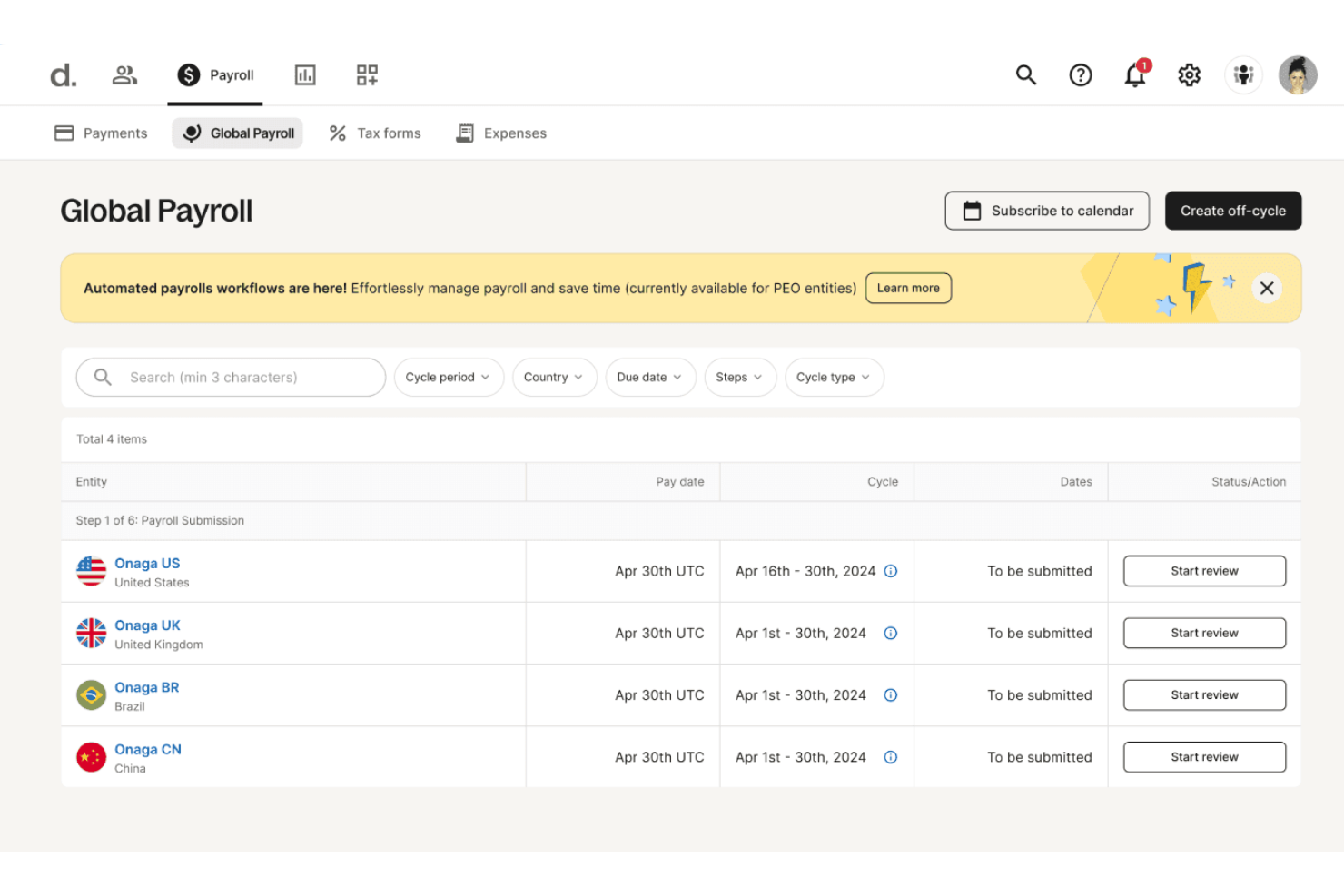
Deel is built for companies that need to hire and pay employees across borders without setting up local entities. It combines employer-of-record services, global payroll, and contractor management into one platform, making it a strong fit for distributed teams scaling internationally.
Why It's A Good Paycor Alternative
I picked Deel because it removes the biggest friction in global payroll: staying compliant in every country you hire in. You can employ full-time staff through Deel’s employer-of-record infrastructure, which handles local payroll, tax filings, benefits, and statutory requirements on your behalf.
For contractor-heavy teams, Deel supports compliant contract generation and localized payment workflows, reducing misclassification risk. I also like that payroll runs are centralized, so you can manage multiple countries from a single dashboard instead of juggling local providers. This makes Deel a practical alternative to Paycor for companies hiring beyond the U.S.
Deel Key Features
Here are some key features worth highlighting:
- Employer of Record (EOR) Services: Hire full-time employees internationally without setting up local legal entities.
- Global Payroll Management: Run payroll across multiple countries with built-in local tax and compliance handling.
- Contractor Compliance Tools: Generate country-specific contracts and manage compliant contractor payments.
- Multi-Currency Payments: Pay employees and contractors in local currencies with transparent payout tracking.
Deel Integrations
Integrations include QuickBooks, NetSuite, Xero, BambooHR, Workday, Greenhouse, Lever, Slack, Brex, and Expensify.
Pros and Cons
Pros:
- Scales well as teams expand into new regions
- Centralized payroll dashboard
- In-country legal entities
Cons:
- Reporting features may lack depth for complex needs
- Mobile app functionality could be improved

Native Teams helps companies hire and pay international employees and contractors in 95+ countries without setting up local legal entities. It combines employer-of-record services with global payroll, tax compliance, and multi-currency payment tools—making it a strong fit for startups and small-to-mid-size businesses expanding globally.
Why It's A Good Paycor Alternative
I picked Native Teams because it lets you employ talent worldwide without the complexity of establishing a legal entity in each country. Its EOR service becomes the official employer on your behalf, handling compliant employment contracts, payroll processing, and local tax obligations across borders—so you avoid legal missteps as you grow.
You can pay your international team in local currencies through one dashboard, ensuring accurate salary distribution and transparent tax reporting.
The platform also supports both full-time employees and freelancers, giving you flexibility as team composition changes.I like that onboarding and contract generation is faster than manual alternatives, helping your HR team spend less time on paperwork and more on people.
Native Teams Key Features
Here are some key features worth highlighting:
- Global EOR Support: Lets you hire legally in 85+ countries without setting up local entities.
- Multi-Currency Payroll: Pay employees and contractors in their local currency from one platform.
- Local Compliance Management: Handles country-specific employment laws, taxes, and social contributions.
- Contract Generation: Create locally compliant employment contracts quickly within the platform.
Native Teams Integrations
Integrations include Google Workspace (Docs, Gmail), Slack, Dropbox Business, Microsoft OneDrive, and Microsoft Outlook.
Pros and Cons
Pros:
- Handles multi-currency payments and local tax reporting
- Offers localized payroll calculators
- Provides compliant employment contracts and documentation
Cons:
- Less advanced HR tools beyond essential features
- Covers fewer countries than some competitors

Gusto offers a suite of payroll and HR solutions designed to simplify the lives of small to mid-sized business owners. If you're looking for a Paycor alternative, Gusto might appeal to you with its user-friendly platform that automates payroll, manages employee benefits, and provides compliance support. It aims to solve common challenges such as time-consuming payroll tasks and the complexities of employee benefits, making it an attractive choice for businesses seeking efficiency and ease of use.
Why I Picked Gusto
I picked Gusto as a strong alternative to Paycor because it excels in providing an intuitive payroll service that automates tax filings and compliance. This feature is crucial for businesses that want to minimize the risk of errors in payroll processing. Additionally, Gusto's employee benefits management enables you to offer health benefits and 401(k) plans, helping attract and retain talent. Gusto’s seamless integration with accounting and time-tracking software reduces administrative burdens, making it an appealing option for businesses aiming to improve operations.
Gusto Key Features
In addition to payroll automation, Gusto offers:
- Hiring and Onboarding: This feature includes tools for creating offer letters and managing onboarding checklists, helping you efficiently bring new hires into your organization.
- Insights and Reporting: With data-driven insights and automated reporting, you can make informed decisions and maintain compliance with ease.
- Performance Management: Gusto offers tools for conducting performance reviews and managing employee development, fostering a culture of growth and feedback.
Gusto Integrations
Integrations include QuickBooks, Xero, FreshBooks, Aplos, Bench, ApplicantPro, Ashby, AttendanceBot, Betterment at Work, and BambooHR.
Pros and Cons
Pros:
- Handles W-2s, 1099s, and year-end filings without manual work
- Employee self-service access for pay stubs, tax forms, and benefits
- Time tracking and PTO data sync directly into payroll
Cons:
- Some users report slow customer service response times
- Customization options are limited, affecting tailored business needs
New Product Updates from Gusto

Gusto Enhances Benefits Renewals with Personalized Insights
Gusto introduces a smarter benefits renewal process with personalized insights and benchmarking. This update helps businesses make more informed decisions when renewing coverage. For more information, visit Gusto’s official site.


BambooHR is built for small to mid-sized businesses that want one place to manage employee data without adding unnecessary complexity. It focuses on keeping core HR records, hiring, and people processes organized, making it a good fit for teams that value clarity over all-in-one enterprise systems.
Why It's A Good Paycor Alternative
I picked BambooHR because it gives you a clear, centralized system for managing employee data, which is exactly what many teams look for when considering a Paycor alternative. You can store and manage employee records, job history, benefits, and time-off data in one secure platform, reducing reliance on spreadsheets or disconnected tools.
I also like that BambooHR includes a built-in applicant tracking system, so you can manage job postings, candidates, and interviews without buying a separate hiring tool. For growing teams, its reporting tools help you answer common HR questions—like turnover or headcount changes—using customizable reports rather than manual exports.
BambooHR Key Features
Here are some key features worth highlighting:
- Employee Self-Service: Employees can update personal details, request time off, and access documents themselves.
- Time-Off Management: Track PTO balances and approvals with configurable policies and approval workflows.
- HR Reporting Library: Build custom reports using employee, compensation, and time-off data.
- Document Management: Store signed policies, offer letters, and contracts in employee profiles.
BambooHR Integrations
Integrations include Microsoft Outlook, Microsoft Teams, Google Workspace, Slack, Salesforce, HubSpot, Zendesk, Azure Active Directory, and PandaDoc.
Pros and Cons
Pros:
- Customizable reporting for better insights
- Add-on payroll for a complete HR solution
- Built-in ATS for better recruitment
Cons:
- Lacks built-in video interviewing and AI resume screening
- Limited free trial compared to other providers
New Product Updates from BambooHR®

BambooHR Adds Cost Capping for Age-Banded Medical Plans
BambooHR introduces cost capping for age-banded medical plans. This update ensures employees are not charged for more than three dependent children under 21. For more information, visit BambooHR’s official site.
 .
.

TimeTrex offers a solid alternative to Paycor for businesses that need workforce management tools: it blends time & attendance tracking, scheduling, payroll, and HR tasks into a single platform designed for small to mid-size companies—particularly those with staff across shifts or hourly workers.
Why I Picked TimeTrex
I picked TimeTrex because it ties time-tracking and payroll together in a way that works well for teams managing shifts and hourly wages. Its time & attendance and scheduling modules help you monitor who’s working and when, reducing manual timesheet errors. At the same time, the payroll features—including pay-stub generation and payroll processing—simplify paying employees on time using the tracked hours. This alignment between attendance and pay processing makes TimeTrex a strong fit for businesses that need both under one roof.
TimeTrex Key Features
Aside from its core time tracking and payroll capabilities, TimeTrex also offers:
- Job Costing and Expense Tracking: This feature allows you to monitor project costs and employee expenses, providing valuable insights into budget management.
- Centralized HR Management: Manage employee information, performance reviews, and compliance documentation from a single platform.
- Employee Scheduling: Create and manage employee schedules with ease, reducing the risk of labor overages and improving overall efficiency.
- Mobile Accessibility: Access TimeTrex's features on the go, ensuring that you can manage your workforce wherever you are.
TimeTrex Integrations
Integrations include custom API solutions that allow you to connect with various systems, enabling seamless data transfer and process automation.
Pros and Cons
Pros:
- Allows employee self-service for time off, schedules, timesheets
- Supports mobile and biometric clock-in, handy for distributed workforces
- Time and attendance plus payroll in one package
Cons:
- Limited number of native integrations compared with leading HR platforms.
- Free plan lacks customer support and mobile app access.

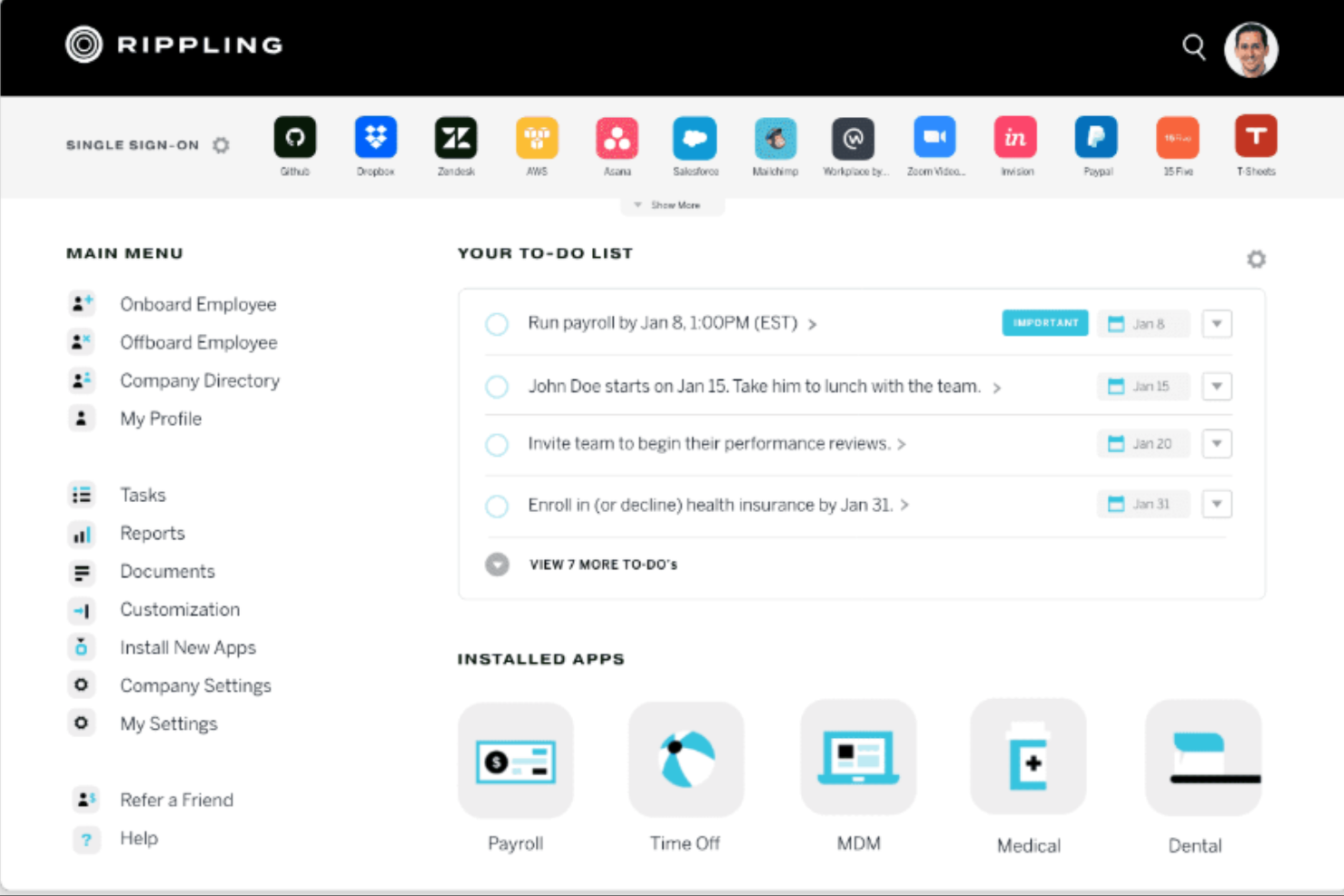
Rippling is a versatile platform that combines HR and IT management solutions, catering to businesses of all sizes. It handles payroll, benefits, device management, and app provisioning, offering comprehensive support for both HR and IT functions.
Why I picked Rippling: Rippling provides a unique integration of IT and HR services, making it ideal for teams needing both functionalities. It features automated app provisioning, device management, and a unified employee directory.
These capabilities help your team manage employee tech needs alongside traditional HR tasks. Rippling's ability to streamline both IT and HR processes sets it apart from other solutions.
Standout features & integrations:
Features include automated onboarding, offboarding workflows, and customizable reports. Automated onboarding ensures new hires have access to necessary tools from day one.
Offboarding workflows help maintain security and compliance when employees leave. Customizable reports provide insights into both HR and IT operations.
Integrations include QuickBooks, Slack, Microsoft 365, Google Workspace, Zoom, Salesforce, Dropbox, GitHub, Okta, and Asana.
Pros and Cons
Pros:
- Customizable workflows
- Supports both HR and IT needs
- Device management included
- Automated app provisioning
- Unified employee directory
Cons:
- Occasional feature updates needed
- Higher learning curve
- Limited customization in some areas
- Requires IT involvement
- Complex initial setup
New Product Updates from Rippling

Rippling Adds New Device Buyback Feature
Rippling has unveiled Device Buyback in its Inventory Management, allowing IT teams to retire and recycle hardware securely, with proceeds credited to future invoices. For more information, visit Rippling's official site.

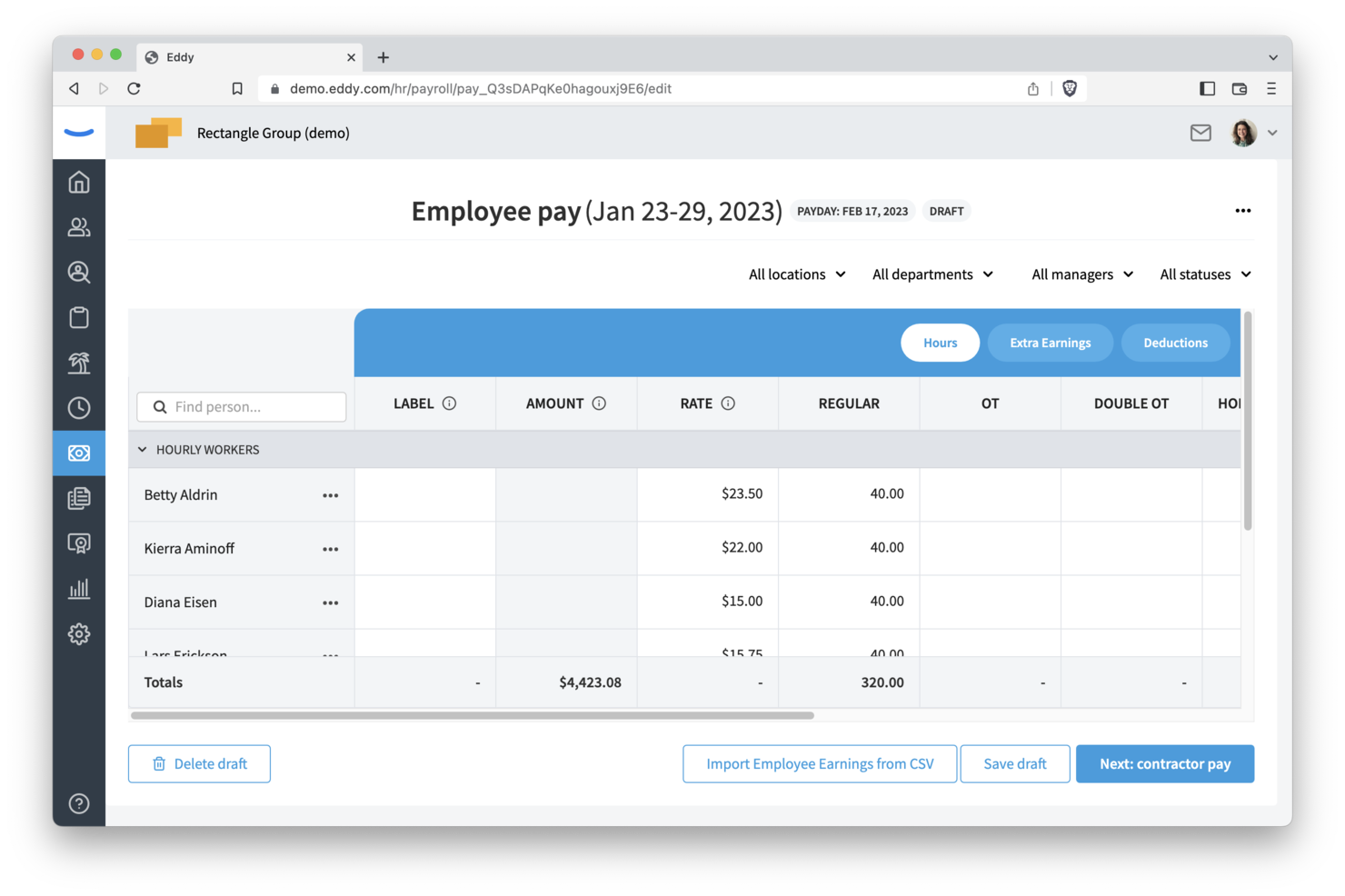
Eddy Payroll is a cloud-based payroll and HR platform best known for its simplicity and focus on small, local businesses. It centralizes payroll, hiring, onboarding, time tracking, and people management in one intuitive system—making it ideal for organizations that want to handle HR and payroll without complexity or outsourcing.
Why I picked Eddy Payroll:
Eddy Payroll stands out as the best payroll software for local and deskless teams because it’s designed to meet the needs of small businesses that value personal service, simple tools, and strong community roots. The platform makes it easy to run payroll, manage taxes, and pay employees quickly while staying compliant with federal and state regulations.
The system automates payroll calculations, tax filings, and direct deposits, ensuring accurate and timely payments every time. It also provides employee self-service access, allowing team members to view pay stubs, W-2s, and tax information at any time. For HR teams, Eddy’s connected platform allows seamless transitions between payroll, onboarding, and employee record management—all in one place.
Eddy Payroll Standout Features & Integrations:
Features include full-service payroll with automatic tax filings, digital pay stubs, direct deposit, year-end W-2 and 1099 generation, and compliance management across states. The payroll system integrates seamlessly with Eddy’s HR suite—covering applicant tracking, onboarding, time tracking, and performance reviews—to give small businesses an end-to-end people management experience.
Integrations include QuickBooks Online and other accounting software, as well as optional API connections for time tracking and scheduling systems. Eddy also connects to major tax filing and benefits administration providers to simplify HR compliance and reporting.
Pros and Cons
Pros:
- Excellent customer service and dedicated onboarding support
- Combines payroll, HR, and time tracking in one platform
- Tailored for small and local businesses with limited HR resources
Cons:
- No built-in global or contractor payment support
- Some reports may require manual exporting for deeper analysis
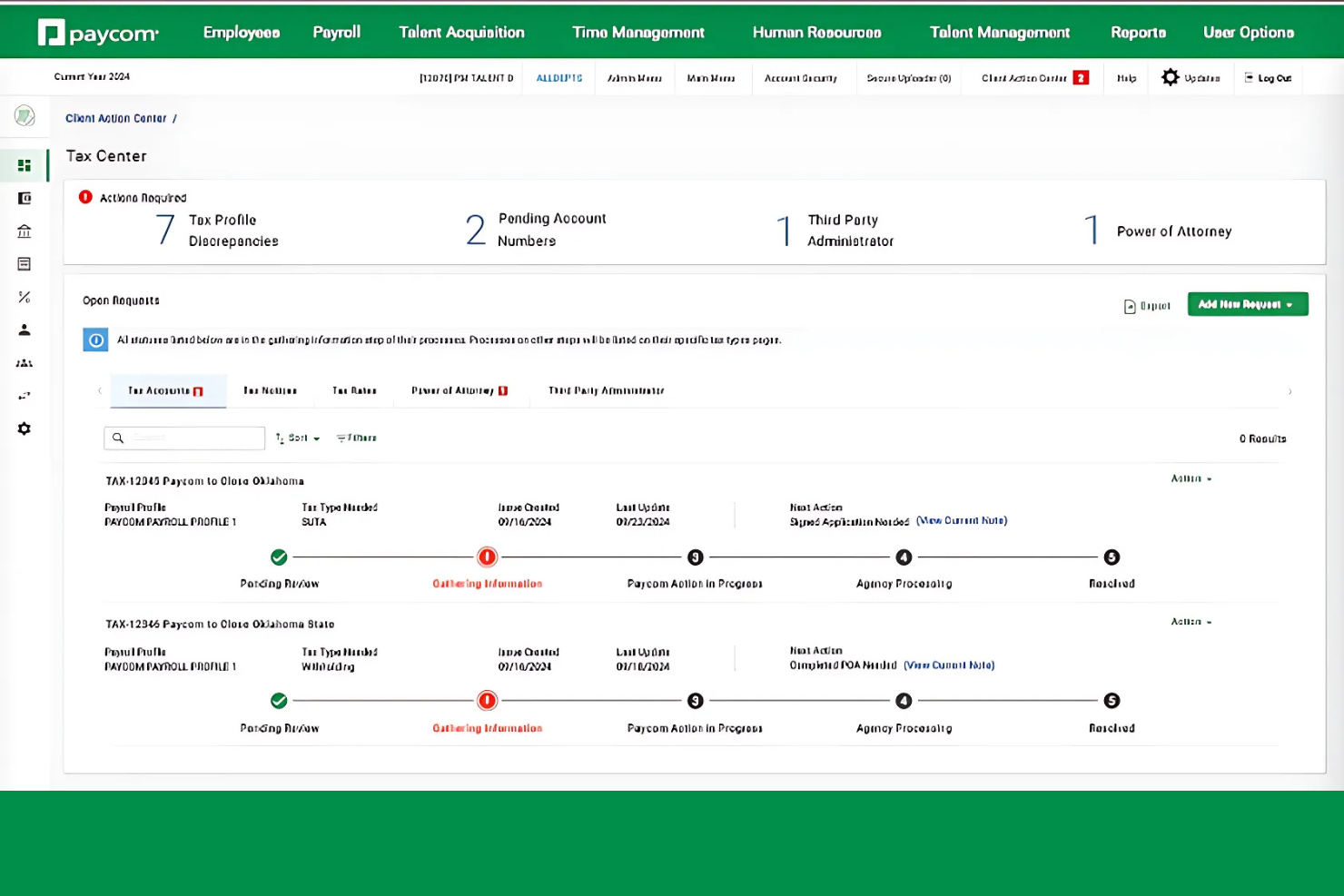
Paycom is a comprehensive HR and payroll solution designed for medium to large businesses. It offers key business functions such as payroll processing, compliance management, and employee self-service options.
Why I picked Paycom: Paycom excels in providing a unified platform for managing HR tasks, which is ideal for medium to large businesses.
Standout features & integrations:
Features include automated payroll processing, detailed compliance tracking, and an intuitive employee self-service portal.
These features align well with the needs of larger teams that require efficient management of complex HR processes. Paycom's ability to handle scalability and integration needs sets it apart from other competitors.
Integrations include ADP, QuickBooks, Xero, TSheets, Microsoft Teams, and Slack.
Pros and Cons
Pros:
- Employee self-service portal
- Scalable for larger teams
- Strong compliance management
Cons:
- Complex for smaller teams
- Limited customization options
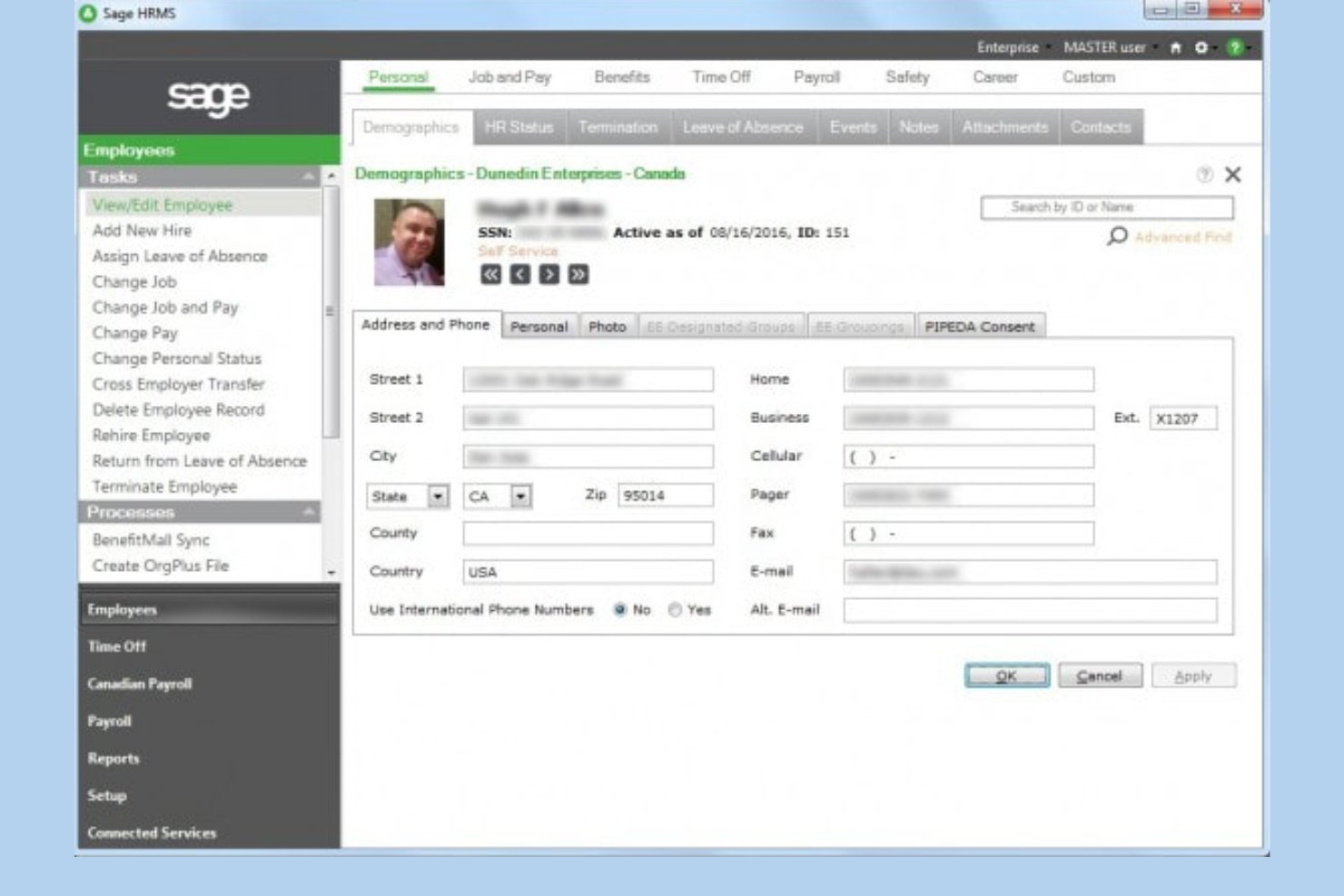
Sage HR is a cloud-based human resources management software designed for small and medium-sized businesses, focusing on performance management. It helps manage employee performance, recruitment, and time tracking effectively.
Why I picked Sage HR: Sage HR offers performance management tools that are ideal for businesses seeking to improve employee performance. It includes features such as goal setting, feedback collection, and performance reviews.
These tools help your team track and enhance employee performance systematically. Sage HR's focus on structured performance management makes it a strong choice for organizations aiming to develop their workforce.
Standout features & integrations:
Features include shift scheduling, expense management, and customizable dashboards. Shift scheduling allows you to manage employee work hours efficiently.
Expense management helps track and reimburse employee expenses. Customizable dashboards provide insights into HR metrics and performance.
Integrations include Xero, Slack, G Suite, Office 365, QuickBooks, Zapier, LinkedIn, BambooHR, ADP, and Indeed.
Pros and Cons
Pros:
- Customizable dashboards
- Structured performance reviews
- Comprehensive feedback tools
Cons:
- Can be complex for new users
- Limited advanced reporting
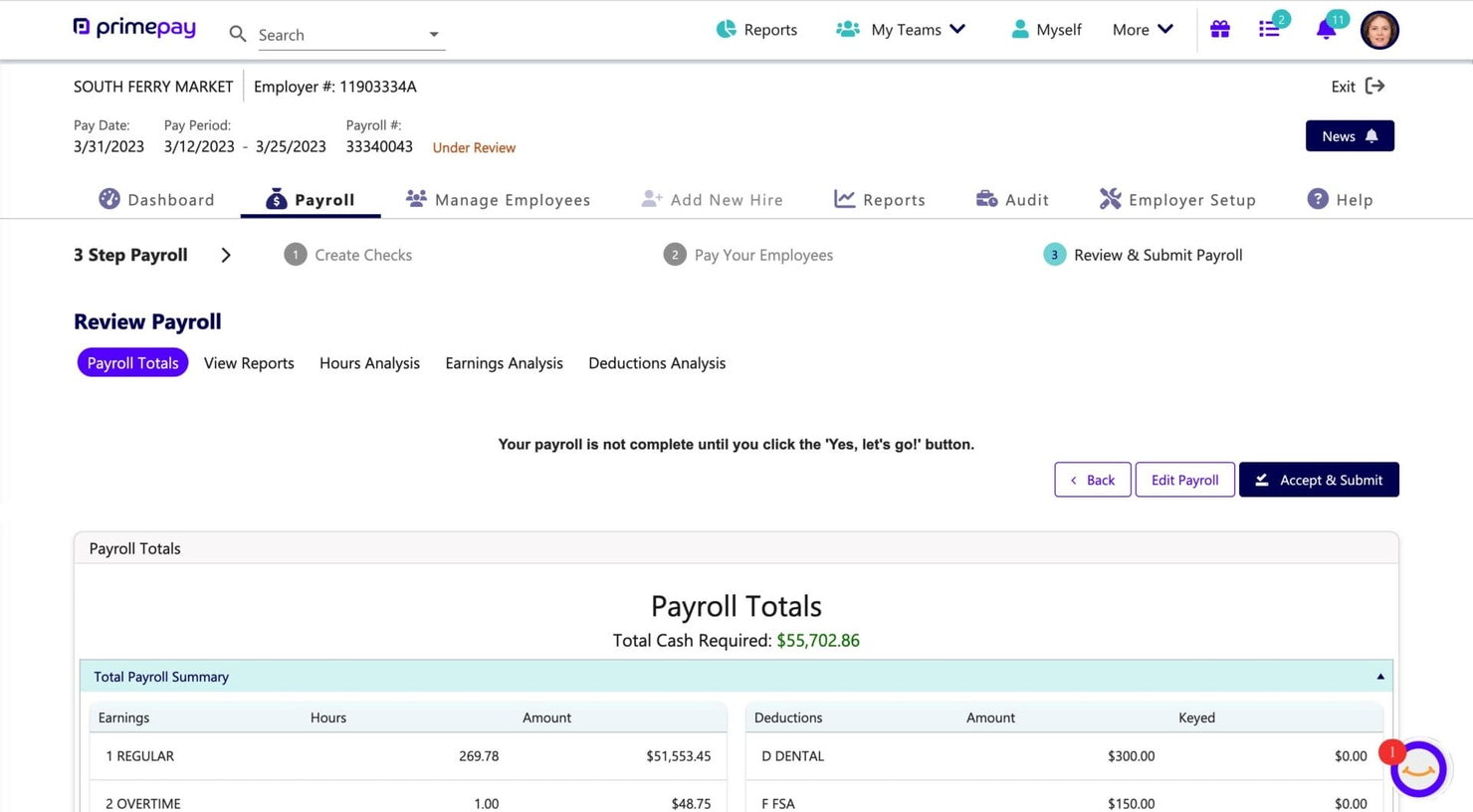
PrimePay is a cloud-based payroll and HR platform best known for its strong integration of payroll, benefits administration, and workforce management. It centralizes payroll processing, tax filing, benefits administration, time & attendance, and employee self-service into one unified system—ideal for businesses seeking a seamless connection between payroll and benefits functions.
Why I picked PrimePay:
PrimePay stands out as the best online payroll software for payroll and benefits integration because its system allows employers to manage payroll and employee benefits from the same platform, reducing duplication and improving accuracy. Its modular design lets companies start with payroll and add benefits, HR, and time & attendance when they’re ready, offering flexibility and scalability.
The platform automates payroll runs, tax calculations, filings, and integrates benefits enrollment and deductions directly into the payroll process—ensuring employees receive accurate pay and benefits without manual reconciliation. Its user-friendly dashboard and modern architecture keep HR and finance teams aligned and efficient.
PrimePay Standout Features & Integrations:
Features include unlimited payroll cycles regardless of pay frequency, direct deposit and debit card options, payroll compliance error alerts, built-in benefits administration with EDI feeds to carriers, and employee self-service mobile access for viewing pay stubs and managing benefits. The platform also offers detailed reporting and analytics on wages, taxes, benefits costs, and workforce metrics.
Integrations include open API access, middleware support, and pre-built connectors with accounting platforms and time-tracking systems. The platform’s architecture allows seamless data flow between payroll, HR, benefits, and finance systems—eliminating data silos and improving visibility.
Pros and Cons
Pros:
- Scalable modular architecture lets you expand functionality over time
- Unlimited payroll cycles with no base fee on certain plans
- Seamless integration of payroll with benefits and HR modules
Cons:
- Reporting may require customization for complex enterprise needs
- Because of its broad feature set, implementation may take time

Zoho People Plus is an all-in-one HR management platform ideal for businesses of various sizes, focusing on a comprehensive HR suite. It manages HR functions like recruitment, onboarding, performance management, and employee engagement.
Why I picked Zoho People Plus: Zoho People Plus offers an extensive suite of HR tools that cater to a wide range of HR needs. It includes features for recruitment management, time tracking, and employee self-service portals.
These functionalities help your team manage HR processes efficiently in a single platform. The breadth of tools available makes it suitable for organizations looking for an integrated HR solution.
Standout features & integrations:
Features include performance appraisals, employee self-service, and time-off management. Performance appraisals allow structured feedback and performance tracking.
Employee self-service portals empower your team to manage their own HR information. Time-off management simplifies the process of requesting and tracking leave.
Integrations include Zoho CRM, Zoho Projects, G Suite, Office 365, Slack, QuickBooks, Xero, Zapier, LinkedIn, and Microsoft Teams.
Pros and Cons
Pros:
- Simplified onboarding processes
- Employee self-service portals
- Efficient time tracking
Cons:
- Technical support response times vary
- Limited customization in reporting

Workday is a cloud-based human capital management software tailored for large enterprises, offering a wide range of HR, finance, and planning solutions. It supports key functions like talent management, payroll, and workforce planning.
Why I picked Workday: Workday offers comprehensive solutions that cater to the complex needs of large enterprises. It features advanced analytics, global compliance management, and talent acquisition tools. These capabilities help your team manage a large workforce efficiently. Workday's ability to integrate HR and financial data makes it a valuable tool for strategic decision-making.
Standout features & integrations:
Features include workforce planning, advanced analytics, and global compliance management. Workforce planning helps you align human resources with business goals. Advanced analytics provide insights into workforce metrics and trends. Global compliance management ensures adherence to international labor laws.
Integrations include Salesforce, Slack, Microsoft Teams, LinkedIn, Okta, ServiceNow, Google Workspace, SAP, Oracle, and DocuSign.
Pros and Cons
Pros:
- Integrates HR and financial data
- Global compliance management
- Advanced workforce analytics
Cons:
- Limited customization options
- Steep learning curve
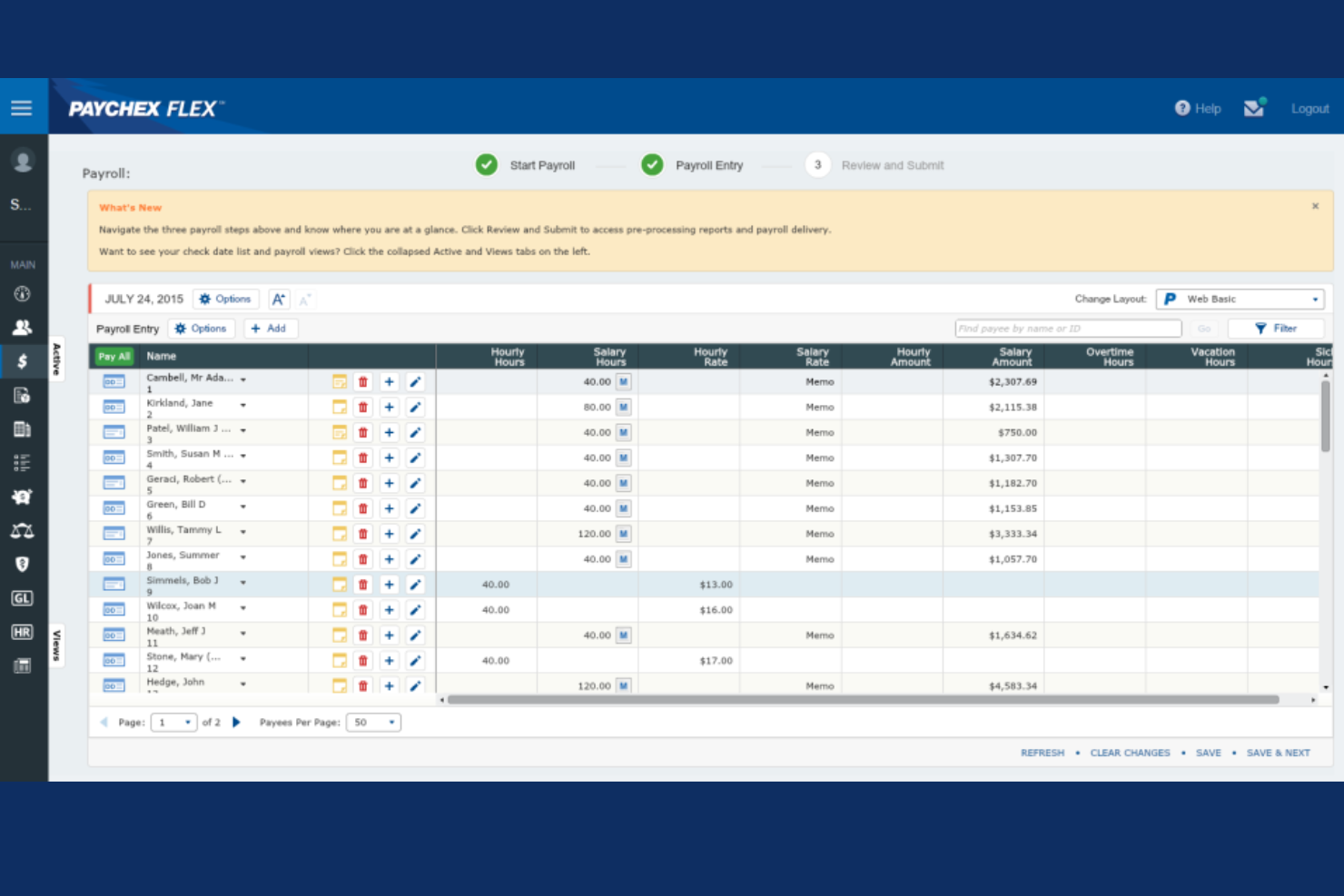
Paychex is a comprehensive payroll and HR solution designed for businesses of all sizes, focusing on scalable solutions. It offers essential functions like payroll processing, benefits administration, and compliance management.
Why I picked Paychex: Paychex provides scalable solutions suitable for businesses at various growth stages. It includes features such as payroll tax administration, retirement services, and HR analytics.
These tools help your team manage payroll and HR needs efficiently as your business grows. Paychex's ability to scale with your business ensures that it remains a valuable resource as your needs evolve.
Standout features & integrations:
Features include mobile payroll, employee screening, and financial wellness programs. Mobile payroll allows your team to process payroll from anywhere. Employee screening ensures that you hire the right candidates. Financial wellness programs support your employees' financial health.
Integrations include QuickBooks, Xero, BambooHR, Sage Intacct, TSheets, Deputy, Indeed, ZipRecruiter, Microsoft Teams, and Slack.
Pros and Cons
Pros:
- Supports financial wellness programs
- Offers retirement services
- Effective tax administration
Cons:
- Lengthy implementation process
- Complex for smaller teams
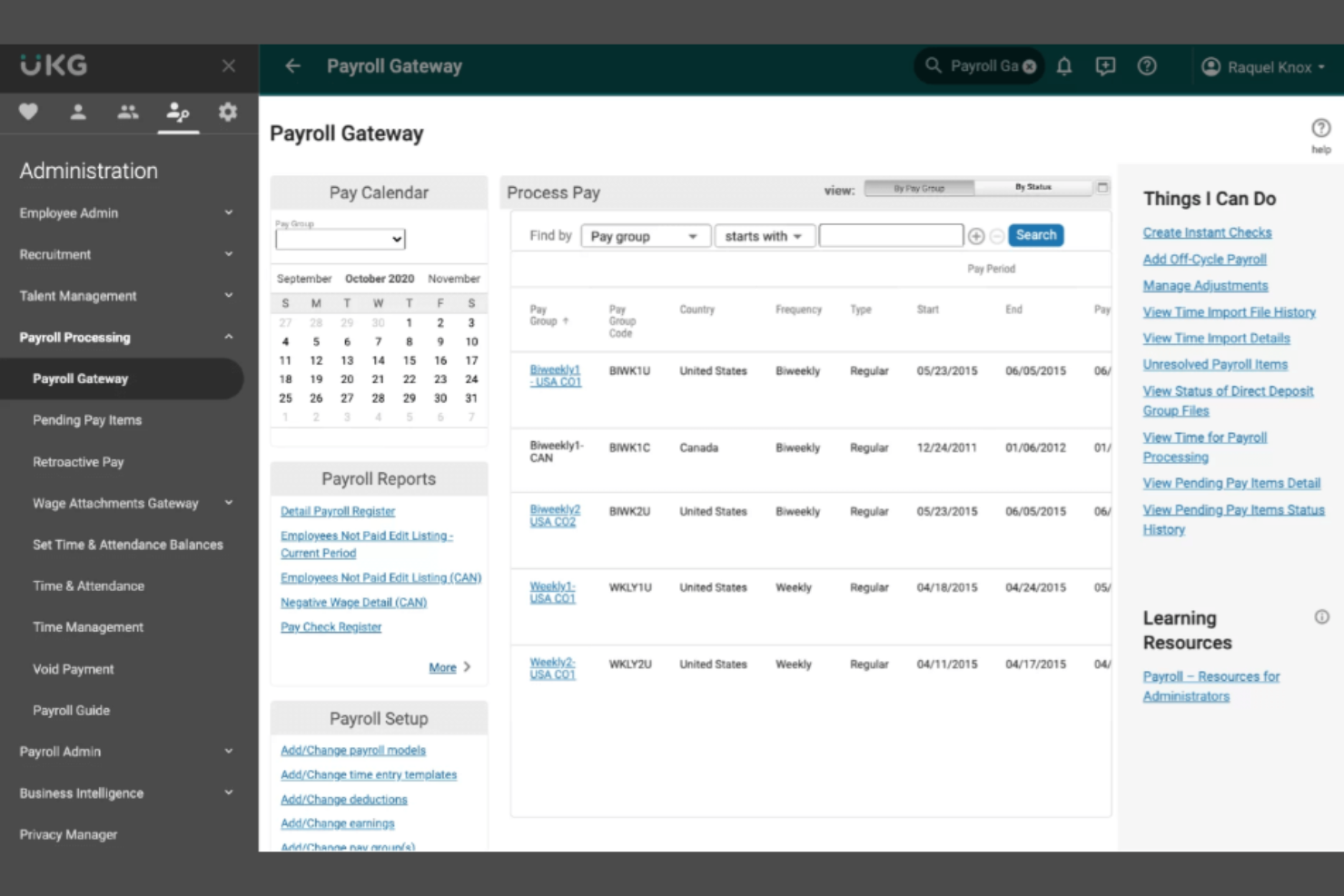
UKG Pro is a cloud-based human capital management solution designed for medium to large enterprises, focusing on talent management. It offers tools for HR, payroll, talent acquisition, and employee engagement.
Why I picked UKG Pro: UKG Pro provides comprehensive talent management features that are ideal for organizations looking to develop and retain their workforce. It includes tools for performance reviews, succession planning, and learning management.
These features help your team identify and nurture talent within the organization. UKG Pro's focus on enhancing employee development makes it a valuable tool for talent-driven companies.
Standout features & integrations:
Features include employee engagement surveys, workforce analytics, and mobile access. Employee engagement surveys help you gauge team satisfaction and areas for improvement.
Workforce analytics provide insights into HR metrics and trends. Mobile access ensures your team can manage HR tasks on the go.
Integrations include Salesforce, Oracle, ADP, Workday, Microsoft Dynamics, QuickBooks, Slack, SAP SuccessFactors, LinkedIn, and Zoom.
Pros and Cons
Pros:
- Detailed performance reviews
- Succession planning features
- Comprehensive talent management tools
Cons:
- Limited customization options
- Requires dedicated training
Other Paycor Alternatives
Here are some additional Paycor competitors options that didn’t make it onto my shortlist, but are still worth checking out:
- TriNet
For industry-specific solutions
- Ceridian Dayforce HCM
For global workforce management
- Papaya Global
For international payroll services
- Paylocity
For customizable payroll solutions
- Arcoro
For construction industry HR
- Keka HR
For employee experience management
- Oracle Cloud HCM
For global HR solutions
- OnPay
For small business payroll
- SAP SuccessFactors
For enterprise HR management
- Namely
For mid-sized company HR needs
- PeopleGuru
For cloud-based HR solutions


Paycor Alternatives Selection Criteria
When selecting the best Paycor alternatives to include in this list, I considered common buyer needs and pain points like payroll accuracy and compliance management.
I also used the following framework to keep my evaluation structured and fair:
Core Functionality (25% of total weighting score)
To be considered for inclusion in this list, each solution had to fulfill these common use cases:
- Payroll processing
- Employee self-service
- Benefits administration
- Time and attendance tracking
- Compliance management
Additional Standout Features (25% of total weighting score)
To help further narrow down the competition, I also looked for unique features, such as:
- Customizable reporting
- Mobile app access
- Advanced analytics
- Integration capabilities
- Automated tax filing
Usability (10% of total weighting score)
To get a sense of the usability of each system, I considered the following:
- Intuitive interface design
- Easy navigation
- Minimal learning curve
- Consistent user experience
- Responsive design
Onboarding (10% of total weighting score)
To evaluate the onboarding experience for each platform, I considered the following:
- Availability of training videos
- Interactive product tours
- Access to templates
- Supportive chatbots
- Webinars for guidance
Customer Support (10% of total weighting score)
To assess each software provider’s customer support services, I considered the following:
- 24/7 availability
- Multiple support channels
- Responsiveness to inquiries
- Knowledgeable support staff
- Availability of a help center
Value For Money (10% of total weighting score)
To evaluate the value for money of each platform, I considered the following:
- Competitive pricing
- Transparency in pricing
- Features offered in each plan
- Discounts for annual billing
- Return on investment
Customer Reviews (10% of total weighting score)
To get a sense of overall customer satisfaction, I considered the following when reading customer reviews:
- Overall satisfaction ratings
- Feedback on reliability
- Comments on ease of use
- Reports on customer service
- Consistency in performance
Why Choose A Paycor Alternative
While Paycor generally gets positive reviews, no system is a perfect fit for everyone. Here are some reasons you might want to consider a Paycor alternative:
1. User experience feels outdated
The interface isn’t as modern or intuitive as other platforms, some users find it clunky or slow to navigate, especially on mobile.
2. Customization can be limited
Paycor works well for standard HR processes, but if you need tailored workflows or unique approval chains, it can be inflexible without extra configuration.
3. Primarily U.S.-focused
It’s designed for U.S.-based teams, so global payroll, international compliance, or EOR support is lacking. Not ideal if you're building a distributed workforce.
4. Support and implementation get mixed reviews
Some users report a lack of responsiveness or guidance during onboarding. If you're a small team without in-house HR IT support, this could be a pain point.
5. Reporting isn't very flexible
Reporting tools are decent but not as dynamic or customizable as you'd get with some other. You might struggle to get the exact data views you need.
How to Choose A Paycor Alternative
It’s easy to get bogged down in long feature lists and complex pricing structures. To help you stay focused as you work through your unique software selection process, here’s a checklist of factors to keep in mind:
| Factor | What to Consider |
| Scalability | Ensure the solution can grow with your business. If you're expanding, the tool should accommodate more users and features without a hitch. |
| Integrations | Check if it integrates with your current systems like accounting software or CRM tools. This will save time and reduce errors. |
| Customizability | Look for options to tailor the software to your processes. Custom workflows and reports can enhance productivity. |
| Ease of Use | Choose a tool that's intuitive for your team. A complicated interface can lead to frustration and lower productivity. |
| Budget | Consider the total cost, including setup fees and monthly charges. Ensure the features you need fit within your budget. |
| Security Safeguards | Verify data protection measures like encryption and compliance with standards such as GDPR or HIPAA to keep your information secure. |
| Support and Training | Evaluate the availability of customer support and training resources. Quick responses and comprehensive training can help your team adapt quickly. |
| Performance and Reliability | Check for consistent uptime and fast processing speeds. A reliable solution ensures smooth operations without disruptions. |
Trends in Paycor Alternatives
In my research, I sourced countless product updates, press releases, and release logs from different Paycor alternative vendors. Here are some of the emerging trends I’m keeping an eye on:
- AI-Driven Insights: More vendors are using AI to provide insights into workforce trends and employee behavior. This helps managers make data-driven decisions quickly. For instance, some tools offer predictive analytics to foresee hiring needs.
- Employee Wellbeing Tools: There's a growing focus on tools that support mental health and work-life balance. Vendors are adding features like stress management resources and wellness tracking to help maintain a healthy workforce.
- Remote Work Support: As remote work becomes the norm, solutions are focusing on features that support distributed teams. This includes virtual collaboration tools and remote employee monitoring to ensure productivity.
- Enhanced Data Privacy: With increasing data protection laws, vendors are strengthening their privacy features. This includes better encryption methods and compliance with regulations like GDPR to safeguard employee data.
- Diversity and Inclusion Metrics: Tools are now offering features to track diversity and inclusion within organizations. These metrics help companies ensure they're meeting their diversity goals and fostering an inclusive workplace environment.
Paycor Competitors Key Features
When selecting Paycor competitors, keep an eye out for the following key features:
- Payroll processing: Competitors should offer reliable payroll tools that handle wage calculations, deductions, tax withholdings, and direct deposits automatically. This reduces administrative workload, minimizes payroll errors, and ensures employees are paid accurately and on time.
- Time and attendance tracking: Look for tools that monitor employee hours, manage schedules, approve shift changes, and track PTO. Accurate time data prevents buddy punching, reduces manual entry, and integrates smoothly with payroll.
- Benefits administration: Strong Paycor alternatives include systems for managing health insurance, retirement plans, FSA/HSA accounts, and other perks. These tools simplify enrollment, track eligibility, and give employees the clarity they need when selecting benefits.
- HR management: Competitors should help you maintain secure employee records, manage documents, track performance, and ensure compliance with employment regulations. Centralized HR data reduces administrative headaches and keeps your workforce organized.
- Onboarding tools: Look for platforms that automate the entire onboarding workflow—collecting new hire forms, distributing policies, setting up accounts, and guiding employees through required steps. This not only saves time but also creates a polished first impression for new team members.
- Reporting and analytics: High-quality Paycor alternatives offer customizable reporting for payroll, attendance, benefits, performance, and more. These insights support strategic decision-making, budgeting, and identifying workforce trends.
- Employee self-service portal: Competitors should empower employees to update personal information, view pay stubs, access tax forms, request time off, and manage benefits. This reduces HR inquiries and gives employees greater independence.
- Compliance management: Top providers monitor changes in labor laws, tax regulations, and benefits requirements, helping you stay compliant and avoid penalties. Automated compliance tools ensure policies and processes remain up to date across your organization.
Common Paycor Competitor AI Features
Many Paycor alternatives are incorporating AI to improve automation, accuracy, and strategic HR insights, for example:
- AI-driven payroll validation: AI reviews payroll runs for anomalies such as miscalculations, duplicate entries, or incorrect deductions—catching issues before payroll is processed.
- Intelligent scheduling and attendance insights: AI detects attendance patterns, predicts staffing gaps, and recommends optimal schedules to reduce overtime, absenteeism, and labor costs.
- Smart compliance monitoring: AI tracks federal, state, and local law changes—including tax updates, overtime rules, and benefits regulations—alerting HR teams when adjustments are required.
- Predictive performance analytics: AI analyzes performance reviews, employee engagement trends, and attendance patterns to identify high performers, at-risk employees, and workforce development opportunities.
- Automated onboarding workflows: AI personalizes onboarding steps for different roles, assigns training modules, reminds employees of incomplete tasks, and ensures all paperwork is submitted on time.
- Intelligent benefits guidance: AI helps employees compare benefit options, estimate out-of-pocket costs, and choose the plans that best fit their needs—reducing confusion during open enrollment.
- AI-powered employee support chatbots: Chatbots answer payroll, HR, benefits, and PTO questions instantly, reducing the volume of routine inquiries sent to HR.
- Advanced reporting and insights: AI surfaces trends in turnover, labor costs, performance, productivity, and hiring—providing leaders with actionable recommendations.
Costs and Pricing of Paycor Alternatives
Selecting Paycor competitors requires an understanding of the various pricing models and plans available.
Costs vary based on features, team size, add-ons, and more. The table below summarizes common plans, their average prices, and typical features included in Paycor alternative solutions:
Plan Comparison Table for Paycor Alternatives
| Plan Type | Average Price | Common Features |
| Free Plan | $0 | Basic payroll processing, employee self-service, and limited reporting. |
| Personal Plan | $5-$25/user/month | Payroll processing, compliance management, and basic benefits administration. |
| Business Plan | $30-$60/user/month | Advanced reporting, time and attendance tracking, and enhanced analytics. |
| Enterprise Plan | $65-$120/ user/month | Customizable features, dedicated support, and comprehensive compliance tools. |
Paycor Alternatives FAQs
Here are some answers to common questions about Paycor competitors:
What are the disadvantages of Paycor competitors?
Disadvantages vary by vendor but can include limited customization options and complex setup processes. Some users report that certain tools have a steep learning curve, making initial adoption challenging. Additionally, not all vendors offer comprehensive customer support, which can be an issue for teams needing quick assistance.
How do Paycor competitors handle compliance?
Most Paycor competitors offer compliance management features to help your team adhere to labor laws and regulations. These tools often include automated updates to stay current with legal changes. They provide resources to ensure your business remains compliant, reducing the risk of fines and penalties.
Are Paycor competitors suitable for small businesses?
Yes, many Paycor competitors cater to small businesses with scalable solutions and affordable pricing plans. They offer essential features like payroll processing and employee self-service, making them a practical choice for small teams. Some vendors also provide personalized support to help smaller businesses get started.
Can Paycor competitors integrate with existing systems?
Many Paycor competitors offer integrations with popular systems like accounting software and CRM tools. This capability helps streamline your business processes by ensuring data flows smoothly between platforms. Check each vendor’s integration options to ensure compatibility with your existing systems.
What support options do Paycor competitors offer?
Support options vary by vendor but may include phone, email, and live chat support. Some vendors provide 24/7 assistance, while others offer dedicated account managers for personalized help. Look for vendors that offer comprehensive support resources, such as knowledge bases and community forums.
How do Paycor competitors ensure data security?
Paycor competitors prioritize data security by implementing measures like encryption and regular security audits. Many comply with industry standards like GDPR and HIPAA to protect sensitive information. It’s crucial to choose a vendor with strong security practices to safeguard your data.
What's Next?
To remain up to date on all the latest in people management, subscribe to our newsletter for leaders and managers. You'll receive insights and offerings tailored to leaders and HR professionals straight to your inbox.