AI Sounds Convincing. That’s Exactly the Problem.

AI Perception: People have strong opinions on AI, yet many lack true understanding of its future impact.
Feedback Quality: Both AI and human feedback often lack reliability, challenging the notion of instinct over AI.
Decision Process: Effective decision-making relies on diverse input rather than confident, unchallenged answers.
AI's Limitations: Increasing reliance on AI can diminish critical thinking and lead to oversight in decision-making.
Structured Judgment: Decision-making benefits from structured approaches, requiring more than informal feedback gatherings.
Confidence isn’t the same as being right. Sounding like you know what you’re talking about isn’t the same as knowing what you’re talking about.

Everyone has a position on AI right now. All in on it, against it, or waiting to see how it shakes out. We hold those positions with a lot of confidence and underneath, almost no one really understands it yet, or where it's all headed. So LinkedIn fills up with people who've made up their minds.
I got into it with one of them last week. They'd posted a plea: stop using AI to get feedback on your work. And their case was a good one, the kind most people nod along to. AI never keeps its mouth shut. Ask it anything and it has something to say, right or wrong. If you need AI to tell you whether your work is any good, they argued, that's the real problem. Trust your gut.
I pushed back. Not because they were wrong, but because they were only half right about the fix. Most feedback isn't good, AI or human. Your own gut fails the same way. And a confident, well-structured answer, the kind AI is so good at producing and people give all the time, is the easiest thing to believe and the hardest to question.
Confidence isn't the same as being right. Sounding like you know what you're talking about isn't the same as knowing what you're talking about. I learned what that costs the hard way.
The Cost of Confidence
Years ago I was the UX manager for the team behind Shopify Capital, the product that offers merchants cash advances based on their store's sales. When a merchant accepted an offer, the money took up to seven days to clear internal approvals. For a small business waiting to restock or get something off the ground, that's a long week.
The system behind those approvals was an early MVP nobody had touched in years. So I pulled the right people into a room to crack it: finance, the people running approvals, the developers and designers who built the original system.
The bottleneck turned out to be a handful of manual approval steps. We walked through exactly how the approvers made each call, and whether a system could make those calls instead. We had a solution in an hour. We could have shipped it the next day.
One approval stood in the way. Sign-off belonged to a product leader, a long way from rooms like ours. The answer came back clear, specific, and certain, it had to stay manual. That decision had been made years earlier. Nobody could tell us why. There was nothing traceable behind it. We couldn't ship it.
So we did what most teams do. We deferred to the confident answer. Then we spent three weeks proving it wrong. Twenty meetings, interviews with everyone who actually touched the system, a map of what was really going on under the hood.
In the end we shipped the exact solution we'd had in the first hour. The stakeholder's feedback had been authoritative, well-structured, and completely wrong. It found a problem that didn't exist.
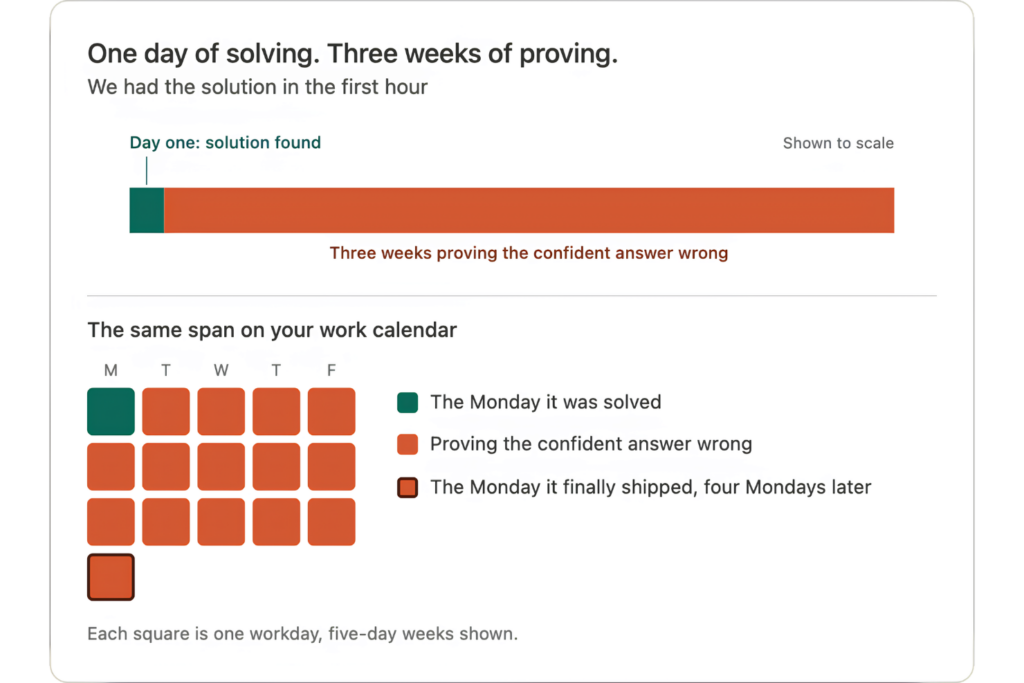
That is the failure this article is about. Not AI. Not humans. Confident input that nobody pressure-tested before acting on it.
The Second Opinion You Stopped Asking For
When a decision matters and something feels off, you don't trust the first confident answer. You ask the person who'd actually know. You pull two or three people into a room and watch where they disagree. You sleep on it. You run it past someone whose judgment you trust before you commit. Nobody taught you this and nobody calls it anything. It's just what careful people do.
That instinct is real judgment. And good judgment needs perspective from more than one set of eyes on the problem and having every trade-off in the open, before anything ships. It's what small teams are built for, close enough to think out loud together and small enough to actually do it.
But perspective isn't automatic. It needs time, proximity, space to breathe. AI works against all three.
And it needs the thing we overlook most: structure. Structure feels slow, and against the speed and allure of AI, slow is the one thing nobody wants to be.
AI produces confident answers faster than you can pressure-test them, and the urge is to take the answer and keep moving.
And we give in to it on purpose, because the promise is seductive. Everyone knows that feeling, being pulled toward something that isn't quite in your best interest and going ahead anyway.
We tolerate what AI gets wrong today for what it might become tomorrow, and we trust the people building it to close the gaps. None of that is foolish. It's human. It's also the exact thing that makes us stop pressure-testing.
Microsoft and Carnegie Mellon studied what happens next. They found that the more confidence people place in AI, the less critical thinking they do, and that the work itself shifts from doing the task to overseeing the AI that does it. Oversight only protects you if you're still actually checking. Most people stop.
So the informal habit that protected you doesn't fail loudly. It just stops scaling. Right when the volume of decisions climbs, the discipline that made those decisions good gets thinner.
Asking for Feedback Isn't a Discipline
Settling one contradiction, rooting out one assumption, understanding why something is supposed to work a certain way, that’s what stops costing minutes and starts costing weeks…A discipline fixes all of it. I don’t mean willpower. I mean a repeatable way to run a decision.
So the fix isn't to trust AI less and your gut more. The fix is structure. But asking around for feedback isn't the same as having a discipline for it, and that difference is the fix.
Asking around is what most teams already do. Something feels off, so you grab whoever's nearby. You float it in a meeting. You hope the person who actually knows happens to be there, and happens to say so. Sometimes they are. Most of the time it's luck, and you can't tell the lucky days from the rest until it's too late.
Asking around is expensive. You line up meetings, calendars are full, and by the time the group can sit down the moment has passed or the call got made without them. So meetings start to feel like a tax, and you pay it less often.
The perspectives scatter instead, to a deck here, an email there, a Slack thread nobody reads in time. Everyone loves async for the time it feels like it gives back, but it means the perspectives never actually meet.
Async holds up right until two perspectives contradict each other. That's exactly when you need real-time give and take, one person saying that's not how it works, another pushing back until you land on what's true. Async can't do that.
The contradiction that would take five minutes in a room ping-pongs across days of replies. Settling one contradiction, rooting out one assumption, understanding why something is supposed to work a certain way, that's what stops costing minutes and starts costing weeks.
A discipline fixes all of it. I don't mean willpower. I mean a repeatable way to run a decision. It decides, on purpose, which perspectives it has to pass through before it ships. Not whoever happens to be around, but the few that actually matter for this call. You run the decision past each of them deliberately, once, and pay attention to what each one tends to miss. That's structure. Weaving the right perspectives in on purpose instead of chasing them down one meeting at a time.
Why does that matter more than it sounds? Because knowing how something works isn't the same as understanding why it works the way it does, and that gap is where the worst mistakes live.
Richard Rumelt, author of "Good Strategy Bad Strategy", calls the first real move diagnosis: working out what's actually going on before you decide. A good one names the real problem, not the symptom. "We're underperforming" isn't a diagnosis, it's a result. The diagnosis is the why underneath it, and it tells you which few things are critical and which to ignore.
This is where a room filled with different perspectives earns its keep. The problem looks different depending on who's holding it.
The budget owner, the person who builds it, the customer, each carries a different version and needs something different from whatever you decide. So solving the right problem isn't one thing. It's finding the one solution that answers enough of those different needs at once, the move that raises the bar for all of them, not just one.
You don't find that alone, or from a distance. You find it when the perspectives are together and their disagreement shows you the real shape of the problem.
You can see how badly we want those other perspectives in the way we talk to AI. "Act like a copywriter." "Act like a marketing expert." Each prompt is an admission that one person only carries so many angles, and we know it. We're asking it to stand in for the ones we're missing.
This is the exact gap AI lives in. A model only ever has what fits in its context window, the limited slice of your situation that's been loaded into it.
It can't see what it's missing, and it can't weigh one view against another. It isn't holding a perspective at all. It runs on probability, predicting what most likely comes next, with nothing at stake in whether it's right. So it tells you something convincing.
Those three weeks my team spent getting to the bottom of it? That was diagnosis. That was understanding why. AI will keep getting better at answers. A better answer still isn't understanding. The understanding came from real people, each seeing the problem differently, each with a stake in how it turned out. One model can't be those people, however good it gets. That part belongs to you and your team.
When Everyone Agrees, Someone's Missing
The harder skill is noticing when one of those angles isn’t in the room. And the signal is the opposite of what you’d expect. It’s agreement. When a decision comes together too cleanly, when everyone nods and nobody’s uncomfortable, that is usually not consensus.
The worry here is that I'm describing more meetings, more people, more process. I'm not.
A discipline isn't about getting everyone in the room. The way I've always thought about it, you want the fewest people who can still see the whole problem between them. Each one covers a part the others can't, so a few people who think differently cover more ground than a crowd who think alike. That's where the leverage is, in how different they are, not how many.
You don't need an org chart for this. You ask, for this specific decision, who sees a piece of it that you don't. Most calls touch some mix of the same handful: the money, the customer, the person who has to build it, the one who has to sell it, and the one who gets blamed if it breaks.
Not every decision needs all of them. A new hire leans on the people they'll be interacting with every day and whoever holds the budget. A change to how the team works leans on the people who actually have to do it, and on the people it's supposed to create value for, who often aren't in the room when it gets decided.
Right now, that's most of what teams are absorbing, new software, more headcount, AI worked into every part of the job, and most of it lands from the top down. The skill is naming the two or three angles a decision turns on, not collecting a quorum.
The harder skill is noticing when one of those angles isn't in the room. And the signal is the opposite of what you'd expect. It's agreement.
When a decision comes together too cleanly, when everyone nods and nobody's uncomfortable, that is usually not consensus. It's a missing perspective. The person who would have pushed back isn't there. The argument that would have surfaced the gap never happens, so the decision feels finished when it's only unchallenged.
When you spot the gap, you have two honest moves. Go get the missing view before you commit, even if it costs you a day. Or, if you truly can't, say it out loud: nobody here represents the customer, so we're guessing on that part.
A named gap is a risk you can manage. An unnamed one is the confident, well-structured answer that turns out to be wrong.
This is also why most teams already keep AI on a short leash. In a recent Harvard Business Review survey, only 6% of companies said they fully trust AI agents to run a core process on their own, while 43% will hand them routine tasks and nothing more.
That instinct is right. AI belongs at the edge of the work, the doing, not the center of the deciding. But keep it straight about what it is. AI is in the room now, listening, transcribing, writing the summary while you talk. That's not the same as a stake in what gets decided.
If you've ever read one of those summaries against what was actually said, you know the rest. It misses things, fills in what it didn't catch and sounds sure about it, and never checks its own work. It can record the room. It can't hold a position in it.
A Version You Can Run on Monday
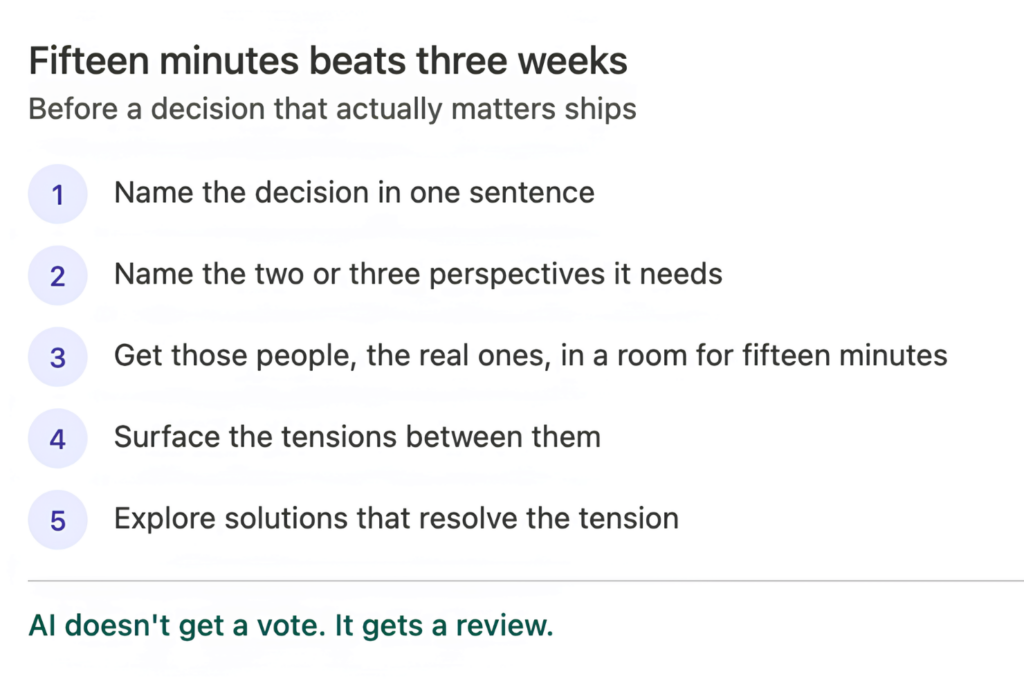
Before a decision that actually matters ships, name it in one sentence, and name the perspectives it needs. Then get those people, the real ones, in the same room or on the same call for fifteen minutes.
None of this needs a new tool, a new hire, or a new layer of process. That's the whole point.
The discipline scaled companies try to buy with software and headcount is something a small team can just do, because you already have the two things it takes: the right people, and the ability to get them in a room.
Here's the lightweight version.
Before a decision that actually matters ships, name it in one sentence, and name the perspectives it needs. Then get those people, the real ones, in the same room or on the same call for fifteen minutes. Not a standing meeting. Not a committee. A short, deliberate pass, on purpose, for this one decision.
In that conversation, make disagreement the job. Don't ask whether everyone agrees. Ask each person what this gets wrong from where they sit. You're not collecting a thumbs up. You're hunting for the one objection that changes the answer. And if it all comes together too easily, remember what that usually means. Someone who should be in the room isn't.
When AI is part of it, and it will be, keep it on the right side of the line. Let it draft, summarize, surface an angle you might have missed. Then put its answer in the room and pressure-test it the way you would anyone else's.
Treat it as a draft to check, never a verdict to accept. It doesn't get a vote. It gets a review. And when it's just you and the AI, the whole call is yours. It can carry the work, not the weight.
That's the whole pattern. Name the decision, name the angles, get the real people in real time, make them disagree, and keep it on the doing side of the line. It costs you fifteen minutes.
The alternative costs you three weeks and a confident answer that turned out to rest on a faulty assumption. A guess no one tested. An inference treated as fact. From AI, we call that a hallucination. From a person, we just call it confidence.
The Gap Small Teams Are Built to Close
Step back for a second. People and AI both get things wrong, and a team can survive that. What it can't survive is the more expensive version of the problem, the perspective that matters most goes missing.
The people who have to create the value and the people it's meant for are rarely in the same room when the decision gets made.
In a big company, that's the normal state of things. The person with the authority to decide is usually the furthest from where the value actually gets made, and the busiest, the last one who can spare fifteen minutes to sit in a room. So the decision gets made at a distance, on a summary, by someone who wasn't there for the disagreement that would have changed the answer.
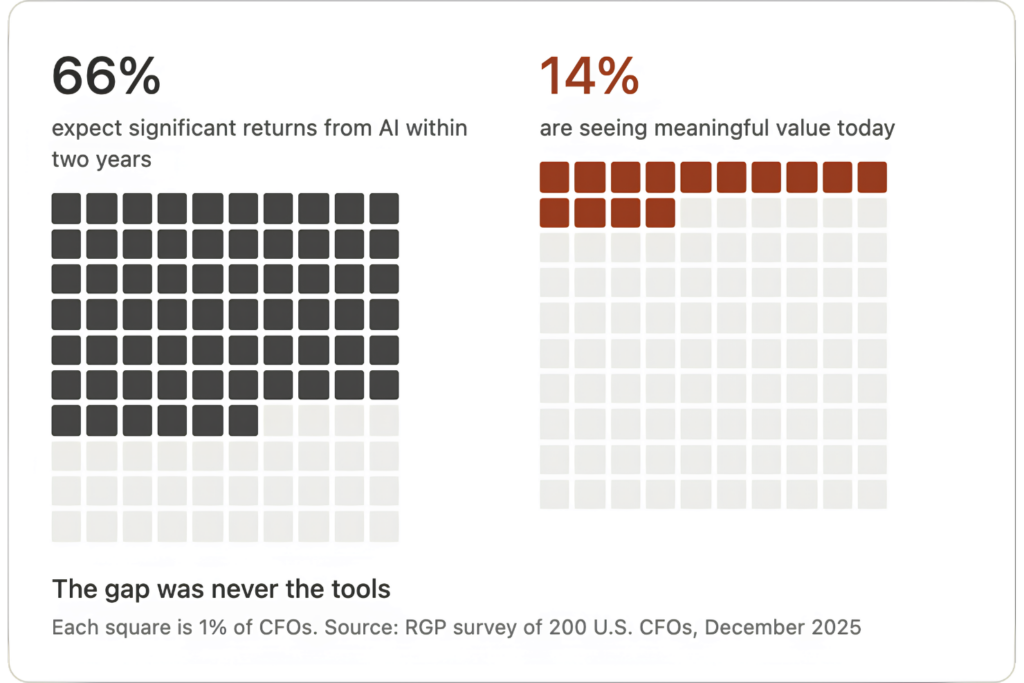
This is the gap CFOs keep reporting and can't explain. In a recent study by the consulting firm RGP, 66% of CFOs said they expect significant returns from AI within two years. Only 14% said they're seeing meaningful value today.
The reflex is to read that as a tooling problem, something a better model or another platform will fix. It won't. The gap was never the tools. It's the quality of the decisions the tools are feeding.
Here's why a small team is the one that closes it. The friction that defeats a big company, all the layers and calendars and coordination, is mostly not your problem.
The people you'd pull in already know each other, already trust each other, and can disagree hard and still grab lunch after. You're not routing a decision through strangers on an org chart. You're turning to three people you work with every day.
The discipline a large company is spending millions trying to rebuild is something you can do this afternoon, because the distance it's fighting was never there for you.
I lived this at a small agency once. We were losing money on most of our biggest projects. The fix wasn't a tool or a new hire. It was getting everyone who touched the work into one room, from estimating and pricing to booking and delivering. Not one meeting, but again and again, working past the symptoms to what was actually going on.
We increased net margin by 33%. The leverage was the decision to make talking through problems and solutions together a habit. What made it click was us weighing in on work that wasn't ours, expert or not. That's where a lot of innovation comes from, and it's exactly what we keep hoping AI will give us.
And it's the work I've done ever since, helping teams work through the problems too big for any one person to solve alone.
The hard thing was never finding the right people. It's getting them in the same room at the same time, arguing and shaping ideas together. Every tool promises to replace it, and none can. Put two people who see it differently in front of each other, in real time, and the real problem shows itself. The rest is logistics.
AI has no perspective. No opinion. Nothing it feels. For a narrow set of decisions, that detachment is exactly what you want, and you should use it there. But most of what we do, we do to build things and solve problems for other human beings, alongside other human beings who care how it turns out.
That caring is what makes someone push back, stay in the tension, and catch the thing everyone else missed.
Those perspectives are the one part of the work you should never let go of. And if you're a small team, you don't have to. They're already sitting around your table. AI can help you do the work. The part that's actually yours, you get to keep.