

10 Best Cloud Recruitment Software for Hiring Teams 2026

10 Best Cloud Recruitment Software Shortlist


Effective recruitment is based on speed and efficiency, which is where cloud recruitment software can provide a real advantage.
These solutions are designed to help you source candidates and manage them through your recruitment process, balancing the appropriate levels of automation vs personalization (recruitment is about people, after all).
But, with so many solutions available, figuring out which is right for you can be time consuming.
Here, I'll help you make your choice easier by sharing my insights on the best cloud recruitment software based on my personal experience using these systems.
Why Trust Our Software Reviews
We’ve been testing and reviewing HR software systems since 2019. As HR experts ourselves, we know how critical and difficult it is to make the right decision when selecting software.
We invest in deep research to help our audience make better software purchasing decisions. We’ve tested more than 2,000 tools for different HR management use cases and written over 1,000 comprehensive software reviews. Learn how we stay transparent & our software review methodology.
Best Cloud Recruitment Software: Pricing Comparison Chart
This comparison chart summarizes pricing details for my top cloud recruitment software selections to help you find the best software that works for your budget and business needs.
| Tool | Best For | Trial Info | Price | ||
|---|---|---|---|---|---|
| 1 | Best for global agency-sourced hiring | Free demo available | From $599/employee/month | Website | |
| 2 | Best for native hiring and onboarding integration | Free trial + free demo available | Pricing upon request | Website | |
| 3 | Best for wide candidate reach | Free demo available | Pricing upon request | Website | |
| 4 | Best for recruitment agencies | 30-day free trial + free demo available | From $85/user/month (billed annually) | Website | |
| 5 | Best for cloud-based recruitment automation | 14-day free trial + free demo available | From $15/user/month (billed annually) | Website | |
| 6 | Best for split placement networking | Free demo available | From $75/month (billed annually) | Website | |
| 7 | Best for sourcing high-quality candidates | Free demo available | From $115/month (billed annually) | Website | |
| 8 | Best for its opportunity marketplace | Free demo available | Pricing upon request | Website | |
| 9 | Best for hiring hourly workers | Free demo available | Pricing upon request | Website | |
| 10 | Best for a central recruitment hub | Free demo available | From $99/user/month | Website |
-

Justworks
Visit WebsiteThis is an aggregated rating for this tool including ratings from Crozdesk users and ratings from other sites.4.6 -
Paycom
Visit WebsiteThis is an aggregated rating for this tool including ratings from Crozdesk users and ratings from other sites.4.3 -
HiBob
Visit WebsiteThis is an aggregated rating for this tool including ratings from Crozdesk users and ratings from other sites.4.5



Best Cloud Recruitment Software Reviews
Here’s a brief description of each cloud recruitment software that showcases each system’s best use case, their noteworthy features, and some pros & cons. I’ve also included screenshots to give you a snapshot of their user interface too.

Deel is a cloud-based platform that helps businesses source, hire, and onboard global talent. It brings your staffing partners, job requisitions, and candidate reviews together in one digital workspace.
Why I picked Deel: I picked Deel because it connects you with a global network of staffing partners who specialize in different industries and regions. Instead of searching for candidates manually or juggling multiple vendors, you can create a job requisition and start reviewing agency-sourced CVs right in the platform. This gives your team quick access to pre-vetted candidates and helps you fill roles faster—especially across borders.
Deel also gives you insight into how your recruiting partners are performing. You get data on applicant volume, time-to-hire, time saved, and spend for each agency. This makes it easier to evaluate which partners are bringing in the best results and optimize your recruiting process over time.
Deel Standout Features and Integrations
Standout features include built-in compliance handling, so you don’t have to worry about local labor law requirements when hiring across countries. Deel also lets you define detailed job roles by specifying job title, location, compensation, and required skills—plus you can upload job specs for better candidate matching.
Integrations include Hubstaff, QuickBooks, Slack, Google Workspace, JIRA, Brex, Expensify, NetSuite, BambooHR, Skovik, Workday, and Xero.
Pros and Cons
Pros:
- Great visibility into recruiter performance
- Helps hire quickly across multiple countries
- Strong compliance support built in
Cons:
- No internal candidate database feature
- You need to rely entirely on partner agencies
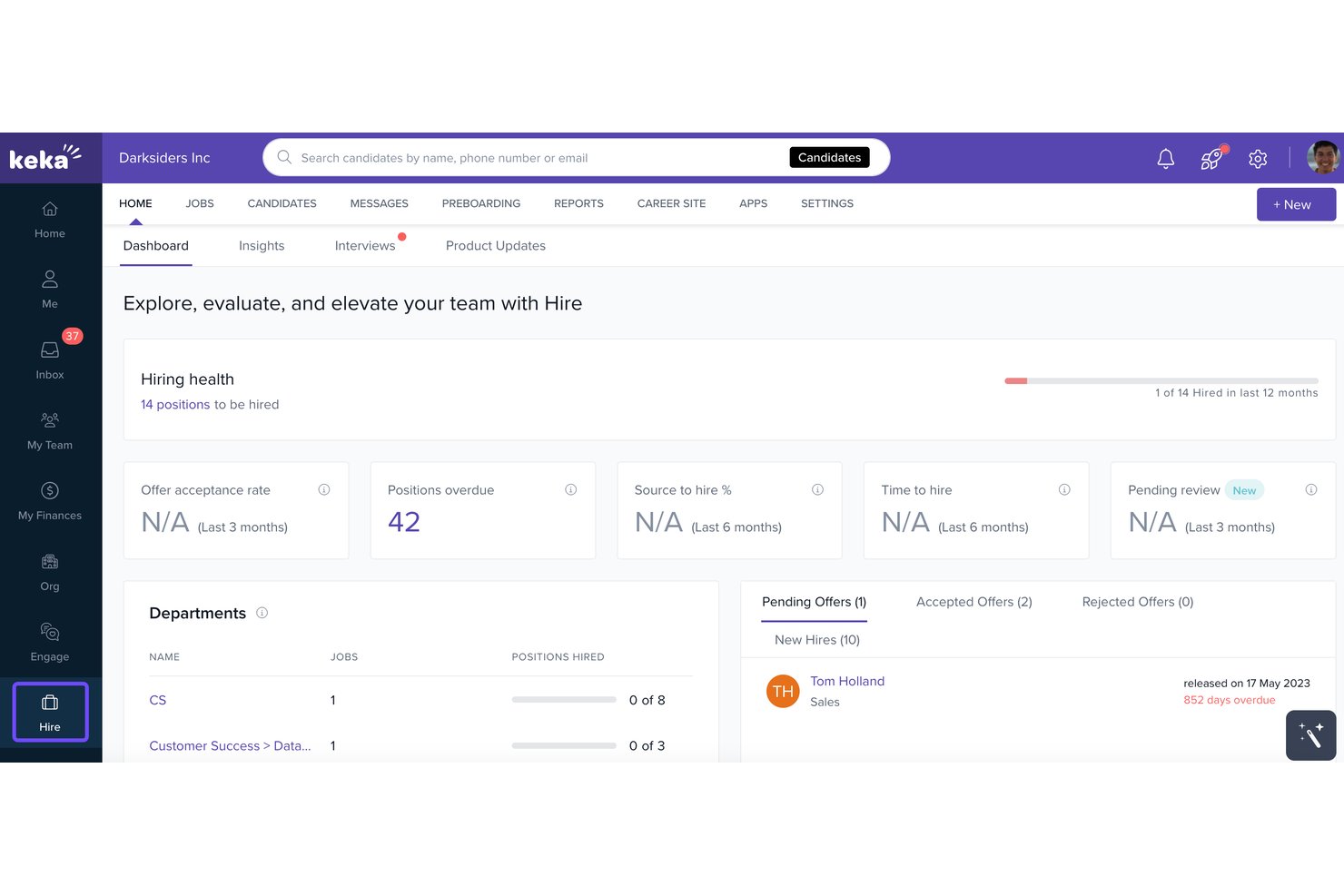
Keka HR is a cloud-based recruitment and HR platform that unifies applicant tracking, candidate sourcing, interview management, and employee onboarding within a single connected HR ecosystem.
Who Is Keka HR Best For?
Keka HR is a strong fit for mid-market companies that want to manage recruiting, onboarding, and core HR in a single platform rather than juggling separate tools.
Why I Picked Keka HR
Keka HR earns its spot on my shortlist because it solves a problem most ATSs ignore: what happens after the offer is signed. I love that candidate data captured during hiring flows directly into onboarding workflows and payroll setup, with no manual re-entry. The preboarding module lets new hires complete documentation before day one, and that data populates their employee record automatically in the HRMS.
Keka HR Key Features
- Job board integrations: Post open roles to LinkedIn, Naukri, and other job sites with one click.
- Chrome sourcing extension: Import candidate profiles from LinkedIn directly into your pipeline.
- Interview scorecards: Standardize interviewer feedback with customizable rating forms and structured questions.
- Talent pool management: Organize, tag, and search candidate records in reusable, filterable pools for future openings.
Keka HR Integrations
Keka HR offers native integrations with Slack, DocuSign, Chekr, Zoom, Azure AD, Tally, Microsoft Teams, Jira, and more. An API is available for custom integrations.
Pros and Cons
Pros:
- Candidate pipelines support multiple roles simultaneously
- Preboarding workflows activate before day one
- Hiring and HRMS data sync automatically
Cons:
- Global job board integrations lack depth
- Reporting depth lags behind standalone ATS tools

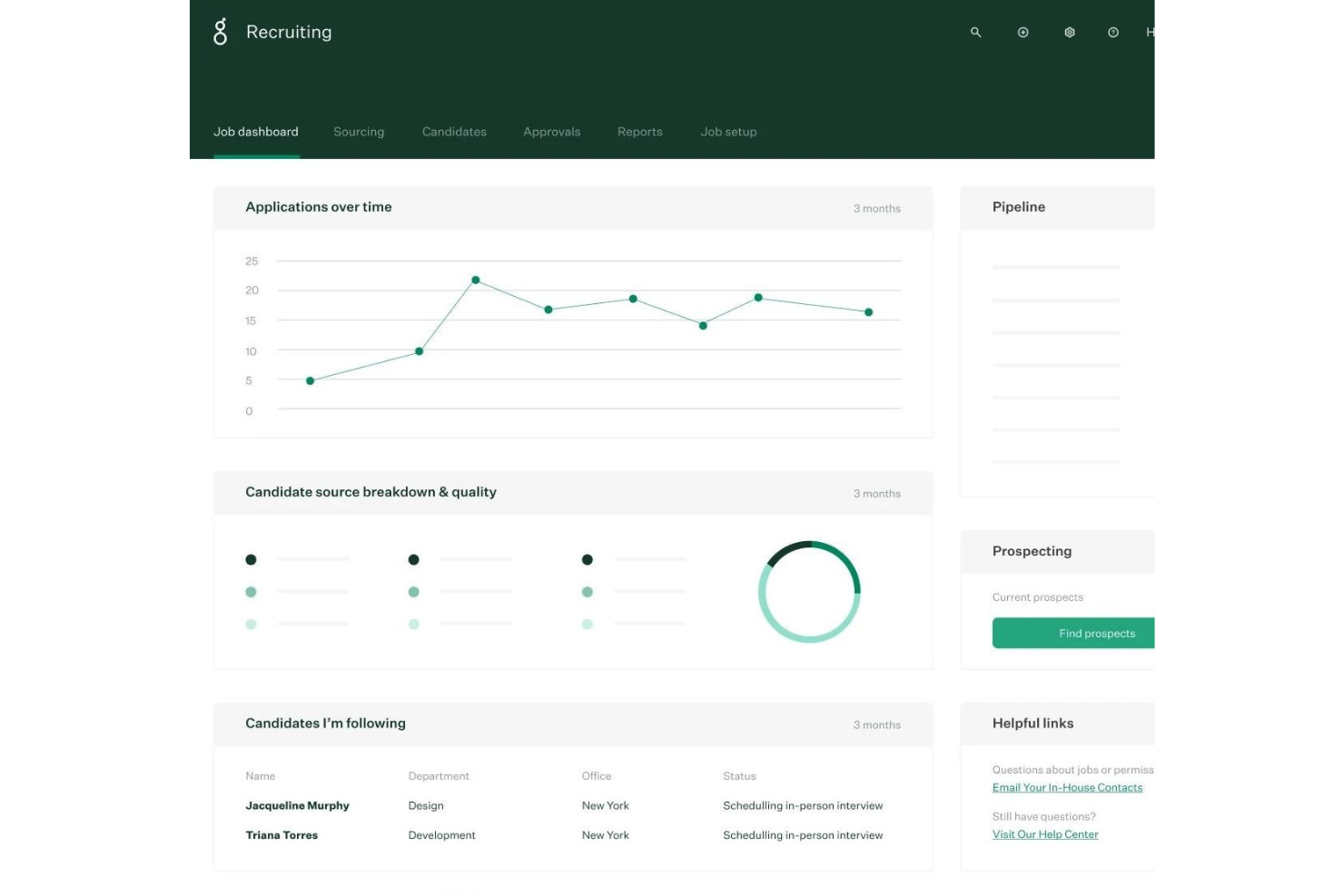
Greenhouse helps you reach, classify, and nurture talent so you can build a robust candidate pipeline, delivering exactly the right candidate for each available position.
Why I picked Greenhouse: Greenhouse delivers massive candidate reach, allowing you to post on over 1,000 job boards, including both niche sites and major job marketplaces. The software recommends the best places to post, based on historical and industry performance.
You can easily capture prospect’s contact information and automate personalized outreach at scale. Greenhouse empowers stakeholders with granular permissions and keeps everyone in the loop with alerts, tasks, and notifications.
You can kickstart new jobs by configuring fields so they capture all the necessary information. Then collaborate directly within Greenhouse with @mentions, shared application reviews, job offers, and approvals.
Greenhouse Standout Features and Integrations
Features include applicant tracking, structured hiring, team collaboration, automated task management, multichannel sourcing, candidate experience, core reports, and a mobile app.
Integrations include Broadbean, Canditech, Cord, Docusign, Dropbox, FlexJobs, Google Meet, Indeed, Microsoft Teams, Paradox, and Seek.
Pros and Cons
Pros:
- Timely emails
- Excellent candidate experience
- Great visibility for hiring managers
Cons:
- Complicated user interface
- Limited reporting options
New Product Updates from Greenhouse

Greenhouse's tofu Integration Moves to Harvest v3 OAuth
Greenhouse’s tofu integration now uses Greenhouse V3 OAuth to auto-sync jobs and applications into tofu, and write screening notes, tags, and advance/reject actions back to Greenhouse. For more information, visit Greenhouse's official site.
 .
.
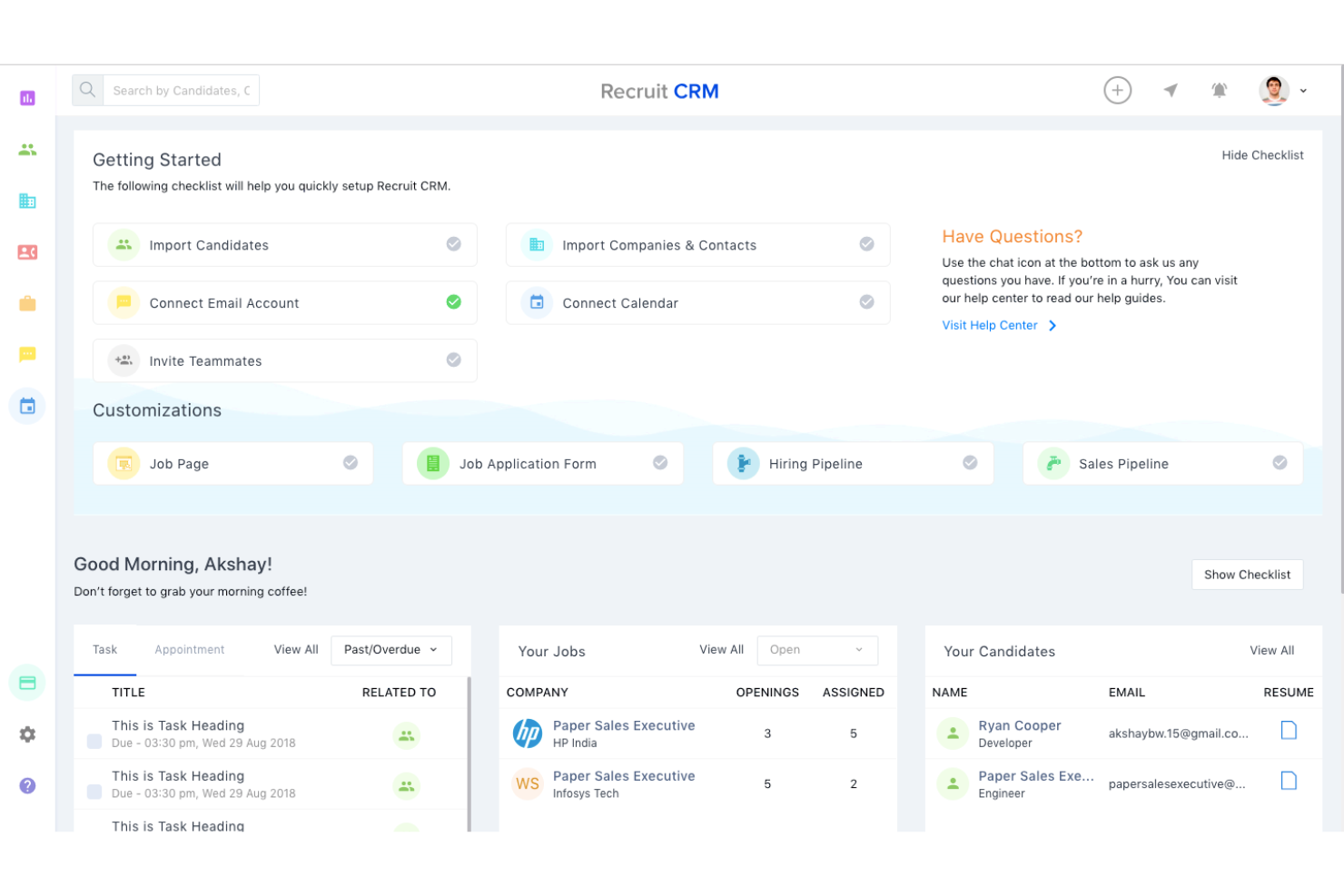
Recruit CRM aims to offer a comprehensive solution for fast moving recruitment teams dealing with large volumes of candidates.
Why I picked Recruit CRM: Being aimed at recruitment teams handling applicants and clients, it's a pretty advanced solution offering tons of automations and integrations including the ability to post roles across 2000+ jobs boards worldwide. It's also highly customizable and therefore easy to tailor to meet your org's needs.
Recruit CRM Standout Features and Integrations
Standout features include the ability to integrate with over 1000 different applications for increased productivity, a Chrome sourcing extension that makes it easy to add new records to your database, a deals pipeline to keep an eye on business opportunities and an invoicing function to make invoicing clients easy.
Integrations are available to a wide range of applications through Zapier.
Pros and Cons
Pros:
- CRM/ATS integration
- Database can be tailored
- Useful Chrome extension
Cons:
- No chatbot
- Can be slow
New Product Updates from Recruit CRM

Recruit CRM Adds AI Candidate Matching and Resume Parsing
Recruit CRM Recruit CRM introduces AI candidate matching and enhanced resume parsing. These updates help recruiters identify candidates faster and improve screening accuracy. For more information, visit Recruit CRM's official site.
 .
.

Manatal is an AI-powered recruitment software tool that aims to help human resources teams, recruiting firms, and headhunters source and hire candidates faster.
Why I picked Manatal: Handy Kanban boards give you an overview of your recruitment process in a single view and you can use the drag-and-drop interface to customize your recruitment pipeline based on your internal process. The posting featuring makes it easy to share your job openings on local, global, and specialized job sites and manage all your sponsored job campaigns from a single platform.
When the applications come flooding in, the system's artificial intelligence engine automates the screening process by suggesting the best candidates based on your job descriptions and you can score candidates’ profiles based on job requirements, facilitating better screening. Profiles can also be enriched with LinkedIn and other social media data for improved matching recommendations.
Manatal Standout Features and Integrations
Standout features include the AI candidate matching tool that recommends both the most suitable jobs for your candidates and the most suitable candidates for your jobs, the job description generator to help you write more effective job descriptions, and the intuitive applicant tracking tool.
Integrations include Codility, Gmail, Google Calendar, Indeed, LinkedIn, Mailchimp, Meta for Business, Microsoft 365, Microsoft Outlook, and Microsoft Power BI.
Pros and Cons
Pros:
- Customizable templates
- AI recommendations
- LinkedIn sourcing
Cons:
- Filtering could be improved
- No way to customize the home page
New Product Updates from Manatal

Manatal Adds Candidate Login and Employee Portal to Career Pages
Manatal has added Candidate Login, Internal Employee Portal, and internal job visibility controls for Career Pages. These features help teams simplify applications, support employee mobility, and manage internal hiring workflows. For more information, visit Manatal’s official site.
 .
.
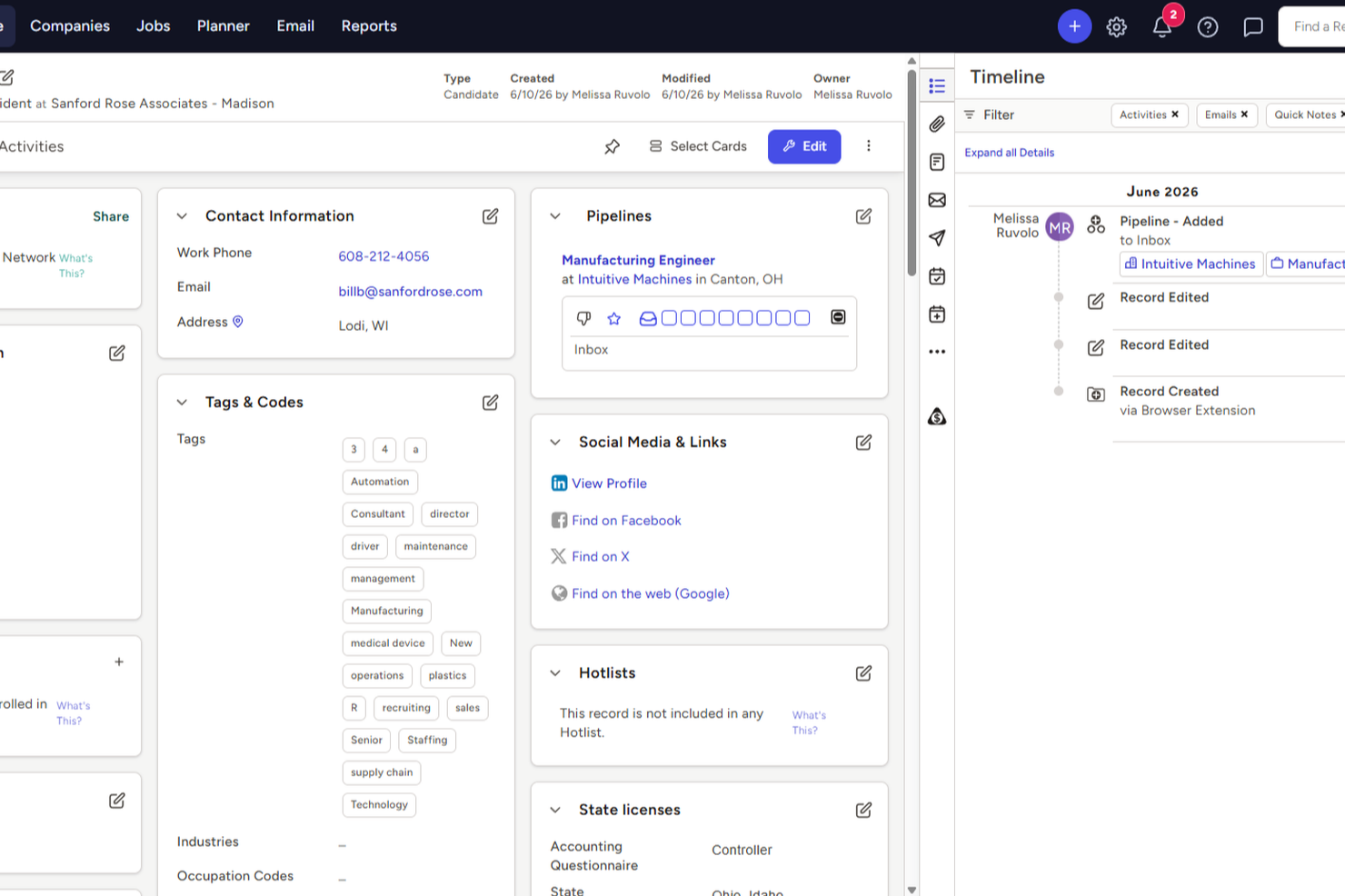
TE Recruit is a cloud-based ATS and recruiting CRM built for independent staffing agencies and search firms, combining applicant tracking, candidate pipeline management, job board distribution, and split placement networking.
Who Is TE Recruit Best For?
TE Recruit is a strong fit for independent recruiters and small-to-mid-sized staffing agencies that operate on a contingency or retained search model.
Why I Picked TE Recruit
I've included TE Recruit in my top picks because of its built-in access to TE Network, a split placement marketplace that lets independent recruiters collaborate directly on job orders and candidate sharing. In practice, that means your agency can take on a job order you don't have the right candidate for, post it to TE Network, and partner with another vetted recruiter who does. The network covers over 1,000 recruiters across the US and Canada, spans most major industries, and operates on a structured fee-split model.
TE Recruit Key Features
- Smart-TE AI search: Automatically ranks candidates in your database based on how closely they match a job order's requirements.
- Automated outreach sequences: Build multi-step email and activity sequences that trigger based on candidate or contact status in the pipeline.
- Resume parsing: Extracts and populates candidate profile fields directly from uploaded resumes to speed up data entry.
- Recruiting analytics dashboard: Tracks pipeline activity, placement metrics, and recruiter performance across your team.
TE Recruit Integrations
TE Recruit offers a marketplace of native integrations that includes Indeed, ZipRecruiter, Dice, Careerjet, ZoomInfo, Spark Hire, Checkr, Verified First, Swordfish, and SourceWhale. An open API is also available for building custom integrations and automating data sharing with third-party tools.
Pros and Cons
Pros:
- One-click multi-board job posting
- Shared candidate hotlists across recruiters
- Built-in split placement recruiting network
Cons:
- Rigid keyword matching may filter out qualified candidates
- Search filters feel limited

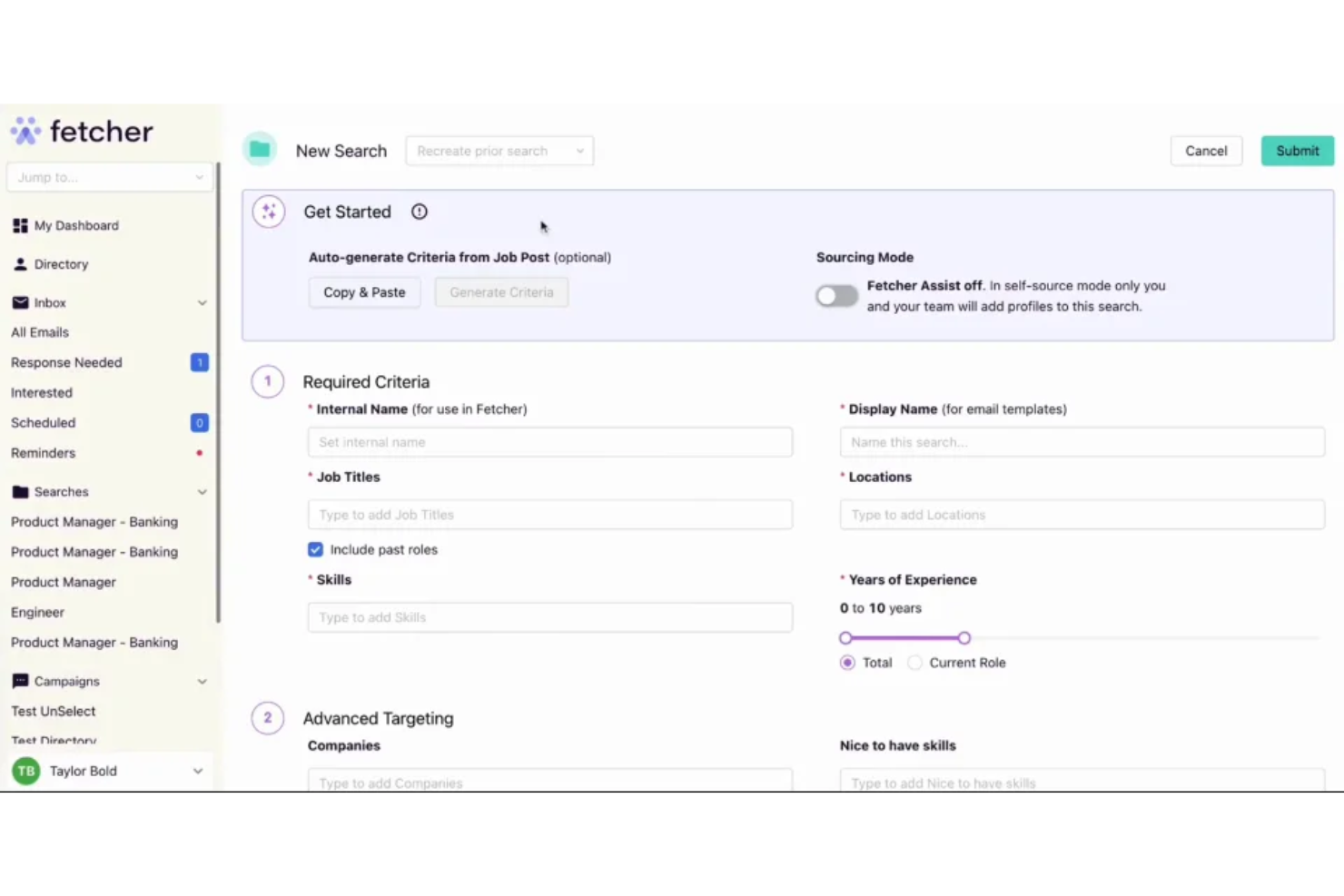
Fetcher is a candidate sourcing tool that uses AI to unearth talent from the market and build your own talent pool.
Why I picked Fetcher: Fetcher stands out with its AI-driven candidate sourcing capabilities. Unlike traditional recruitment tools, Fetcher leverages advanced algorithms to identify and engage with active and passive candidates. The platform's AI automates the search process, scouring vast databases to find high-quality candidates that match specific job requirements.
Fetcher also helps source high-quality candidates through its verified contact information and automated email sequences to nurture potential candidates. Recruiters can also set specific diversity goals, ensuring a more inclusive hiring process.
Fetcher Standout Features and Integrations
Standout features include its super easy and customizable search function, intuitive candidate database, and automated lead nurturing.
Integrations include Ashby, Greenhouse, Lever, Workable, Workday, BambooHR, Freshteam, Gmail, Google Calendar, HR Cloud, Jazz HR, Lano, Sage, SAP, Slack, SmartRecruiters, Smashfly, and TalentLyft.
Pros and Cons
Pros:
- Uses AI to source qualified candidates
- Allows users to create and manage outreach campaigns
- Facilitates smooth communication with candidates
Cons:
- Can be expensive for teams with limited resources
- The user flow can feel complex
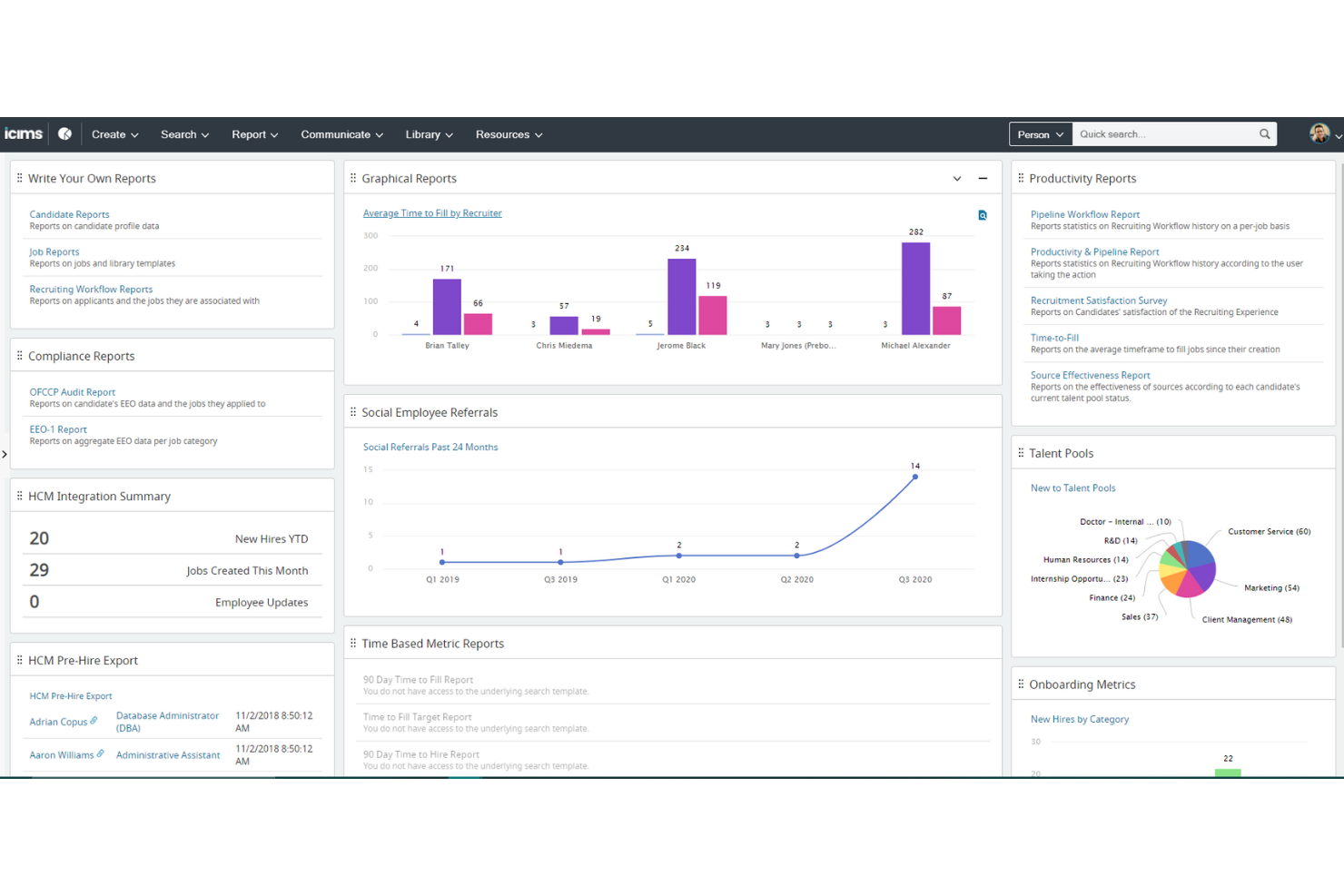
iCIMS offers a talent management solution designed to help organizations recruit and retain talent in one platform.
Why I picked iCIMS: Their talent cloud platform makes it easy to showcase the employer brand and match internal and external candidates with roles. The application process is easy and the system helps provide effective communication thereafter through automated messaging.
From an organizational perspective, the tool helps to qualify candidates and provide timely team feedback for fast and effective decision making.
iCIMS Standout Features and Integrations
Standout features include candidate experience management tools, that combine behavior-based marketing automation with AI insights to qualify candidates and assess their levels of engagement, as well as a digital assistant that supports candidates' applications in 20+ languages and across multiple formats.
Integrations include Appcast, Broadbean, Digi-Me, JobTarget, LinkedIn, Rakuna, Recruitology, TalentCircles, ViziRecruiter, and Worqdrive.
Pros and Cons
Pros:
- Bulk printing capabilities
- All-in-one solution
- Tracks candidates at every step
Cons:
- No auto progression
- Navigation is not intuitive


TalentReef's cloud-based recruitment software is purpose-built for location-based, high-volume recruiting.
Why I picked TalentReef: I included TalentReef in this list because of their unique focus on sourcing candidates to fill hourly positions. This makes their software particularly well-suited for sourcing talent for businesses in the service industry, such as restaurants, retail stores, and other hourly employers that frequently hire new staff in bulk.
TalentReef Standout Features and Integrations
Standout features include their conversational AI chatbot, a text-to-apply feature, two-way texting abilities, and social recruiting tools. Recruiters can also save a lot of time by using their campaign communication features to create templated email and SMS communications for candidate interactions, allowing them to stay in touch with high volumes of candidates at scale.
Another plus worth highlighting is their interview scheduling automation. By allowing candidates to pick a time that works for them, you'll reduce the likelihood of no-shows or last-minute cancellations, and eliminate the need for back-and-forth phone tag to find a time that works.
Integrations are available with payroll systems, candidate assessment tools, background check providers, and learning management systems, though individual platforms are not specified.
Pros and Cons
Pros:
- Automatically ranks candidates
- Includes mobile-friendly features
- Purpose built for staffing hourly positions
Cons:
- Pricing details are not transparent
- No free trial available
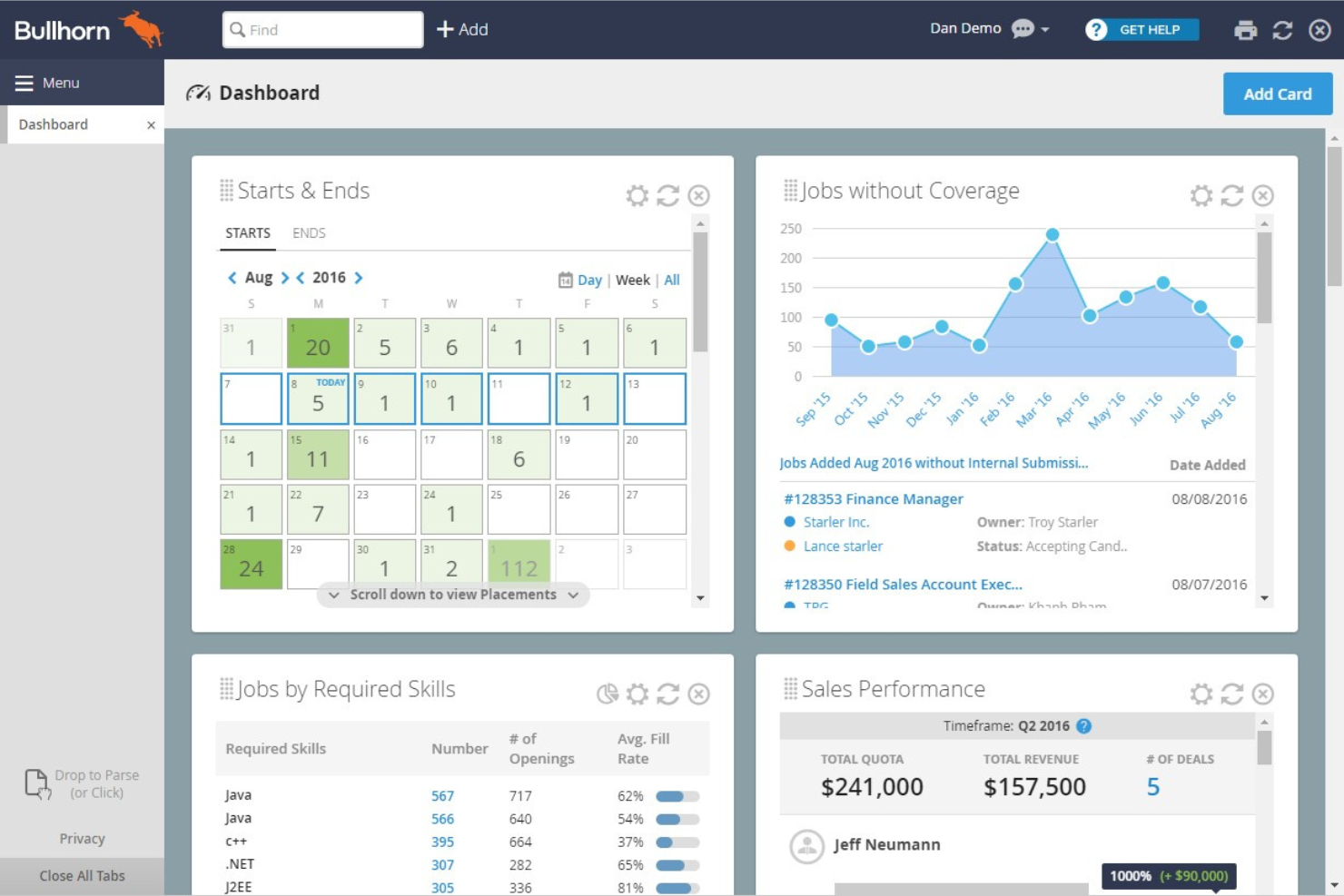
Bullhorn aims to offer a single source of truth for busy staffing agencies and even acts as the central hub for the wider tech stack.
Why I picked Bullhorn: Bullhorn understands how busy recruitment teams are but also the need to balance efficiency (read, automation) with the human touch. As such, they're careful to implement automation with caution and use it to improve the experience for teams and candidates.
They're also generous with knowledge, providing playbooks to help organizations engage with candidates and differentiate their offering.
Bullhorn Standout Features and Integrations
Standout features include their AI tool, built on a sea of recruitment data, to help source and screen candidates and craft relevant communications, as well as advanced analytics features such as real-time dashboards and custom reporting.
Integrations include Broadbean, Candidately, Checkr, CloudCall, Dice, eSkill, Indeed, LinkedIn, Monster, and Referoo.
Pros and Cons
Pros:
- Large partner marketplace
- Clean interface
- Advanced workflow options
Cons:
- Occasional latency issues
- Downtime issues
Other Cloud Recruitment Software
Here are a few more worthwhile options that didn’t make the best cloud recruitment software list:
- Jobvite
For robust employer branding
- Journeyfront
For data-driven decisions
- Unnanu Hire
For AI-powered candidate scoring
- Mitratech Hire
For web-based applicant tracking
- Rippling
For tracking the recruitment pipeline
- Pinpoint
For centralized candidate information
- Tracker
For an ATS with CRM
- ClearCo
For automating communication
- Zoho Recruit
For remote hiring
- WebHR
Cloud recruitment software for a customizable ATS


Related HR Software Reviews
If you still haven't found what you're looking for here, check out these other related tools that we've tested and evaluated:
- HR Software
- Payroll Software
- Recruiting Software
- Employer of Record Services
- Applicant Tracking Systems
- Workforce Management Software
How I Evaluate Cloud Recruitment Software
I split my evaluation into baseline must-haves—like ATS pipelines, job board distribution, and resume parsing—and the differentiators that separate good tools from the right fit for your team.
Core Functionality (Table Stakes For This List)
When I'm selecting tools for my list, I rank each one on a scale from 0 (does not offer the functionality) to 5 (excels in this area) for each core functionality listed below. Then, I calculate the tool's total score into a percentage. Each tool needs to achieve a minimum total score of 75% to be considered for inclusion.
- Applicant Tracking & Pipelines: I check whether hiring stages are customizable and whether recruiters can move candidates through pipelines with bulk actions and automation triggers.
- Job Posting & Distribution: Each tool should let you push a listing to multiple job boards at once—I look at how many boards are supported and whether paid boards are included.
- Candidate Sourcing Tools: Strong sourcing means more than a resume database. I evaluate talent pool tagging, LinkedIn integrations, and browser extensions for passive outreach.
- Resume Parsing & Screening: I look at how well a platform converts uploaded resumes into structured profiles and whether it supports knockout questions or AI-based shortlisting.
- Interview & Collaboration Tools: Hiring is a team sport, so I evaluate calendar sync, structured scorecards, and how feedback flows between recruiters and hiring managers.
- Recruitment Reporting & Analytics: I check for dashboards that track KPIs like time-to-hire and source of hire, plus the ability to build custom reports and schedule exports.
Once I have a list of tools that meet the criteria, I consider what sets each platform apart.
Differentiating Factors (What Sets Vendors Apart)
Here's how I compare and contrast different vendors:
Standout Features
AI candidate matching is a big differentiator—I look at whether a platform can surface past applicants from your talent pool when a new role opens, saving hours of manual searching. DEI tools also matter here. Anonymized screening and diversity dashboards help teams track representation across their pipeline stages. I also evaluate career site builders, since a polished, branded careers page converts more applicants than a generic job board listing.
Beyond Features
HRIS integrations are one of the first things I evaluate. A recruitment tool that connects to your existing HCM—whether that's Workday, BambooHR, or SAP SuccessFactors—means new hires flow into onboarding without manual re-entry. Compliance and data security also carry real weight, especially for teams hiring across multiple regions where GDPR and candidate consent requirements apply. I look at scalability too: whether pricing tiers and feature access fit a 10-person team as well as a 500-person talent acquisition department.
Trends in Cloud Recruitment Software
Staying informed of the latest trends in recruitment software features can help you incorporate new technological advancements into your recruitment strategy to further optimize your processes, attract top talent, and gain a competitive edge.
Here are several trends impacting cloud recruitment software currently:
AI-Driven Candidate Screening
Perhaps the most time-consuming and monotonous part of recruitment, candidate resume screening is still the essential first step to finding the talent you want. Artificial Intelligence (AI) is revolutionizing the way resumes are screened, making the process more efficient and less biased.
AI algorithms can analyze vast amounts of data to identify the most suitable candidates, saving time and reducing human error. Ultimately, AI screening can reduce time-to-hire and help improve the quality of hires by analyzing data more comprehensively than humanly possible. This is particularly important in tech, healthcare, and finance industries where the demand for specialized skills is high.
Predictive Analytics for Employee Retention
Predictive analytics tackles the challenge of retaining employees by helping to predict turnover rates using the following strategies:
- Data Analysis: Uses historical employee data, as well as employee demographics, performance metrics, and engagement levels, to identify patterns indicating potential turnover.
- Risk Identification: Pattern recognition and data analysis also helps HR professionals spot at-risk employees, enabling early intervention.
Adopting predictive analytics can help HR teams understand when and how to implement proactive retention measures, which can significantly reduce turnover and its associated costs.
Enhanced Remote Interviewing Capabilities
With hybrid and remote working models becoming the norm, cloud recruitment software is increasingly incorporating advanced tools for remote interviewing. This includes high-definition video conferencing, interactive assessments, and virtual reality environments. This trend helps HR managers conduct efficient and effective interviews, regardless of geographical boundaries.
Integration with Social Media and Professional Networks
Nowadays, the best talent might not be found on a traditional job board. Instead, social media is becoming the place to find diverse, high-level talent, particularly for executive-level positions. As such, ensuring that your cloud recruitment software integrates with social media can provide several benefits to improve your recruitment process, such as:
- Wider Talent Access: Enables HR professionals to tap into extensive networks on platforms like LinkedIn and Twitter.
- Passive Candidate Engagement: Facilitates connection with candidates who aren't actively job hunting but are potential fits.
- Efficient Sourcing: Streamlines the process of finding and reaching out to suitable candidates, especially in dynamic sectors like tech and finance.
Incorporating this integration into recruitment strategy can vastly improve the scope and efficiency of talent acquisition and, when combined with remote interviewing capabilities, can help you find talent in places that were previously inaccessible.
What is Cloud Recruitment Software?
Cloud recruitment software is a web-based application that allows companies to manage all phases of their recruitment process online, from posting jobs to sorting applicants, comparing their skills, scheduling interviews, completing reference checks, and more. Typically, they're hosted on a remote server and accessed through a web browser through desktop or mobile devices.
Cloud recruiting software helps recruiting teams work together more efficiently and effectively through a combination of features such as resume parsing, skill comparisons, workflow automation, and collaboration tools. These features work together to support better data-driven decision-making, simultaneously improving your hiring outcomes and offering a better candidate experience.
Costs & Pricing for Cloud Recruitment Software
Cloud recruitment software offers a range of different plans and pricing options that cater to various needs, from small businesses just starting out to large enterprises with complex recruitment processes. Each plan typically offers a different set of features and capabilities, with pricing that scales based on the functionality and number of users.
Plan Comparison Table for Cloud Recruitment Software
| Plan | Average Price | Summary | Common Features Included |
|---|---|---|---|
| Free | $0 | Basic functionality for small teams or startups | Job posting, basic applicant tracking, resume parsing, limited candidate communication, and reporting |
| Basic | $50 per month | Entry-level paid plan for small to medium businesses | All Free plan features plus enhanced candidate communication, interview scheduling, and basic analytics |
| Standard | $150 per month | Comprehensive plan for growing businesses | All Basic plan features plus advanced analytics, workflow automation, custom branding, and integrations |
| Professional | $300 per month | Advanced features for larger teams | All Standard plan features plus AI-driven candidate matching, advanced reporting, and priority support |
| Enterprise | Custom pricing | Tailored solutions for large organizations | All Professional plan features plus a dedicated account manager, custom integrations, and enterprise-grade security |
When selecting a plan, consider the specific needs of your business and the features that will provide the most value. This will help you choose a solution that fits both your recruitment budget and your organization's needs.
Frequently Asked Questions
People often ask for advice on choosing the best cloud recruitment software. Here are some answers to the most common questions:
What main features are included in cloud recruitment software?
Cloud recruitment software typically includes features such as applicant tracking, resume parsing, job posting, job distribution, and automated candidate communication. Other common functions include job interview scheduling tools, data analytics, recruitment metrics, and reporting.
How can I improve my recruitment process?
To improve your recruitment process, you can streamline workflows with cloud recruitment software and establish clear hiring criteria. You can also leverage data analytics to make data-driven hiring decisions, improve your recruitment marketing, and prioritize your candidate experience to ensure positive company interactions.
What's Next?
If you're in the process of researching cloud recruitment software, connect with a SoftwareSelect advisor for free recommendations.
You fill out a form and have a quick chat where they get into the specifics of your needs. Then you'll get a shortlist of software to review. They'll even support you through the entire buying process, including price negotiations.