An AI-Enhanced World Demands More Advanced Talent Assessment


Complex Capabilities: AI drives focus on complex skills, but current talent tools lack insights on these abilities.
AI Workforce Impact: HR leaders see AI's role in redesigning jobs, requiring nuanced skills from both humans and AI.
Human Strengths: Humans excel over AI in uncertainty and social dynamics, with adaptability and judgment strengths.
EPOCH Framework: EPOCH skills highlight human value in AI workplaces: empathy, creativity, and ethical judgment.
Evolving Assessments: New immersive tools offer better talent insights, leveraging AI for engaging, dynamic evaluations.
AI is pushing human value creation to be more focused on complex and sophisticated capabilities, yet most talent assessment tools are not designed to provide insights on these skills. Fortunately, advancements in technology and shifts in understanding the nature of talent for today’s world offers new solutions.
HR leaders are acutely aware of how AI is rewriting the workplace, redesigning jobs and reframing how value is created.
AI technology initially proved its worth in technology-oriented routine analyses but has progressively moved into interpretation and decisions.

The diagram below summarizes a report from the IMF and shows how AI is increasingly replacing simpler tasks and augmenting or complementing humans in more complex and nuanced judgements.
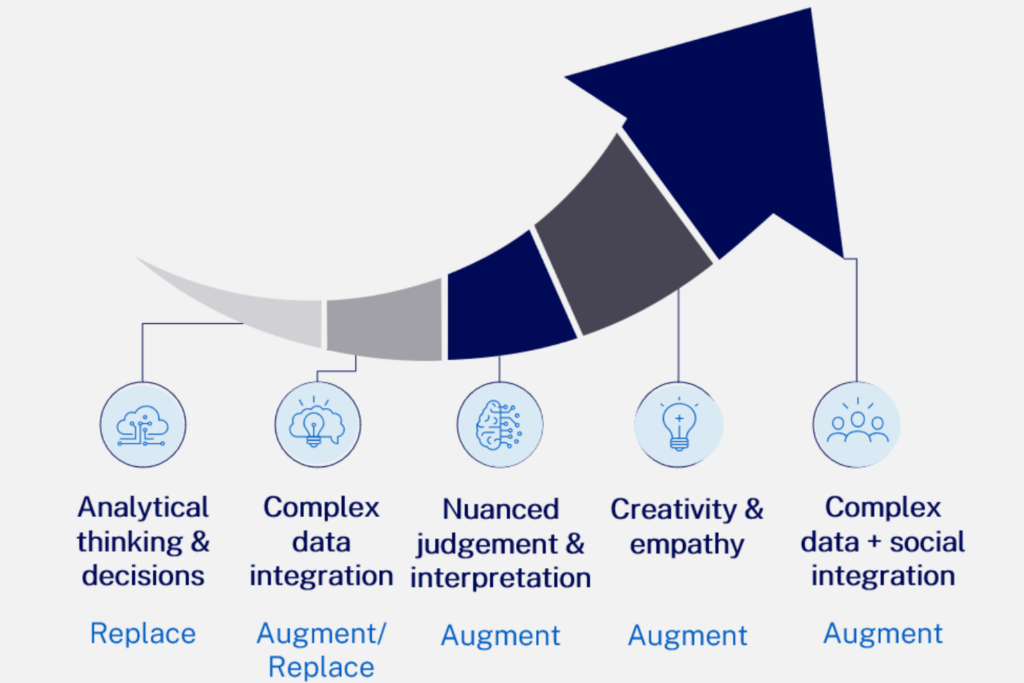
This trajectory makes sense given how AI processes information. Signals move across digital systems at close to the speed of light. AI is also organized into components called vector embeddings, which translate complex, unstructured data into compact arrays of numbers that can be processed mathematically, bypassing the need to wrestle with subtle semantic meaning.
Human neural architecture works differently. Information moves across the brain's synapses at a maximum of 120 m/s, and the amount of cognitive information humans can process is limited — your average scientific calculator can perform vastly more complex calculations than even the most intelligent person.
But AI doesn't exceed humans in every area. Despite rapid advances in processing capability, humans still outperform AI in conditions of uncertainty and complexity, particularly those involving social dynamics or ethical judgment.
The malleable, adaptive nature of human decision-making equips people better for situations requiring an integrated and nuanced view, especially under conditions of dynamism and uncertainty.
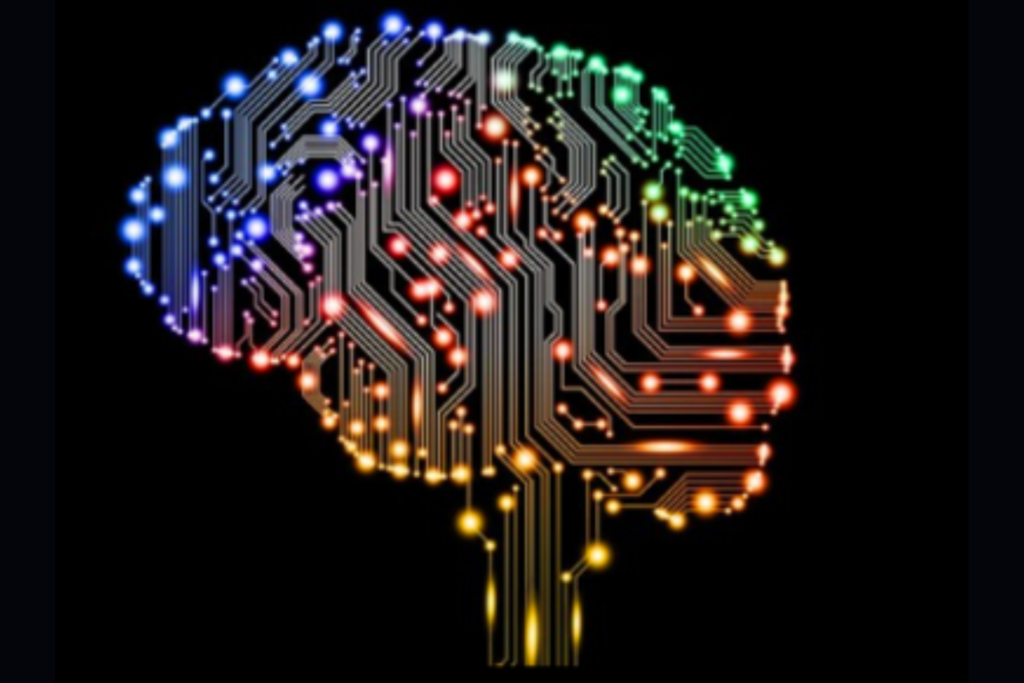
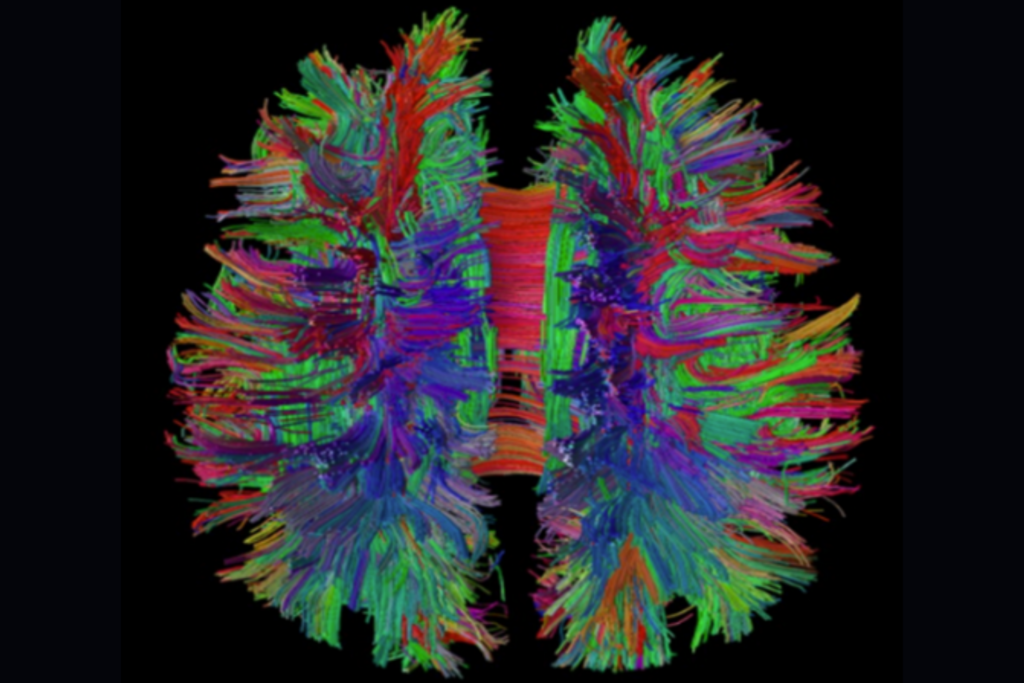
The illustrations in Figure 2 capture these differences. The structured segmentations of AI appear in the first image, while the human brain's workings are revealed by the connectome, a map of the underlying neural wiring.
Far from an organized array of specialized areas, the human brain is a wealth of intertwined signals of different types that interact to construct meaning. Even the level of interconnectivity fluctuates in response to different and dynamic situations.
This understanding of the brain's complexity and interconnectedness is relatively recent. Those who studied psychology before 2000 may well have encountered a segmented model in which different specialized functions operated relatively independently — one that resembles the AI model in Figure 2.
The similarity isn't coincidental. AI models grew out of early work on expert information processing by cognitive psychologists Herbert A. Simon and Allen Newell.
Advances in MRI technology have since revealed a deeper picture of how the human brain actually functions. The strength of human judgment and adaptability lies in the highly interconnected nature of our neural networks, which enable people to see issues from different perspectives, spot underlying connections, and shift responses to changing people and situations.
These capabilities — the ones becoming a stronger feature of how people add value in an AI-enhanced workplace — have been captured in the EPOCH framework.
The EPOCH Skills
- Empathy and Emotional Intelligence
- Presence, Networking, and Connectedness
- Opinion, Judgment, and Ethics
- Creativity and Imagination
- Hope, Vision, and Leadership
The labor market is already showing shifts that reflect this realignment. Since 2022, there has been a 13% decline in roles dominated by repetitive and structured analysis, alongside roughly 20% growth in demand for work requiring technical expertise or creative thinking.
According to Business School Professor Suraj Srinivasan, this shift reflects the impact of AI augmentation. For work processes that are integrated and multifaceted, requiring creativity and analytical thinking, technical mastery and nuanced judgment, compliance and discretion, deploying AI within the process drives up the economic value of the human components. When used as a complementary tool, AI can increase, not diminish, the value of human contribution.
Humans may be ceding ground to AI on work requiring high-speed processing and routine judgment, but their opportunities to harness AI and create value through distinctly human strengths are likely to grow.
While the near-term realities of this transformation, including large-scale job losses, are prompting legitimate concern, the IMF report forecasts a longer-term outlook of more enriched, complex roles delivering higher value creation.
Some writers, including Andrew Lopianowski and Mike Pino in their upcoming book HumanCorps, describe this emerging period as the Wisdom Age, a vision predicated on humans and AI operating through a symbiotic relationship that plays to the strengths of both.
The Implications for Talent Assessment
Given these shifts, how do we assess the capacity for wisdom and the EPOCH skills to support effective talent acquisition and development? The answer is unlikely to come from the tools HR has relied on for the past 50 years.
As the capabilities required for value creation become more complex and integrated, the usefulness of tools that deconstruct people into component parts is declining rapidly. Yet this remains the dominant approach of most talent assessment tools today, which seek to reduce the complex human into simplified quantitative components expressible as mathematical data.
There are several reasons why these tools are less useful for talent identification in an AI-enriched world.
- Limited predictive validity. Despite their widespread adoption, most of these tools don't predict future job performance well. A recent meta-analysis suggests personality predicts less than 6% of the variance in job performance, while cognitive tests perform slightly better at around 10%.
- A flawed assumption of stability. Most current tools take a snapshot of an individual and treat it as a fixed set point. The assumption that personality is consistent over time is embedded into its very definition — "stable measurable patterns of thoughts, feelings, and behaviours" — yet there is now substantial meta-analytic evidence that personality changes and develops over time in response to environmental stimuli and ongoing personal development.
- A flawed assumption of independence. Personality and cognitive ability have traditionally been regarded as unrelated predictors of behavior and outcomes, but there is increasing evidence that strong connections exist between how people describe their behavior and the cognitive abilities they demonstrate. This makes sense given the highly interconnected nature of brain wiring and the well-established principle that neurons that fire together, wire together.
- An inability to capture dynamism. Most tools adopt a point-in-time model that can't capture how individuals respond to dynamic situations. As Ric Roi and I highlight in Future Ready Talent, the ability to learn and adapt to changing conditions may be the most important hallmark of talent that drives value creation — and it's at the core of the EPOCH skills.
- A failure to account for choice. The long-running Dunedin studies, which have examined predictors of life success across health, career, financial well-being, and criminality, identified self-control as the single biggest predictive factor across all outcomes, or in other words, the individual's ability to choose behavior based on what a situation requires rather than personal preference. By over-subscribing to individual constructs, we underweight behavior as a product of the interaction between person and situation, both cognitive and behavioral.
Ironically, most psychometric tools in use today would be well-suited for assessing AI. The structured, segmented, mathematical models that underpin AI align closely with the structured, segmented, mathematical models that define traditional talent assessment.
These tools may have been adequate when work was relatively stable and segmented. In an AI-enhanced workplace defined by dynamism, integration, and complex judgment, they fall short.
The Evolution of Talent Assessment
Part of the drive to evolve traditional assessment tools has been philosophical, but technological limitation was an equally significant factor. The dominance of self-assessment, the prevalence of questionnaires, the constrained number of items, all were shaped by an era of paper-and-pencil testing.
As technology has advanced, many of these tools have been digitized and sometimes gamified, making administration, scoring, and interpretation more efficient while improving candidate engagement. The underlying structures, though, have largely stayed the same.
Predictive validity has seen limited gains, even when machine learning is used to combine insights from multiple tools.
The more meaningful advances in talent assessment are coming from multi-media, immersive, and interactive tools, game-based assessments and business simulations that use structured fictional scenarios to generate data about underlying psychological constructs.
These tools carry several distinct advantages:
- They can be situated in relevant business environments, improving data quality and reducing measurement noise generated when candidates complete tests with little connection to their actual work. They're also not necessarily expensive. The use of fast-authoring development tools have made it possible to create tailored assessments at far lower cost than was historically feasible, and they can double as realistic job previews in talent acquisition.
- They use multi-media, which improves engagement and simplifies data input. Candidates can speak responses rather than type them, and do so in their preferred language, further enhancing data quality.
- They allow for more open-ended questions. Doctoral research on game-based assessments has found that more open questions yield greater depth and quality of insight.
- They can be designed for maximum predictive validity through processes like Evidence-Centred Design, which targets the specific factors most important for success and ensures rigorous scoring.
- They offer the opportunity to observe participant responses across different and dynamic environments, providing a more systemic view of individual capabilities in response to changing stimuli.
None of this is possible without AI, which supports these tools across the full journey — from bringing complex business scenarios to life with interactive gameplay to capturing and analyzing data, to conducting complex analyses of dynamic interactions between measured variables.
AI's capacity for processing large quantities of data is foundational to these advances.
The tools are only as valid as their design, though. The creative and narrative component is essential for generating an environment that feels relevant and immersive, particularly when tools need to surface data around emotional and social dynamics that are central to the EPOCH skills.
Sound psychometric design, grounded in psychological research and a nuanced understanding of people, is what makes the data produced meaningful, useful, and interpretable.
These advances represent a necessary evolution. Without them, our ability to identify and develop the capabilities that drive value creation will continue to erode. The same dynamic reshaping the workplace is reshaping the tools we use to understand it. AI is most powerful here not as a replacement for human judgment, but as the infrastructure that makes deeper human judgment possible.