

10 Types of Employer of Record Services Explained

Not all employer of record services work the same way. A global EOR handling cross-border hiring looks very different from a domestic EOR managing compliance in a single market. Choose the wrong model, and you're paying for capabilities you don't need (or missing the ones you do). I've guided teams through countless EOR decisions, and in this article, I'll cut through the jargon to help you match the right service type to your actual hiring strategy.
What Are Employer of Record Services?
Employer of record services are third-party providers that legally employ workers on your behalf, handling payroll, taxes, and compliance in the worker’s location. These services let you hire talent in new regions without setting up a local entity. They’re essential for businesses expanding globally or managing remote teams, as they reduce legal risk and administrative overhead while ensuring you meet local employment laws and regulations.
The 10 Types of Employer of Record Services
Here’s how each type of employer of record service fits into modern hiring and compliance strategies, so you can match the right solution to your team’s global or domestic needs:

| EOR service type | Best for | Main problem it solves |
|---|---|---|
| Global EOR | Hiring employees in new countries | No local entity |
| Domestic EOR | Hiring across states or provinces | Regional payroll and compliance |
| Global payroll management | Best for companies that already have entities but need multi-country payroll | Multi-country payroll complexity |
| Contractor of Record | Managing global contractors | Classification and payment risk |
| Benefits administration | Managing benefits across markets | Local benefits complexity |
| Compliance and risk management | Reducing employment-law risk | Regulatory monitoring |
| International onboarding | Getting global hires started | Cross-border onboarding |
| Immigration support | Hiring workers who need visas | Work authorization |
| PEO services | Sharing employer responsibilities | HR admin with more employer control |
| Workforce mobility | Moving employees between countries | Relocation, payroll, and immigration changes |
Tip: Don’t start with the service name. Start with the headache you’re trying to remove.
1. Global Employer of Record (EOR) Services
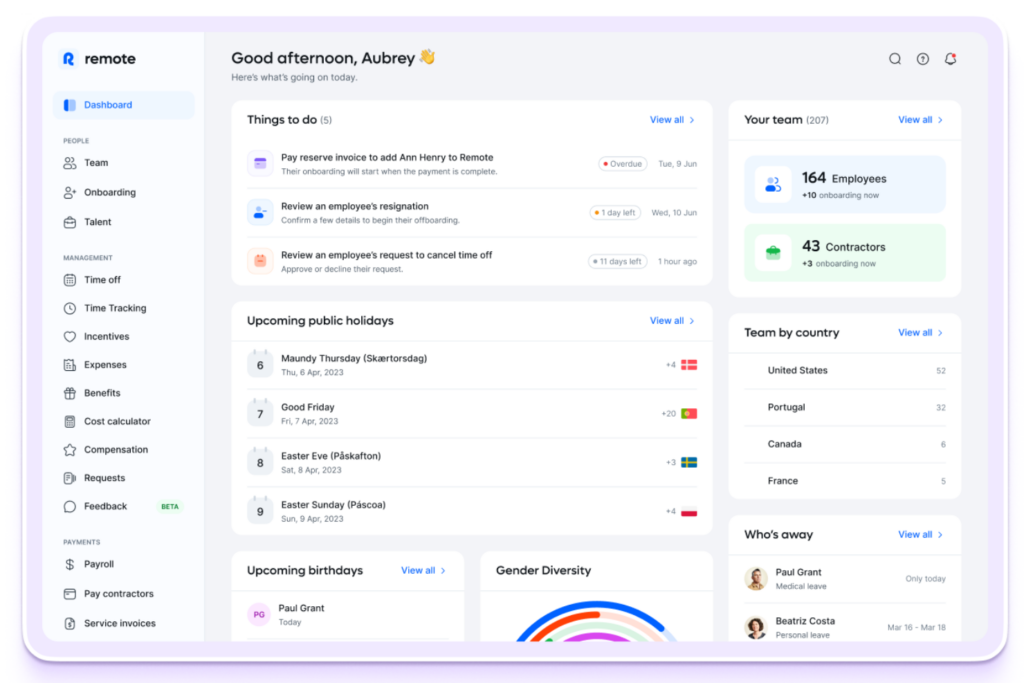
When you're hiring across multiple countries, a global EOR acts as the legal employer in each location, managing payroll, taxes, benefits, and local compliance on your behalf. In my experience, this model works best for companies that need to move quickly into new markets without the time and cost of setting up local legal entities.
Benefits
From what I've seen, the biggest win with a global EOR is speed to market—you can hire in a new country within days rather than months. Platforms like Deel and Remote handle local compliance, payroll, and benefits administration across dozens of countries, so your team avoids the cost and complexity of setting up foreign legal entities. That means your HR team stays focused on people, not paperwork.
Risks
The biggest tradeoff is giving a third party significant control over legal employment, payroll, and compliance. It’s worth understanding the broader risks of using an employer of record, including cost, service dependency, and reduced control. An EOR can also reduce, but not eliminate, permanent establishment risk, especially if in-country employees negotiate contracts, generate revenue, or exercise significant authority.
Features
Global EOR platforms pack a lot into one solution, and knowing what features to look for helps you avoid paying for gaps in coverage:
- Multi-country payroll processing: The platform runs payroll in each worker's local currency, handling tax withholding, social contributions, and payment scheduling according to local rules. Payroll is only one part of the EOR model, though. If payroll administration is your main need, it’s worth understanding the difference between an employer of record and payrolling.
- Local compliance management: Your EOR monitors changes to labor laws, statutory benefits, and employment regulations in each country where you hire. This is the feature I'd call non-negotiable—one missed regulatory update can trigger significant legal exposure.
- Employment contract generation: The platform drafts locally compliant employment agreements that reflect jurisdiction-specific notice periods, termination rules, and mandatory clauses. You don't need a local attorney for every new hire.
- Benefits administration: Global EORs enroll workers in statutory and supplemental benefits packages that meet local norms, including health insurance, pension contributions, and paid leave entitlements.
- Onboarding and offboarding workflows: Most platforms manage the full employee lifecycle, from document collection and right-to-work verification at the start to compliant terminations at the end.
- Intellectual property and equity protections: Quality global EORs include IP assignment agreements and can support equity plan documentation, which matters a great deal when you're hiring engineers or senior contributors abroad.
- Dedicated in-country support: The best platforms pair their software with local HR or legal experts who can answer jurisdiction-specific questions your internal team simply won't have the context to handle.
When comparing providers, look beyond features to country coverage, compliance expertise, support, and pricing. Once you’ve learned how to choose an employer of record, a clear EOR implementation process helps you get payroll, benefits, employee data, and integrations set up correctly, while understanding how to use an employer of record helps you manage the relationship day to day.
2. Domestic Employer of Record Services
Unlike global EOR, this model keeps everything within a single country, making it the go-to for businesses that need compliant hiring across multiple states or provinces without the overhead of managing each jurisdiction separately. In my experience, domestic EOR services work best for companies scaling locally fast, handling payroll, tax filings, and employment compliance at the regional level on your behalf.
Benefits
Multi-state hiring gets complicated fast—different tax codes, varying leave laws, and overlapping classification rules can quietly create liability if you're not on top of them. A domestic EOR handles all of that in one place, so your HR team isn't juggling compliance requirements across a dozen jurisdictions manually.
Platforms like Justworks and Gusto, for example, centralize payroll processing, state tax filings, and benefits enrollment in a single interface, which cuts down significantly on the administrative load your team carries day to day.
Risks
A domestic EOR reduces multi-jurisdiction complexity, but it can also add cost and another layer between your HR team and employees. Coverage may vary significantly by state or province, so make sure the provider actually supports every jurisdiction where you plan to hire rather than assuming “domestic” means nationwide coverage.
Features
Domestic EOR platforms tend to be narrower in scope than global ones, but that focus is exactly what makes them useful for single-country operations with multi-jurisdiction complexity:
- Multi-state payroll processing: The platform calculates and remits payroll taxes across every state or province where your workers are located, accounting for local tax rates, withholding rules, and filing deadlines. Justworks and Gusto, for example, handle this automatically without requiring your team to manage each jurisdiction manually.
- State and local tax compliance: Beyond payroll, domestic EORs stay current on state-level employment taxes, unemployment insurance rates, and locality-specific surcharges. Missing a jurisdiction update is one of the easiest ways to accumulate back tax liability.
- Employment contract management: The platform generates compliant offer letters and employment agreements that reflect state-specific at-will clauses, notice requirements, and mandatory disclosures. I've seen this alone save significant legal review time when hiring across multiple states quickly.
- Leave law tracking: Domestic EORs monitor and administer state and local leave mandates—paid family leave, sick leave accrual rules, and protected leave types—which vary considerably even within a single country.
- Benefits enrollment and administration: Workers get access to health, dental, vision, and retirement benefits managed through the EOR, with eligibility and enrollment tied to local requirements and thresholds.
- Workers' compensation management: The platform secures and administers workers' compensation coverage in each state where you have employees, handling policy enrollment, claims coordination, and premium payments on your behalf.
3. Global Payroll Management
Running payroll across multiple countries is where most HR teams hit a wall, and global payroll management within an EOR handles currency conversion, local tax withholding, and statutory contribution calculations automatically.
If payroll is your main challenge, it’s worth comparing global payroll vs EOR before choosing a model, since you may not need a full EOR if you already have local entities in place.
In my experience, this is the feature that delivers the most immediate relief—your team gets accurate, on-time pay runs across every jurisdiction without manually tracking each country's rules.
Benefits
Running payroll across borders is where I've seen HR teams lose the most time—manually tracking exchange rates, local tax deadlines, and statutory contribution rules across every country is a recipe for errors and burnout. When your EOR handles global payroll management, platforms like Deel and Remote automate currency conversion, tax withholding, and pay scheduling in each jurisdiction, so your team gets accurate pay runs without building country-specific expertise from scratch. For me, the real value is that it removes the operational bottleneck that usually slows international growth.
Risks
Global payroll centralizes payments, but errors can still multiply quickly across countries if employee data, tax settings, or integrations are wrong. You also remain responsible for the underlying employment structure, so payroll support alone won’t solve legal-employer or entity requirements in markets where you aren’t already established.
Features
Global payroll management within an EOR goes well beyond cutting checks—it handles the layered tax, currency, and compliance logic that would otherwise require country-specific expertise your team likely doesn't have in-house:
- Multi-currency payroll processing: The platform converts and disburses salaries in each worker's local currency, applying current exchange rates and scheduling payments according to local pay cycle norms. Deel, for example, handles this across 100+ countries without requiring any manual currency calculations from your team.
- Local tax withholding and remittance: Your EOR calculates income tax, social security contributions, and any other statutory deductions for each jurisdiction, then remits those amounts directly to the relevant authorities on schedule.
- Statutory contribution management: Beyond income tax, most countries require employer contributions to pension schemes, health funds, or unemployment insurance. I've found this is where DIY payroll setups break down fastest—EOR platforms like Remote track these rates and update them automatically when regulations change.
- Payroll compliance monitoring: The platform tracks labor law and tax code changes in each country where you employ workers, updating payroll calculations without requiring your HR team to catch the change manually.
- Pay run reporting and audit trails: You get a clear, consolidated view of every pay run across all jurisdictions—useful for finance reconciliation and critical if you're ever subject to a local audit.
- Year-end and statutory filing support: Global payroll EORs handle annual tax filings and employee tax document generation in each country, so your team isn't scrambling to understand local year-end requirements for every new market you've entered.
Global payroll management is only one way to handle multi-country payroll. Depending on your existing entities, headcount, and need for control, alternatives to building in-house global payroll can include managed payroll, unified platforms, local providers, EOR payroll, or a hybrid model.
Remember, payroll outsourcing doesn’t have to be all or nothing. A hybrid model can make sense when you want to keep payroll in-house in established markets but use outsourced payroll or an EOR in newer or lower-headcount countries.

4. Contractor of Record (Agent of Record) Services
For companies that engage independent contractors rather than full-time employees, a contractor of record acts as the legal intermediary, managing contracts, payments, and tax documentation on your behalf. If you’re comparing contractor-focused models, it’s also worth understanding the difference between an AOR and an EOR, since the two handle different worker relationships and compliance responsibilities.
In my experience, this model is especially useful when you're scaling a global contractor workforce, because the EOR handles worker classification risk and compliance without converting everyone to permanent headcount.
Risks
The main risk is assuming a contractor-of-record arrangement eliminates misclassification exposure entirely. Worker status still depends on how the relationship operates in practice, and a contractor who functions like an employee may create compliance issues regardless of what the contract says.
Benefits
Managing a global contractor workforce without a contractor of record means your team is left tracking classification rules, contract terms, and payment logistics across every jurisdiction on its own—and that's where misclassification risk quietly builds up. In my experience, platforms like Deel and Remote take that exposure off your plate by acting as the legal intermediary for each contractor relationship, handling contracts, invoicing, and tax documentation without pulling your workforce into permanent headcount. If you're scaling contractor teams across multiple countries, this is the model that gives you flexibility without the compliance blind spots.
Features
Contractor of record services sit at the intersection of flexibility and compliance, and the features that matter most are the ones that keep your contractor relationships legally sound without adding overhead to your team:
- Contract generation and management: The platform drafts jurisdiction-specific contractor agreements that reflect local classification rules, IP ownership terms, and termination conditions. In my experience, this alone removes one of the biggest bottlenecks when onboarding contractors across multiple countries quickly.
- Worker classification support: Your EOR assesses and documents each contractor's classification status based on local labor law, which reduces your exposure to misclassification penalties. Platforms like Deel flag classification risk before you engage a worker, not after.
- Invoicing and payment processing: Contractors submit invoices through the platform, and the EOR handles payment disbursement in the contractor's local currency on an agreed schedule. This removes the back-and-forth that usually bogs down finance teams managing dozens of contractor relationships.
- Tax documentation and withholding: The platform manages tax form collection, local withholding requirements where applicable, and year-end documentation for each contractor. Remote, for example, generates country-specific tax documents without requiring your HR or finance team to understand each jurisdiction's requirements.
- IP and confidentiality agreement administration: Contractor of record platforms include built-in intellectual property and non-disclosure clauses in contractor agreements, ensuring your work product is protected from the moment an engagement begins.
- Contractor onboarding workflows: The EOR handles ID verification, document collection, and agreement execution through a guided onboarding flow, so contractors are ready to work without your team managing the process manually across every new engagement.
- Engagement tracking and renewal management: The platform tracks contract durations and flags upcoming renewals or expirations, which I've found is especially useful when managing a large contractor pool where individual end dates are easy to lose track of.
5. Benefits Administration
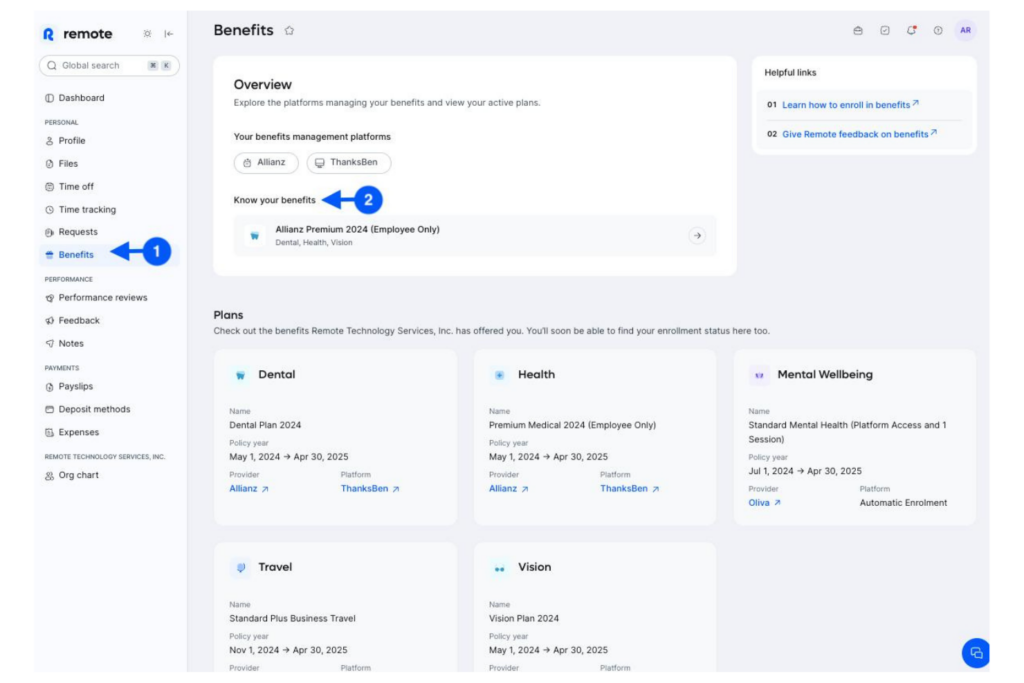
Within an EOR, benefits administration handles health, dental, vision, and retirement enrollment, tying eligibility to local compliance rules across every jurisdiction. In my experience, platforms like Deel and Justworks remove the overhead of managing separate carrier relationships by location—workers get consistent access without your team building country-specific expertise from scratch.
Benefits
The value of EOR benefits administration isn’t just enrollment. It gives employees access to locally appropriate benefits without your HR team having to build and maintain a separate benefits operation in every country.
That matters most when you’re hiring across several smaller markets, where managing individual carriers and local eligibility rules internally can quickly become disproportionate to headcount. The trade-off is less control over plan design, so check whether the provider’s packages are competitive in each market, not merely compliant.
Risks
Outsourcing benefits can limit how much control you have over plan design, carriers, and employee experience. Coverage that meets statutory requirements may also fall short of local employee expectations, which can create retention problems even when the plan is technically compliant.
Features
Benefits administration within an EOR covers more ground than simple enrollment—here's what the feature set actually looks like in practice:
- Local benefits plan configuration: The platform sets up health, dental, vision, and retirement plans that meet the statutory minimums and market norms for each country, so you're not sourcing separate carrier relationships per market. Justworks, for example, handles this across its supported regions without requiring your HR team to negotiate individual plans.
- Eligibility tracking and enrollment management: Workers are automatically enrolled in the correct benefit plans based on their location, employment type, and tenure. In my experience, this is where manual benefits management breaks down fastest—eligibility rules vary enough between jurisdictions that tracking them in a spreadsheet is a genuine liability.
- Statutory benefit compliance: Beyond voluntary benefits, your EOR monitors and administers legally mandated benefits like paid leave entitlements, parental leave, and public health contributions in each jurisdiction, updating plan configurations when regulations change.
- Open enrollment and life event workflows: The platform guides employees through annual enrollment periods and qualifying life events—new dependents, address changes, role transitions—without requiring your HR team to manage those touchpoints individually.
- Benefits cost reporting: You get a consolidated view of employer benefit costs across all jurisdictions, broken down by country and plan type. Deel surfaces this in its reporting dashboard, which I've found makes finance reconciliation significantly easier when you're running headcount across multiple regions.
- Employee self-service access: Workers view their coverage details, download plan documents, and update dependent information directly through the platform, reducing the volume of one-off requests your HR team fields.
- Benefits renewal management: Your EOR handles plan renewal negotiations and timeline coordination with carriers, flagging any coverage changes or cost adjustments before they take effect.
6. Employment Compliance and Risk Management
Staying on the right side of labor law in every country you hire from is one of the hardest parts of international growth—and it's where I've seen teams get burned most. EOR platforms like Deel and Remote monitor regulatory changes, flag classification risks, and manage statutory obligations across jurisdictions, keeping your workforce legally sound without requiring your HR team to become experts in every local employment code.
Benefits
Keeping up with labor law changes across multiple jurisdictions is genuinely one of the harder parts of managing a global workforce, and EOR platforms like Deel and Remote take that monitoring work off your plate entirely. In my experience, the real value isn't just staying compliant—it's catching classification risks and statutory obligation gaps before they become penalties. Your HR team gets to focus on people strategy instead of tracking regulatory updates in countries where you may only have a handful of workers.
Risks
Compliance monitoring reduces the burden on your internal team, but it shouldn’t become a substitute for legal judgment. Providers can miss edge cases or interpret rules differently, especially when your policies, worker arrangements, or business activities create unusual local requirements.
Features
Employment compliance and risk management within an EOR goes well beyond basic regulatory monitoring—here's what that feature set covers across a real global workforce:
- Multi-currency payroll: Calculates and pays workers in local currencies according to country-specific pay cycles.
- Tax and statutory contributions: Handles withholding, employer contributions, and remittance requirements by jurisdiction.
- Compliance updates: Adjusts payroll rules as tax rates and statutory requirements change.
- Reporting and filings: Consolidates payroll records, audit trails, and required year-end filings across countries.
- Termination compliance support: The EOR guides compliant and streamlined offboarding based on local notice period requirements, severance obligations, and documentation rules. I've found this especially valuable in jurisdictions where wrongful termination claims are easy to trigger if the process isn't followed precisely.
7. International Employee Onboarding
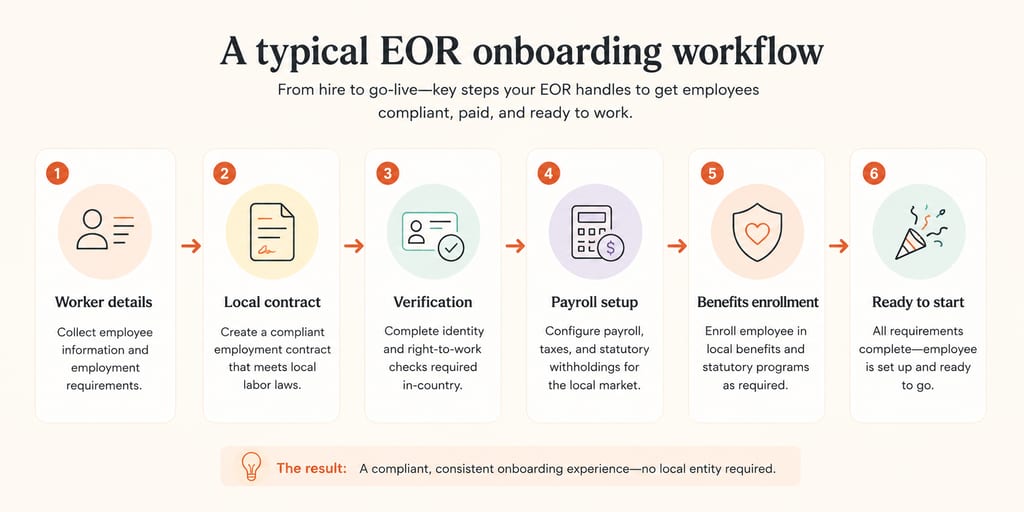
A typical EOR onboarding workflow moves from worker data and contract setup through verification, payroll, benefits, and go-live.
Cross-border onboarding is one of the heavier operational lifts in global expansion—EOR platforms handle ID verification, document collection, contract execution, and local compliance setup through a structured workflow. In my experience, this removes the manual back-and-forth that typically slows cross-border onboarding down and gets workers contributing faster.
Benefits
Cross-border onboarding is one of the heavier operational lifts in global expansion, and EOR platforms handle the hardest parts like ID verification, document collection, contract execution, and local compliance setup through a single structured workflow.
In my experience, this is where tools like Deel and Remote genuinely earn their keep: the manual back-and-forth that typically stalls international hires gets replaced by guided steps that keep both your team and the new worker on track.
The result is faster time-to-productivity without your HR team having to rebuild the process from scratch every time you enter a new market.
Risks
Automated onboarding can make global hiring faster, but incorrect employee data, compensation details, or documentation can flow directly into contracts and payroll. Delays are also still possible when right-to-work checks, registrations, or employee documentation depend on local authorities.
Features
International employee onboarding through an EOR replaces a fragmented, country-by-country setup process with a single guided workflow that handles the administrative and compliance heavy lifting for you:
- Identity verification: The platform collects and validates government-issued ID documents as part of the onboarding flow, removing the back-and-forth that typically delays cross-border hires. Deel handles this digitally, so workers submit documents through the platform without needing to mail anything or visit an office.
- Localized contract generation: Employment agreements are automatically drafted to meet jurisdiction-specific requirements—termination clauses, probationary periods, mandatory disclosures—so you're not templating contracts from scratch for every new market.
- Document collection and e-signature: The platform routes required documents to the right parties and captures legally valid signatures digitally. In my experience, this is where onboarding timelines compress the most—no more chasing PDFs across time zones.
- Local tax and payroll enrollment: New hires are enrolled in the correct payroll structure for their jurisdiction, including tax registrations and statutory deductions, without your team having to understand each country's specific setup requirements.
- Benefits enrollment: Workers are automatically enrolled in the applicable benefit plans based on their location and employment type, with the EOR handling carrier coordination so you don't have to.
- Compliance checklist management: The platform tracks jurisdiction-specific onboarding requirements and flags missing steps before they become compliance gaps. Remote, for example, surfaces these as task lists that both your team and the new hire can work through in parallel.
- Employee self-service onboarding portal: New hires complete their own onboarding steps—uploading documents, reviewing policy agreements, setting up payment details—through a guided interface, which reduces the volume of coordination your HR team has to manage directly.
8. Immigration and Work Authorization Support
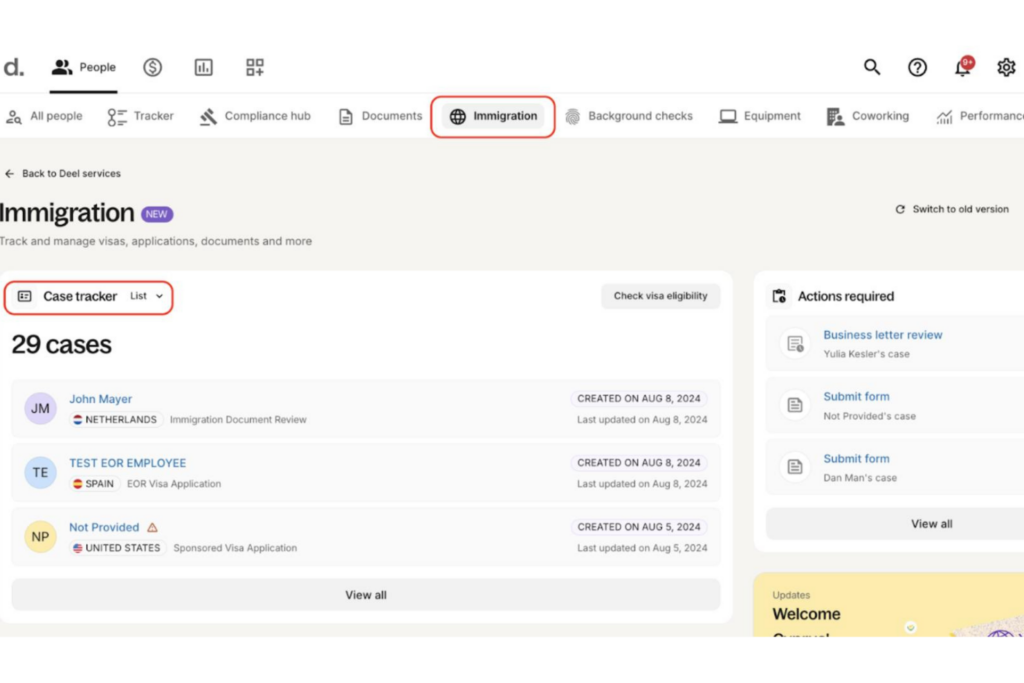
Hiring across borders means navigating visa categories, work permit timelines, and right-to-work documentation that vary significantly by country, and EOR platforms like Deel and Remote handle that coordination on your behalf.
In my experience, having immigration support built into the same platform as payroll and contracts removes a major handoff point that typically slows international hires down.
Benefits
Visa categories, work permit timelines, and right-to-work documentation vary so much by country that managing them manually is a real liability for growing teams. In my experience, having immigration support built into the same platform as payroll and contracts—the way Deel and Remote handle it—removes the handoff point where international hires most often stall. You're not coordinating between your HR team, a separate immigration service, and a local legal contact; it all lives in one place.
Risks
Immigration timelines are often outside the EOR’s control, so provider support doesn’t guarantee that a visa or permit will be approved on schedule. Eligibility rules can also change, making it risky to commit to start dates or relocations before work authorization is confirmed.
Features
Managing immigration through your EOR means the platform handles the coordination, documentation, and status tracking that would otherwise fall to your HR team or a separate legal service:
- Visa and permit application support: The EOR coordinates work permit and visa applications on behalf of your workers, managing the required documentation and submission process for each jurisdiction. Deel, for example, handles this across a wide range of countries through its immigration support offering.
- Right-to-work verification: The platform verifies that each worker is legally authorized to work in their location before the engagement begins, with documentation stored on the record in case of an audit.
- Immigration status tracking: The EOR monitors permit and visa expiration dates and flags upcoming renewals so your team isn't caught off guard by a lapse that puts a worker's status—or your compliance standing—at risk.
- Country-specific eligibility guidance: Before you initiate a hire, the platform surfaces what visa categories are available for a given worker profile and location, so you can make informed decisions early in the hiring process.
- Document collection and submission: Workers submit the required identity and immigration documents through the platform, and the EOR coordinates directly with relevant authorities. In my experience, centralizing this in one place cuts the back-and-forth that typically delays cross-border hires by weeks.
- Relocation coordination: For workers moving between countries, the EOR manages the immigration steps tied to that transition—new work authorization, updated contracts, and jurisdiction-specific enrollment—without your HR team having to start from scratch.
- Compliance documentation storage: All immigration records, approvals, and correspondence are stored within the platform with time-stamped logs, giving you a clear audit trail if a worker's authorization is ever questioned.
9. Professional Employer Organization (PEO) Services
Some EOR platforms extend into co-employment arrangements through PEO services, where the provider shares employer responsibilities with your business rather than acting as the sole employer of record. In my experience, this model works best for teams that want to retain more direct control over HR decisions while still offloading payroll administration, benefits management, and compliance support to the platform.
Benefits
The co-employment model gives your team more direct control over HR decisions while still offloading payroll administration, benefits management, and compliance support to the platform. In my experience, this is a meaningful distinction from a standard EOR arrangement—you're not handing off employer status entirely, which matters if your business needs tighter oversight of how people decisions get made. Rippling, for example, handles the administrative layer without removing your team from the loop on the things that actually shape employee experience.
Risks
Because a PEO uses a co-employment model, your company still retains meaningful employer responsibilities. That shared responsibility can create ambiguity around compliance, employee relations, and liability if the division of duties isn’t clearly defined in the service agreement.
Features
PEO services within an EOR platform give your team a co-employment structure that keeps HR administration off your plate without fully removing you from employer decisions:
- Co-employment arrangement: The PEO shares employer status with your business, meaning both parties carry defined responsibilities. In my experience, this gives your team more visibility and control over HR decisions than a standard EOR setup where the provider holds full employer status.
- Payroll administration: The PEO runs payroll on your behalf, handling tax withholdings, filings, and direct deposits across your workforce. Rippling, for example, manages this layer without pulling your team out of the loop on compensation decisions.
- Benefits procurement and management: PEO platforms pool workers across their client base to access group benefits rates that most individual businesses couldn't negotiate on their own. Workers get enrolled, and the PEO handles carrier coordination and plan administration.
- HR compliance support: The platform monitors regulatory changes and flags where your policies or practices need to be updated. I find this particularly useful for teams operating across multiple jurisdictions where employment law shifts frequently.
- Workers' compensation coverage: The PEO manages workers' compensation insurance on your behalf, including claims administration—an administrative lift most HR teams don't have the bandwidth to own directly.
- Employee handbook and policy management: The platform helps you build and maintain compliant policy documentation, with templates that reflect local requirements rather than generic defaults.
- HR support and advisory access: Most PEO platforms include access to HR specialists who can help your team navigate specific employment situations—performance management, terminations, leave policies—without requiring you to retain outside counsel.
10. Workforce Mobility and Relocation Services
Moving employees across borders triggers a cascade of immigration, payroll, and compliance changes that most HR teams aren't equipped to manage in parallel. In my experience, EOR platforms that include workforce mobility support handle this as a single coordinated process—updating work authorization, contracts, and jurisdiction-specific enrollment—so your team isn't rebuilding the setup from scratch every time someone relocates.
Benefits
Moving someone across borders isn't a single task—it's payroll changes, new contracts, updated work authorization, and jurisdiction-specific compliance all happening at once. In my experience, EOR platforms that handle workforce mobility as a single coordinated process save your HR team from juggling a half-dozen workstreams that each have their own deadlines and dependencies. Platforms like Deel manage these transitions end-to-end, so you're not rebuilding the employment setup from scratch every time someone relocates.
Risks
Relocation creates dependencies across immigration, payroll, tax, benefits, and employment law, so one delayed step can affect the entire move. There’s also a risk of triggering tax or permanent-establishment issues if the employee’s new location changes where the business is considered to operate.
Features
Workforce mobility through an EOR isn't just about moving someone—it's about keeping payroll, contracts, and compliance in sync across every jurisdiction involved:
- Cross-border payroll transition: When a worker relocates, the EOR switches their payroll setup to the new jurisdiction—new tax registrations, withholding rules, and currency—without requiring your team to dismantle and rebuild their employment record. In my experience, this is where most manual relocation processes break down.
- Work authorization management: The EOR handles updated visa and work permit applications tied to the move, coordinating documentation and submission so the worker's authorization is in place before they start in the new location. Deel, for example, manages this across a wide range of countries as part of its relocation support.
- Contract reissuance: A relocation means a new employment contract that reflects local labor law in the destination country. The EOR generates and executes compliant agreements, so you're not sourcing local legal counsel every time someone moves.
- Benefits re-enrollment: Workers relocating between countries need to be enrolled in locally compliant benefits from day one. The EOR handles disenrollment in the origin country and re-enrollment in the destination, including statutory benefits that vary by jurisdiction.
- Compliance gap monitoring: Before a relocation is finalized, the platform surfaces jurisdiction-specific requirements—notice periods, mandatory contributions, statutory entitlements—so your team isn't discovering compliance obligations after the fact.
- Relocation timeline coordination: The EOR tracks the interdependencies between immigration, payroll, and contract steps, flagging what needs to happen in what order. I find this particularly useful when multiple relocations are happening at once and each has different lead times.
- Ongoing status tracking: After the move, the platform monitors permit validity, tax status, and compliance standing in the new jurisdiction, alerting your team to renewals or regulatory changes before they become issues.
Not sure an EOR is the right model?
Depending on your headcount, existing entities, hiring timeline, and need for control, there are several alternatives to an employer of record, including local entities, contractors, PEOs, and global payroll providers.
Next Step: Understand What EOR Services Will Cost You
Once you know which EOR types fit your hiring model, pricing is usually the deciding factor—so it's worth reviewing how much an employer of record costs before you start comparing platforms.

