Employee Misclassification: Definition And How To Avoid It


Employee misclassification can lead to serious legal, financial, and compliance consequences—for both the employer and the worker. Even if the misclassification is accidental, that won’t protect your business from penalties, back pay claims, audits, or reputational damage.
What is Employee Misclassification?
Employee misclassification occurs when an employer incorrectly categorizes a worker, usually as an independent contractor, when legally they should be considered an employee.
The causes for misclassification are varied. However, some of the common scenarios are:

- The employer is unaware of employment rules and regulations (most common when hiring international talent).
- A contractor relationship that evolves over time and does not get reclassified.
- Intentional misclassification to avoid the additional cost of an employee
7 Tips to Avoid Employee Misclassification
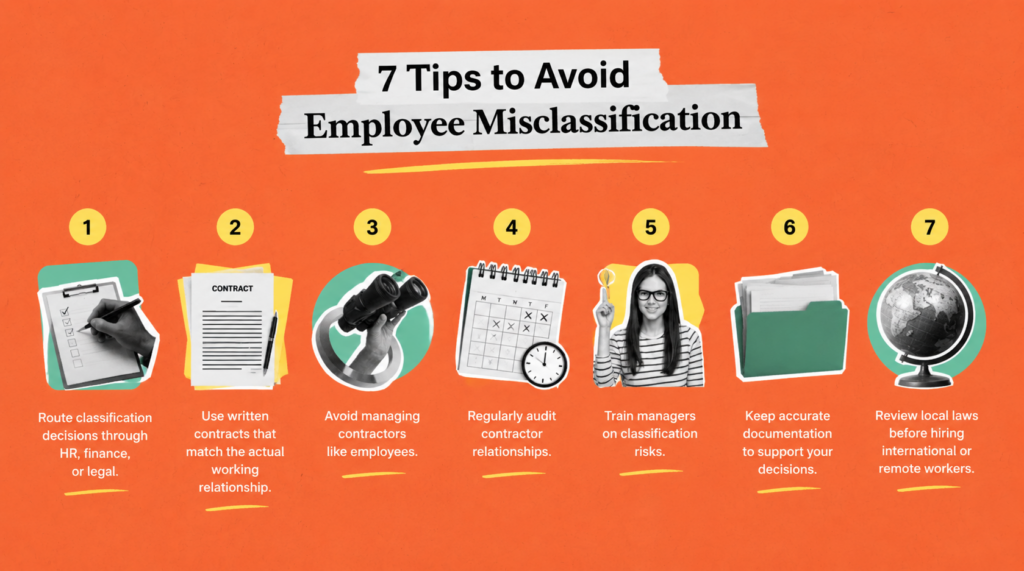
1. Don’t Let Managers Decide Worker Classification Alone
Worker classification should never be an informal decision made by a hiring manager trying to fill a role quickly. Before onboarding a contractor or freelancer, route the arrangement through HR, finance, or legal teams for review. This creates a documented approval process and reduces the risk of inconsistent classifications across departments.
2. Use Written Contracts That Match the Actual Working Relationship
A contract should clearly define whether the worker is an employee or an independent contractor, along with expectations around scope, timelines, payment terms, and autonomy. However, the day-to-day working relationship also needs to align with the contract. If someone is labeled as a contractor but managed like a full-time employee, the contract alone will not protect the company.
3. Avoid Managing Contractors Like Employees
Independent contractors should typically control how and when they complete their work. To reduce misclassification risk:
- Focus on deliverables instead of hours worked
- Avoid assigning fixed schedules when possible
- Limit mandatory internal meetings
- Refrain from using employee-style performance reviews
If a worker requires close supervision, fixed hours, and ongoing operational oversight, they may be better classified as an employee.
4. Regularly Audit Contractor Relationships
A worker’s role can evolve over time. Someone hired for a short-term project may gradually become embedded in daily operations, increasing misclassification risk. Conduct periodic reviews with HR or legal teams to evaluate:
- Length of engagement
- Level of supervision
- Scope of responsibilities
- Degree of independence
This is especially important for long-term contractors or remote teams.
5. Train Managers on Classification Risks
Many misclassification issues begin with well-intentioned managers who are unfamiliar with labor laws. Provide basic training on:
- The difference between employees and contractors
- What behaviors can create compliance risk
- When to escalate questions to HR or legal
Managers do not need to become employment law experts, but they should understand the operational boundaries involved.
6. Keep Accurate Documentation
Maintain records that support your classification decisions, including contracts, invoices, project scopes, and communications about the worker’s responsibilities. Documentation can help demonstrate that the company made a good-faith effort to comply with labor laws if questions arise later.
7. Review Local Laws Before Hiring International or Remote Workers
Classification rules vary significantly by country and region. A contractor arrangement that is acceptable in one jurisdiction may violate employment laws in another. Before hiring remote or international workers, consult local legal counsel or use an Employer of Record (EOR) service to ensure compliance with local labor and tax regulations.
Having adequate controls, internal audits, and a cadence for review—whether every 12 months or less—is critical for mitigating the risks of tax non-compliance and employee misclassification.

Legal Frameworks for Employee Misclassification
When in doubt, employers should refer to the standardized tests laid out by the Internal Revenue Service (IRS) or the Department of Labor (DOL) to ascertain the proper classification.
Fair Labor Standards Act
Established in 1938, the Fair Labor Standards Act (FLSA) is a US federal law that sets standards for minimum wage, overtime pay, recordkeeping, and child labor.
It is widely recognized as the main legislation that safeguards employee compensation practices. The FLSA encompasses full-time and part-time workers in the private sector and in federal, state, and local governments.
In terms of employee misclassification, the FLSA plays a critical role. Under the act, employers are obligated to classify workers as either employees or independent contractors. If a worker is incorrectly classified as an independent contractor, the employer may bypass specific obligations such as overtime pay and benefits.
The FLSA stipulates that employees must receive at least the federal minimum wage and must be paid for overtime hours, which helps counteract misclassification. The Department of Labor actively enforces these standards to ensure employees are receiving their lawful employment rights and benefits.
Misclassification in the USA
In the United States, misclassification occurs under the FLSA when businesses fail to distinguish between exempt and non-exempt employees.
Exempt employees are not entitled to overtime pay and typically perform executive, administrative, or professional duties. In contrast, non-exempt employees must receive overtime pay for hours worked beyond 40 in a workweek.
Misclassification happens when employees are incorrectly labeled as exempt to avoid paying overtime, even though their job duties and salary do not meet the FLSA’s criteria for exemption.
For example, a company might classify a receptionist as an exempt employee, even though their job duties and pay structure qualify them as non-exempt. If that receptionist regularly works more than 40 hours a week, the company would owe them overtime pay, and failing to do so could lead to legal action.
Misclassification in Canada
In Canada, the Canada Revenue Agency (CRA) uses a multifactor classification test to decide if a worker is an employee or a contractor. Key factors include:
- The degree of control an employer has over the worker's schedule and tasks
- Whether the worker provides their own tools and equipment, and
- If the worker has the chance of profit and risk of loss.
Employers who intentionally misclassify workers may face penalties or be held liable for their misclassification. In addition, there can also be significant tax implications resulting from employee misclassification.
Using Canadian payroll software or a specialized Canadian Employer of Record (EOR) service are two ways you can ensure proper worker classification and ongoing compliance with Canadian regulations.
Misclassification Abroad
Employee misclassification is a global issue and different nations have their own labor regulation laws and classification guidelines that must be followed if you plan to do business there.
Countries like the UK, France, and Germany have distinct legal systems and definitions in place for temporary, part-time, or freelance workers. Different legal proceedings are associated with each worker category, and misclassification can lead to fines, penalties, or legal proceedings.
For multinational companies, understanding each country's specific labor laws and keeping up-to-date is crucial to reducing misclassification risk.
However, to get those hassles off of your desk, there are also specialized EOR services for hiring within designated countries, including UK-specific EOR services, or global payroll services that can monitor compliance for all the countries you’re interested in engaging workers in.
Why Does Misclassification Happen?
Employee misclassification can arise from a variety of factors. Understanding the most common root causes of misclassification is a great way to proactively avoid this issue:
- Lack of Awareness: Employers with limited internal resources (especially small businesses or startups) may not be aware of the legal distinctions between employees and contractors, leading to accidental misclassification.
A lack of awareness is also compounded by how complex employment laws are, making it a challenge for employers to stay informed.
- Convenience: For some employers, classifying workers as independent contractors rather than employees is often seen as a simpler way to manage workforce costs and flexibility without delving into the complexities of employment classifications.
However, this convenience can come at the cost of violating labor laws and undermining worker rights.
- Ignorance of Consequences: Some employers may underestimate the legal and financial repercussions of misclassification. Ignorance of the consequences, such as potential penalties, back taxes, and damages for violating labor laws, can make misclassification seem like a low-risk decision.
Unfortunately, this misunderstanding does not protect companies from the significant liabilities that can arise from misclassification, including costly lawsuits and damage to the company's reputation.
- Industry-Specific Practices: In some industries, it's a common practice to engage workers as independent contractors rather than employees. This norm can be so ingrained that employers follow suit without considering the specific legal requirements or implications.
This is particularly common in the gig economy, construction, and consulting sectors, where flexibility and project-based work are valued.
- Complex Regulatory Environments: The criteria for determining employee status can vary significantly between jurisdictions and are subject to change. Employers operating in multiple regions or countries may find it challenging to keep up with the differing and evolving regulations, leading to unintentional misclassification.
This complexity makes it difficult for businesses to consistently apply the correct classification standards across their operations.
- Rapid Business Growth or Downsizing: Companies experiencing rapid growth or significant downsizing may misclassify employees as they try to scale their workforce quickly or cut costs.
In the rush to adapt to changing business needs, proper classification may be overlooked, leading to legal and financial complications down the road.
- Use of Third-Party Staffing Agencies: Businesses that hire workers through third-party staffing agencies might assume that the agency has correctly classified the workers, inadvertently leading to misclassification.
This delegation can lead to a lack of direct oversight and misunderstandings about who bears the responsibility for proper classification. (This is why it’s better to use an EOR service rather than a staffing agency.)
- Intentional Cost Savings: Sometimes the decision to misclassify employees is a deliberate strategy to reduce operational costs. By labeling employees as independent contractors, businesses can avoid paying for employee benefits, overtime, workers' compensation, and part of the Social Security and Medicare taxes.
While this might offer short-term financial savings, it is a risky maneuver that can lead to legal challenges and penalties, reflecting a clear intent to circumvent labor laws for financial gain.
Common Misclassification Misconceptions
Misclassifying employees as independent contractors can lead to significant legal and financial consequences for businesses. Here are some of the most common misconceptions you should be aware of:
- Issuing a 1099 form doesn't automatically make a worker a contractor.
The IRS and other legal bodies focus on the actual working relationship, especially the degree of control the business has over how the work is performed. A 1099 form is a tax reporting mechanism that doesn't remove the employer's responsibility to correctly classify its workers. - Working remotely doesn't mean that someone is an independent contractor.
Remote work alone doesn’t classify someone as an independent contractor. Employment status is determined by the level of control and the nature of the job, regardless of location. The key distinction is how much control the employer exercises over the work. - Independent contractor agreements don't guarantee compliance.
Having an independent contractor agreement in place doesn't mean the classification is correct. Government agencies like the Department of Labor and the IRS look at the actual substance of the working relationship—such as who controls the work, how payments are made, and how integrated the worker is into the company—rather than just what is written in the contract. - Having an LLC or EIN doesn't automatically classify someone as a contractor.
Even if a worker owns a Limited Liability Company (LLC) or has an Employer Identification Number (EIN), it doesn’t automatically mean they are an independent contractor. What truly matters is whether the person operates as an independent business with significant control over their work, or if they're subject to company supervision, which would suggest they are an employee.
Staying Ahead of Employee Misclassification
Employee misclassification can lead to costly legal penalties, back payments, and operational disruptions. To safeguard your business, it’s crucial to stay updated on misclassification laws, especially as they change across jurisdictions and industries.
Relying on an Employer of Record or Agent of Record (AOR) service is an effective way to ensure global compliance, as these services help manage the complex regulations surrounding tax compliance, payroll, and local labor laws (you can read about the difference in out guide to AOR vs EOR).
Deel was a way to guarantee that we were properly classifying [employees] correctly and also making sure we are paying the right taxes and dues to the government. Otherwise, it could be really costly afterward.
To further protect your company, it’s important to regularly audit your worker classifications. By proactively reviewing your workforce and adjusting classifications when necessary, you can reduce the risk of misclassification, avoid significant fines, and maintain smooth business operations.
Staying informed and proactive, and leaning on international HR experts for assistance, will help your business remain compliant with employment regulations across multiple jurisdictions, giving you peace of mind.
Join Us For More Hiring Insights
To remain up to date on all the latest in people management, subscribe to our newsletter for leaders and managers. You'll receive insights and offerings tailored to leaders and HR professionals straight to your inbox.