

10 Best Employer of Record in Canada: Reviewed in 2026

10 Best Canadian Employer of Record Shortlist


The best employer of record in Canada helps you hire, pay, and manage Canadian employees, without needing to open a local entity or learn the intricacies of Canadian labor law.
Whether you already have remote staff in Canada or are exploring the idea of hiring north of the border for the first time, you might be running into some big challenges. Setting up a legal presence, handling payroll taxes, complying with provincial labor rules—it’s a lot to take on, especially when your focus should be on building a great team.
That’s where Canadian EOR services come in. They take care of HR admin, payroll, benefits, and compliance for your Canadian hires so you can onboard faster, avoid legal pitfalls, and stay focused on scaling your business.
As a Canadian HR professional, I've created this guide to help you confidently choose the right partner to hire and manage Canadian employees. I’ll also share insights from my experience navigating the Canadian employment landscape, so you know exactly what to expect.
Now, let’s dive into the top options and get you started—faster, and without the usual headaches.
Why Trust Our Software Recommendations
Our team has been testing and reviewing software since 2012. As HR experts ourselves, we know how difficult—and important—it is to choose the right software.
For this guide, we evaluated tools using hands-on testing and independent research, scoring tools using our selection criteria. We also draw on insights from industry thought leaders and practicing HR experts.
Our reviews reflect our human editorial judgment, not a sales pitch.
Expert reviewers:
Employer of Record Canada Comparison Table
This comparison table summarizes pricing details about for my top Employer of Record selections:
| Tool | Best For | Trial Info | Price | ||
|---|---|---|---|---|---|
| 1 | Best for compliant hiring under Canadian labor law | Free demo available | From $599/employee/month | Website | |
| 2 | Best support for full-time and contractor hiring | Free demo available | From $599/employee/month | Website | |
| 3 | Best for budget-conscious remote team expansion | Free demo available | From $199/user/month | Website | |
| 4 | Best for consistent employee experience | Free demo available | From $399/employee/month | Website | |
| 5 | Best for quick employee onboarding | Free demo available | From $459/user/month (billed annually) | Website | |
| 6 | Best for employee onboarding tools | Not available | From $599/employee/month | Website | |
| 7 | Best for 24/5 dedicated support | Free demo available | Pricing upon request | Website | |
| 8 | Best for direct hiring in Canada | Free demo available | From $99/employee/month | Website | |
| 9 | Best for competitive benefits packages | Free demo available | From $599/user/month | Website | |
| 10 | Best for comprehensive compliance | Free demo available | From $549/employee/month | Website |


Reviews of the Best Employer of Record for Canada
To help you find the best Canadian EOR service for you, I’ve described my top 10 selections in detail, including the specific services each provider offers, and how HR teams can use them. I’ve also included 10 more EOR service providers for Canada below if you’d like even more options to choose from.

Best for compliant hiring under Canadian labor law
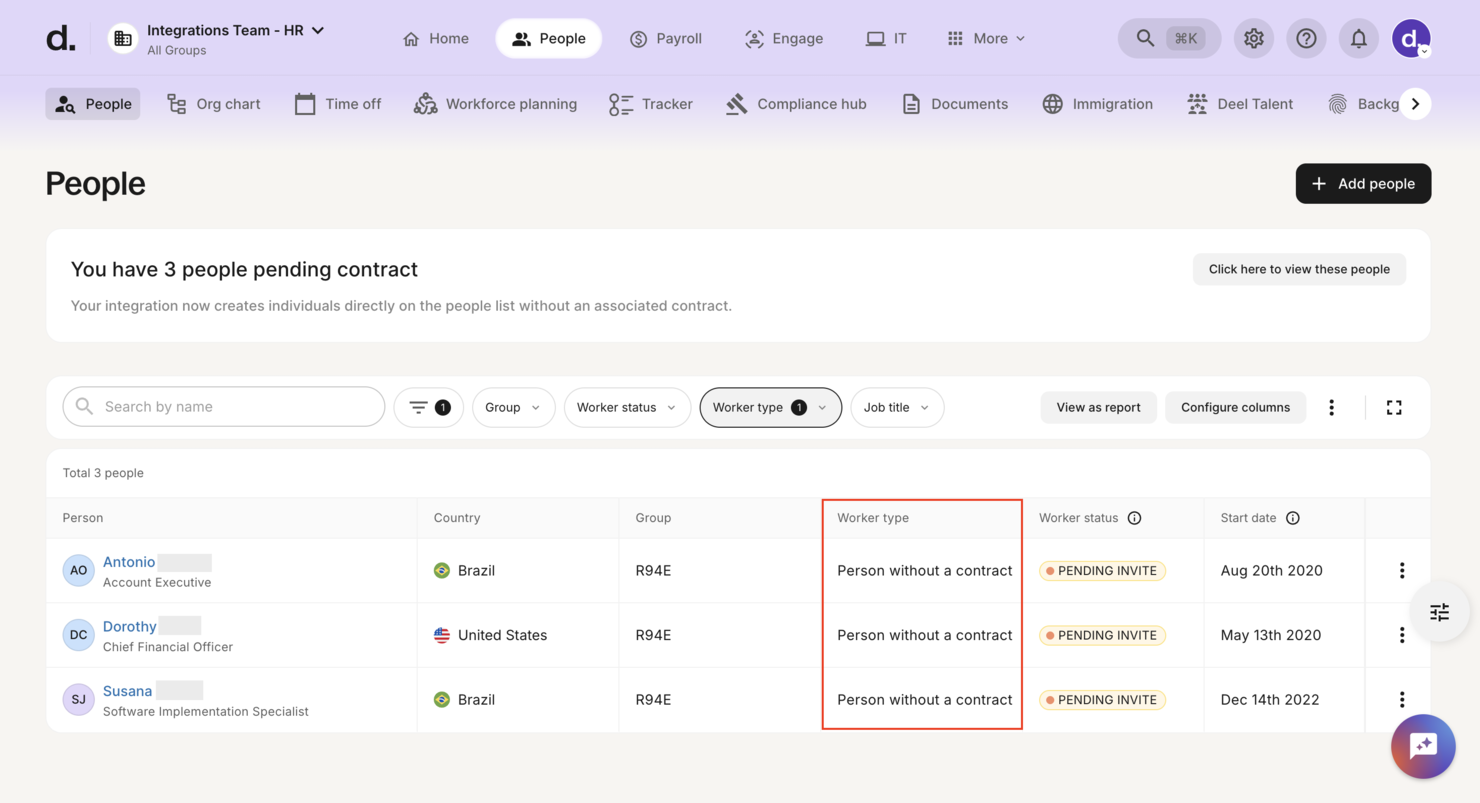
Deel Hire is an employer of record platform built for hiring full-time employees in Canada and 150+ countries, managing provincial tax compliance, payroll, employment contracts, and benefits from a single platform.
Who Is Deel Hire Best For?
Deel Hire is a natural fit for mid-size to enterprise companies hiring across multiple Canadian provinces, especially those with employees in Quebec who need bilingual HR support.
Why I Picked Deel Hire
I've included Deel Hire in my top picks because its bilingual support—in both English and French—is something I genuinely can't overlook when hiring in Canada. Quebec employment law operates under a distinct legal framework from the rest of Canada, and Deel's in-house team of 250+ local experts navigates that complexity directly. I also like that Deel builds ManuLife healthcare options and Wealthsimple pension plans right into its benefits dashboard, so Canadian employees get locally relevant coverage without you sourcing it separately.
Deel Hire Key Services
- IP protection clauses: Embeds intellectual property assignment language directly into every employment contract, so IP ownership transfers to your company from day one.
- Regulatory change monitoring: Tracks and flags upcoming Canadian labor law and tax changes across all provinces, so your employment terms stay current without manual review.
- Onboarding manager assignment: Pairs each new hire with a dedicated onboarding manager who guides employees through documentation, contract signing, and account setup.
- Talent sourcing via agency partners: Lets you post job requests directly in Deel and receive agency-sourced candidates, moving from search to EOR onboarding in one workflow.
Deel Hire Integrations
Deel offers a large app store with integrations across HR, accounting, and productivity categories, including BambooHR, Workday, NetSuite, QuickBooks, Xero, Expensify, Sage Intacct, Microsoft Dynamics 365, and UKG Ready. It also connects with Zapier and provides an API for custom integrations with your existing HRIS, finance, and ERP systems.
Pros and Cons
Pros:
- Cost-calculator aids budgeting for Canadian hires
- Maintains a Canadian entity—reduces entity-setup headaches
- Onboards Canadian employees in as little as 1 day
Cons:
- Some advanced HR duties (e.g., local termination strategy) may still require internal review
- Customization of benefits packages may be limited in smaller plans

G-P
Best support for full-time and contractor hiring
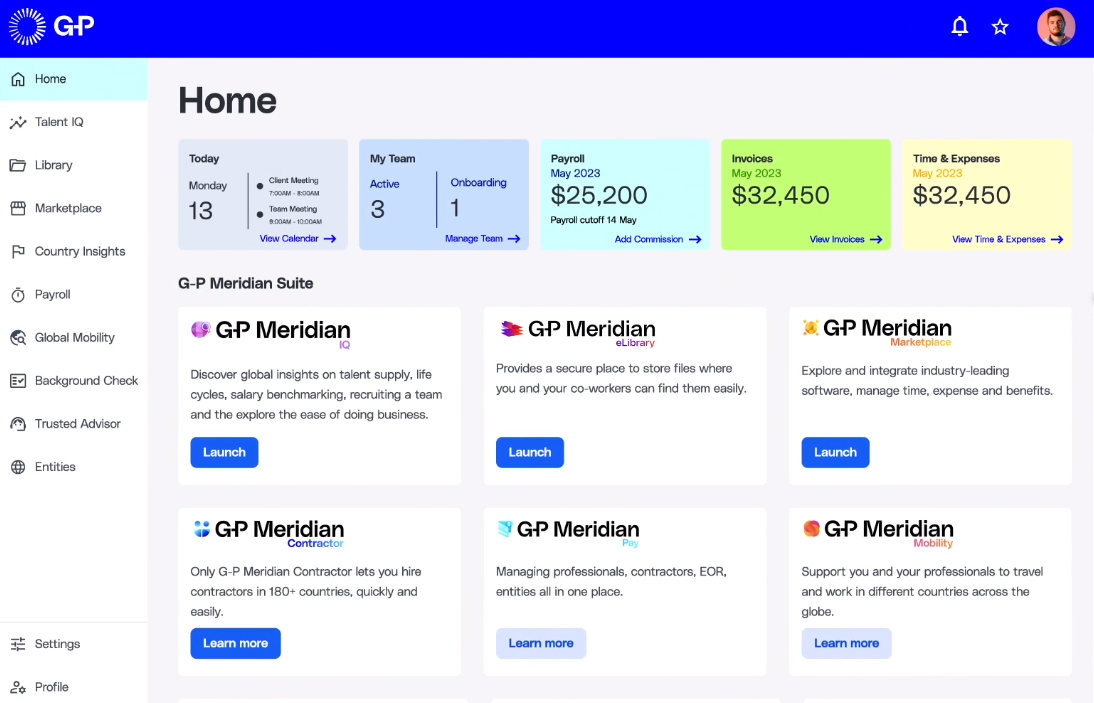
G-P is an AI-powered employer of record platform that manages employment contracts, payroll, tax remittances, and benefits administration for Canadian hires across all provinces and territories.
Who Is G-P Best For?
G-P is a strong fit for mid-size to enterprise companies expanding into Canada who need a well-established EOR with broad provincial coverage.
Why I Picked G-P
G-P earns its spot as one of the best on my shortlist because of how it handles Canada's dual-regulatory environment. I particularly like G-P Gia™, an AI-powered HR agent that generates locally compliant contracts and provides real-time compliance guidance—useful when hiring across provinces with different rules, like Ontario's 44-hour overtime threshold versus Québec's 40-hour one. The platform also manages CPP contributions, EI remittances, and bilingual documentation for Québec hires, which I've found removes a significant layer of compliance risk for teams without a local entity.
G-P Key Services
- Statutory holiday tracking: Automatically tracks and administers correct holiday entitlements based on each employee's province of work.
- Supplemental benefits administration: Provides access to group benefits packages covering prescription drugs, dental, vision, and paramedical services for Canadian hires.
- Termination and severance guidance: Calculates statutory notice periods and common law reasonable notice requirements across provinces to reduce legal risk.
- Multi-province payroll tax remittance: Manages federal and provincial income tax withholdings, CPP, and EI contributions for employees across all Canadian jurisdictions.
G-P Integrations
G-P offers native integrations with ADP TotalSource, ADP Workforce Now, Paylocity, BambooHR, Personio, TriNet, UKG Pro, UKG Ready, Workday, SAP SuccessFactors, HiBob, Microsoft Entra ID, Google Workspace, and Okta/Auth0. An API is also available for one-way or bi-directional custom integrations.
Pros and Cons
Pros:
- Local experts manage complex provincial labor laws
- Reduces misclassification risk with legal review and clear workflows
- Supports both full-time and contractor hiring under one system
Cons:
- Advanced analytics limited to higher-tier plans
- Integrations beyond listed HR systems may require setup help

Best for budget-conscious remote team expansion
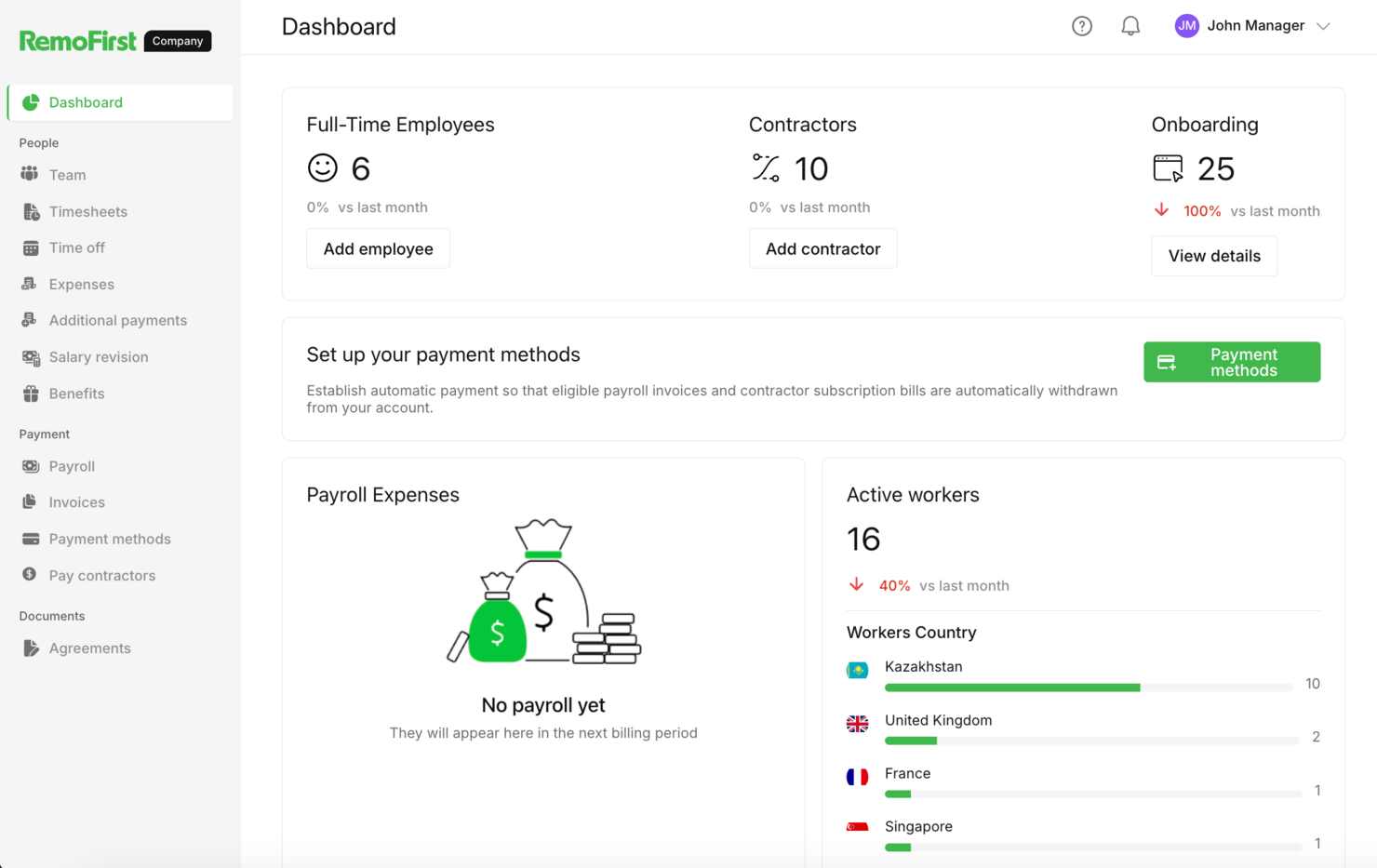
RemoFirst is a global employer of record platform that handles Canadian and international payroll processing, employment contracts, tax filings, and benefits administration across 180+ countries.
Who Is RemoFirst Best For?
RemoFirst is a strong option for budget-conscious startups and growing companies that need to hire in Canada and across multiple countries simultaneously, without paying premium EOR rates.
Why I Picked RemoFirst
RemoFirst earns its spot on my shortlist because its $199/month flat rate makes it one of the most cost-effective EOR options available for hiring in Canada. I picked it specifically because that rate doesn't jump based on country complexity—so hiring a Canadian employee costs the same as hiring in most other markets. The same-day onboarding feature is something I think teams hiring quickly will genuinely appreciate, letting you get a Canadian employee into the system without the multi-week timelines typical of larger EOR providers. RemoFirst also holds strong ratings on G2 and Capterra, which adds confidence when vetting a newer platform.
RemoFirst Key Services
- Localized employment contracts: Generates employment contracts built to Canadian and local labor law standards, including province-specific working hours, notice periods, and termination requirements.
- Aggregated global payroll invoicing: Combines payroll across your entire international team into a single monthly invoice, paid in your preferred currency while employees are paid in their local currency.
- Contractor-to-employee conversion: Converts international contractors to full-time employees with compliant documentation, re-enrollment in payroll, and updated benefits without disrupting day-to-day work.
- Equipment provisioning: Sources and ships laptops and work equipment directly to new Canadian and international hires as part of the onboarding process.
RemoFirst Integrations
RemoFirst offers a small set of native integrations, including BambooHR, ADP Workforce Now, and GoCardless. Compared to more established EOR competitors, this is a limited selection, so teams with a larger HR tech stack should note that RemoFirst has an API for custom integrations to fill the gaps.
Pros and Cons
Pros:
- Transparent pricing with no hidden setup or termination fees
- Dedicated account manager gives you a consistent point of contact
- Lower monthly cost per employee compared with many large EOR providers
Cons:
- Integration depth and customization may be less mature
- Some advanced reporting and analytics features are limited

Pebl
Best for consistent employee experience
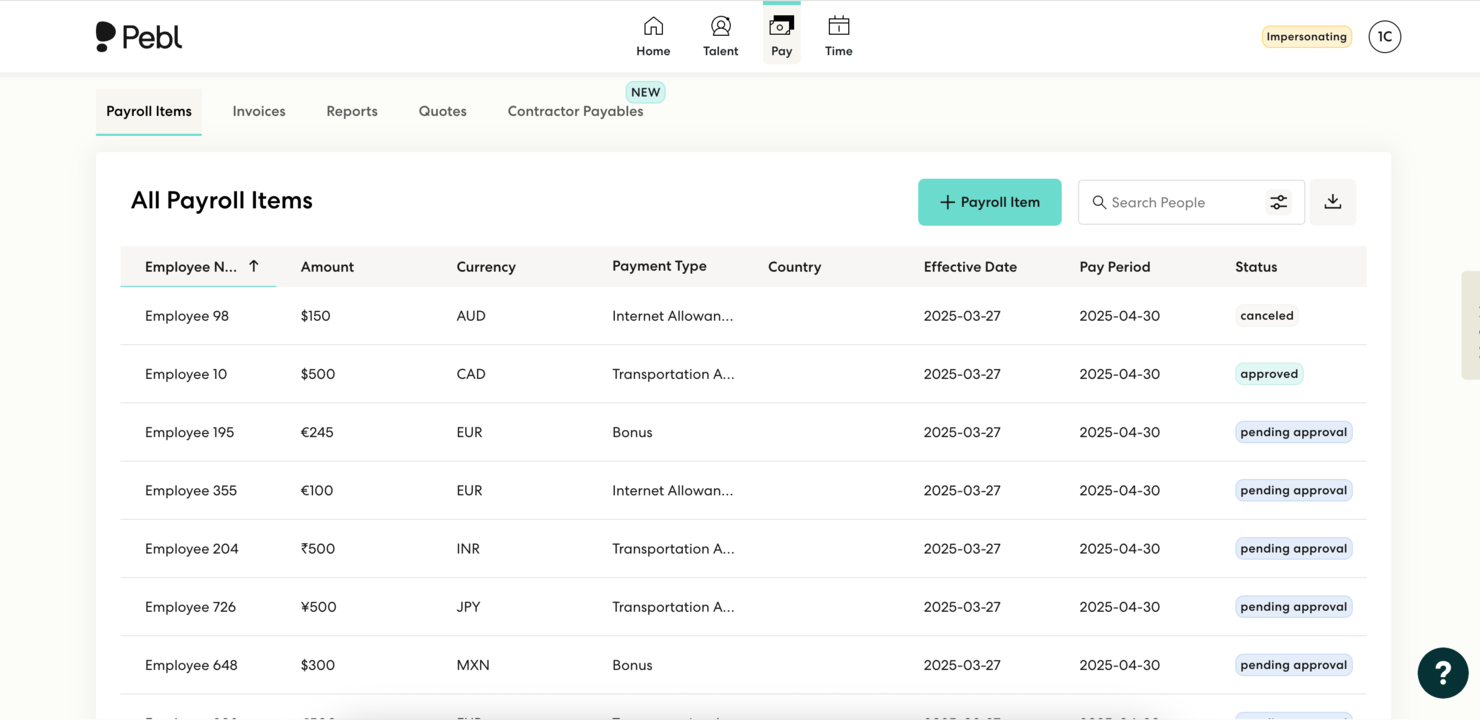
Pebl is an employer of record and global hiring platform covering payroll, benefits, immigration, and compliance across 185+ countries, including a dedicated Canada EOR offering.
Who Is Pebl Best For?
Pebl is a strong fit for growth-stage companies testing or expanding into Canada and other global markets without the time or budget to set up a legal entity.
Why I Picked Pebl
I've included Pebl in my top picks because it's one of the few EOR platforms that covers Canada as part of a genuinely built-out global infrastructure, not a bolted-on market. I like that Pebl's own regional teams manage every account with no third-party brokers involved. That means one dedicated account manager handles payroll, benefits, and compliance filings for your Canadian hires. Quarterly compliance reviews add another layer of protection against local labor law changes.
Pebl Key Services
- Locally compliant contract generation: Draft and send employment contracts tailored to Canadian provincial and federal labor requirements directly from the platform.
- Payroll tax calculation and filing: Pebl calculates, withholds, and remits Canadian payroll taxes, including CPP contributions and provincial tax obligations.
- Leave and PTO tracking: Track statutory leave entitlements for Canadian employees, including parental leave, sick leave, and annual leave, within a centralized platform.
- Contractor-to-employee conversion: Convert existing Canadian contractors to full-time employees while managing misclassification risk and staying compliant with the Canada Labour Code.
Pebl Integrations
Pebl offers 250+ integrations across HR, payroll, finance, and recruiting categories, including Greenhouse, BambooHR, Workday, ADP Workforce Now, Namely, NetSuite, QuickBooks, SAP Concur, Slack, and UKG Pro. An API is also available for custom integrations.
Pros and Cons
Pros:
- Offers dedicated in-country HR and legal support for employees
- Employee portal improves transparency and engagement
- Centralized dashboard for HR and finance oversight
Cons:
- Better suited for long-term employment than short-term contracts
- Limited integrations beyond core HRIS platforms

Best for quick employee onboarding
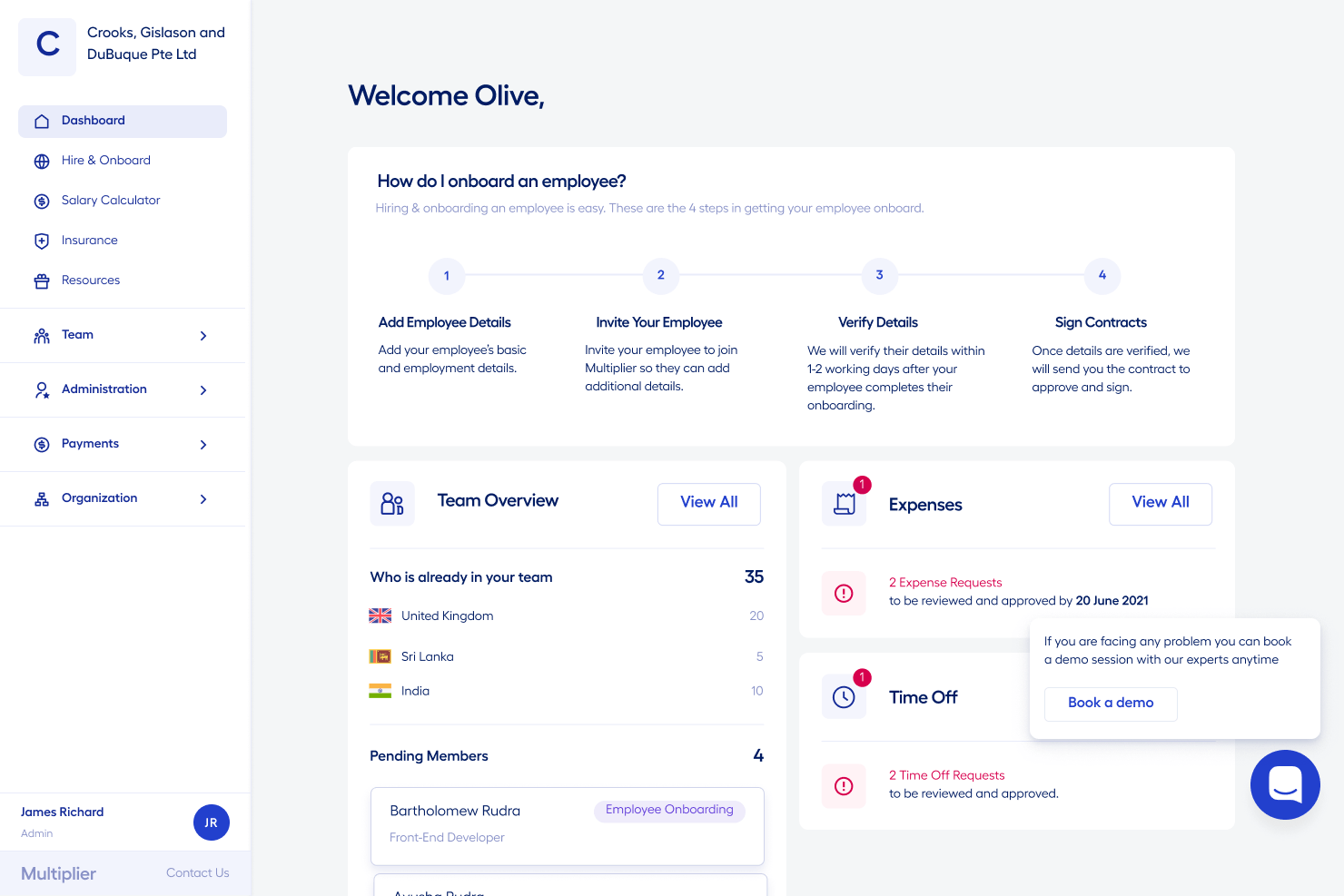
Multiplier is a global EOR platform that lets companies hire, onboard, pay, and manage full-time employees and contractors across 150+ countries, with built-in compliance for local labor laws, payroll, and benefits administration.
Who Is Multiplier Best For?
Multiplier is a strong fit for fast-growing startups and mid-sized companies that need to hire Canadian employees quickly without the overhead of incorporating locally.
Why I Picked Multiplier
Multiplier earns its spot on my shortlist because of how fast it gets Canadian hires onboarded and on payroll. I've seen companies go from signed offer to active employee in days rather than months, with locally compliant employment contracts drafted automatically within the platform. I also like that Multiplier handles CPP, EI, and provincial tax filings natively, so your team isn't manually tracking federal and provincial obligations across different jurisdictions.
Multiplier Key Services
- Benefits package builder: Design and offer benefits that include CPP, EI, healthcare, and retirement plans tailored to Canadian provincial standards.
- Employee cost calculator: Estimate total hiring costs in Canada, including salary, taxes, and statutory contributions, before making an offer.
- Contractor of record management: Onboard and pay independent contractors in Canada through the same platform as full-time employees.
- Compliant offboarding workflow: Manage severance payments, final documentation, and exit processes in line with Canadian employment law.
Multiplier Integrations
Multiplier has fewer than 10 native integrations, including popular HRIS and accounting systems like BambooHR, Personio, and QuickBooks. For systems without native connectors, you can use Multiplier's API to build custom integrations and automate data syncs.
Pros and Cons
Pros:
- Handles both employees and contractors together
- Fast onboarding typically within 24-72 hours
- Owns entities in 100+ countries directly
Cons:
- Hidden FX fees not disclosed upfront
- Support slower outside Asia-Pacific business hours

Best for employee onboarding tools
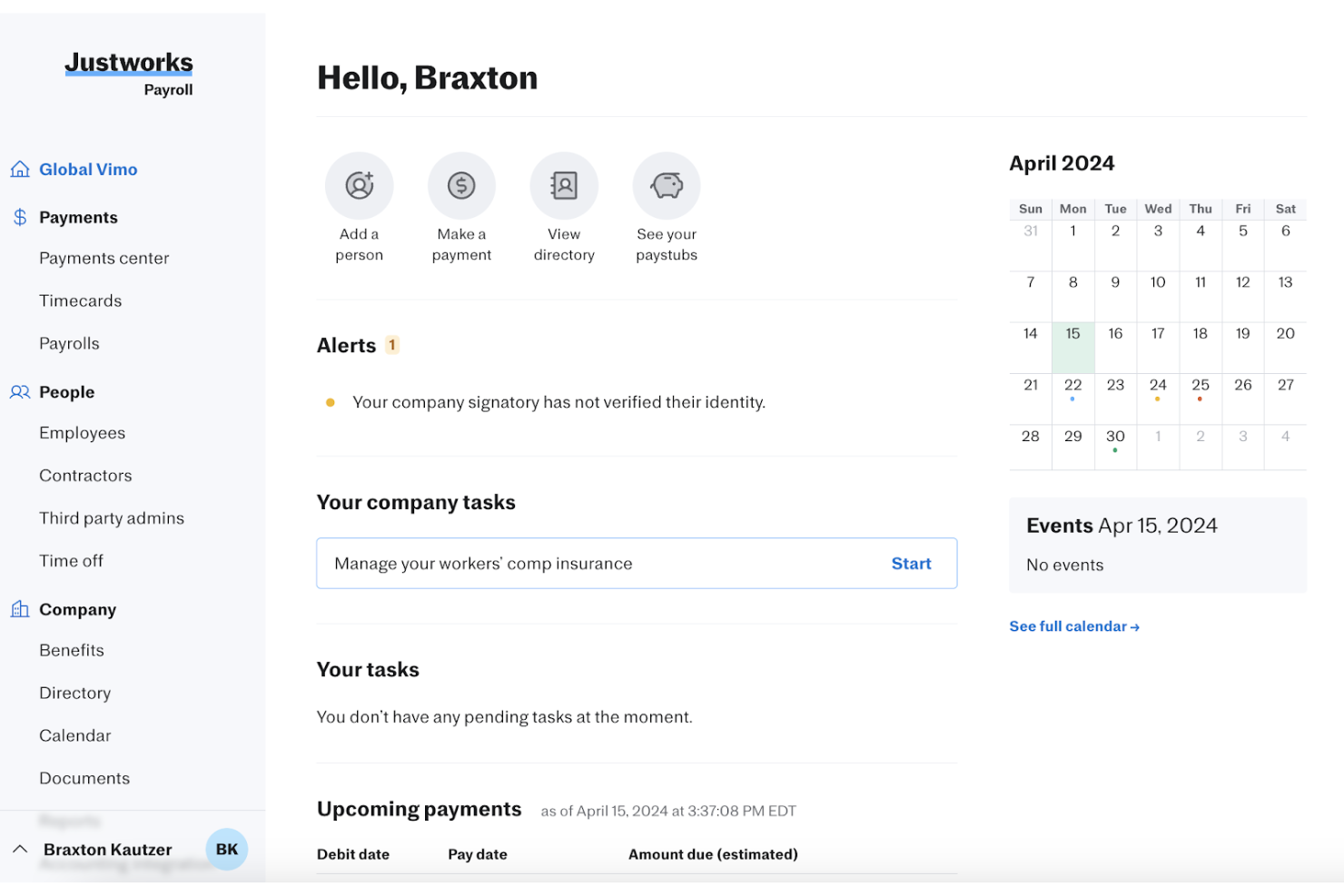
Justworks EOR is a global employer of record platform covering Canadian hiring, onboarding, payroll, benefits administration, tax compliance, and full employee lifecycle management from a single platform.
Who Is Justworks Best For?
Justworks is a natural fit for US-based small and mid-sized businesses hiring their first Canadian employees and needing guided compliance support without building local HR expertise in-house.
Why I Picked Justworks
Justworks earns its spot on my shortlist because of how well it handles the full Canadian employee lifecycle from a single platform. What I particularly like is the 24/7 multilingual support through Travel Assist, which covers emergency medical, legal, and security needs for Canadian hires traveling internationally. Justworks also includes built-in cost calculators, so you can see the true cost of a Canadian hire before committing, factoring in CPP contributions, employment insurance, and local benefits.
Justworks Key Services
- Local currency payroll: Pay Canadian employees directly in CAD from a single platform alongside any US-based employees.
- In-platform benefits quoting: Use self-service quoting and benefits selection tools to compare and choose Canadian benefits plans without leaving the platform.
- PTO and time tracking: Manage Canadian employee paid time off requests and time tracking from a centralized dashboard.
- Document storage: Store and manage Canadian employment records, contracts, and HR documents directly within the platform.
Justworks Integrations
Justworks offers a curated set of native integrations including 15Five, allwhere, Brex, Culture Amp, Electric AI, JazzHR, Leapsome, Lever, Ramp, and Vanta, as well as accounting integrations with QuickBooks, NetSuite, Xero, and Sage Intacct. Additional connectivity is available through integration platforms like Merge and Finch, and Justworks also has a Partner API for building custom integrations.
Pros and Cons
Pros:
- Straightforward onboarding workflow for new hires
- Automated payroll tax filings
- Mobile app lets employees view paystubs, benefits, PTO, and time tracking
Cons:
- Feature depth may feel light for larger, highly regulated companies
- Limited customization for workflows, approvals, and complex org structures

Best for 24/5 dedicated support
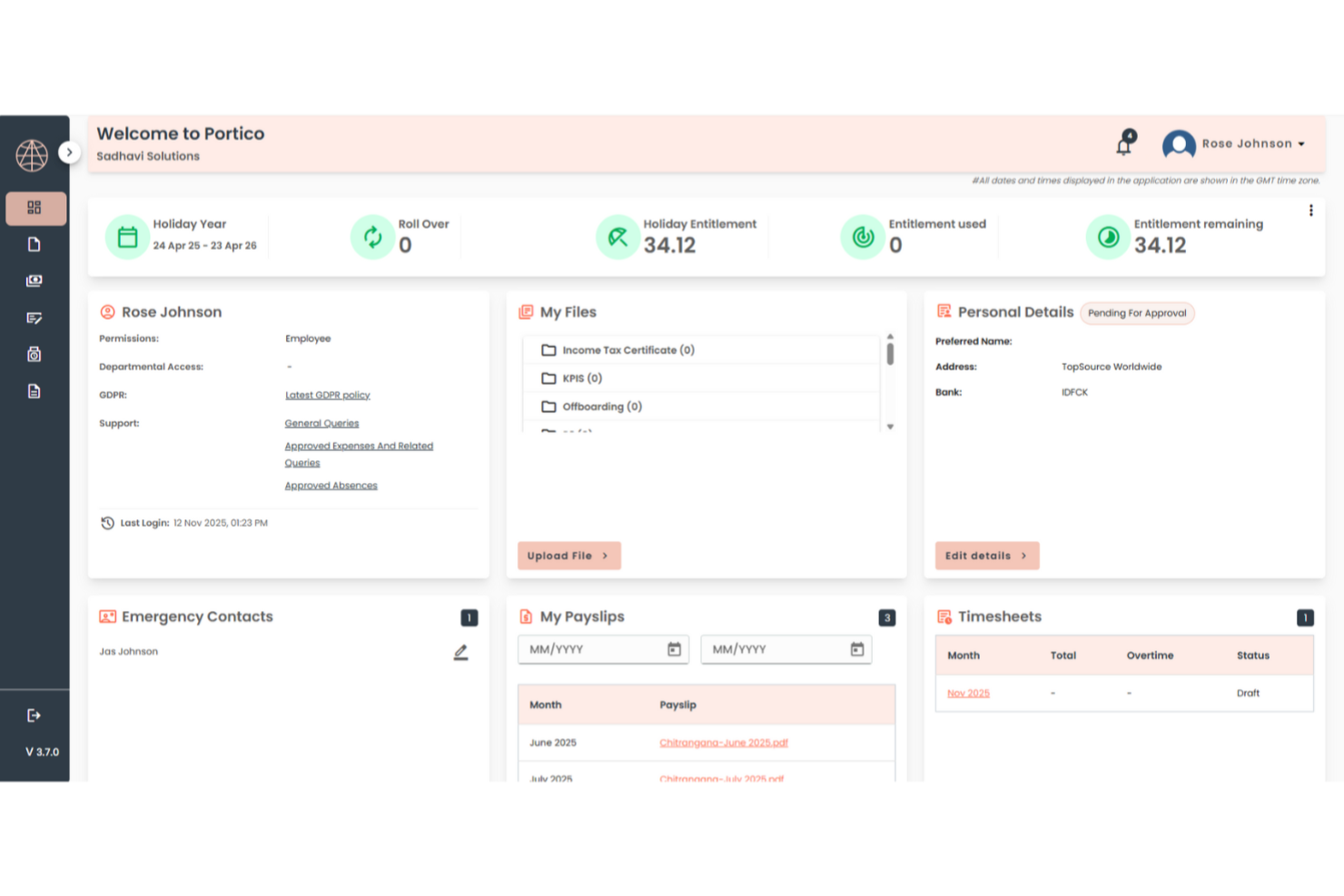
TopSource Worldwide is an employer of record platform that manages compliant hiring, multi-province payroll, contract localization, and statutory benefits administration across Canada and 160+ countries.
Who Is TopSource Best For?
TopSource is a strong fit for compliance-sensitive teams hiring across multiple Canadian provinces who want a named human contact rather than a support ticket queue.
Why I Picked TopSource
I've included TopSource in my top picks because its 24/5 support model genuinely sets it apart: you get a named account manager, in-country HR and payroll specialists, and a direct phone line staffed by real people, with no chatbots or ticket queues. When I'm navigating something like Quebec's distinct payroll system (QPP, QPIP, RL-1 filings, and Bill 96 French-language requirements), having a specialist I can actually call makes a real operational difference.
TopSource Key Services
- Multi-province payroll processing: Runs compliant payroll across all 13 Canadian provinces and territories, handling CPP, CPP2, EI, QPP, QPIP, and provincial employer taxes.
- Quebec-specific compliance tools: Manages RL-1 filings, Health Services Fund contributions, and French-language contract requirements under Bill 96 and the Charter of the French Language.
- Cost calculator: Lets you enter a gross salary and province to estimate total monthly employer costs, including all statutory contributions.
- Portico platform: A web and mobile app with AI-powered expense capture, GPS attendance tracking, leave management, and pre-approval payroll reporting.
TopSource Integrations
TopSource supports integrations with BambooHR, HiBob, Workday, SAP, Personio, and more. Its API connects with HRIS, ATS, payroll, finance, and accounting systems for custom integrations.
Pros and Cons
Pros:
- Clear path from EOR to entity
- Quebec payroll expertise reduces compliance risk
- Dedicated 24/5 human support
Cons:
- Reviews cite delayed issue resolution
- Weekend support is unavailable

Best for direct hiring in Canada
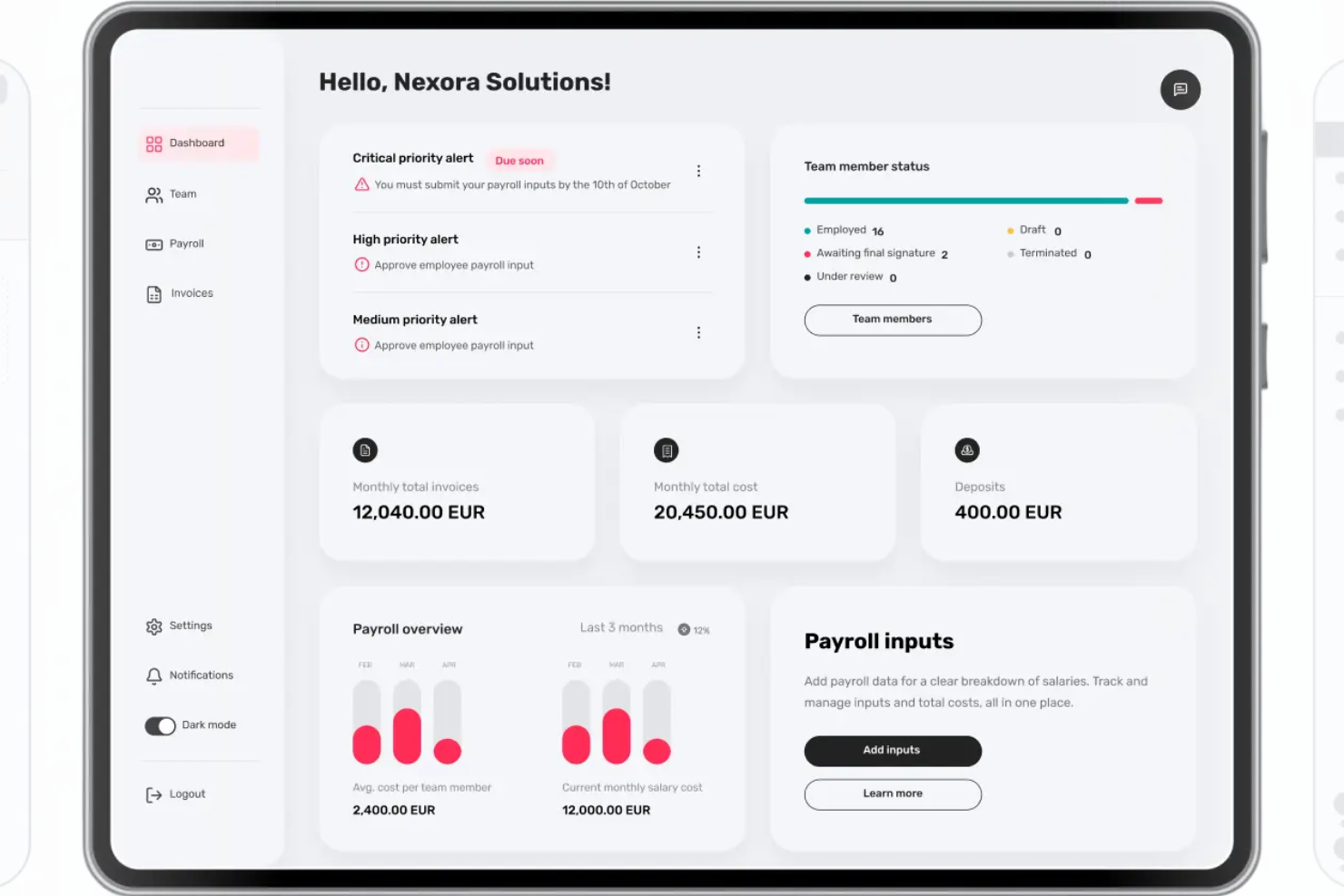
Native Teams is an employer of record and work payments platform that covers Canadian hiring, payroll processing, tax compliance, benefits administration, and employment contract management across 95+ countries.
Who Is Native Teams Best For?
Native Teams is a good fit for startups and scaling companies that need to hire in Canada as part of a broader international expansion, without setting up a local entity in every country they enter.
Why I Picked Native Teams
Native Teams earns its spot on my shortlist because its payroll calculator covers 95+ countries, letting me model salary, taxes, and deductions for Canadian hires before I commit to an offer. I also like that its platform bundles absence management, expense tracking, and employment contract generation into a single dashboard. That setup means I'm not juggling separate tools just to handle day-to-day people operations for a Canadian team.
Native Teams Key Services
- Global employee benefits management: Offer healthcare, insurance, and pension packages to Canadian hires through Native Teams' benefits administration tools.
- Onboarding and offboarding workflows: Manage the full employee lifecycle, including all required documentation for Canadian hires entering or exiting your organization.
- Work permit and visa support: Get assistance sponsoring work permits for foreign nationals you're hiring into Canada.
- HR documentation automation: Auto-generate required HR documents for Canadian employees, accessible from a central dashboard.
Native Teams Integrations
Native Teams offers a smaller set of integrations compared to larger EOR competitors. According to user-reported data on GetApp, integrations include Gmail, Google Docs, Dropbox Business, Microsoft Outlook, OneDrive, Slack, and pCloud Business. An API is listed among its features, but Zapier support is not clearly documented.
Pros and Cons
Pros:
- Centralized payroll visibility in CAD
- Handles mandatory payroll deductions (CPP/QPP, EI) automatically
- Strong compliance across Canadian federal and provincial regulations
Cons:
- Benefits customisation may vary by province
- Limited advanced functionality beyond core employment needs

Remote
Best for competitive benefits packages

Remote is a global employer of record platform that lets you hire and pay employees in Canada without setting up a local entity, handling payroll, compliance, benefits administration, and contracts through its own in-house Canadian legal entity.
Who Is Remote Best For?
Remote is a strong fit for HR teams and startup founders who want to hire Canadian employees quickly, without setting up a local entity, and with access to a wide range of customizable benefits options.
Why I Picked Remote
Remote earns its spot on my shortlist because of its five-tier Canadian benefits structure, which goes well beyond what most employer of record platforms offer. I'm particularly impressed by the RRSP employer match of up to 7%, STD and LTD coverage, and a wellness wallet that runs up to $300 USD per month. Quebec employees are also covered under RAMQ-compliant family plan rules, which is a detail many platforms overlook.
Remote Key Services
- Compliance Watchtower: Remote's in-house legal team monitors employment law changes across 90+ countries, including Canadian federal and provincial updates, and applies them automatically.
- Remote IP Guard: Every EOR contract includes built-in IP protection and moral-rights waivers, keeping your company's intellectual property secure from day one.
- Contractor-to-employee conversion tools: Remote provides a misclassification risk calculator and guided conversion workflow to move Canadian contractors onto compliant employment contracts.
- In-platform cost calculator: A free cost-of-employment calculator estimates total Canadian employer costs, including statutory contributions, with a detailed breakdown available after sign-up.
Remote Integrations
Remote has about 50 native integrations, including Workday, BambooHR, HiBob, Personio, Greenhouse, QuickBooks, Xero, NetSuite, Slack, and Zapier. Its API and sandbox support custom HRIS and payroll connections.
Pros and Cons
Pros:
- Provincial payroll covers Quebec-specific requirements
- Five-tier benefits support competitive employee packages
- Owned Canadian entity reduces third-party delays
Cons:
- Remote approval slows terminations and contract changes
- Customer service responses can take 24–48 hours

WorkMotion
Best for comprehensive compliance
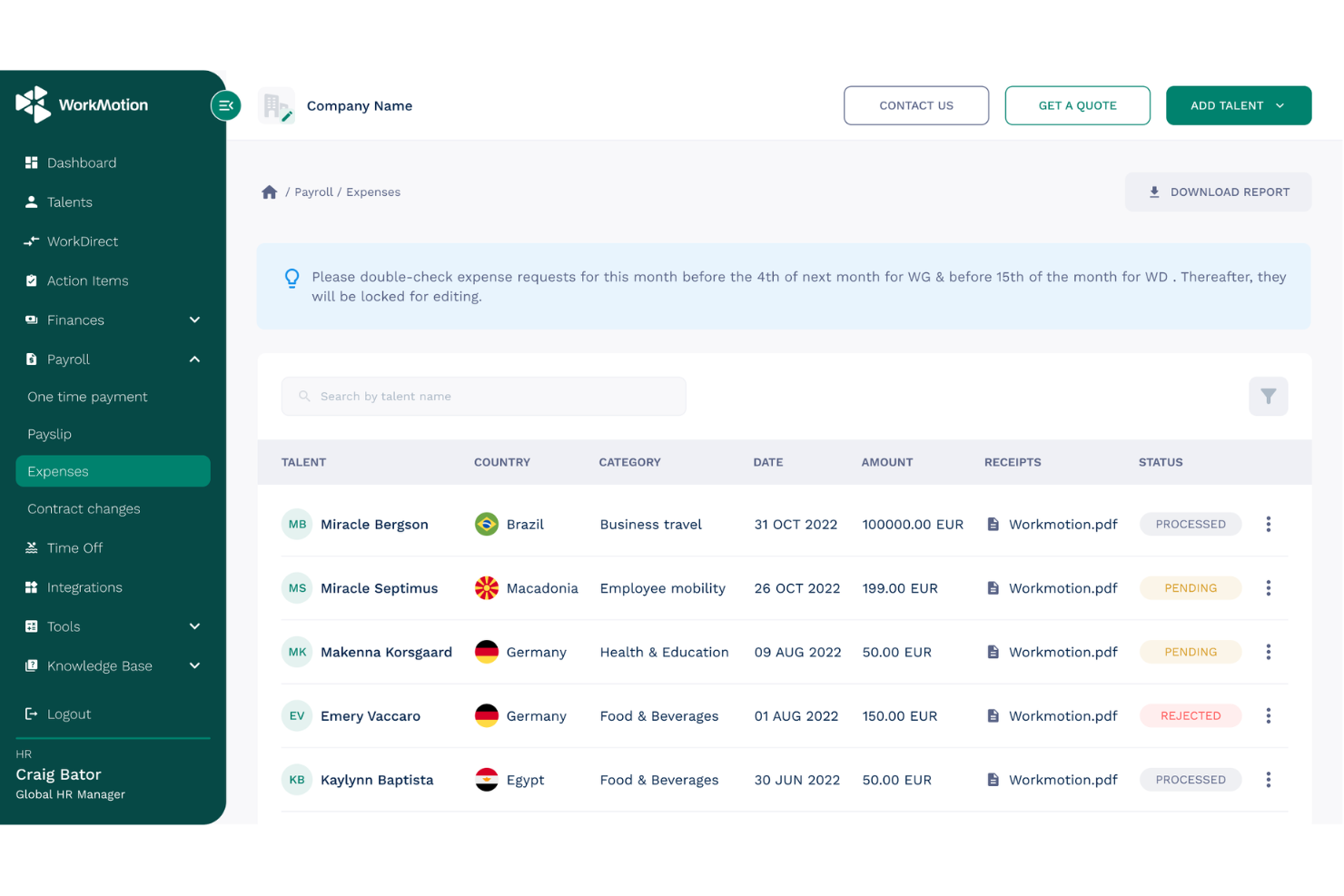
WorkMotion is a global employer of record platform that handles Canadian payroll, province-specific employment contracts, statutory benefits, and offboarding through a partner network.
Who Is WorkMotion Best For?
WorkMotion suits startups and small businesses that want to hire in Canada quickly, without building out their own compliance infrastructure from scratch.
Why I Picked WorkMotion
I've included WorkMotion in my top picks because its compliance documentation for Canada is genuinely detailed, covering CPP/QPP, EI, QPIP, and provincial health tax rates alongside province-specific contracts for Ontario, BC, Alberta, and Quebec. I particularly like that Quebec hires get French-language employment agreements aligned with the Civil Code, which removes a real administrative headache. The Offboarding Cost Calculator, which estimates severance, accrued vacation, and notice periods with a built-in Complexity Meter, gives HR teams a concrete starting point before initiating any termination in Canada.
WorkMotion Key Features
- Employment cost calculator: Estimates total employer costs for Canadian hires, including CPP, EI, and provincial health taxes, with a line-item PDF export.
- Contractor misclassification check: Runs a mandatory risk assessment before onboarding, rating each contractor as low, medium, or high risk before converting them to employees.
- Multi-currency invoicing: Generates itemized invoices showing base salary, allowances, and EOR fees, with pricing available in CAD, EUR, USD, GBP, and CHF.
- HRIS integrations: Syncs employee data with platforms like BambooHR, HiBob, Workday, Personio, and ADP Workforce Now through pre-built connections.
WorkMotion Integrations
WorkMotion documents native integrations with ADP Workforce Now, BambooHR, HiBob, Personio, UKG Pro, Workday, Gusto, and Google Workspace.
Pros and Cons
Pros:
- Offboarding calculator estimates Canadian termination costs
- Province-specific payroll covers CPP and QPIP
- Quebec contracts support French documentation
Cons:
- Contract timelines conflict with instant claims
- Canadian compliance relies on partner entities
When to Use an Employer of Record in Canada
An employer of record in Canada handles the legal side of employment so you can hire Canadian talent without setting up a local entity. It's a practical shortcut for companies that need boots on the ground in Canada but aren't ready to commit to a full subsidiary. If any of the scenarios below sound familiar, an EOR service is likely worth a serious look:
- You're hiring your first Canadian employee: Say you're a U.S.-based company that just found the perfect candidate in Toronto, but you have no legal presence in Canada. An EOR employs them on your behalf, handling payroll, CPP, EI, and provincial tax remittances from day one.
- Your team is misclassifying contractors: It's easy to think of long-term Canadian contractors like employees, but CRA scrutiny on worker misclassification is real and penalties add up fast. An EOR converts them to compliant employees without you needing to build out local HR infrastructure.
- Managing multi-province payroll is slowing you down: Each province has its own rules around payroll tax, benefits, and termination notice. An EOR centralizes it so nothing falls through the cracks.
- You're scaling fast and can't wait 4-6 months: Registering a Canadian subsidiary takes time, legal fees, and ongoing administrative overhead you may not be ready for. An EOR service gets your new hires onboarded in days, keeping your hiring momentum intact.
- It's taking too long to offboard departing employees compliantly: Canadian termination rules vary by province and tenure, and getting them wrong exposes you to wrongful dismissal claims. An EOR manages the process correctly, so you're not left navigating employment law alone.
Other Canadian Employer of Record Services
Here are some other Canadian EOR service providers that didn’t make the top list, in case you’d like a few more suggestions:
- Pivotal
For temporary staffing and short-term contracts
- Payoneer Workforce Management
For onboarding and paying Canadian talent
- Papaya Global
For assessing provincial requirements
- Atlas HXM
For small businesses
- Oyster HR
For deep local intelligence
- Safeguard Global
For NGOs and non-profit organizations
- Borderless AI
Platform for quick expansion to Canada
- Rippling
For dedicated local HR experts
- Canadian Payroll Services Inc.
For small Canadian teams needing bilingual EOR
- Bridgewater Talent Integration
For Canada-only EOR with Québec expertise


How I Evaluate Employer of Record Canada
I split my evaluation into three parts, with core functionality carrying most weight: hire across provinces, calculate taxes and CPP/EI, and support compliant terminations. Next, I look for Quebec bilingual compliance and transparent cost calculators. Finally, I consider support, onboarding speed, integrations, and total pricing beyond features.
Core Functionality (Table Stakes For This List)
When I'm selecting tools for my list, I score each one on a scale from 0 (does not offer the functionality) to 5 (excels in this area) for each core functionality listed below. I then convert the total into a percentage to help assess each tool's overall fit, with extra weight on any functionalities I’ve deemed essential.
- Canadian Employment (Essential): I look for an established Canadian entity that employs workers directly and assumes responsibility for local employment compliance.
- Payroll & Remittances (Essential): I assess Canadian payroll calculations for income tax, CPP, EI, provincial deductions, remittances, and year-end reporting.
- Localized Contracts: I check whether contracts reflect province-specific employment standards for roles, pay, leave, probation, and termination terms.
- Benefits Administration: I evaluate statutory leave, vacation, health coverage, enrollment, and benefits support for employees across Canadian provinces.
- Termination & Offboarding: I look for documented support with notice, severance, final pay, records, and province-specific termination requirements.
- Multi-Province Coverage: I check whether one platform supports consistent hiring and compliance across provinces and territories, including Quebec-specific requirements.
Once I have a list of tools that meet the criteria, I consider what sets each platform apart.
Differentiating Factors (What Sets Vendors Apart)
Here's how I compare and contrast different vendors:
Standout Features
Quebec compliance is a major differentiator. I look for platforms with native support for Bill 96 French-language requirements, civil law distinctions, and CNESST obligations rather than bolted-on workarounds. I also check whether vendors offer direct access to Canadian employment lawyers embedded in the platform, which matters when navigating province-specific termination disputes. Speed-to-hire guarantees and transparent total cost calculators round out my evaluation, since a vendor that can onboard a hire within 24-48 hours and show itemized statutory employer costs upfront saves real planning time.
Beyond Features
I check whether a vendor owns its Canadian entity or subcontracts to a partner network, since that directly affects liability, data control, and how fast compliance issues get resolved. Native integrations with your existing HRIS or accounting tools like BambooHR or QuickBooks also matter—duplicate data entry across platforms drains time when you're managing Canadian hires alongside a global workforce. I also evaluate Canadian-timezone support and whether you get a named account manager who knows your provincial footprint.
Market Details for Hiring in Canada
- Capital City: Ottawa
- Currency: Canadian Dollars (CAD)
- Payroll Frequency: Bi-weekly or
Semi-monthly - Official Languages: English & French
- Approx. Population: 41 Million
- Public Holidays: 9 to 13, depending on the province
Why Hire Employees in Canada?
Canada is an appealing destination for hiring remote employees due to its highly educated workforce, strategic location, and trade agreements with major economies, including the US. It’s known for its deep talent marketplace in the technology, engineering, healthcare, and finance sectors. In particular, Canada's healthcare and engineering sectors are globally recognized.
The country offers a diverse and skilled labor pool, which is continually replenished by top-tier universities and research institutions.
How to Choose an Employer of Record in Canada
An EOR service can solve many different challenges and simplify the process of hiring and managing Canadian staff. To help you figure out which EOR service best fits your needs, you need to document your specific challenges first.

As you work through your own unique selection process, keep the following points in mind:
- What problem are you trying to solve? Start by identifying the challenges you're trying to overcome, whether that's sourcing Canadian staff in specific geographic locations, managing compliance against CRA requirements, paying employees in Canadian dollars, or offering health benefits to your Canadian staff.
- Who will benefit from the service? Consider who will manage the EOR relationship (i.e., who will be your main contact people in-house?) and how having an employer of record will improve their day-to-day work tasks.
- What is your budget? To evaluate cost, estimate how many Canadian employees you anticipate hiring. Since EOR providers typically charge a monthly fee for each new hire, this will help you anticipate your monthly costs.
- What outcomes are important? Review the capabilities you want to gain or improve, and how you will measure success. For example, you may want to hire employees within a specific province or city, making it easier for them to work together in person as needed. You could compare service providers until you’re blue in the face but if you aren’t thinking about the outcomes you want to achieve, you'll waste a lot of valuable time.
- How would it work within your organization? Consider how the service provider's software ecosystem would work alongside your existing workflows and systems. Would their software framework integrate with your existing HR software, or would you face data management roadblocks?
What is a Canadian Employer of Record?
A Canadian employer of record (EOR) is a third-party service that legally employs staff in Canada on your behalf, handling payroll, benefits, taxes, and compliance.
They're used by international companies that want to hire Canadian workers without setting up a local entity. EOR services solve complex challenges like navigating provincial labor laws, managing local tax obligations, and ensuring compliance—so you can focus on scaling your team, not bureaucracy.
Why Use an Employer of Record in Canada?
Canada is one of the easier markets to hire in operationally, but that does not mean it is simple. You get access to a highly educated, English-speaking workforce, strong tech and professional services talent, and a business environment that is already built for international companies.
From a hiring perspective, Canada is especially attractive for software, AI, finance, operations, and customer support roles. Major hubs like Toronto, Vancouver, Montreal, and Calgary all have strong talent ecosystems, and remote hiring is widely accepted across the country.
The challenge is compliance. Employment standards, payroll taxes, and leave entitlements can vary by province, which means hiring in Ontario is not exactly the same as hiring in British Columbia or Quebec. An employer of record handles payroll, taxes, benefits, and local compliance so you can hire in Canada without setting up a local entity first.
EOR vs Legal Entity
If you’re weighing your options between working with an Employer of Record (EOR) or setting up a legal entity in Canada, it’s important to understand the key differences. While both approaches allow you to hire Canadian employees, they vary significantly in terms of complexity, cost, and time to hire.
Here’s a quick side-by-side comparison to help you decide which path makes the most sense for your business:
| Category | Employer of Record | Setting Up a Legal Entity |
|---|---|---|
| Setup Time | Days to weeks | Several months |
| Cost | Pay-as-you-go service fees | High upfront legal, tax, and admin costs |
| Legal Registration | Not required | Required with federal and provincial authorities |
| Employment Compliance | Handled by the EOR | Your responsibility |
| Payroll & Tax Filing | Managed by the EOR | You must register for and manage payroll/tax filings |
| Benefit Administration | Offered through EOR’s plans | You must source and manage benefit plans |
| HR & Onboarding Support | Included in most EOR services | Requires internal HR infrastructure |
| Control Over Operations | Less control over HR processes | Full control over employment practices |
Using an EOR is often the fastest and most cost-effective way to start hiring in Canada, especially if you're testing the market or hiring a small number of employees. On the other hand, setting up a legal entity may make more sense for companies planning a long-term investment with a larger local team.
If you already have a legal entity established in Canada, but you need some additional help providing HR services to your staff, you may want to consider using a PEO service in Canada instead.
EOR vs Permanent Establishment in Canada
Permanent establishment risk is one of the bigger tax considerations when hiring internationally in Canada. It happens when authorities determine that your company has enough business activity in the country to be treated as a taxable local presence, even if no formal entity exists.
In practice, this usually depends on what employees are doing locally. If they are negotiating contracts, managing local clients, or generating revenue in Canada, tax authorities may view that as carrying on business in the country. That can trigger corporate tax obligations, registration requirements, and additional reporting.
And because Canada also has provincial tax considerations, things can get complicated faster than companies expect.
Using an employer of record does not eliminate permanent establishment risk entirely, but it helps reduce exposure. By employing workers through a local legal employer, companies can hire in Canada without creating a direct business presence through their workforce.
How EORs Protect From Permanent Establishment Risk
- Legal employer structure: The EOR employs workers on paper, helping avoid a direct business presence in Canada.
- Reduced tax exposure: Since payroll, contracts, and employment are managed locally, the risk of being classified as having a permanent establishment is lower.
- Compliance coverage: Canadian labor laws, payroll filings, and statutory obligations are handled through the EOR, reducing compliance gaps.
- Role scope control: Helps structure roles so employees are not directly signing contracts or generating revenue locally.
- Flexible market entry: Makes it easier to hire and test the Canadian market without creating a taxable presence too early.
Hiring in Canada: Important Details
Here are some key details to note if this is your first time hiring Canadian staff. Your EOR provider will manage these compliance details on your behalf. However, proactively informing yourself of these details is always recommended before you invest your resources into sourcing Canadian staff.
In Canada:
- Employment laws are determined federally and by province.
- For employees and employers involved in federally regulated industries (e.g., interprovincial services such as transportation, telecommunications, shipping, banking, etc.) the Canada Labour Code applies.
- For all other industries (i.e., those that aren’t federally regulated), provincial or territorial labour standards apply.
- You can hire three types of workers: employees, dependent contractors, and independent contractors. Your Canadian EOR provider can help you determine the best hiring option depending on your needs while helping you prevent employee misclassification issues.
- Employment taxes and payroll deductions include federal and provincial taxes, and contributions to the Canada Pension Plan (CPP), Employment Insurance (EI), and Workers’ Compensation Insurance. Employers must also deduct an Employment Health Tax, which varies by province.
- English and French are the two official languages in Canada.
- Standard working hours are eight hours per day and 40 hours per week, with some provincial exceptions up to 44 hours/week for certain industries (e.g., oil and gas, shipping, trucking, etc.).
- Paid vacation is determined according to provincial regulations (except for federally regulated industries) and often begins with two weeks of paid holidays per year.
- There are five paid public holidays in Canada: New Year’s Day, Good Friday, Canada Day, Labour Day, and Christmas Day.
- Statutory holidays are determined provincially and may include: Family Day, Easter Monday, Victoria Day, Civic Holiday, National Day for Truth and Reconciliation, Thanksgiving, Remembrance Day, and Boxing Day.
- Maternity leave is governed by federal laws with some provincial variations. During maternity/paternity leave, employees are eligible for compensation from the federal government. Some employers also offer additional compensation to employees on maternity/parental leave, though there is no legal requirement to do so.
- Maternity leave: Employees can take up to 15 weeks of maternity leave from their place of employment.
- Parental leave: Employees and their partners can choose between a standard or extended leave option:
- Standard leave is up to 40 weeks total, with a maximum of 35 weeks per parent.
- Extended leave is up to 69 weeks total, with a maximum of 61 weeks per parent).
- NOTE: There is no separate "paternity leave" in Canada. Instead, partners use parental leave.
- Paid sick leave is determined by provincial laws. Up to 17 weeks of unpaid medical leave is available according to Canadian Labour Laws.
- Probation in Canada ranges from 3 to 6 months, depending on the province and industry.
- Termination of employment is governed by Canadian Labour Laws and the Canada Severance Pay Law. Employees must be given a notice period ranging between 1 to 8 weeks, or pay in lieu of notice.
- If terminated, employees who have completed 1 year of service are eligible for severance pay equal to 2 paid days for every year of service prior to termination.
This overview reflects the most up-to-date (mid‑2025) employment regulations in Canada. Your EOR will manage all these aspects, but understanding them helps you set realistic expectations and evaluate providers effectively.
An employer of record processes invoicing and salaries but reduces complexity by handling simpler payroll types, often focusing on salaried employees.

Tax Overview for Employers in Canada
Canada’s payroll system is relatively manageable, but employer costs still extend well beyond base salary. Payroll taxes, pension contributions, and provincial differences all need to be factored into hiring budgets.
Here’s a quick view of what employers pay vs what gets deducted from employees:
| Category | Tax Type | Rate |
|---|---|---|
| Employer costs | CPP Contributions (Base + CPP2) | 5.95% + 4% (matches employee) |
| Employee costs | EI Premiums | 1.4x the employee rate (~2.28%) |
| Employee deductions | CPP Contributions (Base + CPP2) | 5.95% + 4% |
| Employee deductions | EI Premiums | 1.63% |
| Employee taxes | Income Tax | Federal (14%–33%) + Provincial |
Some key payroll and compliance facts for 2026:
- Employment Insurance (EI) Multiplier: The employer rate is officially 1.4 times the employee rate. For 2026, the employee rate is 1.63% (capped at $1,123.07), making the employer rate approximately 2.28% (capped at $1,572.30 CAD per year).
- Provincial Health Taxes (Hidden Cost): Several provinces have an Employer Health Tax (EHT) that does not appear on the employee's pay stub:
- Ontario: Up to 1.95% (if annual payroll > $1M).
- British Columbia: Up to 2.925% (if annual payroll > $1M).
- Quebec: Up to 4.26% for the Health Services Fund (HFS).
- Workers' Compensation (WCB/WSIB): This is a 100% employer-paid insurance. Rates vary by industry and province. For a standard office/IT role, budget roughly $0.20 per $100 of salary; for higher-risk roles, this can exceed $3.00.
Trends in Employer of Record Services
As more businesses expand across borders, the need for efficient, compliant, and user-friendly solutions for hiring employees abroad, and managing international payments, compliance, benefits, and onboarding has never been more critical.
As a result, EOR services have continued to evolve, with an emphasis on technology-driven solutions that offer flexibility, comprehensive support, and innovative features to facilitate global operations.
Here are the most recent trends affecting EOR services and the HR software systems that are used to offer them:
- Immigration Support: There is a growing demand for assistance with immigration services like visa and work permit sponsorships, simplifying global talent acquisition processes for client companies immensely.
- Specialized Services for Diverse Needs: Several EOR providers have begun to offer IP and invention rights protection and equity incentive planning services, to cater to the specific needs of their client companies.
- Enhanced Employee Benefits Packages: There's a growing trend in EOR providers going beyond standard healthcare coverage to offer a full spread of enterprise-level medical and health benefits, stock options, and even one-time benefits like moving bonuses. This trend demonstrates an understanding of the importance of attracting and retaining top talent effectively.
- AI-Backed Knowledge Bases: Some EOR providers (including Deel) are beginning to offer legally vetted knowledge bases or information wikis that use artificial intelligence to surface answers to common questions quickly. This helps customers source details on hiring within a specific country quickly, without relying on human-run support systems.
As the market continues to evolve, these trends are likely to shape the future of international employment, making it easier for businesses to navigate the challenges of global expansion. For a closer look at specific EOR providers that are capitalizing on these trends, I recommend reading our in-depth reviews of Pebl, Payoneer Workforce Management, and Oyster HR.
Key Services of Employer of Record Canada
When selecting an employer of record in Canada, keep an eye out for the following key services:
- Payroll management: Handles all aspects of employee payroll, from calculating salaries and deductions to processing payments and issuing pay slips. This makes sure your team gets paid correctly and on time, no matter where they're located in Canada.
- Compliance assurance: Keeps your business aligned with Canadian employment laws and regulations, such as tax requirements and labor standards. This protects you from costly legal errors and lets you stay focused on running your team.
- Benefits administration: Manages employee benefits like health insurance, retirement plans, and paid leave. It simplifies the enrollment process and ensures your team gets the perks they expect.
- Contract management: Drafts, updates, and maintains compliant employment contracts tailored for Canadian laws and your company’s needs. You can hire staff with peace of mind, knowing all paperwork is covered.
- Onboarding support: Guides new hires through the administrative details of starting their job, from collecting documents to introducing company policies. This smooths out the transitions so new employees can get up to speed fast.
- Tax filing and remittance: Takes care of withholding and remitting the right provincial and federal taxes for your employees. This saves you from paperwork headaches and helps avoid fines for missed filings.
- Termination support: Assists with offboarding employees appropriately and legally, ensuring that final payments, benefits termination, and necessary documentation are all completed according to Canadian law.
- HR advisory services: Provides practical guidance on HR matters, such as workplace policies, conflict resolution, and performance management, to help you build and support a healthy work environment.
Common Employer of Record Canada AI Features
Many of these solutions are incorporating AI features to support their offering, such as:
- Automated compliance monitoring: Uses AI to continuously scan changes in Canadian employment regulations and update compliance processes automatically. This reduces risk and ensures your business stays on the right side of the law.
- Smart document processing: Employs AI-driven tools to collect, verify, and file employee documents, making onboarding, record-keeping, and contract management quicker and error-free.
- Predictive payroll analytics: Harnesses AI to analyze payroll data, identify trends, and forecast labor costs, giving you actionable insights to better plan your workforce budget.
- Intelligent help desks: Utilizes AI-powered chatbots to answer employee HR inquiries around the clock, providing instant support and freeing up your human team for more complex tasks.
Benefits of Using an EOR in Canada
A Canadian-specific EOR service offers many benefits for companies that want to hire top talent in Canada, including:
- They’ve already established a legal entity in Canada
- They’re up-to-speed on the local employment laws and tax regulations in Canada
- They can help you source and hire new talent quickly
- They can negotiate better insurance rates and benefit packages on your behalf
Using a Canadian EOR service is also cost-effective for businesses trying to enter a new market, compared to the significant costs of establishing a new Canadian entity. The latter option involves significant upfront legal fees, plus other costs related to office infrastructure, staffing, and local benefits and insurance coverage.
Costs & Pricing for Employer of Record Services in Canada
EOR services are complicated, which is why the price tag can sometimes be high. Most providers offer a flat rate per employee or contractor hired through their service. However, some only offer pricing details upon request. Either way, the prices for their services still offer a good ROI considering the complexity of the premium-grade services you're gaining.
In general, EOR services in Canada cost between $200 to $800 per employee, per month.
Key factors that can influence the pricing of an employer of record service include:
- Employee Seniority and Role Complexity: The level and nature of the roles being filled can impact the monthly cost. Senior positions or roles requiring special qualifications may increase the price due to higher benefits and compensation management costs.
- Number of Employees: The total number of employees being managed can also impact the cost. In some cases, higher volumes may lead to volume discounts, making per-employee costs more economical.
- Custom Requirements: Any specific needs beyond the standard service offering may also contribute to the monthly cost. This may include customized solutions for recruitment, specialized employee onboarding, or unique compliance requirements, all of which can affect pricing.
FAQs about EOR Services in Canada
If you’ve got specific questions about the requirements to hire Canadian employees or how EOR services work, these answers to frequently asked questions are a good place to start:
Can I use an EOR in Canada to hire both full-time employees and contractors?
Yes, a Canadian EOR typically supports hiring both full-time employees and independent contractors. However, Canadian law requires strict classification of worker types. Misclassifying an employee as a contractor can result in fines or back payments.
An EOR will advise you on correct worker classification and help structure contracts so you can confidently hire the talent you need, whether on a permanent or flexible/project basis.
How long does it take to onboard an employee in Canada using an EOR?
Onboarding with an EOR in Canada usually takes between 1 and 3 weeks, depending on how quickly all required documentation is provided and verified. Factors like background checks, work permit validation, and contract finalization can affect the timeline.
If you and your team promptly submit everything that’s needed, the EOR can often get your new hire started much faster than setting up an entity on your own.
What documents or information do I need to provide to an EOR to hire in Canada quickly?
To speed up the hiring process with an EOR, you’ll need to provide some key documents and information. This usually includes personal identification for each new hire (such as a passport or Canadian ID), a signed employment agreement, work permit or visa information for non-citizens, completed tax forms (like TD1), and core company details (business registration, contact info, etc.). Having this information ready in advance lets the EOR onboard your team quickly and accurately.
What are the standard working hours and overtime regulations in Canada?
Employees in Canada typically work 8 hours a day or 40 hours per week, though this can vary by province. Overtime usually starts after 8 hours a day or 40 hours a week and is paid at 1.5 times the regular rate. An EOR helps make sure your business meets all legal requirements, so your team doesn’t risk accidental non-compliance with local labor laws.
What are the minimum wage requirements in Canada?
In Canada, the minimum wage requirements vary depending on which province your employee or EOR hire is located in. As of April 1st, 2025, the current federal minimum wage in Canada increased from $17.30 to $17.75 CAD per hour. Staying on top of changes to minimum wages is just one of the benefits of working with an EOR.
What are the public holidays in Canada?
There are five nationwide public holidays in Canada, including: New Year, Good Friday, Canada Day, Labour Day, and Christmas Day. Many Canadian provinces also celebrate additional statutory holidays where employees are also given time off of work, including: Family Day, Easter Monday, Victoria Day, Civic Holiday, National Day for Truth and Reconciliation, Thanksgiving, Remembrance Day, and Boxing Day.
The number and timing of paid holidays can differ depending on where your employees are located. An EOR will track these regional holidays and adapt payroll schedules accordingly, helping you avoid errors and ensuring your employees receive statutory pay or time off as required by law.
Are there any risks to using an Employer of Record service?
Yes, while EORs take on most HR and compliance risks, choosing the wrong provider can expose you to issues. Some risks include hidden fees, poor service delivery, or lack of local legal expertise. Data privacy can also be a concern, especially if the EOR doesn’t follow Canadian data protection laws.
Make sure to vet an EOR thoroughly by reviewing client references, their financial stability, and their approach to employee data privacy before committing.
What are some of the consequences of non-compliance?
Non-compliance with Canadian labor laws can lead to significant problems, including fines, back pay requirements, government audits, or even being barred from hiring in Canada. For founders and HR professionals new to Canadian regulations, these risks are heightened.
An EOR safeguards you by monitoring regulatory updates, managing document filings, and making sure your payroll, tax filings, and contracts align with all relevant laws. This minimizes your exposure to unexpected costs or legal challenges.
Do EOR providers offer other types of global HR services?
Yes, most of the time they do. Many service providers in this space also offer professional employer organization services (also known as PEO services), as well as multi-country payroll services.
PEO services are a way of outsourcing human resources to support your international teams. They can help you with international compliance issues, benefits administration, workers’ compensation, and other HR administrative tasks.
Multi-country payroll services make it possible pay remote employees or independent contractors in multiple local currencies within the same unified payroll run. They also manage in-country compliance and tax requirements on your behalf, making the payroll process considerably easier.
How does an EOR handle IP transfer upon termination?
Employer of record providers include IP assignment clauses in employment contracts to ensure all work created by the employee belongs to your company. Upon termination, they help ensure any code, documents, or assets are properly transferred in line with Canadian law.
This content is provided for general informational purposes only and does not constitute legal, tax, or other professional advice. It may not be complete, accurate, or current, and laws and practices may change without notice and vary by jurisdiction. You should not act on this information without obtaining advice from qualified legal or tax counsel in the relevant jurisdiction regarding your specific circumstances.