

10 Best Global Payroll Services for 2026

Best Global Payroll Services Shortlist


Scaling a distributed workforce is hard enough without payroll getting in the way. You’re constantly balancing global hiring with tighter operational budgets—and as someone who has spent 9+ years in the HR trenches managing everything from onboarding to analytics, I know firsthand how much a broken workflow can cost your team.
Drawing on my HR background and my research evaluating software, I analyzed this year's top global payroll service providers through a process-oriented lens to bring you platforms that actually deliver on their promises without adding administrative noise.
Why Trust Our Software Reviews
Our team has been testing and reviewing software since 2012. As HR experts ourselves, we know how difficult—and important—it is to choose the right software.
For this guide, we evaluated tools using hands-on testing and independent research, scoring tools using our selection criteria. We also draw on insights from industry thought leaders and practicing HR experts.
Our reviews reflect our human editorial judgment, not a sales pitch.
Expert reviewers:
Best Global Payroll Services: Comparison Chart
This comparison chart summarizes pricing, trial, and demo details for my top global payroll service selections to help you find the best option for your budget and business needs.
| Service | Best For | Trial Info | Price | ||
|---|---|---|---|---|---|
| 1 | Best for running payroll across 100+ countries | Free demo available | From $29/employee/month | Website | |
| 2 | Best for global payroll without local entities | Free demo available | From $599/employee/month | Website | |
| 3 | Best for budget-conscious remote team expansion | Free demo available | From $199/user/month | Website | |
| 4 | Best with real-time payroll analytics | Free demo available | Pricing upon request | Website | |
| 5 | Best for onboarding and payment compliance | Free demo available | From $459/user/month (billed annually) | Website | |
| 6 | Best for supporting business expansion | Free demo available | Pricing upon request | Website | |
| 7 | Best for global employee support & local benefits | Free demo available | From $99/employee/month | Website | |
| 8 | Best for multi-currency payroll | Free demo available | From $19/employee/month | Website | |
| 9 | Best for fast international onboarding | Free demo available | From $549/employee/month | Website | |
| 10 | Best for consolidating U.S. and global payroll | Free demo available | From $49/month + $6/month/user | Website |


Reviews of the Best Global Payroll Services
I’ve put together detailed reviews to help you quickly compare top global payroll service providers. Each one explains why it made the list, highlights standout features like tax handling and local compliance support, and includes screenshots so you know what to expect before booking a demo.


Deel is built for companies that want to manage global payroll and core HR workflows in one place. It lets you hire, onboard, pay, and support employees or contractors across 130+ countries without juggling separate HR tools or local vendors.
Who is Deel Best For?
HR and payroll leaders at small to enterprise companies that need an all-in-one platform for managing employee onboarding, payroll, and compliance across multiple countries.
Why I Picked Deel
I picked Deel because it combines global payroll with HR tools your team would normally need multiple platforms for. You can run payroll, manage contracts, track time off, store employee records, and handle expenses—all in the same system, reducing the friction of working across borders.
Their in-country experts ensure you remain compliant whenever pay rules or employment laws change, which helps prevent costly mistakes. I also like that employees get a self-service portal where they can view pay, update personal data, and choose local withdrawal methods. If you want an HR hub that supports your entire global workforce while keeping payroll accurate and compliant, Deel fits that need well.
Deel Key Services
Here are some standout services worth highlighting:
- Multi-country onboarding: Create compliant contracts and start dates tailored to each country without external legal help.
- Unified HRIS: Store employee data, track time off, and manage documents directly inside Deel instead of using a separate HR system.
- Expense & reimbursement tools: Employees upload receipts, and approved expenses flow directly into the next payroll run.
- Visa & mobility support: Deel helps manage work permits and relocations, connecting immigration steps with payroll and HR data.
Deel Integrations
Integrations include BambooHR, Workday, QuickBooks, Xero, NetSuite, Greenhouse, Ashby, and Okta.
Pros and Cons
Pros:
- Self-service mobile app for payslips, personal data, and withdrawals
- In-country experts help you stay compliant in 130+ countries
- Combines payroll, HRIS, onboarding, and expenses in one platform
Cons:
- Advanced reporting requires setup and can be complex at first
- Pricing is custom and may increase with multi-country hiring


If you’re looking to pay and manage international teams across borders without setting up local entities, Globalization Partners (G-P) is built for you. You’ll be able to onboard full-time employees and contractors, and pay them in their preferred currency and method, while someone else handles the legal and tax compliance.
Who is G-P Best For?
Finance and HR teams at mid-sized to large global organizations that require international payroll processing without establishing local entities.
Why I Picked Globalization Partners
I picked Globalization Partners because it lets you expand globally without the burden of entity setup—you can hire in 180+ countries and pay in 50+ currencies. Their platform gives you a single dashboard for global payroll and payments, which means you get visibility and control over cross-border compensation.
You also gain access to local HR, legal and compliance experts who keep you aligned with labor laws in each country, and their contractor solution lets you consolidate full-time and project-based payments in one place, reducing administrative complexity.
Globalization Partners Key Services
Here are some standout services worth highlighting:
- Multi-currency payments: Pay your international team in 50+ currencies, via digital wallets, ACH, bank transfer, wire transfer, or card.
- Global employment platform: Hire and onboard employees and contractors in over 180 countries without setting up your own entity.
- Compliance & payroll accuracy: The platform offers 99 % payroll accuracy and handles tax, benefits and local law compliance across jurisdictions.
- Single view for employees and contractors: Manage both employee and contractor payments and contracts from the same platform.
Globalization Partners Integrations
Integrations include BambooHR, Personio, HiBob, UKG Pro, SAP SuccessFactors, ADP Workforce Now, Workday and TriNet.
Pros and Cons
Pros:
- Centralizes global payroll, contracts and compliance
- Combines contractor and full-time workflows in one platform
- Supports payments in 50+ currencies and multiple methods per employee
Cons:
- Pricing can be higher than rivals
- Limited advanced HR features


RemoFirst is built for companies that want to hire globally without overspending on complex payroll setups. If you’re expanding into new countries and need a compliant, low-cost way to pay employees or contractors, RemoFirst gives you global coverage at a price point that’s hard to match.
Who is RemoFirst Best For?
Startups and small to mid-sized companies that are hiring remote teams on a tight budget, focusing on cost-effective global expansion.
Why I Picked RemoFirst
I picked RemoFirst because it delivers international payroll and EOR support at some of the most affordable rates in the category, making it ideal for budget-conscious teams that still need broad country coverage.
You can hire in 185+ countries without setting up entities, and the platform handles local-currency payroll, taxes, and statutory deductions for you. I also like that you can consolidate all payroll charges into a single monthly invoice, which helps you avoid the administrative overhead that often comes with global hiring.
Also, their dedicated account managers and 24/7 support give you a direct line to HR and compliance experts without extra fees.
RemoFirst Key Services
Here are some standout services worth highlighting:
- Global Payroll Processing: Executes payroll and tax calculations across 185+ countries with local-currency payments.
- Employer of Record (EOR): Lets you hire full-time employees abroad without opening local entities.
- Contractor Management: Onboards and pays international contractors, including bulk payment options.
- Benefits & Equipment Provisioning: Provides global benefits support and ships laptops or equipment directly to remote hires.
RemoFirst Integrations
Integrations include ADP Workforce Now, common HRIS time-off systems, standard payroll-HR sync connectors, and payment-gateway partners for contractor payouts.
Pros and Cons
Pros:
- 24/7 support with dedicated account managers
- Local-currency payments with automated tax calculations
- Affordable pricing suitable for cost-sensitive global expansion
Cons:
- Limited native integrations beyond ADP
- Reporting customization options are still developing

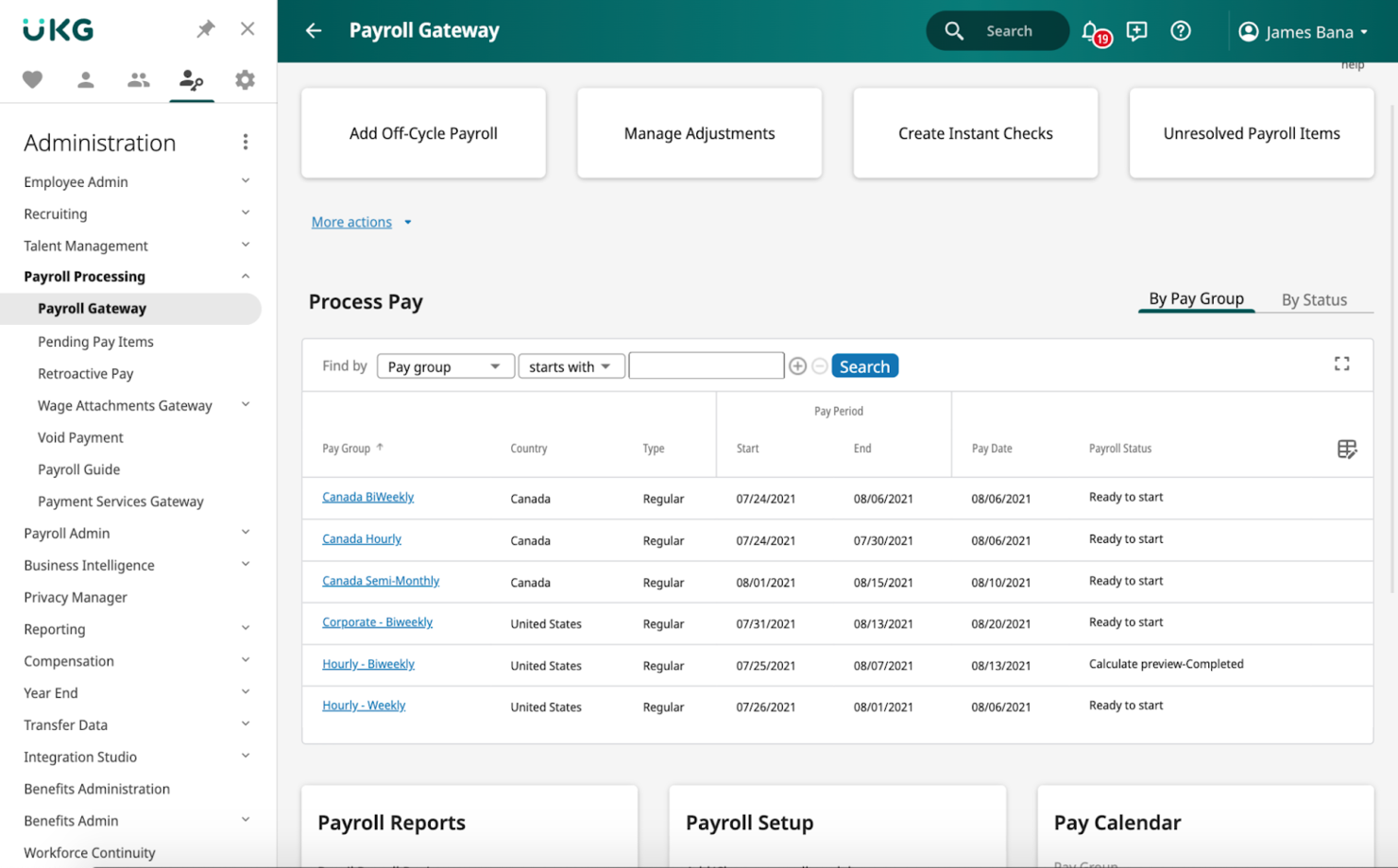
UKG offers a global payroll platform designed for organizations managing complex, multi-country workforces. It appeals to HR and payroll teams that need to navigate international compliance, currency differences, and evolving workforce needs. The platform helps businesses unify payroll operations and reduce manual errors across borders.
Who Is UKG Best For?
UKG is a good fit for mid-sized to large organizations with international operations that need to manage payroll and compliance across multiple countries.
Why I Picked UKG
I picked UKG for its ability to deliver real-time payroll analytics, which is especially valuable for organizations managing payroll across multiple countries. The platform provides live dashboards and customizable reports that let payroll teams monitor trends, spot discrepancies, and make data-driven decisions instantly. I appreciate how UKG’s analytics tools help HR professionals track payroll costs, compliance risks, and workforce changes as they happen. This level of visibility is essential for businesses that need to respond quickly to payroll issues and maintain accuracy on a global scale.
UKG Key Services
Some other features in UKG that support global payroll management include:
- Multi-country payroll processing: Run payroll for employees in multiple countries from a single platform, with support for local tax and labor regulations.
- Automated compliance updates: Receive automatic updates to payroll rules and tax rates to help maintain compliance with changing international laws.
- Employee self-service portal: Give employees access to their pay statements, tax documents, and personal payroll information online.
- Integration with HR and time systems: Connect payroll with HR, time tracking, and workforce management tools to ensure accurate and up-to-date payroll data.
UKG Integrations
Integrations include QuickBooks Online, Sage Intacct, Procore, HR Cloud, HireRight, Boomi, OpenSesame, Accenture, and more.
Pros and Cons
Pros:
- Employee self-service for pay and tax documents
- Automated compliance updates for local laws
- Multi-currency and multi-country payroll support
Cons:
- Some payroll features require additional modules
- Occasional system performance and downtime issues


Multiplier is designed for companies that need reliable payroll, onboarding, and compliance support when hiring across multiple countries. If you’re expanding into new markets or managing distributed teams and want a tool that keeps employment documentation and payments compliant from day one, Multiplier is a strong fit.
Who is Multiplier Best For?
HR and finance teams at mid-sized and enterprise companies that need assistance with employee onboarding and payment compliance internationally.
Why I Picked Multiplier
I picked Multiplier because it helps your team stay compliant at every stage of hiring—from generating locally compliant contracts to ensuring payroll, taxes, and benefits meet each country’s rules.
Its onboarding workflows guide you through collecting the right documents and setting up employees according to local requirements, reducing the risk of compliance gaps. The platform then calculates taxes, contributions, and social-security obligations automatically, so payments stay accurate month after month.
I also like that Multiplier provides access to in-country payroll and legal experts, giving your team real support when navigating unfamiliar regulations. And with multi-currency payments built in, you can pay global employees and contractors without switching tools.
Multiplier Key Services
Here are some standout services worth highlighting:
- Locally compliant onboarding: Generates country-specific contracts and collects required documentation during hiring.
- Automatic tax & statutory calculations: Adjusts payroll according to local laws to avoid compliance errors.
- Global payments in 120+ currencies: Supports cross-border payouts to employees and contractors.
- Benefits administration: Offers region-specific benefits packages that align with local requirements.
Multiplier Integrations
Integrations include Workday, BambooHR, HiBob, Personio, SAP SuccessFactors, Zoho People, Xero, QuickBooks, and NetSuite.
Pros and Cons
Pros:
- Supports compliant contractor and employee payments globally
- Automatic tax adjustments reduce manual payroll work
- Country-specific onboarding steps improve compliance accuracy
Cons:
- Some reports lack deeper customization for finance workflows
- Limited native integrations compared to broader HR suites
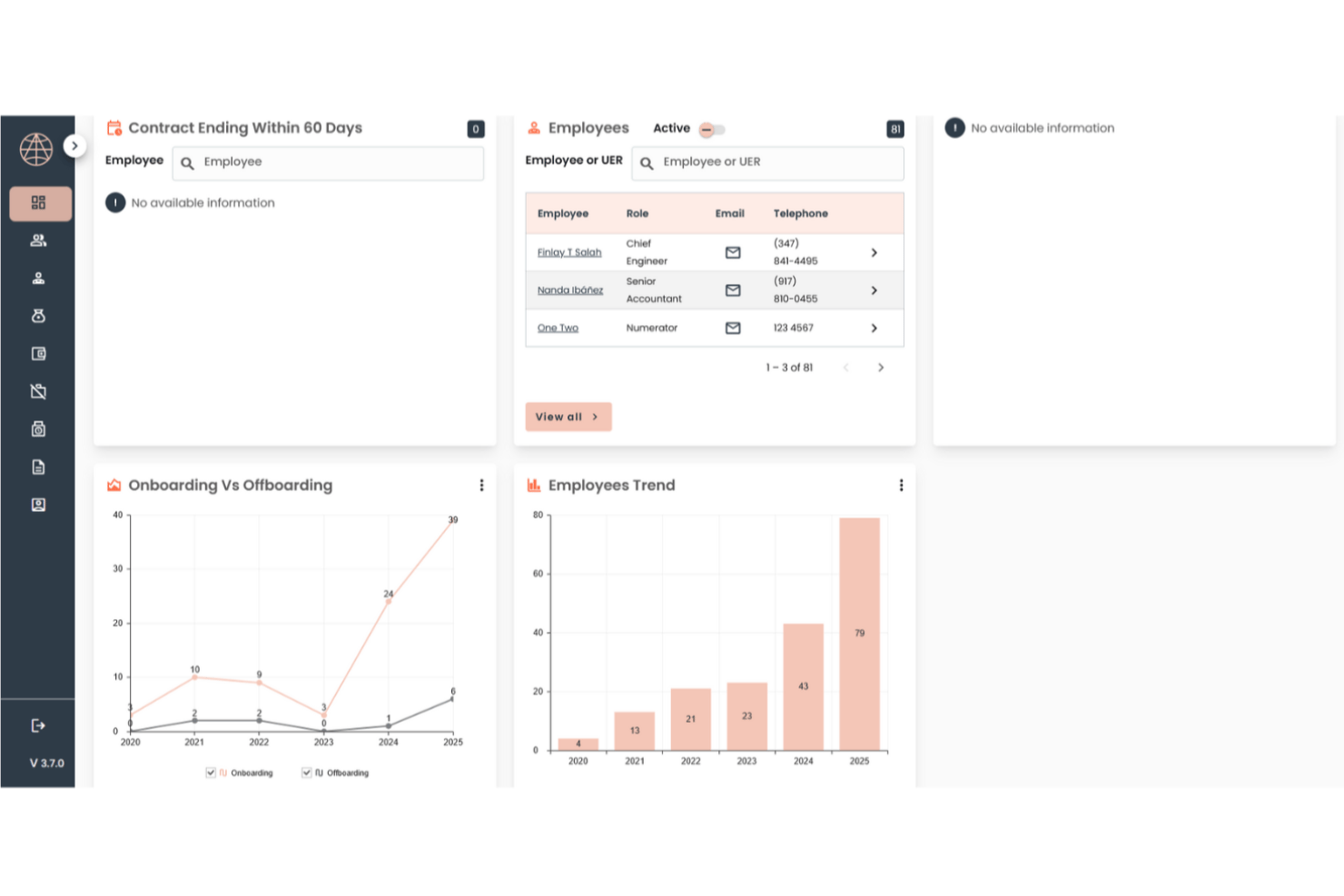
TopSource is built for organizations looking to expand into new markets while keeping payroll and compliance under control. This platform is especially useful for HR teams and business leaders who need support navigating local employment laws and onboarding talent in unfamiliar regions. TopSource combines global payroll processing with in-country expertise, helping you manage risk and scale your workforce confidently.
Who is TopSource Best For?
Operations and HR leaders at growing companies that are expanding into new markets and need support for local compliance and workforce management.
Why I Picked TopSource
When you’re planning to expand your business into new countries, TopSource stands out for its focus on supporting that growth with tailored payroll and compliance solutions. I picked TopSource because it offers in-country experts who guide you through local employment regulations and help you onboard employees in unfamiliar markets. The platform also provides consolidated payroll reporting across multiple countries, making it easier to manage your expanding workforce. These features make TopSource a strong choice for businesses that want to grow internationally without getting overwhelmed by regional payroll complexities.
TopSource Key Services
Here are some standout services worth highlighting:
- Automated payroll processing: The platform calculates salaries, deductions, and taxes for each employee based on local requirements.
- Employee self-service portal: Employees can access payslips, tax documents, and personal information online.
- Expense management tools: Users can submit, approve, and track employee expenses within the system.
- Document management: Securely store and manage employment contracts, compliance documents, and payroll records.
TopSource Integrations
Integrations include Workday, SAP SuccessFactors, UKG, BambooHR, and Workable.

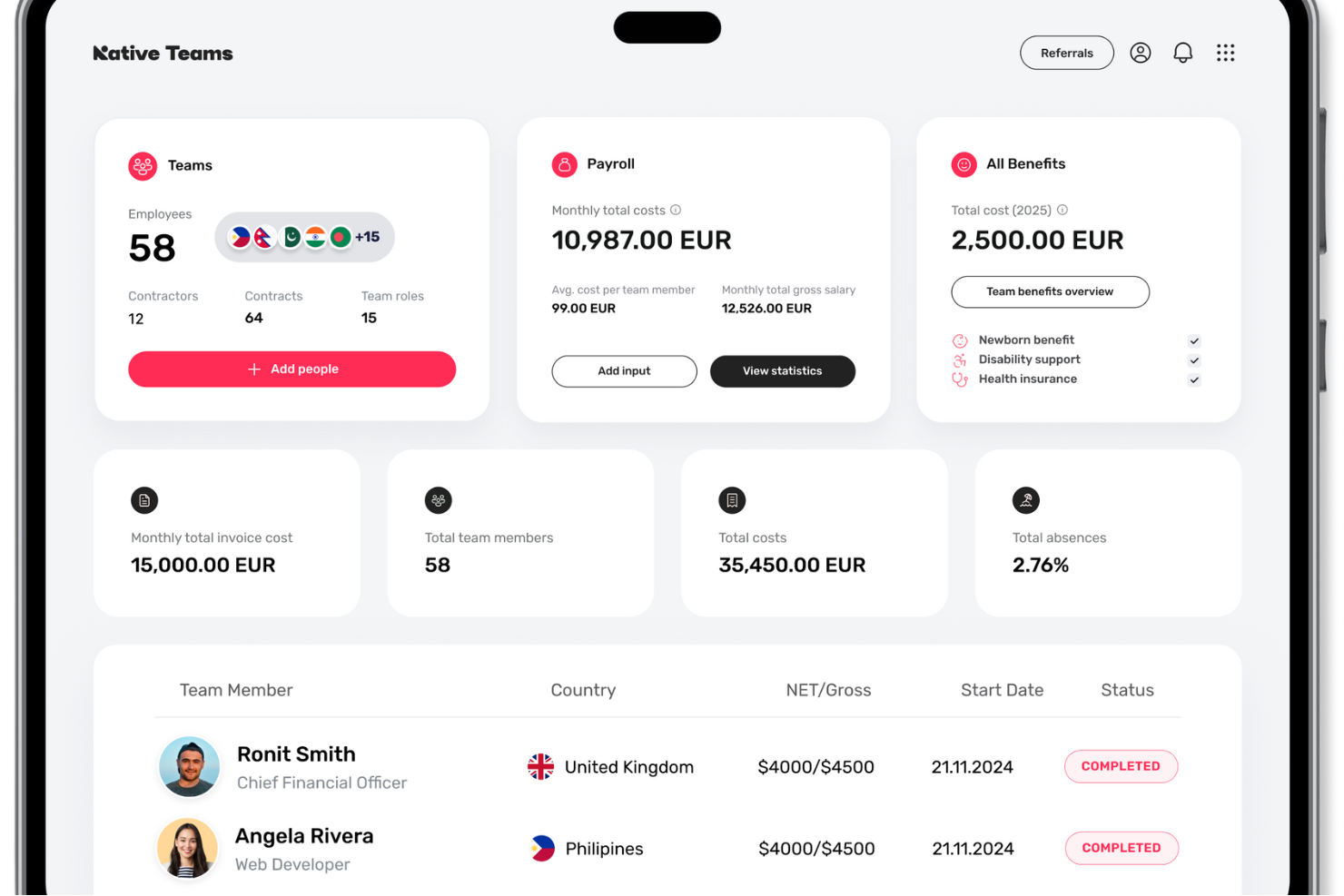
Native Teams stands out for businesses that want to offer local benefits and support to employees in multiple countries. This platform is especially useful for HR teams and people managers who need to handle payroll, compliance, and benefits tailored to each region. Native Teams helps you provide country-specific perks and employment support, making it easier to attract and retain global talent.
Who is Native Teams Best For?
HR and employee experience teams at mid-sized to enterprise companies that need global employee support and locally compliant benefits administration.
Why I Picked Native Teams
What sets Native Teams apart is its focus on supporting employees with local benefits and compliance in each country. I picked Native Teams because it lets you offer region-specific perks, such as health insurance and pension plans, directly through the platform. The tool also manages local employment contracts and statutory benefits, so your team members receive the support they expect in their home country. This approach helps you build trust and loyalty with global employees while staying compliant with local regulations.
Native Teams Key Services
Here are some standout services worth highlighting:
- Multi-country payroll processing: Run payroll for employees and contractors in multiple countries from a single dashboard.
- Automated tax calculations: The platform calculates and withholds the correct taxes based on each employee’s location.
- Expense management tools: Submit, approve, and reimburse employee expenses directly within the platform.
- Digital wallet integration: Employees can receive payments and manage funds through a built-in digital wallet.
Native Teams Integrations
Native integrations are not currently listed by Native Teams.

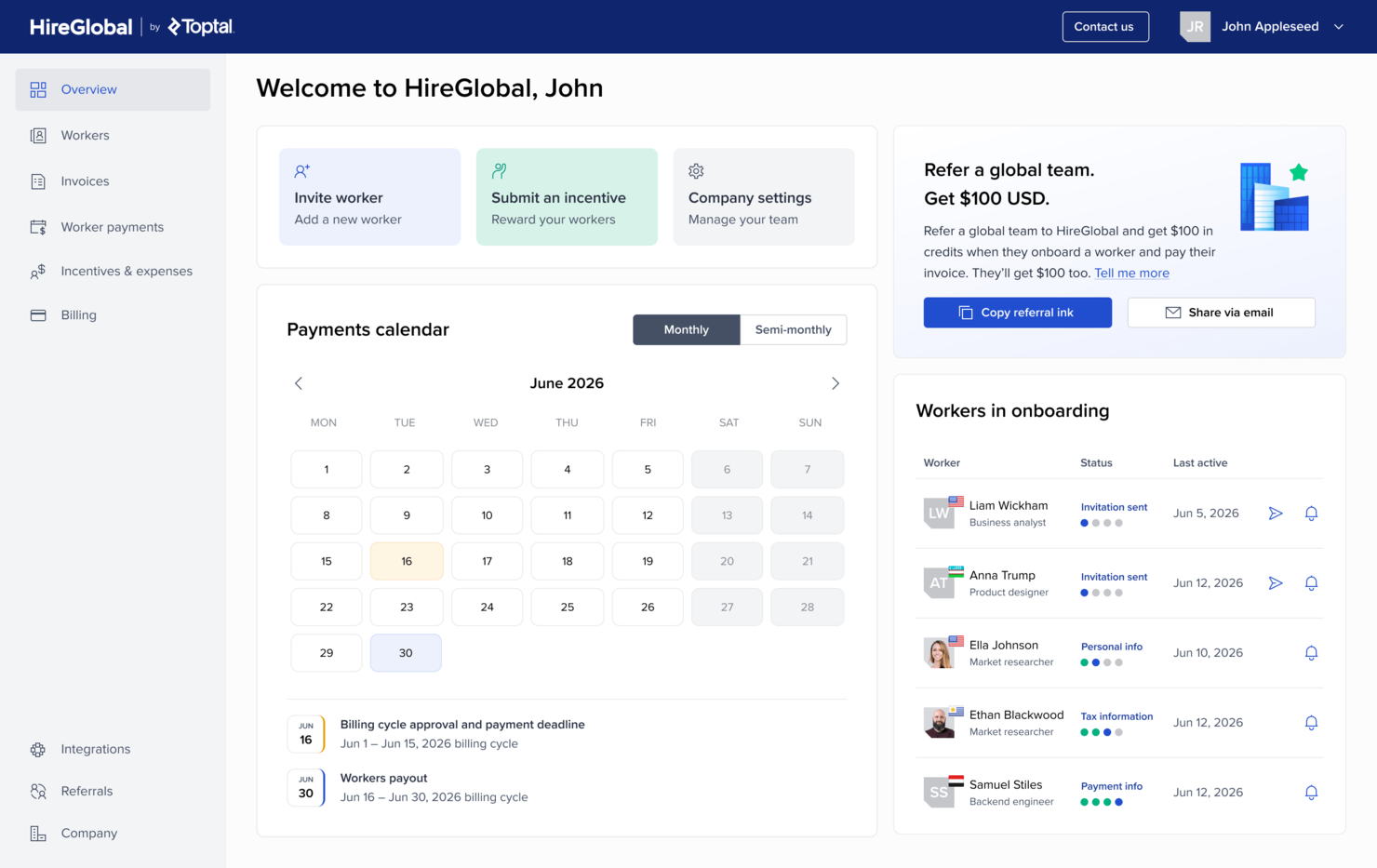
HireGlobal is a workforce management and global payroll platform that supports hiring, paying, and managing workers in 180+ countries across multiple employment models, from contractor management to full employer of record services.
Who Is HireGlobal Best For?
HireGlobal is a strong fit for growing companies that need to hire and pay workers across multiple countries without setting up local legal entities.
Why I Picked HireGlobal
I picked HireGlobal as one of the best global payroll solutions because its compliance infrastructure is genuinely built to flex around your hiring structure, not the other way around. What I find most useful is that HireGlobal recommends the right employment model for each individual worker, whether that's Contractor Management, Agent of Record, Virtual EOR, or full Employer of Record. That means your compliance approach adapts as your workforce grows across regions. Backed by a team of 40+ lawyers, HireGlobal also manages law changes actively, working with you to update arrangements whenever local regulations shift.
HireGlobal Key Services
- Multiple hiring models: Choose between contractor management, Agent of Record, Virtual EOR, and Employer of Record based on your workforce needs.
- Built-in HRIS: Manage hiring, payroll, benefits, and compliance data for your global workforce in one centralized system.
- Consolidated invoicing: Receive a single invoice covering all worker payments across countries, regardless of employment model.
- Background check services: Run pre-hire background checks on international workers directly through the HireGlobal platform.
HireGlobal Integrations
HireGlobal integrates natively with TopTracker, Toptal's time tracking platform, for end-to-end time tracking, invoice approval, and workforce payments. Native integrations with other third-party apps are not clearly documented, and Zapier and API support don't appear to be available.
Pros and Cons
Pros:
- Consolidated invoicing across global payroll
- Backed by 40+ legal experts
- $1 million indemnification per V-EOR worker
Cons:
- Newer platform than established global payroll providers
- Limited third-party software integrations available


WorkMotion is built for companies that want an easier way to hire and pay international employees without setting up local entities. If you need a compliant, centrally managed global payroll system that covers 160 plus countries, WorkMotion gives you broad coverage and strong compliance support in one platform.
Who is WorkMotion Best For?
Talent acquisition and HR teams at mid-sized and enterprise organizations that need fast international onboarding for remote employees.
Why I Picked WorkMotion
I picked WorkMotion because it simplifies global expansion by acting as the legal employer for your international hires, which helps you stay compliant without forming a local entity. The platform calculates payroll in local currencies, applies the right tax rules, and manages required filings, so you can pay your team accurately and on time.
I also like that WorkMotion focuses on quick onboarding. You can generate compliant contracts in minutes, which helps your new hires get started faster. Their ISO certified data protection and GDPR compliance also give you added confidence when handling sensitive payroll information across regions.
Another reason I chose WorkMotion is its transparent pricing and clear monthly invoicing. You get one structured invoice covering each country, which reduces the manual work that usually comes with multi country payroll. And with local HR expertise available when needed, you get support navigating country specific regulations without extra cost.
WorkMotion Key Services
Here are some standout services worth highlighting:
- Global Payroll Management: Runs payroll across 160 plus countries with automated tax calculations, currency handling, and compliant payment cycles.
- Employer of Record (EOR): Lets you hire full time international employees without opening a local entity while WorkMotion manages contracts, benefits, and compliance.
- Employee Expense and Benefits Management: Handles expense submissions, reviews, and payments, along with region specific benefits to support retention.
- Automated Onboarding and Offboarding: Generates compliant contracts quickly and manages end to end offboarding steps aligned with local labor laws.
WorkMotion Integrations
Integrations include BambooHR, Workday Platform, HiBob, SafetyWing, and Personio.
Pros and Cons
Pros:
- Transparent pricing with clear invoices
- Quick contract generation and onboarding
- Strong compliance across 160 plus countries
Cons:
- Limited customization for advanced workflows
- Interface may be challenging for some users


Gusto gives you a solid platform for managing payroll across borders — whether you’re running a small startup or scaling up with remote team members around the world. If your team spans the U.S. and other countries and you want to handle payroll, compliance, and contractor payments from a single place, Gusto offers a solution aimed at exactly that kind of global-payroll challenge.
Who is Gusto Best For?
HR and payroll teams at small to mid-sized organizations that want to consolidate U.S. and international payroll in a single platform.
Why I Picked Gusto
I picked Gusto because it makes it possible to manage both U.S. and international payroll from one dashboard — which can save you from juggling multiple systems as you grow globally. The platform lets you pay contractors in dozens of countries and, through its EOR (Employer-of-Record) partnership, hire international full-time employees compliantly, covering local taxes, benefits, and legal obligations. That means your HR or finance team doesn’t need deep local compliance knowledge for every country. For companies expanding overseas or using international contractors, Gusto can reduce complexity while keeping operations under one roof.
Gusto Key Features
In addition to its international payroll capabilities, Gusto provides several other features that make it a compelling choice for businesses:
- Employee Self-Service Portals: Employees can access pay stubs, tax documents, and update personal information through a dedicated portal.
- Automated Tax Calculations: Gusto automatically calculates and files federal, state, and local taxes, reducing administrative burdens.
- Direct Deposit Options: The platform supports various payment methods, including direct deposit, ensuring timely employee payments.
- Unlimited Payroll Runs: You can run payroll as often as you need for your domestic and global team, without worrying about extra fees.
Gusto Integrations
Integrations include QuickBooks, Xero, FreshBooks, Clover, TSheets, When I Work, Deputy, Homebase, Receipt Bank, and Google Workspace.
Pros and Cons
Pros:
- Multi-currency support facilitates global business operations.
- Handles both contractor and employee payroll, simplifying mixed workforces.
- Offers self-service onboarding and online storage of tax forms and pay stubs for contractors and employees.
Cons:
- SMBs that need advanced compliance or niche industry-specific HR modules may find Gusto limiting.
- Not customizable enough to handle large, complex orgs.
New Product Updates from Gusto
Gusto Adds Solo Advisory Tools and Mobile Money Features
Gusto adds Solo S-Corp Advisory Tools and Gusto Money on Mobile for tax guidance, invoicing, and bill payments. These updates help accountants advise solopreneurs and let users manage business finances from their phones. For more information, visit Gusto’s official site.
Other Global Payroll Service Providers
Here are a few more global payroll providers that didn’t make the best international payroll services list but are still worthy of consideration:
- RUN Powered by ADP®
For small business payroll flexibility
- CXC Global
For compliance and risk management
- ADP GlobalView Payroll
For scalable payroll
- Atlas HXM
For end-to-end employee management
- Mercans
For HR outsourcing
- Dayforce
For eliminating third-party aggregators
- Lano
For complex enterprise payroll setups
- Transformify
Add-on to an HRMS solution
- Trinet
For integrated HR and payroll
- Rippling
For unified local and global payroll


Related HR Software to Support Your Global Team
Your global payroll system is only as good as the tools it talks to. These curated software picks help you build a unified system that scales with your team—no spreadsheets, no silos.
- Expense Management Software
- Benefits Administration Platforms
- Remote Employee Monitoring Software
- Attendance Tracking Software
- Performance Management Software
- Applicant Tracking Systems
How I Evaluate Global Payroll Solutions
I look at every tool through two lenses: baseline requirements—like processing payroll across 20+ countries with automated local tax filings—and differentiators that set the best options apart.
Core Functionality (Table Stakes For This List)
When I'm selecting tools for my list, I rank each one on a scale from 0 (does not offer the functionality) to 5 (excels in this area) for each core functionality listed below. Then, I calculate the tool's total score into a percentage. Each tool needs to achieve a minimum total score of 65% to be considered for inclusion.
- Multi-Country Payroll Processing: I evaluate how many countries a platform supports natively and whether it can handle varied pay schedules, statutory deductions, and local pay elements from one unified system.
- Local Tax & Compliance Management: Automated tax withholding, social contributions, and year-end filings matter here—I check whether the platform keeps up with regulatory changes or relies on manual input.
- Multi-Currency Payments: I look at how many currencies a platform supports, whether FX conversion is built in, and if employees receive funds through local payment rails rather than costly international wire transfers.
- EOR & Contractor Support: For teams hiring in countries where they lack a legal entity, I evaluate the depth of EOR coverage and whether contractor payments, invoicing, and classification safeguards live in the same platform.
- HRIS & Accounting Integrations: Payroll data needs to flow into your existing stack. I check for native connectors with widely used HRIS and general ledger tools, plus API access for custom builds.
- Global Reporting & Analytics: Consolidated reporting across entities, currencies, and cost centers is what I look for—especially the ability to build custom views rather than relying solely on prebuilt templates.
Once I have a list of tools that meet the criteria, I consider what sets each platform apart.
Differentiating Factors (What Sets Vendors Apart)
Here's how I compare and contrast different vendors:
Standout Features
Expat and shadow payroll handling is a major differentiator when your workforce includes globally mobile employees who need split payroll or tax equalization across assignments. I also evaluate how well a platform handles off-cycle payments—bonuses, severance, or commission runs—without requiring a full payroll reprocessing cycle. A multilingual employee self-service portal rounds out the picture, giving distributed teams direct access to payslips and tax documents in their local language and format.
Beyond Features
Country coverage model matters—I check whether a vendor processes payroll through owned entities or relies on third-party in-country partners, since that directly affects data control and turnaround times. Pricing transparency is another factor I weigh carefully, especially hidden costs like FX markups or per-country fees that inflate the bill as your headcount grows. I also consider client fit, looking at whether a platform suits a growing team hiring its first overseas employees or a multi-entity organization running payroll for thousands across dozens of countries.
How to Choose a Global Payroll Provider
Choosing the right global payroll service starts with understanding your own needs. While these services can simplify complex tasks like managing international tax compliance and multi-currency payroll, the best solution for your business depends on your unique challenges.
Here are a few key questions to guide your selection process:
- What challenge are you solving? Are you struggling with multi-currency payments, navigating local compliance rules, or calculating taxes across borders? It's crucial to identify your challenges up-front to help guide your selection process.
- Who benefits most? Think about the internal team that will manage the service and how their daily tasks could become easier.
- What's your budget? Estimate how many international employees you’ll hire. Since most providers charge per employee per month, this will help you project costs.
- What outcomes matter? Focus on what success looks like—whether that’s consolidating global payroll into one platform or reducing compliance risks.
- How will it fit in? Consider how well the provider’s tools integrate with your existing HR systems to avoid workflow disruptions. Would their software framework integrate with your existing HR software, or would you face data management roadblocks?
And remember: just because a provider is well-known doesn’t mean it’s the right fit for your organization. Prioritize alignment over popularity!
Don’t just think about what you need today—look ahead and make sure the system can handle more employees, more complex workflows, and additional integrations as your company grows.

What are Global Payroll Services?
Global payroll services are outsourced solutions that manage employee compensation, taxes, and compliance across multiple countries. These services handle everything from local currency payments to labor law adherence, helping companies pay international teams accurately and on time.
HR and finance teams use global payroll services to simplify international payroll, reduce compliance risks, and avoid the hassle of managing multiple local providers.
Then, What is Local Payroll?
Local payroll is the process of managing employee compensation, taxes, and benefits within a single country. It typically involves in-house teams or domestic payroll providers who handle local labor laws, tax systems, and currency requirements.
This approach works well for companies operating in one country, but it becomes inefficient when expanding internationally or trying to centralize payroll operations across multiple regions.
Outsourcing vs. Running In-House Global Payroll
Running payroll in-house gives you more control over data, workflows, and employee support. However, your team must manage local tax rules, statutory deductions, filing deadlines, currency conversions, payroll registrations, and regulatory changes in every country where you employ people.
Outsourcing shifts much of that operational work to a global payroll provider. The provider calculates payroll, applies local rules, manages filings, and may coordinate employee payments through local partners. Your HR team still owns payroll inputs, approvals, employee data, and vendor oversight.
| Factor | Outsourced Global Payroll | In-House Global Payroll |
|---|---|---|
| Best for | Growing international teams | Established global organizations |
| Internal expertise required | Low to moderate | High |
| Compliance management | Provider-led | Internal team |
| Administrative workload | Lower | Higher |
| Scaling into new countries | Faster and easier | Requires additional resources and local expertise |
| Control over payroll processes | Moderate | High |
| Upfront investment | Lower | Higher (staff, systems, and setup) |
How to Choose Between Outsourced and In-House Global Payroll
Outsource when the provider can manage local complexity more efficiently than your internal team. Keep payroll in-house when you have the expertise, systems, and scale to run it reliably.
In fact, you don’t have to choose one model for every country. Many organizations use a hybrid approach, keeping payroll in-house in established markets while outsourcing smaller or more complex locations.
For example, you might run payroll internally in countries where you have large teams and mature infrastructure, then use a global provider for new markets or countries with only a few employees.
Whichever model you choose, make sure one internal owner remains accountable for payroll governance, vendor performance, data quality, and the employee pay experience.
For global payroll, about 30-40% of the data fields are country-specific, but the rest is the same. You need to understand what each country needs before you hire.

Key Features of Global Payroll Services
When you're comparing platforms, look past the basic ability to send direct deposits and focus on features that actually save you time and protect your sanity:
- Unified Multi-Country Pay Runs: You shouldn't have to jump between five different local portals to run payroll. Look for systems that handle multi-currency payments, tax withholdings, and salary calculations in one place so you aren't stuck managing a web of spreadsheets.
- Built-in Compliance and Misclassification Shields: Local labor laws and contractor rules change constantly. The best systems continuously track local tax updates for you, help clear visa hurdles, and flag misclassification risks before local tax authorities do.
- Smart Auditing and Expense Forecasting: A good platform catches errors before you push money out the door. Modern tools use smart flags to highlight duplicate payments, sudden spend spikes, or missing tax IDs, while letting you forecast future payroll costs across regions.
- Two-Way Tech Stack Integration: Your payroll software needs to talk to your existing HRIS and accounting tools (like BambooHR, Workday, or QuickBooks). If employee data doesn't sync automatically, your team will spend hours on manual data entry every pay cycle.
- Localized Self-Service for Employees: Save your team from endless Slack messages by giving international staff an intuitive portal. Employees should be able to log in, view localized paystubs, download tax forms, and update bank details on their own time—from their phone or desktop.
- Tax Withholding and Filing: Automated calculation, withholding, and filing of local income taxes, social security contributions, and other levies for both employees and contractors. Reliable handling of these complex and country-specific requirements reduces risk and helps you avoid financial penalties.
- Data Security and Privacy Compliance: Bank-grade encryption, strict access controls, and certifications like SOC 2, ISO 27001, or GDPR make sure sensitive payroll and employee data stays secure. This foundational security builds trust and provides peace of mind when managing payroll information globally.
The complexity isn’t in the payroll calculations themselves, but in staying compliant with each country’s regulations. You have to be sure your system separates the data from the rules, especially when tax and social security rates change across borders.
Common Global Payroll Services AI Features
Beyond the standard global payroll services features listed above, many of these solutions are incorporating AI with features like:
- Automated document processing: AI extracts, validates, and organizes payroll data from invoices, contracts, or local tax forms—removing manual data entry and speeding up global payroll cycles.
- Automated compliance monitoring: AI-powered systems continuously monitor global labor laws and regulations, flagging changes in real time so you can stay effortlessly compliant in every market you operate.
- Predictive payroll analytics: AI analyzes historical payroll and workforce data to forecast future payroll spend, spot trends, and alert you to potential overages or underpayments before they happen.
- Smart anomaly detection: Machine learning models automatically detect irregularities in payroll data, such as duplicate payments or policy breaches, enabling you to catch and fix issues before they cause bigger problems.
- Natural language query assistants: AI-driven chatbots or virtual assistants let you and your team quickly ask payroll-related questions ("Show me last quarter’s spend by region") in everyday language, making complex data easily accessible.
Benefits of Global Payroll Service Providers
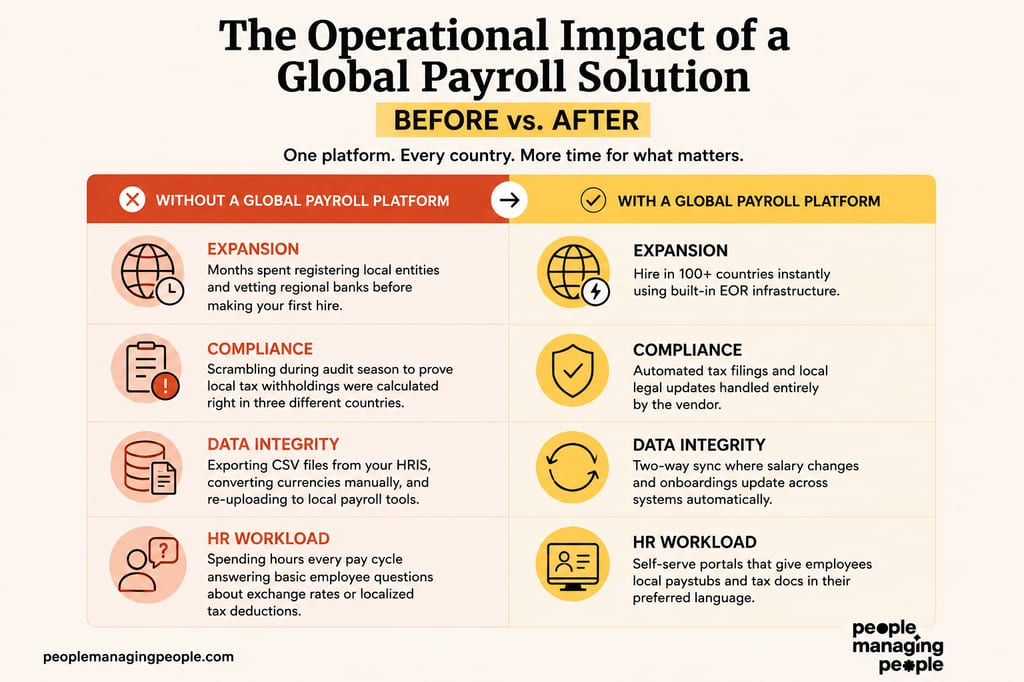
International payroll services centralize multi-country wage disbursements, local tax withholdings, and workforce reporting into a single system. Instead of managing disparate regional software or local accounting firms in every market, you get a unified workflow to pay a global workforce accurately, on time, and in full compliance with local labor laws.
Here is what your organization gains by running international payroll through a global payroll service provider:
- Fewer Operational Overhead Costs: Centralizing your payroll infrastructure replaces expensive per-country accounting retainers and reduces cross-border wire transfer fees from traditional banks.
- Audit-Ready Peace of Mind: Local tax filings, statutory withholdings, and social security contributions happen automatically according to each country’s tax rules, keeping you off the radar of foreign tax authorities.
- Accurate Financial Forecasting: Finance leaders gain a single dashboard showing total labor spend across every active market, making global headcount planning straightforward without currency translation delays.
- Predictable Paydays for Remote Teams: International staff receive localized payslips and on-time direct deposits in their local currency, preventing pay discrepancies that erode trust with distant workers.
- Data Consistency Across Systems: Connecting your payroll directly to your primary HRIS means salary adjustments, promotions, and offboardings reflect immediately, keeping your core HR records aligned with actual payout numbers.
Global Payroll Costs & Pricing Breakdown
The cost of global payroll services typically ranges between $20 and $50 per employee per month if you own local entities, or $299 to $699 per employee per month when using an employer of record (EOR) service.
However, your final bottom line depends heavily on how a provider structures its pricing model, currency exchange rates, and administrative add-ons. For example, here are some factors and how they affect your total cost:
- Team Size: More employees = more complexity = higher cost.
- Country Coverage: Countries with strict tax or labor laws often cost more due to added compliance overhead.
- Payroll Frequency: Weekly payroll costs more than monthly due to extra processing cycles.
- System Integration: Need the platform to sync with your existing HR or finance tools? That may require custom work (and increase costs).
- Service Scope: Basic payroll is cheaper than packages that also include HR support, compliance, or EOR services.
- Compliance & Reporting: If you operate in a heavily regulated industry or need detailed reports, expect to pay a premium.
Trends in International Payroll Software
The international payroll market is evolving fast, but certain trends consistently show up in the tools that get it right. These are the features making global teams faster, safer, and a whole lot easier to scale.
1. Smarter Payroll Automation with AI
Modern payroll platforms use AI to streamline complex processes, calculating salaries, applying tax rules, converting currencies, and flagging potential compliance issues automatically.
Why it matters: You get fewer manual steps, fewer errors, and a faster, more reliable payroll cycle across every country you operate in, freeing up your team to focus on scaling, not spreadsheet firefighting.
2. End-to-End Integration with HR and Time Tools
Today’s global payroll tools don’t work in isolation. Instead, they connect with your HRIS, time tracking, and finance systems to create one continuous workflow.
Why it matters: Cleaner data, fewer admin tasks, and faster insights. This gives your HR and finance teams real-time visibility into costs, compliance, and headcount, so you can make smarter decisions, faster.
3. Tighter Data Security & Privacy Controls
Leading platforms are prioritizing security—rolling out stronger encryption, granular access controls, and built-in compliance with global privacy laws like GDPR.
Why it matters: You protect sensitive employee data across borders while staying compliant with evolving privacy regulations. That builds trust internally and shields your business from serious risk.
Frequently Asked Questions
Here are clear, expert-backed answers to the most common ones I hear from teams navigating global payroll.
All-in-one global payroll platform vs. separate local providers: Which one should I choose?
For most organizations with employees in multiple countries, an all-in-one global payroll platform is the better choice. It centralizes payroll operations, improves reporting, and reduces the complexity of managing multiple local vendors. Separate local providers are a better fit if you operate in only a few countries and require specialized local expertise.
| All-in-One Global Payroll Platform | Separate Local Providers |
| Centralizes payroll across multiple countries in one system | Uses a different payroll provider in each country |
| Provides standardized reporting and processes | Offers deep local expertise and flexibility |
| Reduces vendor management and manual consolidation | Requires coordinating multiple vendors and payroll calendars |
| Integrates more easily with HR and finance systems | Integrations and reporting may vary by provider |
| Best for companies managing employees in multiple countries | Best for organizations operating in only a few countries with established local payroll partners |
Can I pay employees in a country where I don't have a local entity?
Yes, you can pay employees in countries where you don’t have a legal entity by using a global payroll provider that offers an employer of record (EOR) service. These providers manage employment, payroll, and compliance, handling taxes, benefits, and labor laws on your behalf, so you don’t need to set up a physical entity in each country. This can help you scale more quickly and reduce legal risks.
Global Payroll vs. EOR vs. PEO: What’s the Difference?
Here’s how the three differ:
-
- Global payroll services handle the logistics—paying people across countries, calculating taxes, converting currencies, staying compliant. But it assumes you already have legal entities wherever you’re hiring.
-
- EOR (employer of record) service goes further. The EOR provider becomes the legal employer for your hires in countries where you don’t have an entity. That means you can get up and running fast, without setting up a local company.
-
- PEO (Professional Employer Organization) is more local. It’s a co-employment model, usually in the U.S., where you and the PEO share employer responsibilities. You run the business; they handle the back-office HR.
The right choice depends on your setup. Going global without a legal entity? Use an EOR. Already registered and just need payroll support? Invest in a global payroll partner. Managing U.S. teams with limited in-house HR staff? A PEO might be the way to go.
How do global payroll solutions handle currency conversion and tax regulations?
Global payroll solutions handle currency conversion by pulling exchange rates from financial data providers and applying them during payroll calculations or at the time payments are processed. Employees are paid in their local currency, while employers can typically fund payroll in a single currency. Some providers also let you lock exchange rates before payroll runs to reduce the impact of currency fluctuations.
To handle tax regulations, global payroll solutions maintain country-specific payroll rules for each jurisdiction. The software automatically applies the correct income tax rates, social security contributions, statutory benefits, and other required deductions based on an employee’s work location. Many providers also update these rules as regulations change and validate payroll calculations before filing tax reports and remitting payments to local authorities.
How do global payroll services prevent compliance mistakes?
Global payroll services reduce compliance risk by:
- Applying country-specific payroll rules to automatically calculate taxes, statutory deductions, and employer contributions.
- Keeping payroll requirements up to date as local tax and labor laws change.
- Generating required payroll reports and tax filings based on local regulations.
- Providing access to in-country payroll experts who help navigate complex compliance requirements and regulatory changes.
While global payroll services automate many compliance tasks, employers are still responsible for maintaining accurate employee data and approving payroll before it’s processed.
How do I choose a global payroll solution for remote teams?
When evaluating global payroll solutions for remote teams, prioritize providers that can support your current workforce while scaling as you hire in new countries.
Use the checklist below to compare vendors:
| Consideration | Why It Matters |
| Country coverage | Ensure the provider supports every country where you currently employ or plan to hire workers. |
| Compliance support | Look for automatic updates to local tax, payroll, and labor regulations to reduce compliance risk. |
| Worker types | Verify the platform can manage employees, contractors, and Employer of Record (EOR) workers if needed. |
| Multi-currency payments | Confirm employees can be paid in their local currency and check for any currency conversion fees. |
| Integrations | Choose a solution that integrates with your HRIS, time tracking, accounting, and finance systems to reduce manual work. |
| Reporting | Look for centralized payroll reporting across countries to improve visibility into global labor costs. |
| Employee experience | Self-service access to payslips, tax documents, and payroll information can reduce HR support requests. |
| Scalability | Select a provider that can support additional countries and growing headcount without requiring major system changes. |
What challenges should I expect when onboarding new countries to my global payroll?
Expect to face compliance complexity, varied employment laws, language barriers, and limited banking options. Getting tax IDs, registering with authorities, and adapting to local regulations can slow down onboarding. Use a provider with expertise in your target countries, and always collect complete employee documentation early in the process to speed things up.
How do I integrate global payroll with HR systems?
Most global payroll solutions integrate with HR systems through native integrations or APIs that automatically sync employee data.
To ensure a smooth integration:
- Connect your HRIS and payroll platform using a native integration or API.
- Sync employee records, compensation, time tracking, and leave data automatically.
- Test the integration with a parallel payroll run before going live.
- Regularly monitor data syncs to identify and resolve errors quickly.
Choosing a payroll solution that integrates with your existing HR, time tracking, and accounting systems helps reduce manual work and improve payroll accuracy.
Scale Your Global Payroll
Managing global payroll doesn’t have to be a headache. The right platform can simplify your systems, keep you compliant, and improve the experience for your international team. Start by auditing your current setup, identifying your must-have features, and asking vendors clear, direct questions before you commit.
Want to stay ahead on global HR trends? Subscribe to the People Managing People newsletter for practical updates, emerging tools, and actionable insights tailored to HR professionals.

