Global HR Services: What They Are, and How They Can Help You


Managing HR across multiple countries quickly becomes complex. Global HR services and outsourcing help organizations handle international hiring, payroll, compliance, and workforce administration while staying aligned with local labor laws and supporting scalable global growth.
What are Global HR Services?
Global HR services help organizations manage international employees, HR operations, and compliance across multiple countries without building large local HR teams in every region.
These services commonly include:

- International hiring and talent acquisition (including recruitment process outsourcing)
- Global payroll and multi-currency payments
- Employment contracts and onboarding
- Benefits administration
- HR compliance and labor law support
- Employee performance and workforce management
- HR consulting and operational support
For example, a company hiring employees in several countries may use a global HR service provider to manage payroll, local compliance requirements, onboarding, and country-specific employment documentation from one centralized system.
Having the local knowledge and expertise provided by your HR consulting partner also helps you enhance employee engagement and increase retention.
How Global HR Services Can Help You
Global HR services make it easier for organizations to hire talent across multiple countries without building large internal HR operations in every region.
In addition to expanding access to international talent pools, global HR outsourcing can help organizations support remote employees more effectively, navigate local hiring requirements, and improve workforce scalability as global teams grow.
For example, companies hiring internationally often face operational challenges around local payroll, employment contracts, benefits administration, and labor law compliance. Working with a global HR service provider helps reduce this complexity while giving internal HR teams more time to focus on recruiting, employee experience, and workforce strategy.
Many organizations also combine global HR services with a global HRIS or workforce management platform to centralize employee data, payroll operations, onboarding, and reporting across countries.
To give you a leg up in this department, take a look at these tips on how to tap into global talent and hire remote employees from our international recruiting expert Mariya Hristova.
How Do Global HR Services Work?
Global HR services help organizations outsource or streamline international HR operations such as payroll, compliance, onboarding, and workforce administration across multiple countries.
Most providers charge either:
- a monthly fee per employee, or
- pricing based on the specific services used, such as payroll, benefits administration, or compliance support.
The way the partnership works usually depends on the provider model:
| Model | How It Works |
|---|---|
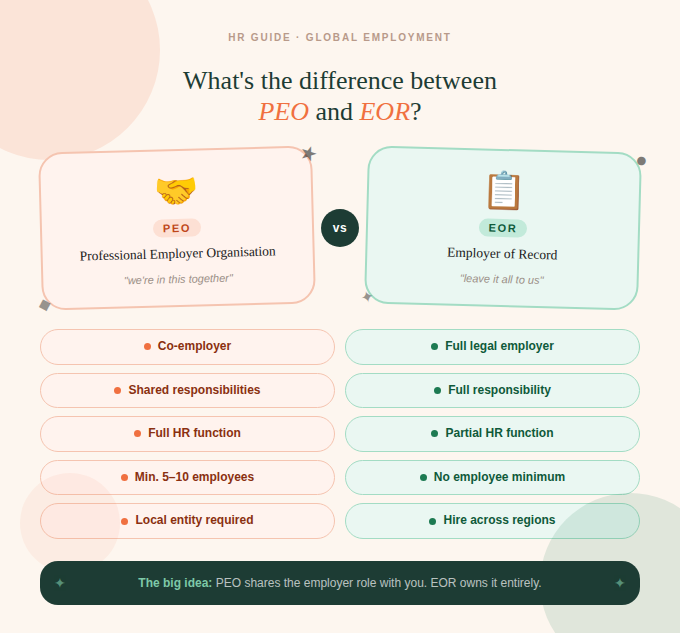
| Co-employment model (PEO/HRO) | The provider supports HR operations, payroll, benefits, and compliance while your company remains the legal employer. |
| Employer of Record (EOR) | The provider becomes the legal employer on behalf of your organization and manages local employment compliance, contracts, payroll, and statutory requirements. |
For example, companies expanding internationally without opening local entities often use an EOR model to hire employees compliantly in new countries much faster than building local HR infrastructure from scratch.
Types of Global HR Service Providers
Different global HR providers solve different operational challenges. Some focus on payroll and compliance, while others support international hiring, HR administration, or recruitment operations.
| Provider Type | Best For |
|---|---|
| Global Payroll Providers | Centralizing payroll operations across multiple countries |
| Employer of Record (EOR) | Hiring internationally without establishing local entities |
| Professional Employer Organization (PEO) | Outsourcing HR administration while retaining local entities |
| Recruitment Process Outsourcing (RPO) | Scaling recruitment and hiring operations |
Global Payroll Services
Global payroll providers help organizations manage employee payments, taxes, deductions, and payroll compliance across multiple countries from one centralized system.
Typically Handle:
- Multi-country payroll processing
- Multi-currency payments
- Payroll tax reporting
- Statutory deductions
- Contractor payments
- Centralized payroll reporting
Best Used When:
You already have legal entities established internationally, but need to simplify payroll administration and compliance across regions.
Important To Know:
Global payroll providers usually manage payroll operations, not legal employment responsibility. Your organization still remains the legal employer.
Employer of Record (EOR) Services
Employer of Record (EOR) providers help organizations hire employees internationally without establishing local legal entities in each country.
Typically Handle:
- Employment contracts
- International onboarding
- Payroll and tax compliance
- Global employee benefits administration
- Labor law compliance
- Visa and work permit sponsorship
Best Used When:
You need to hire quickly in new countries or support remote international employees without setting up entities.
Important To Know:
An EOR becomes the legal employer on your behalf while your organization continues managing day-to-day work and employee performance. Organizations comparing the best EOR services should also evaluate the potential risks of using an EOR service, including long-term scalability, customization limitations, and provider dependency.
Country-Specific EOR Services
Are you interested in hiring talent within a specific country? If so, take a look at my lists of the best EOR services for the following countries:
- Australia's best EOR services
- Brazil's best EOR services
- Canada's best EOR services
- Chile's best EOR services
- China's best EOR services
- Colombia's best EOR services
- France's best EOR services
- Germany's best EOR services
- Hong Kong's best EOR services
- India's best EOR services
- Indonesia's best EOR services
- Italy's best EOR services
- Japan's best EOR services
- Netherland's best EOR services
- Philippines' best EOR services
- Portugal's best EOR services
- Singapore's best EOR services
- Spain's best EOR services
- Switzerland's best EOR services
- Turkey's best EOR services
- UAE's best EOR services
- United Kingdom's best EOR services
Professional Employer Organization (PEO) Services
PEOs help organizations outsource HR administration while operating through a co-employment model.
Typically Handle:
- Payroll administration
- Benefits management
- HR support
- Compliance guidance
- Onboarding/offboarding
- HR reporting
Best Used When:
You already operate legally in a country but want additional HR infrastructure and administrative support.
Important To Know:
The cost of PEO services can vary significantly depending on workforce size, countries supported, and the level of HR administration included.
One major benefit of working with a PEO is gaining access to payroll, compliance, and HR expertise without building a large in-house HR department. Organizations comparing providers should also understand the difference between PEO and EOR models before selecting a solution. Many growing businesses evaluate multiple providers and pricing structures before choosing the best PEO companies, while some organizations also work with PEO brokers to simplify vendor comparisons and collect pricing quotes from several providers.
Recruitment Process Outsourcing (RPO) Companies
Recruitment process outsourcing (RPO) companies are specialized service providers that RPO providers manage some or all recruitment operations on behalf of organizations scaling hiring across regions or departments.
Typically Handle:
- Candidate sourcing
- Screening and assessments
- Interview coordination
- Employer branding
- Recruitment analytics
- Onboarding support
Best Used When:
Your biggest operational challenge is recruiting efficiently or scaling hiring capacity quickly.
Important To Know:
RPO providers focus on recruitment operations rather than payroll, employment compliance, or workforce administration.
If this sounds like the type of HR expert you're looking to partner with, take a look at my list of the best RPO companies next.
Trends in Global HR Outsourcing
Global HR services are evolving rapidly, shaped by technology, employee expectations, and the realities of a mobile workforce. Here are four key trends transforming how companies manage HR on a global scale:
| Trend | What’s Changing | Why It Matters |
|---|---|---|
| AI & Automation | Global HR providers are increasingly using AI and automation for resume screening, onboarding, payroll workflows, and compliance tracking. | Reduces manual HR administration, improves scalability, and helps minimize payroll and compliance errors across regions. |
| Employee Experience Platforms | More providers now include self-service portals, engagement tools, real-time feedback systems, and personalized employee support. | Improves employee engagement, retention, and communication across distributed global teams. |
| Global Mobility Support | HR outsourcing providers are expanding services around relocation, immigration, visa support, and cross-border tax compliance. | Helps organizations support remote and international employees while reducing operational complexity during global expansion. |
| Ongoing International HR Support | Global HR services increasingly provide continuous support beyond onboarding, including localized HR assistance and labor law updates. | Helps organizations stay compliant as employment laws evolve and improves long-term support for international employees. |
Stay in Touch
To stay up-to-date on all the latest trends in international recruiting and global HR, don’t forget to sign up for our newsletter!