
26 Best Employer of Record in China: Reviewed in 2025

Best Chinese Employer of Record Service Shortlist
Here's my pick of the 10 best software from the 26 tools reviewed.
Talk through what you’re looking for. Get a custom shortlist based on your needs. No fees.


Hiring employees in China can be a strategic move—but navigating the country’s legal, bureaucratic, and regulatory hurdles often leaves HR professionals feeling overwhelmed.
From registering with the State Administration for Market Regulation (SAMR) to ensuring compliance with the Ministry of Human Resources and Social Security (MOHRSS), the process is time-consuming, risky, and expensive—especially if you don’t have an established legal entity in China.
That’s where a Chinese Employer of Record (EOR) service comes in. An EOR lets you legally hire, onboard, and pay employees in China—without needing to set up a local entity. You’ll stay compliant with local labor laws, provide support to your employees on the ground, and accelerate your market entry with minimal red tape.
Sounds like a worthwhile partnership, right? The challenging part is figuring out which Chinese EOR service is the best fit for your needs.
As someone who’s researched dozens of global HR services and helped companies compare international hiring solutions, I’ve created this curated list of the best EOR services for hiring in China. It’s designed to save you time, reduce risk, and help you find a provider you can trust.
Market Details for Hiring in China
- Capital City: Beijing
- Payroll Frequency: Monthly
- Currency: Chinese Yuan (CNY) & Renminbi (RMB)
- Official Language: Mandarin Chinese
- Approx. Population: 1.4 Billion
- Public Holidays: 7 to 10 holidays (regional differences; some are multiple days)
Why Hire Employees in China?
Hiring employees in China offers several strategic advantages for foreign companies. China's educational system produces graduates with specialized skills in STEM fields, which are crucial skills for industries such as manufacturing, information technology, electronics, and engineering, contributing to a deep talent marketplace in these sectors.
In addition, industries such as artificial intelligence (AI), renewable energy, and biotechnology are thriving in China, making it a hub for companies looking to recruit the best talent globally. These skills, coupled with generally low employment costs, have made China an increasingly attractive market for employing skilled workers abroad.

Need expert help selecting the right tool?
With one-on-one help, we guide you to your top software options. Narrow down your software search & make a confident choice.
Why Trust Our Reviews
We've been testing and reviewing HR software + services since 2019. As HR professionals ourselves, we know how critical and difficult it is to make the right decision when selecting a new HR service provider to work with.
We invest in deep research to help our audience make better purchasing decisions. We've tested more than 2,000 tools and 200 service providers for different HR use cases and written over 1,000 comprehensive software reviews. Learn how we stay transparent, and take a look at our review methodology.
Best Employer of Record in China: Pricing Comparison Chart
This comparison chart summarizes pricing details for my top Employer of Record selections for hiring staff in China to help you find the best EOR service for your budget and business needs.
| Tool | Best For | Trial Info | Price | ||
|---|---|---|---|---|---|
| 1 | Best for offering local health benefits to Chinese EOR employees | Free trial + demo available | From $29/month | Website | |
| 2 | Best for budget-conscious remote team expansion | Free demo available | From $25 - $199/user/month | Website | |
| 3 | Best for hiring and paying talent in China | Free demo available | From $199/employee/month or $19/contractor/month | Website | |
| 4 | Best for direct EOR services | Free demo available | From $595/employee/month or $49/contractor/month | Website | |
| 5 | Best for complying with local laws | Free trial available | From $39/employee/month | Website | |
| 6 | Best for hiring without a legal entity | Not available | From $29/contractor/month to $499/EOR employee/month | Website | |
| 7 | Best EOR for accessing Asian talent quickly | Not available | From $300/employee/month | Website | |
| 8 | Best for navigating complex regulatory landscapes | Free demo available | Pricing upon request | Website | |
| 9 | Best for a flexible EOR contract with no termination fee | Free demo available | From $49/contractor/month | Website | |
| 10 | Best for an advanced EOR management platform | Free demo available | Pricing upon request | Website |
-

edays
Visit WebsiteThis is an aggregated rating for this tool including ratings from Crozdesk users and ratings from other sites.4.3 -
Boon
Visit WebsiteThis is an aggregated rating for this tool including ratings from Crozdesk users and ratings from other sites.4.7 -
ClearCompany
Visit WebsiteThis is an aggregated rating for this tool including ratings from Crozdesk users and ratings from other sites.4.6





Reviews of the Best Employer of Record Services in China
To make your search easier, I’ve summarized my top 10 EOR providers for hiring in China, highlighting what they offer and how they can support your HR operations. You’ll also find 10 additional providers below for even more options to explore.


Deel is a well-established employer of record platform that helps companies rapidly employ workers in 150+ countries, including China.
Deel owns a local entity in China staffed with legal experts to keep track of regulatory changes and ensure all legal obligations are met on your behalf. To hire an employee in China with Deel, the average onboarding time frame is 7 days.
Why I picked Deel: Deel excels as an EOR service provider in China by offering streamlined contract management, ensuring compliance with Chinese employment laws. Deel also helps organizations offer localized employee benefits for Chinese staff, including private health insurance, a housing fund, a retirement pension, and social security contributions.
In addition, Deel has launched several new offerings over the past year, including global payroll, global mobility support, integrated Slack tools, and advanced integrations. These services, all combined, facilitate efficient and compliant hiring processes within the Chinese talent market.
Deel Key Services:
Deel offers end-to-end management for your employees based in China, covering everything from hiring and onboarding to termination. Their web app is user-friendly and provides a range of features to help businesses manage their remote teams effectively, including contract management and expense tracking.
Their integrated contract management function supports advanced customizations such as stipends, signing bonuses, and stock options. You can also use Deel for visa and immigration support if you want to relocate existing employees to China, with Deel managing the entire visa process for your organization in-house.
Deel offers 24/7 customer support and live chat and is known for its fast support.
Pros and cons
Pros:
- Comprehensive employee benefits
- Local compliance expertise
- Fast onboarding process
Cons:
- Potential complexity for first-time users
- Limited customization options
New Product Updates from Deel

500+ New Platform Enhancements for Global Hiring and Payroll
Deel announced over 500 platform enhancements focusing on global hiring, HR, payroll, and AI-driven compliance, featuring tools for faster hiring, smarter HR management, strategic planning, and enhanced payroll flexibility. For more details, visit the source: Deel Blog.


Remofirst is a global EOR service provider on a mission to free employers from geographical boundaries so they can build global teams with ease. They offer EOR services in 180+ countries, eliminating the need to set up multiple legal entities abroad.
Why I picked Remofirst: If you plan to hire many EOR employees in different countries, like China, Remofirst is a good option for those expanding on a budget. Hiring in China can be expensive if you try to go at it alone, but Remofirst takes care of employment contracts, taxes, and social security requirements for you so you don't need to worry about the costs associated with setting up a local entity.
In addition, Remofirst handles the unique challenges of China’s employment landscape, including mandatory health insurance and social benefits for employees. You’ll also get help with understanding labor contracts and probation periods. Furthermore, to simplify your payroll process, Remofirst summarizes and aggregates your EOR invoices for review, showing each EOR employee’s salary in their local currency, including Chinese Yuan (CNY). They'll also automatically calculate your team’s hours, time off, holidays, bonuses, and commissions so you don’t have to worry about it.
Remofirst Key Services:
Their team of legal experts and HR professionals will ensure your business operations are always compliant with changing Chinese regulations, with compliance documentation accessible at all times through your secure dashboard. Their customer support team is also available 24/7 in case you need additional help. All clients also receive a dedicated account manager as their main point of contact.
On top of their EOR services, Remofirst also provides international payroll and invoice management, global benefits management (including insurance and equity plans, plus time-off management), and employee support with obtaining visas and other immigration documentation. They can even help you allocate equipment to your global employees.
Pros and cons
Pros:
- Robust employee support
- User-friendly platform
- Comprehensive compliance management
Cons:
- Service availability may vary by region
- Dependence on third-party providers for some services


Skuad is a global HR platform that facilitates international hiring, payroll, and compliance for businesses in over 160 countries, including China. When you hire them as your Chinese EOR partner, they’ll manage the whole hiring process on your behalf, including creating employment agreements and other legal documents.
Why I picked Skuad: As part of their EOR service, Skuad offers remote onboarding and can facilitate payroll in multiple currencies. This includes the management of invoices as well as payroll automation. Skuad also offers robust compliance frameworks for local Chinese employment laws, including visa and immigration processes, statutory benefits, and tax obligations.
Skuad Key Services:
Skuad's EOR services include remote employee onboarding, employee benefits, time-off tracking, and managing tax compliance. As part of their global hiring service, they’ll handle all the required documentation on your behalf, including work permits and visas for your new hires and their dependents.
Beyond that, Skuad can also help you distribute computer equipment to your new employees, and track company assets like phones and other IT devices.
Pros and cons
Pros:
- Comprehensive local compliance management
- Robust HR support
- User-friendly interface
Cons:
- Deductions only available on Enterprise plan
- Limited customization options
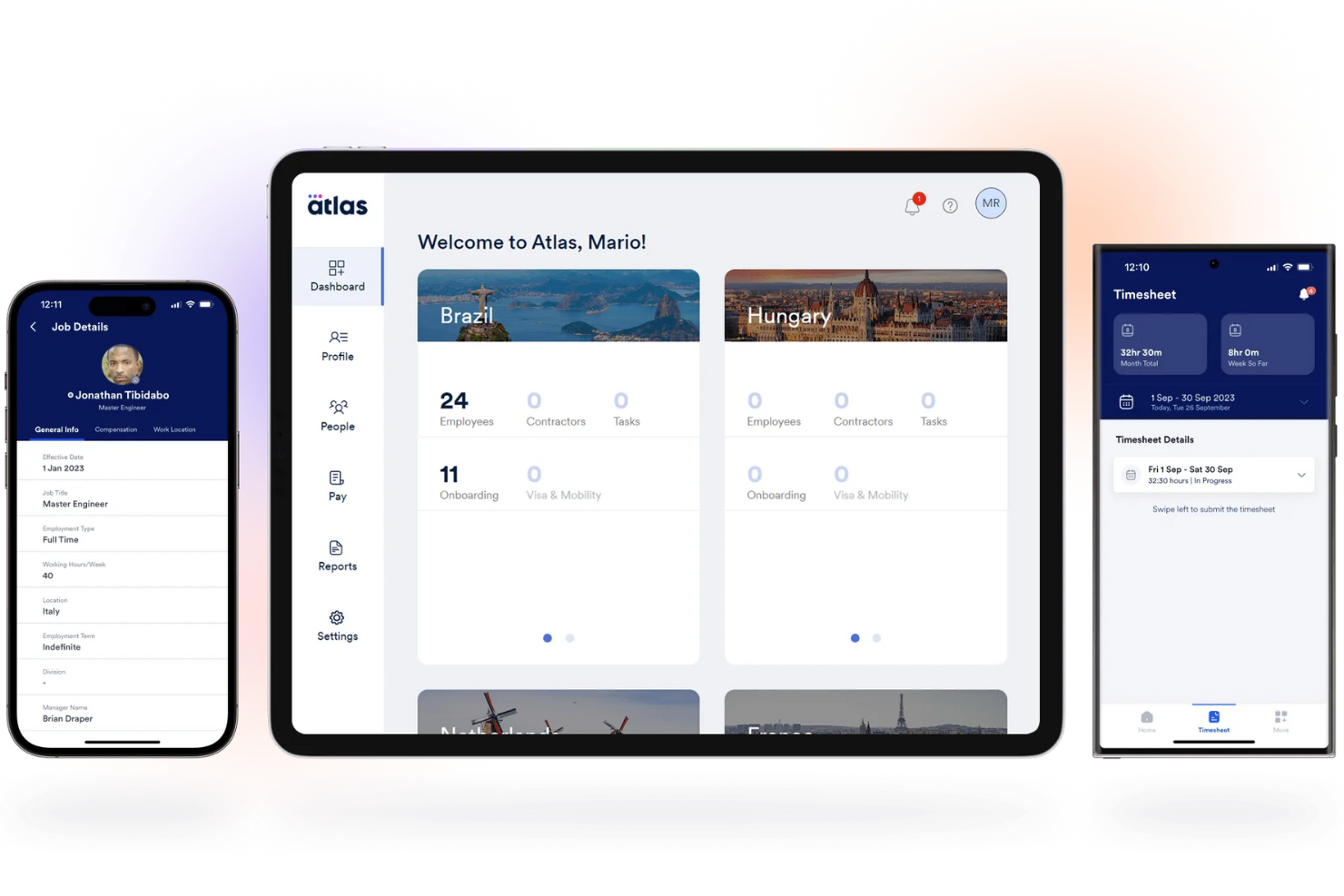
Atlas HXM is a platform that transforms global people operations by offering a centralized solution for onboarding, compliance management, and payments in over 160 countries. It enables companies to expand internationally without the need for a local entity, managing compliance and payroll for your global workforce.
Why I picked Atlas HXM: When considering an employer of record in China, Atlas HXM stands out due to its direct model. They own entities in over 160 countries, including China, which eliminates the need for third-party providers and streamlines HR support. This direct presence ensures that your operations in China are compliant with local regulations, reducing the risk associated with international hiring.
I also like their global compliance management. Atlas HXM assumes the compliance risk, ensuring total adherence to local labor laws and regulations in China. This means you don't have to navigate the complex legal landscape by yourself as Atlas HXM handles it for you, allowing you to focus on your core business activities.
Atlas HXM Key Services:
Their team also offers visa and global mobility services, providing support for obtaining visas and facilitating international transitions for your employees. Additionally, their data insights offer a central hub with real-time data from over 160 countries, empowering your decision-making and allowing for country comparisons.
The platform also centralizes payroll processing across countries, ensuring accurate and timely payments to employees in China while staying compliant with local tax regulations and contributions. You even have the option to provide localized benefits to your employees.
Pros and cons
Pros:
- Automated payroll processing
- Direct EOR approach in all their service countries
- Ensures compliance with local labor laws
Cons:
- Platform could offer more customizability
- Doesn't source talent for you


Agile Hero is an all-in-one HR platform designed to simplify global workforce management. It enables businesses to manage various employee types, including full-time staff, contractors, and Employer of Record (EOR) hires, all in one place.
Why I picked Agile Hero: Agile Hero's global employer of record services are perfect for managing remote teams in China. This feature takes care of hiring and managing international talent, handling the details of onboarding and legal tasks, so you don't have to navigate China's complex regulatory environment. By offloading these responsibilities, your team can focus more on core business activities, knowing local compliance with laws and regulations is well managed.
Agile Hero Key Services:
Other key services include robust global mobility support, encompassing corporate immigration assistance, relocation support, tax and compensation guidance, and cultural induction programs. The platform also offers self-onboarding capabilities, allowing new employees to complete training and documentation at their convenience.
Agile Hero also provides real-time reporting tools, giving you in-depth insights into your workforce metrics and payroll expenses.
Pros and cons
Pros:
- User-friendly interface
- Supports global mobility
- Employee self-service portals
Cons:
- Per employee pricing be costly for smaller businesses or startups
- Limited customization options


Omnipresent is a global employment platform that helps businesses hire and manage international teams without the need to establish local entities. By acting as an Employer of Record (EOR), Omnipresent handles employment administration, compliance, and payroll across over 160 countries, including China.
Why I picked Omnipresent: Omnipresent's EOR services ensure compliance with local employment laws, reducing the risk of legal issues. They handle employment contracts, tax contributions, and benefits in accordance with Chinese regulations, so you can confidently expand your team in China.
Omnipresent Key Services:
Omnipresent also offers global payroll services that ensure your Chinese employees are paid accurately and on time. They manage currency conversions, tax withholdings, and other payroll complexities
Other key services include dedicated legal support to help you navigate international employment complexities, assistance with onboarding processes to ensure your employees are integrated smoothly, and the ability to provide competitive benefits packages tailored to the Chinese market, helping you attract and retain top talent.
Pros and cons
Pros:
- Strong local expertise in employment regulations
- Handles tax compliance across multiple countries
- Easy to manage payroll for global teams in one platform
Cons:
- Support in certain regions can be lacking
- Limited flexibility in customizing certain benefits packages


Links International is a well-known EOR service provider that offers HR outsourcing solutions across numerous Asian countries, including China.
Why I picked Links International: They provide detailed support for onboarding and offboarding processes, ensuring smooth transitions for employees. This service includes document preparation, orientation, and exit interviews, enhancing the employee experience and maintaining operational efficiency. Their onboarding process is also very quick, with the ability to hire employees in China in as little as 48 hours.
Links International Key Services:
Their services include payroll management, compliance assurance, and employee benefits administration, tailored to meet the unique needs of businesses in the Chinese market. Links International stands out with its extensive local expertise and personalized service approach, ensuring seamless HR operations for companies expanding into China.
Their extensive network of benefit providers also helps organizations craft competitive packages that can attract and retain top talent in China.
Pros and cons
Pros:
- Personalized and responsive customer service
- Extensive network of employee benefit providers
- Strong local market expertise in China
Cons:
- Smaller scale operations might affect scalability for very large enterprises
- Limited to specific regions in Asia


Velocity Global is a well-known employer of record (EOR) and professional employer organization (PEO) provider that simplifies global hiring thanks to its network of on-the-ground experts in 185+ countries, including China.
Why I picked Velocity Global: I included Velocity Global in this list because of their well-known reputation for global EOR services and their expertise in navigating complex regulatory environments. They stand out with their ability to handle intricate regulatory landscapes, ensuring companies can expand efficiently without legal hurdles.
Velocity Global Key Services:
Velocity Global offers comprehensive support for their EOR clients, including everything from onboarding to ongoing HR management, backed by a deep understanding of local employment laws. Key services include payroll, compliance, benefits management, employee training, and risk management for your Chinese employee operations.
In addition to its EOR services, Velocity Global can also help you simplify your plans for global expansion or offer additional global immigration services in case you want to move international employees to another location.
Pros and cons
Pros:
- Strong understanding of the Chinese regulatory environment
- Localized payroll management
- Efficient and thorough onboarding process
Cons:
- Pricing details are not transparent
- Limited customization options

Horizons offers streamlined global HR solutions including EOR and PEO services, international payroll and recruitment, and global mobility & immigration support.
Why I picked Horizons: I included Horizons in this list because their EOR service is cost-effective compared to others, and they offer flexible contract terms. You can end your EOR relationship with them at any time without worrying about costly termination fees or other penalties.
Their China-based EOR services are administered by their local experts who are well-versed in China’s employment laws, including statutory benefits such as vacation leave, maternity leave, and paternity leave. Their onboarding process for new employees in China is also very quick, with a minimum onboarding time of just 12 hours.
Horizons Key Services:
In addition to their standard EOR services, they offer additional niche service offerings such as tips for doing business in China, guides to help with global expansion, resources for strategic mergers & acquisitions, and advice on accessing new and emerging markets.
Horizons also provides cultural training and support to help employees integrate seamlessly into their new work environment. This service enhances employee satisfaction and retention by addressing cultural nuances and fostering a positive workplace culture.
Pros and cons
Pros:
- Cultural integration support
- Strong focus on compliance
- Deep knowledge of Chinese labor laws
Cons:
- Service offerings may vary by region
- Dependence on local partners for some services

Mercans is a global EOR provider that offers services in China, including global payroll and other HR solutions. Their services emphasize compliance, local expertise, and seamless integration for businesses expanding into the Chinese market.
Why I picked Mercans: EOR services via Mercans include compliance management and extensive local knowledge, a commitment to personalized service, and access to an advanced technology platform to streamline payroll and HR processes. They stand out for their ability to handle complex employment scenarios, making them a top choice for companies seeking reliable EOR services in China.
Mercans Key Services:
Mercans provides tailored HR solutions to support the diverse needs of each client. This customization ensures that businesses receive support aligned with their unique requirements, enhancing overall employee satisfaction.
Mercans also runs its EOR services from an advanced technology platform that includes real-time reporting and analytics features, giving client companies valuable insights into their global HR operations. This level of data also helps client companies make informed decisions and improve strategic planning.
Pros and cons
Pros:
- Extensive local expertise
- Personalized service
- Advanced technology platform
Cons:
- Integration challenges with some existing systems
- Limited physical presence in some regions
Other Chinese Employer of Record Services
Here are some other EOR service providers in China that didn’t make it into my top 10 shortlist, but are still worth considering:
- AYP Group
EOR service for Asian market expertise
- Remote
For competitive and cost-effective benefits packages
- Multiplier
EOR service for quick employee onboarding
- Papaya Global
For an AI-based payroll engine
- G-P
For quick, locally-compliant contracts
- Native Teams
For focus on localized employee support
- Rippling
For managing IT requirements for EOR employees
- HROne
EOR with a head office in Shanghai
- Rivermate
EOR service for European client companies
- NN Road
For compliantly hiring foreign expats who live in China
- Sky Executive
For support with corporate expansion across Southeast Asia
- GlobalPEO
For combined EOR and PEO services
- Gibson Watts Global
EOR service for risk management expertise
- Bradford Jacobs
EOR service for assistance with business expansion into China
- Gloroots
EOR service for small businesses or startups
- Safeguard Global
EOR service for NGOs and non-profit organizations


Hiring in China: Important Details
Here are some key details to note if this is your first time hiring staff located in China. Your EOR provider will manage these compliance details on your behalf. However, proactively informing yourself of these details is always recommended before you invest your resources into sourcing staff based in China.
In China:
- Employment laws in China are set by the Ministry of Human Resources and Social Security (MOHRSS). In addition, China has local labor bureaus within each province.
- You can hire employees (full-time, part-time, temporary, or seasonal) or contractors. Your Chinese EOR provider can help you determine the best hiring option depending on your needs while ensuring you protect against employee misclassification issues.
- China has both mandatory payroll deductions and social security contributions that must be collected, including the following:
- Basic Pension Insurance
- Medical Insurance
- Unemployment Insurance
- Work-Related Injury Insurance
- Maternity Insurance, and the
- Housing Provident Fund.
- Mandarin Chinese is the official language in China. However, many other languages are spoken, including Cantonese, Shanghainese, Hokkien, Tibetan, and Uyghur, depending on the region.
- The standard working week in China is 40 hours per week for a 5-day work week.
- Overtime is allowed under the Labor Law of the People’s Republic of China and is calculated at 150% of the normal wage for overtime on weekdays, 200% for weekends, and 300% for public holidays.
- In China, employees are paid monthly, plus there is an additional 13th-month salary payment given to employees typically before Chinese New Year.
- Paid vacation in China starts at 5 days per year for employees who have worked between 1 and 10 years, 10 days for those with 10 to 20 years of service, and 15 days for those with more than 20 years.
- There are 7 national public holidays (spread over 23 days) plus up to 3 regional holidays that are celebrated in China which employees are paid for. Understanding and complying with employment norms and legal requirements surrounding Chinese public holidays is one area where your EOR service will shine, managing these occurrences hassle-free on your behalf.
- National public holidays in China include:
- New Year's Day (January 1)
- Chinese New Year (variable dates, 7 days)
- Qingming Festival (1 day)
- Labor Day (5 days)
- Dragon Boat Festival (1 day)
- Mid-Autumn Festival (1 day)
- National Day (7 days)
- China offers maternity leave and paternity leave.
- The maternity leave entitlement is up to 98 days (or up to 158 days in Beijing), beginning up to 15 days before the child’s birth.
- The paternity leave entitlement for fathers is 7 to 15 days, depending on the region.
- During these leaves, employees receive their full salary payments from China’s Social Security Fund.
- Paid sick leave in China is calculated based on the employee’s length of service, with a minimum of 3 months and a maximum of 24 months. The sick leave wage is a percentage of the employee's regular wage, depending on the duration of their illness and local regulations.
- The probationary period in China is typically 1 to 6 months, depending on the length of the employment contract. For contracts less than 3 months, there is no probation period.
- The termination terms in China are mandated by the Labor Contract Law of the People's Republic of China. The required notice period is 30 days if initiated by the employer, and employees must give 30 days' notice if resigning. This is another area where a local Chinese EOR can provide assistance to ensure the probation period and related severance are handled correctly.
- Severance pay: In China severance pay is calculated as one month’s salary for each year of service. If an employee has been with a company for less than one full year, the severance is prorated based on their time worked.
Selection Criteria for Employer of Record China
Finding the best EOR services for hiring in China meant digging into how each provider helps solve real-world challenges—like navigating local labor laws, running compliant payroll, offering competitive benefits, and making onboarding smooth.
Here are the criteria I used to evaluate each provider in this list:
Core Employer of Record Services (25% of total score): To be considered for inclusion in this list, each EOR provider had to offer the following basic services first:
- The corporate structure to legally and compliantly hire employees in multiple countries without a local entity
- The ability to manage international payroll and taxes in compliance with local regulations
- Assistance with offering competitive and locally compliant benefits packages
- Assistance with navigating visa and work permit processes for expatriate employees
- Robust procedures to ensure data privacy and security that comply with international standards, including GDPR and other requirements
Additional Standout Services (25% of total score): To help me narrow in on the best EOR services out of the numerous options available, I also took note of any unique or less common services, including:
- Advanced technology platforms that streamlined payroll and HR processes while still offering ease of use
- Specialized experience in hiring employees within specific new countries or key industries
- Services that enhance remote work compliance and global mobility needs
- Specialized customer support for complex immigration cases
- Assistance with international IT requirements, including managing computer equipment, software licenses, and other asset-tracking requirements
- A focus on eco-friendly and sustainable employment practices
Industry Experience (10% of total score): To evaluate the industry experience of each EOR service provider, I considered the following:
- How many years their business has operated in the EOR space
- Any industry recognitions or certifications the provider may hold in international HR and payroll
- Their depth of knowledge in local labor laws across multiple jurisdictions
- Their expertise in new markets, including how many different countries they offer local expertise in
- Evidence of a strong track record managing global expansion processes
- The combined experience and credentials of their team members, if available
Customer Onboarding (10% of total score): To get a sense of each provider's customer onboarding process, I considered the following factors:
- The availability of comprehensive onboarding materials, such as fact sheets, guides, FAQ repositories, or other training resources
- Support for integrating the EOR provider's software with existing HR systems
- Direct access to onboarding specialists, customer support, or a dedicated account manager during the setup phase
Customer Support (10% of total score): Since the EOR provider will act as your remote workers' legal employer, it's important to ensure you'll receive timely communications and top-level support. To evaluate the level of customer support each company offered, I considered the following:
- The availability of a multilingual support team that covers different time zones
- Multiple support channels, including phone, email, and live chat
- Evidence of responsiveness and effectiveness in resolving issues, as inferred from customer reviews
- The existence of dedicated account managers to provide assistance as needed
Value for Price (10% of total score): To gauge the overall value of each service, I considered the following factors:
- Transparent pricing models without hidden fees
- Comparative analysis of service offerings versus cost
- Flexibility in service packages to suit different business sizes and needs
Keep in mind that EOR services are complicated, and because of that the price tag can sometimes be high. However, the prices for their services still offer a good ROI considering the complexity of the premium-grade services you're gaining.
Customer Reviews (10% of total score): Evaluating customer reviews is the final element of my selection process, which helps me understand how happy real users are with a service. To determine this, I considered the following factors:
- Consistently high ratings across various consumer review platforms
- Specific feedback on the ease of use of the EOR services
- Testimonials highlighting exceptional customer support and problem resolution
Using this assessment framework helped me identify the employer of record services that go beyond basic requirements to offer additional value through unique services, deep industry experience, smooth onboarding, effective support, and overall value for price.
What is an Employer of Record in China?
An Employer of Record (EOR) in China refers to a third-party service that legally employs workers in China on behalf of your company. While your organization retains control over these employees’ daily tasks and workloads, the EOR takes on the full legal responsibility for employment.
As the legal employer, the EOR assumes full legal responsibility for any new hires. This includes managing payroll, deducting taxes, ensuring compliance with local employment regulations, administering benefits, and handling any other employee-related requirements specific to China.
Partnering with an EOR service is beneficial for companies wanting to hire skilled foreign workers or expand their operations into China since it simplifies this process considerably.
Instead of requiring your HR team to master China’s employment laws and regulations, you can delegate these responsibilities to a local EOR in China and gain peace of mind that your global operations will be compliant.
EOR vs Legal Entity
If you're looking to hire employees in China, you typically have two options: partner with an EOR or establish your own legal entity in the country. Each path comes with its own set of requirements, costs, and timelines.
To help you decide which approach is right for your business, here's a side-by-side comparison:
| Aspect | EOR | Legal Entity in China |
|---|---|---|
| Setup Time | A few days to a couple of weeks | Several months (often 3–6+) |
| Initial Investment | Minimal | High (legal, admin, office setup, bank accounts) |
| Regulatory Complexity | Handled by the EOR | Must manage all Chinese legal, tax, and labor filings |
| Hiring Capability | Immediate local hiring | Only possible once entity setup is complete |
| HR & Payroll | Managed by EOR | Must build internal systems or contract local vendors |
| Compliance Responsibility | Shared/outsourced to EOR | Fully on the business |
| Exit Flexibility | High – easy to scale down or exit | Complex and costly exit process |
Setting up a legal entity in China may be necessary for long-term investments or physical operations, but for many companies, an EOR offers a faster, simpler, and less risky way to start hiring. If speed, cost-efficiency, and compliance peace of mind are priorities, an EOR is often the smarter choice.
How to Choose an Employer of Record in China
An EOR service can solve many different challenges and simplify the process of hiring and managing staff in China. To help you figure out which EOR service best fits your business needs, you need to document your specific challenges first.
As you work through your own unique selection process, keep the following points in mind:
- What problem are you trying to solve? Start by identifying the challenges you're trying to overcome, whether that's managing compliance with China’s employment laws and tax regulations, offering health benefits that are compliant with Chinese government requirements, or sourcing staff within a specific Chinese province or municipality, such as Shanghai, Tianjin, or Chongqing.
- Who will benefit from the service? Consider who will manage the EOR relationship (i.e., who will your main contact people be in-house?) and how having an employer of record will improve their day-to-day work tasks.
- What is your budget? To evaluate cost, estimate how many employees you anticipate hiring in China. Since EOR providers typically charge a monthly fee for each new hire, this will help you anticipate your monthly costs.
- What outcomes are important? Review the capabilities you want to gain or improve, and how you will measure success. Being clear on your desired outcomes upfront is crucial to avoid wasting valuable time.
- Would the EOR platform work with your technical requirements? Consider how the service provider's software ecosystem would work alongside your existing workflows and systems. Does their software framework integrate with your existing HR software, or would you face data management roadblocks?
Remember every business is different — don’t assume that a Chinese employer of record service will work for your organization just because it's popular.
Trends in Employer of Record Services
With global hiring on the rise, companies need fast, compliant, and intuitive ways to manage payroll, benefits, and onboarding across borders. In response, today’s EOR platforms are evolving rapidly, leveraging tech-driven features, flexible service models, and end-to-end support to streamline international growth.
Here are the latest trends shaping EOR services and the HR tools behind them:
- Immigration Support: There is a growing demand for assistance with immigration services like visa and work permit sponsorships, simplifying global talent acquisition processes for client companies immensely.
- Specialized Services for Diverse Needs: Several EOR providers have begun to offer IP and invention rights protection and equity incentive planning services, to cater to the specific needs of their client companies.
- Enhanced Employee Benefits Packages: There's a growing trend in EOR providers going beyond standard healthcare coverage to offer a full spread of enterprise-level medical and health benefits, stock options, and even one-time benefits like moving bonuses. This trend demonstrates an understanding of the importance of attracting and retaining top talent globally.
- AI-Backed Knowledge Bases: Some EOR providers (including Deel) are beginning to offer legally vetted knowledge bases or information wikis that use artificial intelligence to surface answers to common questions quickly. This helps customers source details on hiring within a specific country fast, without relying on human-run support systems.
As the market continues to evolve, these trends are likely to shape the future of international employment, making it easier for businesses to navigate the challenges of global expansion. For a closer look at specific EOR providers that are capitalizing on these trends, I recommend reading our in-depth reviews of Velocity Global, Skuad, Omnipresent, and Oyster HR.
Key Employer of Record Services
An Employer of Record (EOR) simplifies hiring and compliance in China by managing payroll, tax obligations, and labor laws. Key services include:
- Payroll in CNY: Ensures accurate salary payments in compliance with Chinese labor laws, including the Labor Contract Law, covering wage rates, overtime, and record-keeping to prevent penalties from the Ministry of Human Resources and Social Security (MOHRSS).
- Tax Compliance and Social Contributions: Handles individual income tax (IIT) and mandatory social insurance contributions, such as pension, medical, unemployment, and housing funds, ensuring adherence to local tax regulations and reporting standards.
- Labor Law Compliance: Provides expertise on Chinese employment regulations under the Labor Contract Law, ensuring compliance with requirements such as employment contracts, working hours, paid leave, and termination processes, mitigating risks associated with domestic and ensuring compliance with domestic labor laws and alignment with global workforce laws and conventions.
- Talent Acquisition and Background Checks: Conducts industry-specific credential verification and background checks to ensure new hires meet Chinese certification standards and legal requirements.
- Visa and Work Permits: Assists with securing appropriate Chinese visas and work permits for foreign employees, ensuring compliance with the National Immigration Administration and local Public Security Bureau (PSB) regulations.
- Onboarding and Offboarding: Manages compliant employee onboarding and terminations in line with Chinese labor laws, reducing the risk of disputes or claims related to unfair dismissal or severance pay.
- Benefits Administration: Provides competitive benefits, including health insurance, housing fund contributions, and other region-specific benefits tailored to China’s labor market.
- HR Support: Offers ongoing consultation on Chinese employment laws, workplace safety standards, and compliance with the Labor Contract Law, ensuring all mandatory documents and procedures are in place.
- Risk Management and Insurance: Oversees workers' compensation and ensures compliance with local insurance requirements, reducing the risk of financial or legal penalties.
- Multi-Language Support: Facilitates communication with China’s diverse workforce through translation and localization of contracts and legal documents.
Benefits of an Employer of Record Service
EOR services make it easier to grow globally—without getting tangled in foreign employment laws or legal liabilities. If you’re planning to expand into new markets, the right EOR partner can simplify the process and give you the confidence to scale faster.
Here are several benefits you’ll gain by using an EOR service:
- Quick Market Entry: For organizations aiming to test new markets or hire talent in new countries where they have no legal presence, an EOR offers a swift and efficient solution to initiate operations, saving time and resources.
- Simplified Global Payroll: Using an EOR service simplifies the complex process of managing international payroll, including tax deductions, withholdings, and currency conversions for your employees worldwide.
- Global Compliance & Risk Mitigation: By managing compliance, an EOR service provides expertise in navigating the intricacies of employment laws, tax regulations, and insurance requirements in multiple jurisdictions, helping businesses safeguard their operations against compliance-related risks.
- Improved Cost Effectiveness: Using an EOR service is a cost-effective way for businesses to enter new markets, compared to the significant costs of establishing a new foreign entity. The latter option involves significant upfront legal fees, plus other costs related to office infrastructure, staffing, and local benefits and insurance coverage.
- Enhanced Benefits Negotiation: By leveraging their extensive networks and purchasing power, EORs can negotiate better international insurance rates and secure competitive benefit packages on your behalf, enhancing your ability to attract and retain top talent worldwide.

By removing the roadblocks of global hiring — like legal complexity, payroll logistics, and compliance risk — partnering with an EOR service frees you to focus on what matters most: building a strong international team.
Whether you’re exploring new markets or scaling an existing presence, partnering with the right EOR can be the strategic edge that turns global ambition into confident execution
Costs & Pricing for Employer of Record Services
Typically, the cost of an EOR service follows a fee per-employee, per-month pricing model, which can vary widely depending on a range of factors. This model allows for scalability and predictability in budgeting for international expansion efforts.
In general, EOR services in China cost between $199 to $2,000 per employee, per month.
Key factors that can influence the pricing of an employer of record service include:
- Geographic Location: Costs can vary significantly based on the country or countries you're hiring in. This is due to local economic conditions, labor laws, and the complexity of compliance requirements.
- Employee Seniority and Role Complexity: The level and nature of the roles being filled can also impact the monthly cost. Senior positions or roles requiring special qualifications may increase the price due to higher benefits and compensation management costs.
- Number of Employees: The total number of employees being managed can also impact the cost. In some cases, higher volumes may lead to volume discounts, making per-employee costs more economical.
- Custom Requirements: Any specific needs beyond the standard service offering may also contribute to the monthly cost. This may include customized solutions for recruitment, specialized employee onboarding, or unique compliance requirements, all of which can affect pricing.

Some EORs also operate under different pricing models, including a percentage of employee salary model, a fixed pricing model, and custom pricing models.
When considering an EOR service, it is crucial to understand how these factors impact the overall cost to ensure that the service aligns with your business's needs and budget constraints.
Anticipating the specific requirements of your international expansion strategy will help you choose the most cost-effective and efficient EOR solution for your needs.
FAQs about EOR Services in China
If you’ve got specific questions about the requirements to hire Chinese employees or how EOR services work, these answers to frequently asked questions are a good place to start:
What does an Employer of Record do?
An Employer of Record (EOR) service provider is a third-party entity that can help an organization hire a new employee in a country where it has no physical presence. It’s a useful service for businesses that are expanding internationally but don’t have physical offices established yet, or don’t ever plan to establish them. In these situations, the EOR provider becomes the legal employer of your remote staff on your behalf.
In this type of partnership, the EOR service provider deals with local employee-related matters such as managing payroll, deducting taxes, and administering the onboarding process for new employees. This allows organizations to access global talent while reducing their legal liabilities and compliance risks. This is because the EOR company assumes the legal responsibility for your international new hires on your behalf.
What are the minimum wage requirements in China?
In China, the minimum wage is not set at the national level. Instead, it’s managed locally by each province, municipality, or autonomous region leading to significant variations in the minimum wage rate depending on the location.
Here are some examples of minimum wage rates in various regions as of 2024:
- Shanghai: Shanghai has one of the highest minimum wage rates in China. The monthly minimum wage is 2,690 RMB (approximately $370 USD), and the hourly minimum wage is 25 RMB (approximately $3.50 USD).
- Beijing: The monthly minimum wage is 2,420 RMB (approximately $330 USD), with an hourly minimum wage of 24 RMB (approximately $3.30 USD).
- Shenzhen: The monthly minimum wage is 2,360 RMB (approximately $325 USD), and the hourly minimum wage is 22.20 RMB (approximately $3.05 USD).
- Guangdong Province (excluding Shenzhen): The minimum wage varies across different cities, ranging from 1,620 RMB (approximately $223 USD) to 2,100 RMB (approximately $289 USD) per month.
- Heilongjiang Province: One of the lowest rates in the country, the minimum wage here is 1,450 RMB (approximately $200 USD) per month.
These minimum wage levels reflect the diverse economic conditions across China, with wealthier, urbanized areas like Shanghai and Beijing offering higher wages compared to rural or less developed regions.
For the most accurate and up-to-date information, consult local government sources or work directly with an employer of record in China.
Do EOR providers offer other types of global HR services?
Yes, many service providers in this space also offer global payroll processing services as well as professional employer organization services (also known as PEO services).
PEO services are a way of outsourcing human resources to support your international teams. PEO companies can help you with international compliance issues, benefits administration, workers’ compensation, and other HR administrative tasks.
What are some of the consequences of non-compliance?
As an organization, you never want to be deemed as non-compliant in the eyes of any government body. The exact rules and regulations will vary according to the jurisdiction you’re operating in, which is one of the main benefits of using an EOR service provider.
If you don’t use an EOR and you do hire international workers, you may quickly find yourself in non-compliance. The consequences of doing so will depend on the severity of the violation, but they could include all of the following:
- Fines and penalties
- Legal actions such as lawsuits or other litigation proceedings
- Corrective measures and compliance orders
- Revocation of business licenses or operating permits
- Reputational damage if the news becomes public (loss of public trust and loss of internal employee respect)
- Increased monitoring and additional government scrutiny
Companies who fail to follow international labor laws cannot simply say they were unaware of the legalities, and hence, didn’t follow them. That’s where an EOR service can really remove a lot of potential risk and liability from the international hiring process.
Are there any risks to using an Employer of Record service?
In the world of business, nothing is ever 100% risk-free, and that is true for EOR services as well. While EOR services do offer substantial advantages, here are some of the risks you should also be mindful of as you choose the right partner for you:
Financial risks:
- Hidden costs and service fees: Some EOR providers may charge additional service fees for specific tasks, such as processing documents, onboarding or offboarding employees, or providing additional HR advice.
- Mandatory benefits: Some countries require mandatory benefits for employees. In that case, the EOR will charge you for those benefits in addition to the employee salary and their service percentage, which can add up.
- Currency fluctuations: Exchange fluctuations can impact the cost of payroll and other financial transactions as the strength of a currency you’re using goes up or down.
Operational risks:
- Data security: Since you’re entrusting sensitive employee data to your EOR, you’ll want to consider the strength of their data protection practices and policies, including their incident response plans, IT penetration testing, and data management certifications, such as ISO 27001.
Strategic risks:
- Loss of control: You will need to relinquish some degree of control over the workforce management processes of your EOR employees, which may impact your organization’s strategic decision-making capabilities.
- Brand reputation: Any negative actions, incidents, or practices of your chosen EOR can directly impact your organization’s brand reputation and create a negative employee experience if not handled properly.
Gain Access to the Best Talent with an EOR in China
If you made it this far, I hope you have a better sense of how EOR services can simplify the process of hiring Chinese employees. They're truly a valuable resource, whether you're an enterprise organization looking to snap up the top talent in China, or a small business or startup trying to break into the Chinese talent marketplace without launching your own entity.
If you found this article helpful, I recommend signing up for our weekly People Managing People newsletter too. You'll get access to the latest insights from thought leaders, as well as our latest podcasts, and more software and service recommendations.