

10 Best Employer of Record in Spain: Reviewed in 2026

10 Best Spanish Employer of Record Service Shortlist


Hiring in Spain sounds like a smart move—until you’re faced with confusing tax laws, employee classifications, and the paperwork of setting up a local entity.
That’s where a Spanish Employer of Record (EOR) can add value, by handling compliance, onboarding, payroll, and legal risks so you can hire faster and focus on growing your team.
In this guide, I break down the best EOR providers for hiring in Spain based on features, compliance support, pricing, and usability, so you can confidently choose a partner that fits your goals without wasting time or risking fines.
Why Trust Our Software Recommendations
Our team has been testing and reviewing software since 2012. As HR experts ourselves, we know how difficult—and important—it is to choose the right software.
For this guide, we evaluated tools using hands-on testing and independent research, scoring tools using our selection criteria. We also draw on insights from industry thought leaders and practicing HR experts.
Our reviews reflect our human editorial judgment, not a sales pitch.
Expert reviewers:
Employer of Record in Spain: Pricing Comparison Table
This comparison table summarizes pricing details for my top Employer of Record selections.
| Tool | Best For | Trial Info | Price | ||
|---|---|---|---|---|---|
| 1 | Best for ease of use | Free demo available | From $199/employee/month | Website | |
| 2 | Best for compliant hiring under Spanish labor law | Free demo available | From $599/employee/month | Website | |
| 3 | Best for budget-conscious remote team expansion | Free demo available | From $199/employee/month | Website | |
| 4 | Best for quick employee onboarding | Free demo available | From $459/employee/month (billed annually) | Website | |
| 5 | Best for 24/5 dedicated support | Not available | Pricing upon request | Website | |
| 6 | Best for multi-currency payments | Not available | From $599/employee/month | Website | |
| 7 | Best for quick contract creation | Free demo available | From $549/employee/month | Website | |
| 8 | Best for Human+ model integration | Not available | Pricing upon request | Website | |
| 9 | Best for employment compliance | Free demo available | From $599/employee/month | Website | |
| 10 | Best for managing collective bargaining agreements | Free demo available | From $699/user/month | Website |


Reviews of the Best Employer of Record Services in Spain
To help you hire confidently in Spain, I’ve reviewed the top 10 EOR providers based on their services, strengths, and how HR teams can use them effectively. You’ll also find additional providers further down if you want more options to explore.

Best for ease of use
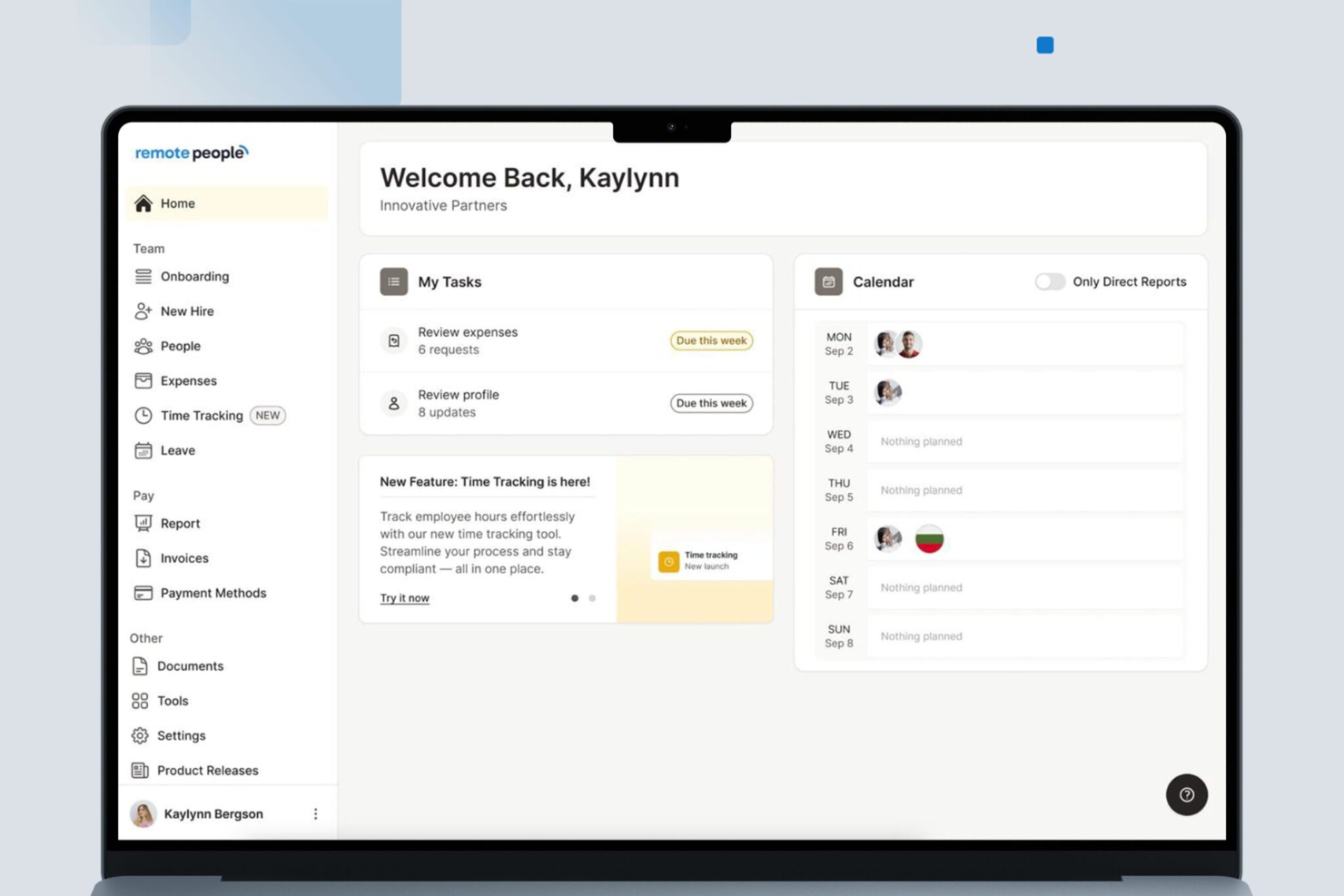
RemotePeople is a global employer of record platform that handles payroll, tax compliance, contracts, and benefits across 150+ countries, with built-in recruitment and contractor management in a single dashboard.
Who Is RemotePeople Best For?
RemotePeople is a strong fit for small to mid-sized companies hiring their first international employees and looking for a straightforward, guided EOR experience.
Why I Picked RemotePeople
RemotePeople earns its spot on my shortlist because I love how fast it gets new hires up and running. The 48-hour onboarding timeline is one I've seen hold up in practice. When I've needed to bring a Spanish hire fully online with a signed contract, enrolled benefits, and running payroll, RemotePeople gets it done without back-and-forth. The dedicated account manager model also means I'm working with one point of contact, not rotating through a support queue every time a question comes up.
RemotePeople Key Services
- Global payroll management: Run payroll in 150+ countries with in-country experts handling local tax codes, deductions, and filings every pay cycle.
- Contractor of record: Onboard, classify, and pay global contractors with compliant agreements and payments across 120+ currencies.
- In-country recruitment: In-house recruiters source and screen candidates in your target country and deliver a vetted shortlist within 72 hours.
- ISO 27001 and SOC 2 certification: RemotePeople meets enterprise-grade security and data compliance standards across all countries it operates in.
RemotePeople Integrations
RemotePeople offers 70+ native integrations with major HRIS, HCM, payroll, and SSO platforms, including BambooHR, Workday, SAP SuccessFactors, Personio, HiBob, Rippling, Gusto, Okta, and Microsoft Entra ID. Additional integrations include Paylocity, Factorial, Lattice, JumpCloud, TriNet, and UKG Pro. An open API is available for custom workflows.
Pros and Cons
Pros:
- Built-in recruitment support alongside EOR services
- Dedicated account manager assigned to every client
- Strong security credentials for global employment data
Cons:
- Reporting dashboard lacks custom report building
- Contractor workflows may feel limited for larger teams

Best for compliant hiring under Spanish labor law
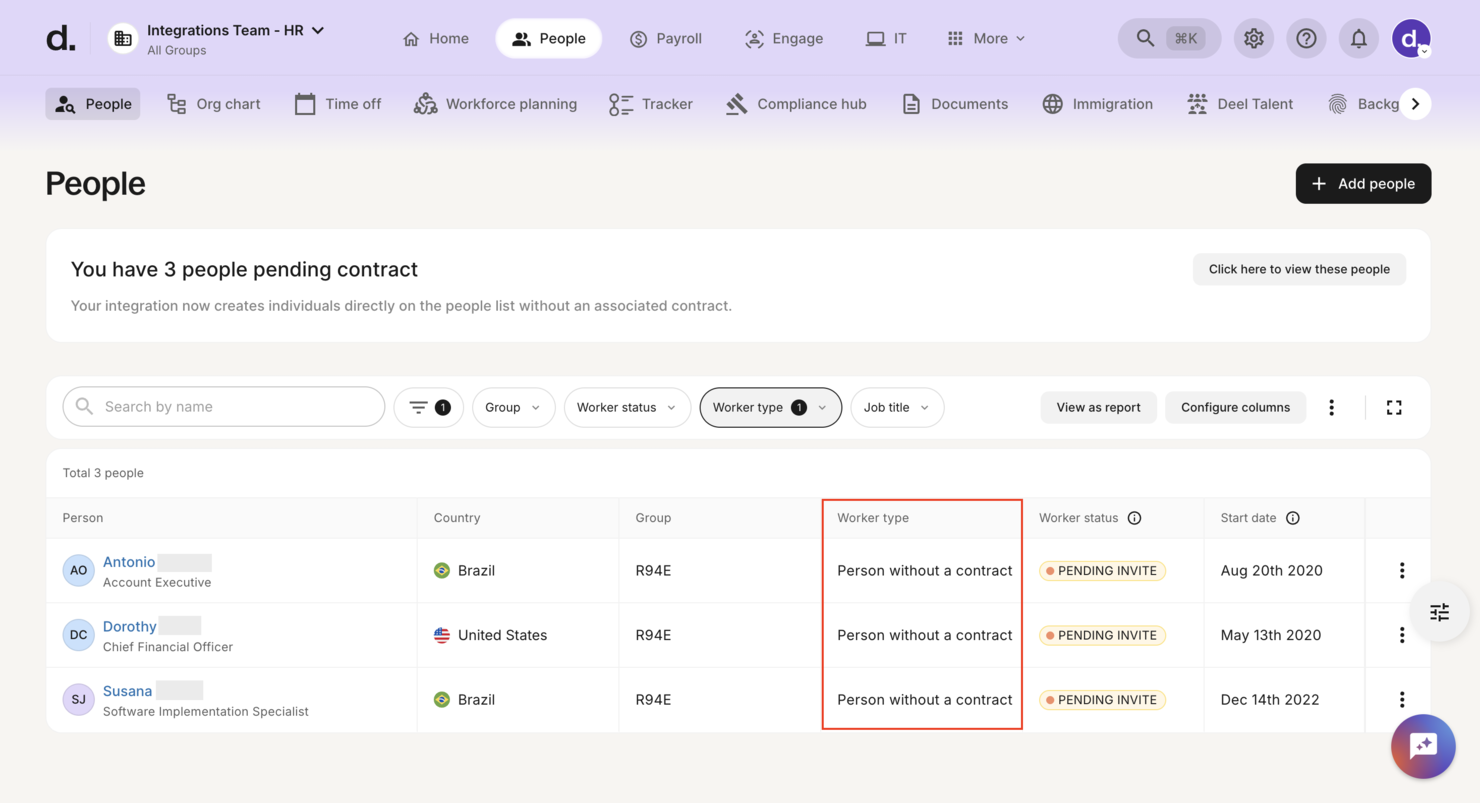
Deel is an employer of record platform that manages locally compliant employment contracts, payroll, taxes, and statutory benefits for full-time employees across 100+ countries, with Spain-specific compliance built directly into its hiring and onboarding workflows.
Who Is Deel Best For?
Deel is a strong fit for scaling companies that need to hire in Spain quickly without setting up a local legal entity.
Why I Picked Deel
I picked Deel as one of the best because it operates through its own wholly-owned Spanish entity, staffed with in-country legal experts who track regulatory changes directly. That matters when you're dealing with Spain's Workers' Statute and industry-specific convenios colectivos, which can affect everything from salary floors to termination procedures. I also rely on Deel Compliance Hub for real-time alerts on filing deadlines and labor law updates specific to Spain, which removes the manual compliance monitoring I'd otherwise have to do. The average Spain onboarding time is four days, with contracts, social security registration, and payroll all handled through a single platform.
Deel Key Services
- Built-in applicant tracking system: Track candidates, manage interviews, and move applicants through a hiring pipeline without switching to a separate ATS.
- Background screening: Automate new hire background checks at the point of onboarding, with the option to add human-led verification for higher-risk roles.
- Equipment provisioning: Order and ship hardware automatically as part of the onboarding flow, so new hires in Spain receive equipment without manual IT requests.
- Global contractor management: Create locally compliant contracts and pay contractors in 120+ currencies, including crypto, from the same platform used for EOR hires.
Deel Integrations
Deel offers 68+ integrations through its App Store, including HRIS tools like Workday, BambooHR, SAP SuccessFactors, and UKG, accounting platforms like NetSuite, Xero, and QuickBooks, ATS tools like Greenhouse and Ashby, and productivity apps like Slack and Microsoft Teams. SSO support includes Okta, OneLogin, JumpCloud, and Azure AD. It connects with Zapier and provides an API for custom integrations.
Pros and Cons
Pros:
- Built-in ATS connects recruiting with employee onboarding
- Supports visa and equity management for global hires
- Owns its own legal entity in Spain
Cons:
- Benefits and offboarding workflows may require extra setup
- Performance management tools lack depth

Best for budget-conscious remote team expansion

RemoFirst is an employer of record platform that handles compliant hiring, payroll, tax filings, and benefits administration for full-time employees across 185+ countries, with contractor management available as a separate service.
Who Is RemoFirst Best For?
RemoFirst is a strong fit for startups and small businesses hiring their first international employees in Spain on a tight budget.
Why I Picked RemoFirst
RemoFirst earns its spot on my shortlist because its $199/person/month flat rate makes it the most accessible EOR for Spain among the major providers. I like that the pricing includes no minimum employee count and no long-term contracts, which means a startup hiring their first Spanish employee isn't locked into a costly commitment. The platform handles Spain's IRPF withholding, social security contributions, and payroll across all required 14 annual salary payments without any added configuration. Onboarding a Spanish hire typically takes one to three days, which is fast for a market with Spain's level of regulatory complexity.
RemoFirst Key Services
- Localized employment contracts: Generate Spain-specific contracts that reflect local labor law requirements, including indefinite contract terms and collective agreement obligations.
- Time-off and bonus management: Track and process annual leave, public holidays, and Spain's mandatory 13th- and 14th-month salary payments directly within the platform.
- RemoHealth: Offer employees private health insurance or localized health plans tailored to the standards and expectations of their country.
- Contractor-to-employee conversion: Convert international contractors to full-time employees with compliant documentation, payroll enrollment, and benefits setup handled by RemoFirst.
RemoFirst Integrations
RemoFirst offers a smaller set of native integrations, including BambooHR, ADP Workforce Now, and GoCardless. An API is available for custom integrations, and RemoFirst has a Developer & Tech Partner Program for building additional connections.
Pros and Cons
Pros:
- No minimum employee count required
- Dedicated account manager for each client
- Handles Spain’s 14 annual salary payments
Cons:
- Limited reporting and workforce analytics tools
- Relies on third-party local partners

Best for quick employee onboarding

Multiplier is an EOR platform covering 150+ countries that handles compliant hiring, contract creation, multi-currency payroll, benefits administration, and employee onboarding without requiring you to set up a local entity.
Who Is Multiplier Best For?
Multiplier is a strong fit for fast-growing startups and scale-ups that need to hire in Spain quickly without a lengthy legal setup.
Why I Picked Multiplier
Multiplier earns its spot on my shortlist because of how fast it actually gets a Spanish employee working. I can generate a Spain-compliant employment contract in under five minutes directly in the platform, and Multiplier's onboarding milestone tracker lets me see exactly where each new hire is in the process. What I also like is the built-in onboarding checklist that consolidates document collection, contract signing, and payroll setup in one flow, so nothing falls through the cracks when hiring in a market like Spain with strict labor requirements.
Multiplier Key Services
- Multi-currency payroll: Process Spanish employee salaries in EUR and 100+ other currencies, with tax withholdings and social security contributions calculated automatically.
- Local benefits administration: Source and manage Spain-specific benefits through Multiplier's network of local providers, covering health and dental coverage.
- Time-off and expense management: Handle leave requests, timesheets, and expense reimbursements for Spanish employees directly within the platform.
- Workforce reporting: Pull headcount, gross-to-net, and cost center reports across your global team from a single dashboard.
Multiplier Integrations
Multiplier integrates with QuickBooks, Xero, BambooHR, HiBob, Workday, SAP SuccessFactors, Oracle, Google Workspace, Slack, and Okta. Compared to other EOR providers, Multiplier offers a smaller set of native integrations, but a public API is available for custom connections.
Pros and Cons
Pros:
- Dedicated customer success manager assigned per account
- Owned entities reduce third-party dependency
- Onboards Spain hires in under 24 hours
Cons:
- FX conversion fees not disclosed upfront
- European support slower outside APAC hours

Best for 24/5 dedicated support
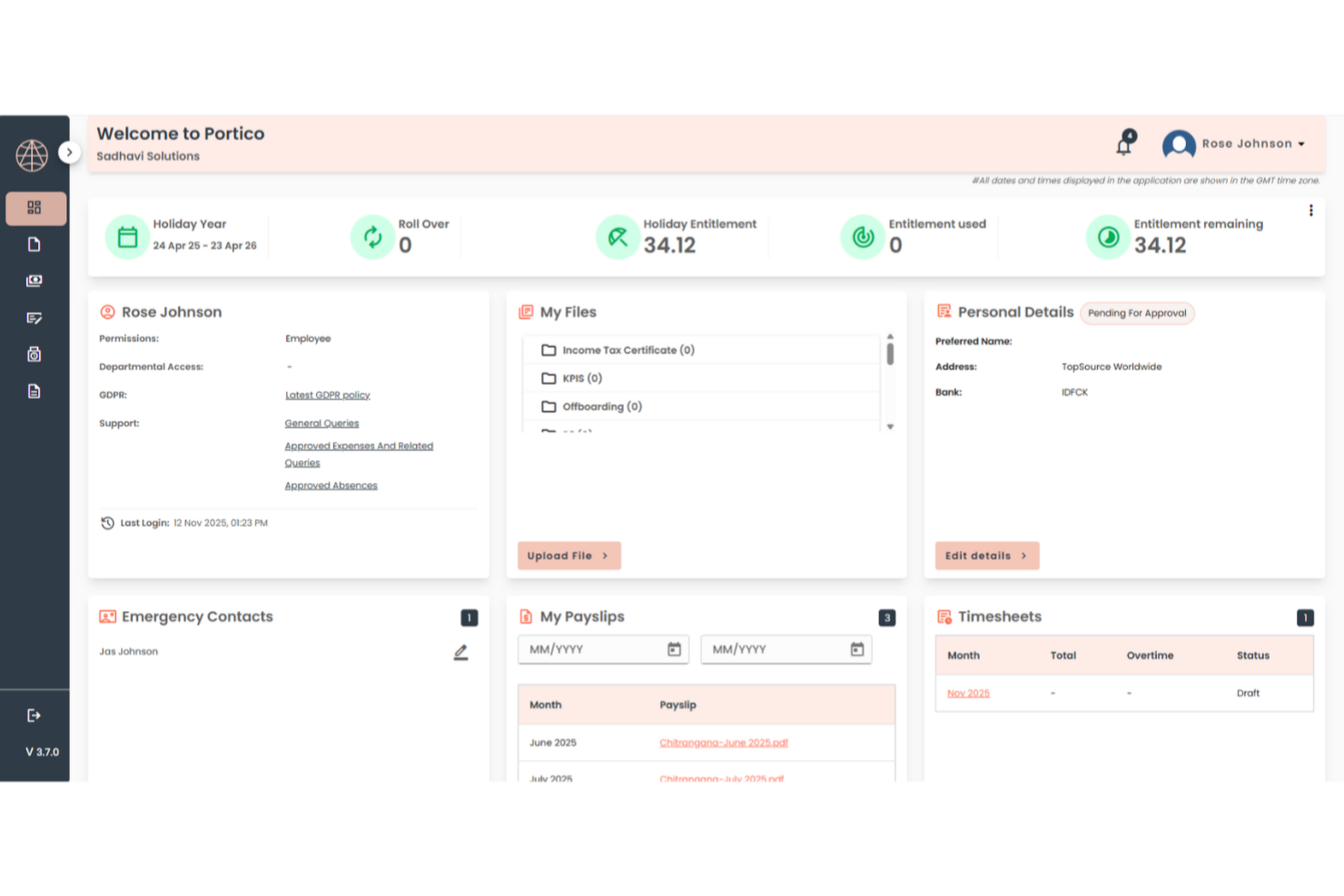
TopSource Worldwide is an employer of record that lets you hire in Spain without a local entity, handling Spanish payroll across 14 annual payments, IRPF withholding, social security contributions, statutory benefits, and termination compliance.
Who Is TopSource Best For?
TopSource is a strong fit for HR teams and finance leaders who want hands-on, people-first support when hiring in Spain.
Why I Picked TopSource
I've included TopSource in my top picks because its 24/5 phone access to in-country experts means your team isn't left waiting when a Spanish payroll question or termination issue surfaces. Every client gets a named account manager who knows your account, not a rotating support queue. I particularly like that this support extends into real compliance detail, like upfront severance estimates using Spain's statutory formulas and Beckham Law eligibility checks at the offer stage.
TopSource Key Features
- Spain employment cost calculator: An online tool that estimates total employer costs based on gross salary, factoring in social security contributions and the 14-payment structure.
- Portico employee self-service portal: Employees can access payslips, submit leave requests, log expenses, and track attendance from desktop or mobile.
- HRIS and ATS integrations: TopSource connects with tools like BambooHR, HiBob, Greenhouse, and Workable to sync onboarding, offboarding, and compensation data automatically.
- Highly Qualified Professional visa sponsorship: TopSource manages Spanish work authorization applications for non-EU hires, including eligibility checks, application support, and renewal tracking.
TopSource Integrations
TopSource integrations include BambooHR, HiBob, Workday, SAP SuccessFactors, and more. A dedicated API supports custom integrations, with payroll journals mapped to GL codes.
Pros and Cons
Pros:
- Visa sponsorship for highly qualified professionals
- Detailed Spanish payroll and severance guidance
- 24/5 dedicated support with named account managers
Cons:
- Onboarding timelines vary across company pages
- Spanish entity ownership remains undisclosed

Best for multi-currency payments
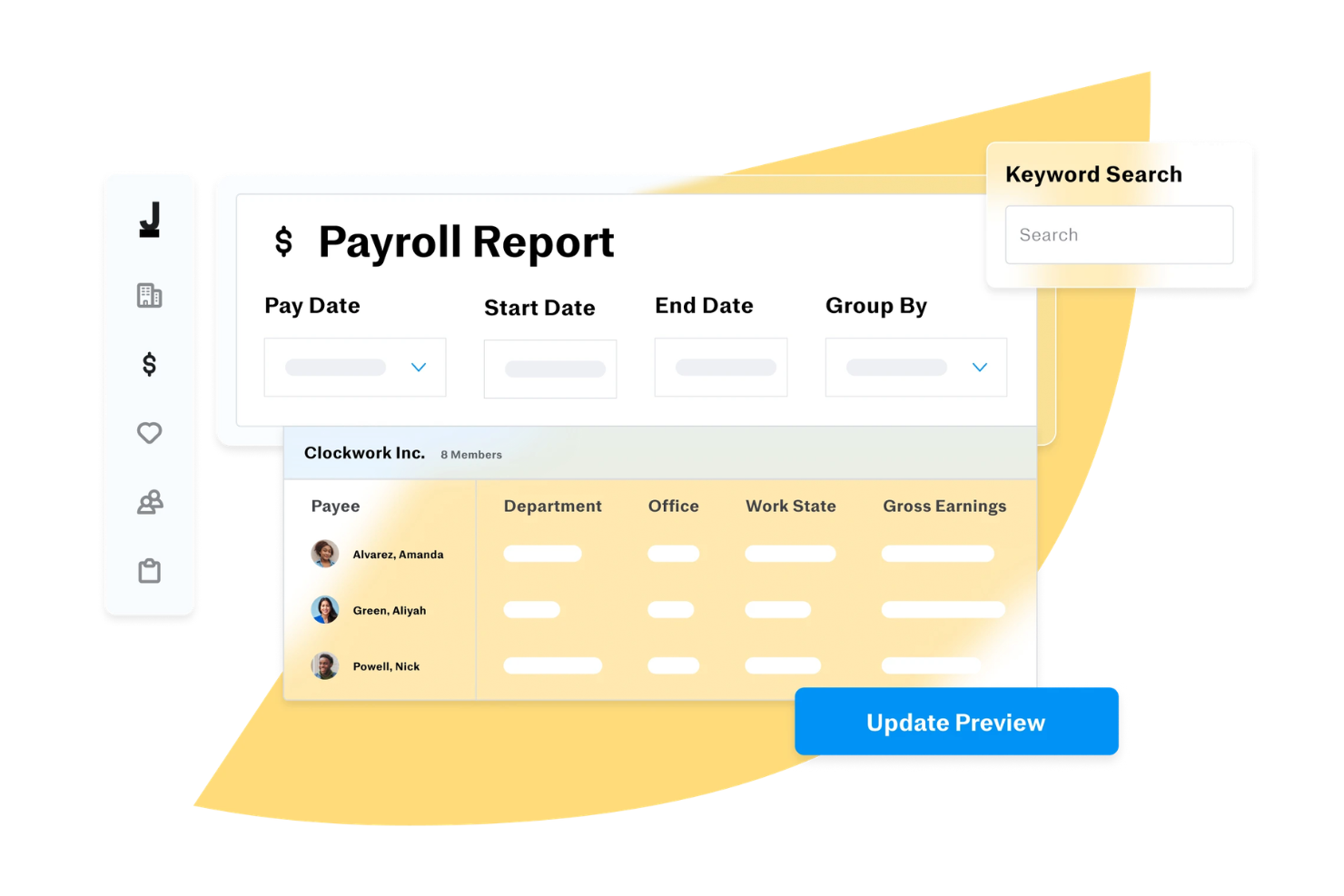
Justworks EOR is a global employer of record platform built for small businesses, covering international employee onboarding, local benefits administration, multi-currency payroll, and compliance support across Spain and 40+ other countries.
Who Is Justworks Best For?
Justworks EOR is a strong fit for small and early-stage companies hiring their first Spanish employees who need a guided, structured process without an in-house HR or legal team.
Why I Picked Justworks
I've included Justworks in my top picks because its multi-currency payment support is genuinely built into the platform, not bolted on. When paying Spanish employees, you can run payroll directly in euros from the same dashboard you use for your US team. I also like that it handles contractor payments internationally through the same platform, so you're not juggling separate tools when your Spain headcount mixes employees and freelancers.
Justworks Key Features
- Local benefits administration: Access and manage Spain-specific statutory benefits, including localized health and wellness perks, directly through the platform.
- Time tracking and PTO reporting: Built-in time tracking and paid time-off reporting for EU employees, including Spanish workers, without needing a separate tool.
- International business travel coverage: Justworks includes Travel Assist at no extra cost, giving Spanish employees access to emergency medical, security, and legal support while traveling.
- Document storage: Store employment contracts, onboarding documents, and HR records for Spanish hires in one centralized location within the platform.
Justworks Integrations
Justworks offers native integrations with QuickBooks, Xero, NetSuite, Sage Intacct, Greenhouse Recruiting, JazzHR, Lever, Culture Amp, 15Five, and Leapsome. The Leapsome integration is the only one available on the EOR plan, while most others are limited to PEO and Payroll plans. A Partner API is available for custom integrations.
Pros and Cons
Pros:
- Built-in travel support for international employees
- Unified PEO and EOR options on one platform
- Country-specific onboarding guides for Spanish hires
Cons:
- Reported web portal glitches and error messages
- Better suited for US-based businesses managing small international teams

Best for quick contract creation
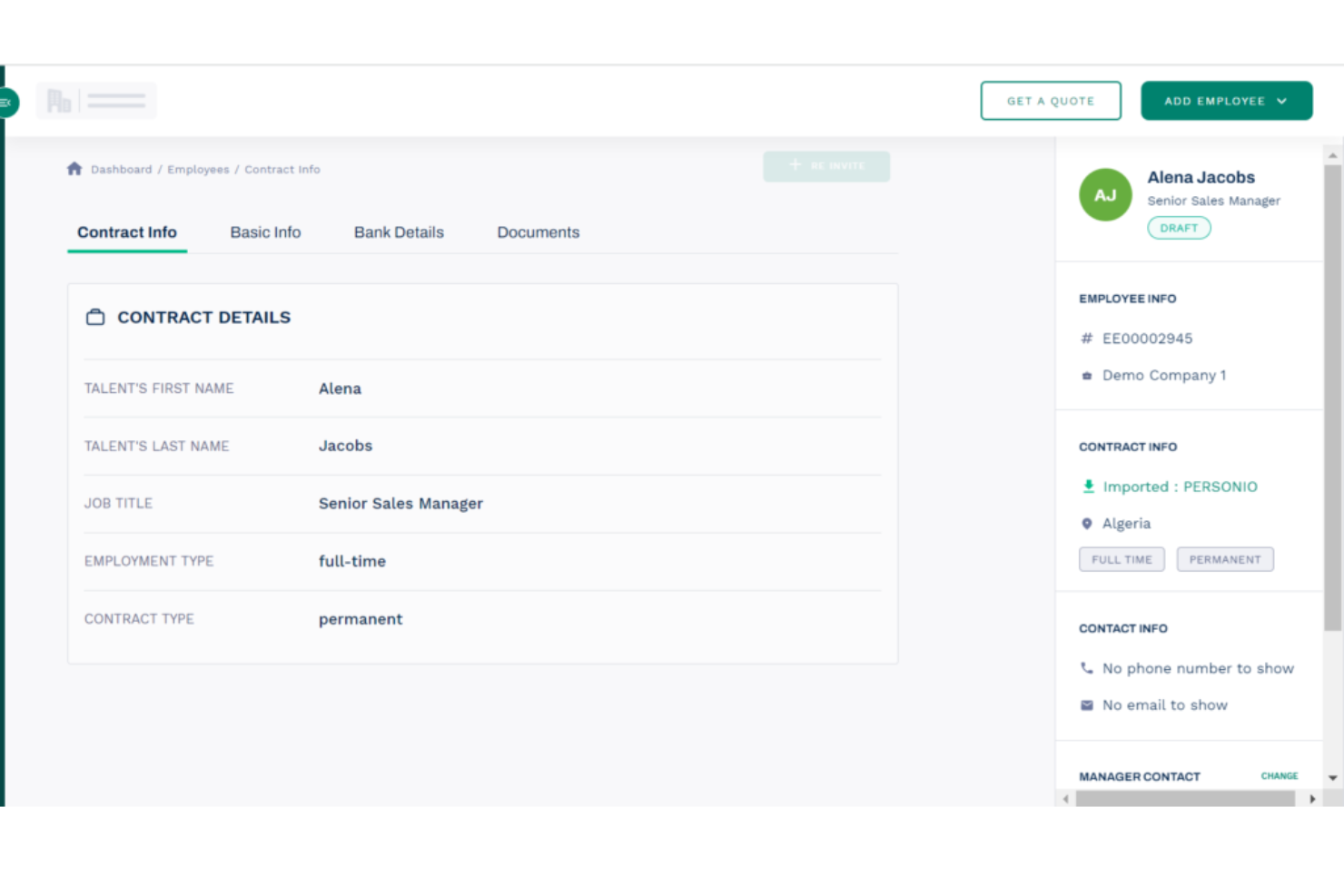
WorkMotion is an employer of record platform that manages Spanish employment contracts, payroll, social security contributions, statutory benefits, and terminations for companies hiring in Spain without a local entity.
Who Is WorkMotion Best For?
WorkMotion is a strong fit for startups and scaling companies that need to get a Spanish employment contract signed and a new hire onboarded without delays.
Why I Picked WorkMotion
I've included WorkMotion in my top picks because it gets a compliant Spanish employment contract in front of a new hire faster than any other tool I've seen, with a 10-minute onboarding flow and contracts issued instantly to within two days. The platform uses vetted, country-specific templates that already account for Spain's collective agreement requirements, probation rules, and mandatory home office allowance. I also like that visa and work permit sponsorship is built directly into the onboarding flow.
WorkMotion Key Features
- Statutory benefits administration: WorkMotion manages Spain's full leave entitlements, sick pay top-up obligations, and social security contributions directly through the platform.
- Offboarding cost calculator: A built-in calculator helps you estimate severance and termination costs before initiating any dismissal in Spain.
- Wanda AI assistant: An AI tool that answers Spain-specific labor law and leave questions from within the platform or Slack, escalating to a human expert when needed.
- Contractor management: A separate module lets you engage Spanish freelancers and contractors while managing misclassification risk and processing payments compliantly.
WorkMotion Integrations
WorkMotion documents integrations with Personio, Factorial, Sesame, BambooHR, ADP Workforce Now, and Workday.
Pros and Cons
Pros:
- Offboarding calculator supports severance planning
- Spanish statutory payroll coverage
- Contracts issued within two days
Cons:
- Spanish entity ownership remains unclear
- Indefinite contracts only

Best for Human+ model integration

CXC Global is an employer of record service that combines AI-driven automation with in-country compliance experts to handle Spanish payroll, employment contracts, statutory benefits, and workforce compliance.
Who Is CXC Global Best For?
CXC Global suits enterprise HR and payroll teams that want a dedicated human compliance expert alongside automation, rather than a self-serve portal.
Why I Picked CXC Global
I've included CXC Global in my top picks because its Human+ model is one of the more thoughtful approaches I've seen to Spain's notoriously complex employment law. Rather than relying purely on automation, CXC pairs AI-driven payroll processing with dedicated in-country compliance experts who actively manage IRPF withholding, social security contributions, and statutory obligations like the 13th and 14th salary payments. I also like that its CXC Comply layer handles worker classification risk and right-to-work checks, which matters when Spain's contract rules are this specific.
CXC Global Key Features
- CXC Comply worker classification: Assesses misclassification risk and runs right-to-work checks, background screening, and document management for Spanish hires.
- Single global invoice: Consolidates multi-country workforce costs into one invoice in any currency, including local-currency payouts for workers in Spain.
- MyCXC worker portal: Gives contractors and employees access to contracts, timesheets, and payment information through a dedicated online portal.
- SAP Fieldglass and Beeline integration: Connects CXC's EoR service to enterprise vendor management systems for teams already running contingent workforce programs.
CXC Global Integrations
CXC Global offers integrations with SAP Fieldglass and Beeline for enterprise contingent-workforce program.
Pros and Cons
Pros:
- Misclassification checks support safer hiring
- Detailed payroll and termination guidance
- Human-led oversight for Spanish compliance
Cons:
- Spanish entity ownership remains unconfirmed
- Limited self-service for workers

G-P
Best for employment compliance

G-P is an employer of record platform that manages cross-border hiring, locally compliant employment contracts, payroll, and benefits across 180+ countries through a network of owned legal entities.
Who Is G-P Best For?
G-P is a strong fit for enterprise HR and legal teams that need to hire in Spain with full compliance accountability and minimal legal exposure.
Why I Picked G-P
I picked G-P as one of the best because its compliance infrastructure goes deeper than most EOR providers I've evaluated. G-P automatically reviews employment contracts, benefits packages, and legal documentation on an ongoing basis to keep your Spanish hires in line with Spain's evolving labor laws. I also rely on G-P Gia, its AI compliance assistant, which is trained on over 100,000 legally vetted articles and can generate Spain-specific compliant documents and answer employment law questions on demand.
G-P Key Services
- Multi-currency payroll processing: Run on-time payroll in 150 currencies with automatic tax withholdings and social security contributions calculated for Spanish employees.
- Spain-specific benefits administration: Source and manage locally competitive benefits packages for Spanish hires, including mandatory statutory benefits required under the Workers' Statute.
- G-P Assist: An in-platform AI agent that answers HR questions and generates workforce reports across your global team, pulling from pre-set or custom report configurations.
- Dedicated account management: Each account gets a dedicated customer success manager plus 24/7 support via email, phone, chat, and help desk.
G-P Integrations
G-P offers native integrations with ADP TotalSource, ADP Workforce Now, Paylocity, BambooHR, Personio, TriNet, UKG Pro, UKG Ready, Workday, SAP SuccessFactors, HiBob, Microsoft Entra ID, Google Workspace, and Okta. An API is available for one-way or bi-directional custom integrations with other platforms in your tech stack.
Pros and Cons
Pros:
- In-country legal experts handle tricky terminations
- AI-powered compliance alerts for labor law changes
- Owned entities in 180+ countries reduce risk
Cons:
- Onboarding speed may trail newer EOR platforms Support ticket responses can lag on follow-ups
- Onboarding speed may trail newer EOR platforms

Oyster HR
Best for managing collective bargaining agreements
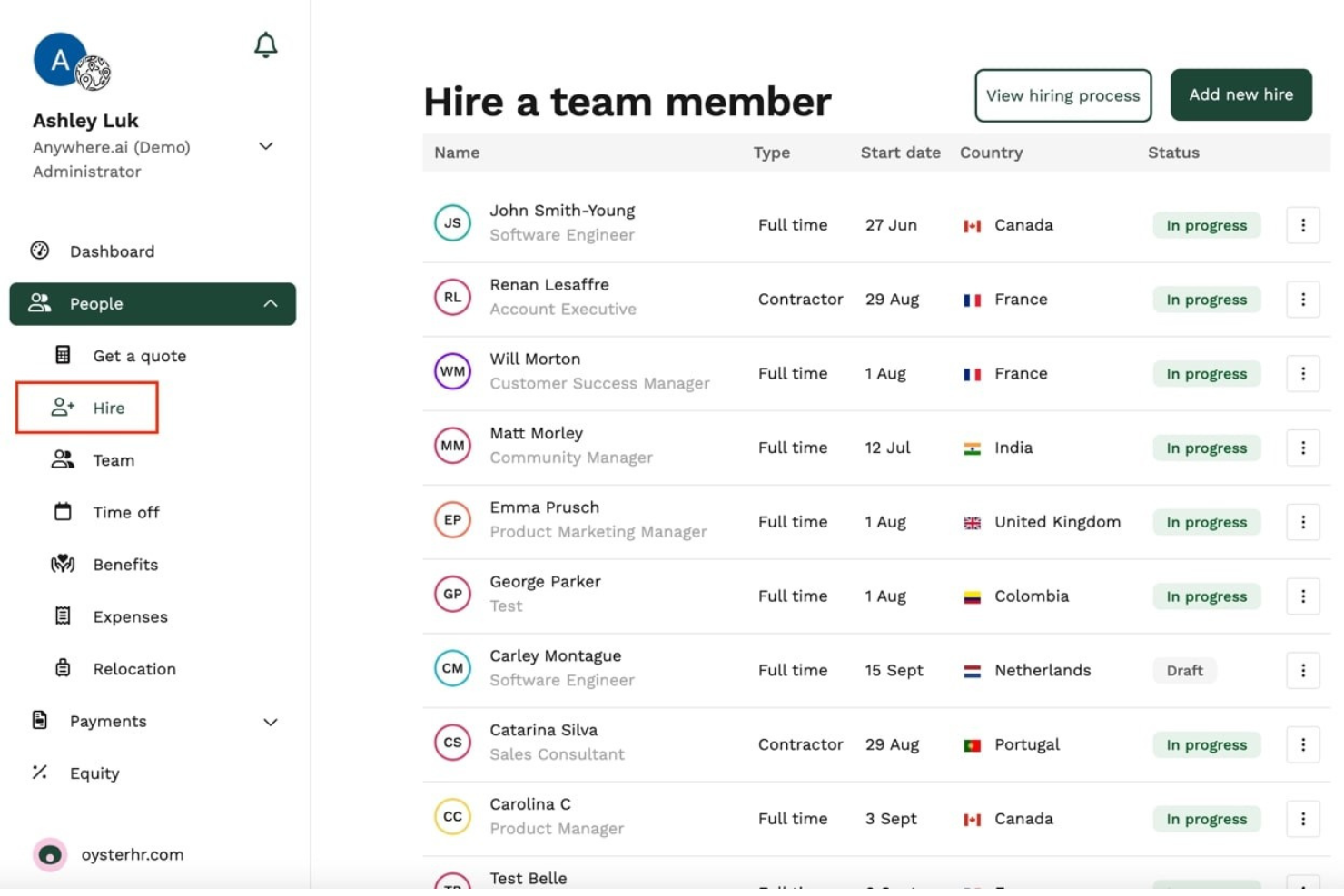
Oyster HR is a global employer of record platform that handles Spanish payroll, statutory benefits, compliant contract generation, and employee lifecycle management across 180+ countries.
Who Is Oyster HR Best For?
Oyster HR is a strong fit for global HR teams hiring Spanish employees across multiple countries who need CBA-compliant contracts and end-to-end payroll handled without setting up a local entity.
Why I Picked Oyster HR
I've included Oyster HR in my top picks because it's one of the few EOR platforms that explicitly addresses Spain's convenios colectivos (collective bargaining agreements) as a core part of its contract generation process. When hiring in Spain, CBA clauses can override national law on everything from notice periods to overtime pay, and Oyster's local expert network ensures each contract references the applicable CBA for that industry or region. The contractor-to-employee conversion workflow also handles TRADE misclassification risk directly, which is a real concern when bringing on Spanish freelancers.
Oyster HR Key Services
- Contractor-to-employee conversion workflow: A structured three-step conversion process that assesses misclassification risk, compares contractor vs. full-time costs, and manages the transition with weekly check-ins.
- 14-payment cycle payroll: Oyster processes Spain's mandatory dual extraordinary bonus payments, either as standalone June/December disbursements or prorated across monthly payroll runs.
- Oyster Shell misclassification protection: An insurance layer providing up to $500,000 in aggregate coverage for contractor engagements flagged with misclassification risk.
- Employment Cost Calculator: An in-platform modeling tool that estimates the total cost of hiring in Spain, including employer social security contributions, benefits, and taxes.
Oyster HR Integrations
Oyster HR offers 15+ native integrations, including BambooHR, Workday, HiBob, Greenhouse, Workable, Ashby, QuickBooks Online, NetSuite, Concur, Expensify, Carta, and Okta. It also provides an API and Zapier integration.
Pros and Cons
Pros:
- Offers contractor-to-employee conversion workflow
- Supports 48-hour onboarding for Spanish hires
- Handles Spain’s collective bargaining agreement clauses
Cons:
- CBA contract mapping not fully automated
- Uses local partners instead of owned entity
Other Spanish Employer of Record Services
Here are some other EOR service providers in Spain that didn’t make it into my top 10 shortlist, but are still worth considering:
- Payoneer Workforce Management
For onboarding and paying Spanish talent
- Native Teams
For direct hiring in Spain
- Papaya Global
For an AI-based payroll engine
- Remote
For competitive benefits packages
- Atlas HXM
For enterprise organizations
- Mercans
EOR for supporting payments in cryptocurrency
- Safeguard Global
EOR service for NGOs and non-profit organizations
- Rippling
For dedicated local HR experts
- Teamed
For EOR-to-entity transition planning
- Agility EOR
For legal compliance support


Hiring in Spain: Important Details
Here are some key details to note if this is your first time hiring staff located in Spain. Your EOR provider will manage these compliance details on your behalf. However, proactively informing yourself of these details is always recommended before you invest your resources into sourcing staff based in Spain.
In Spain:
- Employment laws are determined by the Ministry of Labour and Social Economy (Ministerio de Trabajo y Economía Social). They are responsible for a wide range of functions related to labor, employment, and social economy policies.
- Spain also has numerous collective bargaining agreements in place that determine labor standards for different job categories.
- You can hire employees or contractors. You can hire an employee under a fixed-term contract for a specific length of time, or as a permanent employee under an indefinite contract. However, employers are prohibited from offering the same person more than two successive fixed-term contracts for the same job within a specific length of time. Your Spanish EOR provider can help you determine the best hiring option depending on your needs while helping protect your business against accidental employee misclassification.
- Spain has both mandatory payroll deductions and social security contributions that must be collected. These include Personal Income Taxes, Unemployment Insurance, Occupational Accident and Disease Contributions, Wage Guarantee Fund Contributions, and Professional Training Contributions, as well as Seguridad Social, the name of Spain’s Social Security program.
- Spanish (Castilian dialect) is the official language in Spain, as well as other Spanish dialects including Catalan, Galician, and Basque.
- The standard working week in Spanish is 40 hours, with 9 hours per day maximum. A lengthy mid-day break of 1 to 2 hours (called a Siesta) is also customary in Spain. Overtime is generally discouraged, but if needed, employees can work a maximum of 80 hours of overtime per year.
- Spain requires 14 salary payments per year. This equates to 12 months of work, plus 2 additional payment periods — one during Christmas, and one during the holiday period in July. Some organizations pro-rate their salary payments to include the two extra months of pay spread out over 12 monthly payments. This is another important detail your Spanish EOR service can help you manage.
- Paid vacation in Spain starts at a minimum of 30 working days per year.
- There are 14 public holidays in Spain, including 12 that are recognized nationally, plus two locally celebrated holidays. Understanding and complying with employment norms and legal requirements surrounding Spanish public holidays is one area where your EOR service will shine, managing these occurrences hassle-free on your behalf.
- Spain offers maternity leave and paternity leave.
- Maternity leave is 16 weeks in Spain and begins after birth.
- Paternity leave was introduced in 2021 and grants fathers 16 weeks, also beginning at birth.
- Paid sick leave is offered in Spain. However, the amount of sick leave an employee is eligible for depends on their duration of employment and the reason for the leave.
- The probationary period in Spain is determined by the collective agreement for each job, ranging from 2 to 6 months.
- Termination of employment in Spain is also governed by collective bargaining agreements for each job type. Most jobs require a 15-day termination notice period, with employees receiving 20 days of gross salary as a severance payment. If an employee voluntarily chooses to terminate their employment, they must give 2 to 3 weeks' notice to their employer, depending on their collective agreement.
How I Evaluate Employer of Record Spain
I split my evaluation into three parts, giving most weight to processing Spanish payroll and managing compliant contracts, leave, taxes, and terminations. Next, I look for Spanish self-service portals and visa support. Finally, I consider entity ownership, GDPR, onboarding, integrations, support, and pricing.
Core Functionality (Table Stakes For This List)
When I'm selecting tools for my list, I score each one on a scale from 0 (does not offer the functionality) to 5 (excels in this area) for each core functionality listed below. I then convert the total into a percentage to help assess each tool's overall fit, with extra weight on any functionalities I’ve deemed essential.
- Spanish Legal Entity (Essential): I look for a registered Spanish entity, clear employment liability, and direct compliance ownership rather than a partner-only model.
- Spanish Payroll (Essential): I assess payroll calculations, social security, income tax withholding, remittances, pay schedules, and employee reporting.
- Local Employment Contracts: I check templates for Spanish contract types, probation terms, notice clauses, and guided localization for different roles.
- Statutory Benefits: I look for social security enrollment, paid leave tracking, accruals, and employee visibility into mandatory entitlements.
- Termination And Offboarding: I assess notice handling, severance calculations, required documents, approvals, and guidance for compliant employee exits.
- Multi-Currency Payments: I check whether clients can fund payroll in one currency while employees receive local-currency payments.
- Compliance Documentation: I review audit trails, payroll records, contracts, and filings that support reviews by finance, HR, or regulators.
Once I have a list of tools that meet the criteria, I consider what sets each platform apart.
Differentiating Factors (What Sets Vendors Apart)
Here's how I compare and contrast different vendors:
Standout Features
Visa and work permit assistance matters when you're hiring non-EU talent into Spain. I look for providers that handle immigration sponsorship end to end, including residence permit applications and work authorization renewals. A Spanish-language self-service portal is equally important because employees expect to access payslips, request time off, and download tax documents in their own language. I also check whether the provider offers committed onboarding timelines, since delays in contract generation can stall your entire hiring plan.
Beyond Features
I check whether a provider owns its Spanish entity directly or subcontracts through local partners, since that affects how fast payroll disputes get resolved and how stable your per-employee pricing stays over time. GDPR compliance is another priority—I look for clear data residency commitments and processing agreements that align with Spain's data protection law (LOPDGDD). I also evaluate native integrations with popular HRIS and accounting tools, because duplicate data entry between your employer of record and your existing payroll stack creates real compliance risk during audits.
What is an Employer of Record in Spain?
An Employer of Record (EOR) in Spain is a third-party service that legally employs your Spanish employees on your behalf—handling payroll, taxes, benefits, and compliance—while you remain in control of their day-to-day work.
Instead of navigating Spain’s complex labor laws yourself, an EOR takes on the legal responsibility, letting you hire quickly and compliantly without setting up a local entity or overloading your HR team.
Rather than asking your HR professionals to become experts in Spanish labor laws and regulations, you can outsource these requirements to an EOR in Spain and gain peace of mind that your future operations will always be compliant.
Why Use an Employer of Record Service in Spain?
Spain is a "compliance-first" market where administrative errors carry high penalties.
- Managing the "Super-Parental" Leave: As of January 1, 2026, paid birth and care leave has been extended to 19 weeks for each parent. An EOR handles the complex Social Security filings to ensure the state pays the employee while you manage the temporary vacancy.
- Dismissal Insulation: Terminating a contract in Spain is complex and expensive (often requiring 33 days of salary per year of service). An EOR provides the HR expertise to manage these exits, reducing the risk of a "null and void" dismissal claim in labor court.
- Digital Time-Tracking: 2026 regulations have tightened the rules on mandatory daily time-recording. EORs provide the digital, interoperable systems required by the Labor Inspectorate to avoid "invisible overtime" fines.
EOR vs Legal Entity
Not sure whether to use an EOR or set up your own legal entity in Spain? Here’s a quick side-by-side comparison to help you weigh the time, cost, and complexity of each option.
| Factor | Employer of Record (EOR) | Setting Up a Legal Entity |
|---|---|---|
| Setup Time | Days (often under a week) | Several weeks to months |
| Cost | Monthly fee per employee | High upfront legal, tax, and admin fees |
| Legal Responsibility | Handled by EOR | Fully on your company |
| Compliance Management | Included in EOR service | Must be managed in-house |
| Hiring Speed | Fast, EOR can onboard quickly | Slower due to registration delays |
| Payroll & Benefits Admin | Managed by EOR | Requires in-house setup and ongoing management |
| Ideal For | Testing new markets or hiring quickly without risk | Long-term expansion with local presence |
If you’re hiring a few employees or testing the waters in Spain, using an EOR is faster, simpler, and lower risk. Conversely, a legal entity can make sense if you’re planning a long-term investment and want full control—but it requires a lot more time, effort, and resources to get there.
EOR vs. Permanent Establishment in Spain
The Spanish Tax Agency (Hacienda) is aggressive about Permanent Establishment (PE). If your Spanish staff is signing local client contracts or you have a physical "hub," you risk triggering a 25% Corporate Tax on global profits.
How EORs Protect From Permanent Establishment Risk
- Legal Separation: The employee is legally contracted to the EOR’s Spanish entity. This keeps your foreign company's name out of the Registro Mercantil.
- Service-Based Invoicing: Your relationship is B2B. You are paying a "service fee" to a Spanish company, which helps categorize your presence as "exploratory" rather than "permanent."
- Local Tax Shield: The EOR remits all payroll taxes locally, satisfying Hacienda’s revenue requirements without your entity needing a Spanish tax ID (NIF).
How to Choose an Employer of Record in Spain
The right EOR can take the stress out of hiring in Spain, but only if it fits your specific needs. Before choosing a provider, get clear on the challenges you’re facing and the outcomes you want to achieve.
Here are five questions to guide your decision:
- What problem are you solving?
Are you struggling with compliance, payroll in Euros, sourcing talent in a specific region, or offering the right mix of Spanish employee benefits? Be specific about what you want help with—like hiring in specific geographic locations, or paying employees in Euros, etc. - Who will benefit from the EOR?
Think about who will manage the EOR relationship internally. How will it improve their workload, processes, or confidence in global hiring? - What's your budget?
Estimate how many employees you plan to hire in Spain. Since EOR fees are typically charged per employee per month, this helps forecast your total costs. - What outcomes matter most?
Do you need fast hiring in certain regions, better compliance support, or smoother onboarding? Define your success metrics up front to avoid wasting time on mismatched options. - Will it work with your HR systems?
Consider how the provider’s platform integrates with your current HR tools. Look for solutions that support your workflows, not complicate them.
Remember, every business is different — don’t assume that a Spanish employer of record service will work for your organization just because it's popular. Instead, choose the one that best fits your goals.

Key Employer of Record Services
An Employer of Record (EOR) simplifies hiring and compliance in Spain by managing payroll, tax obligations, and labor laws. Key services include:
- Payroll in EUR: Ensures accurate salary payments in compliance with Spanish labor laws, including the Workers' Statute (Estatuto de los Trabajadores), covering wage rates, overtime, and record-keeping to avoid penalties from the Spanish Social Security and Labor Authorities.
- Tax Compliance and Social Security Contributions: Handles income tax (Impuesto sobre la Renta de las Personas Físicas, IRPF) and mandatory social security contributions such as pension, health insurance, and unemployment insurance, ensuring compliance with the Spanish Tax Agency (Agencia Tributaria) and the Social Security system (Seguridad Social).
- Labor Law Compliance: Provides expertise on Spanish labor regulations, including working hours, overtime, paid leave, and termination procedures under the Workers' Statute and collective bargaining agreements (Convenios Colectivos), mitigating legal risks. This ensures compliance with regional, national, and international workforce regulations and conventions.
- Talent Acquisition and Background Checks: Conducts industry-specific credential verification and background checks to ensure new hires meet Spanish legal standards for employment and professional certifications.
- Visa and Work Permits: Assists with securing the necessary visas and work permits for non-EU employees, ensuring compliance with Spanish immigration laws and the Ministry of Labour, Migration and Social Security.
- Onboarding and Offboarding: Manages compliant onboarding and terminations in line with Spanish labor laws, including notice periods, severance pay (finiquito), and proper documentation of employment cessation.
- Benefits Administration: Provides competitive benefits packages, including health insurance, pension contributions, meal vouchers (tickets restaurante), and transportation allowances, tailored to the Spanish labor market.
- HR Support: Offers ongoing consultation on Spanish employment laws, workplace safety regulations (Ley de Prevención de Riesgos Laborales), and compliance with mandatory employee-related documentation, such as payroll records and Social Security filings.
- Risk Management and Insurance: Oversees workers’ compensation and ensures compliance with local insurance requirements, such as occupational accident insurance and private health insurance, mitigating legal and financial risks.
- Multi-Language Support: Facilitates communication with Spain’s diverse workforce through translation and localization of employment contracts, legal documents, and HR materials.
AI Features of Employer of Record Services in Spain
AI is still an emerging layer in EOR platforms and is not yet standard across all providers in Spain. Most solutions continue to rely on automation, structured workflows, and local employment experts to manage Spanish labor law, payroll, social security, and HR compliance.
That said, AI is beginning to help teams manage Spain’s administrative and compliance requirements more efficiently. Below are the most relevant capabilities and where they add value:
- Automated contract generation: Uses localized templates aligned with Spanish labor law, sometimes enhanced with AI, to create compliant employment agreements.
- Compliance monitoring support: Tracks updates to employment regulations, social security requirements, tax rules, and collective agreement obligations.
- Payroll anomaly flagging: Identifies inconsistencies in payroll data, including tax withholding errors, social security contribution issues, or benefit miscalculations.
- Workflow automation for onboarding: Guides employees through onboarding steps such as document submission, payroll setup, and required employment registrations.
- Document organization and tagging: Helps manage contracts, payslips, statutory documents, and compliance records in a centralized system.
- Workforce reporting and insights: Provides visibility into payroll costs, hiring trends, workforce distribution, and employment-related expenses in Spain.
- Chat-based support tools: Offers automated responses to common HR and payroll questions, helping teams navigate Spain-specific processes more efficiently.
Benefits of an Employer of Record Service
Expanding internationally doesn’t have to mean dealing with red tape, legal risks, or hiring delays. An EOR takes on the heavy lifting so you can hire globally with speed, confidence, and compliance.
Here’s what you gain by partnering with an EOR:
- Quick Market Entry: For organizations aiming to test new markets or hire talent in new countries where they have no legal presence, an EOR offers a swift and efficient solution to initiate operations, saving time and resources.
- Simplified Global Payroll: Using an EOR service simplifies the complex process of managing international payroll, including tax deductions, withholdings, and currency conversions for your employees worldwide.
- Global Compliance & Risk Mitigation: By managing compliance, an EOR service provides expertise in navigating the intricacies of employment laws, tax regulations, and insurance requirements in multiple jurisdictions, helping businesses safeguard their operations against compliance-related risks.
- Enhanced Benefits Negotiation: By leveraging their extensive networks and purchasing power, EORs can negotiate better international insurance rates and secure competitive benefit packages on your behalf, enhancing your ability to attract and retain top talent worldwide.
- Improved Cost Effectiveness: Using an EOR service is a cost-effective way for businesses to enter new markets, compared to the significant costs of establishing a new foreign entity. The latter option involves significant upfront legal fees, plus other costs related to office infrastructure, staffing, and local benefits and insurance coverage.
Understanding the benefits of an EOR service is crucial for strategic planning and operational efficiency. As businesses look towards international markets for growth opportunities, partnering with an EOR provider offers a streamlined, cost-effective, and compliant pathway to global expansion.
Need a better pitch for upper management on EOR services? Emphasizing hiring foreign workers’ costs and the ease of hiring internationally with an EOR could help.
Costs & Pricing for Employer of Record Services
Typically, the cost of an EOR service follows a fee per-employee, per-month pricing model, which can vary widely depending on a range of factors. This model allows for scalability and predictability in budgeting for international expansion efforts.
In general, EOR services in Spain cost between $199 to $599/employee/month.
Key factors that can influence the pricing of an employer of record service include:
- Geographic Location: Costs can vary significantly based on the country or countries you're hiring in. This is due to local economic conditions, labor laws, and the complexity of compliance requirements.
- Employee Seniority and Role Complexity: The level and nature of the roles being filled can also impact the monthly cost. Senior positions or roles requiring special qualifications may increase the price due to higher benefits and compensation management costs.
- Custom Requirements: Any specific needs beyond the standard service offering may also contribute to the monthly cost. This may include customized solutions for recruitment, specialized employee onboarding, or unique compliance requirements, all of which can affect pricing.
- Number of Employees: The total number of employees being managed can also impact the cost. In some cases, higher volumes may lead to volume discounts, making per-employee costs more economical.

Some EORs also operate under different pricing models, including a percentage of employee salary model, a fixed pricing model, and custom pricing models.
When considering an EOR service, it is crucial to understand how these factors impact the overall cost to ensure that the service aligns with your business's needs and budget constraints. Anticipating the specific requirements of your international expansion strategy will help you choose the most cost-effective and efficient EOR solution for your needs.
Hiring in Spain: Important Details (2026 Edition)
- The 14th Month: Salaries are typically quoted as an annual gross amount paid in 14 installments (pagas extraordinarias).
- Probation Period: Strictly limited by the Convenio. Usually 6 months for qualified technicians and 2 months for others.
- Work Hours: The legal maximum is 40 hours, though a move toward 37.5 hours is the market standard for tech and office roles in 2026.
- Leave Entitlements: 22 working days (30 calendar days) of annual leave + 14 public holidays.
- Severance: For unfair dismissal, the standard is 33 days of salary per year of service, capped at 24 monthly payments.
Market Details for Hiring in Spain
- Capital City: Madrid
- Currency: Euro (€, EUR)
- Payroll Frequency: Monthly
- Official Language: Spanish (Castilian)
- Approx. Population: 47.5 Million
- Public Holidays: 14 national holidays (varies per region)
Tax Overview for Employers in Spain (2026)
Spain has one of the highest employer social security burdens in Europe. In 2026, the combined load is approximately 31.5% to 32%.
| Contribution Branch | Rate (%) | Notes |
| Common Contingencies | 23.60% | |
| Unemployment | 5.50% | For indefinite contracts. |
| Intergenerational Equity (MEI) | 0.90% | Updated for 2026. |
| Wage Guarantee Fund (FOGASA) | 0.20% | |
| Professional Training | 0.60% | |
| Accident Insurance | ~1.50% | Variable; ~1.5% for office work. |
| Total Statutory Load | ~32.3% | Applied up to the monthly cap of €5,101. |
Total Cost of Employment in Spain
To budget for Spain, you must look at the "Super-Gross" (the total cost to the company). In 2026, the gap between what the employee earns and what you pay is roughly 32%.
Fully Loaded Cost Illustration (€4,000 Gross Monthly Salary)
Assuming you are looking to hire a Senior Developer in Madrid or Barcelona:
| Item | Monthly Amount (€) |
| Gross Monthly Salary | €4,000.00 |
| Employer Social Security Burden (~32.3%) | €1,292.00 |
| EOR Management Fee (Typical) | €450.00 |
| TOTAL MONTHLY COST | €5,742.00 |
Note: The 14-Pay Impact: If you pay in 14 installments, your monthly bill will look lower (€3,428 salary + extra costs), but you will face two "double bills" in July and December. Most EORs allow you to pro-rate these bonuses across 12 months to flatten your cash flow.
Why Hire Employees in Spain?
Spain's universities and technical schools produce a steady stream of qualified professionals who are skilled in sectors such as technology, engineering, and finance. Additionally, the cost efficiency of hiring in Spain, with lower salaries and lower operational costs compared to other Western European countries, makes it an attractive option for businesses seeking to manage their budgets effectively.
In addition, Spain’s strategic location, multilingual workforce, and favorable time zone also make the country an attractive market for hiring foreign professionals, lending access to the European market at large.
FAQs About EOR Services in Spain
If you’ve got specific questions about the requirements to hire Spanish employees or how EOR services work, these answers to frequently asked questions are a good place to start:
How does an EOR handle IP transfer upon termination?
In Spain, an Employer of Record (EOR) typically defines intellectual property (IP) ownership in the employment agreement to avoid disputes when employment ends. IP created within the scope of employment can often be assigned to the employer or client company, but the contract should clearly state how those rights are handled. Upon termination, the EOR helps ensure the assignment is properly confirmed, including completing required documentation and coordinating the return of company materials.
What are the minimum wage requirements in Spain?
As of January 1, 2024, the minimum wage in Spain, known as the Salario Mínimo Interprofesional (SMI), is set at €1,134 gross per month, distributed over 14 payments per year. This translates to approximately €1,323 gross per month if considered over 12 payments. For domestic workers, the minimum hourly wage is €8.87.
For more details, consult a Spanish EOR partner or learn more about the Salario Mínimo Interprofesional.
Do EOR providers offer other types of global HR services?
Yes, many service providers in this space also offer professional employer organization services (also known as PEO services), as well as multi-country payroll services.
PEO services, offered by PEO companies, are a popular partner for HR outsourcing. They can help you with international compliance issues, benefits administration, workers’ compensation, and other HR administrative tasks.
What are some of the consequences of non-compliance?
As an organization, you never want to be deemed as non-compliant in the eyes of any government body. The exact rules and regulations will vary according to the jurisdiction you’re operating in, which is one of the main benefits of using an EOR service provider.
If you don’t use an EOR and you do hire international workers, you may quickly find yourself in non-compliance. The consequences of doing so will depend on the severity of the violation, but they could include all of the following:
- Fines and penalties
- Legal actions such as lawsuits or other litigation proceedings
- Corrective measures and compliance orders
- Revocation of business licenses or operating permits
- Reputational damage if the news becomes public (loss of public trust and loss of internal employee respect)
- Increased monitoring and additional government scrutiny
Companies who fail to follow international labor laws cannot simply say they were unaware of the legalities, and hence, didn’t follow them. That’s where an EOR service can really remove a lot of potential risk and liability from the international hiring process.
Are there any risks to using an Employer of Record service?
While EOR services offer major advantages, like faster hiring and simplified compliance, they aren’t entirely risk-free. As with any partnership, it’s important to understand the potential downsides before choosing a provider.
Here are a few risks to keep in mind:
-
Financial risks: Unexpected fees can arise for onboarding, offboarding, or additional HR services. EORs may also charge separately for mandatory benefits in some countries. And, because payroll often involves currency exchange, fluctuations can impact your overall costs.
-
Operational risks: You’re entrusting sensitive employee data to a third party, so strong data security is essential. Look for providers with clear policies, certifications (like ISO 27001), and robust incident response protocols.
-
Strategic risks: Since the EOR becomes the legal employer, you’ll give up some control over HR processes, which could affect decision-making. And if your EOR delivers a poor employee experience or operates unethically, it could reflect poorly on your brand.
Carefully vetting EOR providers, and understanding the terms of your agreement, can help mitigate these risks and ensure a strong global hiring foundation.
This content is provided for general informational purposes only and does not constitute legal, tax, or other professional advice. It may not be complete, accurate, or current, and laws and practices may change without notice and vary by jurisdiction. You should not act on this information without obtaining advice from qualified legal or tax counsel in the relevant jurisdiction regarding your specific circumstances.